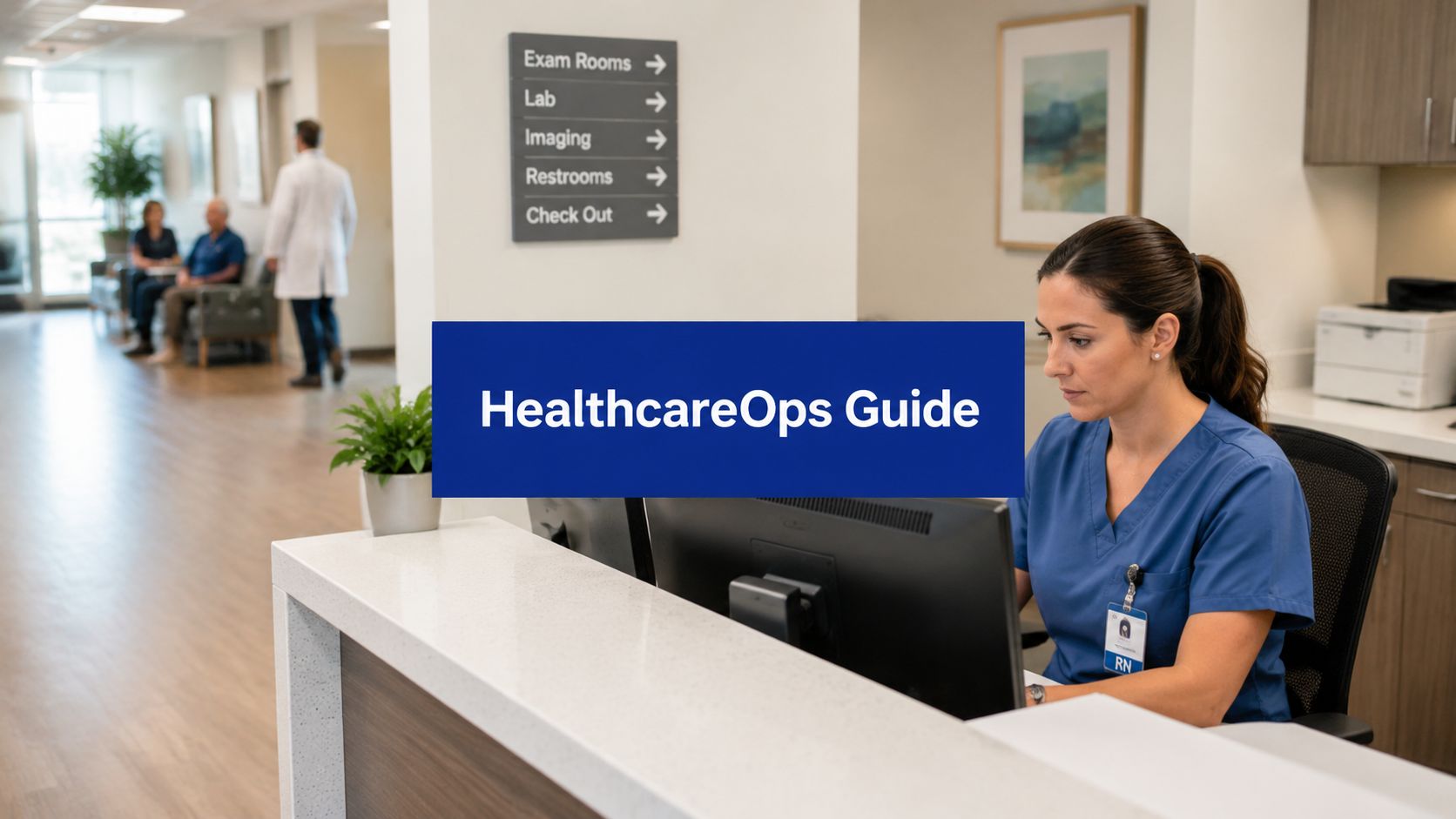


The clinic opens at 8:00. By 8:12, the front desk has already handled a patient who was booked into the wrong appointment type, a prior authorisation that still hasn't come back, two voicemails about prescription renewals, and a claim rejection that no one noticed until the patient called upset. The practice manager is toggling between the EHR, a scheduling tool, email, and a spreadsheet that somehow became the actual source of truth.
That scene isn't unusual. It's normal in small and mid-sized healthcare organisations that have grown faster than their processes. People compensate with workarounds. Staff members memorise exceptions. Someone always knows how to fix the referral that got stuck, or which payer needs a different attachment, or which specialist's calendar can absorb an urgent visit. Then that person goes on leave, resigns, or burns out, and the whole operation wobbles.
That's where healthcareops matters. Not as a buzzword, and not as a software category. It's the discipline of making a healthcare organisation run reliably when the day gets messy, which it always does.
The Daily Chaos of Clinic Management
A lot of operational pain in healthcare looks small when you see it in isolation. One duplicate registration. One missing eligibility check. One referral fax that never made it into the queue. One patient who arrived for a virtual follow-up that was accidentally booked as in-person. None of these events feels strategic. Together, they shape access, cash flow, staff morale, and patient trust.
For a smaller clinic, the pattern is familiar. Front-desk staff spend too much time on repetitive verification calls. Nurses chase incomplete intake information. Billing teams clean up errors that started days earlier during scheduling. Managers react to whatever is loudest instead of improving the flow behind it. The result isn't just inefficiency. It's operational fragility.
Where the Day Actually Breaks Down
Most clinics don't fail because people aren't trying. They fail because the work is fragmented.
Scheduling breaks first: Appointment types, provider availability, and room constraints aren't aligned.
Eligibility creates rework: Staff discover coverage issues after the visit is already booked or completed.
Referral tracking goes dark: The handoff leaves one system and never cleanly enters the next.
Billing absorbs upstream mistakes: Bad data at intake becomes delayed reimbursement later.
Follow-up gets inconsistent: Patients who need reminders, education, or care-plan outreach fall into manual queues.
The operational problem usually isn't one bad tool. It's five half-connected steps that rely on memory.
That matters more than many clinic leaders realise. Hospitals alone accounted for $1.5 trillion in spending in 2023, or 31% of total U.S. health care spending, and employed 6.7 million people, according to KFF's hospital spending and workforce overview. KFF also notes that Medicare and Medicaid represented 67% of all hospital discharges in 2023 in that same analysis. Even if you're running a clinic rather than a hospital, the lesson is the same. Healthcare operations sit inside a system with huge administrative complexity, heavy public-payer volume, and constant pressure on throughput.
Healthcareops Is the Practical Answer
Healthcareops starts with a simple idea. Stop treating scheduling, intake, clinical handoff, claims, and follow-up as separate administrative chores. Manage them as one operating system.
In practice, that means defining who owns each handoff, what data must be complete before the next step begins, which exceptions trigger human review, and where automation can remove repetitive work without creating new risk. The point isn't to make the clinic feel more technological. The point is to make it less chaotic.
What Exactly Is HealthcareOps
Healthcareops is the operational layer that connects care delivery, administration, and technology. If the clinical team is the heart of the organisation, healthcareops is the nervous system. It carries signals between intake, scheduling, documentation, referrals, billing, compliance, and patient communication so the organisation reacts coherently instead of in fragments.

That's why healthcareops isn't the same thing as IT support. IT keeps systems available, patched, and secure. Healthcareops decides how those systems should support real work. It asks practical questions. What must happen before a specialist visit can be booked? Which payer rules should be checked upstream? When should a task route to a person instead of a bot? Where do exceptions sit, and who clears them?
The Difference Between Software and Operations
Small and medium-sized providers often buy tools to fix local pain. A reminder platform for no-shows. A referral app for specialist coordination. A revenue-cycle add-on for denials. Those tools can help, but if no one redesigns the workflow around them, the clinic just adds another screen and another login.
A workable healthcareops model usually includes these elements:
Clear process ownership so handoffs don't disappear between departments.
Standard data requirements so scheduling, billing, and care teams aren't correcting the same information repeatedly.
Exception management so unusual cases surface quickly instead of hiding in inboxes.
Interoperability rules so systems exchange data consistently and securely.
Measurement discipline so decisions come from observed bottlenecks, not anecdotes.
Why This Matters So Much in California
California operations teams deal with scale and payer complexity that quickly expose weak workflows. The state has roughly 39 million residents and historically has the largest Medi-Cal enrollment in the U.S., which means operations stacks need to support high-volume eligibility checks, claims routing, and provider-network coordination at scale. The same source points to a practical pattern that works well in CA settings: automate eligibility and prior-authorisation verification before scheduling and billing, then track exceptions by payer, county, and line of business.
Practical rule: If a task can be verified before the patient arrives, don't leave it for the back office to clean up later.
For organisations exploring external support, it helps to look at partners that understand both workflow design and model governance. Resources on AI consulting for the healthcare industry can be useful when you're deciding where automation belongs, what needs human oversight, and how to avoid turning AI into another disconnected layer.
The Core Pillars of Modern HealthcareOps
Every sustainable healthcareops model rests on three pillars. Leave one weak, and the others won't hold for long. A clinic can automate intake, but if governance is poor, the risk increases. It can tighten compliance, but if workflows stay fragmented, staff still waste time. It can build dashboards, but if data is inconsistent, the numbers won't guide action.
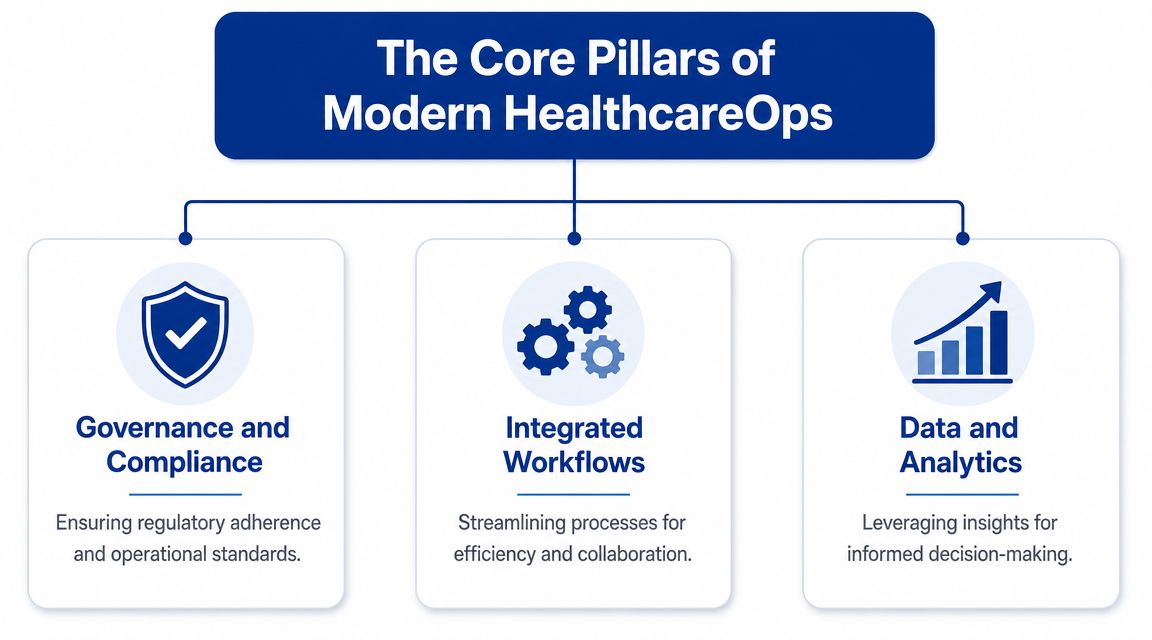
Governance and Compliance
This pillar is where many smaller providers underinvest until something goes wrong. Governance isn't paperwork for its own sake. It defines access controls, data-handling rules, auditability, device security, and escalation paths when systems fail or staff encounter something unusual.
The cybersecurity angle is no longer optional. A TPx summary of healthcare cybersecurity findings reports that 88% of healthcare organisations experienced at least one cyberattack in 2023, with an average of 40 attacks per organisation per year. It also reports that nearly 80% of data breaches were attributed to hacking, and that the average cost of disruptions to healthcare operations reached $1.3 million in 2023, up 30% year over year, according to TPx's healthcare cybersecurity review.
That's not just an IT issue. If scheduling, records access, pharmacy workflows, or claims processing go down, patient care and revenue flow suffer at the same time.
Integrated Workflows
This is the pillar clinicians and administrators feel every day. Integrated workflows reduce the need to re-enter data, chase missing information, and reconcile conflicting records between systems. The strongest operations teams design from the patient journey backwards.
A good workflow should answer a few basic questions:
What triggers the next step: Booking, referral receipt, lab result, discharge note, or claim status update.
What must be present: Demographics, insurance details, referral attachments, diagnosis codes, and consent forms.
Who owns the exception: Front desk, referral coordinator, nurse, biller, practice manager.
What happens if the system can't resolve it: Queue it, route it, escalate it, or hold it.
When this pillar is weak, staff create shadow processes. That's when spreadsheets replace workflows, email becomes task management, and no one fully trusts the EHR timeline.
Clinics don't need more steps. They need fewer unowned ones.
Data and Analytics
Data becomes useful only when it helps a manager act. Operational analytics should identify where patients get stuck, where revenue leaks begin, and which teams are repeatedly working around avoidable problems. For smaller organisations, this rarely starts with advanced modelling. It starts with reliable definitions.
A clean operational view often includes:
| Operational focus | Useful question | Typical action |
|---|---|---|
| Scheduling flow | Where are bookings being rescheduled or abandoned? | Adjust templates, visit types, and reminder rules |
| Referral pipeline | Which referrals stall before appointment completion? | Fix intake requirements, follow-up ownership |
| Revenue cycle | Which denials trace back to front-end errors? | Tighten verification and registration checks |
| Staff workload | Which teams spend time on manual reconciliation? | Automate routine tasks and simplify handoffs |
Teams that treat analytics as a monthly reporting ritual miss the point. The value comes when data changes decisions during the week, not after the quarter ends.
Key Technologies Driving The Transformation
The most useful healthcareops technologies don't act alone. Automation, AI, and secure integration work best when each one has a defined job. Automation handles repetition. AI helps prioritise and predict. Integration makes sure information reaches the right system, person, or queue without manual copying.
That combination matters because healthcare's biggest bottlenecks still come from workforce strain and administrative load. Recent reviews of hospital administration emphasise that patient outcomes depend on interdisciplinary coordination, standardised protocols, and measurement, not technology by itself, as discussed in this review of hospital administration and operational effectiveness. The same discussion is highly relevant in California, where AI adoption raises practical concerns around privacy, clinical safety, and equity across diverse patient populations.
Automation That Removes Repetitive Friction
Start with the tasks staff repeat all day and don't need to think creatively about.
Eligibility and prior-auth checks: Run them before the visit reaches the point of billing risk.
Appointment reminders and confirmations: Use rules that match visit type, patient preference, and escalation logic.
Referral intake routing: Classify incoming referrals and send incomplete ones into a review queue immediately.
Document collection: Trigger requests for forms, attachments, and missing records as part of intake.
For many practices, scheduling is one of the first places to intervene because staffing and patient flow are tightly linked. A practical guide on choosing the right staff scheduling solution can help operations leaders think through coverage rules, shift visibility, and day-to-day roster management without treating scheduling as a separate problem from access.
AI That Assists Rather Than Overreaches
AI can be useful in healthcareops, but only if the use case is narrow and governed. Good early applications include message triage, forecasting likely no-shows, prioritising work queues, summarising intake information, and identifying claims or referral exceptions that need human review.
What doesn't work well is dropping a chatbot or predictive engine into a messy process and hoping the process will organise itself. It won't. AI amplifies both good design and bad design.
A sensible deployment model looks like this:
Automate simple decisions first.
Keep human review for clinically sensitive or financially material exceptions.
Log model outputs and override reasons.
Review performance across patient groups, not just overall averages.
Integration That Keeps the Whole Operation Coherent
If systems can't exchange structured data securely, the rest of the stack becomes cosmetic. APIs, interface engines, and interoperability standards matter because scheduling, EHR, billing, pharmacy, imaging, and communications tools have to behave like one environment from the user's perspective.
That's where FHIR often becomes relevant for operational design, not just clinical data exchange. This explainer on how FHIR integration transforms healthcare is a useful reference if you're evaluating how modern interfaces can reduce brittle point-to-point connections.
One example from the market is Cleffex Digital Ltd, which develops healthcare software that can support functions such as scheduling automation, patient query handling, and digital health workflows. For a smaller provider, the key evaluation point isn't branding. It's whether the tool fits your process, integrates cleanly, and gives your team control over exceptions.
Measuring Success With the Right KPIs
Healthcareops fails when leaders try to judge it by general impressions. Staff say things feel smoother. Patients complain less. Claims seem cleaner. That's not enough. If you want to know whether a change is working and if you want budget approval for the next one, you need measurable evidence tied to daily operations.
The trick is to avoid vanity metrics. A dashboard full of activity counts won't tell you whether handoffs improved or whether the clinic reduced avoidable rework. Good KPIs connect to patient access, staff time, and financial reliability.
The KPIs That Actually Guide Decisions
Use a small set first. Track them consistently. Define who owns them.
| KPI Category | Example KPI | What It Measures |
|---|---|---|
| Patient-centred | Appointment wait time | How quickly patients can access care |
| Patient-centred | No-show rate | Whether reminders, confirmation flows, and scheduling logic are working |
| Patient-centred | Referral completion rate | Whether patients successfully move from referral to attended visit |
| Operational | Eligibility exception volume | How often coverage or authorisation issues disrupt the workflow |
| Operational | Staff overtime hours | Whether the current process is creating avoidable manual load |
| Operational | Task queue ageing | How long unresolved work sits before action |
| Financial | Claim denial pattern by source | Where reimbursement problems begin in the workflow |
| Financial | Revenue cycle turnaround time | How quickly encounters move toward payment |
| Financial | Cost per patient encounter | How efficiently the clinic operates overall |
Why Document Control Belongs in the KPI Discussion
Many operational bottlenecks aren't visible until someone audits the documents behind them. Missing forms, unsigned consents, outdated templates, and inconsistent retention practices create hidden delays that later appear as compliance risk or billing friction. That's why guidance like AuditReady's DMS insights can be practical for healthcare teams reviewing how documents move through intake, approvals, and records management.
If a process depends on staff hunting for the latest version of a form, the process is already broken.
Operational metrics also become more meaningful when they're tied to stronger analytics practices. This overview of healthcare data analytics solutions is useful if you're building reporting that goes beyond static dashboards and starts surfacing causes, not just symptoms.
A Simple Rule for Smaller Organisations
Don't start with twenty KPIs. Start with the six that reflect your biggest pain points. Review them weekly, not just monthly. Attach each metric to a process owner, and ask one direct question every time the number moves: What changed upstream?
That discipline does two things. It shows whether technology is delivering operational value, and it keeps the conversation grounded in patient flow rather than software features.
HealthcareOps in Action: Real-World Examples
A small multi-practitioner clinic often doesn't need a grand transformation programme. It needs the phones to quiet down, the schedule to hold, and the claims to leave cleanly. One common pattern is a front desk drowning in reminder calls, missed confirmations, and manual insurance checks. Staff spend the first part of the day reacting to the schedule instead of managing it.
The practical fix usually isn't “add more software”. It's a redesign of the sequence. The clinic moves eligibility verification earlier, adds structured reminder logic, and routes unresolved coverage issues into a queue before the patient arrives. Front-desk staff stop repeating the same verification conversation for routine visits and start spending more time on patients who need help navigating the appointment.
Example One From a General Clinic
Before the change, a patient booked online or by phone, the appointment landed on the calendar, and actual verification work happened later. Sometimes much later. Problems surfaced when the patient was already on-site or when the bill was submitted.
After the redesign, the clinic treated scheduling as a controlled workflow:
At booking, the system captured the required visit type and payer details.
Before confirmation, eligibility and prior-auth checks ran where applicable.
If something failed, the appointment moved into an exception queue instead of remaining “normal”.
Before the visit, reminders reflected the patient's preferred communication channel and asked for confirmation or an update.
That sort of healthcareops redesign doesn't remove human judgment. It reserves judgment for the cases that need it.
Example Two From a Speciality Practice
A mid-sized speciality provider usually has a different headache. Referrals arrive through too many channels, attachments are inconsistent, and the practice loses time chasing clinical notes, authorisation details, and PCP follow-up. Patients don't always disappear because they changed their minds. They disappear because the handoff between organisations is weak.
A better operating model puts referral management into one tracked workflow with clear statuses, intake rules, and escalation triggers. In that setup, staff can see whether the referral is waiting on records, payer approval, patient scheduling, or specialist review. That visibility changes behaviour quickly because no one has to guess where the delay sits.
Virtual care only improves access when scheduling, escalation, reimbursement, and staffing are redesigned around it.
That point is especially important in California. The state has 58 counties, and many rural communities face long travel distances, specialist shortages, and primary care gaps. California-focused rural health discussions emphasise telehealth and remote monitoring as complements to local capacity, not replacements, as outlined in this discussion of digital health in rural and underserved California communities. For smaller clinics, the lesson is clear. Virtual care works only when the operating model around it is deliberate.
Your Roadmap to Implementing HealthcareOps
Most organisations shouldn't attempt a full operational overhaul in one go. That approach usually creates too much disruption, too many moving dependencies, and too little clarity about what has improved. A phased rollout works better because it lets teams test assumptions, prove value, and adjust before the next layer is added.
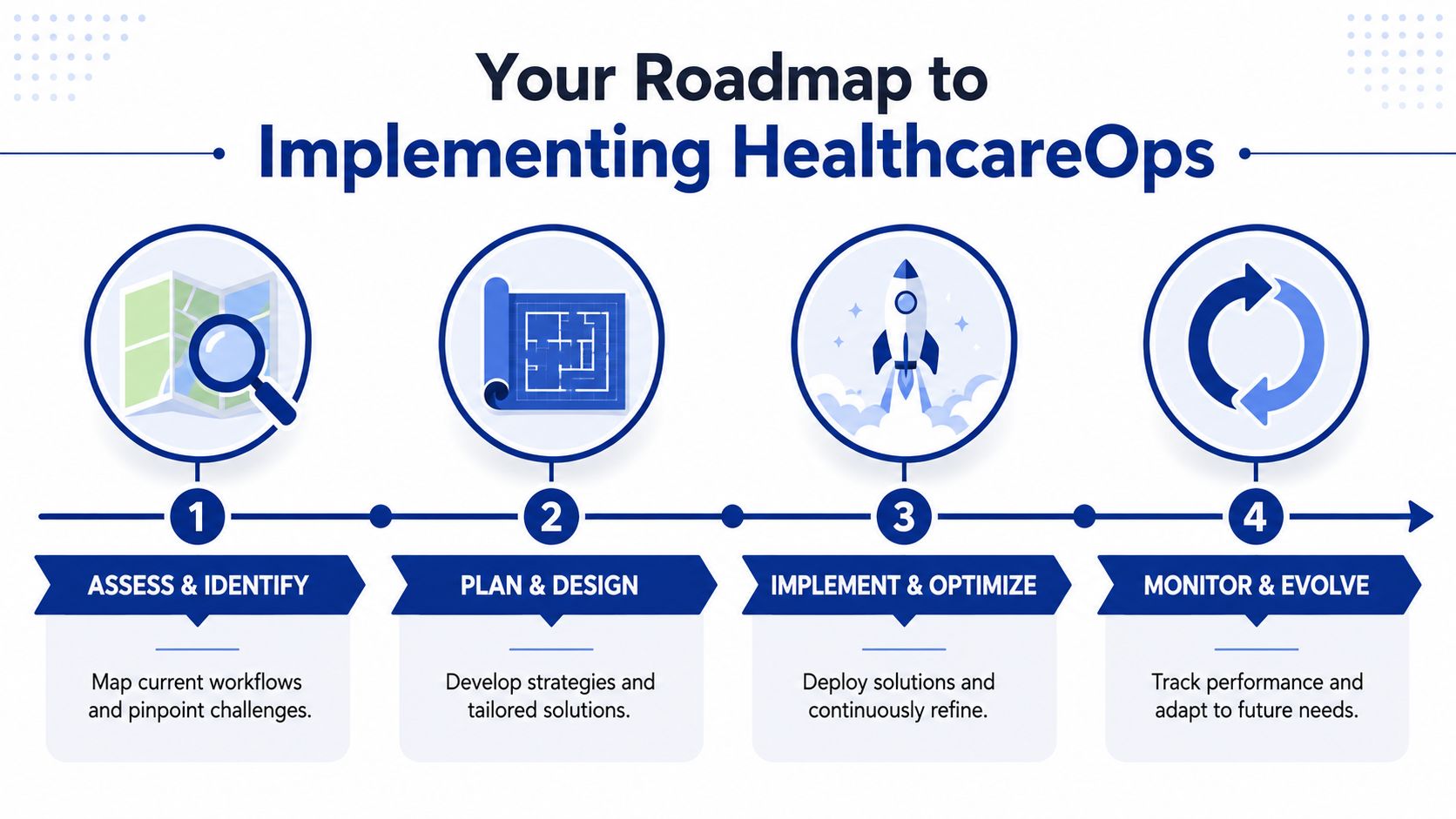
Assess and Identify
Start with observation, not procurement. Map the current workflow from appointment request to payment or follow-up completion. Look for delays, duplicate entries, hidden spreadsheets, queue backlogs, and recurring exceptions.
A simple discovery exercise should answer:
Where does work wait the longest?
Which step creates the most downstream rework?
Which process depends on one experienced staff member?
Which data fields are repeatedly missing or corrected?
Which issue affects both patient experience and revenue?
The best first target usually sits where operational pain is frequent, visible, and fixable.
Plan and Design
Once you know the bottleneck, define the future-state workflow in detail. That means triggers, owners, data requirements, exception paths, and success measures. Don't skip this because the technology looks straightforward. Most failed implementations come from vague workflow design, not from the product itself.
A useful benchmark is whether a new staff member could follow the process without tribal knowledge. If not, the design still has gaps.
For teams thinking beyond off-the-shelf tools, this guide to clinic management software development is helpful when deciding whether customisation is justified by your workflows, integrations, or compliance requirements.
Implement and Optimise
Choose one pilot. Keep the scope narrow enough that the team can learn quickly. Good starting points include appointment reminders, digital intake, referral tracking, eligibility verification, or document routing.
Then run the pilot with discipline:
Train the exact users involved
Set a short review cadence
Log every exception
Adjust the workflow before expanding it
Monitor and Evolve
After go-live, don't ask whether people like the system. Ask whether the process improved. Review the KPI movement, the quality of exceptions, and the level of manual effort still required. Some automation should be tightened. Some should be rolled back. Some tasks will prove that they still need a person making the call.
That's normal. Mature healthcareops teams don't chase perfect automation. They build reliable operations that can evolve without throwing the clinic into disorder each time something changes.
Answering Your HealthcareOps Questions
Is Healthcareops Only for Hospitals and Large Health Systems?
No. Smaller clinics often feel the operational pain more sharply because fewer people absorb the rework. A hospital may have separate teams for referrals, authorisations, scheduling, and denial management. A small practice may have two or three people doing all of it. That makes workflow design even more important.
Will New Software Solve the Problem on Its Own?
Usually not. Software can support a better process, but it can't define ownership, clean up exceptions, or remove conflicting rules by itself. If the workflow is unclear before implementation, the tool often makes the confusion worse.
Where Should a Clinic Start if Resources Are Limited?
Start where patient access and back-office friction overlap. Scheduling, intake, eligibility checks, referral tracking, and document collection are common entry points because the operational gains are visible quickly. Pick one process with a clear owner and a measurable pain point.
Is AI Worth Using in Healthcareops Yet?
Yes, in focused use cases. No, as a blanket answer. AI is useful when it triages, summarises, flags, or prioritises within a governed workflow. It becomes risky when it's asked to replace clinical judgement, hide poor process design, or operate without clear review rules.
How Do You Know a Healthcareops Project Is Working?
You should see fewer avoidable exceptions, clearer queue ownership, less duplicate work, and more predictable movement through scheduling, referrals, billing, or follow-up. The signal isn't that everyone is excited about the tool. The signal is that fewer things get stuck.
What’s the Biggest Mistake Organisations Make?
They try to modernise everything at once, or they buy a platform before agreeing on how the process should run. The better path is narrower. Map the workflow. Fix the handoffs. Pilot the change. Measure the result. Then scale what holds up under real clinic pressure.
Cleffex Digital Ltd helps organisations build and modernise secure software for operationally demanding environments, including healthcare. If your clinic, speciality practice or health tech team needs support with workflow automation, integration, patient-facing systems, or custom healthcare platforms, Cleffex Digital Ltd is one option to evaluate alongside your internal roadmap and existing vendors.