

Most advice about digital transformation starts in the wrong place. It starts with tools.
That's why many Canadian firms buy a new platform, migrate part of their stack, add a dashboard or two, and then wonder why the business still feels slow, fragmented, and hard to scale. The problem usually isn't that the technology was bad. It's that the operating model stayed the same.
Digital transformation consulting is useful when it helps a company redesign how work gets done. That means how teams hand off work, how data moves, how managers make decisions, how customers experience the business, and how risk is controlled. For a mid-market CEO, that's the question: not “What software should we buy?” but “What should change in the business first, and how do we prove it was worth doing?”
Beyond the Buzzword: What Digital Transformation Really Means
A lot of digital transformation projects are just furniture shopping. New CRM. New ERP module. New analytics tool. New AI pilot.
Real transformation is closer to a house renovation. You're not changing the sofa. You're moving walls, updating wiring, fixing plumbing, and making sure the structure supports the way people live and work. In business terms, that means changing processes, decision flows, data access, governance, and team behaviour, not just replacing old software with newer software.
That distinction matters because the market has already moved past one-off IT upgrades. According to Statista's digital transformation market overview, worldwide digital transformation spending reached US$1.85 trillion in 2022, over 90% of organisations worldwide had implemented cloud technologies by 2023, and global public cloud spending surpassed US$560 billion. For Canadian businesses, that's not abstract market noise. It reflects a structural shift toward cloud migration, remote-work enablement, automation, and digitally coordinated operations.
Why Canadian Firms Get Stuck
Mid-market companies in Canada usually don't fail because they lack ambition. They get stuck because they try to modernise around existing friction.
Typical examples look like this:
Operations still run on email and spreadsheets even after a new system goes live.
Customer data sits in multiple systems: sales, service, and finance. Each sees a different version of the truth.
Compliance-heavy teams move cautiously because they can't afford a rushed rollout in insurance or healthcare.
Leadership sponsors the project, but not the operating changes required to make the project useful.
Practical rule: If the workflow, approval path, reporting cadence, and accountability model don't change, you probably haven't transformed anything important.
Digital transformation consulting earns its keep. The consultant's role isn't only technical. It's diagnostic. Someone has to assess where the business is losing time, where data is breaking down, where teams are duplicating effort, and where risk sits if the company scales without fixing the basics.
For firms thinking through next steps, Cleffex's overview of digital transformation strategies for modern businesses is a useful companion because it frames transformation as a business design problem, not a software procurement exercise.
What Transformation Should Feel Like
When the work is done properly, the change is visible in daily operations:
Leaders see cleaner KPIs
Front-line staff complete fewer manual handoffs
Customers get faster, more consistent service
IT spends less time maintaining brittle workarounds
Risk teams can trace access, approvals, and data usage more clearly
That's the standard to use. If the result is only “we installed a new system,” the effort was incomplete.
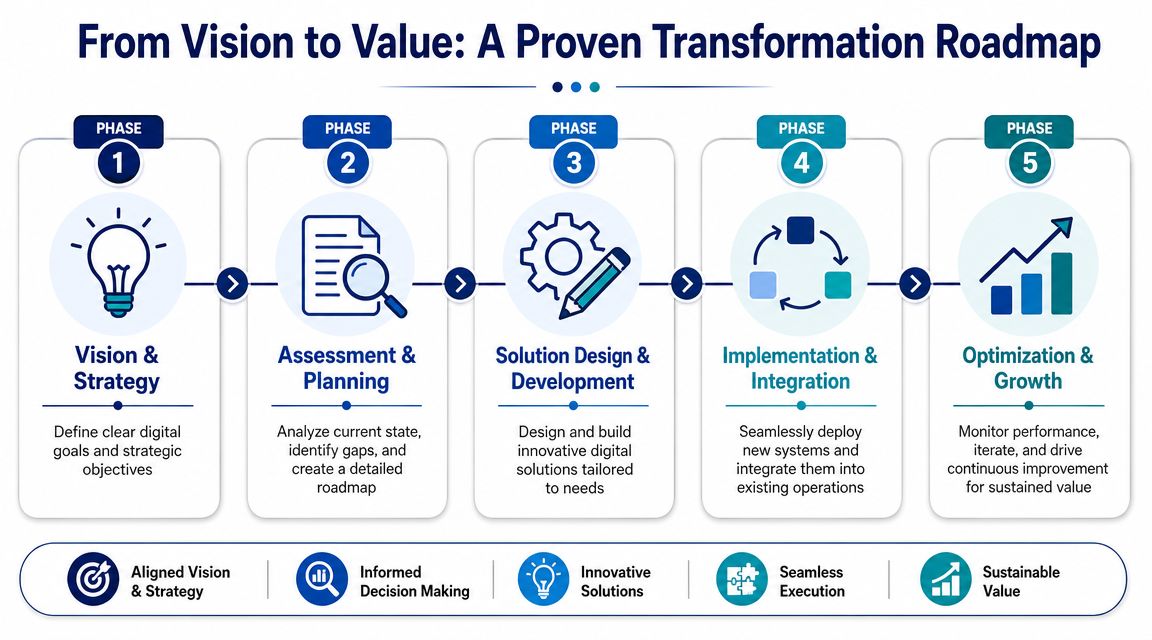
From Vision To Value: A Proven Transformation Roadmap
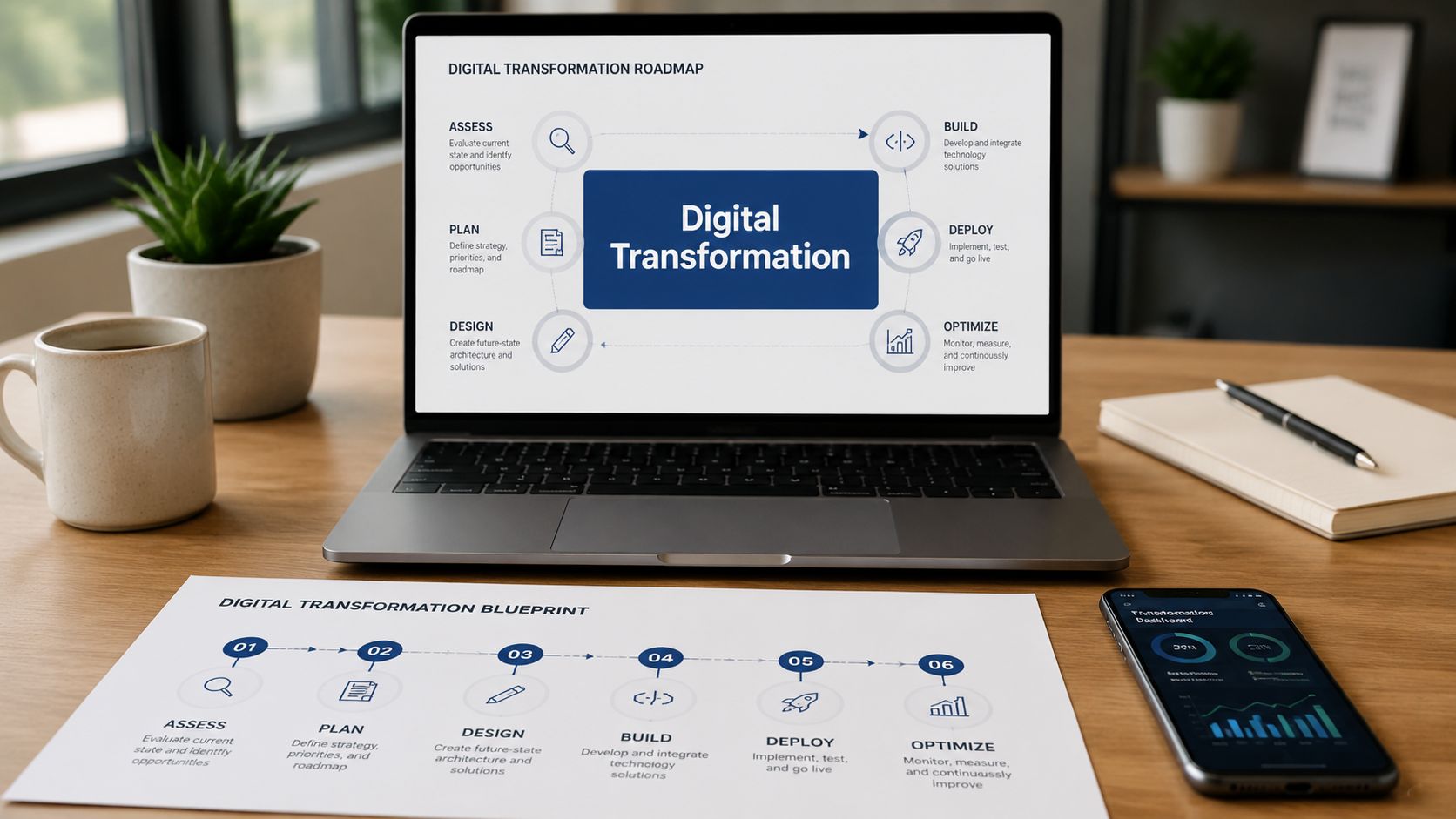
The fastest way to waste money in digital transformation consulting is to jump from ambition to procurement. The safer path is phased, sequenced, and tied to operating outcomes.
Bain's view is directionally right here: strong transformation programmes assess people, technology, data, culture, leadership, and governance, then connect the roadmap directly to business outcomes. It also points toward agile ways of working, platform-driven operating models, and modular architectures built with data lakes, APIs, and microservices for scalable delivery and faster value realisation, as outlined in Bain's digital transformation consulting perspective.
Stage One Begins With Friction, Not Software
A useful engagement starts with an uncomfortable audit.
Map one business process end-to-end. Claims intake. Patient scheduling. Dealer lead follow-up. Order-to-cash. Don't ask what tools are missing first. Ask where work stalls, where staff rekey data, where approvals sit too long, and where customers disappear because the process is clumsy.
At this stage, gather:
Process maps that show actual work, not ideal-state diagrams
System inventory, including spreadsheets, shadow tools, and manual exports
Role clarity, so you know who owns each decision and exception
Baseline metrics such as cycle time, backlog, error patterns, or rework volume
If you need a planning reference before formalising a programme, Cleffex's technology roadmap template guide can help structure the discussion into decisions, dependencies, and sequencing.
Strategy Means Choosing What Not To Do
Most firms have more opportunities than budget, time, or change capacity. That's why prioritisation matters more than brainstorming.
A practical roadmap usually separates work into a few categories:
Foundation work
Identity and access controls, integration layers, data cleanup, and core platform decisions. These aren't always exciting, but they prevent future projects from collapsing under technical debt.Quick operational wins
Narrow workflow automation, digital forms, alerts, approval routing, or reporting fixes. These create visible momentum.Customer-facing improvements
Self-service portals, booking, claims status visibility, quoting workflows, or service updates. These tend to matter when service responsiveness is part of the competitive edge.Scalable capability building
API-based services, reusable components, microservices, and analytics foundations that support multiple business functions later.
A good roadmap also matches the organisation's ability to absorb change. A smaller company can't run five major transformations at once and still execute its day job.
Don't reward the loudest internal request. Prioritise the initiative that removes the most friction with the least disruption.
Pilot Before You Standardise
Many programmes regain credibility by starting with a bounded use case, a specific team, and a clear success test.
For example, instead of “modernise operations,” pilot one workflow with a measurable bottleneck. Replace email approvals with a structured workflow. Surface one shared dashboard. Connect one legacy system through an API rather than rebuilding everything at once.
That approach is also reflected in DataTeams' transformation blog, which is worth reading if you want another practical view on sequencing transformation work before trying to scale it.
Scale Only After Governance Is Real
A pilot that works in one department can fail at the company level if governance is weak. Once something proves useful, then standardise ownership, support, access rules, KPI review, and release cadence.
The common pattern that works is simple:
Integrate legacy systems through APIs
Break reusable functions into services
Measure progress against business KPIs, not deployment milestones
Review adoption and exception handling before expanding the scope
That's how vision turns into value, not through one big launch, but through a staged operating-model change that compounds.
How Canadian Industries Are Winning With Digital Transformation
The phrase “digital transformation” gets vague fast unless you ground it in business problems. The pattern changes by industry, especially in Canada, where regulated sectors have to balance service improvement with privacy, auditability, and operational continuity.
Canadian firms also can't treat cyber risk as background noise. Statistics Canada's 2024 survey found that 16% of businesses experienced a cybersecurity incident, up from 12% in 2023, as cited in this discussion of digital transformation consulting and risk. For healthcare and insurance in particular, data residency, access controls, and auditability need to be designed before automation scales.

Insurance Firms Win When Claims and Servicing Become Traceable
In insurance, the temptation is to start with flashy customer experiences. In practice, the bigger payoff often starts in the middle office.
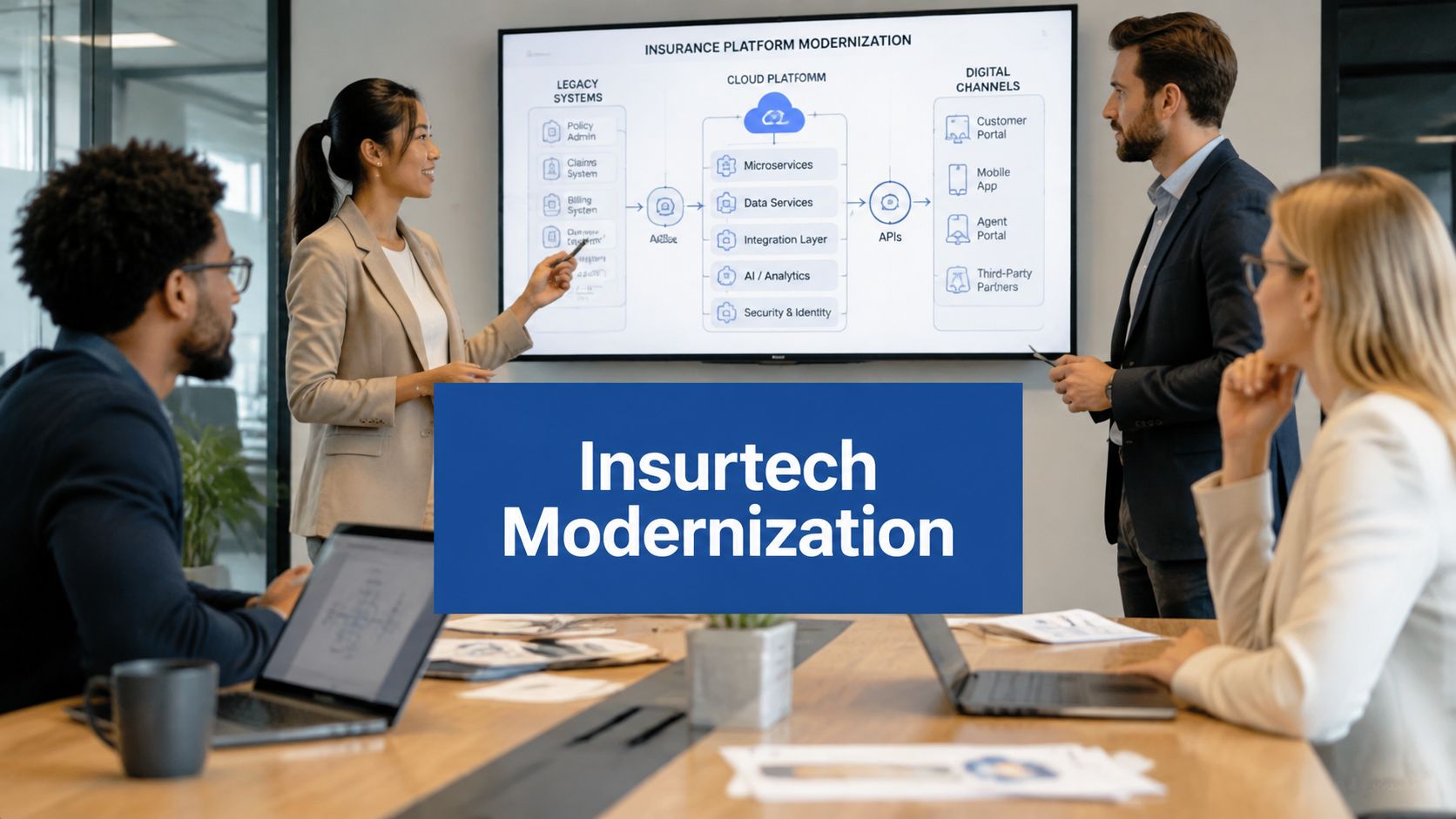
A common problem is fragmented claims handling. Intake sits in one system, documents arrive through another channel, adjudication depends on manual review, and customer updates are inconsistent. A consultant usually improves this by designing a controlled workflow with rules-based routing, document capture, status visibility, and API links back to policy and finance systems.
What works:
Structured intake so claims enter the process cleanly
Role-based access to keep sensitive information restricted
Audit trails for every status change and approval
Customer communications triggered by workflow state, not manual chasing
What doesn't work is forcing a full stack replacement before the insurer knows which part of the process is creating delay and complaints.
Healthcare Organisations Win When Security Architecture Comes First
Healthcare leaders often hear “AI-first” advice that assumes the data environment is already clean, governed, and interoperable. It usually isn't.
A better path starts with practical controls. Patient scheduling, referral workflows, intake forms, and clinician access patterns are often better first targets than ambitious automation. The consultant's job is to separate low-risk workflow improvement from higher-risk clinical or privacy-sensitive use cases.
In healthcare, a fast rollout that weakens auditability isn't a transformation. It's exposure.
Useful patterns include secure patient communications, workflow redesign around referrals and scheduling, and controlled integration between administrative systems so staff stop re-entering information. Once governance is stable, analytics and automation become much safer to expand.
Automotive Businesses Win Through Response Speed and Connected Operations
Dealerships and auto service businesses don't always label their work as digital transformation, but the underlying problems are familiar. Leads come in from multiple channels. Service booking is fragmented. Follow-up depends too much on individual staff discipline. Marketing, sales, and service often operate on separate systems.
The strongest projects in this sector usually focus on coordination:
Lead routing that sends inquiries to the right team quickly
Booking and service workflows tied to technician availability
Unified customer records across marketing, sales, and after-sales
Management dashboards that reveal drop-offs and bottlenecks
For this kind of work, a provider like Cleffex Digital Ltd can be one option if a business needs custom software, integration, automation, or AI-enabled workflow support rather than an off-the-shelf marketing fix alone.
Startups Win by Avoiding Future Rework
Startups face a different trap. They can move quickly, but they often build in ways that won't survive growth.
The smart move isn't to over-engineer from day one. It's to choose a structure that allows later expansion without a painful rebuild. That usually means cloud-native foundations, clean APIs, and clear separation between customer-facing features and core business logic.
For founders, the consultant's value is often restrained. Don't add enterprise complexity too early. Do make sure data models, integration patterns, and security decisions won't block the next stage of growth.
The Shared Lesson Across Sectors
The winners don't start by asking which platform is fashionable. They start by asking which workflow creates the most operational drag or customer frustration, and which change can be introduced without creating unacceptable risk.
That's especially important in Canadian mid-market firms. When budgets are finite, and teams are lean, the first move has to earn the right to fund the second one.
How To Select the Right Transformation Consultant
Most firms don't need a consultant who can talk convincingly about AI, cloud, and disruption. They need one who can diagnose bottlenecks, work with internal teams, and make trade-offs that fit the company's size, industry, and risk tolerance.
The wrong partner usually shows up with a polished maturity model and a pre-packaged platform preference. The right one asks harder questions. Which process is broken? Where is the rework? What can't be interrupted? Which teams will resist? What data can't leave certain environments? How will success be measured in operating terms?
What To Test in the First Conversation
A serious digital transformation consulting partner should be able to explain how their approach changes for a smaller business versus a large enterprise. A company with lean internal IT and tight budgets can't absorb the same programme design as a national insurer or hospital network.
Ask questions like these:
How do you define success in the first six months?
What would you recommend we do first, and what would you postpone?
How do you handle change management when managers are already overloaded?
What does your governance model look like after go-live?
How do you approach security review in regulated environments?
If security is part of the scope, it helps to review how specialists assess vendors in adjacent areas. For example, this guide on white-label pentest partner selection is useful because it shows the kind of due diligence mindset buyers should bring to specialist partners, especially when risk and trust are material.
Consultant Selection Checklist
| Evaluation Criteria | What to Look For | Score (1-5) |
|---|---|---|
| Industry fit | Can they speak credibly about your workflows, regulations, and operational constraints? | |
| Business size alignment | Do they adapt scope and governance for a mid-market firm instead of selling an enterprise programme? | |
| Strategy plus execution | Can they diagnose the problem, design the roadmap, and help implement it? | |
| Integration capability | Do they understand APIs, legacy constraints, data flows, and modern architecture patterns? | |
| Change management approach | Can they explain how staff adoption, training, and communication will work in practice? | |
| KPI discipline | Do they define measurable outcomes before recommending technology? | |
| Security and compliance awareness | Can they discuss access control, auditability, and risk sequencing in plain business terms? | |
| Delivery transparency | Are phases, assumptions, exclusions, and decision points clearly documented? | |
| Team quality | Will senior people stay involved after the sale, or disappear once the project starts? | |
| Cultural fit | Can they challenge your team without creating friction that slows execution? |
A consultant should reduce ambiguity. If every answer sounds broad and inspirational, keep looking.
For a broader baseline on what firms should expect from an advisory partner, Cleffex's article on what an IT consultancy service does is a good practical reference.
Red Flags Worth Taking Seriously
Some warning signs are easy to miss because they sound complex:
Technology-first pitches with no process assessment
Promises of rapid enterprise-wide rollout before a pilot proves value
No clear answer on post-launch ownership
Minimal attention to internal adoption
Generic recommendations that could apply to any industry
If the partner can't translate strategy into a manageable sequence of operational changes, they're not ready to lead transformation.
Proving the ROI of Your Digital Transformation
If you can't explain the return in operating terms, the project will always feel discretionary.
That matters because the spending environment is large and still growing. Grand View Research estimates the global digital transformation market at US$1,302.95 billion in 2025, projected to reach US$5,493.15 billion by 2033 at a 19.4% CAGR, with North America holding 42.7% of the market in 2025, according to Grand View Research's digital transformation market analysis. For Canadian businesses, that makes ROI discipline more important, not less. There's plenty of spending in the market. That doesn't mean every project deserves funding.
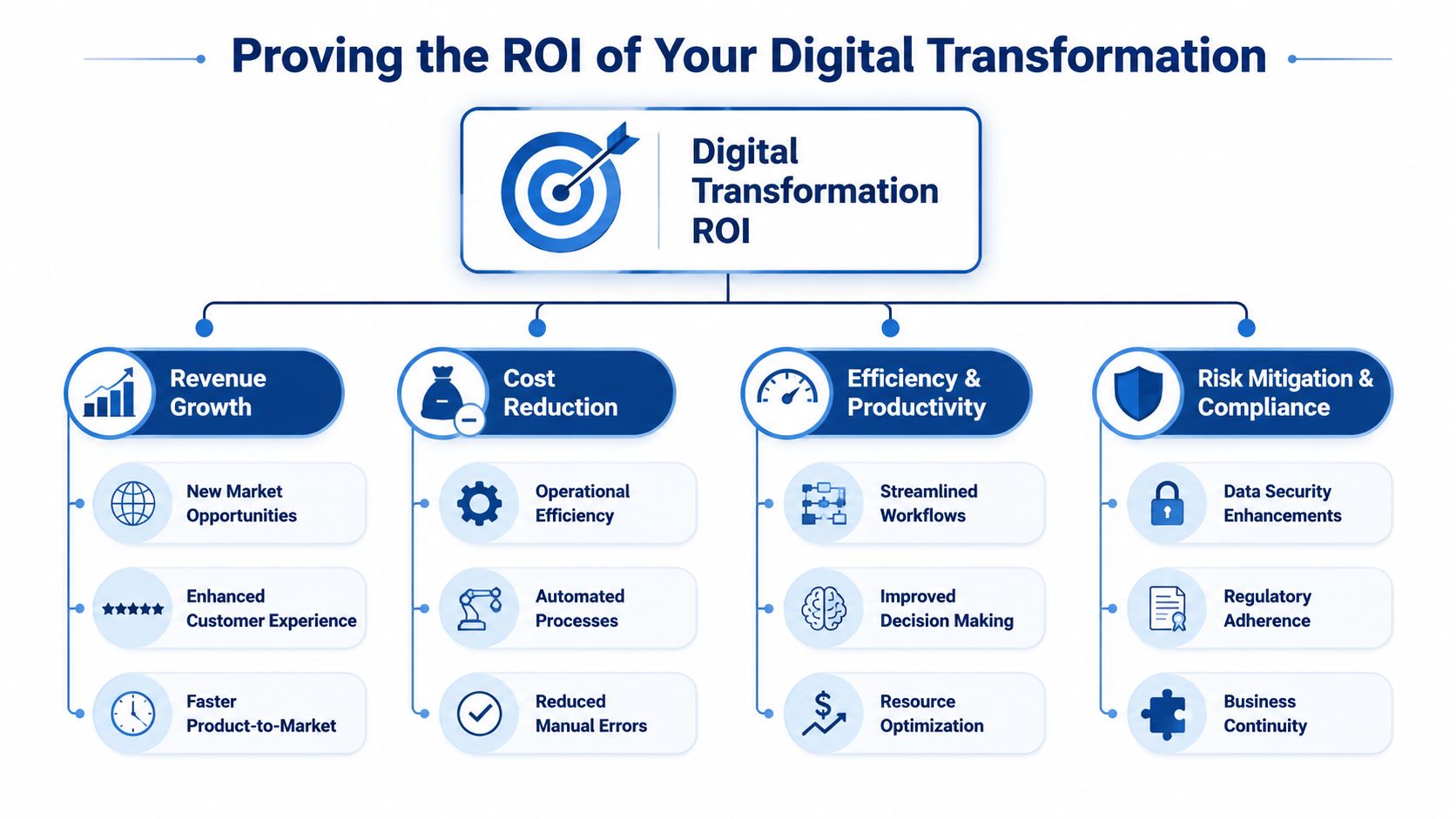
Three KPI Groups That Actually Matter
Many business cases fail because they jump straight to soft language like innovation, modernisation, or future readiness. Those ideas may be valid, but they rarely secure a budget by themselves.
Use three KPI groups instead.
Operational Efficiency
Start here when the project targets internal workflows.
Track metrics such as:
Cycle time for a core process
Manual handoffs between teams
Error and rework patterns
Time spent on repetitive admin
Backlog visibility and ageing
If a workflow tool, API integration, or automation layer reduces friction, these numbers should move in a way managers can see.
Customer Experience
This matters when the transformation changes how clients interact with the business.
Relevant measures often include:
Response speed
Status transparency
Completion rates
Drop-off points in forms or bookings
Complaint themes
The point isn't to create a perfect digital journey map. It's to find the places where customer effort is highest, and friction is hurting revenue or retention.
Business Agility
This category is often ignored until the company tries to launch something new and discovers the stack can't support it.
Look at:
How quickly a new feature or workflow can be introduced
How many teams depend on one manual workaround
How hard it is to connect systems
Whether leadership can make decisions based on timely information
A Simple Way To Build the Case
The cleanest ROI case links one initiative to one operational problem.
Use a working model like this:
| ROI component | What to define |
|---|---|
| Business problem | One specific bottleneck or failure point |
| Current-state cost | Labour time, delays, rework, lost responsiveness, or compliance burden |
| Proposed change | Workflow redesign, integration, dashboarding, automation, or platform change |
| Measurement window | The review period after pilot and after scaled rollout |
| Decision rule | Continue, expand, pause, or redesign based on observed results |
You don't need a complex finance model at the start. You need a disciplined baseline and an honest test.
The first ROI win should be easy to explain in one meeting. If it takes twenty slides to justify, the scope is probably too broad.
What Executives Should Insist On
Before funding any initiative, ask for these five things:
A baseline for the current process
A narrow first phase
Named KPI owners
A review point after the pilot
A clear explanation of what happens if adoption is weaker than expected
That's how transformation becomes investable. Not because the trend is big, but because the business case is specific.
Navigating Common Digital Transformation Pitfalls
Most failed transformation work doesn't fail at the architecture diagram. It fails in daily behaviour. Teams keep using spreadsheets, managers keep approving exceptions by email, data quality stays messy, and no one owns the process after launch.
Ricoh Canada's view is useful here. Digital transformation changes priorities across technology, processes, and how people work, and a key consulting function is building analytics capability that brings structured and unstructured data into a single view for forecasting and continuous improvement, as described in Ricoh's explanation of digital transformation consulting. That last part matters because many firms stop at deployment and never build the measurement layer needed to improve.
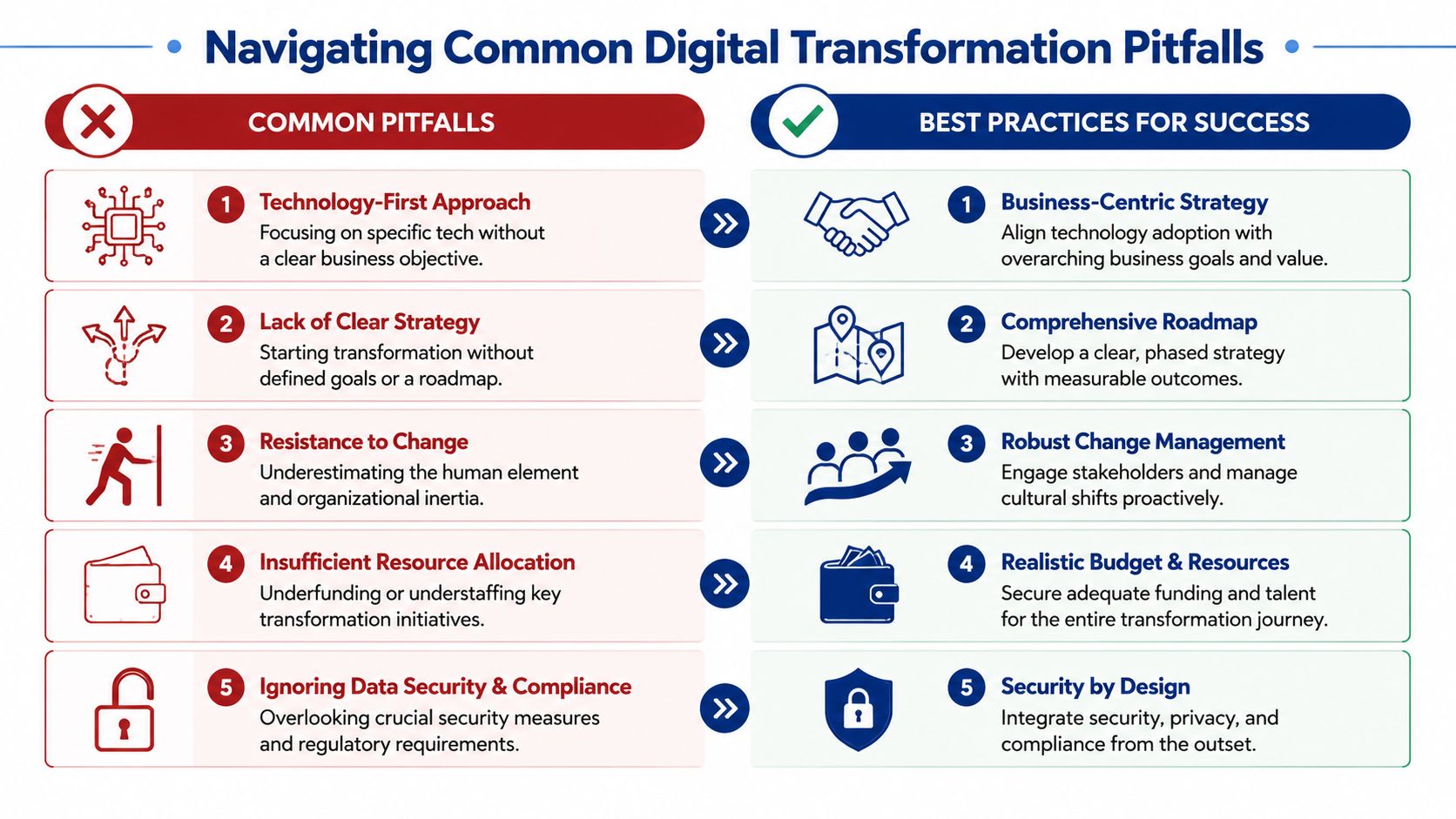
Five Mistakes That Keep Showing Up
1. Technology-First Decision Making
A leadership team gets excited about a platform before defining the business problem. The result is predictable. The tool becomes a forced fit.
Better approach: write down the friction first. Which workflow is slow, error-prone, opaque, or hard to scale? Only then choose the technology.
2. Big-Bang Rollout Logic
Some organisations still try to replace too much at once. That creates fear, resistance, and a long delay before anyone sees value.
Better approach: pilot in one process or business unit. Keep the scope narrow enough that teams can adapt while still running the business.
3. Weak Change Management
This is the quiet killer. Staff aren't told what's changing, managers don't reinforce the new workflow, and old habits remain the unofficial process.
Better approach: define new responsibilities, train by role, and make frontline managers accountable for adoption. A process is not live because the system is live.
4. Poor Data Discipline
If customer, operational, or financial data is inconsistent, automation will move bad information faster. Dashboards will look polished and still be wrong.
Better approach: agree on ownership, field definitions, and exception handling before reporting or automation scales.
5. No Governance After Launch
A lot of firms treat go-live as the finish line. Then requests pile up, exceptions expand, and no one knows who decides what changes get made next.
Better approach: establish a cadence for KPI review, backlog prioritisation, access decisions, and release management.
What To Do Instead
The strongest programmes usually share a few traits:
They start with a business problem
They use phased delivery
They treat adoption as a workstream
They build reporting into the solution
They assign operational ownership early
Systems don't sustain change. Managers do.
A consultant should keep returning the discussion to operations. Are people using the process? Are exceptions rising or falling? Can leadership see what's happening? Is customer friction lower? If those answers stay fuzzy, the programme needs correction before more money goes in.
Starting Your Digital Transformation Journey Today
Most firms don't need a grand launch. They need a disciplined first move.
If you're not ready to hire a consultant yet, start internally. Pick one workflow that is painful, visible, and important enough that people care about fixing it. Bring together operations, IT, finance, and one frontline manager. Map how the work happens today, where it breaks, which systems are involved, and what a better version would look like.
If You Want To Start Internally
Use a short internal discovery cycle:
Choose One Process
Claims intake, appointment scheduling, quote approval, lead follow-up, invoicing, or another workflow that creates daily friction.Map the Current State
Document handoffs, approval steps, manual entry points, exceptions, and reporting gaps.Define the Pain Clearly
Is the problem delay, inconsistency, visibility, workload, customer drop-off, or risk?Set a Small Success Test
Decide what improvement would justify a pilot.Identify Constraints Early
Security, privacy, integration limitations, staffing, and training capacity all shape what's realistic.
If You’re Preparing To Speak With a Consultant
Come prepared. The first conversation is far more productive when leadership has done some basic homework.
Bring these items into the discussion:
Current process notes or screenshots
A list of systems involved
One priority business problem
Known risks or compliance constraints
The names of people who own the workflow
A rough sense of what cannot be disrupted
If part of your transformation includes commercial growth, don't forget the operating side of revenue generation. For instance, teams scaling outbound sales may also need specialist support, such as hiring SDRs through LatHire, while internal systems for lead routing, CRM hygiene, and reporting are being improved. Transformation often works best when front-office execution and back-office process design move together.
What To Keep in Mind
Start smaller than your ambition. Measure more than feels comfortable. Fix the process before you automate the mess. And don't confuse a software launch with a business result.
That mindset prevents expensive detours and gives your team a realistic path to value.
If you want a practical partner to assess workflows, plan phased delivery, and build the software, automation, or integration layers behind that roadmap, Cleffex Digital Ltd works with organisations that need grounded digital transformation support rather than abstract strategy alone.