

Your store is already being judged as an online business, even if most of your revenue still comes from the floor. A shopper finds a jacket on Instagram, checks stock in your app, walks into your downtown location, asks an associate to hold it, then buys through the website for pickup because the line is shorter. That is normal now, and it exposes the key question behind omnichannel retail solutions: not how many channels you have, but how well they work together.
The weak point is usually not the storefront, the ad account, or the app. It's the plumbing between inventory, POS, CRM, commerce, and fulfilment, where broken sync creates missed sales, duplicate effort, and awkward customer handoffs. Canadian retailers that keep treating omnichannel as a channel-counting exercise are paying for dashboards instead of buying coordination.
Why Omnichannel Now Matters for Every Retail Decision
A customer can discover a product on social media, check availability in your app, walk into a store to confirm the fit, then place the order online for pickup because that is the fastest way to finish the purchase. If stock, identity, and order status do not line up across systems, staff improvise while the customer waits.
That is why omnichannel retail solutions belong in every retail decision now. Merchandising, fulfilment, service, and media spend all depend on whether your systems share one current view of the customer and the order. Market data shows the category is growing quickly, and Canadian retail is already moving in that direction. For a tighter view of customer behaviour across touchpoints, Tagada's omnichannel DTC guide is useful because it treats experience as connected action, not a stack of isolated channels. Grand View Research estimates the global market continues to expand, while Statistics Canada reported e-commerce represented 6.0% of total Canadian retail trade in 2023.
The strategic shift retailers can't ignore
The decision is not whether to add another channel. The decision is whether your channels share enough data for the customer to move without friction, and whether your store network can act as a fulfilment asset instead of a separate universe.
That matters more for Canadian SMBs and mid-market chains than for vendors selling platform dreams. If the web team, store team, and service team each tell a different stock story, you do not have omnichannel. You have three systems and one customer caught between them.
Practical rule: if your web team, store team, and service team all tell a different stock story, you don't have omnichannel. You have three separate systems with one customer standing in the middle.
Shoppers already behave that way. A 2025 shopper survey found 73% of retail shoppers engage across multiple channels during their buying journey and use an average of six touchpoints before purchase. Treating retail as a straight line from ad click to checkout is a planning error, and it wastes capital on the wrong integrations. The smarter move is to size ROI by journey stage and by region, then fund the parts of the stack that reduce friction where your customers buy.
What Omnichannel Really Means Beyond the Buzzword
Omnichannel is not the same thing as multichannel. Multichannel means you're present in more than one place. Omnichannel means the shopper can move between those places without reintroducing themselves, rebuilding the basket, or hearing conflicting answers from staff.
The easiest test is simple. If a customer logs into your mobile app, your website, and your POS all recognise the same loyalty ID, the same cart, and the same order history, you're operating like an omnichannel retailer. If each system knows only part of the story, you're still multichannel, no matter what the vendor deck says.
The six pieces that need to move as one system
The core stack usually includes POS, inventory, CRM, commerce platform, mobile, and analytics. None of those should behave like standalone islands. They need to read and write to a shared commerce backbone so a cashier, a web shopper, and a fulfilment manager are all seeing the same customer and the same stock picture.
That backbone matters more than any single feature. When the inventory view is centralised, available-to-promise becomes consistent. When the customer record is shared, service can see prior orders, preferences, and loyalty state. When analytics sits on top of clean event flow, the retailer can see where the journey breaks rather than guessing.
A lot of vendor conversations get lost here. Teams buy a mobile app, bolt on a loyalty layer, then discover the order management story is still fragmented. That is why retail system integration has to be the starting point, not the afterthought.
A retailer doesn't need more channels first. It needs one truth about stock, one truth about the customer, and one fulfilment view that every channel can call.
For a useful benchmark on how this should be planned at the stack level, see the cost of going headless in 2026. I'd still rather see a retailer choose the right architecture for its operational maturity than chase headless because it sounds modern. A modular stack is only useful if the team can run it.
The Integration Architecture Behind Modern Retail
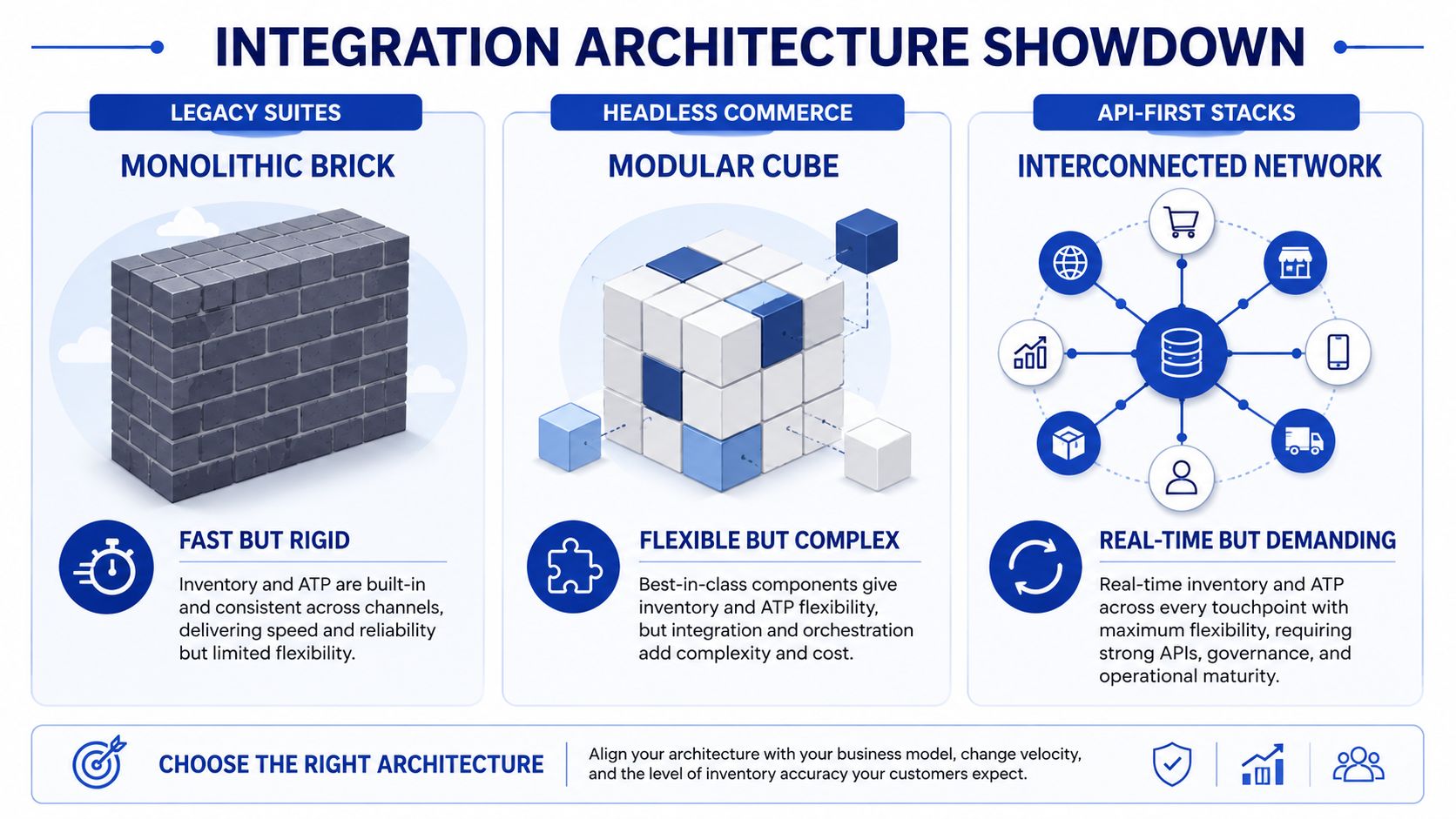
A retailer can have the right channels and still lose control of the customer experience. The decision is architectural. Buy for control, or buy for appearances. Monolithic suites look safe because one vendor promises an end-to-end answer. Headless commerce looks attractive because it gives the front end more freedom. Event-driven API-first stacks do the most work, and they demand the most discipline from the team running them.
A monolithic suite can launch quickly, but it tends to get rigid when stock, pricing, and order routing need to change fast. A headless setup separates presentation from commerce services, which helps with channel flexibility, but it still needs hard integration rules and clear ownership. An event-driven API-first model gives the cleanest path to near real-time updates across POS, web, and fulfilment, which is why I prefer it for retailers serious about customer journey optimisation.
The commercial signal is simple. Better integration quality changes the economics because the retailer can keep customer, order, and stock data aligned across touchpoints. That matters most when stores, e-commerce, and service teams all need the same answer at the same time.
Comparing Integration Architecture Patterns
| Pattern | Strength | Weakness | Best Fit |
|---|---|---|---|
| Monolithic suite | Simplest governance, fewer vendors | Rigid change cycles, weaker channel agility | Smaller teams that need fast basic control |
| Headless commerce | Flexible front ends, cleaner channel experimentation | Can become complex without strong data rules | Retailers with a capable digital team |
| Event-driven API-first | Strongest near-real-time stock and order flow | Requires mature integration discipline | Growth retailers and multi-store chains |
A modular, headless stack is often the bridge from having channels to running coordinated commerce. McKinsey describes next-generation retail architecture as fully omnichannel, data-powered, and highly modular, and that is the direction worth taking when you want central control over pricing, inventory, and routing without welding every channel together. For a practical backend lens, the ecommerce backend modernisation guide is a useful internal read.
The trade-off is straightforward. Each step toward modularity raises the need for integration governance, testing discipline, and a team that can manage dependencies without guessing. That is also why the cost of going headless in 2026 deserves a hard look before anyone sells headless as a shortcut.
A Five-Stage Roadmap for Smart Retail Integration
Most failed rollouts try to do too much at once. They replace systems, change workflows, and launch new customer promises in the same quarter, then spend the next six months cleaning up preventable mistakes. A smarter plan is staged, measurable, and boring in the best way.
Start with the systems audit
List every system that touches stock, customer identity, orders, returns, and fulfilment. Then map where truth is created and where it gets overwritten. If two systems can both change the same record without a clear rule, that's a conflict waiting to happen.
The exit gate here is simple. Every critical field needs a named owner, and every overlap needs an agreed rule.
Define the unified data model
Before you connect anything, define what a product, a customer, an order, and a return mean in your business. Many teams get stuck because they treat data mapping as a technical cleanup task. It isn't; it's a commercial decision.
Build the model once, then force every channel to use it. That keeps your retail system integration honest.
Build the API and event layer
Your systems stop shouting at each other and start passing updates cleanly. Use APIs for request and response flows, then add event-driven messaging so stock decrements, order captures, and fulfilment updates move without locking channel apps to back-end systems.
That also reduces oversell risk, which matters most when stores act as fulfilment nodes. If you want a practical place to review implementation paths, find integration options at Exerta and compare them against the processes you run.
Pilot one customer journey end to end
Do not launch everything at once. Choose one journey, such as buy online, pick up in store, and test it from click to fulfilment. The gate here is operational, not cosmetic. If store staff, web status, and customer notifications all match, you're ready to extend.
Scale only after the first journey is stable
Once the first flow works, repeat the model for returns, ship-from-store, and service-led reorder. That sequence protects store operations while digital channels evolve. It also gives leadership a sane way to review scope instead of asking for a massive all-at-once promise.
Industry research shows omnichannel customers spend 16% more per order and have 30% higher lifetime value than single-channel shoppers, while brands with strong omnichannel engagement retain 89% of customers versus 33% for weak strategies. Those are exactly the kinds of gains you achieve by sequencing the work correctly, not by doing everything at once.
For project governance, the technology roadmap template is worth reviewing before you lock your milestones.
Choosing the Right Scope for SMB and Enterprise Retailers
This is a capital allocation decision, not a feature checklist. A small retailer does not need the same stack as a national chain, and treating them as if they do burns money on capabilities the team will not use for years. Scope should follow fulfilment density, team maturity, and how much change the store network can absorb.
SMBs should fund control first
For smaller retailers, the first money should go into inventory sync, POS integration, and a single commerce platform that can speak cleanly to both. That combination usually delivers the fastest operational relief because it stops the most visible customer-facing errors.
Hold back advanced CDP work, complex personalisation, and oversized orchestration until the basics are stable. A retailer with one accurate stock view will beat a retailer with six disconnected “smart” tools every time.
Enterprises should fund orchestration first
Larger chains usually need a stronger OMS, identity layer, and analytics stack earlier because scale multiplies inconsistency. Once multiple banners, store formats, and fulfilment paths are in play, the core challenge is orchestration, not checkout.
Ecommerce integrations stop being a project and become operating infrastructure. Central rules should handle pricing, routing, and customer state, while local flexibility should exist only where the business needs it.
Capital decisions should follow business reality
Canadian retail is already carrying meaningful digital demand, so this is not an experiment anymore. The right response is to invest where demand already shows up, then delay the pieces the business cannot support yet.
For teams comparing build-versus-buy options, custom retail software solutions are a useful reference point. Use it to test scope discipline, not to build a shopping list.
Common Pitfalls and How Canadian Retailers Avoid Them
Canadian retailers often copy global omnichannel playbooks without checking whether the promise fits the geography. A dense urban network can support faster fulfilment models than a spread-out regional chain with fewer stores and more variable shipping economics. If you standardise every promise everywhere, you end up overcommitting the business.
The five mistakes I'd stop immediately
Channel-first thinking: Start with customer journeys and back-end truth, not with the next shiny channel.
No unified inventory: If web, store, and support each see a different number, trust collapses fast.
Weak identity resolution: A customer who looks new in every channel is a customer you can't learn from.
Over-customised journeys: Too much local variation makes support and maintenance expensive.
Skipping change management: Staff adoption matters as much as code, because store teams carry the customer experience.
The more practical model is regional and phased. Some channels should be integrated differently depending on where stores sit, what delivery partners can realistically cover, and how much same-day fulfilment the network can sustain. That lines up with EY's view that omnichannel success depends on functional integration, customer insights, next-generation inventory, distribution partnerships, and real-estate strategy, not on a universal promise delivered everywhere.
That's the hard trade-off many teams miss. A simplified BOPIS promise, stronger inventory discipline, and supply chain automation usually beat feature parity with global giants. If your store network can't support a promise consistently, don't market it.
Build for what your network can actually deliver. Customers forgive limited scope more easily than they forgive broken promises.
Measuring ROI, Picking Vendors, and Your Next Steps
If you can't measure omnichannel value, you're not managing a programme. You're funding a hope. The best KPIs are the ones that reveal whether your systems are integrated and whether the customer is behaving differently because of it.
Track share of customer data across channels, ATP accuracy, repeat purchase rate, and cross-channel margin. Those metrics tell you whether the stack is improving availability, loyalty, and profit, not just adding logins and reports. Google's 2024 omnichannel retail report notes that Canadian shoppers now use more touchpoints before buying, and McKinsey's advice is to size the value at stake, define a fact base, and target the consumer-back segments most likely to create value rather than rolling omnichannel out as a blanket initiative.
A vendor scorecard that actually matters
Use three filters. First, integration openness, because closed platforms trap your data. Second, roadmap transparency, because hidden dependencies turn into future cost. Third, post-launch support, because rollout day is when your store staff discover what the spec missed.
For Canadian SMBs and mid-market chains, I'd look at vendors that can connect commerce, inventory, service, and reporting without forcing a rip-and-replace on day one. That's where implementation partners earn their keep, whether you choose packaged software, custom build, or a hybrid path. Cleffex Digital Ltd is one option in that category, because its ecommerce work includes integration requirements across systems and connected retail workflows.
FAQs
What should a Canadian retailer integrate first?
Start with inventory, POS, and the core commerce platform. If those three don't agree, every other investment gets noisier.
Is headless commerce required for omnichannel success?
No. It's useful when you need channel flexibility and cleaner service separation, but it only works if your data model and API discipline are strong.
How do I know if my ROI case is real?
If ATP accuracy improves, repeat purchases rise, and store and digital teams stop arguing about stock, the case is getting real. If you only have prettier dashboards, it isn't.
Cleffex Digital Ltd helps retailers connect commerce platforms, inventory systems, and customer data into one operating model instead of a pile of disconnected tools. If you're planning omnichannel retail solutions and want a practical integration path for your store, web, and fulfilment stack, visit Cleffex Digital Ltd and take the next step with a team that builds for how retail works.