


Imagine you could create one single key that opens doors for both Apple and Android users. That's the essence of mobile app development cross platforms. It’s a strategy where developers build an app just once, and then it works everywhere. This approach saves a ton of time and money compared to building separate apps for each operating system.
Build Once, Run Everywhere with Cross-Platform Development

The old way of doing things meant doubling the work. To reach everyone on mobile, businesses had to run two completely separate projects. You'd have one team building the iOS app in Swift, and another team building the Android version with Kotlin or Java. This native approach meant separate teams, separate budgets, and separate schedules – making it expensive and slow to get your app to market.
Cross-platform development completely flips that script. Instead of starting from scratch twice, a single team writes one shared codebase that creates an app that feels right at home on both major platforms. This "write once, run anywhere" philosophy is the main reason so many businesses are getting on board.
Why Businesses Are Making the Switch
This move toward a single development model isn't just a trend; it's driven by real business needs. When competition is fierce, speed and efficiency are everything. More and more companies are finding that a cross-platform strategy gives them a serious advantage by hitting key business goals head-on.
This modern approach comes with some pretty convincing perks:
Faster Time-to-Market: You can launch on both iOS and Android at the same time, practically cutting your development timeline in half. This means you can get your app in front of a bigger audience right from the start.
Reduced Development Costs: Managing one codebase means you only need one development team, not two. That translates into huge savings on salaries and project overhead.
Consistent Brand Experience: Because it’s all coming from the same code, your app’s look, feel, and features will be consistent on every device. This helps build a stronger, more recognisable brand identity.
Simplified Maintenance: When it’s time to roll out updates, fix bugs, or add new features, the process is way simpler. You only have to make the changes once.
A Proven Strategy for Efficiency
This isn’t just a nice idea in theory; it's delivering real-world results. For instance, a Toronto-based retail company cut its development time by roughly 40% by using the Flutter framework for its app.
That kind of speed allows Canadian businesses to launch products faster, keep their user experience consistent, and make their budgets go further. You can find more insights about what’s next for cross-platform apps in Canada at app-scoop.com. This is exactly why cross-platform development has gone from a niche alternative to a go-to strategy for smart, scalable growth.
Here is the rewritten section, crafted to sound like it was written by an experienced human expert.
Why Smart Businesses Are Choosing a Unified Development Approach
Picking a development strategy isn't just a technical choice for the IT department; it's a fundamental business decision that hits your budget and your go-to-market plan. When businesses decide to go with mobile app development cross platforms, they’re usually chasing efficiency, speed, and a consistent brand experience. This single-codebase approach offers some very real, tangible benefits that solve the classic headaches of launching a mobile app.
The most obvious win is the cost savings. It’s pretty straightforward: instead of bankrolling two separate development teams and projects for iOS and Android, you’re funnelling all your resources into one.
Think about it this way: building one app for both platforms can cut your development costs by around 30% compared to building two separate native apps. That's not just pocket change; it's a significant chunk of your budget you can now redirect into marketing, adding more features, or other critical growth areas.
This financial upside goes beyond just the initial coding. You only need to manage one team of developers, one project manager, and a single quality assurance pipeline. Right from the start, this simplifies your overhead and makes communication a whole lot easier.
Getting to Market Faster
In today's market, timing can make or break you. A huge reason businesses lean towards a cross-platform strategy is simply getting their product out the door quicker. When you develop a single codebase, you're ready to launch on both the Apple App Store and Google Play Store at the same time. This means you can capture the entire market from day one, avoiding that tough choice of which user base to prioritise first.
By essentially cutting the development work in half, you get your app into users' hands sooner. You start collecting feedback faster, building your audience earlier, and hopefully, bringing in revenue more quickly. For startups or any company trying to break into a crowded space, that speed can be the difference between leading the pack and playing catch-up.
The Honest Trade-Offs You Need to Know
Now, let's be realistic. A unified approach isn't a silver bullet for every single project. It's really important to weigh the undeniable benefits against the potential downsides to make a smart decision that actually fits your long-term goals. While modern frameworks are incredibly powerful, there are a couple of honest trade-offs to keep in mind.
Performance Nuances: If you're building something that needs a ton of graphical muscle, like a high-end 3D game or a sophisticated augmented reality app, native development often has the upper hand. Cross-platform apps run on an extra layer of abstraction, which can sometimes lead to a slight performance dip in these very intensive scenarios compared to code written specifically for the operating system.
Access to the Latest OS Features: Whenever Apple or Google drops a shiny new feature in their latest OS update, native developers get instant access to it through the official tools. For cross-platform frameworks, there's often a short delay while the framework's maintainers build in support for these new capabilities.
Keeping Your Brand and User Experience Consistent
Perhaps one of the strongest arguments for mobile app development cross platforms is the ability to deliver a rock-solid, consistent user experience. Since the app is built from one codebase, the look, feel, and functionality are naturally the same on every device.
This consistency is huge for reinforcing your brand identity. It makes the app feel familiar and intuitive, whether your customer is on an iPhone or an Android. And when it comes to long-term maintenance? It’s a game-changer. Fixing a bug or rolling out an update means changing the code in one place, and the fix goes live everywhere. This makes ongoing support so much simpler and ensures all your users get the same great experience at the same time.
Choosing Your Framework: React Native vs. Flutter and More
Stepping into cross-platform development means you’ve got a big decision to make right at the start: choosing your tools. This isn’t just a technical detail; the framework you pick will shape everything from your app’s performance and user interface to the very skills your development team needs. Think of it like a chef choosing their knife set – different sets are designed for different cooking styles, and the right one makes all the difference.
The market has a few heavy hitters, and each one comes with its own philosophy and unique strengths. Getting to grips with these differences is the first step toward picking a framework that doesn’t just work, but actively helps you hit your business goals on time and on budget.
This decision tree helps visualise the first major fork in the road. Are you chasing raw, down-to-the-metal performance, or is getting to market faster with a unified codebase the bigger prize?
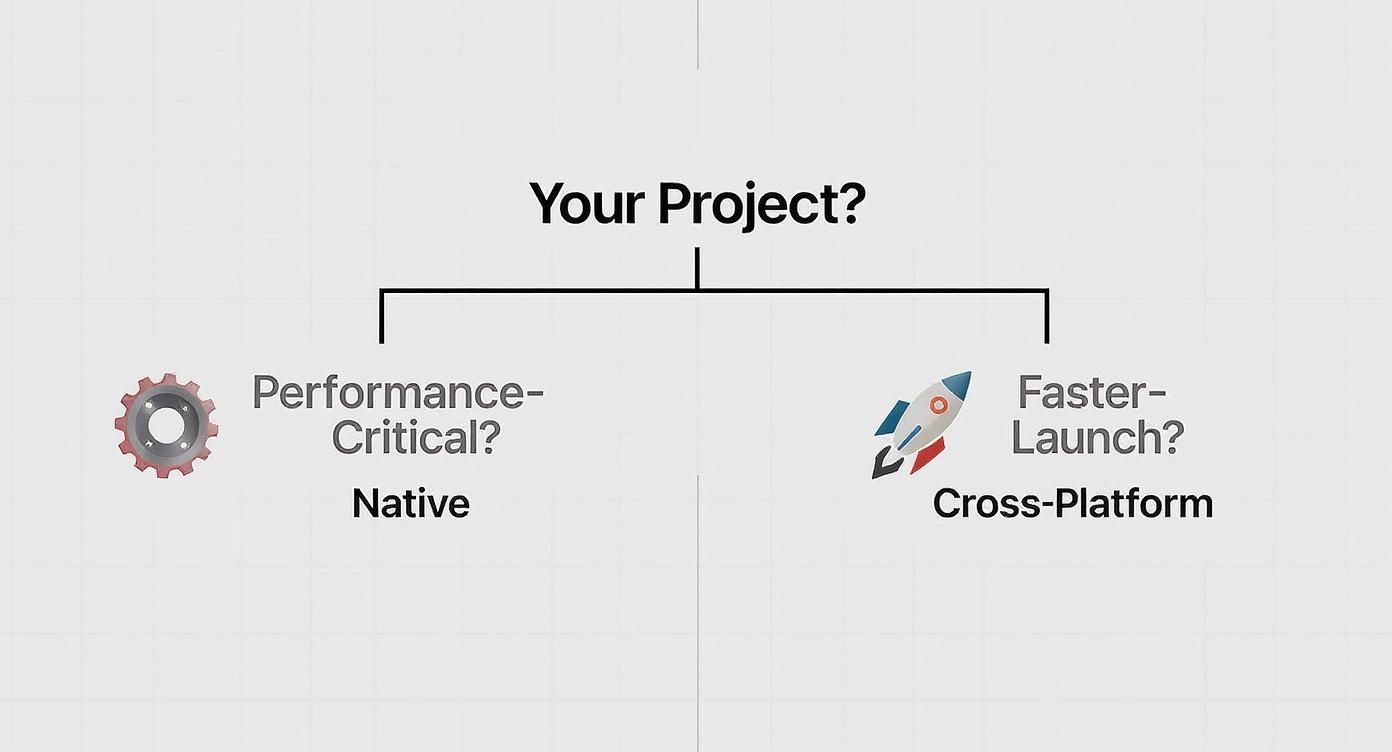
As you can see, if you’re building something like a high-intensity 3D game, going native is often the only way to get the absolute peak performance you need. For the vast majority of business and consumer apps, however, a cross-platform framework delivers that sweet spot of speed, cost savings, and a high-quality user experience.
React Native: The JavaScript Powerhouse
Developed by Meta, React Native has long been a crowd favourite. Its biggest draw? It lets web developers use their existing JavaScript and React skills to build for mobile. This drastically shortens the learning curve and opens up a huge talent pool.
The core idea behind React Native is "learn once, write anywhere." It doesn't just wrap your app in a web browser. Instead, it uses a clever "bridge" to talk to the phone's native UI components. This means a button in your React Native app is the real iOS or Android button, giving users an experience that feels completely authentic to their device.
Because it uses native UI elements, React Native is fantastic for creating apps that look and feel like they belong on the operating system. It's no wonder major apps like Instagram, Skype, and Walmart have used it to build their mobile presence.
The one thing to watch for is that this reliance on the bridge can occasionally create performance hiccups, especially with complex animations or heavy data processing. That back-and-forth translation between JavaScript and the native code adds an extra step that can sometimes slow things down.
Flutter: The UI-Focused Challenger
Google’s Flutter has exploded in popularity by taking a totally different route. It doesn’t bother with native UI components at all. Instead, Flutter brings its own high-performance rendering engine, Skia, to draw every single pixel on the screen itself.
This gives developers complete control, allowing for stunning, lightning-fast, and highly customised user interfaces that look identical on any device. If you have a strong brand identity and need pixel-perfect design consistency, Flutter is a dream come true.
Because everything is self-contained, animations are buttery smooth and performance is generally excellent, there’s no bridge to slow things down. The trade-off is that the app won't automatically update its look when iOS or Android gets a design refresh; your team has to handle that manually. It also uses a language called Dart, which might be new to your team.
Other Strong Contenders in the Field
While React Native and Flutter grab most of the headlines, they aren't your only options. A couple of other battle-tested frameworks cater to specific ecosystems and needs.
.NET MAUI (formerly Xamarin): Backed by Microsoft, this is the default choice for developers already deep in the C# and .NET world. It plugs directly into the Microsoft development ecosystem and lets you share an incredible amount of code often over 90% across platforms. It’s a rock-solid option for enterprise-grade apps, especially if your company already has a team of .NET developers.
Ionic: This framework is all about web tech. It uses standard HTML, CSS, and JavaScript, essentially running your app inside a web view (a kind of in-app browser). This makes development incredibly quick and easy for any web developer, but it might not deliver the same near-native snappiness as Flutter or React Native for really demanding apps.
To get a more granular view, you can check out our detailed comparison of the best frameworks for app development in 2022 and see a full breakdown of their specs.
Cross-Platform Framework Feature Comparison
This table offers a quick, side-by-side look at what makes each framework unique, helping you align their strengths with your project's specific needs.
| Framework | UI Approach | Performance | Primary Language | Best For |
|---|---|---|---|---|
| React Native | Native UI Components | Very Good | JavaScript | Teams with React skills; apps needing a native look and feel. |
| Flutter | Custom Rendering | Excellent | Dart | Highly branded, custom UIs; apps needing top-tier performance. |
| .NET MAUI | Native UI Components | Very Good | C# | Enterprise apps; teams already invested in the Microsoft .NET ecosystem. |
| Ionic | Web View (HTML/CSS) | Good | JavaScript/TypeScript | Rapid prototyping; simple apps; teams with web development skills. |
Ultimately, each of these frameworks is a powerful tool capable of producing fantastic applications. The "best" one is simply the one that fits your specific context.
Making the Right Technical Decision
Choosing a framework is a long-term commitment that goes beyond the tech itself. Your final decision should be guided by a few key questions:
What’s Your UI Philosophy? Do you want your app to feel like a natural extension of the phone's OS (React Native), or do you need a beautiful, brand-consistent design that looks the same everywhere (Flutter)?
What are Your Performance Needs? For most business apps, any of these will do the job well. But if your app is heavy on complex animations and interactions, Flutter's architecture often gives it a slight edge.
What’s Your Team’s Skill Set? This is a huge one. If you have a room full of JavaScript experts, React Native is a no-brainer. If you're a Microsoft shop, .NET MAUI is the logical path.
How Big is the Community? Both React Native and Flutter have massive, vibrant communities. This means tons of tutorials, third-party libraries, and people who can help when you get stuck, which can seriously speed up development.
In the end, the right choice is the one that empowers your team to build an amazing product efficiently, delivering real value to your users without getting in the way of your business goals.
Achieving Native Performance and a Seamless User Experience
One of the biggest myths floating around mobile development is that going cross-platform means you’re automatically settling for second best. Years ago, that might have been true, but modern frameworks have completely flipped the script. Today, it's entirely possible to build an app that runs beautifully on both iOS and Android, and your users will be none the wiser.
The secret isn't some magic bullet; it's a dedicated focus on three critical areas: performance, security, and user experience. This goes way beyond just writing code that works. It’s about crafting an application that feels snappy, protects user data like a fortress, and is genuinely a joy to use on any device.
When you nail these three pillars, the old line between native and cross-platform practically vanishes. What you're left with is a high-quality product that people love to use.
Delivering Near-Native Performance
Performance is usually the first question on everyone's mind when considering mobile app development cross platforms. Is it going to feel slow? Will the animations stutter? Thankfully, frameworks like Flutter and React Native were built from the ground up for speed, often delivering performance that’s indistinguishable from a native app.
Flutter, for instance, bypasses the native UI components and draws every single pixel on the screen itself using its own high-performance rendering engine. This gives it incredible control, resulting in buttery-smooth animations that consistently hit 60 frames per second. React Native takes a different approach, using a "bridge" to communicate with native OS components, a method that is incredibly efficient for the vast majority of app functions.
To really squeeze every drop of performance out of these tools, a skilled team will implement a few key techniques:
Efficient State Management: This is all about how your app's data is stored and updated. A smart approach prevents the app from re-drawing parts of the screen unnecessarily, which is a classic cause of slowdowns.
Code Splitting: Think of it like serving a meal one course at a time instead of putting everything on the table at once. The app only loads the code needed for the screen you're currently on, which dramatically cuts down initial load times.
Image and Asset Optimisation: Compressing images and using modern formats ensures that even apps with lots of media feel light and responsive without compromising on visual quality.
A well-architected cross-platform app can feel just as snappy and responsive as a native one. The key is not just the framework you choose, but how skillfully your development team uses it to manage resources and optimize the codebase.
Securing a Shared Codebase
When your app’s brain lives in a single codebase, protecting it is non-negotiable. A single vulnerability could potentially impact your entire user base, which makes a proactive security strategy absolutely essential right from day one. This means protecting user data both when it's stored on the device and when it's flying across the internet.
Standard security protocols are a must, like strong data encryption for any sensitive information stored locally and using secure channels like HTTPS for all communication with your servers. It's also crucial to implement solid authentication and authorisation to make sure users can only see and touch their own data. For a deeper dive into structuring your app for both security and growth, check out our guide on mobile application architecture.
Crafting a Flawless User Experience
This is where the real artistry of cross-platform development comes into play. A fantastic user experience (UX) isn't about making your app look identical on an iPhone and a Samsung Galaxy. It's about making it feel at home on each platform by respecting their unique design languages and what users have come to expect.
To truly achieve a seamless user experience that feels native, understanding the foundational principles of user experience design (UX) is paramount, guiding the creation of intuitive and satisfying interactions within your app.
This means honouring the little details that make each platform unique:
Navigation: iOS users instinctively look for tab bars at the bottom of the screen, while Android users are used to navigation drawers and a dedicated hardware or software back button.
Buttons and Controls: The look, feel, and even the feedback of interactive elements should match what users are accustomed to on their device.
Typography: Simply using the default system fonts – San Francisco for iOS and Roboto for Android – goes a long way in making an app feel instantly familiar and trustworthy.
The real challenge is balancing these platform-specific norms with a strong, consistent brand identity. You want a cohesive brand experience that intelligently adapts to its environment, making the app intuitive for everyone, no matter what phone is in their pocket. This user-first approach has produced incredible results across Canada. In Montreal's healthcare sector, for example, cross-platform apps have helped cut patient wait times by 50%, while in Ottawa, new financial apps have reduced transaction failures by 30%.
Budgeting Your Cross-Platform Project
Figuring out the actual cost of a project is one of the toughest, yet most important, parts of any business plan. When it comes to cross-platform mobile app development, it’s about more than just the price of coding. A solid budget acts as your financial roadmap, detailing every expense from the initial design sketch to long-term support. This clarity is what you need to secure funding and set goals you can actually hit.
A good budget breaks down into several distinct phases, each with its own costs. Think of it less as a single number and more as a collection of essential investments that come together to build a successful app. If you skimp on any one of these areas, you're setting yourself up for surprise expenses and delays down the road.
Key Budget Components to Consider
To get an accurate financial picture, you have to look at the entire project lifecycle. This is the best way to make sure no critical stage gets left behind or underfunded.
UI/UX Design: This is essentially the blueprint for your app. It involves creating the wireframes, mockups, and prototypes that map out the user's journey and define your app's look and feel. A well-designed app feels intuitive and keeps users coming back.
Development and Coding: Here's where the actual construction happens and developers write the code. The cost is directly tied to your app's complexity: the more features, third-party integrations, and custom logic you need, the more development hours it will take.
Quality Assurance (QA) Testing: You simply can't skip rigorous testing. QA specialists hunt for bugs across countless devices and OS versions to ensure your app is stable and polished before it ever reaches your users.
Project Management: A great project manager is the glue that holds everything together. They coordinate the design, development, and QA teams to make sure everyone hits their deadlines and, most importantly, stays within the budget.
The real financial win with cross-platform development isn't just a lower up-front cost. It's the long-term value you get from a more efficient, unified process that cuts down on complexity and overhead at every stage of the app's life.
Comparing Costs: Native vs. Cross-Platform
The most common reason businesses opt for a unified approach is the potential for major savings. Think about it: building two separate native apps means hiring two separate teams, which doubles the work and the cost. A cross-platform strategy condenses this into a single, much more efficient workflow.
The numbers really tell the story here. In Canadian dollars, native app development can run anywhere from $54,000 to $202,500 CAD for iOS and $47,250 to $189,000 CAD for Android – each. In contrast, a cross-platform app typically costs between $67,500 and $270,000 CAD total. You get a product for both platforms from one codebase, often cutting overall costs by 20-30%.
Beyond the Launch: Maintenance and Updates
Your budget doesn't just stop once the app is live. Ongoing maintenance is a critical, long-term investment that you need to plan for. This covers everything from server costs and bug fixes to OS compatibility updates and rolling out new features to stay competitive. A single codebase makes this whole process much simpler and cheaper to manage. To get a handle on these recurring expenses, check out our detailed guide on app maintenance costs.
To keep your project on track and within its financial guardrails, a deep understanding of effective software project estimation for costs and timelines is key. Proper planning and a clear-eyed view of all the expenses involved are the cornerstones of a successful and financially sound mobile app.
From Concept to Launch: The Cross-Platform App Lifecycle
Building a cross-platform app is a lot like constructing a house. You wouldn't start hammering without a solid blueprint, right? The same principle applies here. The journey from a great idea to a polished app on someone's phone follows a structured path, ensuring every decision is purposeful and tied directly to your business goals.

Think of this process as a clear roadmap. By understanding the route ahead, you can better anticipate the resources, time, and focus needed at each milestone. It’s a well-trodden path that turns a promising concept into a market-ready product.
Discovery and Strategic Planning
This is ground zero – the stage where you figure out the "what" and "why" behind your app. It's about more than just features; you're digging deep into market research, pinpointing your ideal users, and getting crystal clear on the exact problem your app solves. For a cross-platform build, this is also where you confirm that a single, unified codebase can deliver the performance and experience you need.
Strategic planning isn't just about features; it's about building a business case. A successful app begins with a clear vision of its purpose, its audience, and how it will stand out in a crowded marketplace. This initial roadmap guides every subsequent decision.
Here's what happens during this crucial first phase:
Competitive Analysis: We look at what similar apps are doing well and, more importantly, where they're missing the mark.
Feature Prioritisation: We define a Minimum Viable Product (MVP) to get your app to market efficiently and start gathering real user feedback.
Technology Stack Selection: We choose the right framework, whether it's Flutter or React Native, that best fits your project's specific needs.
Design, Development, and Deployment
With a solid strategy in place, the creative and technical work kicks into high gear. The UI/UX design phase is where we create the visual blueprint, focusing on a user journey that feels intuitive and looks great on both iOS and Android devices. After that, our developers get to work, writing the single codebase that will bring your app to life.
A key part of the cross-platform process is quality assurance (QA). The testing has to be rigorous, covering a huge range of real devices, not just simulators. We need to ensure your app runs perfectly on different screen sizes, hardware, and OS versions, from the newest iPhone to an older Android tablet. Once everything is pixel-perfect, we handle the submission process for both the Google Play Store and Apple's App Store.
Maintenance and Continuous Improvement
The launch isn't the finish line; it’s the starting gun. This is where the real value of a single codebase becomes obvious. Pushing updates, fixing bugs, or adding new features is so much simpler.
Instead of juggling two separate development teams and schedules, your team makes a change once, and it rolls out to everyone, everywhere. This streamlined approach drastically cuts down on ongoing costs and complexity. It allows you to react quickly to user feedback and stay ahead of market trends, keeping your app relevant and successful for the long haul.
Frequently Asked Questions
Jumping into cross-platform development often sparks a few questions. Whether you're trying to figure out the budget or which tools to use, getting straight answers is key. Let's tackle some of the most common queries we hear.
Think of this as a quick-start guide to clear up the big questions you might have about building one app for every device.
Is Cross-Platform Development Suitable For Every App?
Not always, and it's important to be honest about that. While it’s a fantastic, cost-effective choice for most business apps, e-commerce platforms, and content-driven experiences, native development still wins in a few specific arenas.
For example, if you're building a graphics-heavy 3D game or an app that needs instant access to the latest, most advanced hardware features, like a brand-new augmented reality kit just released for iOS, going native is probably your best bet.
How Does App Maintenance Differ From Native Development?
This is where you'll see one of the biggest wins. Maintenance becomes so much simpler. With a single codebase, your team can write a fix, test it, and deploy an update once, and it goes live on both the App Store and Google Play simultaneously.
It completely cuts out the logistical headache and extra cost of managing two separate, parallel development efforts just to fix a bug or add a new feature.
The real benefit is streamlined simplicity. Instead of doubling your work for every patch, you have a single source of truth for your app. This ensures consistency and saves a ton of resources down the road.
Can A Cross-Platform App Look and Feel Truly Native?
Absolutely. Modern frameworks like React Native and Flutter are designed from the ground up to deliver authentic user experiences that don’t feel compromised.
Flutter, for instance, uses its own rendering engine, giving developers pixel-perfect control to create beautiful, branded UIs that are identical everywhere. React Native takes a different approach by using the actual native UI components from iOS and Android.
With a smart design team that respects each platform's conventions and skilled developers at the helm, your users won't know the difference. They'll just know they're using a great app that feels right at home on their phone.
Ready to build an app that reaches your entire audience without doubling your budget? The team at Cleffex Digital Ltd specializes in creating high-performance cross-platform applications that drive business growth. Contact us today to discuss your project.