

Your core operations still run on a ten-year-old application that nobody dares reboot on a Friday afternoon. Adding a single validation rule takes six weeks, every release requires a manual checklist, and the one developer who remembers how the nightly billing batch works is thinking about retirement.
When leaders face that kind of friction, the first instinct is usually to scrap the platform and commission a fresh build from scratch. That's almost always the most expensive and riskiest move you can make. Big-bang rewrites stall because they force you to rediscover years of undocumented business rules while keeping the live operation running.
Effective legacy software modernization is a sequencing problem before it's a technology problem. Most estates are dominated by quiet, essential back-office plumbing; a 2012 inventory by the Treasury Board of Canada Secretariat catalogued more than 16,000 federal systems and found that 75% supported back-office functions rather than department-specific front-line work. Ranking those systems by business risk and criticality lets you stabilise, wrap, or retire components in order, treating cloud migration as a targeted tactic rather than proof of progress and planning interoperability and workflow change as the constraints that govern delivery in practice.
Six Ways to Modernise Software Without a Full Rebuild
Most ageing systems didn't reach a fragile state because of one bad technical call. They got there through years of bolt-on integrations, patched databases, staff turnover, and deferred upgrades that slowly locked business logic inside ageing code. By the time a small change takes months, nobody can untangle the application without risking an outage.
Large organisations struggle with the exact same backlog. In a 2023 audit of roughly 7,500 federal applications, the Office of the Auditor General of Canada found that only 38% were considered healthy, and about one-third of its 1,480 mission-critical applications remained in poor health. Modernisation work hadn't even started on 65% of the roughly 4,500 applications already flagged for remediation as of March 2023, proving that waiting for a total replacement leaves critical services exposed for years.
Rather than choosing between doing nothing and rewriting everything, you have six practical paths ordered from least to most invasive.
Modernisation strategies compared
| Strategy | What changes | Typical use | Effort and disruption | Rebuild needed |
|---|---|---|---|---|
| Rehost (lift and shift) | Application moves to new infrastructure with little or no code change | Failing hardware or a data centre exit | Low to moderate | No |
| Replatform | Small changes so the application runs on a supported database, OS or runtime | Stable application on an unsupported platform | Moderate | No |
| Refactor | Code is restructured while behaviour stays the same | Sound business logic buried in messy code | Moderate to high | No |
| Wrap with APIs | An interface sits in front of the old system so newer tools can reuse its rules and data | Core system must keep running for now | Moderate | No |
| Re-architect | Application is split into services or modules | Scaling limits or tight coupling between features | High | Partly |
| Replace or retire | New or packaged software replaces it, or unused functions are switched off | Duplicated, unused or unsupported systems | High, with data migration | Yes, for that system only |
Rehosting gives you breathing room when servers are dying or a hosting lease is ending, because you move the workload without altering application logic. Replatforming goes one step further by swapping out an unsupported operating system, runtime, or database engine such as moving from an end-of-life SQL Server version to a managed database service. Refactoring leaves external behaviour intact while cleaning internal modules so engineers can test and ship changes faster.
Wrapping a core system with REST or event-driven APIs lets newer web portals, mobile apps, or partner feeds consume trusted data without touching fragile internals. Re-architecting separates bottlenecks so a high-volume pricing engine or document processor can scale independently from slower admin screens. Replacing or retiring removes dead weight entirely, such as replacing spreadsheets with unified CEF software when disconnected workbooks have turned into informal production systems.
Why most estates combine several paths at once
No sensible portfolio applies a single strategy to every workload. You might rehost a reporting server to exit a lease, wrap a core policy administration platform behind APIs, and retire three redundant desktop utilities during the same year. Treating legacy application modernization as a portfolio mix keeps spending tied to risk rather than ideology.
Rehosting is a tactical waypoint, not a finish line. Lifting an inefficient, tightly coupled application onto cloud infrastructure leaves every underlying code and licensing bottleneck untouched.
Before moving on, pick one troublesome application in your own organisation and match it to a row in the table above. That single choice will anchor how you evaluate the rest of your estate.
How to Assess a Legacy System Before You Change It
Modernisation programmes usually stumble long before anyone writes new code, because teams skipped discovery and guessed at what the old system really did. When you don't map dependencies, hidden feeds, and manual workarounds up front, every migration step triggers surprise breakage downstream.
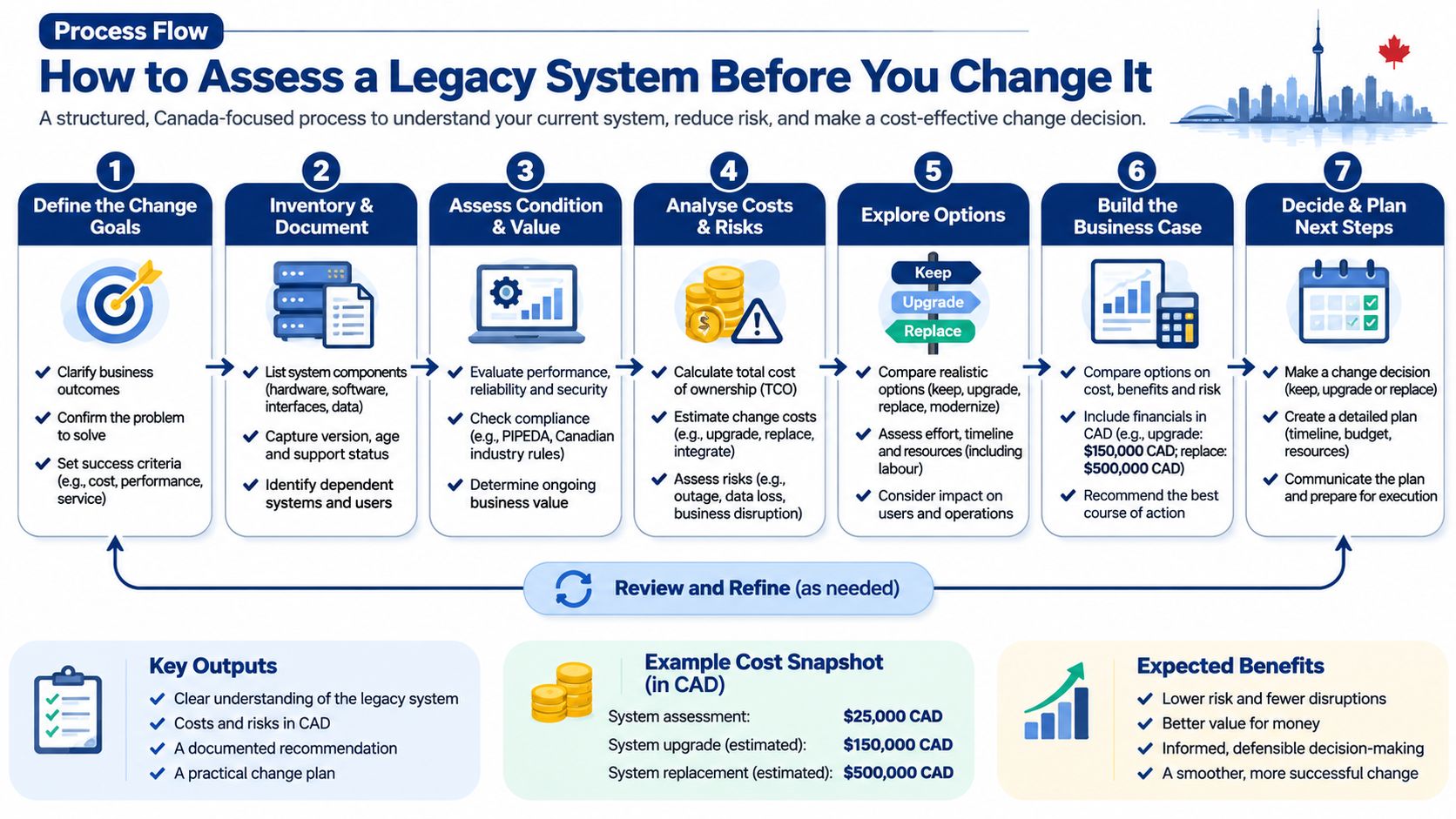
A structured assessment takes a few weeks and prevents months of rework. Run through these seven checks for every candidate workload:
- Catalogue every running asset. List core platforms alongside shadow spreadsheets, scheduled batch scripts, Access databases, and utilities nobody formally claims. Teams routinely miss overnight file transfers and departmental macros, which then break without warning the moment a parent database changes.
- Record the business owner and outage impact. Name who relies on the tool and write down exactly what stops if the system goes offline for 24 hours. Relying on IT assumptions instead of asking operations leads often hides revenue-critical reporting or regulatory submissions.
- Verify vendor support and security posture. Check end-of-life dates for the operating system, runtime, database, and third-party libraries, then log every unpatched vulnerability. According to Canada's Digital Ambition 2022-23, more than half of federal applications weren't considered healthy, with technical debt driven largely by vendors ending support and skilled maintainers becoming scarce.
- Trace every inbound and outbound integration. Document which systems read from or write to the database, including direct SQL queries, SFTP drops, and undocumented webhooks. Skipping runtime log inspection is the classic mistake here, because architecture diagrams are almost always years out of date.
- Audit skills coverage across the team. Count how many people can diagnose a production fault and deploy a fix safely without calling one specific colleague. A platform that runs smoothly today still poses severe operational risk if all institutional knowledge sits with a single developer.
- Measure the actual cost of a small change. Track how long a minor field addition or rule tweak takes from business request to production deployment, including manual regression testing. Teams often underestimate this drag until they compare ticket timestamps side by side.
- Check cross-system data quality. Compare records across connected platforms for duplicate customer IDs, conflicting product codes, and orphaned accounts. Migration magnifies every inconsistency you ignore, and running this comparison early gives you the reconciliation baseline you'll need for parallel testing later.
Turning code reviews and scores into a ranked estate
Surface-level interviews won't reveal tangled dependencies inside the source tree, so high-priority candidates need a code-level inspection too. On the MDIS project, our team at Cleffex reviewed and enhanced the client's existing codebase specifically for long-term maintainability, establishing where structural complexity sat before committing to broader changes. Pairing static analysis, dependency scanning, and targeted code walkthroughs shows whether the core logic is worth preserving.
Once you've gathered the evidence, score every system from 1 to 5 across seven standard criteria, where 5 represents the highest urgency.
| Criterion | Question to ask | Red flag |
|---|---|---|
| Business criticality | What breaks if this is down for a day? | Revenue, safety or compliance depends on it |
| Technical health | Does the vendor still support the platform? | Support has ended or ends within 12 months |
| Security exposure | Are patches still released, and when was the last security test? | Known unpatched vulnerabilities |
| Integration dependency | How many systems read from or write to it? | Undocumented point-to-point feeds |
| Skills availability | Can you hire or contract people who know this stack? | One person holds the knowledge |
| Data quality | Is data consistent across records and sources? | Duplicate customers or conflicting codes |
| Change cost | How long does a small change take to ship? | Weeks for a minor field change |
Practical rule: Let the total risk score set your priority list, never the age of the software. A well-tested 18-year-old billing engine with active support is safer to leave alone than a four-year-old custom portal written in an abandoned framework by a contractor who left.
Total each row and sort your portfolio from highest score to lowest. You now have an evidence-backed queue instead of an opinion debate.
Matching Each System to the Right Strategy
Your score sheet tells you where the risk lives, and the next step is pairing each high-scoring system with the least invasive move that neutralises its main problem. Treat that choice as a first move rather than a permanent decree, because learning more during early delivery often reveals a cleaner follow-on step.
Consider three realistic scenarios you'll see across mid-sized organisations:
- A regional insurer's claims processor encodes accurate underwriting and payout rules, yet the source code is a tangle of 2,000-line procedures with zero automated tests. Refactoring those modules behind a clean API preserves trusted business rules while cutting the time needed for every regulatory tweak.
- A clinic network's appointment scheduler works fine for staff, but runs on an unsupported database engine whose security patches stopped last year. Replatforming the application onto a supported relational database eliminates compliance exposure without disrupting front-desk workflows or funding a redesign.
- An older regional reporting portal serves three analysts once a quarter and has no named product owner. Retiring the portal and folding its three queries into your main analytics environment removes a maintenance and security liability outright.

Large public portfolios apply this exact triage logic at scale. A 2022 ministerial briefing from Shared Services Canada detailed its Workload Modernization and Migration programme, backed by an additional $213.8 million earmarked in Budget 2021, which assessed applications and data to consolidate fragmented data centres and choose between relocating workloads, modernising critical systems, or replacing outdated tools.
Situation and likely first move
| Situation | Likely first move | Why it fits |
|---|---|---|
| Business-critical, stable, rarely changed | Wrap with APIs or stabilise | Protects operations while the team learns the system |
| Sound business rules, poor code quality | Refactor | Keeps the rules and cuts the cost of every change |
| Platform out of support, logic still fine | Replatform | Removes the risk without a redesign |
| Data centre exit deadline | Rehost | Fast relief, but it preserves technical debt |
| Scaling or release bottleneck | Re-architect the constrained parts only | Targets the real constraint rather than the whole system |
| Duplicated, unused or low-value | Retire or merge | Removes cost and risk outright |
| Packaged product with no upgrade path | Replace in stages | Limits the cutover risk |
Handling high-stakes edge cases
Not every system drops neatly into a single box. When an application is mission-critical and even small modifications carry heavy outage risk, I'd stabilise monitoring and wrap it behind an API façade first so operations keep humming while engineers build characterisation tests. Exploring proven enterprise application architecture patterns helps teams choose clean isolation boundaries before untangling shared databases.
Regulatory constraints can also overrule a quick technical fix. If healthcare privacy statutes or financial data residency rules dictate where patient or transaction records must reside, confirm hosting compliance before choosing to rehost on a public cloud region.
Commercial packages with no viable upgrade path demand a staged replacement rather than an overnight swap. Sectors with heavy transaction volumes face this constantly, as seen when operators handle switching casino and sportsbook platform providers by isolating wallets, player accounts, and compliance reporting in phases instead of cutting over every dependency at once. Write down the intended first move beside every high-scoring system on your sheet before drafting a delivery plan.
Incremental Modernisation from First Slice to Retired System
Think of incremental modernization like a strangler fig growing around an old tree, or renovating a house while your family still sleeps in it. You don't demolish the roof to fix the plumbing. Instead, you build new capabilities beside the legacy trunk, shift load gradually once each piece is proven, and remove old code only after nothing calls it anymore.
Say you're modernising a core billing or claims intake module inside a busy monolith. You begin by putting an API gateway or lightweight routing façade in front of that single capability so callers talk to the façade rather than directly to the old database. Next, you build the replacement service behind the façade, complete with automated tests verifying that its calculations match legacy behaviour on real historical payloads.
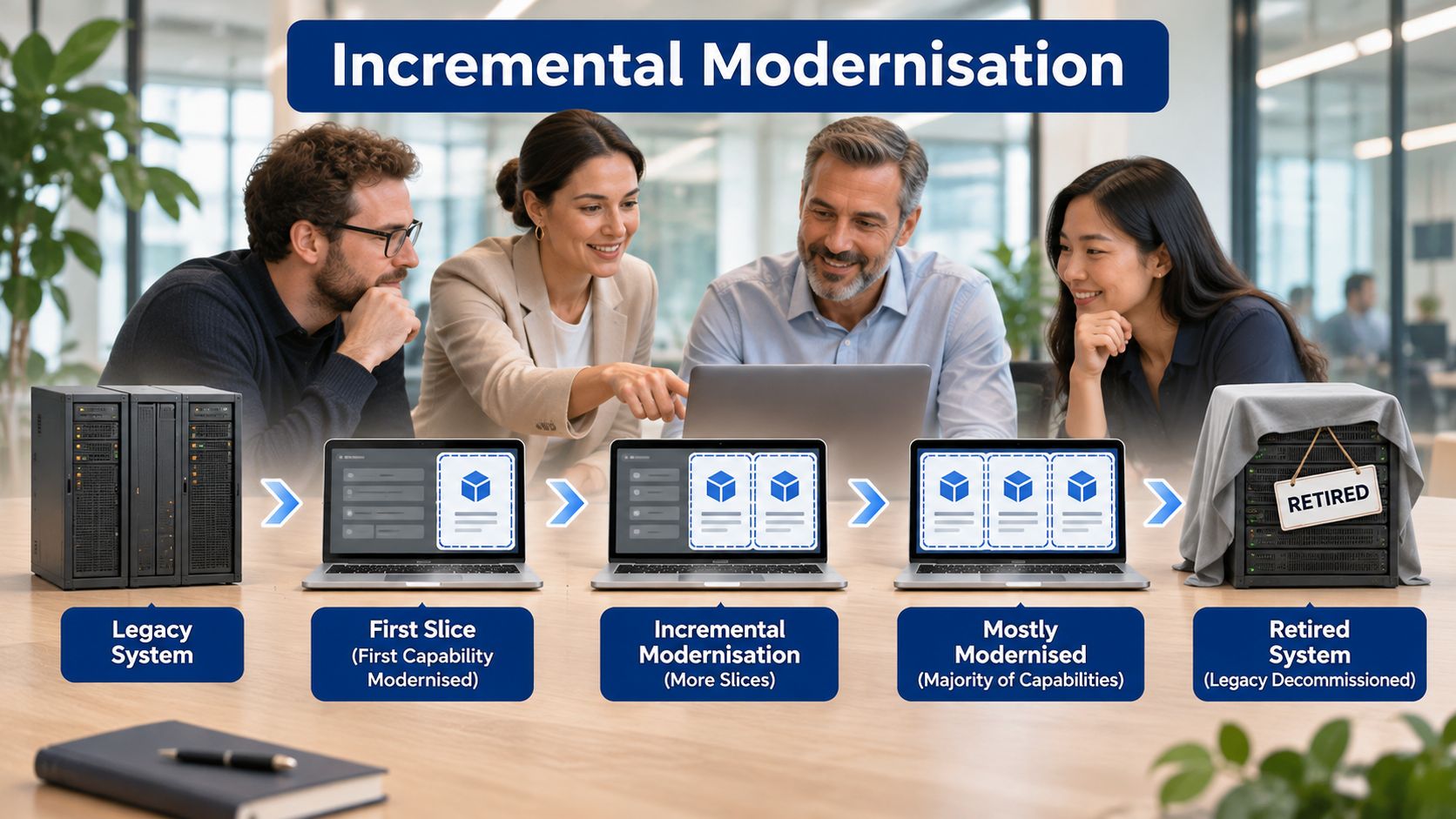
Once the new service is live, route a small slice of non-critical traffic through it while shadowing outputs against the legacy path. Compare every response, edge case, and ledger entry. Only expand traffic share as outputs match consistently, keeping the old path live as an instant fallback until full operational parity is confirmed.
Measuring every slice and avoiding cloud cost traps
The Government of Canada's Target Enterprise Architecture white paper advocates an incremental "evolve-and-transcend" model precisely because replacing entire legacy platforms one at a time becomes cost- and risk-prohibitive once debt accumulates. Notably, the same guidance warns that moving an unmodified legacy application directly to a cloud provider can cost more than self-hosting, making workload-specific total-cost analysis essential before any cloud migration.
To prove a slice improved anything, capture a six-point baseline before moving traffic and measure the exact same indicators afterwards:
- End-to-end latency: Track p95 response times for interactive requests so an extra API hop doesn't slowly degrade staff screens.
- Batch-window duration: Record how long overnight reconciliations or billing runs take before and after extracting a domain.
- Production failure rates: Count incidents, failed jobs, and rollback events across both old and new paths.
- Release frequency: Measure how often the team ships small updates to the extracted capability compared with the legacy monolith.
- Infrastructure cost per workload: Compare hosting, licensing, and data transfer bills directly against the previous baseline.
- Open security findings: Track critical and high vulnerabilities closed by moving off unsupported runtimes.
Never route high-volume production traffic onto a newly carved service without a tested one-click fallback to the legacy path. Fast reversal turns a potential outage into a routine debugging session.
Phasing delivery from stabilisation to retirement
A clear public-sector example shows how structured phasing keeps large software re-engineering efforts under control. According to Immigration, Refugees and Citizenship Canada's transition briefing, its Digital Platform Modernization programme allocated $58.7 million to a "Stabilize" phase from December 2020 to November 2021, followed by $72.8 million for a "Standardize" phase from December 2021 to March 2023 to cut technical debt, secure cloud connectivity, and establish reusable building blocks.
You don't need a federal budget to borrow that discipline. Organise your own programme into six gated stages:
- Set measurable business outcomes. Define targets leaders care about, such as cutting manual billing reconciliations or speeding up claims turnaround, rather than counting servers moved.
- Select a low-risk first slice. Choose a capability with clear boundaries and manageable blast radius, such as authentication, document intake, or read-only reporting.
- Stabilise security and reliability. Patch critical exposures, add logging and automated monitoring, and establish reliable backups before refactoring business logic.
- Standardise shared foundations. Build reusable identity, audit logging, and API data access layers so every later slice plugs into the same rails instead of inventing bespoke plumbing.
- Expand and redesign workflows. Migrate higher-value domains onto modern services while simplifying operational steps that only existed to work around old software limits.
- Retire proven legacy components. Switch off superseded screens, jobs, and tables once parallel metrics confirm zero remaining traffic, locking in lower maintenance spend.
Run a formal checkpoint review at the end of every phase to verify benefits against the original business outcomes before funding the next slice. Iterative rhythms work best here; the benefits of Agile software development show up directly when cross-functional teams validate thin slices in short feedback cycles rather than disappearing for a year.
When architecture itself is the bottleneck, targeted decomposition pays off. Cleffex helped an Indonesian financial technology company shift its architecture to microservices to support application scaling and integrated backend functionalities, and our full-cycle delivery covers strategy, UI/UX design, development, testing, deployment, and post-launch support alongside ongoing oversight of cloud applications and infrastructure. Whether you handle delivery in-house or with an external engineering partner, plan for continuous cloud and operational stewardship from day one rather than treating go-live as the end of the job.
Where Modernisation Stalls and How to Prevent It
Many organisations blame stalled programmes on tricky frameworks or slow coding. In practice, integration gaps and human workflows are what derail delivery. A Digital Journal report on Canadian public-sector IT resilience found that 57% of public-sector leaders say major improvements are needed in data compatibility, 66% are unsure their current strategies will deliver the interoperability they need, and 49% of Canadian organisations cite legacy systems as a major transformation barrier.
Those figures reflect what happens in regulated insurance, healthcare, and mid-sized commercial estates every day. You can write spotless new microservices, yet if two systems disagree on what defines an active customer or a closed claim, operations grind to a halt. Growing pressure to layer AI tools on top of operational data only sharpens the constraint, because analytics and automation fail immediately when underlying identifiers and definitions conflict.
Six moves that protect interoperability and compliance
Preventing stalls means treating data contracts, governance, and operating procedures as first-class engineering deliverables:
- Agree a canonical data model before moving records. Establish one authoritative definition and identifier for every core entity, such as customer, policy, patient, claim, or vehicle, so downstream reporting doesn't fracture during coexistence.
- Publish versioned API and event contracts with named owners. Require clear schemas, deprecation timelines, and an accountable technical owner for every interface so new services don't harden into another web of brittle point-to-point feeds.
- Reconcile outputs across a full monthly close. Run old and new paths side by side through at least one complete month-end or billing cycle, investigating every penny or record discrepancy before flipping the switch.
- Verify residency, audit trails, and retention rules early. Confirm where regulated records can legally sit and preserve immutable logging across every transitional hop, not just inside the final destination.
- Redesign the workflow alongside the code. Update standard operating procedures, adjust team handoffs, and retrain staff so employees aren't forced to run outdated manual steps inside brand-new screens.
- Bring operations staff into acceptance testing early. Front-line coordinators know every unwritten workaround and seasonal exception; testing with them surfaces edge cases while changes are still cheap.
Treating people and ownership as budget lines
Staff resistance to new software is rarely stubbornness. When employees rely on undocumented quirks in a legacy screen to keep orders flowing or pass compliance checks, replacing that behaviour without explanation puts their daily targets at risk.
Change reality: If you don't fund knowledge capture while your last legacy specialist is still on payroll, you'll pay triple to reverse-engineer those same rules from production outages later.
Assign one named business owner per capability to arbitrate rule changes and sign off on parity. Put training, documentation, and parallel-run support directly into the project budget as line items rather than hoping teams absorb change management in their spare time.
Costs, Benefits and Risks Worth Weighing
Honest budgeting starts with accepting that early modernisation estimates are almost always floors, not ceilings. In its 2023 review of federal IT, the Auditor General of Canada reported roughly $496 million in estimated funding needed merely to modernise applications classified as being in poor health, while explicitly noting that the figure was likely understated. The same audit recorded roughly $5.1 billion in planned costs across 22 major projects and about $44 billion across 2,100 active projects, illustrating why disciplined sequencing and benefits tracking protect budgets at any scale.
Separating upfront costs from multi-year value
Decision-makers often compare the first invoice of a modernisation slice against this year's hosting bill and balk. The only honest comparison is total cost of ownership over three to five years, weighing status-quo drag against staged investment.
Plan your budget across six distinct cost buckets:
- Discovery and architecture assessment: Time spent mapping dependencies, auditing data quality, and writing characterisation tests.
- Engineering and migration execution: Code refactoring, API wrapping, database replatforming, or selective package configuration.
- Parallel running overhead: Dual infrastructure, temporary sync pipelines, and extra reconciliation effort while old and new systems operate together.
- Training and process rollout: Updated documentation, staff coaching, and temporary productivity dips during transition.
- Vendor and specialist support: Extended security patches for ageing platforms or short-term domain contractors.
- Decommissioning and archival: Shutting down retired servers, cancelling redundant licences, and moving historical records into compliant cold storage.
On the return side, value rarely arrives as a single windfall. Instead, it compounds through lower ongoing maintenance spend, fewer emergency outages, faster release cycles for revenue-generating features, reduced breach exposure, and eliminating single-person dependency across core workflows.
Modernisation risks and early warnings
Even well-funded slices can drift off course if teams ignore early operational signals. Watch for these five failure modes and act the week a warning sign appears.
| Risk | Early warning sign | Mitigation |
|---|---|---|
| Hidden business rules lost | Staff say the system has always handled a case in an unwritten way | Document rules and test new outputs against the old system |
| Data meaning changes | Reports disagree after cutover | Agree a shared data model before moving data |
| Cloud cost overrun | Monthly bills exceed the migration estimate | Model total cost for each workload before migrating |
| Staff resistance | Manual workarounds reappear after go-live | Involve users in acceptance testing from the start |
| Compliance gap | Audit trail missing for migrated processes | Keep logging and controls in every phase |
Hidden business rules cause the nastiest surprises because nobody writes down a decade-old pricing exception or regulatory workaround until an automated test catches it or a customer complains. Treating shadow-mode output comparison as a required step catches those silent discrepancies before live users ever feel them.
Common Questions About Legacy Software Modernisation
Putting a phased roadmap into motion raises four recurring questions in leadership meetings. Each one has a direct, actionable answer.
Is rewriting a legacy system ever the right answer?
Yes, though it's rarely the first move for a large, load-bearing platform. A full rewrite makes sense when the source code is genuinely unreadable, the underlying platform can no longer be supported or secured, and the scope of embedded business rules is compact enough to rebuild and verify safely. Before approving a rewrite, write down every active business rule, regulatory calculation, and downstream integration you'll have to recreate; if that list runs into hundreds of undocumented edge cases, wrap and carve slices instead.
How long does incremental modernisation take and what proves it works?
For a complex core estate, expect multi-quarter horizons rather than a quick sprint. Spending roughly a year stabilising fragile dependencies and a little over a year standardising shared identity, logging, and data rails is a grounded yardstick for larger environments, while smaller mid-market pilots can deliver a first live slice within a single quarter. Judge momentum by operational metrics that move the needle, specifically release frequency, production failure rate, and cost per small change, rather than celebrating internal project milestones that haven't reduced legacy load.
What if nobody left on the team understands the old code?
Waiting until the final knowledgeable engineer leaves turns a manageable project into an emergency. Pair your remaining specialist immediately with two successors to shadow incident response, walk through critical modules, and record unwritten rules in plain language alongside automated characterisation tests. Keep the legacy system running in parallel with any replacement slice until outputs match across real workloads, using observed behaviour rather than memory as your specification.
Who should own the programme and how is the next slice funded?
Divide accountability across three roles so technical work stays tied to business reality. A named business owner is responsible for operational outcomes and signs off on business rules, a senior technical lead is responsible for target architecture and interface contracts, and a small cross-functional data group settles disputes over shared identifiers and reporting definitions. Fund the roadmap in stages by demonstrating measurable savings or risk reduction on the first slice, then use that verified evidence to release budget for the next highest-scoring system on your register.
Pick One System and Start a Pilot This Quarter
Think back to that ageing application everyone hesitates to touch on a Friday afternoon. You don't need a multi-year budget approval or a sweeping platform rewrite to start lowering its risk. Pull out your assessment score sheet and choose one candidate: not the biggest system in your building, but the highest-risk workload that has an engaged business owner and a clear, testable boundary.
Use the next 90 days to run a disciplined pilot. Spend the first few weeks completing the seven-point assessment and data quality check for that system so there are no hidden dependencies left unmapped. Next, isolate one discrete capability to wrap behind an API or refactor safely, and lock in your six before-and-after metrics alongside a firm checkpoint date to review parity and business impact.
A clean first pilot does two things at once: it removes an active operational bottleneck and builds hard proof to fund the next slice. Using a structured technology roadmap template makes it easier to tie that quarterly pilot to multi-quarter architecture goals without committing prematurely to later phases.
If you're evaluating external engineering partners to accelerate discovery or delivery, Cleffex works with medium-sized and large enterprises on custom software and digital transformation using Agile development approaches. You can review our custom software and modernisation capabilities for an overview of how we support staged delivery, or explore our desktop application development service if your legacy estate includes ageing desktop tools that need careful rework.
Before closing your notes today, write down three concrete items and share them with your leadership team: the single legacy system you'll pilot first, the least invasive first move you'll test on it, and the exact calendar date for your first checkpoint review.
If your organisation is weighing how to sequence a legacy portfolio without risking daily operations, Cleffex Digital ltd helps medium-sized and enterprise teams assess existing codebases, design incremental modernisation plans, and migrate workloads cleanly into maintainable cloud-native or modular architectures. Our Agile engineering teams handle everything from architectural discovery and API integration to desktop rework and post-launch cloud oversight so every phase delivers measurable operational stability. Explore how we work or start a conversation about your first pilot at Cleffex Digital ltd.