

You've probably lived some version of this already. A clinic, insurer, or health system has a working EHR, a telehealth platform, a billing stack, and a CRM that all do their jobs separately, yet the people who deliver care still spend too much time rekeying data, chasing status updates, and untangling mismatched records. That's the moment when choosing the right HealthTech integration partner stops being a procurement exercise and starts shaping clinical workflow, compliance posture, and day-to-day trust across the organisation.
The wrong partner can make a simple integration look successful in pilot, then leave you with brittle interfaces, weak governance, and frustrated teams once the deployment goes live. The right one treats interoperability as an operating discipline, not a sales claim. In Canada, that matters even more because digital health demand is growing alongside policy pressure for interoperability, and the market itself is large enough to sustain serious partner demand, with the Canadian health IT market valued at US$8.46 billion in 2024 and projected to reach US$25.65 billion by 2030 at a 20.4% CAGR.

Why Your Integration Partner Decision Shapes Everything
A mid-sized Canadian health system can buy solid software and still deliver a poor patient experience. One team lives in the EHR, another works in telehealth, finance relies on billing tools, and the care navigation group depends on CRM notes that never quite match the chart. When those systems do not move together, the burden falls on nurses, coordinators, and admins, not on the vendor demo deck.
The healthtech integration partner you choose sets the tone for everything after that. A partner who only talks about connectors and APIs often misses the harder questions, like who owns workflow decisions, how audit trails are handled, and whether the deployment helps or harms staff adoption. That is why integration has become a buying criterion, not a back-end feature, with the integration requirement showing up as a top decision factor in partner evaluations.
A practical rule applies here.
If the partner cannot describe how the workflow changes for front-line staff, the “integration” is probably only technical, not operational.
That distinction matters in healthcare because technical success can still fail in real use. A platform that exchanges data cleanly but adds clicks, breaks accountability, or confuses role-based access will not reduce friction for clinicians. It just hides the complexity until go-live.
For Canadian buyers, the stakes are even higher because the buying conversation now spans providers, payers, public health, and community-facing services. The Pan-Canadian Interoperability Roadmap makes interoperability a policy priority, so the partner has to work across organisational boundaries, not just inside one IT team. The market pressure is real too, as noted in a Canadian health IT overview from partnerfleet.io. Executive sponsors should frame the search around outcomes before vendor demos start, including workflow fit, governance, security, equity impact, and the reporting needed to defend revenue cycle KPIs and ROI.
The best integrations usually begin with a clear business case, a realistic map of system dependencies, and a partner who can show how they have handled similar complexity before. If those pieces are not visible early, the project is usually just moving risk around.
A strong partner also asks about the parts buyers often leave out: how changes are approved, who reconciles conflicting data definitions, and which staff groups will need extra support once the system is live. Those are the governance and workflow-fit issues that decide whether an integration holds up after deployment, especially in clinics serving diverse patient groups where equity gaps can appear in scheduling, access, and communication pathways.
Technical and Compliance Capabilities to Demand
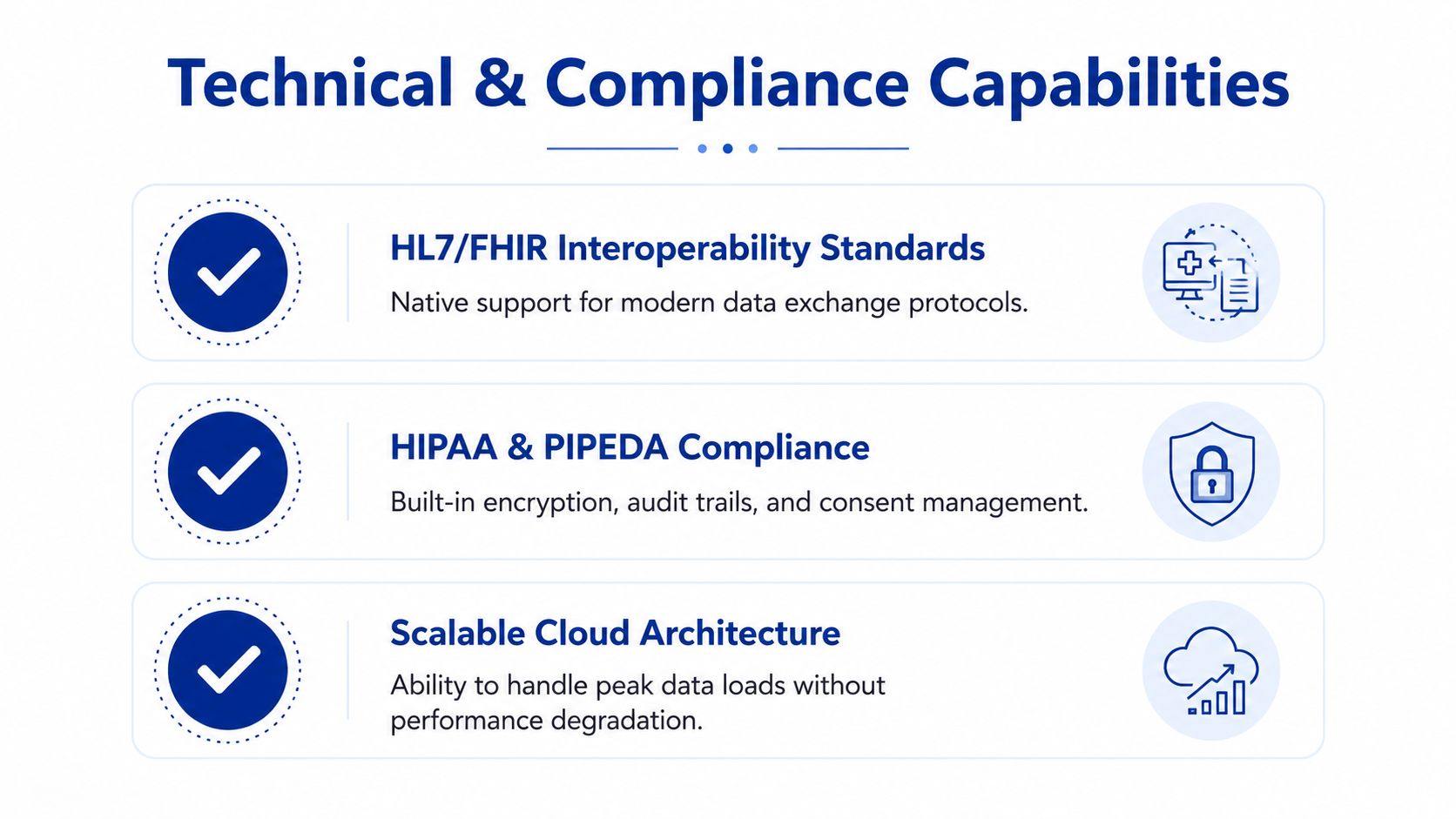
A credible healthcare software integration partner should be able to speak fluently about FHIR, HL7, single sign-on, and real-time syncing across CRM, EMR, and telehealth platforms (Zrafted checklist). If they hedge on those basics, the rest of the conversation usually falls apart later, often during security review or implementation.
Ask for proof, not promises
The fastest way to separate real capability from marketing language is to ask for evidence tied to actual workflows. Ask which standards they support natively, what data they sync in real time, and how they handle role-based permissions at the API layer. You're looking for clarity about access control, not just a polished user interface.
A useful due diligence question is whether they can explain how access is segmented for clinicians, admins, analysts, and external partners. One partner evaluation article flags a weak RBAC explanation for multi-role healthcare applications as a red flag and recommends named case studies with measurable outcomes, including reducing patient waitlists from 6 months to 30 days and scaling from 1 to 24 clinics across 8 states. You don't need to copy those figures into your own selection process, but you do need that level of specificity when assessing references.
Match compliance to the environment
For Canadian deployments, compliance conversations should include HIPAA-style controls, GDPR awareness, and healthcare-specific expectations around interoperability and scalability. That doesn't mean every partner needs to recite legal frameworks perfectly, but they should be able to show encryption practices, access control logic, disaster recovery thinking, and audit logging discipline.
If you're evaluating a healthcare integration services company for revenue-linked workflows, it also helps to connect integration planning to revenue cycle KPIs and ROI. That lens keeps the conversation grounded in operational value, not just technical completion.
A good screening sequence looks like this:
Standards first: Confirm FHIR, HL7, SSO, and the specific systems they've integrated.
Security second: Request documentation for encryption, access control, logging, and recovery.
Workflow third: Ask how data moves across clinical, administrative, and patient-facing steps.
Evidence fourth: Review references from organisations that resemble your own environment.
For teams that want a deeper framework for standards and auditability, the guide on FHIR integration services and compliance is a useful complement to your internal checklist.
Building Your Vendor Evaluation Checklist
A strong shortlist isn't built by comparing feature grids. It's built by testing whether a vendor can support your clinical, operational, and governance reality over time. The best healthcare IT consulting services teams bring proof, not just claims, and the proof usually sits in the details most buyers overlook.
Start with strategic fit
A vendor can be technically solid and still be a poor match if they don't understand your environment. That's why I look at whether they've worked in settings similar to mine, whether they can explain implementation trade-offs clearly, and whether their references sound like real operational partners rather than generic testimonials.
Use a simple scoring model when comparing vendors:
| Criterion | What to look for | Weight in a complex healthcare programme |
|---|---|---|
| Technical credibility | Standards, APIs, real-time data movement | High |
| Security and compliance | Audit trails, encryption, recovery, access controls | High |
| Workflow fit | Clinical and administrative usability | High |
| Reference quality | Similar scale, similar regulations, similar stakeholders | Medium |
| Governance maturity | Clear ownership, QBRs, escalation paths | High |
The weights matter more than the template. A safety-net clinic, insurer, and outpatient network won't all prioritise the same thing, but each one still needs governance, evidence, and implementation discipline.
Practical rule: if a vendor can't name the person who owns the partnership after signature, the contract will probably drift.
Ask the questions buyers forget
Many teams ask whether a vendor can integrate with the EHR. Fewer ask whether the vendor can explain API-layer permissions, how they handle version changes, or how they prevent workflow disruption when a downstream system changes. That's where technical maturity shows up.
The internal due diligence also benefits from a second pass on workflow continuity. A healthcare software integration partner should be able to explain what happens when a user switches roles, when a patient record is updated mid-journey, or when claims and clinical data don't match. If their answer is vague, that usually means the integration was designed around systems, not around people.
For a broader view of clinical data architecture and partner selection, the internal guide on choosing a clinical data integration partner is a practical companion to this checklist.
The result you want is a shortlist that reflects evidence, not enthusiasm. A vendor that can show operational depth in similar healthcare settings will usually save you far more time than one that dazzles in the demo and struggles in production.
Choosing the Right Partnership Model
Not every engagement should be structured the same way. Some organisations need a straightforward vendor relationship because the integration has to go live quickly. Others need a deeper arrangement because they want more control, more shared investment, or a long-term collaborative model.
The Chartis framework is useful here. If you need capabilities immediately, a vendor relationship may be the right fit. If you want an exclusive relationship, a more integrated partnership model makes more sense. If your organisation is willing to invest financial or operational resources, a tester/developer, joint venture, or licensing arrangement may be more appropriate.
| Model | Best When | Investment Level | Control & Governance |
|---|---|---|---|
| Vendor relationship | Speed matters most | Lower | More standardised, less shared decision-making |
| Integrated partnership | You need tighter alignment | Moderate | Shared processes and clearer governance |
| Tester/developer | You're validating a new solution | Moderate to high | Strong collaboration, more iteration |
| Joint venture | Both sides want deep strategic commitment | High | Shared risk, shared control |
| Licensing arrangement | You want to extend existing IP | Variable | Clear rights, defined operating boundaries |
The key trade-off is not complexity for its own sake. It's whether the model matches your timing, internal capacity, and appetite for shared governance. A hospital group with limited change bandwidth may prefer a vendor model even if a joint venture sounds more ambitious. An insurer piloting a new care-navigation workflow may need more collaboration because the partner has to adapt as the operating model changes.
In Canadian healthcare, this choice gets harder because insurers, clinics, and vendors often sit in different governance structures. That means decision rights need to be explicit. Who approves scope changes? Who owns the clinical sign-off? Who resolves a data-quality dispute? If those questions are left vague, the relationship usually becomes slower and more political over time.
A good partnership model doesn't just describe the legal structure. It shows who makes decisions, how often the parties review progress, and what happens when priorities collide. That's the part most organisations under-specify, and it's usually where the trouble begins.
Onboarding and Governance That Prevents Failure
Signing the contract is not the finish line. It's the point where weak governance starts to show itself. In digital health, partnership failures usually don't come from one dramatic mistake; they come from a series of small delays, assumptions, and unresolved ownership gaps.
The uncomfortable benchmark is that only 13% of digital health startup-incumbent partnerships were successful, with the leading failure drivers being a missing partnership strategy (55%), slow decision processes (46%), and mismatched expectations (43%). Those failure modes are exactly why onboarding needs structure before any build begins.
A governance sequence that actually holds up
Start by locking the joint outcomes and decision rights in writing before technical work starts. Then assign a named senior partnership owner on both sides, because distributed accountability rarely survives a live integration. After that, set quarterly business reviews against the original business case so the work keeps returning to the outcome, not just the backlog.
The best time to discover a workflow mismatch is before pilot launch, not after the first users start depending on it.
That sounds obvious, but many teams wait too long to validate workflow integration. The result is predictable: the pilot proves technical feasibility, then operations discovers that the process doesn't fit how staff work. In AI-enabled programmes, that problem becomes even more severe.
A separate benchmark shows that 80% of healthcare AI projects fail to scale beyond pilot, with data quality cited as a failure driver in 62% of implementations and workflow integration as a barrier in 72%. The practical response is to start with data normalisation and governance, then map the solution into existing EHR and claims workflows, then run a tightly scoped pilot with defined clinical and administrative KPIs, and only then expand.
For teams building their internal control framework, the article on healthcare data governance is a strong reference point. The core idea is simple: governance is not overhead; it's what keeps the integration usable after the novelty wears off.
A partner that helps you define ownership, escalation, and review cadence from day one is far more likely to survive real-world complexity. A partner that treats onboarding as a quick handoff usually becomes an integration support problem six months later.
Pricing Models and Measuring Real Outcomes
Pricing is where many healthcare teams get cautious for good reason. Fixed-fee, time-and-materials, outcome-based, and hybrid models all have a place, but the right choice depends on how clear your scope is and how much operational uncertainty you are carrying. A simple integration with stable inputs may suit a fixed-fee approach. A programme with changing clinical requirements often needs a hybrid structure so the partner is not forced to guess at scope while the work is still evolving.
The mistake is choosing the lowest quote and stopping there. A low initial price can hide weak discovery, thin governance, or extra costs that show up once the partner starts working through the complexity you already knew was there. In healthcare, the budget usually gets blown up by rework, not by innovation.
Measure what proves value
The metrics that matter most are usually operational, not decorative. Staff adoption, integration latency, churn reduction, workflow time savings, and scale readiness tell you whether the integration is helping people work better. API uptime still matters, but it will not tell you whether nurses trust the new process or whether billing staff still need to reconcile records by hand.
Canadian buyers should also keep the broader market in view. Health IT spending is growing, and partner capacity is not unlimited, so pricing should be judged against the cost of weak delivery, not just the sticker price. That does not justify overpaying. It does mean serious integration expertise has value, especially when the work touches clinical operations, claims, and reporting at the same time.
A contract should tie milestones to outcomes that can be observed in the workflow. If the integration is meant to reduce manual handoffs, measure handoff time. If it is meant to reduce churn among integrated users, measure retention signals in the cohort you deployed. If it is meant to support multi-site growth, define what scale readiness looks like before the rollout broadens.
A healthtech integration partner should also understand the business model around the system, not just the interfaces. Strong partners connect technical delivery to measurable outcomes, and the best ones can discuss those outcomes in terms that finance, operations, and clinical leadership can all use. That matters because integrations fail when the system works but the workflow, governance, or incentive structure does not.
The Overlooked Questions That Separate Good Partners From Great Ones
Most vendor lists ask the same safe questions. Can you integrate with our EHR? Do you support FHIR? What's your security posture? Those are necessary, but they're not sufficient. The harder question is whether the integration will work for underserved communities, low-trust environments, and teams that are already overloaded.
Research on underserved populations points to the digital divide being driven by socioeconomic barriers, uneven infrastructure investment, and digital tools that are not culturally or linguistically aligned. That means a technically successful deployment can still fail the people it was meant to help if it assumes stable access, high digital confidence, or a one-size-fits-all interaction model.
California-linked policy and expert commentary also highlight four practical collaboration areas: consumer awareness, telehealth, cross-state licensing and billing, and technology-enabled tools. CHCF's recent work adds concerns around generative AI in under-resourced clinics, especially the need for funding pathways, staff education, and transparency before deployment. Those themes translate well to Canadian buyers because the same operational questions apply when payer, provider, and community programmes all need to align.
A strong partner should be able to answer questions like these:
How will this integration reduce burden for staff in a safety-net setting?
What happens when patients have limited digital access or low trust in the system?
How do you document workflow impact across providers, payers, and community programmes?
What governance do you apply when AI features affect triage, documentation, or patient communication?
How do you support staff training so the tool is adopted rather than ignored?
If the answer is only about technical connectivity, the partner probably isn't ready for equity-sensitive healthcare deployment.
A useful final filter is whether the partner can describe access control at the API level, prove workflow fit, and explain how the deployment supports adoption in real practice, not just in a controlled pilot. Cleffex Digital Ltd works on healthcare software integration for North American healthtech companies, connecting medical devices, SaMD apps, digital platforms, and hospital EHRs, so it's one option to consider if you're comparing delivery partners with compliance and hospital connectivity needs.
The main takeaway is straightforward. The right healthtech integration partner doesn't just connect systems; they help you govern the relationship between systems, people, and outcomes. If you're comparing vendors now, visit Cleffex Digital Ltd and review its healthcare software integration services to see how a delivery partner can fit into your evaluation process.