

When we talk about using AI for ecommerce personalisation, we're really talking about using smart technology to understand customer data and craft shopping experiences that feel like they were made for just one person. It's so much more than just showing a few "you might also like" products. We're building dynamic, one-to-one journeys that adapt on the fly to browsing habits, purchase history, and even what a customer is doing on the site right now. The goal? More sales and customers who stick around.
Why Generic Shopping Experiences Are Failing

Let's be honest: the one-size-fits-all online store is a dinosaur. Today's shoppers are spoiled by the hyper-curated feeds on Netflix and Spotify, and they've come to expect that same level of personal attention from retailers. When they land on a website that throws a wall of irrelevant products and generic offers at them, it feels jarring and, frankly, a bit lazy.
This disconnect isn't just a small annoyance; it's a direct hit to your bottom line. Research consistently shows that 71% of consumers expect companies to deliver personalised interactions. A huge chunk of them will jump ship to a competitor if they don't get it. A generic experience basically tells a customer, "I don't know you, and I haven't tried to," which is the quickest way to lose their business.
Moving Beyond Basic Segmentation
Traditional marketing has always leaned on broad segments – grouping people by age, location, or gender. While it’s better than nothing, this approach still lumps thousands of very different people under one big, generic umbrella. AI-driven personalisation completely flips that model on its head by zooming in on the individual.
Instead of just knowing a customer is a 30-year-old woman from Toronto, an AI system knows she’s bought trail running shoes, recently browsed for hydration packs, and usually shops on Sunday mornings. This incredibly deep, granular insight is what allows you to create hyper-relevant interactions that feel genuinely helpful, not creepy.
This is where the magic really happens – shifting from clumsy segments to true one-to-one engagement. Putting a solid AI strategy in place isn't just a tech upgrade; it’s a fundamental change in how you build relationships with customers and drive sustainable growth.
The Data Fuelling Intelligent Interactions
At its heart, AI-driven personalisation is powered by data. Every single click, search query, abandoned cart, and viewed product is a breadcrumb that tells a story about what a shopper wants. AI is simply brilliant at sifting through these massive data streams in real-time to make a very educated guess about what that customer wants to see next.
The system pulls from all sorts of sources:
Behavioural Data: Which pages did they visit? How long did they stay? What did they add to their cart? Even where their mouse is hovering.
Transactional Data: What have they bought before? What’s their average order value? How often do they shop?
Contextual Data: Are they on a phone or a desktop? Where are they located? What time is it?
By pulling all this information together, AI can orchestrate a truly dynamic experience. For instance, it might reshuffle a category page to put a customer's favourite brands at the top or display a homepage banner that ties into their last search. If you want to dig deeper, our article on the role of AI in retail and ecommerce gets into more of these applications.
The real goal of AI personalisation isn't just to sell more stuff. It's to make the entire shopping journey feel effortless and intuitive. Your website transforms from a static catalogue into a responsive, personal shopping assistant.
Ultimately, ignoring this shift means you're choosing to fall behind. Customer expectations are only getting higher, and the brands that win will be the ones using AI to create meaningful, individual experiences. This guide will show you exactly how to make that happen.
Gathering the Right Data for Personalisation
Any solid ecommerce personalisation using AI starts with good data. It's that simple. Think of data as the fuel for your AI engine – the higher the quality, the better it performs. Without the right signals from your customers, even the most sophisticated algorithms are just guessing.
But this isn't about hoarding every scrap of information you can find. It’s about being strategic. The real goal is to collect the specific signals that tell you about a customer’s intent, what they like, and how they behave. You're trying to build a complete, 360-degree picture of each shopper to make their experience genuinely feel like it was made for them. For a business just getting started, working with a software development company can be a huge help in building this critical data infrastructure from the ground up.
Identifying Crucial Data Sources
Your ecommerce platform is a goldmine of data,; you just need to know where to dig. The trick is to pull information from various touchpoints and weave it all together into a single, coherent customer profile.
Here’s where I recommend you focus your efforts:
On-Site Behavioural Data: This is your bread and butter. We're talking about every click, every search term typed, every product page viewed, and every item added to a cart or wishlist. Tools like Google Tag Manager are perfect for capturing these micro-interactions and funnelling them into your data warehouse.
Transactional Data: This is the hard evidence of what people actually buy. Past orders, average order value (AOV), how often they purchase, and even what they return; it all tells a story. This historical data helps your AI understand a customer's real value and their affinity for certain brands, price points, or categories.
Customer Relationship Management (CRM) Data: Your CRM is where you'll find demographic details and explicit preferences. This includes things like age, location, or answers from customer satisfaction surveys. When you blend this with behavioural data, you get a much richer context for why they do what they do.
Off-Site Data: Don't forget about interactions that happen off your website. How people engage with your email campaigns (opens and clicks), their activity on your social channels, and even customer support tickets provide crucial pieces of the puzzle. It helps you map out the entire customer journey.
A classic mistake I see all the time is keeping these data sources in separate silos. The real magic happens when you can connect the dots – linking a customer's recent browsing history with their past purchases and a recent support query to accurately predict what they'll do next.
Data Types and Their Role in AI Personalisation
To put it all into perspective, here’s a breakdown of the key data types you'll be working with and how they directly influence the personalised experiences you can create.
| Data Type | Primary Source | Personalisation Application |
|---|---|---|
| Behavioural | Website/App Analytics | Recommending products based on recently viewed items or search history. |
| Transactional | Order Management System | Showing promotions for categories a customer frequently purchases from. |
| Demographic | CRM, Account Sign-up | Customising homepage banners based on the user's geographic location. |
| Contextual | User's Device, Geolocation | Displaying a "free shipping" offer when a user is near a physical store. |
| Explicit | Surveys, Wishlists, Reviews | Highlighting items from a user's wishlist that have just gone on sale. |
This table isn't exhaustive, of course, but it shows how different signals come together to power smarter, more relevant interactions across your site.
From Raw Data to Actionable Insights
Just collecting data isn't enough. Raw data is almost always messy, full of duplicates, or missing key information. Before you can feed it to a machine learning model, you have to clean it up. This is the unglamorous but absolutely essential work of data preparation.
This process really boils down to three main activities:
Cleaning: This is all about finding and fixing errors. You'll be removing duplicate entries, standardising formatting (e.g., changing "ON" to "Ontario"), and figuring out a consistent way to handle missing values.
Structuring: Machine learning models need data in a neat, predictable format. This means getting everything organised into tables where each row is a record and each column is that a specific attribute, all properly labelled.
Enriching: Sometimes, you can make your data even more powerful by adding information from external sources. For instance, you could layer in weather data to see how it correlates with sales of seasonal clothing or use third-party demographic data to better flesh out your customer segments.
This entire pipeline, from collection to preparation, is a foundational part of our AI-powered ecommerce services. It's the groundwork that makes everything else possible. And as we explored in our ecommerce solutions guide, respecting customer privacy is non-negotiable. You must be transparent about what data you collect and how you use it, ensuring you’re fully compliant with regulations like GDPR. Getting expert guidance from AI-powered ecommerce strategy & consulting services can help ensure your data practices are both effective and ethical.
Choosing the Right AI Models for Your Store
The term ‘AI model’ can sound intimidating, but it’s really just the engine running your personalisation strategy. Think of it as a set of rules and algorithms that learn from your data to make smart predictions, like figuring out what a specific shopper might buy next. Picking the right model is absolutely crucial for any serious ecommerce personalisation using AI.
Your choice really boils down to your goals, the data you have on hand, and your technical resources. You don't need a massively complex, custom-built model right out of the gate. In fact, some of the most powerful strategies start with well-established approaches that deliver value almost immediately.
Common AI Models for Ecommerce
Let's unpack a few of the most impactful AI models and see how they work in the real world, minus the jargon. Most online stores get their start with recommendation engines, which usually come in two main flavours.
Collaborative Filtering: This is the classic "customers who bought this also bought…" model you see everywhere. It works by sifting through the behaviour of thousands of users to spot patterns. For instance, if Customer A and Customer B both bought the same pair of running shoes, and Customer A also grabbed a specific brand of socks, the model will suggest those socks to Customer B. It’s effective because it leans on the wisdom of the crowd and doesn't need to know anything specific about the products themselves.
Content-Based Filtering: This model, on the other hand, is all about product attributes. If a customer is looking at a blue cotton t-shirt, it will recommend other t-shirts that are also blue or made of cotton. This is a great approach for stores with detailed product data, as it helps people discover items that are visually or thematically similar to what they’re already interested in.
Beyond these foundational models, you can get even more sophisticated. AI can be used to dynamically rank your search results, pushing the products a specific user is most likely to buy right to the top. You've also likely seen AI-driven dynamic pricing, which adjusts prices in real-time based on demand, what competitors are doing, and user behaviour – a strategy that's been a staple in the travel industry for years.
The Build vs. Buy Decision
One of the first big strategic questions you’ll run into is whether to build a custom AI model from scratch or use a third-party platform. Each path has clear pros and cons, and the right answer depends entirely on your business's scale and in-house expertise.
Building your own model gives you total control to create a solution perfectly matched to your unique business logic. The catch? This route is incredibly resource-intensive, demanding a significant investment in data scientists, engineers, and infrastructure. It's a long-term play best suited for large enterprises with very specific needs.
For the vast majority of small to medium-sized businesses, using a third-party AI platform is the smarter, more practical option. These solutions come with pre-built models that plug right into popular ecommerce platforms, letting you get started fast without needing a dedicated AI team.
Here’s a quick breakdown to help guide your decision:
| Factor | Building Custom AI | Using a Third-Party Platform |
|---|---|---|
| Control | Total control over the model and its logic. | Limited to the features and customisation the vendor offers. |
| Cost | High upfront and ongoing costs for talent and infrastructure. | Predictable, often affordable subscription-based fees. |
| Time to Market | Slow; can take many months or even years to develop and deploy. | Fast; implementation can often be done in just a few weeks. |
| Expertise | Requires an in-house team of data scientists and ML engineers. | Managed by the vendor; no specialised in-house talent needed. |
Making an Informed Choice
At the end of the day, the best AI model is the one that fits your strategic goals and can grow with you. For most stores, starting with a proven third-party solution for product recommendations is a fantastic entry point. To better understand future customer behaviour when selecting a model, check out this comprehensive guide to predictive analytics for ecommerce.
As your business matures and your data gets richer, you can always explore more complex models or even a hybrid approach. The key is to start with a clear objective: whether it’s boosting average order value or improving product discovery, and then pick the tool that gets you there most efficiently.
Integrating AI with Your Ecommerce Platform
Your AI model is just an engine sitting in the garage until you hook it up to your storefront. The integration phase is where all the data science and modelling work finally translates into real-world customer interactions. This is the moment your ecommerce personalisation using AI strategy comes to life, bridging the gap between intelligent algorithms and the clicks, carts, and conversions that drive your business.
The good news? You don't need to tear down your existing site and start over. Most modern personalisation engines are built to play nicely with major platforms like Shopify or Magento, and they can certainly connect with custom-built solutions too. The secret sauce that makes this all possible is the API (Application Programming Interface).
Think of an API as a dedicated translator and messenger between your AI and your website. It allows them to have a constant, real-time conversation. When a shopper lands on your homepage, your site pings the AI via the API: "User #123 just arrived." The AI instantly crunches the numbers on that user and sends back a command: "Great, show them the banner for those hiking boots they were looking at yesterday."
This whole back-and-forth happens in the blink of an eye, completely behind the scenes. For the customer, it just feels like the site gets them.
Where Should You Deploy AI Personalisation?
Once you've got the technical plumbing connected, the fun part begins: deciding where to sprinkle this AI magic. My advice is always to start small. You don't need to personalise every pixel of your site on day one. Pick a few high-impact areas, test rigorously, and expand from there.
Here are some of the most effective places to start:
Homepage Banners: Ditch the generic welcome mat. Greet returning customers with a banner that reflects their most recently viewed category or past purchases.
Product Recommendation Carousels: Move beyond the basic "You might also like." Power up carousels with titles like "Recommended For You" or "Inspired By Your Browsing" that are genuinely tailored to the individual.
Dynamic Search Results: Why show everyone the same search results? Reorder them to push products a specific user is statistically more likely to buy right to the top.
Personalised Email Campaigns: Connect your AI to your email service provider. You can then trigger automated emails with specific product suggestions based on abandoned carts or recent browsing sessions.
This is also a key decision point: do you build this capability in-house or partner with a third-party specialist? This flowchart can help you think through the trade-offs.
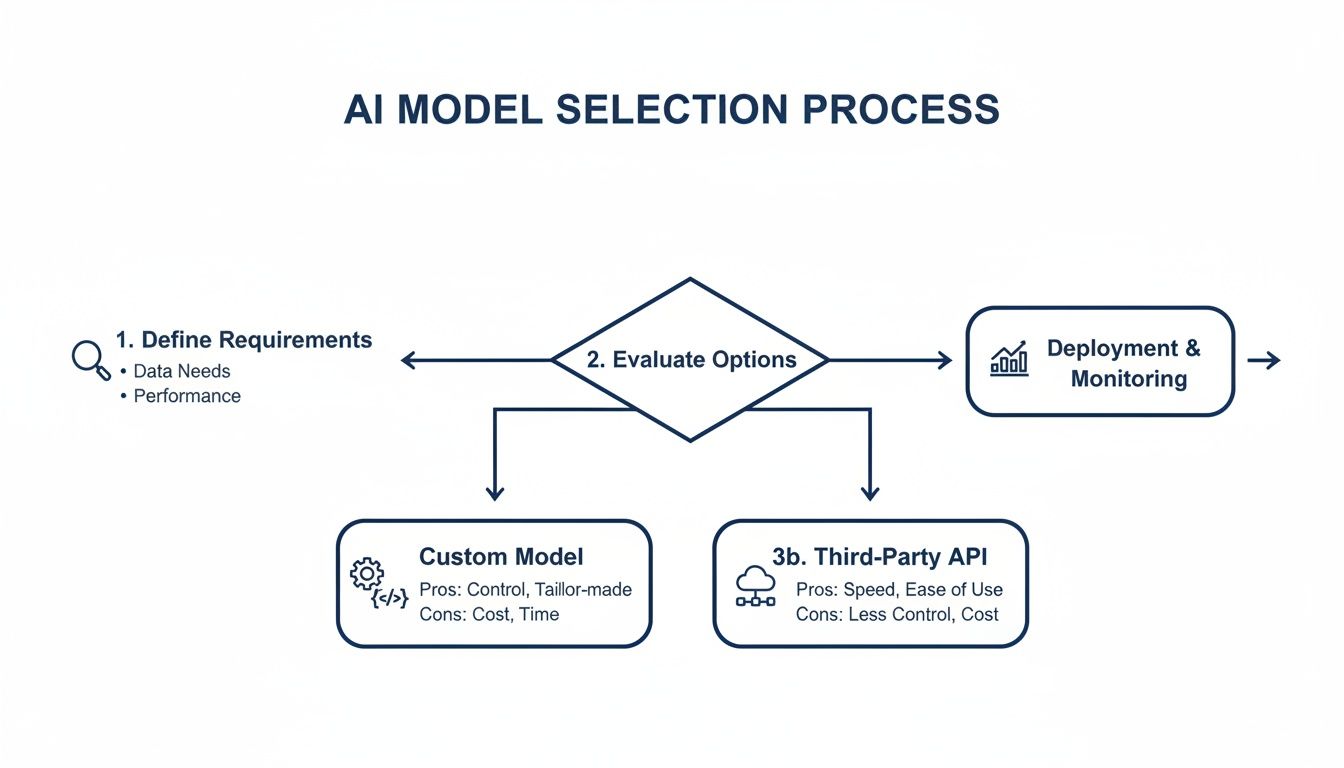
As the chart shows, the choice between a custom build and an off-the-shelf tool often boils down to a classic balancing act between your available resources, your need for control, and how quickly you want to get to market.
The Critical Need for Real-Time Data Sync
For personalisation to feel truly personal, it has to be immediate. If a customer clicks on a pair of running shoes, the recommendations on the very next page they visit should reflect that interest. This demands a rock-solid, instantaneous flow of data between your website and your AI model.
I've seen it happen time and again: the most common point of failure in an AI integration project is a lag in data synchronisation. Recommendations based on yesterday's browsing data feel stale and completely miss the mark for a customer on a new shopping mission.
Making sure your data syncs in real-time isn't a "nice-to-have"; it's an operational must. This usually means setting up event-based tracking, where every key user action: a page view, an add-to-cart, a search query, is fired off to the AI engine the moment it happens. This allows the model to constantly update its understanding of the user and refine its predictions on the fly. You can learn more by exploring our in-depth guide on the essentials of AI ecommerce development services.
Measuring Success and Optimising Your Strategy
Getting your AI model live is a huge step, but it’s really just the starting line. The most successful ecommerce personalisation using AI isn't a "set it and forget it" project. It’s a living system that needs constant attention: measuring, testing, and refining, to truly deliver. Without a clear way to see what’s working, you're flying blind, unable to prove the ROI or make smart calls to improve performance.
This is where the rubber meets the road. It’s time to move from theory to tangible results by setting up a solid framework for tracking key performance indicators (KPIs) and running experiments. This data-driven habit is what turns a one-time tech project into a powerful, ever-improving growth engine for your business.
Identifying the Metrics That Truly Matter
Forget vanity metrics like page views or social media likes. They might feel good, but they won’t tell you if your personalisation strategy is actually making you money. You need to zero in on KPIs that directly tie back to commercial impact. These are the numbers that connect your AI's brainpower to your bottom line.
Here are the core metrics you should have on your dashboard:
Conversion Rate Uplift: This is your most direct proof of success. It shows the percentage increase in conversions from a personalised group versus a control group seeing a generic experience. A positive uplift is the clearest sign your AI is doing its job.
Average Order Value (AOV): Good personalisation, especially with smart cross-sells and up-sells, should get customers to add more to their carts. If your AOV is climbing, it means your recommendations are not just relevant but also compelling.
Customer Lifetime Value (CLV): This is the long game. By creating better, more relevant shopping experiences, you build loyalty and encourage repeat business. Tracking CLV shows if your personalisation efforts are creating valuable, long-term customer relationships.
Add-to-Cart Rate: Think of this as an early warning signal for engagement. If more people are adding personalised recommendations to their carts, it’s a strong sign your AI is hitting the mark, even if they don't all check out immediately.
The real magic isn't just tracking these numbers; it's slicing them. Analyse performance across different customer segments, product categories, and even devices. This granular view will uncover powerful insights about where your strategy is making the biggest dent.
For a deeper look into the foundational metrics that drive success, check out our comprehensive guide to ecommerce analytics, metrics, and KPIs.
Embracing a Culture of Experimentation
Your first swing at personalisation will almost never be your best. Real improvement comes from a relentless commitment to A/B testing – pitting different ideas against each other to see what truly connects with your customers. It’s basically the scientific method for boosting revenue.
A strong testing programme means systematically experimenting with different variables. This goes way beyond changing button colours; it’s about testing fundamental strategic choices.
So, what does a solid testing plan look like?
Test Different AI Models: Don’t just marry the first algorithm you deploy. Run tests comparing a collaborative filtering model (“Customers also bought…”) against a content-based one (“More like this…”) to see which drives more engagement for a specific category.
Experiment with UX Placements: Where you put recommendations matters immensely. Test a recommendation carousel at the bottom of a product page against a pop-up that appears when an item is added to the cart. The context of the suggestion can completely change how effective it is.
Vary the Messaging: The headline on your recommendation widget can have a huge impact. Test “Recommended For You” against “Complete The Look” or “Frequently Bought Together” to find the phrase that triggers the right psychological response.
Interpreting Results and Refining Your Approach
Once an experiment is done, the real work begins. Reading the results correctly is what separates teams that win from those that just gather data. You have to look for statistical significance to be sure your results aren't just a fluke. Most A/B testing tools handle the maths, but a good rule of thumb is to aim for at least a 95% confidence level before you call a winner.
When you find a winning variation, roll it out to everyone and start planning your next test. This iterative cycle: hypothesise, test, analyse, implement, is the heart of optimisation. It's a complex but crucial process where expert guidance can make all the difference. A skilled software development company can help you build a robust testing infrastructure, while our AI-powered ecommerce strategy & consulting services can help you design and interpret the experiments that will yield the most valuable insights.
Wrapping It Up: Building a Customer-Centric Future
Hopefully, this guide has made one thing clear: successful ecommerce personalisation using AI isn't a one-and-done project. It’s a living, breathing part of your business – a continuous cycle of learning, testing, and refining.
It all starts with a solid data foundation and smart model selection, then moves into smooth integration and a relentless drive to optimise. For a broader look at how this all fits into modern marketing, the core principles of artificial intelligence personalisation are a great place to dig deeper.
The key is to start small. You don't need to rebuild your entire operation overnight. Focus on testing your key assumptions with rigour, proving the value with tangible results, and then scaling your efforts from there. Incremental improvements that deliver real, immediate value are the name of the game.
From Smart Strategy to Sustainable Growth
At its heart, this is about shifting your mindset. You're not just selling products; you're creating genuinely helpful and intuitive shopping experiences. That customer-centric approach is where real loyalty is built.
A well-thought-out strategy, often hammered out with an expert partner offering AI-powered ecommerce strategy & consulting services, creates the kind of brand affinity that fuels growth for years.
When you make each customer feel genuinely seen and understood, your website transforms from a simple product catalogue into a trusted shopping companion. In a crowded market, that relationship is your ultimate competitive advantage.
At the end of the day, the most sophisticated AI is only as effective as the strategy behind it. As we've covered, the technical side of things must always serve a single purpose: making the customer’s journey better. The future of ecommerce belongs to the brands that use technology not just to automate tasks, but to forge real human connections.
The insights and methods we've walked through are what our team at Cleffex lives and breathes. As a dedicated software development company, we're passionate about helping businesses like yours evolve. If you'd like to learn more about the people behind this guide, feel free to visit our about us page.
Frequently Asked Questions
When you start digging into AI-powered personalisation for ecommerce, a few questions always pop up. Let's tackle some of the most common ones I hear from clients, so you can move forward with confidence.
How Much Data Do I Really Need to Get Started?
This is the big one, and the answer is probably less than you think. You don't need a mountain of data to see results. A solid starting point is your existing product catalogue, some transaction history, and basic user browsing data. In fact, many platforms can start delivering value with just a few thousand user interactions.
The trick is to begin with what you've got and have a plan to grow. Focus on models like content-based filtering that don't need massive datasets, and make sure you have a solid data collection strategy in place. Your AI will get smarter as you feed it more quality information over time.
What's the Single Biggest Hurdle in Implementation?
It's almost never the AI itself. The real challenge, and where most projects get stuck, is dealing with data. Getting clean, consistent data from all your different sources to talk to each other in real-time is a major technical headache.
If your customer data is trapped in separate silos (your CRM, your email platform, your analytics), the AI can't build a complete picture. This leads to weak or irrelevant personalisation. Before you even think about models, you need a unified data strategy. Our AI-powered ecommerce services are built specifically to handle this messy but crucial groundwork.
How Do I Avoid Being "Creepy" with Personalisation?
This is a valid concern, and it’s where the art of personalisation comes in. The line between helpful and creepy is all about value and transparency. If your efforts feel genuinely useful, customers will welcome them.
Think of it this way: suggesting a compatible case for a phone someone just bought is helpful. Showing them an ad for something they briefly mentioned in a private message is intrusive. Be upfront in your privacy policy, offer relevant suggestions, and always give users control. The goal is to be a smart shopping assistant, not Big Brother.