

At its core, demand forecasting AI is about using intelligent systems to get an incredibly accurate read on what your customers are going to buy. It's a massive leap beyond simply looking at last year's sales numbers.
Think of it as the difference between guessing and knowing. This technology helps retailers make sure they have the right products, at the right time, in the right place, which is the holy grail of retail. The result? You dramatically cut down on both frustrating stockouts and the profit-killing problem of overstock.
The Future of Retail Forecasting Is Already Here
Imagine a retail world where you're never caught off guard. No more empty shelves during a surprise sales rush, and no more stockrooms overflowing with products nobody wants after a big promotion. That’s not a far-off dream; it's exactly what AI-powered demand forecasting delivers. It turns inventory management from a reactive guessing game into a smart, proactive strategy.
To really get it, let's look at how things used to be versus how they are now.
Traditional Forecasting vs AI-Powered Forecasting
This quick comparison shows the fundamental differences between outdated methods and modern AI-driven approaches to retail demand forecasting.
| Aspect | Traditional Forecasting (The Old Way) | AI-Powered Forecasting (The New Way) |
|---|---|---|
| Data Source | Relies almost exclusively on historical sales data. | Analyses a vast mix of real-time and historical data. |
| Adaptability | Slow to react to sudden market changes or new trends. | Dynamically adapts to new information in real-time. |
| Influencing Factors | Ignores external factors like weather, events, or social media. | Integrates dozens of variables (weather, trends, promotions, etc.). |
| Accuracy | Prone to significant errors, leading to overstock or stockouts. | Delivers a much higher degree of accuracy and granularity. |
| Process | Often a manual, time-consuming, and gut-feel-based process. | Fully automated, data-driven, and continuously learning. |
Essentially, the old way was like driving while only looking in the rear-view mirror. The new way is like having a real-time GPS with live traffic, weather, and road-closure updates; it sees what's ahead and helps you navigate it.
Beyond Historical Data
An AI system doesn’t just glance at last quarter's numbers. It's constantly sifting through a massive amount of information to build a rich, detailed picture of what's coming.
These inputs often include things you wouldn't normally connect:
Real-time sales data streaming from your POS systems
Social media trends and what people are talking about online
Local events, such as concerts or festivals, can drive foot traffic
Weather patterns, because a forecasted heatwave means more sunscreen and ice cream sales
Competitor pricing and what kind of promotions they're running
By seeing how all these different pieces connect, AI can predict customer demand with a precision that just wasn't possible before. The real value here is building a supply chain that can respond instantly, which boosts your bottom line and keeps customers happy. You can dive deeper into how this technology is changing the game in our article on the role of AI in retail and ecommerce.
This isn't just a theoretical concept; it's actively being put to work. A 2024 KPMG survey found that 68% of Canadian retail leaders are already using generative AI to predict product demand and manage inventory. With over 80% planning to roll it out this year, it's clear that AI forecasting is no longer a "nice-to-have"; it's becoming essential to compete and grow.
How AI Actually Predicts Retail Demand
To really get your head around how AI is changing retail forecasting, you have to appreciate the sheer amount and variety of information it's crunching. Old-school methods mostly just looked at last year's sales figures. AI, on the other hand, is like a team of expert analysts working 24/7, sifting through mountains of data to find patterns no human ever could. It’s this process that turns raw information into shockingly accurate predictions about what your customers will want next.
The real magic is in how AI connects the dots between things that seem completely unrelated. Imagine correlating a local weather forecast with an upcoming music festival and sales data from similar events last year. The result? It predicts a sudden rush on portable chargers and rain ponchos at a specific store. We're moving way beyond simple historical averages and into a deep, contextual understanding of the market.
Before diving deeper, it helps to understand the foundational inventory forecasting methods that these AI systems build upon. Think of them as the basic principles that AI supercharges with its advanced analytical power.
The Data That Fuels the Engine
An AI forecasting model is only as smart as the data you feed it. The more diverse and high-quality the data sources, the sharper the predictions will be. A truly effective system pulls information from many different streams to build a complete, 360-degree view.
Here are the essential data inputs:
Point-of-Sale (POS) Data: This is ground zero. It gives you a real-time feed of what's selling, where it's selling, and when.
Inventory and Supply Chain Data: The AI needs to know what you have on hand, how long it takes to get more from suppliers, and any hiccups along the way to make realistic forecasts.
External Factors: This is where AI really pulls ahead of the pack. It can analyse competitor pricing, chatter on social media, economic trends, public holidays, and even local traffic reports.
Promotional Calendars: Feeding the AI your schedule for upcoming sales, marketing campaigns, and loyalty offers helps it anticipate the resulting peaks and valleys in demand.
This image shows how AI acts as a central brain, turning all these data points into better profits, happier customers, and a smoother operation.
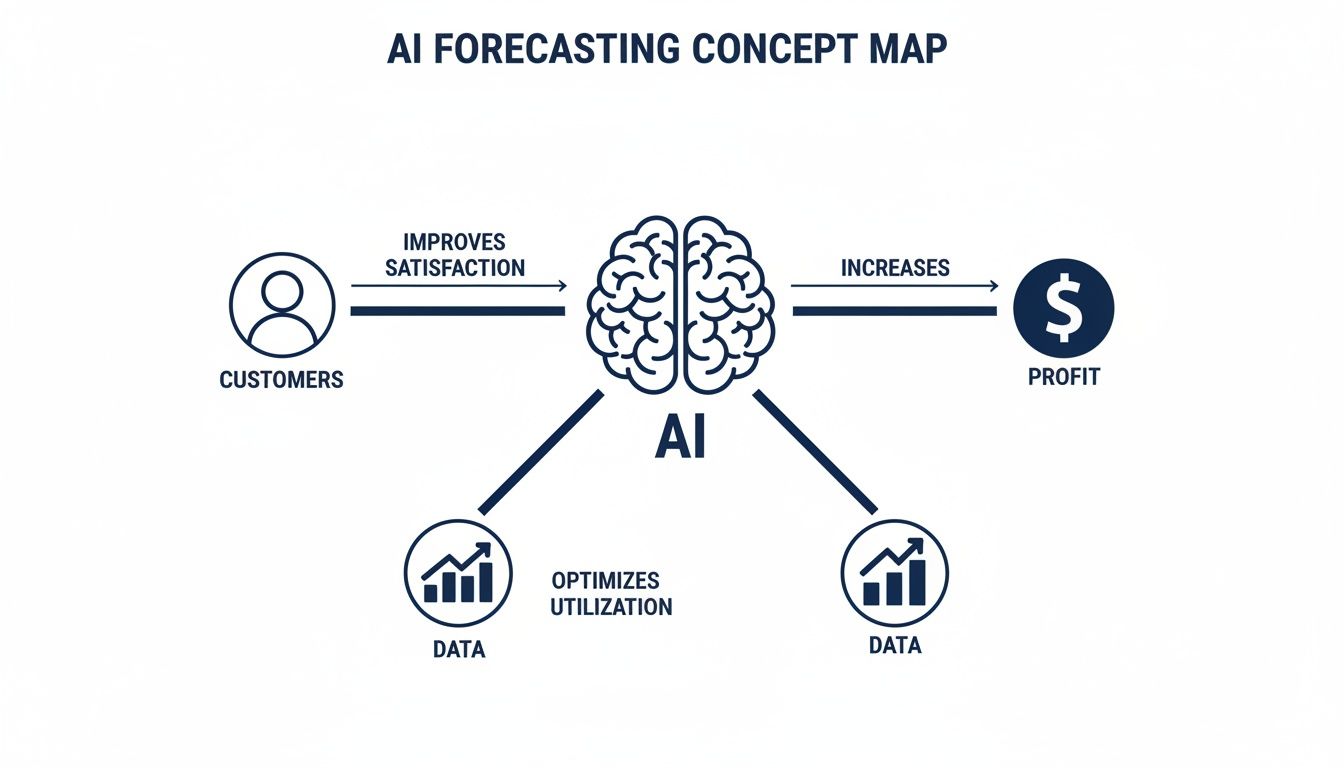
The key takeaway is that demand forecasting AI for the retail industry isn't just a piece of tech; it's a strategic hub connecting data directly to real-world business results.
Unpacking the AI Models
At the core of AI forecasting are some seriously sophisticated algorithms. The maths behind them can get intense, but the way they work is actually quite intuitive. Different models work together, each with its own speciality, to create a powerful and dynamic predictive engine.
An AI-driven approach lets businesses stop looking in the rear-view mirror and start planning for what's ahead. Forecasting becomes a live, always-on process that reflects what’s happening right now, not just what happened last quarter.
Let's look at the most common types of algorithms used in retail today.
Time-Series Analysis
Think of time-series analysis like finding the beat in a song. This model looks for patterns in your sales data over time. It spots seasonality (more winter coats sold in the autumn), trends (the slow-but-steady rise of a new snack brand), and cycles (the weekly Friday night rush). It's fantastic for establishing a solid baseline forecast based on what you already know has happened.
Machine Learning Models
Machine learning (ML) models are like a savvy store manager who learns from every single sale. Algorithms with names like Random Forest or Gradient Boosting can figure out complex relationships between all sorts of variables. For instance, an ML model might learn that a 20% discount on a certain brand of coffee, combined with a rainy weekend, consistently leads to a 45% jump in sales.
It constantly refines its own understanding, getting smarter and more accurate with every new piece of data it sees.
Deep Learning and Neural Networks
If machine learning is the savvy manager, deep learning is the master detective. These algorithms use neural networks, which are loosely modelled on the human brain, to uncover incredibly subtle connections buried in massive datasets. A deep learning model could, for example, analyse images on social media and text from online reviews to predict the next "viral" fashion trend before it even hits the mainstream.
This is what allows retailers to anticipate demand for brand-new products or react to sudden shifts in consumer taste with incredible speed. By layering these different models, you create a forecasting system that is both reliably consistent and incredibly agile, perfect for the fast-moving world of retail.
The Real-World Payoff of AI Forecasting
Let's move beyond the theory and talk about what really matters: results. The true value of demand forecasting AI for the retail industry shows up on the bottom line. Bringing this technology into your business isn't just a tech upgrade; it's a strategic move that delivers a clear return on investment, with benefits felt everywhere from the stockroom to the annual report.
The first and most powerful impact is on your inventory. Every retailer knows that holding too much stock is a cash drain. It ties up capital in products that aren't moving and racks up carrying costs for storage, insurance, and the risk of obsolescence. This is a constant headache, especially for fast-fashion brands and grocers dealing with perishables.
Smarter Inventory, Less Waste
AI forecasting arms retailers with the precision to stock exactly what's needed, when it's needed. This isn't just about small adjustments; it's a fundamental shift away from guesswork. In Canada's competitive retail scene, AI has been a game-changer. Merchants using AI-powered tools have managed to slash overstock by an impressive 20% to 35%, a massive reduction in waste that directly pads their profit margins.
This kind of optimisation frees up working capital that can be put to better use, whether that’s boosting your marketing budget or renovating a storefront. For a closer look at how this works, we have a detailed guide on AI inventory management for ecommerce.
A More Efficient Supply Chain
Spot-on forecasts create a ripple effect of efficiency all the way up the supply chain. When you have a clear picture of future demand, you can fine-tune everything from warehouse staffing and transportation logistics to your orders with suppliers. This proactive approach helps you sidestep expensive problems like rush shipments or production delays.
By predicting demand with high accuracy, retailers transform their supply chain from a reactive cost centre into a proactive, strategic asset. This predictive capability is the foundation for a more resilient and agile operation.
Ultimately, smarter forecasting leads to smarter fulfilment. It’s a key piece of the puzzle for creating an efficient ecommerce fulfilment centre design that prioritises speed and accuracy, cutting both lead times and operational costs.
Happier, More Loyal Customers
There's almost nothing more frustrating for a customer than finding an empty shelf where their go-to product should be. Stockouts aren't just lost sales in the moment; they chip away at customer loyalty. A shopper who walks away disappointed might just keep walking, straight to a competitor.
AI forecasting helps put an end to that. By ensuring your most popular items are consistently available, you build trust and create a reliable shopping experience. That's how you earn repeat business and get people talking for all the right reasons.
Fewer Stockouts: Keeping in-demand products on the shelf is the simplest way to keep customers happy.
Better Availability: AI helps you stay ahead, ensuring even items with tricky demand patterns are there when shoppers want them.
Stronger Loyalty: Reliability is the bedrock of customer retention.
Smart Pricing and Maximised Margins
Finally, AI forecasting opens the door to smarter pricing strategies. When you understand demand fluctuations in detail, you can adjust prices dynamically to get the most out of every sale.
For instance, an AI system can spot a coming surge in demand, allowing you to nudge prices up slightly without losing customers. It can also identify slow-moving products that could benefit from a well-timed promotion. This lets you move beyond a one-price-fits-all model and adapt to the market in real time, capturing every last pound of potential profit.
Your Roadmap to Implementing AI Forecasting
Bringing AI-powered demand forecasting into your retail operation isn’t an overnight flip of a switch. Think of it as a carefully planned journey, not a single, giant leap. A clear, methodical plan that lines up the technology with what you want to achieve is essential. By breaking the process down into manageable stages, you can ensure a smoother transition, measure what’s working, and build a solid foundation for using it across the entire company. This roadmap is your blueprint for getting from an idea to a system that genuinely drives value.
The very first step is strategic. Before you even think about algorithms or data, you have to define what success actually looks like for your business. Are you trying to cut down on waste in your fresh produce aisle? Maybe you want to eliminate stockouts on your best-selling clothing items, or perhaps get a better handle on your supply chain for those big seasonal promotions. Pinpointing clear, measurable goals from the start is absolutely crucial.
Begin with a Pilot Project
Starting small is often the smartest way to win big. Instead of trying to roll out a massive, company-wide system all at once, kick things off with a focused pilot project. This lets you prove the concept works, sort out any kinks, and show a clear return on investment in a controlled setting. The goal here is to create a success story that gets everyone else excited and on board for a wider rollout.
When picking where to start your pilot, choose a specific product category or even just a handful of stores. Good candidates are often areas where you know you have challenges, like items with super volatile demand or a category that’s always running out of stock. This makes it much easier to see and measure the real impact of your demand forecasting AI for the retail industry.
For instance, a grocery chain might pilot the AI on perishable dairy products to get a handle on spoilage. A fashion retailer could test it on a single, fast-moving clothing line to get ahead of trends. Keeping the scope tight makes the project manageable and the results impossible to ignore.
Define Your Key Performance Indicators
How do you know if your pilot, and eventually, the full-scale system, is actually working? You need to track the right metrics. These Key Performance Indicators (KPIs) give you the hard numbers to show the AI's impact.
The table below breaks down the essential metrics you'll want to keep an eye on. They provide the tangible proof needed to justify expanding the project and show everyone, from the stockroom to the boardroom, just how much value the AI is adding.
Key Performance Indicators (KPIs) for AI Forecasting
| Metric | What It Measures | Why It Matters for Retail |
|---|---|---|
| Forecast Accuracy | The difference between predicted and actual sales. | This is the core measure of how well the AI is doing. Higher accuracy directly leads to smarter inventory decisions. |
| Stockout Rate | The percentage of time a specific product is unavailable. | Directly impacts customer happiness and lost sales. It's a key metric for proving ROI to leadership. |
| Inventory Carrying Costs | The cost of holding unsold stock (storage, insurance, etc.). | A lower number here means the AI is successfully cutting down on overstock and freeing up cash. |
| Waste/Spoilage Reduction | The amount of perishable or obsolete stock that gets thrown out. | Crucial for grocers and fast-fashion retailers, this shows a direct, positive impact on your bottom line. |
By tracking these KPIs, you're not just guessing; you're gathering the concrete evidence needed to make informed decisions about the future of your AI forecasting strategy.
Seamless Integration and Scaling Up
For this AI to truly deliver, it can’t live on an island. It has to be woven into the fabric of your existing business systems. That means creating a smooth, two-way street for information to flow between the AI forecaster and your core operational platforms.
Enterprise Resource Planning (ERP): Your ERP is the heart of your supply chain and financial data. Connecting the AI to it ensures its forecasts are based on what's actually happening on the ground.
Point of Sale (POS) Systems: Hooking into your POS gives the AI a direct line to real-time sales data. This is the fuel that makes its learning models more dynamic and its predictions sharper over time.
Once your pilot is a proven success and the integrations are solid, it's time to scale. This process should be just as thoughtful and deliberate as the pilot was. You can start expanding the solution by rolling it out to more product categories, more stores, or even across different countries.
The scaling phase is all about taking the wins from your pilot and replicating them across the entire organisation. A well-planned, phased rollout ensures that every new department or region gets the training and support they need, which is key to getting everyone to use it and see its long-term value.
Real-World Victories: Retailers Winning with AI
Theory is one thing, but the real test of any technology is what it does on the shop floor. For retailers, switching to AI for demand forecasting isn't an academic exercise; it's about seeing tangible, measurable improvements in the business. Across the industry, we're seeing companies of all sizes move from educated guesses to sharp, data-driven predictions.
These stories aren't just about big grocery chains or nimble online boutiques; they're proof of a fundamental shift. By getting a better handle on what customers will want, these businesses are optimising stock, cutting waste, and building more resilient, profitable operations. Let’s look at a few real-world examples of how demand forecasting AI for the retail industry is changing the game.
The Grocery Chain Tackling Perishable Waste
The Problem: A major grocery chain was constantly battling waste in its fresh produce and dairy aisles. Their old forecasting methods just couldn't keep up with the daily swings in demand. The result? Overstocked shelves, spoiled food, and profits getting tossed in the bin.
The Fix: They brought in an AI-powered demand forecasting system. This wasn't a one-size-fits-all solution; the platform dug into real-time sales data, local weather forecasts, seasonal patterns, and even upcoming promotions to predict demand for specific items, right down to the individual store level.
The Payoff: The change was almost immediate. Within six months, the grocer cut its perishable waste by a massive 30%. This did more than just pad their bottom line; it boosted their reputation as a sustainable business and ensured customers got fresher products.
The Fashion Retailer Staying Ahead of Trends
The Problem: In the world of fast fashion, trends can change in a heartbeat. One retailer was struggling to keep pace. Their manual forecasting meant they were often late to the party, ordering too much of a style that was already fading or not enough of the next big thing. This led to a painful cycle of missed sales and deep, profit-slashing markdowns.
The Fix: They plugged in an AI model that acted like a trend-spotter, monitoring social media chatter, Google searches, and influencer posts. It gave them the ability to see which styles were about to take off before they went mainstream, a huge advantage in a cut-throat market.
By predicting which styles would capture the public's imagination, the retailer could adjust its production and inventory orders proactively. This transformed their supply chain from a reactive system into a trend-setting engine.
The Payoff: The retailer managed a 25% drop in stockouts on its best-selling items and drastically cut down on end-of-season sales. Being the first to have the "it" item strengthened their brand and kept customers coming back. This is especially relevant in the Canadian market, where the AI revolution in retail is exploding. The market is projected to soar from USD 254.54 million in 2024 to an incredible $2,769.23 million by 2032, driven by ecommerce growth and advances in machine learning. It's no surprise that 68% of retailers are focusing on demand prediction to avoid empty shelves. You can learn more about this explosive growth from Credence Research.
The Online Store Nailing Seasonal Promotions
The Problem: For an ecommerce store built around seasonal goods, big events like Black Friday and Christmas were a high-stakes gamble. If they misjudged demand, they'd either sell out of their hottest deals in hours, leaving customers frustrated, or end up with a warehouse of festive-themed stock in January.
The Fix: The business turned to an AI platform designed specifically to forecast demand during these intense promotional spikes. The system chewed through historical sales data from past promotions, kept an eye on competitor pricing, and analysed the performance of their current marketing campaigns to create incredibly detailed forecasts.
The Payoff: The results were stunning. For their most recent holiday season, the online store hit a 95% forecast accuracy. This precision meant they had just the right amount of stock, which drove a 20% increase in profit margins during the sale and left them with almost no unwanted inventory afterwards.
Choosing Your Path: Vendor vs. Custom Build
Alright, you're convinced of the power of AI forecasting. Now comes the big strategic question: do you buy a solution off the shelf from a vendor, or do you roll up your sleeves and build your own? This isn't just a technical choice; it's a decision that will define your budget, timeline, and ultimately, your long-term competitive standing in the demand forecasting AI for the retail industry.
Think of it this way. A vendor solution is like leasing a fully-equipped, top-of-the-line commercial kitchen. It’s ready to go on day one with all the professional-grade tools and a support team on standby. A custom build, on the other hand, is like designing and constructing that kitchen yourself. It takes more time and expertise, but every single appliance and prep counter is placed exactly where you need it for your unique menu.
The Case for Vendor Solutions
For many retailers, the most important factor is speed. You need to see a return on your investment, and you need it fast. Off-the-shelf AI forecasting platforms are built for exactly that kind of rapid deployment. They often come with pre-built integrations for common retail systems and have been battle-tested across countless clients, giving you a proven and reliable path to better forecasting.
Choosing a vendor usually gets you:
Faster Implementation: You can have a powerful system running in a matter of weeks or months, not years.
Lower Upfront Cost: The initial outlay is a fraction of what it would cost to hire and stand up an in-house data science team from scratch.
Built-in Expertise: You're not just buying software; you're getting instant access to specialised knowledge and ongoing support without having to find and hire those people yourself.
This is a fantastic route for small to medium-sized businesses or any retailer who needs a solid, industry-standard solution without the headache of a massive internal project. It’s a way to get a serious competitive upgrade, quickly and efficiently.
The Power of a Custom Build
On the flip side, building your own system gives you something a vendor can't: complete control and a truly unique competitive weapon. This path means creating a forecasting model that is meticulously crafted for your specific business problems, your unique data streams, and your precise operational workflows. It’s a bigger lift, no doubt about it, requiring more time, talent, and capital, but the payoff can be immense.
A custom-built AI model becomes a proprietary asset. It’s a strategic tool that your competitors cannot buy or replicate, designed to solve your unique market challenges with unmatched precision.
This approach makes the most sense for larger enterprises or retailers with very particular needs that off-the-shelf products just can't handle. For example, if you operate in a niche market with strange demand patterns or rely on unconventional data, a bespoke model might be the only way to get the accuracy you need. A custom solution isn't just software; it's a long-term investment in building a core business advantage. If this path intrigues you, getting a broader view of the available AI solutions for ecommerce and retail is a great next step.
Ultimately, there's no single right answer. The best choice hinges on your strategic goals, internal capabilities, and market position. A vendor gets you a powerful tool, fast. A custom build gives you a deeply integrated, proprietary asset for the long haul. Take a hard look at your company's readiness, budget, and vision to decide which path will steer your retail business towards a smarter, more profitable future.
Your Questions, Answered
Jumping into the world of AI forecasting naturally brings up some practical questions. Let's tackle some of the most common ones we hear from retailers who are thinking about making the switch.
How Much Data Do I Need to Get Started?
You probably have enough to begin right now. A good starting point is at least one to two years of historical sales data from your point-of-sale (POS) system, paired with your current inventory and supply chain records.
While adding more layers of data, like promotional schedules, competitor pricing, or even local weather patterns, will certainly sharpen the forecasts, you don't need a perfect, all-encompassing dataset to launch a pilot. The most important thing is to start with your core data in a clean, organised state. The system gets smarter as it learns from more information over time.
A common myth is that you need a massive, flawless dataset from the get-go. The truth is, a solid AI platform can start adding value with the sales and inventory history you already have, improving as it goes.
Will AI Replace My Planning Team?
Not a chance. It will make them better. Think of demand forecasting AI for the retail industry as a super-powered analyst for your team, not a replacement. AI takes on the tedious, heavy-lifting of crunching numbers and spotting patterns.
This frees up your human experts to focus on what they do best: high-level strategy, managing unexpected events, and applying their invaluable market intuition to situations that data alone can't explain. The goal is to enhance human expertise, not replace it.
Is AI Forecasting Only for Big-Box Retailers?
This kind of technology is more within reach than ever before. Large chains were definitely the first to jump on board, but today, many providers offer scalable, cloud-based solutions designed for small and medium-sized businesses.
These platforms often run on a subscription basis, which means you can get started without a huge upfront cost for servers or hiring a team of data scientists.
How Long Until I See Real Results?
You can start seeing a tangible return on your investment much faster than you might think. A smart approach is to launch a pilot project focused on a specific challenge, like reducing spoilage in your fresh produce section or optimising stock for a key product line.
With a focused pilot, it's common to see measurable improvements within the first three to six months. Those early wins build a powerful business case for expanding the system across your entire operation.
Ready to stop guessing and start building a strategy driven by data? The team at Cleffex Digital Ltd specialises in building software that solves real-world business problems. We can help you build or integrate the perfect AI forecasting tool for your retail business. Find out how we can help.