

Let's face it, every ecommerce business owner knows the inventory tightrope walk all too well. One side of the rope is a warehouse full of products gathering dust, tying up cash you desperately need elsewhere. On the other side? Your best-sellers are perpetually out of stock, sending frustrated customers straight to your competitors.
For years, the go-to solution has been a shaky combination of complex spreadsheets and gut instinct. It’s a reactive game, at best. A spreadsheet tells you what you have now, but it can’t tell you what you’ll need next week, let alone next month. This leaves you wide open to sudden demand spikes, unexpected supply chain hiccups, or a promotional campaign that works a little too well.
Moving Beyond Spreadsheets and Guesswork
This constant firefighting is precisely what AI-powered inventory management is designed to solve. Think of it like swapping an old paper map for a live GPS. The map shows you where you are, but the GPS predicts traffic jams, reroutes you in real-time, and tells you exactly when you'll arrive. A spreadsheet just records history; an AI system actively learns from it.
This isn't just a simple tool upgrade; it's a fundamental shift in how you run your business. AI moves you from a reactive "what just happened?" mindset to a predictive "what's coming next?" approach, giving you a serious competitive edge.
By digging into your sales history, seasonal trends, upcoming promotions, and even external factors like competitor pricing, AI algorithms can forecast future demand with a level of accuracy that's simply not humanly possible. This proactive insight helps you keep your stock levels perfectly tuned to what your customers actually want to buy. Before jumping straight into advanced AI, many businesses find it helpful to first get a handle on traditional dedicated inventory management software to build a solid foundation.
Why Intelligent Automation Matters
The real magic happens when this forecasting ability is combined with automation. It’s not just about knowing what to order; it’s about creating a smarter, more resilient supply chain.
Automated Reordering: The system can automatically trigger purchase orders the moment stock drops to a pre-set level. No more last-minute scrambles or missed opportunities because someone forgot to place an order.
Reduced Carrying Costs: By getting rid of excess stock, you slash the money spent on warehousing, insurance, and products that eventually become obsolete. Industry reports show AI can help cut inventory levels by a massive 20-30%.
Happier Customers: Nothing builds brand loyalty like always having the products people want. Keeping your popular items consistently available encourages repeat business and turns casual shoppers into loyal fans.
In the end, bringing AI into your inventory management is about swapping uncertainty for intelligence. It gives your ecommerce business the agility to make smarter, data-backed decisions that directly boost your bottom line and set you up for long-term growth.
How AI Actually Manages Your Stock
Let's pull back the curtain on how AI inventory management really works for an e-commerce business. It's easy to get lost in the tech talk, but the concept is surprisingly straightforward. Think of an AI system as the most brilliant, data-obsessed analyst you could ever hire – one that never sleeps. It digs into your business data and learns constantly, making smarter and faster decisions than any person with a spreadsheet ever could. It turns a sea of numbers into a clear, actionable game plan.
It all starts with data. The system takes in massive amounts of information: everything from your past sales numbers and marketing calendars to supplier lead times and even outside influences like public holidays or what’s trending on social media. It’s not just looking at the numbers; it's finding the hidden patterns and connections between them.
Predictive Analytics: The AI Crystal Ball
The first big job for the AI is predictive analytics. This is a lot more than just simple forecasting. Instead of just looking at last year's sales to guess what you’ll sell this year, the algorithm builds a living, breathing model of your business. It learns the unique rhythm of your sales cycles and gets a real feel for the subtle shifts in customer behaviour.
Imagine a homeware shop's AI noticing that a sunny weather forecast in spring consistently triggers a 30% spike in searches for garden furniture. It connects that external signal to your sales history and sees the demand coming before it even hits. This gives you the heads-up to stock up proactively, capturing sales you would have otherwise missed. For a deeper dive, check out our guide on how ecommerce predictive analytics can boost sales.
This kind of predictive power completely changes the game. You stop reacting to last week's sales report and start anticipating next month's demand, making sure you have the right products on the shelf at exactly the right time.
Dynamic Automation: The System That Takes Action
Knowing a stockout is coming is one thing; actually stopping it is another. That’s where dynamic automation steps in. A smart AI system doesn't just send you an alert and wait for you to do something. It takes the next logical step on its own.
Based on its predictions, the AI can:
Generate intelligent purchase orders: When it sees stock for a bestseller is about to get low, the system can automatically create a purchase order for the perfect amount, factoring in supplier lead times so the new inventory arrives just in the nick of time.
Adjust safety stock levels: Forget a static, "one-size-fits-all" buffer. The AI dynamically fine-tunes the safety stock for every single product based on its demand swings and how reliable your supply chain is.
Recommend stock transfers: If you have multiple warehouses, the AI can suggest moving products between them to meet regional demand surges. This helps you make the most of the inventory you already have without needing to order more.
This level of automation frees up your team from the tedious, repetitive work of manual ordering and tracking. It lets them focus on the big picture, like negotiating better deals with suppliers or planning your next big expansion, while the AI handles the daily grind.
Synchronised, Real-Time Visibility
Finally, one of the most crucial jobs of an AI inventory system is to create a single, undisputed source of truth for your stock. It syncs your inventory levels across every single place you sell – in real time. Whether a sale happens on your Shopify store, your Amazon listing, or even at a pop-up event, the central system knows about it instantly.
This total visibility makes the dreaded overselling problem a thing of the past. No more telling two different customers they’ve bought the very last item. By keeping everything perfectly in sync, the AI guarantees your stock counts are always accurate, which builds customer trust and saves you from the operational nightmare of issuing refunds to unhappy buyers.
To put this into perspective, let's compare the old way of doing things with the new AI-powered approach. The difference is night and day.
Traditional Methods vs AI-Powered Systems
| Feature | Traditional Management | AI-Powered Management |
|---|---|---|
| Forecasting | Based on historical sales data; often manual and prone to human bias. | Uses multi-factor predictive models (trends, seasonality, weather, etc.) for high accuracy. |
| Ordering | Manual reordering based on fixed thresholds; reactive process. | Automated, just-in-time purchase order generation based on predictive demand. |
| Safety Stock | Static, rule-of-thumb buffer that can lead to overstocking or stockouts. | Dynamically adjusted for each product based on volatility and lead times. |
| Data Sync | Manual updates or batched syncing, leading to delays and overselling risks. | Real-time, multi-channel synchronisation, providing a single source of truth. |
| Adaptability | Slow to react to sudden market changes or unexpected trends. | Learns and adapts instantly to new data and market shifts. |
| Human Effort | Labour-intensive, requiring significant time for analysis and data entry. | Frees up staff for strategic tasks by automating repetitive operational work. |
As the table shows, making the switch isn't just a minor upgrade. It’s a fundamental shift from a reactive, labour-intensive process to a proactive, intelligent, and automated system that can truly scale with your business.
What You Actually Gain from AI Inventory Control
Bringing intelligent systems into your warehouse isn't just a theoretical upgrade; it delivers real, measurable improvements that you can see on your balance sheet. The single biggest advantage of using AI for inventory management is its direct hit on profitability. When you swap guesswork for data-driven predictions, you start unlocking serious financial and operational wins that make your whole business stronger.
The first thing you'll notice is a drop in costs. Excess inventory isn't just product sitting on a shelf; it's tied-up cash, warehousing fees, insurance payments, and the growing risk of it all becoming obsolete. AI forecasting helps you slash these carrying costs by making sure you only stock what you're actually likely to sell.
By getting your inventory levels just right, AI can help you trim overall stock by 20-30%. That’s a huge chunk of cash flow freed up to pump back into marketing, new product development, or other areas that actually grow your business.
At the same time, AI tackles the opposite, equally painful problem: stockouts. When a popular item goes out of stock, you don't just lose one sale. You risk losing a customer's trust and sending them straight to a competitor. The predictive muscle of AI keeps your best-sellers on the shelf, ensuring you capture every possible pound.
Making Your Operations Run Smoother
Beyond the direct financial savings, AI inventory management for ecommerce gives your day-to-day operations a massive efficiency boost. Think about all the routine tasks: generating purchase orders, tracking stock levels, and syncing inventory across different sales channels. AI automates that grind, freeing up countless hours for your team.
This isn't just about saving time; it's about eliminating human error. A single misplaced decimal point in a spreadsheet can spiral into a costly ordering disaster. AI systems handle these tasks with cold, hard precision, delivering accuracy you can count on.
Your team is suddenly liberated from the tedious, repetitive work. They can now shift their energy to high-value activities that genuinely need a human touch, like:
Supplier Negotiations: Focusing on building better relationships and securing more favourable terms.
Strategic Planning: Diving into market trends to spot the next big product opportunity.
Customer Experience: Working on ways to improve service and build a fiercely loyal customer base.
This change turns your inventory team from reactive order-takers into proactive business drivers, which is a powerful engine for long-term growth. To see how this fits into the bigger picture, our article on AI in supply chain and logistics operations provides some great context.
Keeping Customers Happy and Coming Back
At the end of the day, every operational tweak you make should circle back to creating a better customer experience. And perfectly managed inventory does exactly that. When shoppers know they can consistently find what they're looking for, it builds a powerful sense of trust and reliability in your brand.
Put yourself in their shoes for a second. A smooth buying experience where the item is always in stock is what earns you glowing reviews and repeat business. On the flip side, seeing that "out of stock" message over and over is just frustrating and pushes people away for good. AI helps you nail that consistency.
The results speak for themselves. In competitive markets like California, businesses adopting AI are seeing stockouts drop by 30% and operational efficiency climb by up to 50%. By getting stock right, they’re also cutting fulfilment times by 23% – a direct line to happier customers. If you want to explore how AI is being applied more broadly in online retail, checking out some general AI solutions for the ecommerce industry can be really eye-opening.
Your Step-by-Step Implementation Plan
Bringing an AI inventory management system into your ecommerce business is a strategic move, not some scary, rip-and-replace overhaul. If you follow a clear plan, you can smoothly shift from constantly reacting to stock issues to running a predictive, automated operation. Think of it less like flipping a switch and more like paving a smarter road for your business, one section at a time.
It all starts with getting brutally honest about where you are right now. Before you can even think about picking a solution, you need to know exactly what problems you're trying to solve. Are you constantly running out of your best-sellers, leaving money on the table? Is your warehouse full of slow-moving products that are tying up cash? Nailing down these specific pain points is the most critical first step.
Define Your Goals and Assess Your Needs
First things first, sketch out what "success" actually looks like for your business. Setting clear, measurable goals will act as your north star for the entire project. These can't be fluffy, vague ambitions; they need to be specific and actionable.
For example, your goals might look something like this:
Cut stockouts on our top-selling products by 30% within six months.
Bring down our inventory carrying costs by 15% in the first year.
Automate 90% of our purchase order creation so the team can focus on bigger things.
Once you have these goals, you can figure out your must-have features. Do you need a system that can handle multiple warehouses? Do you sell complex product bundles that need special tracking? Getting this clarity early on stops you from getting distracted by flashy features you'll never actually use.
Prepare Your Data for AI
An AI system is only as good as the data it’s fed. Your historical data is basically the textbook your new AI will use to learn the ins and outs of your business. If that textbook is full of typos, missing pages, and messy scribbles, the AI is going to learn all the wrong lessons. Data readiness isn't just a suggestion; it's non-negotiable.
The number one reason AI projects stumble is poor data quality. The old saying "rubbish in, rubbish out" has never been truer. Taking the time to clean and organise your data beforehand is the single best investment you can make in the project's success.
You’ll need to pull together a few key datasets. We're talking at least one to two years of sales history, detailed product info (SKUs, categories, costs), supplier lead times, and records of past promotions. Make sure all this information is accurate, consistent, and complete before you even think about plugging it into a new system.
Getting these foundational steps right leads directly to the good stuff: slashing costs, boosting efficiency, and making customers happier, as this flowchart shows.
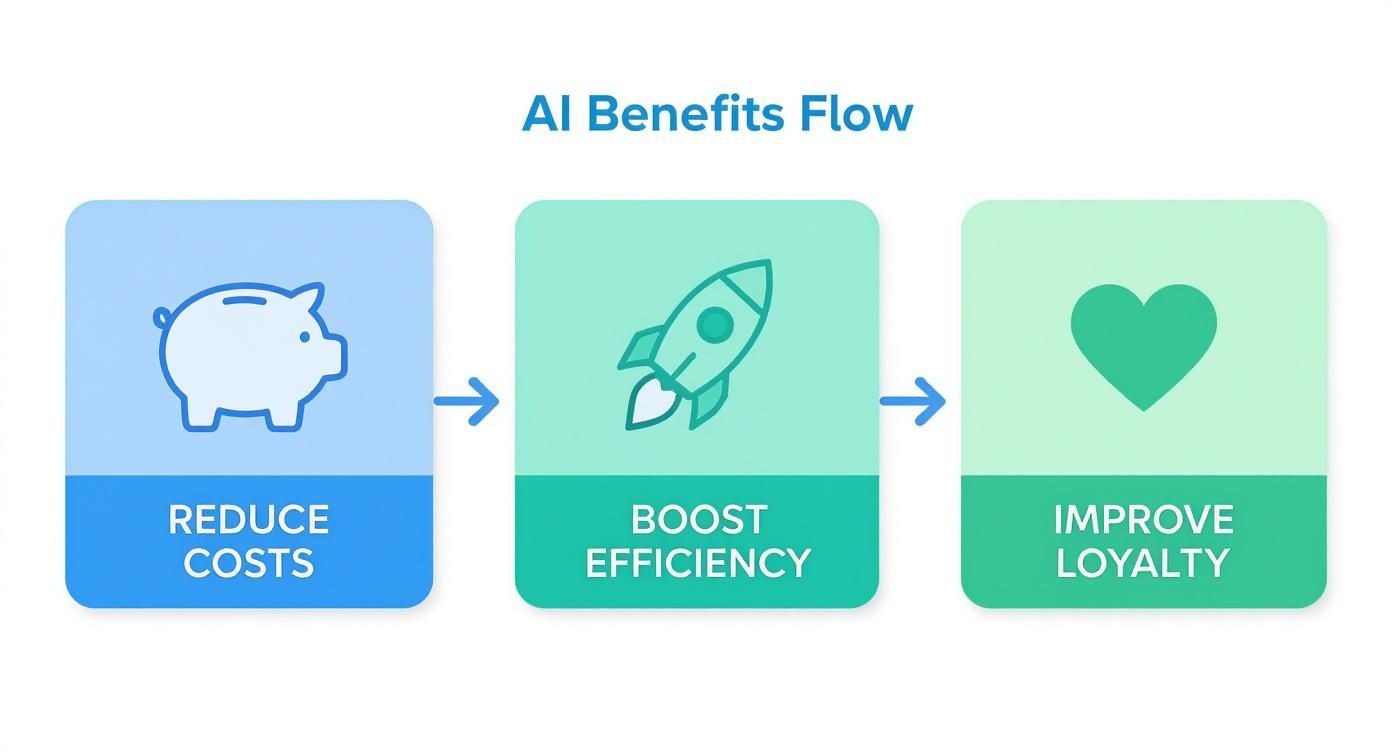
This is the proof: a well-planned AI strategy pays off in a more profitable, efficient, and customer-focused business.
Choose the Right AI-Powered Software
With your goals set and your data in good shape, you can finally start looking at software partners. Not all AI inventory tools are built the same, so the trick is to find one that fits neatly into your specific ecommerce setup.
Here’s what to look for when you're comparing options:
Seamless Integration: How easily will it connect with your current tech, like Shopify, Magento, or your ERP? A tool that creates data silos is just going to cause more headaches.
Scalability: You need a solution that can grow with you. It has to handle more SKUs, more sales channels, and more orders down the road without slowing to a crawl.
User Experience: The interface needs to be intuitive for your team. A system can have all the power in the world, but if nobody can figure out how to use it, it's worthless.
Transparent Pricing: Get the full story on costs. Look for simple pricing models without hidden fees for support, training, or data storage.
This is also a great time to think about how other tech could work with your new system. For a deeper dive, our guide on IoT in warehouse management explores how connected devices can feed even richer, real-time data into your AI.
Train Your Team and Manage the Change
Finally, remember that technology is only half the battle; your team is the other half. A smooth transition hinges on getting everyone on board, from the people in the warehouse to your procurement managers. You can't just drop a new system in their laps and expect them to figure it out.
Start with solid training that shows them how the new tool will make their jobs easier and more strategic, not redundant. Frame the AI as a helpful assistant that takes care of the grunt work, freeing them up to tackle more interesting challenges. By managing the human side of this change, you ensure everyone embraces the new way of working, which is how you'll get the best possible return on your investment.
How to Measure Your Success and ROI
Putting a new system in place is a big step, and you need to see real results to know it was worth the investment. To justify making the switch to AI inventory management for ecommerce, you have to track the right numbers. This isn't about guesswork; it's about using hard data to build a solid business case, show a clear return on investment (ROI), and prove the system is actually doing what you hoped it would.
Forget vanity metrics. We’re talking about measuring the vital signs of your inventory operations. By zeroing in on a handful of key performance indicators (KPIs), you can see exactly how AI is trimming costs, lifting sales, and making your entire business run more smoothly.
Key Performance Indicators to Track
To get the full story, you need to look at performance from a few different angles: speed, cost, efficiency, and accuracy. These four KPIs give you a solid framework for measuring the direct impact of your AI system.
Let's break down the essential metrics you’ll want to keep on your dashboard.
1. Inventory Turnover Rate
This classic KPI tells you how many times your business sells and replaces its entire stock within a certain period. Generally, a higher turnover rate is a good thing; it signals healthy sales and that your inventory isn’t just sitting on a shelf collecting dust.
How to Calculate It: Cost of Goods Sold / Average Inventory Value
What to Expect: AI gives this a serious boost by stopping you from overstocking slow-movers while keeping your bestsellers in ready supply. The result is a faster sales cycle, and any increase here is a great sign that your cash is working harder for you.
2. Stock-to-Sales Ratio
This metric is all about balance. It compares how much inventory you're holding to how much you're actually selling, helping you figure out if your stock levels are in sync with what your customers want.
How to Calculate It: Value of Inventory at Month's Start / Value of Sales in That Month
What to Expect: The aim is to get this ratio as low as possible without running out of stock. AI's predictive forecasting helps you nail that sweet spot, so you hold just enough inventory to meet demand. That frees up capital that would otherwise be tied up in your warehouse.
A well-tuned AI system transforms your warehouse from a costly storage centre into a dynamic, fast-moving hub. The ultimate goal is to hold the least amount of inventory possible while still satisfying every single customer order.
Watching these numbers climb (or drop, in the case of the stock-to-sales ratio) gives you the proof you need to show stakeholders that the investment is paying off.
Measuring Cost and Accuracy Improvements
While turnover and sales ratios are great for gauging efficiency, you also need to track direct cost savings and how precise your operations have become. These next two KPIs get right to the financial impact on your bottom line and the quality of your fulfilment.
3. Carrying Costs of Inventory
This is the total expense of holding onto unsold stock. It’s a sneaky profit-killer made up of warehousing fees, insurance, staff salaries, and the risk of products becoming obsolete.
How to Calculate It: (Warehousing Costs + Employee Salaries + Insurance + Obsolescence Costs) / Total Annual Inventory Value
What to Expect: This is where AI often delivers its most significant wins. By fine-tuning stock levels and cutting down on excess inventory, AI directly slashes your carrying costs. Aiming for a 15-20% reduction is a realistic and impactful target.
4. Order Fulfillment Accuracy
This metric measures the percentage of orders shipped perfectly: the right items, no damage, on time. High accuracy is non-negotiable for keeping customers happy and protecting your brand’s reputation.
How to Calculate It: (Number of Correct Orders Sent / Total Number of Orders Shipped) x 100
What to Expect: AI helps here by keeping your stock data razor-sharp and consistent across every sales channel, which stops overselling in its tracks. That means fewer cancelled orders, fewer wrong items sent out, and happier customers who come back for more.
Common Mistakes to Avoid on Your AI Journey
Adopting AI for inventory management is a huge step forward, but it's not without its potential stumbles. A few common missteps can easily trip up even the most well-intentioned projects before they really get going. Knowing what these are ahead of time is your best defence.
Think of it as navigating a new trail; knowing where the tricky spots are makes for a much smoother hike.
Feeding Your AI 'Dirty' Data
The single biggest danger? Feeding the system rubbish data. An AI is only as smart as the information you give it. If your sales history, supplier lead times, and product details are messy, incomplete, or just plain wrong, the AI will learn the wrong lessons.
This leads directly to flawed forecasts and, ultimately, poor business decisions.
It's like trying to navigate with a map full of errors. You'll move with confidence, but you'll be heading straight for a dead end. The old saying, "rubbish in, rubbish out," has never been more true.
Choosing a System in Isolation
Another classic blunder is picking a shiny new tool that doesn't play well with your existing tech. Your ecommerce platform, accounting software, and warehouse management system (WMS) are all holding critical pieces of the puzzle. An AI tool that can't connect to them just creates another data silo.
When systems don't talk, you force your team back into the world of manual data entry to fill the gaps. That completely defeats the purpose of automation. The whole point of AI inventory management for ecommerce is to create one cohesive, synchronised hub for your operations, not another isolated island of information.
Overlooking the Human Element
Finally, it’s surprisingly easy to underestimate the importance of your team in all of this. You can invest in the most sophisticated platform available, but if your people don't understand why you're using it or how to use it, the project is doomed.
Without proper onboarding and ongoing support, you’ll see low adoption rates and maybe even outright resistance. It’s crucial to present the AI as a tool that helps them, taking over the tedious work so they can focus on more strategic, high-value tasks.
By steering clear of these three common pitfalls: bad data, poor integration, and neglecting your team, you set yourself up for a successful implementation. Avoiding these mistakes is just as important as picking the right software to begin with.
Your Questions Answered
When you're thinking about bringing AI into your inventory management, a few questions always seem to pop up. Let's tackle some of the most common ones to clear the air.
Is This Really Something a Small Business Can Use?
Absolutely. It used to be that only the big players with deep pockets could afford this kind of tech. That’s changed completely.
Now, there are plenty of AI-powered tools built specifically for small and medium-sized ecommerce shops. Many even plug straight into platforms like Shopify or WooCommerce, giving you powerful forecasting tools without needing a massive budget or an in-house data scientist.
How Far Back Does My Sales Data Need to Go?
The more clean, reliable data you can feed the AI, the sharper its insights will be. As a rule of thumb, having at least one to two years of sales history is the sweet spot. This gives the system enough information to really nail down seasonal trends and buying patterns.
That said, some of the newer AI tools are surprisingly good at getting started with less. They can start delivering useful predictions with as little as six months of data and will only get smarter as more time passes.
Think of AI as a powerful assistant, not a replacement for your team. It’s brilliant at handling the grunt work of sifting through massive amounts of data, which frees up your people to do what they do best: think strategically.
Is This Going to Make Our Inventory Manager Obsolete?
This is probably the biggest worry we hear, but it's a misconception. The goal of AI isn't to replace your experts; it's to supercharge them.
AI takes over the mind-numbing, repetitive tasks, like crunching sales numbers for forecasting or triggering reorder points, and does them with incredible accuracy. This frees up your inventory manager to focus on the things that require a human touch. They can spend their time building stronger supplier relationships, negotiating better contracts, navigating unexpected supply chain hiccups, and fine-tuning your overall inventory strategy.
Ready to see how intelligent, data-driven solutions can change your business? Cleffex Digital Ltd builds custom software designed to solve your toughest operational challenges. Visit our website at Cleffex.com to find out how we can help you grow.