

You’re probably dealing with a dataset that looks usable on paper and messy in practice. A CRM export with half-complete fields. Claims data with old labels you no longer trust. Website sessions that clearly exhibit patterns, but nobody has yet identified those patterns. That’s usually the point where teams ask the wrong question first: “Which algorithm should we use?”
The better question is simpler. Are you trying to predict a known outcome, or discover a structure that nobody has labelled yet? That’s the core dividing line in clustering vs classification.
For small and mid-sized Canadian businesses, that choice isn’t academic. It affects data collection, cloud cost, stakeholder expectations, and how quickly a pilot turns into something operational. A dealership trying to personalise marketing from raw behavioural data has a different path from an insurer triaging known claim types. Both are valid machine learning problems. They just need different tools.
Making Sense of Your Business Data
Most business datasets begin as operational records, rather than analytical assets. Sales teams enter notes to close deals. Claims teams update files to move work forward. Clinic staff record visits to support care. The result is useful data, but not organised for decision-making.

Before any model helps, a team needs a workable interpretation of data. If your inputs are inconsistent, mislabeled, or driven by changing business processes, the model will reflect that confusion. A practical primer on the interpretation of data is useful here because it forces the team to ask what each field means in context, not just what the column name says.
Two Different Jobs
Classification is for assigning records to a known category. You already know the labels that matter, such as fraud or not fraud, churn risk or low risk, approved or declined. The model learns from historical examples and predicts the label for new records.
Clustering is for finding groups without predefined labels. You don’t start with “high-value customer” or “casual browser” as fixed categories. Instead, the algorithm groups similar records and helps the team decide what those groups mean.
A useful rule is this:
Practical rule: If the business already has a decision it wants to automate, start by testing classification. If the business is still trying to understand the shape of the problem, start with clustering.
Why This Matters Early
Teams often skip the data readiness question and go straight to modelling. That’s expensive. A business with strong reporting but weak data governance may not be ready for a reliable classifier yet. In those cases, a data capability check is often more valuable than another proof of concept. A framework like a data maturity model for business growth helps reveal whether the blocker is the algorithm, the data pipeline, or the operating process around the model.
Core Differences Unpacked
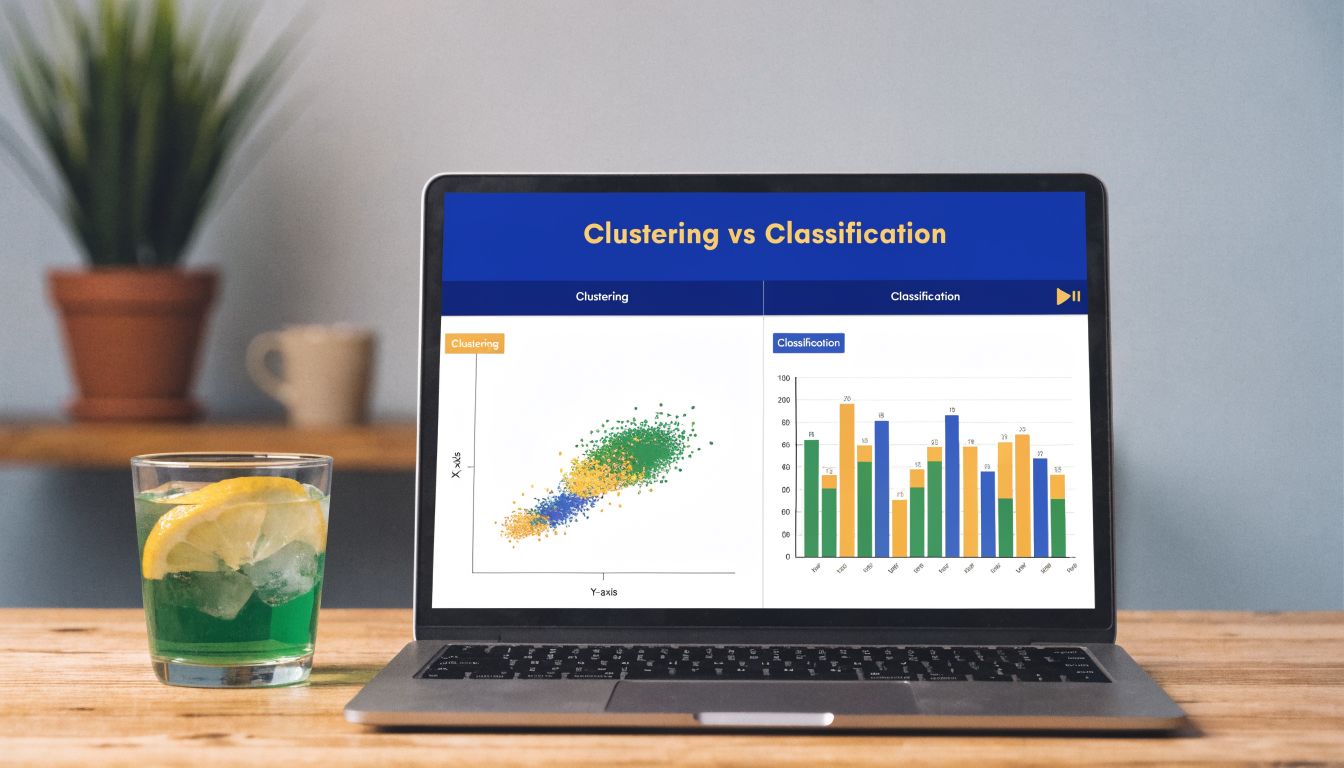
The easiest way to compare clustering vs classification is to look at the job each one performs inside a project.

| Criterion | Classification | Clustering |
|---|---|---|
| Learning type | Supervised learning | Unsupervised learning |
| Primary goal | Predict a known label | Discover natural groupings |
| Data requirement | Labelled training data | Unlabelled data |
| Typical output | Category assignment | Cluster membership |
| Best fit | Operational decisions | Exploration and segmentation |
| Validation style | Compare predictions to known labels | Evaluate the separation, stability, and usefulness of groups |
| Business question | “What is this?” | “What patterns exist here?” |
Learning Type
Classification is supervised. Someone has already defined the target. That target might be “policy likely fraudulent” or “lead likely to convert.” The model isn’t inventing categories. It’s learning the relationship between input features and labels created by the business.
Clustering is unsupervised. There is no target column to predict. The algorithm tries to organise the data by similarity, distance, or density, depending on the method.
Objective
A classifier is usually attached to an action. If the model predicts a high fraud risk, the claim gets routed for review. If it predicts high lead quality, the sales team gets a priority queue. The output is meant to drive a defined workflow.
A clustering model is often attached to understanding. It helps teams see the structure they couldn’t define beforehand. That can shape marketing segments, product bundles, support playbooks, or future labelling strategy.
Clustering helps you discover categories. Classification helps you operationalise them.
Input Data
Projects succeed or fail here.
Classification depends on labels that are both available and trustworthy. Many businesses technically have labels, but they were captured inconsistently over time. A lead status might reflect sales behaviour rather than actual quality. A fraud flag may reflect who got investigated, not who was fraudulent.
Clustering avoids that label dependency, but it creates a different burden. The team has to decide which variables represent meaningful similarity. If those features are weak, the clusters may be mathematically clean and commercially useless.
Evaluation
Classification has clearer scorekeeping. You compare predicted labels to actual labels. That makes it easier to explain progress to stakeholders.
Clustering requires a more careful review. A tidy-looking cluster chart doesn’t prove business value. The team has to check whether segments are stable over time, whether they map to real operational differences, and whether anyone can act on them.
Where Teams Get Confused
The confusion usually starts when people treat clustering as a rough version of classification or classification as the only “serious” machine learning option. Neither is true.
Classification breaks down when labels are stale, biased, or too expensive to maintain.
Clustering breaks down when the business needs deterministic decisions but only gets descriptive groupings.
Both break down when features reflect reporting convenience instead of real behaviour.
That’s why clustering vs classification is rarely just a technical decision. It’s a data strategy decision.
A Look at Common Algorithms
You don’t need a catalogue of every method. You need a shortlist of tools that solve common business problems well enough to prototype quickly.
Classification Tools
Logistic Regression is often the best baseline for tabular business data. It’s fast, interpretable, and easy to explain to stakeholders. If you’re scoring leads, predicting renewal likelihood, or flagging simple approval outcomes, it’s usually the first model worth training.
Support Vector Machines (SVM) can work well when class boundaries are complex, especially in medium-sized structured datasets. They’re less attractive when explainability matters or when training speed becomes a concern.
Random Forest is a strong default for many practical classification tasks. It handles mixed features well, tolerates some noise, and often performs reliably without extreme tuning. In fraud screening or customer risk scoring, it’s a common choice when teams want a solid performance baseline before considering more complex ensembles.
Clustering Tools
K-Means is the workhorse for segmentation. It’s simple, relatively fast, and useful when you expect reasonably compact groups. For customer grouping, product usage segmentation, or regional behaviour analysis, it’s often the first clustering model to test.
DBSCAN is more useful when the data contains irregularly shaped groups or noisy records. It’s particularly helpful when you care about identifying outliers rather than forcing every record into a segment.
Hierarchical clustering is useful when the business wants to inspect groupings at different levels. It can support exploratory work where the team doesn’t yet know whether there should be a handful of broad segments or many narrow ones.
How I’d Choose in Practice
If the data is tabular, the timeline is short, and the business needs a prediction, I’d usually start with Logistic Regression and Random Forest. If the task is exploratory segmentation, I’d test K-Means first, then move to DBSCAN if the segments look forced or if noise matters.
A good first pass isn’t about elegance. It’s about learning quickly which assumptions hold.
Industry Use Cases and Real-World Impact
A project manager at a mid-sized insurer or dealership usually is not asking for clustering or classification in the abstract. They are asking a simpler question. Which approach will improve a live process without creating a cost or maintenance problem six months from now?

Insurance Fraud in Canada
In Canadian insurance, classification usually enters first because the operational path is already defined. A claim comes in, the model scores risk, and the file is routed to straight-through processing or manual review. If past claims have usable fraud labels, that setup can produce value quickly.
The limitation shows up after deployment. Fraud patterns change faster than claim taxonomies, and smaller carriers often feel that drift first because they have fewer specialist investigators and less room for model retraining overhead. A classifier trained on last year's confirmed fraud cases can miss new patterns that have not yet been labelled in the claims system.
That is why many teams use both methods together. Clustering helps analysts find unusual pockets of behaviour in unlabelled claims, such as odd repair networks, timing anomalies, or claimant histories that do not match the expected profile. The claims team can review those groups, decide which ones reflect genuine risk, and feed that learning back into a supervised model for day-to-day triage.
In practice, this hybrid approach costs more to set up. It needs cleaner feature engineering, analyst review time, and stronger governance around what becomes a new label. For a small or mid-sized Canadian insurer, those costs are justified when fraud patterns are shifting, and false positives are already creating adjuster backlog. A broader overview of machine learning in insurance claims and underwriting workflows is useful if you are planning that roadmap.
Fraud models fail less often from weak algorithms than from stale labels and weak feedback loops.
Automotive Marketing and Lead Scoring
Automotive businesses often face the opposite constraint. Independent dealer groups, service chains, and aftermarket providers usually have plenty of behavioural data but weak outcome labels. CRM exports are inconsistent, lead stages mean different things across stores, and web traffic data rarely maps cleanly to actual purchases.
Clustering is often the faster way to get business value from that environment. It can separate shoppers into groups that the sales or marketing team can act on, such as finance-first prospects, repeat service customers, high-intent used inventory browsers, or visitors comparing prices across regions. That segmentation helps with campaign design, budget allocation, and follow-up rules even before the business has enough reliable labels for lead scoring.
Classification becomes more useful once the operation standardises its definitions. If each rooftop records leads differently, a lead score model will learn local process quirks. I have seen smaller automotive clients spend money on supervised models before fixing CRM hygiene, then wonder why the predictions are unstable across locations.
There is also a straightforward infrastructure trade-off. Clustering can be heavier to run and harder to explain to non-technical stakeholders, especially if segments shift every month as inventory mix and consumer demand change. Classification is usually easier to plug into an existing workflow once the labels are trustworthy. For smaller Canadian businesses working under tighter cloud budgets and data residency constraints, that difference matters as much as raw model performance.
Healthcare and Startups
Healthcare organisations often use classification for known operational decisions, such as triage support, coding assistance, or document routing. The challenge is not model type alone. It is label quality, auditability, and whether clinical teams trust the output enough to use it.
Startups are different. Early-stage teams often begin with clustering because they need to understand user behaviour before they can predict it. Product usage data can reveal adoption patterns, churn-risk groups, or feature preferences well before the company has stable labels and enough historical volume for a reliable classifier.
Business impact comes from matching the method to the maturity of the operation. Established workflows with usable labels usually benefit from classification first. Messy datasets, changing behaviour, and unclear segments usually justify clustering first, or a staged combination of both.
How To Choose the Right Model for Your Project
A good model choice starts with business pressure, not tooling preference. If a stakeholder says, “We need AI,” slow the conversation down and ask what decision they’re trying to improve.

Start With the Operational Question
Use classification when the business needs a direct prediction tied to a workflow. Fraud review, lead qualification, renewal risk, and ticket routing all fit that pattern. The label exists, the action is known, and the team can measure whether predictions improve the process.
Use clustering when the business is trying to understand customer groups, usage patterns, anomaly pockets, or behavioural segments that no one has formally defined.
Check the Data Reality
Ask four questions before approving a build:
Are the labels trustworthy?
If labels were created inconsistently or changed with business policy, classification will inherit that mess.Do the features represent behaviour or just process noise?
Fields created for reporting convenience often perform badly in both approaches.Can the team act on the output?
A beautiful cluster model is wasted if marketing, claims, or operations can’t use the segments.Will the data change quickly after deployment?
Fast-changing environments make static models brittle.
Choose the Simplest Model That Answers the Question
Here, many teams overbuild.
If labels are strong and the action path is clear, start with a basic classifier.
If labels are weak but behavioural signals are rich, start with clustering.
If you have some labels, many unlabelled records, and a changing pattern environment, consider a hybrid workflow.
Decision shortcut: If you can’t explain how the model output changes a queue, message, or review path, you’re still in discovery mode. That usually points to clustering first.
Implementation and Deployment Considerations
A prototype that runs in a notebook isn’t the hard part. The hard part is getting the same logic to run reliably against fresh data every day.
Typical Workflow Differences
A classification project usually follows this pattern:
Prepare labelled data and define the target carefully.
Engineer features from transactions, text, timestamps, or interactions.
Split training and validation data in a way that respects time and process reality.
Train and compare models.
Deploy scoring logic into an application, dashboard, or batch pipeline.
A clustering project looks different:
Clean and standardise input features because distance-based methods are sensitive to scale.
Reduce noise and dimensionality where needed.
Test more than one clustering algorithm because assumptions differ.
Review clusters with domain experts before naming or using them.
Decide how clusters will be refreshed as new data arrives.
Small Python Examples
Classification with scikit-learn:
from sklearn.model_selection import train_test_split
from sklearn.ensemble import RandomForestClassifier

X_train, X_test, y_train, y_test = train_test_split(X, y, random_state=42)
model = RandomForestClassifier(random_state=42)
model.fit(X_train, y_train)
predictions = model.predict(X_test)
Clustering with scikit-learn:
from sklearn.preprocessing import StandardScaler
from sklearn.cluster import KMeans

X_scaled = StandardScaler().fit_transform(X)
model = KMeans(n_clusters=4, random_state=42)
clusters = model.fit_predict(X_scaled)
What Usually Goes Wrong
Data leakage is a classic classification mistake. Teams include fields that are only available after the decision point, then wonder why validation looks great, and production fails.
Curse of dimensionality hurts clustering fast. If you feed too many weak features into a distance-based model, similarity becomes meaningless.
Operational drift affects both. Customer behaviour changes. Claims patterns shift. Sales teams change how they enter notes. If your deployment doesn’t monitor input quality and output behaviour, the model degrades unnoticed.
That’s why production machine learning needs workflow discipline, not just model code. If you’re building event-driven scoring or segment refresh processes, a reference on AI/ML pipelines is useful because it frames the plumbing around ingestion, transformation, monitoring, and retraining. Teams also need practical cloud operations support when prototypes start consuming real infrastructure, especially in regulated environments. A guide to managed cloud service operations is relevant when the handoff from data science to production engineering becomes the primary bottleneck.
Frequently Asked Questions
Can clustering and classification work together?
Yes. In practice, this is often the most useful setup when the business has some labels but not enough to cover changing patterns. Clustering can reveal structure in unlabelled records, and classification can then turn those insights into repeatable predictions.
Which is more computationally expensive?
It depends on the data and algorithm, but clustering often becomes more expensive during exploration because teams test multiple feature sets, multiple cluster counts, and more than one algorithm. In the automotive example discussed earlier, clustering delivered strong marketing value but came with heavier compute demands than classification.
What if I have both labelled and unlabelled data?
That’s usually a sign to consider a hybrid or staged workflow. Start by checking whether the labelled subset is representative of the current reality. If it isn’t, clustering can help identify new groups before you expand or revise labels.
Which is easier to explain to stakeholders?
Classification is usually easier to connect to business actions because the output is a known label. Clustering takes more workshop time. Teams need to inspect the groups, validate whether they make sense, and agree on how each segment should be used.
Is one method better for small businesses?
Neither is always superior. Small businesses often benefit from clustering earlier because they lack clean labels. But if a business already has a consistent process and reliable outcomes in historical data, classification can get to operational value faster.
Cleffex Digital Ltd helps Canadian businesses turn messy operational data into usable products, workflows, and AI systems. If you’re weighing clustering vs classification for insurance, automotive, healthcare, or a growing digital business, Cleffex Digital Ltd can help you scope the right approach, build the supporting software, and move from pilot to production without overengineering the stack.