

Growth often stalls in ways that don’t show up on a sales dashboard first. A team adds people, launches new services, signs more customers, and then discovers the business is still running on spreadsheets, disconnected software, manual approvals, and data that lives in five places. Staff compensated with workarounds for a while. Then response times slow, reporting becomes unreliable, and every new initiative feels harder than it should.
That’s the point where many owners and operators start looking for a digital transformation partner. Not because they want a fashionable tech project, but because the business has become harder to run than it needs to be.
The Crossroads of Growth and Technology
A familiar pattern shows up in SMBs and mid-market firms. The company has demand. The team is capable. The problem sits underneath the surface. Customer information is fragmented, internal processes are still manual, and the systems that once supported growth now create friction.
Often, leaders make the wrong call. They buy a single tool and hope it solves a structural issue. It rarely does. A new CRM won’t fix poor integration. A cloud subscription won’t fix broken workflows. An AI feature won’t help if the underlying data is inconsistent.
The business case for acting has become hard to ignore. The global digital transformation market is projected to reach $3,140.86 billion in 2026, and North America holds nearly 40% of the market share, according to Fortune Business Insights' digital transformation market analysis. For Canadian companies, that means two things at once. There’s pressure to modernise, and there’s a real opportunity to do it before slower competitors catch up.
The Real Problem Isn’t Technology Alone
Most companies at this stage don’t need more software options. They need someone who can sort out priorities, sequence the work, and connect business goals to technical delivery. That’s the practical role of a digital transformation partner.
In customer-facing teams, this often starts with experience design. If your service model still forces staff to patch together updates manually, a stronger AI-driven customer experience approach can help clarify where automation improves responsiveness and where human support still matters most.
Practical rule: If your team spends more time moving information between systems than acting on it, you don’t have a software gap. You have an operating model gap.
Why This Moment Matters
For SMBs, delay is expensive in quiet ways. Staff burn time on repetitive tasks. Managers don’t trust the reporting. Customers feel the lag before leadership sees the cause. By the time the issue is obvious, the business has already absorbed months of avoidable drag.
A capable partner helps break that cycle. They don’t just recommend tools. They help you decide what to modernise first, what to leave alone, and what has to integrate cleanly so the next stage of growth doesn’t collapse under operational friction.
What a Digital Transformation Partner Really Does
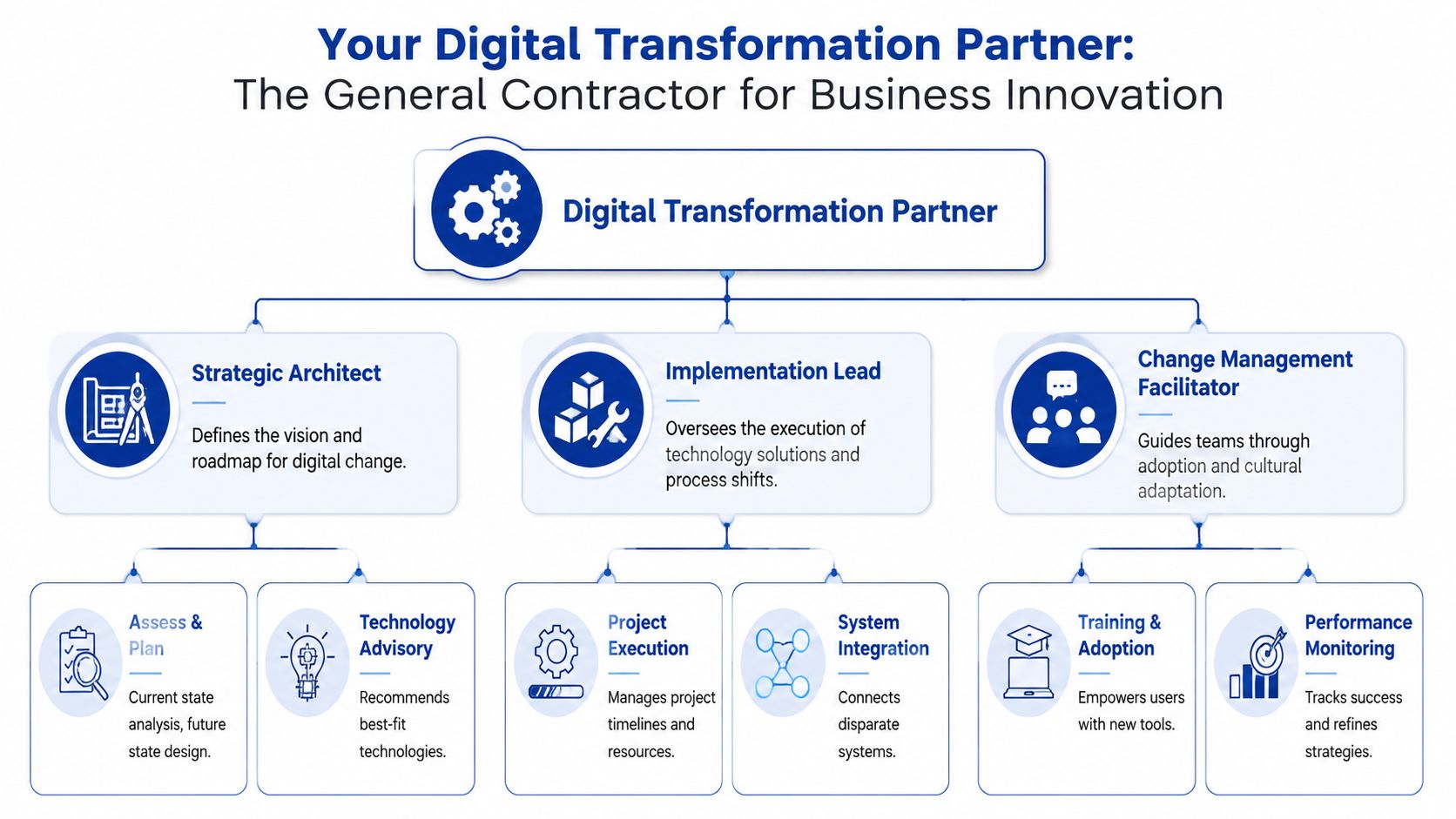
A strong digital transformation partner is less like a software reseller and more like a general contractor for your business technology. They don’t just hand you materials and leave. They coordinate the plan, line up the specialists, manage trade-offs, and make sure the finished system works as one environment rather than a pile of disconnected components.
That difference matters because most SMBs don’t fail for lack of software access. They struggle because strategy, implementation, operations, and team adoption are handled separately.
Strategy Before Stack
The first job isn’t coding. It’s a diagnosis. A useful partner looks at revenue workflows, service bottlenecks, compliance constraints, data quality, customer journeys, and team capacity before they talk about platforms.
That early work usually includes:
Current-state assessment that maps where work slows down, where data gets duplicated, and where teams rely on manual intervention
Future-state design that defines what should change first and what should stay stable
Technology selection based on fit, not novelty. That might mean AWS, Azure, Google Cloud, Shopify, custom applications, or a combination
Roadmapping so the business isn’t trying to replace everything at once
If you want a useful framework for sequencing that work, Cleffex has a practical breakdown of top digital transformation strategies that align well with how phased delivery should be approached.
Implementation Across Multiple Layers
Once the plan is clear, the partner moves into execution. This usually spans more than one technical discipline.
A real-world transformation often includes:
| Area | What the partner actually handles |
|---|---|
| Cloud and infrastructure | Moving workloads to AWS or Azure, setting up environments, improving resilience, and reducing dependence on ageing on-premise systems |
| Software delivery | Building or modernising internal tools, portals, apps, APIs, and workflow systems |
| Integration | Connecting CRM, ERP, claims systems, EHR platforms, dealer systems, payment tools, and reporting layers |
| Data and AI | Cleaning source data, structuring pipelines, and applying automation or machine learning where it improves operations |
| UX and adoption | Designing interfaces that employees and customers can actually use without creating more friction |
Change Management Is Part of the Build
Many firms still treat training as an afterthought. That’s one reason projects go live and underperform. A digital transformation partner should prepare teams to use the new workflows, not just deliver the software.
Good transformation work changes daily habits, not just systems.
That means documenting processes, transferring knowledge, running adoption sessions, and setting up a rhythm for refinement after launch. Without that, the business gets a technically finished project and an operationally unfinished one.
Vendor Versus Partner
The quickest way to spot the difference is to listen to how they talk. A vendor talks about product features. A partner talks about operating constraints, dependencies, rollout sequence, ownership, and measurable business outcomes.
That distinction becomes even more important when your environment includes several tools from different providers. In those cases, the best partner doesn’t try to own every component. They make the whole system work together.
The Tangible ROI of a Strategic Partnership
Executives don’t need another abstract promise about innovation. They need to know whether a digital transformation partner will help the business run better, generate value faster, and reduce operational drag in measurable ways.
There is encouraging evidence for smaller firms. Companies with 100 or fewer employees are 2.7 times more likely to succeed in digital transformation than firms with 50,000 or more employees, based on Mooncamp’s digital transformation statistics roundup. That should get the attention of any SMB leader who assumes larger organisations automatically have the advantage.

Why Smaller Firms Often Win
Large enterprises have scale, but they also carry layers of approvals, older architecture, and harder-to-move governance structures. Smaller companies usually have a shorter route from decision to action. That speed matters when the partner is good, and the scope is clear.
The same source shows that 35% of companies worldwide successfully achieved their digital transformation goals in 2021, up from 30% in 2020, and that 59% reported profit growth of at least 11% from digital transformation efforts, while 87% used technology to boost profits in the previous 24 months. Those numbers don’t mean every programme pays off. They do show that when the work is aligned to business outcomes, the upside is real.
ROI Shows Up in Operations First
In practice, ROI usually appears before it lands in a polished board report. Teams stop re-entering the same information. Managers get cleaner visibility. Customer-facing staff spend less time chasing updates. Compliance tasks become more consistent. Leaders can make decisions without waiting for someone to reconcile spreadsheets.
That’s why the right partnership often creates value through a sequence of improvements:
Faster internal workflows because systems share data instead of forcing staff to copy it manually
Better profit performance when delays, rework, and service friction are removed
Improved customer experience through more consistent service and faster response cycles
Greater resilience because the business no longer depends on brittle processes and hidden manual knowledge
What works: Tying each phase of transformation to a business problem that already costs time, margin, or customer confidence.
The Business Case for SMB Leaders
If you run a smaller company, don’t assume your size is a handicap. It can be an advantage. You can align leadership faster, shorten implementation feedback loops, and adjust the roadmap with less internal resistance.
The mistake is trying to move quickly without enough orchestration. Speed helps only when the partner can translate that agility into disciplined execution.
Transformation in Action: Industry-Specific Examples
The value of a digital transformation partner becomes clearer when you look at how the work plays out inside specific operating environments. The tools vary by sector, but the pattern stays consistent. A business problem sits at the centre, the partner reshapes the workflow and systems around it, and the result shows up in cost, speed, compliance, or customer experience.
Insurance
Insurance firms often hit the same wall first. Core processes still depend on legacy applications, on-premise infrastructure, and manual handoffs between underwriting, claims, and customer service. That creates latency and compliance risk at the same time.
A partner with cloud migration experience can redesign that environment around secure, compliant infrastructure. In the Canadian insurance sector, a digital transformation partner with cloud expertise can reduce operational costs by 25 to 35 per cent while supporting PIPEDA compliance, with ROI seen in 12 to 18 months, according to this analysis of choosing the right digital transformation partner.
A practical implementation might include AWS Database Migration Service for moving data with minimal interruption, Kubernetes for scalable workloads, and GuardDuty for security monitoring. The point isn’t the tool list by itself. It’s that the partner knows how to combine these components so that claims processing, policy administration, and reporting keep working during the transition.
Healthcare
Healthcare teams usually face different pressures. They need efficiency, but they can’t treat patient data or workflow changes casually. Systems have to support care delivery and privacy obligations at the same time.
In this setting, a digital transformation partner often focuses on automation that reduces administrative load without disrupting clinical workflows. The same source notes that AI automation can deliver 40 to 50 per cent efficiency gains in healthcare. In practice, that may involve FHIR-compliant APIs, mobile interfaces for staff, and tightly controlled integrations between existing records systems and new patient-facing applications.
In regulated sectors, the best partner doesn’t pitch speed alone. They show how the architecture supports compliance while still reducing operational friction.
The strongest healthcare projects usually start small. Appointment flow, intake, internal coordination, or reporting are often better first targets than a sweeping platform overhaul.
Automotive
Automotive businesses, especially dealership groups and service networks, often live with disconnected CRM records, inventory blind spots, and slow lead handling. Revenue leaks happen in the handoff between marketing, sales, finance, and service.
A digital transformation partner can improve that operating chain with predictive analytics, better lead routing, modern front-end experiences, and cleaner system integration. The same source indicates that AI automation can deliver 40 to 50 per cent efficiency gains in automotive. In practical terms, that can mean demand forecasting, stockout reduction, and faster movement from enquiry to follow-up.
For dealerships and aftermarket service businesses, this work often blends customer experience and operations. A faster website or modern app alone won’t fix weak conversion if the lead data still lands in disconnected systems or if service advisors can’t see the full customer history.
Startups and Commerce-Led Firms
Startups and online sellers usually have a different challenge. They need to move quickly without baking in technical debt from day one. A partner can help by choosing scalable foundations early, especially around storefront performance, workflow automation, analytics, and fulfilment integrations.
That may involve Shopify UX improvements, Next.js front ends, or custom middleware that keeps operations flexible as the business adds channels. The smartest partner won’t over-engineer a young business. They’ll build enough structure to support growth while keeping the stack manageable for a lean team.
How To Choose Your Digital Transformation Partner
Most selection mistakes happen before any contract is signed. A company gets impressed by a polished demo, a familiar logo, or a broad capability deck, then discovers too late that the partner can’t manage the actual complexity of the environment.
A good choice starts with a simple rule. Pick the partner that can solve your operational reality, not the one that sounds most impressive.
The Capability That Gets Overlooked
One of the biggest failure drivers in transformation is ecosystem complexity. Businesses need a partner that can “stitch together multiple vendors” and manage integrations in live legacy environments, as discussed in Paragon Edge’s analysis of why transformation initiatives fail. That matters far more for SMBs and mid-market firms than many guides admit.
Most growing businesses don’t have the luxury of replacing everything with one platform. They have accounting software, line-of-business tools, CRM, reporting tools, communication apps, cloud services, and industry systems that all have to coexist during the transition.
If a partner only knows how to implement one stack in isolation, they’re not ready for the actual job.
What To Evaluate in Practice
You’re not just hiring builders. You’re hiring coordinators, translators, and risk managers.
For a sharper view of what strong software delivery capability looks like, Modernisation Intel's insights offer useful context on how to assess development partners beyond surface-level claims.
Use this checklist during evaluation:
| Criteria | What to Look For | Red Flag |
|---|---|---|
| Business alignment | They ask about margins, workflow friction, customer impact, compliance, and internal ownership | They jump straight into tools or architecture |
| Integration skill | They can explain how they connect legacy systems, APIs, third-party vendors, and data flows | They treat integration as a minor implementation detail |
| Delivery model | They define phases, responsibilities, decision points, and acceptance criteria | Their proposal is broad, vague, or overloaded with jargon |
| Change adoption | They include training, documentation, and knowledge transfer in scope | They assume your team will “pick it up” after launch |
| Post-launch support | They describe how optimisation, issue review, and performance tracking will work after go-live | They disappear once the release is done |
| Industry relevance | They understand your regulatory and operational constraints | They rely on generic examples that don’t match your environment |
| Communication style | They speak clearly about trade-offs and risks | They overpromise and avoid hard conversations |
Questions Worth Asking in the Room
The best interview questions force a partner to reveal how they think under real delivery pressure.
Ask questions like these:
How do you decide what not to transform in phase one?
Mature partners know restraint is part of good architecture.How do you handle a multi-vendor environment when no single platform covers everything?
Listen for specifics about orchestration, ownership, and dependency management.How do you ensure knowledge transfer to our internal team?
If they can’t answer this clearly, you may end up dependent on them for routine operations.What does post-launch governance look like?
You want a defined cadence, not an informal promise.How do you manage scope when business priorities change mid-project?
Strong partners don’t pretend priorities stay fixed.Who owns integration testing across systems and vendors?
If that answer is blurry, expect confusion later.
A useful companion resource is Cleffex’s guide on the steps for a successful partnership with a tech vendor, especially if your team is formalising how it evaluates delivery partners.
Ask for a walkthrough of a messy project, not just a successful one. You’ll learn more from how they handled constraints than from a perfect slide deck.
What a Strong Short-List Looks Like
By the end of the process, your short-list should contain partners who can do three things well:
Translate business goals into a phased roadmap
Orchestrate multiple systems and vendors without creating new silos
Stay accountable after implementation, when the value has to be proven
That’s the standard. Anything less creates more moving parts than progress.
Common Pitfalls To Avoid in Your Partnership
Even a capable digital transformation partner can’t rescue a weak operating model if the client sets the relationship up poorly. Most failures aren’t dramatic. They happen through preventable gaps in scope, accountability, and internal readiness.

The Post-Launch Drop-Off
One of the most common mistakes is treating go-live as the finish line. It isn’t. Many businesses neglect vendor performance evaluation after implementation, creating an accountability vacuum, especially SMBs that depend on external partners for continuous value extraction, as outlined in Meegle’s overview of digital transformation vendors.
That’s where good projects start losing value. The platform is live, but workflows still need tuning. Adoption is uneven. Reports need refinement. Integration issues appear under real usage. If the contract doesn’t define post-launch review and optimisation, the business carries the burden alone.
Other Mistakes That Cost More Than Expected
A few traps show up repeatedly:
Vague success measures
If your KPI is “improve efficiency,” no one will agree later on whether the project worked.Weak internal ownership
When nobody on the client side owns decisions, blockers sit unresolved, and delivery slows.Underestimating data migration
Old records, inconsistent naming, duplicate fields, and missing logic cause more pain than many teams expect.Treating training as optional
New systems fail unnoticed when staff invent workarounds instead of using the intended process.
Build Accountability Into the Relationship
The safer model is a partnership with structured review cycles. That doesn’t have to mean an endless open-ended retainer. It does mean defining who reviews performance, how issues are prioritised, what gets measured after launch, and when roadmap adjustments are made.
Watch for this sign: If the partner talks a lot about implementation and almost nothing about optimisation, they may be planning to exit too early.
A healthy partnership includes quarterly review points, documented responsibilities, and a clear method for deciding what gets improved next. Without that, the business gets software delivered but not value managed.
Your Next Steps Toward Modernisation
Modernisation becomes manageable when you stop treating it as one giant technical leap. It’s a business exercise in sequencing change, reducing friction, and putting the right systems around the way your company operates.
A good digital transformation partner helps you do that with discipline. They shape the roadmap, coordinate vendors, manage integration risk, support adoption, and stay involved long enough to prove the work is paying off. For SMBs and mid-market firms, that orchestration role often matters more than any single platform decision.
Start with an internal audit. Identify where manual effort is highest, where data breaks down, and which workflows create the most customer or staff friction. Then put those findings into a practical planning document. If you need a starting point, this technology roadmap template is a useful way to organise priorities before you speak with potential partners.
The goal isn’t to modernise everything at once. It’s to modernise the right things in the right order.
If your team is weighing systems modernisation, cloud migration, AI-enabled workflows, or multi-vendor integration, Cleffex Digital Ltd is one option to consider. As a Canada-based software development company, it works across custom software, agile delivery, and digital transformation initiatives for businesses that need a practical roadmap rather than a generic technology pitch.