


Over 1,400 fintech companies were operating in Canada as of 2023, a 300% increase since 2016, while Toronto attracted $3.5 billion in venture capital funding between 2018 and 2023, according to TMASolutions’ Canadian fintech overview. That changes the conversation for every startup and SME. Fintech software development is no longer a niche concern for banks. It’s how insurers streamline claims, how Shopify merchants embed payments, how automotive businesses add financing, and how healthcare platforms handle billing and identity with less friction.
For business leaders, the primary question isn’t “Should we build fintech capability?” It’s “What should we build first, how should we architect it, and which delivery model gives us the best chance of getting to market without creating compliance debt?” Those decisions shape time to revenue, audit readiness, operational resilience, and customer trust.
The Fintech Revolution in Canada
More than 1,400 fintech companies were operating in Canada by 2023. For a startup or SME, that is a market signal, not background noise. Financial capability is becoming part of the product in sectors that did not use to treat it that way, including retail, insurance, healthcare, logistics, and automotive.

Why This Market Matters Now
In Canada, fintech demand is being shaped by a practical business problem. Customers expect faster approvals, easier payments, clearer account visibility, and less paperwork. Operators want lower servicing costs, tighter controls, and fewer manual exceptions. Those expectations put pressure on legacy processes first, then on the technology stack behind them.
That is why fintech software development should be treated as a business capability program. A company may start with one use case, such as digital onboarding, embedded payments, lending workflows, or claims automation. The long-term value comes from building the underlying services, integrations, and controls in a way that supports future products without rebuilding the foundation each time.
For Canadian firms, the local context matters. Payment preferences, bilingual requirements, privacy obligations, provincial insurance or lending rules, and evolving expectations around consumer-permissioned data all affect architecture and delivery choices. Teams that ignore those constraints usually pay for it later through rework, audit friction, or slower launch timelines.
What Fintech Software Enables
The strongest fintech products improve a measurable business outcome:
Lower drop-off in revenue-critical flows: Faster onboarding, fewer handoffs, and cleaner payment or funding journeys help convert more customers.
New monetisation options: Non-financial businesses can add payments, lending, insurance, or wallet features inside their own customer experience.
Better operational control: Finance and operations teams get clearer visibility into transactions, exceptions, fraud signals, and reconciliation issues.
Stronger readiness for API-based finance: Many Canadian businesses are preparing for more interoperable financial services. For teams evaluating that shift, this guide to Canada’s open banking solutions outlines the decisions that usually appear early in planning.
I have seen the same pattern repeatedly. The companies that get to market with less wasted spend are rarely the ones chasing broad transformation programs. They start with a narrow commercial problem, define the compliance boundary early, and choose technology based on integration effort, operating cost, and launch risk.
That approach also helps when you choose outside partners. A capable fintech development team should be able to connect product goals with delivery constraints, whether the issue is payment orchestration, KYC flow design, ledger accuracy, or internal process automation. Teams exploring operations-heavy banking workflows may also find RPA in banking by 2026 useful for understanding where automation fits once transaction volume and exception handling begin to grow.
The Canadian fintech opportunity is real. So is the cost of building the wrong thing first. Cleffex works best as a guide at this stage because the goal is not just to ship software. The goal is to choose the right product scope, architecture, and delivery path for a Canadian business that needs to reach the market, satisfy compliance expectations, and keep room to scale.
What You Can Build With Fintech Development
The most useful way to think about fintech software development is by workflow, not by buzzword. A founder or operations lead doesn’t need “AI-powered embedded finance” in the abstract. They need a payment flow that closes sales, a lending workflow that shortens approval cycles, or an insurance interface that removes paperwork.
Payments and Embedded Finance
Canada’s embedded finance market was valued at CAD 12.6 billion in 2024 and is forecasted to reach CAD 35.8 billion by 2030, according to Talentica’s fintech software development analysis. That matters because financial features are moving into non-financial products.
A practical example is a Shopify merchant selling higher-ticket products. Instead of sending customers to a separate lender or payment portal, the merchant can embed instalment options, wallet payments, or financing eligibility directly in the buying journey. That reduces context switching and keeps the commercial interaction under one brand.
For teams exploring automation around back-office banking tasks, RPA in banking by 2026 is a useful companion read because it shows where robotic process automation fits once transaction flows and internal approvals start to scale.
Digital Lending
Digital lending isn’t only for neobanks. A car dealership group can use fintech software to pre-qualify applicants, gather documents, route exceptions to staff, and keep a full audit trail. A B2B platform can offer financing to merchants or buyers at the point of purchase.
What works here is a tight scope. The first release should focus on intake, scoring rules, document collection, and decision visibility. What doesn’t work is overbuilding a “full loan operating system” before you’ve validated demand, risk appetite, and partner requirements.
Insurtech and Claims Workflows
Insurance is one of the clearest fintech opportunities for Canadian SMEs and mid-market firms. A digital claims portal can collect evidence, trigger status updates, route assessors, and keep policyholders informed without email chains and spreadsheet tracking.
The business win is often less about flashy interfaces and more about removing uncertainty. Customers want to know what happens next. Internal teams want fewer blind spots. Good fintech software development gives both sides a reliable process.
Wealth, Savings, and Financial Guidance
Not every product needs to be a trading platform. Wealth-oriented fintech can mean goal tracking, savings automation, portfolio views, or rules-based recommendations for specific customer groups. Healthcare professionals, franchise operators, and independent contractors often need simple tools that help them manage income variability, not complex market products.
A sensible pattern is to start with a narrow financial decision and make it easier. Then expand carefully.
For a more in-depth look at how custom builds support these kinds of business models, this overview of custom fintech software development is worth reviewing.
Practical rule: Build the financial moment that sits closest to revenue or retention first. Leave adjacent features for later.
Architecting Your Fintech Platform for Scale and Speed
Architecture is where many promising fintech ideas either become scalable products or expensive rewrites. The key mistake is choosing a structure that matches today’s demo rather than tomorrow’s transaction reality.
A monolith is like a single large building where every team works under one roof. It can be fast to start, but every change affects the whole structure. A microservices platform is more like a campus of specialised buildings. Payments, KYC, notifications, ledger logic, and reporting operate as separate units with clear interfaces.
The Architecture Choices That Matter Most
In Canada’s real-time transaction environment, latency and reliability aren’t abstract technical concerns. To support Canada’s Real-Time Payments system, fintech apps require low-latency architectures with settlement under 100ms. Microservices on Go or Python backends with Kafka for event streaming are benchmarked to achieve 99.99% reliability and reduce settlement failures by 92% according to this fintech architecture benchmark.
That doesn’t mean every startup should split everything into services from day one. It means you should isolate the parts of the system most likely to grow, fail independently, or require separate compliance treatment.
The usual candidates are:
Payments service: Handles transaction orchestration and state changes.
Identity and KYC module: Manages verification workflows and provider integrations.
Ledger or accounting layer: Tracks financial truth separately from user-facing activity.
Notification service: Sends status changes without blocking core transaction flow.
Risk and fraud engine: Evaluates suspicious behaviour outside the main request cycle.
A Practical Stack View
Technology selection should follow business constraints.
| Layer | Common choice | Best when |
|---|---|---|
| Backend services | Go or Python | You need fast API development, event processing, or transaction-focused services |
| Frontend | React or Vue | You need responsive dashboards, portals, and admin interfaces |
| Event streaming | Kafka | Transactions trigger downstream actions like notifications, risk checks, or ledger updates |
| Containers | Docker with Kubernetes | Teams need repeatable deployments and service isolation |
| Data layer | PostgreSQL plus cache, such as Redis | You need reliable transactional storage with fast access for hot paths |
A business stakeholder doesn’t need to memorise the stack. They do need to understand the trade-off. Simpler architecture gets you to MVP faster. Modular architecture makes change safer later. The right answer depends on where complexity sits in your business model.
What Works and What Usually Fails
What works is identifying the system’s “hard centre” early. In fintech, that’s usually transaction integrity, identity, or compliance evidence. Those pieces deserve stronger boundaries and cleaner interfaces from the start.
What fails is pushing all complexity into one application and hoping DevOps discipline will save it later. It usually won’t. Teams then struggle with release coordination, partial outages, and brittle integrations.
A sound architecture review should answer these questions:
Which flows must never fail unnoticed? Payments, payouts, ledger updates, and compliance events need explicit handling.
Which features will change most often? Customer-facing journeys and partner integrations usually evolve faster than core ledger logic.
Where do retries need to be safe? Financial systems must avoid double-processing and inconsistent states.
What has to be observable in production? Logs, metrics, and traces must show where money, requests, and exceptions moved.
If you can’t trace a transaction across services, you don’t yet have a production-grade fintech platform.
Mastering Fintech Security and Regulatory Compliance
In fintech, security isn’t a hardening phase at the end. It’s a design choice that affects architecture, vendor selection, release cadence, and customer trust from day one. Companies that treat compliance as documentation work usually discover the problem too late. Their product is already shaped in ways auditors, partners, or enterprise buyers won’t accept.
Why Secure by Design Changes Business Outcomes
In Canadian fintech, compliance with OSFI’s Technology and Cyber Risk Management guideline is mandatory, and a secure-by-design architecture using end-to-end encryption and tokenisation can reduce data breach risks by 87% while cutting regulatory audit cycles by an average of 40%, according to this analysis of Canadian fintech security practice.
Those numbers matter because they connect security decisions to two outcomes executives care about. Lower risk exposure and faster movement through reviews. When a product team tokenises sensitive payment data, enforces encryption end-to-end, and limits data spread across services, they aren’t only improving defence. They’re reducing future friction with partners, legal teams, and auditors.
The Controls That Deserve Early Investment
Most fintech platforms need the same security spine, even if the product category differs.
Identity and access management: Use strict role separation so support staff, finance teams, and administrators don’t all see the same data.
Tokenisation: Replace sensitive payment or identity values wherever possible so internal systems don’t carry unnecessary exposure.
KYC and AML integration: Treat onboarding and monitoring as product workflows, not external appendices.
Auditability: Every meaningful action should leave a clear event trail.
Consent and privacy controls: PIPEDA and sector-specific privacy obligations require deliberate data handling, especially in healthcare-linked financial workflows.
This becomes even more important when crypto exposure, wallet screening, or transaction surveillance enters the roadmap. For teams evaluating transaction monitoring approaches, Inabit’s KYT compliance service is a relevant example of how on-demand Know Your Transaction capabilities are being packaged.
Compliance as a Product Feature
The strongest teams design compliance into user journeys. If your onboarding flow asks for documents, the system should also manage review states, exception handling, expiry logic, and evidence retention. If your platform supports payments, the reconciliation path should be visible and testable. If you use AI for fraud or decisioning, the rationale needs to be reviewable.
A useful reference point for broader planning is this piece on fintech compliance solutions, especially if your roadmap touches healthcare, insurance, or multi-partner ecosystems.
Security controls that users never feel are still shaping whether users trust you.
What Not To Do
Several patterns create avoidable compliance debt:
Bolting on KYC after launch: This usually breaks onboarding UX and forces awkward data migrations.
Letting vendors define your data model: You need abstraction around third-party providers so you can change tools without redesigning the platform.
Logging too much sensitive data: Debug convenience today becomes incident response pain later.
Mixing production access too broadly: Fast support isn’t worth weak segregation of duties.
The commercial upside of good compliance is simple. Enterprise partners move faster with vendors that can answer technical and governance questions clearly. Regulators and auditors respond better when controls are visible in the system, not buried in policy documents.
Your Product Journey From MVP to Scalable Fintech
A fintech MVP shouldn’t be a stripped-down copy of the final vision. It should be the smallest credible version of the product that proves one important thing. Customers want it, operators can run it, and the risk model is still manageable.

Start With a Narrow Commercial Use Case
A good MVP begins with a focused operational promise. For example, “customers can apply, verify identity, and receive a financing decision inside one flow” is clear. “We will launch a digital finance ecosystem” isn’t.
That scope discipline matters because fintech products accumulate edge cases quickly. The earlier you identify where human review is still required, where third-party checks slow things down, and where exceptions cluster, the easier the later scale-up becomes.
The Path That Usually Works
A practical delivery sequence often looks like this:
Discovery and Process Mapping
Define the user journey, exception paths, operational owners, and compliance checkpoints. This stage should identify what must be automated and what can remain manual for the first release.Prototype and UX Validation
Build clickable flows before heavy engineering starts. In fintech, poor onboarding logic creates downstream support costs.MVP Engineering
Develop the smallest secure production path. Core functions often include login, onboarding, transaction or application submission, status visibility, and admin review.QA Beyond Functional Testing
Fintech testing must include negative paths, retries, permission boundaries, failed integrations, and suspicious input patterns. Penetration testing and load testing become important as launch approaches.CI/CD and Release Discipline
Teams need predictable deployment, rollback readiness, and environment consistency. Fast iteration is only valuable if releases are controlled.
How To Decide What Stays Out
Business discipline matters most. Leave out anything that doesn’t help you prove adoption, unit economics, or operational feasibility.
Typical candidates to defer include:
Advanced analytics dashboards: Useful later, but not always required to validate the core service.
Multiple partner integrations: One well-chosen partner usually teaches more than three shallow integrations.
Complex personalisation: Rules-based recommendations are often enough for an early release.
Edge-case automation: Manual handling is acceptable at low volume if the process is documented.
Early fintech success comes from learning where the process breaks, not pretending the process is already perfect.
A strong MVP creates evidence. It shows where users hesitate, where internal teams intervene, and which controls need reinforcement before volume increases. That evidence is what turns a prototype into a roadmap.
Choosing Your Fintech Development Team Model
The delivery model you choose affects more than staffing. It changes speed, control, governance overhead, and how quickly specialised expertise becomes available. In fintech software development, that choice matters because product, compliance, infrastructure, and integration work all move together.
Comparison of Fintech Development Team Models
| Criteria | In-House Team | Full Outsourcing | Team Augmentation |
|---|---|---|---|
| Control | Highest day-to-day control | Control through partner governance | Shared control |
| Speed to start | Slower, due to hiring and onboarding | Faster if partner has ready capability | Fast for targeted roles |
| Access to niche fintech skills | Harder to assemble quickly | Strong if the vendor has domain depth | Good for filling specific gaps |
| Institutional knowledge retention | Strongest over time | Depends on documentation and handover quality | Strong if internal leads remain active |
| Management overhead | Highest | Lower on delivery operations | Moderate |
| Best fit | Long-term product companies with a stable roadmap | Startups or SMEs needing end-to-end execution | Firms with an existing team that needs acceleration |
When an In-House Team Makes Sense
An internal team is the best fit when fintech capability is core to the company’s long-term identity and leadership is prepared to invest in product, engineering, security, and platform operations as lasting functions.
This model gives the strongest internal ownership. It also demands the most patience. Hiring for backend, frontend, QA, DevOps, security, product, and compliance-aware engineering takes time, and fintech usually doesn’t reward slow starts.
When Full Outsourcing Is the Right Move
Outsourcing works well when a company needs to get from concept to working product without building every capability internally first. That’s common for startups, non-financial businesses entering embedded finance, and SMEs that need a launch team before they need a permanent department.
The trade-off is governance. The client still needs a clear owner of the scope, priorities, and acceptance criteria. Outsourcing doesn’t remove accountability. It redistributes execution.
When Team Augmentation Is the Better Compromise
Augmentation is often the most pragmatic model for medium-sized enterprises. You keep internal product and domain control, then add specialised talent for architecture, cloud, mobile, data, or compliance-heavy integration work.
This works especially well when the bottleneck is obvious. For example, your internal team can handle product and frontend work, but you need stronger fintech backend expertise for payments, identity, or reconciliation.
A sensible selection test is simple:
Choose in-house if fintech is strategic and long-term.
Choose outsourcing if speed and packaged expertise matter most.
Choose augmentation if you already have momentum and need a specific capability, not a full new organisation.
The wrong choice is usually ideological. Companies either insist on keeping everything internal too early or outsource without keeping enough product ownership in-house.
Your Roadmap for Engaging a Fintech Development Partner
Choosing a partner for fintech software development is less about finding a vendor and more about reducing execution risk. The right partner helps you define what to build, what to delay, which controls to embed early, and how to avoid architectural dead ends that become expensive later.
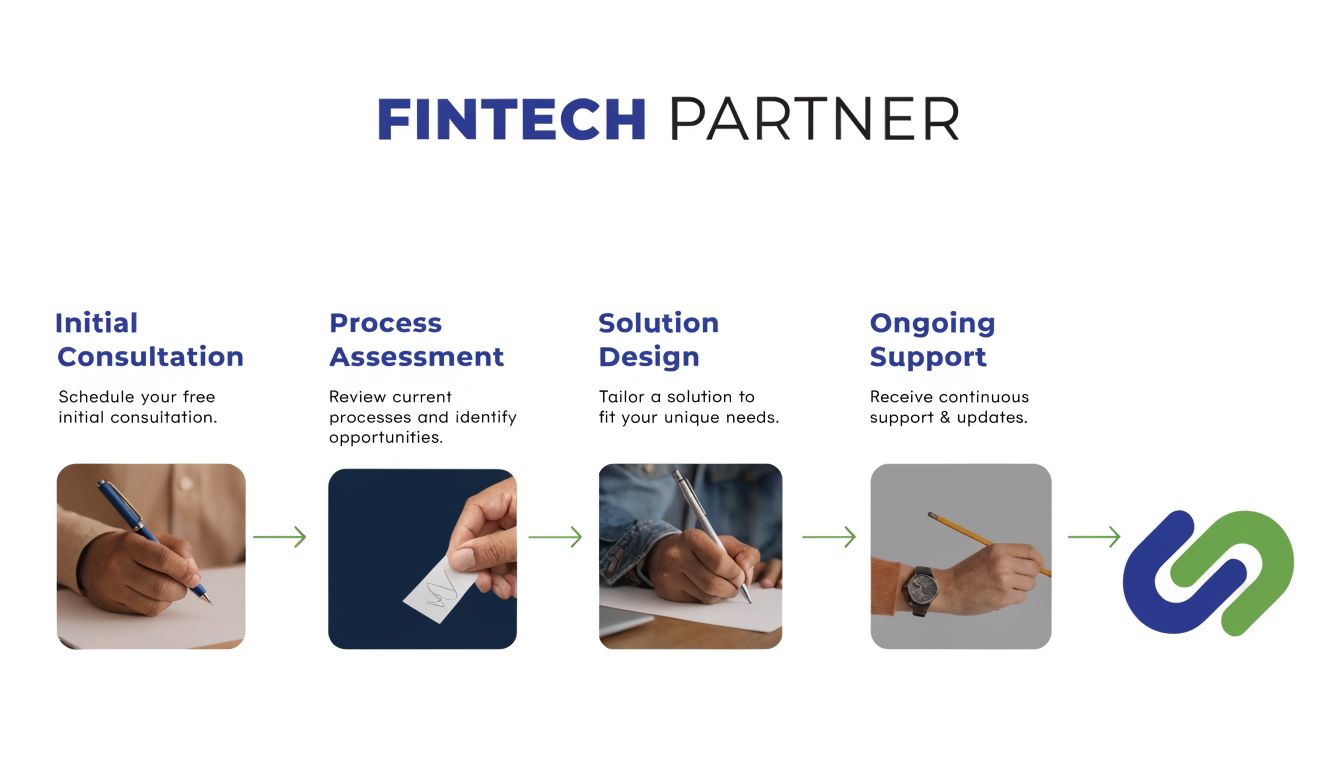
Step One: Define the Business Case
The engagement should begin with discovery, not estimates. A serious partner will ask about customer journeys, operational pain points, regulatory exposure, exception handling, target integrations, and what success looks like commercially.
This stage should produce a few concrete outputs:
A ranked problem list: Which workflow creates the most friction or opportunity?
A first-release scope: Which features are essential for launch and which can wait?
A delivery risk view: Where compliance, third-party dependencies, or legacy systems may slow progress?
A target architecture direction: Enough clarity to avoid building the wrong foundation?
If a provider jumps straight to screen counts and effort guesses, that’s usually a warning sign.
Step Two: Test the Partner, Not Just the Proposal
Good vendor selection goes beyond portfolio slides. You need to understand how the team thinks.
Ask practical questions:
How do they handle failed payments or retries?
How do they separate sensitive data from operational workflows?
How do they structure audit trails?
How do they manage handover and documentation?
How do they test negative paths, not just happy paths?
For companies still weighing sourcing options, a broad market resource on how to hire full-stack developers can help frame the talent questions, but fintech selection should go further than general software hiring. You need product engineering plus security and compliance judgment.
Step Three: Turn Ambiguity Into Scoped Decisions
The proposal phase should leave you with a roadmap, not a vague promise. The best proposals define assumptions, dependencies, exclusions, and delivery responsibilities clearly.
A useful scoping package usually includes:
| Deliverable | Why it matters |
|---|---|
| Prioritised feature list | Prevents scope inflation |
| Architecture outline | Shows whether the system can scale safely |
| Integration map | Clarifies third-party and data dependencies |
| Testing strategy | Reveals whether the team understands fintech risk |
| Roles and governance model | Avoids confusion during execution |
Step Four: Keep Ethics in the Technical Conversation
A credible fintech partner should also be able to discuss a more difficult issue. How to build personalisation without sliding into exploitative finance patterns.
This isn’t theoretical. With 80% AI adoption, a central challenge is building Explainable AI systems that are transparent, auditable, and provably serve user interests, especially for underserved communities, according to this analysis of trust and personalisation in fintech. For Canadian firms in insurance, healthcare, lending, or benefits administration, that means model decisions can’t be a black box.
Ethical fintech architecture means a product team can explain why the system made a recommendation, who it may disadvantage, and how a person can intervene.
That changes partner selection. You don’t just want engineers who can ship a rules engine or ML service. You want a team that can design for transparency, reviewability, and user protection. In practice, that means clear feature flags, decision logs, model monitoring, approval thresholds, and human override paths.
The Engagement Model That Creates the Least Regret
The best fintech engagements usually share a few traits:
Short feedback cycles: Business stakeholders review working software often.
Visible risk management: Compliance and security questions are surfaced early.
Documented decisions: Architecture, integrations, and workflow rules are written down as the product evolves.
Shared ownership: The partner builds, but the client retains product clarity and business accountability.
This is what turns a fintech initiative from a software project into a business capability. The partner isn’t just writing code. They’re helping shape how your organisation moves money, proves trust, and operates under scrutiny.
If you’re planning a fintech product for payments, lending, insurance, healthcare, or embedded finance, Cleffex Digital Ltd can help you turn the idea into a practical roadmap. Their team supports Canadian startups and SMEs with custom software development, agile delivery, and compliance-aware engineering so you can move from concept to launch with fewer blind spots.