


You can get a pilot live, win over a few clinicians, and still have the whole thing wobble the moment the next clinic joins. That's the trap many founders hit with healthcare platform development. The product works in a demo, then real appointments, payer checks, compliance reviews, and integration requests arrive at once.
A scalable HealthTech platform is built for that moment. It doesn't just add features; it keeps the same foundation stable as user numbers, data flows, partners, and clinical workflows grow. In Canada and the wider North American market, that matters even more because the region sits inside the largest projected healthtech market, with a 43.3% share in 2026 and a global market projected at USD 1.25 trillion in 2026, rising to USD 3.07 trillion by 2033 at a 13.7% CAGR. That growth is being built on cloud-based platforms, projected at 68.5% of deployment share in 2026, and software platforms, applications, and AI models projected to make up 47.8% of the market in the same source.
That combination changes how founders should think. If the first release is a throwaway prototype, every new customer becomes a rebuild. If the first release is a platform, every new customer becomes a reuse decision.
Why Most HealthTech Platforms Stall Before They Scale
A product lead ships a tidy MVP for one clinic. The front desk likes it, the clinicians tolerate it, and the founder starts talking about expansion. Then the second site asks for a different EHR connection, the privacy team wants a new audit trail, and the first billing workflow starts slowing down under real traffic.
That's usually where the trouble begins.
The first shortcuts become the future bottlenecks
The most common failure is a single-tenant shortcut that feels harmless at launch. It solves one customer fast, but it makes every new site feel like a custom project. The next one is a monolithic codebase, where a small compliance change forces a risky release across the whole system. The third is a brittle integration layer, where one EHR update breaks appointment booking, referrals, or claims.
Practical rule: if a change for one customer still feels like a change for all customers, the platform is not really a platform yet.
That's why scalability is a day-one design choice, not a post-launch upgrade. A startup needs enough flexibility to survive the first cohort. An SMB clinic network needs repeatable onboarding. An enterprise health system needs controlled change across many sites and rulesets. The same design mistake hurts all three; it just shows up at different speeds.
One useful way to think about it is this. A prototype is a shop fitting. A platform is the building structure. If you keep moving walls after tenants move in, the whole operation gets expensive and slow.
For founders comparing build options, the question is not whether the product can work. It's whether the structure can still work after the tenth clinic, the third payer, and the next compliance update. For a deeper product planning lens, see this guide to healthtech MVP development.
What Makes a HealthTech Platform Scalable
A scalable platform can take on more users, data, integrations, and clinical complexity without forcing a rewrite. That becomes clearer when the business starts to grow. A single clinic can run on a light setup, a regional chain needs repeatable operations across sites, and an enterprise health system needs structure that can hold under many teams, rules, and payer relationships.
Three kinds of scalability matter
Technical scalability is the first layer people notice: Can the system handle more traffic, more records, and more integrations without falling over?
Operational scalability sits behind that: Can the team support more workflows without adding a new person for every new customer?
Commercial scalability asks a harder question: Can the product grow across different reimbursement models, buyer types, and regulatory jurisdictions without turning every deal into a custom negotiation?
Those three layers fail in different ways. A technically strong product can still be commercially limited if it only fits one payment model. A commercially attractive product can still create operational strain if every onboarding needs manual intervention.
Practical lens: if growth always means more headcount, you've built a service business with software, not a scalable platform.
For healthtech founders in Canada and North America, that commercial layer often decides whether the platform works in the market. A product can be architecturally clean and still struggle if it does not fit how clinics, payers, and health systems get paid, approve workflows, and share risk. Equity also matters. If only larger providers can afford the implementation path, the platform may scale technically while still missing the broader market it claims to serve. For a planning perspective that connects product shape to platform structure, see this guide to enterprise application architecture patterns.
Shared services and separation are the real foundation
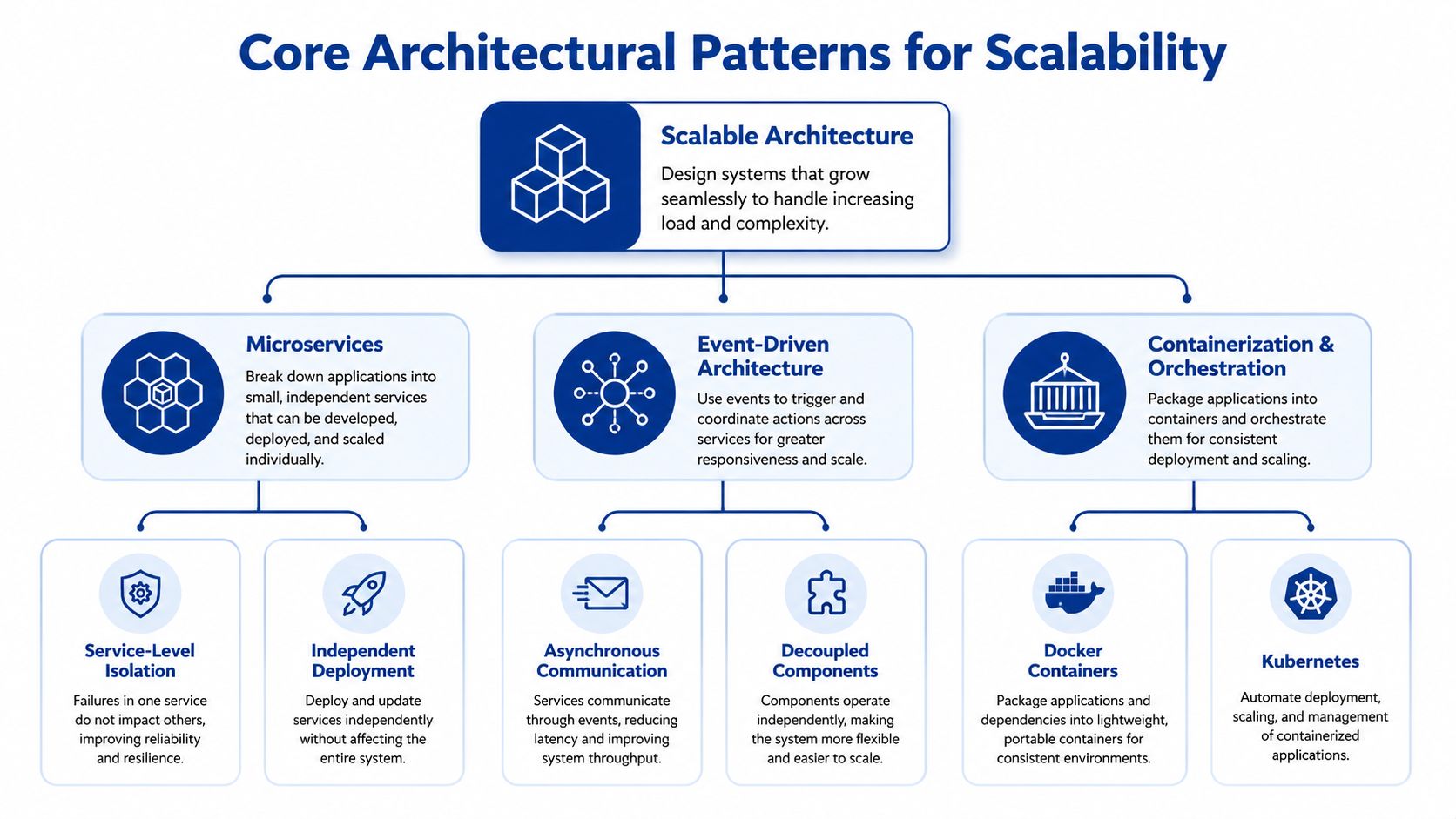
The building blocks are simple to name and hard to execute well. You need shared services for common capabilities, modular components for change isolation, interoperability standards for exchange, clear governance for decision-making, and a firm separation between regulated and non-regulated workloads. That last one matters because analytics, experimentation, and marketing should not sit in the same blast radius as clinical records.
A useful internal question is simple. Which part of the platform is weakest today: load handling, onboarding, or monetisation? Developers usually know where the friction sits. The harder work is admitting that a weak reimbursement fit or a messy stakeholder model can slow scaling just as much as a fragile codebase. A platform scales well when the technical design, operating model, and business model can all carry the same growth path.
A load balancer helps at the traffic layer, but the bigger question is how the platform distributes cost, risk, and attention across customers. For that, teams still need a clear decision on how to choose a load balancer.
Core Architectural Patterns That Hold Up Under Growth
Architecture gets easier to judge once you stop thinking in slogans and start thinking in layers. A healthtech platform usually has ingestion, storage, transformation, security, analytics, and monitoring. If one layer grows faster than the others, the system becomes unbalanced.
The stack tells you where the pain will show up
At the front, ingestion needs to handle multiple formats. In healthcare, that often means HL7 v2, FHIR APIs, DICOM, CSV, and EDI. Those are not edge cases. They're the everyday reality of healthcare platform development. FHIR is especially important because it has become the default interoperability layer for modern healthcare systems, while HL7 v2 still survives in many legacy connections.
The key choice is not just which standard you support. It's how the architecture handles change. A modular platform separates each concern so high-volume telehealth traffic, claims traffic, or notification traffic can scale independently. That is where microservices help, because service-level isolation lets one workflow grow without forcing a full-system rewrite. Event-driven architecture helps too, because it suits asynchronous work like claims, alerts, and analytics pipelines. API-first design turns workflows into contracts that other systems can reuse.
For teams choosing infrastructure, the load distribution question matters just as much as the data model. A practical overview of that decision is covered in how to choose a load balancer, which is useful when traffic patterns are uneven across clinics or regions.
Multi-tenancy solves one problem and creates another
Multi-tenant design is attractive because it avoids duplicating the whole stack for each customer. But it also creates data-model constraints, because tenant boundaries have to stay strong enough for privacy and operational isolation. That's why multi-tenancy should be treated as an architecture decision, not just a hosting choice.
The trade-offs are real. Microservices add operational overhead. Event-driven systems introduce eventual consistency. Multi-tenancy demands cleaner data partitioning. None of those patterns is automatically better. The right answer is the one that fits the rollout pattern you expect.
If you want a deeper pattern library, the enterprise application architecture patterns guide is a useful companion piece.
Security, Privacy, and Compliance as a Scaling Feature
Compliance often gets treated like a tax on growth. In healthcare, it's the opposite. The platforms that scale best are usually the ones that treat privacy-by-design as part of the product architecture, not a late-stage checklist.
Match the control to the layer
At the identity layer, use role-based access and purpose-based permissions so users only see what they need.
At the network layer, encrypt traffic in transit and keep regulated services separated from experimental or marketing systems.
At the data layer, use encryption at rest, de-identification pipelines, and careful consent handling.
At the application layer, log sensitive actions and build breach response automation early, not after an incident.
At the audit layer, keep logs usable, searchable, and tied to real user activity.
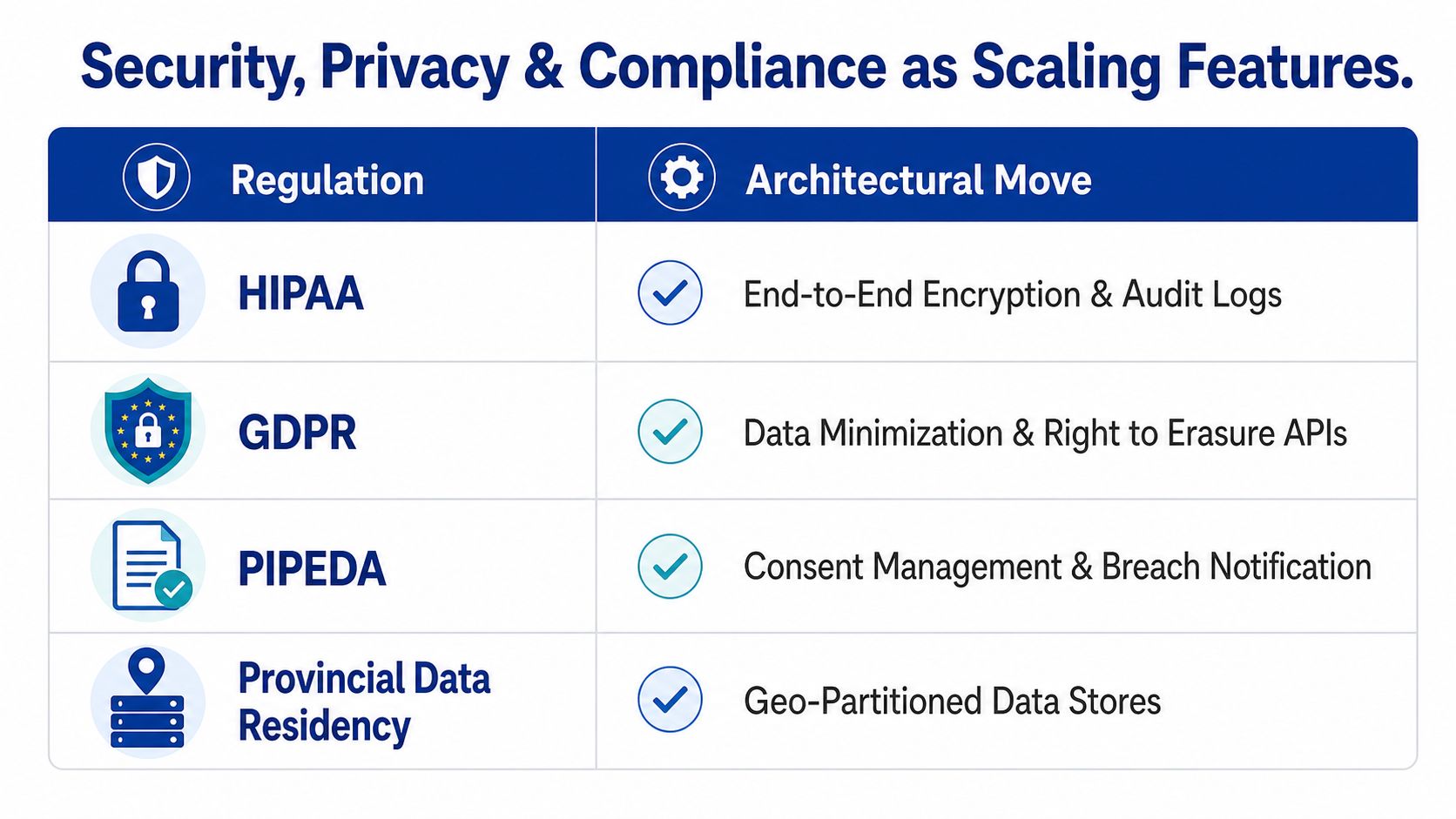
That mapping matters because different markets bring different obligations. HIPAA, GDPR, PIPEDA, and provincial data residency rules don't ask for identical controls. A platform that serves U.S. covered entities, European users, and Canadian health organisations often needs all of them at once, even if the wording differs.
Regulated workloads should be isolated from non-regulated analytics, marketing, and experimentation layers. If one tier has a security issue, the whole platform shouldn't have to go down.
Why this becomes a growth enabler
When privacy controls are built into the structure, onboarding a new payer or region becomes easier. You're not rebuilding trust boundaries every time. That's why compliant design is not just about avoiding penalties. It's about making the platform repeatable.
If you need a security-focused technical reference, data security in healthcare information systems is a practical starting point. The broader lesson is simple, though. In healthcare, trust is part of the architecture, not a layer added after launch.
Scaling Strategies, Observability, and Reliability
Growth in healthcare usually fails in one of three places. The system runs out of capacity, the team can't see what's happening, or a small outage spreads into a bigger operational mess. That's why scaling and reliability belong in the same conversation.
Pick the right scaling lever for the problem
Horizontal scaling helps when traffic is uneven or spikes quickly. Vertical scaling helps when one service needs more resources without changing the architecture. Sharding makes sense when clinical or operational data gets too large for one database path. Caching is useful for high-read data like provider directories or formulary lookups. Queues help with bursts, such as telehealth check-ins, notification fan-out, or batch ETL.
A queue-based intake flow is a good example. Instead of letting a morning appointment storm write directly into the EHR all at once, requests can be buffered and processed in a controlled flow. That reduces pressure on the write path and keeps patient-facing services from choking each other.
Here's a simple comparison of the most common patterns.
| Pattern | Best For | Watch Out For |
|---|---|---|
| Horizontal scaling | Bursty traffic and user growth | More service coordination |
| Vertical scaling | Quick gains on one bottleneck | Hard limits and cost spikes |
| Sharding | Large clinical or operational datasets | Complex data access patterns |
| Caching | Repeated reads and directory lookups | Stale data if invalidation is poor |
| Queueing | Spiky intake, ETL, and notifications | Delays if backlogs are not watched |
Observability makes scaling manageable
A platform you can't see is a platform you can't really scale. Use structured logs, distributed tracing, golden-signal metrics, and synthetic monitoring so problems show up before users complain. Define service-level objectives per service, not just for the whole platform, because patient-facing video, scheduling, and document exchange do not fail in the same way.
Load testing and failover drills should sit beside feature work, not behind it. If a team waits until after launch to test regional recovery, it is already late. The best operators treat resilience as a release criterion, not a nice-to-have.
Operational rule: if the analytics database starts competing with clinical writes, you've mixed workloads that should have stayed apart.
The Business Side of Scaling That Most Architecture Guides Ignore
A lot of architecture advice stops where the decision begins. A platform can be technically elegant and still fail commercially if the vendor stack, reimbursement model, and stakeholder economics don't line up.
Vendor choice is part of the product strategy
When evaluating cloud or SaaS vendors for healthcare platform development, security attestations are only the first checkpoint. Teams also need to look at BAA coverage, exit clauses, multi-region redundancy, and pricing models that grow with usage rather than punishing success. If a vendor makes every new clinic or data volume increase feel like a billing trap, the platform will eventually slow down.
The same logic applies to partnerships. A platform needs a commercial model that fits the buyer's world. In Canada, that often means paying close attention to reimbursement fit, workflow integration, and whether the platform supports blended or outcome-based financing when serving harder-to-monetise care segments. That's especially relevant in hybrid mental health, elderly care, and speciality clinic networks, where demand is real but the path to revenue is not always straightforward.
Equity is part of scale, not separate from it
Scaling responsibly also means not leaving people behind. Rural users, multilingual communities, and low-digital-literacy patients often struggle more with live video, wearables, and tracking tools than urban users do. A feature-rich platform that assumes perfect connectivity can widen exclusion even while it grows.
That's why mobile-first and language-aware design matter. The highest-growth product is not always the most advanced one. Sometimes the better platform is the one people can use in low-bandwidth settings, with fewer steps and clearer instructions.
Cleffex Digital Ltd fits into that discussion as a delivery partner that works across architecture, compliance, and integration rather than treating them as separate workstreams. Its healthcare software integration service is relevant when the commercial model depends on connecting legacy systems cleanly. For teams evaluating options, that kind of cross-functional alignment matters more than a feature checklist.
A Realistic Migration and Rollout Roadmap
The right rollout plan depends on who you're serving. Startups, SMB clinics, and enterprise systems are all dealing with the same scaling problem, but they're solving it from very different starting points.
Startups should earn the right to refactor
A startup can begin with a single-tenant MVP, but it shouldn't stop there. The goal is to prove clinical value fast, then deliberately refactor into shared services before the second customer cohort creates a maintenance mess. Introduce feature flags once the first customer asks for variation without a separate code branch. Invest in observability when support tickets start repeating.
SMB clinics need repeatability before breadth
For smaller clinic networks and digital health vendors, the early win is not giant scale. It's multi-tenant onboarding that doesn't require heroic manual setup. Keep the integration list small at first, focus on a few regional EHRs, and move compliance evidence from manual collection to automated capture as soon as the same questions keep coming back. That's usually the sign the process can be standardised.
Enterprise migrations need coexistence
Hospitals and payers usually can't rip and replace. They need brownfield migration and a strangler-fig pattern, where one workflow at a time moves off the monolith. Negotiate the data residency plan and BAA early, especially before the first regulated workflow goes live. Keep the legacy path alive until the new service has proven it can stand on its own.
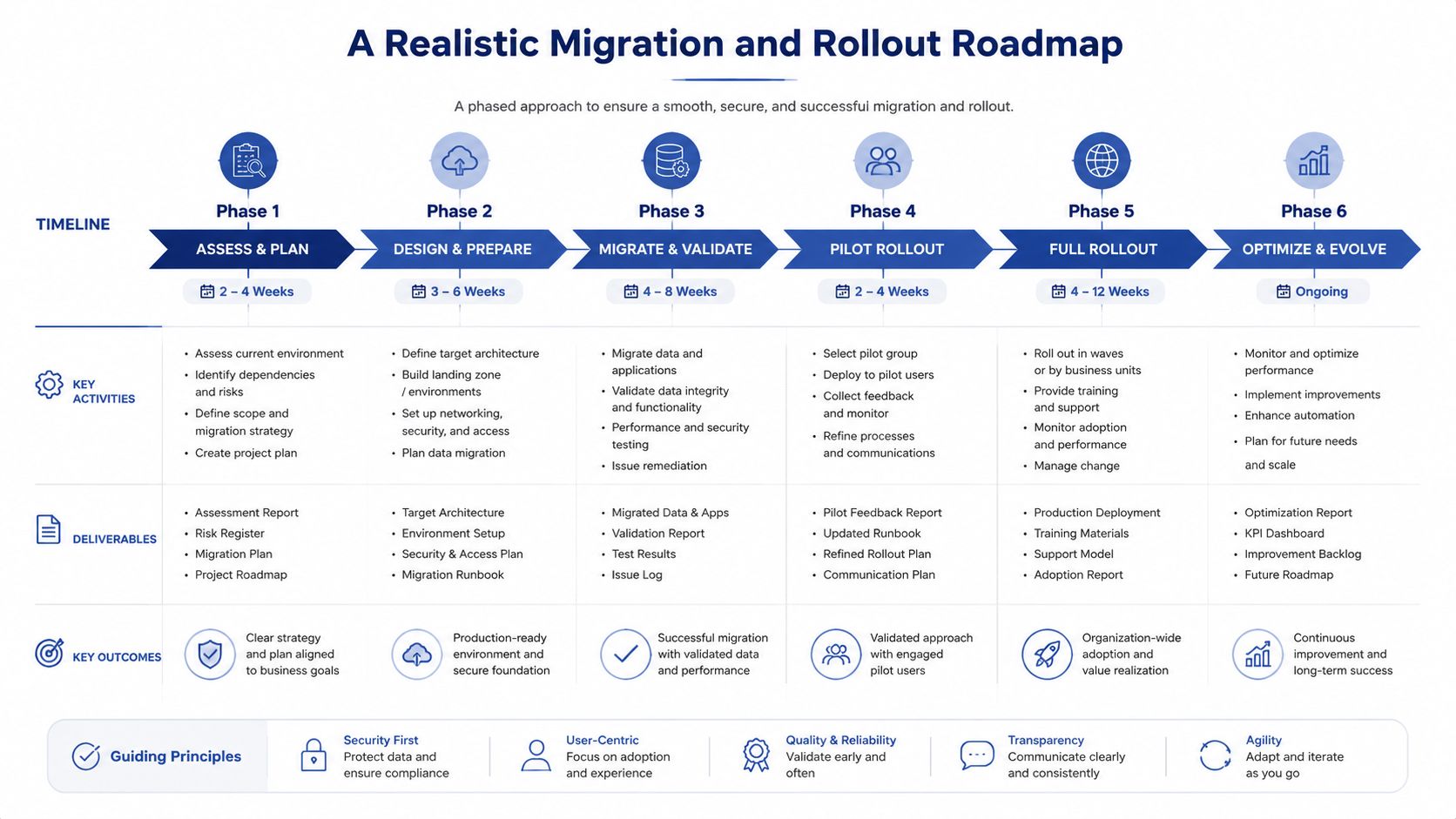
A workable calendar often looks like this: discovery, pilot, integration, controlled rollout, observability hardening, then expansion. The exact timing varies, but the sequence usually doesn't.
Long-Term Growth and Frequently Asked Questions
The platforms that keep growing for years usually do three things well. They fit a real operational need, they stay adaptable as regulations and workflows change, and they don't ignore how money flows through healthcare. That's especially true in the underorganised care segments opening up across Canada and North America, where the opportunity is real but the economics need discipline.
FAQ
How long does a realistic healthtech platform build take?
It depends on scope, integrations, and compliance burden. A narrow pilot can move quickly, but a platform that needs interoperability, auditability, and multi-site rollout takes longer because those pieces can't be bolted on safely after launch.
What KPIs show real scalability?
Look for repeatable onboarding, stable service performance, lower manual support effort per customer, and the ability to add a new workflow without destabilising the existing ones. Vanity growth is more users. True scale is more users without a proportional increase in complexity.
When should a team build custom rather than configure an existing tool?
Build custom when the workflow, data exchange, or reimbursement logic is a core differentiator. Configure existing tools when the need is common, and the risk of lock-in is acceptable. The wrong choice is usually forcing a standard product to behave like a platform.
How do I know whether Cleffex Digital Ltd is a fit?
If your next stage depends on secure integration, cloud healthcare solutions, or cleaner healthcare software architecture, start with the Cleffex Digital Ltd homepage and assess whether the team can connect compliance, interoperability, and delivery without separating them into disconnected projects.
The next 30 days matter more than the next 30 months of slides. Choose the architecture that matches your real growth path, not the one that only looks good in a demo.
Cleffex Digital Ltd helps healthcare teams design secure, compliant, and scalable platforms that can grow across clinics, payers, and patient populations. If you're planning your next integration, platform modernisation, or cloud healthcare solutions roadmap, visit Cleffex Digital Ltd to see how the team approaches healthcare software architecture and long-term growth.