

Imagine your store knowing exactly what every customer wants, sometimes even before they do. That’s the real power of AI in retail and ecommerce. It's not some futuristic fantasy; it’s a technology that’s already here, working behind the scenes to help businesses make smarter decisions and create shopping experiences that just feel right.
Think of it as a digital co-pilot for your entire operation.
Your New Digital Storefront: How AI Is Reshaping Retail

Artificial intelligence is fundamentally changing the relationship between retailers and shoppers. It's not just a single tool but more like an expert assistant woven into every part of your business. It pores over mountains of data: everything from browsing history and abandoned carts to past purchases, to figure out what makes each customer tick.
This isn't just a minor trend. It's a massive operational shift. In Canada, the adoption of AI in business has been accelerating rapidly. In 2025, Statistics Canada reported that 12.2% of businesses were using AI to produce goods or deliver services, a huge jump from just 6.1% the year before.
From Store Shelves to Smart Suggestions
The old way of doing retail was pretty passive. You’d stock your shelves, arrange your products, and hope the right person happened to walk by and find what they were looking for.
AI flips that entire model on its head. It actively steers customers toward products they’re likely to love, creating a much more intuitive and responsive digital storefront. This intelligent approach isn't just about making customers happier; it delivers real, measurable results. Businesses that get AI right often see a 10-12% average increase in revenue.
The goal of AI in retail isn't just to sell more stuff. It's about building genuine relationships by showing you understand your customer's needs at every single touchpoint.
Creating a Competitive Edge with AI
Today's shoppers expect a lot. They want things to be easy, personalised, and quick. AI is the toolkit that helps you meet and exceed those expectations, giving you a serious advantage in a very crowded market. It allows you to stop reacting to problems and start proactively building better experiences.
Here are a few key advantages AI brings to the table:
Hyper-Personalisation: AI algorithms dig into customer data to serve up unique product recommendations and promotions. It makes each shopper feel like the store was designed just for them.
Operational Efficiency: Behind the scenes, AI is a workhorse. It optimises inventory, fine-tunes supply chains, and makes sure your most popular products never go out of stock, which cuts down on waste and lost sales.
Better Customer Engagement: AI-powered chatbots and virtual assistants are always on, ready to provide instant support, answer questions, and guide customers 24/7.
Smarter Business Insights: AI helps you connect the dots in complex market trends and consumer behaviour. This leads to more accurate forecasting and much smarter strategic decisions.
As AI continues to reshape retail, the look and feel of your online storefront is more important than ever. Creating compelling visuals is crucial, and you can now use advanced tools to generate high-quality AI images for websites. By weaving these smart technologies into your strategy, your digital storefront becomes more than a simple catalogue; it evolves into an intelligent, interactive, and incredibly effective sales engine.
Core AI Applications Driving Real Ecommerce Success
It’s easy to get lost in the buzz around artificial intelligence. But when it comes to retail and ecommerce, AI isn't just a futuristic concept; it’s a set of practical tools already delivering real, measurable results. These aren't just shiny new toys; they're workhorses that increase sales, slash inefficiencies, and forge stronger bonds with customers.
Let's cut through the noise and look at the core applications making a tangible difference right now.
Hyper-Personalisation and Recommendation Engines
Think of the best salesperson you've ever met – someone who instantly gets your style, knows your budget, and anticipates what you need. That's what an AI personalisation engine does, but for every single visitor on your site. It dives deep into customer data, looking at past purchases, browsing habits, and even abandoned carts to surface the most relevant products imaginable.
This is worlds away from a generic "You might also like" carousel. AI algorithms spot subtle patterns in behaviour to craft a genuine one-to-one shopping journey. It's a powerful approach, with retailers often seeing a 40% increase in revenue from well-executed personalisation alone.
This kind of tailored experience directly tackles a huge ecommerce headache: cart abandonment. By showing customers exactly what they’re looking for before they even have to search, AI dramatically improves the odds of making a sale.
Dynamic Pricing Optimisation
Imagine having a seasoned stock trader managing your product prices. That’s essentially what dynamic pricing does. Instead of locking in a price and hoping it’s right, AI algorithms constantly scan the market in real time to find the perfect price point.
These systems juggle a huge number of variables to maximise your profitability without scaring away customers.
Competitor Pricing: The AI keeps a close eye on what your rivals are charging and adjusts your prices to stay competitive.
Demand Signals: It picks up on sudden spikes in interest, like a product going viral, and can tweak the price to match the buzz.
Inventory Levels: If you’re overstocked on an item, the AI can strategically lower the price to move units and free up warehouse space.
This automated, data-first strategy lets you react to market shifts instantly – something a human team could never manage at scale. The result is often a healthy 5-10% improvement in profit margins.
AI-driven pricing isn't a race to the bottom. It’s about finding that sweet spot where price, demand, and inventory all line up for maximum value.
Predictive Analytics for Inventory Management
Stockouts are silent killers. They cost you a sale and, more importantly, can send a loyal customer straight to a competitor. Predictive analytics is the AI-powered antidote to this all-too-common problem.
Instead of just looking at historical sales, AI models take a much wider view. They analyse market trends, upcoming holidays, weather patterns, and even social media chatter to forecast future demand with startling accuracy. It’s about being proactive, not reactive, ensuring you have what your customers want, right when they want it. For any business serious about this, a deep dive into AI inventory management for ecommerce is a non-negotiable first step.
The bottom-line impact is huge. Research shows that companies using AI in their supply chain have cut logistics costs by 15% and reduced inventory levels by 35%, all while improving service levels.
AI-Powered Chatbots and Customer Service
In today’s world, customers expect answers now, not tomorrow. AI-powered chatbots and virtual assistants deliver on that expectation, providing instant support 24/7 without the need for a massive service team.
Forget the clunky, repetitive bots of the past. Modern chatbots use Natural Language Processing (NLP) to understand what customers are actually asking and provide genuinely useful responses. They can effortlessly handle a huge range of tasks:
Answering common questions about shipping policies and returns.
Giving customers real-time updates on their order status.
Recommending products based on a simple description of what a customer needs.
By taking care of the routine inquiries, these bots free up your human agents to tackle the complex, high-touch issues that really matter. It’s no wonder that AI chatbots can now fully resolve customer conversations around 70% of the time. Enhancing this interaction often starts with great content, which is where AI content optimisation for ecommerce comes into play. Pulling these elements together is what a modern AI in retail and ecommerce strategy is all about.
To give you a clearer picture, here’s a quick summary of how these key AI applications translate into direct business value.
Key AI Use Cases in Retail and Their Business Impact
| AI Application | Primary Function | Key Business Benefit |
|---|---|---|
| Personalisation Engine | Analyses user data to deliver individualised product recommendations and experiences. | Increased conversion rates, higher average order value, and improved customer loyalty. |
| Dynamic Pricing | Adjusts product prices in real time based on demand, competition, and inventory. | Maximised profit margins, competitive positioning, and efficient stock clearance. |
| Predictive Inventory | Forecasts future demand using AI models to prevent stockouts and overstock situations. | Reduced carrying costs, eliminated lost sales, and a more efficient supply chain. |
| AI Chatbots | Provides 24/7 automated customer support and handles routine inquiries. | Lower service costs, faster response times, and improved customer satisfaction. |
As you can see, each application targets a specific, high-impact area of the business, turning data into a tangible competitive advantage.
Meeting the Modern Shopper with AI-Powered Experiences
Let's face it: today's customers are anything but passive. They're active, engaged, and in control of their shopping journey. They aren't just looking to buy a product; they expect an experience that feels like it was designed specifically for them – intuitive, helpful, and personal. This is where AI in retail and ecommerce makes its biggest impact, moving beyond simple back-end efficiencies to create memorable interactions that keep customers coming back.
The way people find products is fundamentally changing. A growing number of shoppers are skipping traditional search engines and heading straight to conversational AI tools for their initial research. They’re using platforms like ChatGPT as a sort of personal shopping consultant, asking for recommendations and comparing features before they even visit a single retail website.
This shift isn't just a trend; it's a big change in how consumers behave. Having a great product is no longer enough. You also need to provide an intelligent, frictionless path for people to find it.
The New Era of Personalisation
The demand for a personal touch is stronger than ever. Shoppers know their data has value, and most are happy to share it if it means getting a better, more relevant experience. They expect you to remember what they like, anticipate what they might need next, and surface products that match their style without them having to dig for them.
AI is the engine that makes this kind of one-to-one attention possible, even for businesses with thousands of customers. By analysing customer behaviour, AI can tailor everything from the layout of a webpage to the promotions a person sees, making every interaction feel uniquely relevant. Getting this right requires a solid strategy, which you can dive into with our ultimate guide to ecommerce personalisation.
This data-driven approach effectively turns your generic online store into a personal boutique for every single visitor. It’s a powerful way to meet customer expectations and drive serious engagement.
Bridging the Digital and Physical Worlds with AR
One of the oldest hurdles in ecommerce is the "touch-and-feel" gap. Customers can't physically interact with a product online, which often leads to hesitation. AI-powered Augmented Reality (AR) is solving this problem beautifully, blending the convenience of online shopping with the confidence you get from an in-store trial.
Think about it: a customer can now point their phone at their living room and see exactly how that new sofa would look, or virtually try on a dozen pairs of sunglasses in seconds. This isn't just a cool feature; it's a powerful tool that closes sales.
Augmented Reality removes the guesswork from online shopping. It gives customers the confidence to click 'buy' by letting them visualise products in their own space, dramatically reducing uncertainty and buyer's remorse.
This technology is already paying off big time. Canadian consumers are quickly embracing AI, and a recent report found that AR experiences can increase conversion rates by a staggering 250%. The same report from Novatize on AI in Canadian ecommerce points to another major shift: 15% of 16-24 year-olds now use AI as their first stop for search. And looking ahead, 44% of Canadians planned to use AI agents for price comparisons during the 2025 holiday season, showing a clear appetite for these smarter shopping tools.
Crafting Experiences That Drive Loyalty
At the end of the day, AI gives retailers the tools to build real relationships, not just process transactions. When you can understand and anticipate what your customers need, you create a shopping journey that is not only effortless but genuinely enjoyable.
Those positive, memorable experiences are what build true customer loyalty. A shopper who feels understood is far more likely to become a repeat customer. That’s the real promise of AI in retail and ecommerce; it’s not just about optimising for a single sale, but about creating a loyal customer for life.
Your Practical Roadmap for Implementing AI in Retail
Diving into AI in retail and ecommerce sounds intimidating, but it doesn't have to be some massive, complicated overhaul. The secret to a successful AI strategy isn't about fancy algorithms; it's about deeply understanding your own business. This roadmap breaks down the essential steps for bringing artificial intelligence into your operations in a way that delivers real, measurable value right from the start.
The journey begins not with technology, but with your core business challenges. Before you even think about a single line of code, ask a simple question: What problem are we actually trying to solve? Maybe you're aiming to boost conversion rates, slash cart abandonment, or finally get a handle on your stock levels. These are all perfect starting points.
Nailing down these specific, tangible goals is the most critical step you'll take. It gives your AI initiatives a clear target and stops you from sinking money into shiny solutions that don’t fix a genuine business need.
Start with Your Business Goals
Think of AI as a powerful tool in your workshop, not a magic wand. Like any good tool, it’s most effective when you have a specific job for it. To figure out where to begin, pinpoint the biggest friction points in your customer journey or your day-to-day operations.
Here are a few common headaches that are prime candidates for an AI fix:
Low Customer Engagement: Are shoppers bouncing from your site without buying? AI-driven personalisation can show them products they actually want to see.
Inventory Nightmares: Constantly selling out of popular items while others gather dust? Predictive analytics can bring balance to your warehouse.
Swamped Support Teams: Are your agents stuck answering the same basic questions over and over? An AI chatbot can easily handle that repetitive work.
Choosing one or two high-impact areas to focus on first will give your project a clear direction and make it much easier to measure success later on.
The flowchart below shows how AI can completely reshape the customer experience, guiding them from their first look to their final purchase.
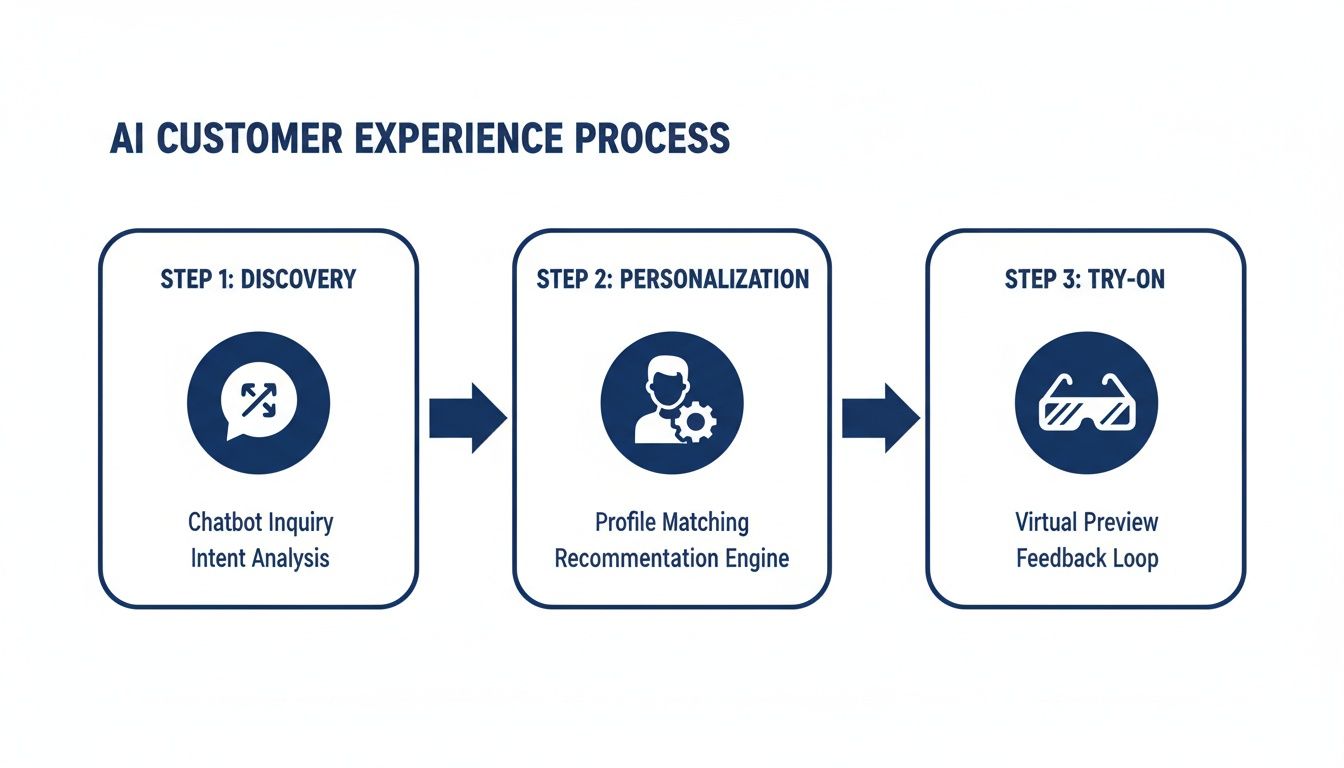
This illustrates how AI creates a smooth path to purchase by seamlessly guiding a shopper from broad discovery, through personalised recommendations, and even into immersive try-on experiences.
Assess Your Data Readiness
Fantastic AI is built on a foundation of fantastic data; it’s the fuel that makes the engine run. Before you can roll out any intelligent solutions, you need to get your information in order. Your data has to be clean, organised, and, most importantly, accessible.
This means pulling together information from all your different systems: your ecommerce platform, CRM, and marketing tools, into a single, unified view. The quality of your data directly impacts the quality of the insights your AI can produce. If your data is a mess, your AI's performance will be, too.
Decide Whether to Build or Buy
One of the biggest crossroads you'll reach is deciding whether to build a custom AI solution from the ground up or buy an off-the-shelf one. For most small and medium-sized businesses, buying is hands-down the smarter, more efficient choice.
Build vs. Buy: Creating a custom AI model requires a dedicated team of data scientists and a serious investment of time and money. Buying a SaaS (Software as a Service) solution, on the other hand, gives you access to powerful, pre-built tools without the crippling upfront cost.
SaaS platforms are typically designed to be user-friendly and integrate nicely with popular ecommerce systems like Shopify or Magento. They let you get up and running quickly so you can start seeing a return on your investment much faster. For a deeper dive into this, understanding the details of AI-powered ecommerce development can help you make an informed decision.
Launch a Pilot Project and Measure Success
Don't try to boil the ocean. The smartest way to introduce AI in retail and ecommerce is to start small with a focused pilot project. Pick one of the business goals you identified earlier and run a test to prove the concept works for you.
For instance, you could roll out a product recommendation engine on a few of your top-selling product pages or deploy a chatbot to handle customer questions after hours. This approach lets you test the tech in a controlled environment, iron out any wrinkles, and collect hard data on its performance.
Before you start, set clear Key Performance Indicators (KPIs), like achieving a 10% increase in average order value or a 20% reduction in customer service tickets. Once you’ve proven the ROI on a smaller scale, you'll have the confidence and the compelling business case to expand your AI efforts across the rest of your operation.
Navigating the Common Stumbling Blocks of AI Adoption
Bringing artificial intelligence into your business is a game-changer, but let's be honest, it’s not a simple plug-and-play solution. Getting AI in retail and ecommerce right means looking past the hype and anticipating the very real hurdles you’ll face. By knowing what to expect, you can build a smarter strategy that avoids common pitfalls and sets you up for a win.
The first and most critical hurdle is almost always data. Think of AI as a brilliant apprentice; it can only learn from the information you give it. If your customer data is scattered across different systems, full of errors, or just plain incomplete, your AI's performance will be mediocre at best. Getting your data house in order is step one.
Then there's the ever-present challenge of data privacy. Customers today are savvy about their data, and trust is incredibly fragile.
Handling Data Privacy and Compliance
In a world where data is as valuable as cash, protecting customer privacy isn’t just about following the rules; it's fundamental to keeping your customers' trust. When you use AI, you're handling massive amounts of shopper data, which puts you squarely under the microscope of regulations like Canada's PIPEDA.
To get this right, you need to be upfront with customers. Tell them what you're collecting and how it helps you make their shopping experience better. This comes down to a few core practices:
Getting Clear Consent: Make sure you have a clear "yes" from users before you track or use their information.
Locking It Down: Implement serious security measures to safeguard that data from breaches.
Building in Privacy from Day One: Don't treat privacy as an afterthought. It needs to be a core part of your AI system's design from the very beginning.
Ignoring privacy can lead to crippling fines, but the real damage is a loss of customer loyalty that can be impossible to win back. For any AI strategy to succeed in the long run, this part is non-negotiable.
Weaving AI into Your Existing Tech Stack
One of the biggest practical headaches is getting your shiny new AI tools to talk to the systems you already rely on. Your ecommerce platform, your CRM, your inventory software – they all need to connect seamlessly for the AI to do its job. A clunky integration is worse than no integration at all; it just creates new problems.
This is why choosing the right AI solution is so important. Look for platforms that already have established integrations with the tools you use, or at least provide clear, developer-friendly APIs to build those connections. When data can flow smoothly between systems, your AI can access the information it needs to give you accurate insights in real time.
Closing the Skills Gap on Your Team
The minute you mention AI, people start worrying about their jobs. But the data tells a different story. For AI in retail and ecommerce, it’s less about replacing people and more about evolving their roles. The real challenge isn't automation; it's getting your team ready to work with these new tools.
This is a huge deal in Canada's retail sector, which is a massive employer with over two million people. A recent survey found that while 9.3% of businesses had adopted generative AI by early 2024, a whopping 89.4% of them expected their number of employees to stay the same or even grow.
The goal isn't to replace your team with AI, but to empower them with it. Focus on training your staff to interpret AI insights and use them to make smarter, more creative business decisions.
The key is to invest in training and create a workplace culture that embraces learning. When your team understands how to use AI to their advantage, what once looked like a threat becomes your greatest asset.
Got Questions About AI in Retail? Let's Get Them Answered.
Thinking about bringing AI into your retail or ecommerce business is exciting, but it almost always brings up some big, practical questions. Moving from an idea to a real-world plan means you need clear, straightforward answers. This section is all about tackling the most common questions we hear from business owners, breaking them down into simple takeaways you can actually use.
We’ll dig into the three questions that come up time and again: Is this stuff even affordable for a smaller business? What’s the very first thing I should do? And how will I know if any of this is actually working?
Can My Small Business Really Afford AI?
Let’s clear up one of the biggest misconceptions right away: AI is not just for multinational corporations with bottomless budgets. A few years ago, that might have been the case, but things have changed – a lot. Today, incredibly powerful AI tools are within reach for businesses of all sizes, mainly because of Software as a Service (SaaS) solutions.
Instead of the monumental task of building a custom AI model from the ground up (which, yes, requires a team of data scientists and a serious financial commitment), you can now subscribe to a ready-made platform. These services are built to plug right into popular ecommerce systems like Shopify or Magento, and they usually run on a predictable monthly fee. That intimidating, five-figure upfront cost? Gone.
Here’s how even a small shop can get started without breaking the bank:
Start with a Chatbot: An AI-powered chatbot is a classic, cost-effective first step. It can instantly improve your customer service and take a huge load off your team, and most providers offer tiered pricing so you can start small and grow.
Use AI-Enhanced Marketing Tools: Chances are, your email or social media marketing platform already has AI features baked in. These can help you fine-tune campaigns and personalise content without a massive new expense.
Look for Platform-Native AI: More and more, ecommerce platforms are building AI directly into their core services. Think smart product recommendations or fraud detection – features you might already have access to.
The secret is to focus on tools that solve one specific, high-impact problem. You don't need a sprawling, enterprise-grade system to get a fantastic return.
What Is the Single Most Important First Step?
With all the options out there, it’s easy to get analysis paralysis. So, what's the one thing you need to do first? It has absolutely nothing to do with technology. The single most important first step is to clearly define your business goal.
Before you even think about looking at a single vendor or algorithm, you have to answer one simple question: What problem are we actually trying to solve? If you don't have a clear target, you'll end up with a powerful, expensive tool that doesn't actually help your business.
An AI tool is only as valuable as the problem it solves. Start by identifying your biggest operational headache or your greatest growth opportunity, and let that guide your entire strategy.
Think about the real pain points in your business right now. Are you struggling with:
High Cart Abandonment? A personalisation engine should be your first port of call.
Constant Stockouts? Predictive inventory analytics is where you need to look.
An Overwhelmed Support Team? A customer service chatbot is the logical starting point.
By zeroing in on a tangible, measurable goal, like "cut customer service response times in half" or "boost average order value by 15%", you give your AI project a clear sense of purpose. This focus not only makes your decision-making process a hundred times easier but also sets you up to measure your success down the road. Everything else should flow from this one crucial step.
How Do I Measure the Return on My AI Investment?
Knowing whether your investment is paying off is non-negotiable. "Feeling" like things are better isn't good enough – you need hard data to justify the cost and guide your next moves. The great news is, if you started by defining a clear business goal, you're already halfway there.
The trick is to connect your AI tool directly to specific Key Performance Indicators (KPIs). For every AI application, there are concrete numbers you can track to see what kind of impact it's having.
Here’s a practical look at what to measure for some common AI tools:
| AI Application | Key Metrics to Track for ROI | What Success Looks Like |
|---|---|---|
| Personalisation Engine | – Conversion Rate | |
| – Average Order Value (AOV) | ||
| – Customer Lifetime Value (CLV) | After three months, AOV increases by 18% for shoppers who engage with AI-powered recommendations. | |
| AI Chatbot | – Customer Support Ticket Volume | |
| – First Response Time | ||
| – Customer Satisfaction (CSAT) Scores | The chatbot handles 60% of routine questions, freeing up human agents and boosting CSAT scores by 25%. | |
| Predictive Inventory | – Stockout Rate | |
| – Inventory Carrying Costs | ||
| – Order Fulfilment Time | Stockouts of your best-sellers drop by 90%, while carrying costs for slow-movers fall by 30%. | |
| Dynamic Pricing | – Gross Profit Margin | |
| – Sales Volume During Promotions | ||
| – Competitor Price Parity | Profit margins climb by 7% by automatically adjusting prices to match real-time market demand. |
To get this right, you need a "before" picture. Establish a baseline by tracking your chosen KPIs for a month or two before you implement anything. Once the AI is up and running, keep tracking those same metrics. The difference between your baseline and your new numbers is the real, measurable lift – and the proof that your investment is paying off. This data-driven approach takes the guesswork out of the equation and builds a solid case for expanding your use of AI in retail and ecommerce.
At Cleffex Digital Ltd, we specialise in building innovative technology solutions that solve real business challenges. If you're ready to explore how AI can drive growth for your business, we can help you build a practical, results-driven strategy. Learn more about our custom software development services and start your journey today.