

Healthcare software development is the craft of designing, building, and maintaining software specifically for the healthcare world. It's all about creating applications that make patient care better, simplify how clinics run, and keep sensitive medical data locked down tight. Think of everything from complex Electronic Health Records (EHRs) to the telehealth platforms we’ve all grown used to.
The Evolution of Modern Healthcare Software
At its heart, developing software for healthcare isn't just about writing lines of code; it's about building digital tools that support human health. Imagine it as the central nervous system for a modern hospital. Decades ago, this might have been a simple digital filing cabinet. Today, it’s a sprawling ecosystem of interconnected apps that handle everything from booking an appointment to running AI-powered diagnostics.
This evolution is a direct response to the massive demand for more efficiency, better patient outcomes, and real, data-driven insights. The global digital health market is exploding, on track to hit over $660 billion by 2025. This isn't just a number; it shows just how critical reliable and robust software has become. As a leading software development company, we see this demand every day. Our clients need solutions that are not only powerful but also incredibly secure and easy for both clinicians and patients to use.
Key Drivers of Change in Healthtech
A few major forces are pushing healthtech forward. If you're building a product in this space, you need to understand them inside and out.
The Rise of Telehealth: Virtual care is no longer a "nice-to-have"; it's a fundamental part of modern medicine. This means we need software that can handle secure video calls, remote patient monitoring, and digital prescriptions without a single hiccup.
A New Focus on Patient Engagement: People now expect to be partners in their own healthcare journey. This has led to a boom in patient portals, wellness apps, and educational tools that give users direct access to their health information.
The Absolute Need for Interconnected Systems: For too long, patient data has been trapped in digital silos. The push for interoperability: getting different systems like EHRs, pharmacy databases, and lab software to actually talk to each other, is one of the biggest challenges we're tackling. It’s the only way to get a full picture of a patient's health.
Modern healthcare software development is all about creating a connected, intelligent, and patient-first ecosystem. It’s the bridge that turns raw medical data into life-saving insights and better quality of care.
Common Types of Healthcare Software
The healthtech field is massive, but most projects tend to fall into a handful of core categories. For example, our custom software development services are often brought in to build highly specific solutions designed for unique clinical challenges.
These solutions typically include:
Electronic Health Record (EHR) Systems: These are the digital backbones of modern healthcare, holding a patient's entire medical history in one place.
Hospital Management Software (HMS): These are the operational tools that keep a facility running, from patient billing and staff scheduling to managing pharmacy inventory.
Telemedicine Applications: These are the platforms that connect doctors and patients remotely for consultations and ongoing care.
Medical Imaging Software: These are sophisticated systems that help clinicians view and analyse complex scans like MRIs, CTs, and X-rays.
Building any of these requires a genuine understanding of how doctors and nurses actually work, plus an unwavering commitment to the strict regulations that govern healthcare. That unique combination is what sets this kind of development apart, and we'll dive into those challenges throughout this guide.
2. Navigating Healthcare Compliance and Regulations
When you're building healthcare software, compliance isn't just a box to tick at the end of the project; it’s the foundation of everything. You can think of it like the sterile protocols in an operating room. Without them, even the most advanced surgical tools can do more harm than good. It's the same with software; every single line of code that touches patient data must follow a rigid set of rules designed to keep that information private and secure.
These aren't just best practices or friendly suggestions. They are legally binding frameworks, and the penalties for getting them wrong are severe. For any team venturing into healthtech, mastering these regulations is job number one. It’s the only way to build tools that are not only innovative but also safe, secure, and worthy of the trust placed in them by patients and clinicians alike.
This flowchart shows how modern healthcare isn't just one single action but a series of interconnected processes. Compliance is the thread that ties all of them: from patient care to diagnostics and back-office operations, together securely.
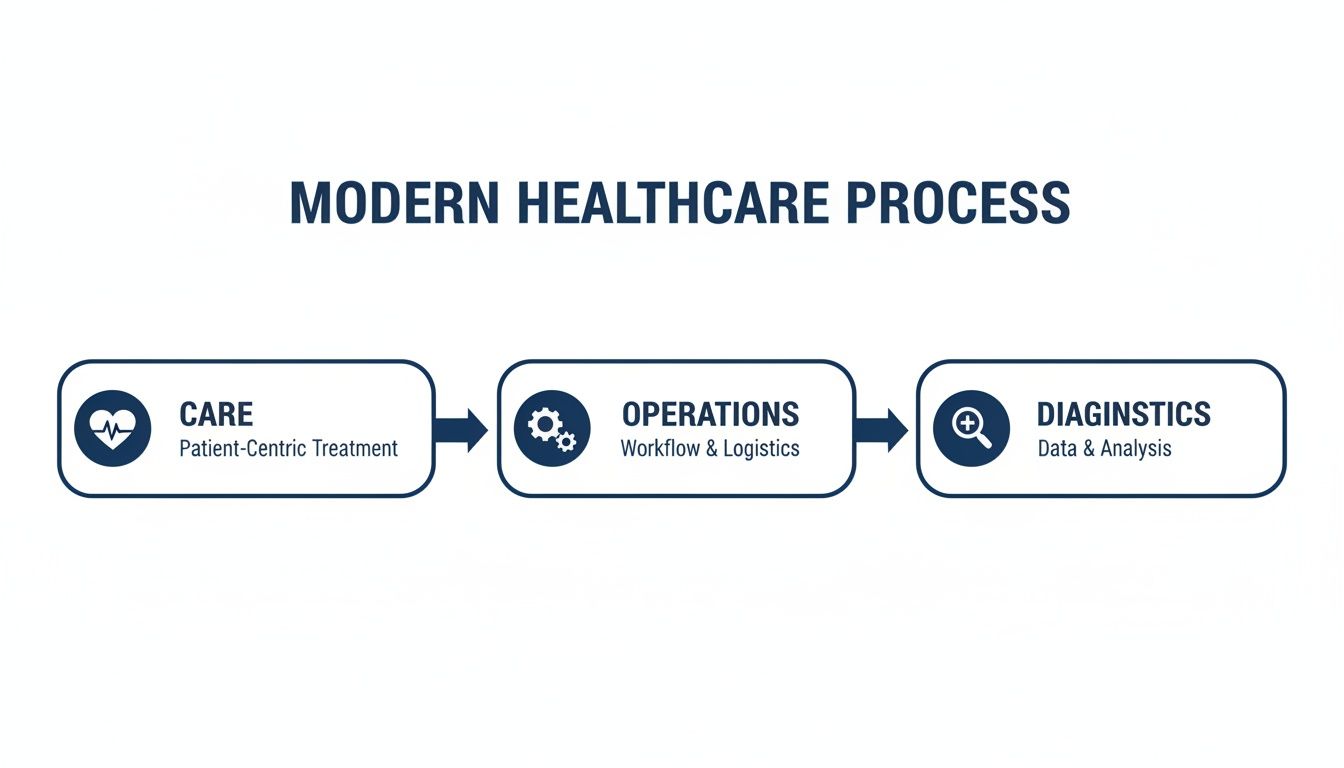
As you can see, a compliant framework is what allows patient information to move smoothly and safely between different parts of the system, which is absolutely critical for providing effective care.
Understanding the Core Regulatory Frameworks
In Canada, the main piece of legislation you need to know is the Personal Information Protection and Electronic Documents Act (PIPEDA). It lays out the ground rules for how private organisations must handle personal information during any commercial activity. If your software will be used in the United States or by American patients, then the Health Insurance Portability and Accountability Act (HIPAA) becomes your guide.
At their heart, both of these frameworks operate on a simple, powerful principle: a patient’s health information belongs to them. Our job as developers is to act as responsible stewards of that data.
PIPEDA: This Canadian act is principle-based. It focuses on accountability, ensuring you have clear consent, and giving people the right to access their own information.
HIPAA: This U.S. law is much more specific. It has a detailed Privacy Rule (defining what data is protected) and a Security Rule (outlining how you must protect it).
For anyone building software that could be classified as a medical device, the regulatory landscape gets even more complex. It's well worth taking the time to understand the specific medical device regulatory pathway to avoid major roadblocks later on.
Baking Compliance Into Your Software Architecture
You can't achieve compliance by slapping a security patch on at the last minute. It has to be woven into the very fabric of your application from the first day of planning. This idea is known as "compliance by design." It’s a proactive mindset that forces you to treat security and privacy as core features, not afterthoughts.
This means every database schema, every API endpoint, and every user-facing feature is built with these rules in mind from the get-go.
To help you get started, we've put together a practical checklist covering the essential compliance areas you need to address when developing healthcare software.
Essential Compliance Checklist for Healthcare Software
This table outlines the key regulatory and security measures required when developing software that handles protected health information (PHI).
| Requirement Area | Key Action or Consideration | Example Implementation |
|---|---|---|
| Access Control | Implement Role-Based Access Control (RBAC) to enforce the "minimum necessary" principle. | A nurse's login grants access to their assigned patients' charts, while a hospital administrator can see billing data but not clinical notes. |
| Data Encryption | All PHI must be encrypted both "at rest" (in the database) and "in transit" (over the network). | Using AES-256 encryption for stored database files and enforcing TLS 1.2 or higher for all API communications. |
| Audit Trails | Log every single action performed on PHI: who, what, when, and where. | The system records an immutable log entry every time a user views a patient record, edits a prescription, or exports a report. |
| Data Disposal | Establish and automate secure data deletion protocols according to legal retention periods. | A scheduled script that permanently purges patient records 7 years after their last interaction, in line with regional regulations. |
| Data Backups & Recovery | Maintain secure, encrypted, and regularly tested backups of all PHI. | Creating daily encrypted backups stored in a separate, geographically isolated cloud region with a documented disaster recovery plan. |
By following a checklist like this, you can systematically build a compliant foundation rather than scrambling to fix issues after the fact.
Let's break down some of those architectural elements a bit further.
Robust Access Controls: This is about making sure people can only see the information they absolutely need to do their jobs. A billing clerk doesn't need to read a doctor's clinical notes, and a nurse shouldn't have access to the entire hospital's patient database.
End-to-End Data Encryption: Think of this as putting PHI into a locked safe. Whether the data is just sitting on a server (at rest) or moving between the server and a user's device (in transit), it must be scrambled and unreadable to anyone without the key.
Comprehensive Audit Trails: Your system must keep a detailed diary of everything that happens to sensitive data. If a record is accessed, edited, or deleted, you need to know who did it and when. These logs are non-negotiable for accountability and for investigating any security incidents.
Secure Data Disposal: You can't just hit "delete." You need clear, legally sound procedures for permanently destroying data once it's no longer required.
By embedding these principles directly into your development process, you create a system that is secure by its very nature. It’s not just about writing code; it's about building a digital environment where patient trust is the highest priority.
Choosing Your Core Architecture and Technology
Deciding on your software's core architecture is like drawing up the blueprint for a new hospital. Are you building a single, massive tower where every department is interconnected under one roof? That’s a monolith. Or are you designing a campus of specialised clinics that operate independently but communicate perfectly? That’s microservices. This foundational choice in healthcare software development shapes how your application will grow, adapt, and perform under pressure.
Think about it this way: a hospital campus lets you renovate the cardiology wing without shutting down the emergency room. A microservices architecture offers that same kind of flexibility. Each function, like patient scheduling or medical billing, is its own separate service. This means you can update, scale, or even rebuild one piece of the system without taking the entire application offline – a massive advantage when uptime can directly affect patient care.
On the other hand, a monolithic architecture packs everything into a single, tightly-knit codebase. While often simpler and faster to get off the ground, monoliths can become difficult to manage as they grow. An update to a small feature might mean redeploying the whole system, which introduces risk and downtime. For smaller, more focused applications, though, a monolith can still be a perfectly sound and efficient choice.
Selecting the Right Technology Stack
Once your blueprint is ready, it's time to choose the building materials – your technology stack. This mix of programming languages, frameworks, and databases will define your software’s performance, security, and how easy it is to maintain down the road. Every choice here has a ripple effect.
The front-end, which is the part of the application your users actually see and interact with, needs to be fast, responsive, and secure.
Front-End Frameworks: Tools like React or Angular are industry standards for creating dynamic, intuitive user interfaces that work just as well on a desktop computer as they do on a mobile device.
Back-End Languages: The "engine" running everything behind the scenes could be built using Python or Java. These languages are known for their strong security features and huge ecosystems of pre-built libraries, which can significantly speed up the development of complex medical logic.
Database Systems: Storing Protected Health Information (PHI) securely is absolutely non-negotiable. Databases such as PostgreSQL or MySQL offer the robust encryption and access controls required to meet HIPAA and PIPEDA compliance.
Picking the right stack ensures your application isn't just functional, but also scalable and defended against security threats. As we explored in our app development in healthcare guide, the right technology is the foundation of a successful product.
The Essential Role of Cloud Platforms
These days, modern healthcare software almost always lives in the cloud. Platforms like Amazon Web Services (AWS), Microsoft Azure, and Google Cloud provide the HIPAA-compliant infrastructure needed to build and deploy secure healthtech solutions. They take care of the physical security, network infrastructure, and foundational compliance, freeing up your development team to focus on building features that matter.
Cloud platforms give you the elasticity to handle fluctuating demand: from a handful of users overnight to thousands during a public health event, without a massive upfront investment in physical servers.
This kind of scalability is no longer a "nice-to-have." A recent HIMSS survey found that 60% of healthcare organisations planned to ramp up their cloud adoption to handle the explosion of patient data. For instance, mobile health apps have become a key driver of patient engagement, with simple features like appointment reminders cutting no-show rates by up to 30% in some programs.
Getting your cloud setup right is crucial. A simple misconfiguration can open up serious security holes, so having real expertise here is vital. Making these architectural and technological decisions with care from the beginning sets the stage for a successful, secure, and scalable healthcare application.
Solving the Data Interoperability Puzzle
A healthcare application that can't talk to other systems is like an island – functional on its own, but its real power is unleashed when it connects to the mainland. In healthcare, that connection is called interoperability, and frankly, it's one of the toughest nuts to crack in the entire industry. It’s the ability for different software systems to communicate, share data, and actually use that information without a hitch.
When interoperability is missing, patient data gets stuck in digital silos. A patient’s records from their family doctor can't be easily seen by a specialist, and a hospital's electronic health record (EHR) can’t automatically pull in new lab results. This kind of fragmentation doesn't just create inefficiencies and drive up costs; it dangerously increases the risk of medical errors.

True interoperability makes sure a patient's complete health story is consistent and available to the right clinician at the right moment. This is where data standards come into play – they’re absolutely essential.
The Universal Translators of Health Data
To get different systems speaking the same language, the industry relies on a set of standards. Think of them as universal translators that let an EHR from one company understand a message sent from a pharmacy's system built by a completely different one. Two of the most important standards you'll hear about are HL7 and FHIR.
HL7 (Health Level Seven): For decades, HL7 has been the workhorse of health data exchange. It's a set of messaging standards that allows systems to swap clinical and administrative information. It’s incredibly reliable, but it can also be complex and quite rigid to work with.
FHIR (Fast Healthcare Interoperability Resources): FHIR is the new kid on the block, representing a modern evolution of these standards. It uses web-based tech that developers already know and love, like RESTful APIs, which makes it much easier and faster to implement. FHIR cleverly breaks down health data into small, manageable "resources," such as a patient, a prescription, or an appointment.
FHIR's modern approach is a genuine game-changer. It lets developers build apps that can securely pull just the specific data they need from an EHR, like a list of current medications, without having to process the patient's entire, complex medical history.
This flexibility is what powers the new wave of healthcare applications. A patient can now use an app on their phone to see lab results from multiple clinics, all because those systems are set up to communicate using FHIR. As we explored in our healthcare data management software development guide, managing this data flow is key.
Interoperability in Action: Real-World Examples
When data can flow freely and securely, the impact on patient care is immediate and profound. Getting interoperability right is a core goal of our custom software development services, because we know it leads directly to better health outcomes.
Just think about these scenarios:
Reducing Medical Errors: A patient arrives at the emergency room unconscious. Using an interoperable network, the ER doctor can instantly access the patient's medication list and allergy information from their family doctor's EHR. This simple action can prevent a potentially fatal drug interaction.
Improving Care Coordination: A person with diabetes uses a remote monitoring device that sends their blood glucose readings straight to their doctor's clinic. The data flows directly into the EHR, flagging dangerous trends for the care team so they can step in before a crisis happens.
Empowering Patients: Someone with a chronic illness uses a mobile app to pull together test results from different labs, track their symptoms, and share that unified view with their specialist. This gives them a powerful, active role in managing their own health.
As a trusted software development company, we've seen time and again how solving the interoperability puzzle changes everything. It helps us move away from a fragmented system of isolated data points and toward a truly connected network that delivers safer, more effective care for everyone.
Weaving AI and Machine Learning into Healthtech
Artificial intelligence isn't some far-off sci-fi concept anymore; it's here now, and it's fundamentally changing how we approach healthcare software development. Think of AI and Machine Learning (ML) not as replacements for doctors, but as incredibly powerful tools that help them find life-saving patterns hidden in mountains of data. It’s all about turning raw patient information into clear, actionable intelligence.
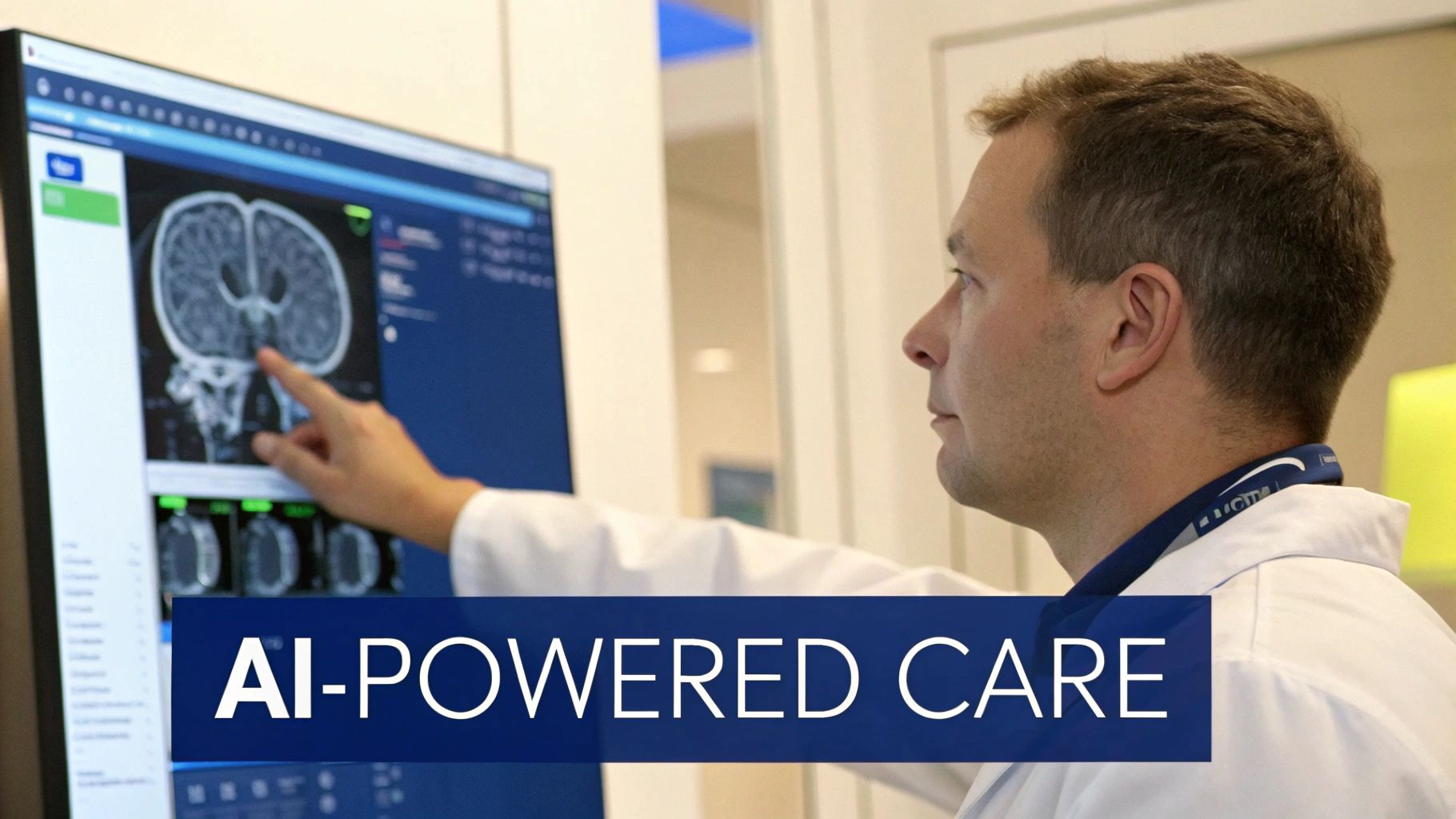
Imagine an algorithm that can sift through thousands of medical images, flagging tiny anomalies the human eye might otherwise miss. Or a system that analyses public health data to accurately predict a flu outbreak weeks before it hits. This is what AI is doing in medicine today; it’s a partner to human expertise, giving clinicians the support they need to make faster, more confident decisions.
Real-World AI Applications in Medical Software
The impact of AI goes far beyond diagnostics. These intelligent tools are being integrated across the entire patient journey, from the first check-up to long-term treatment management. As we explored in our AI in medical software development guide, the applications are vast and growing.
Here are a few common ways it's being used:
Predictive Analytics: AI models can chew through historical data to forecast things like patient admission rates, pinpoint at-risk populations for preventative care, and help hospitals allocate their resources much more efficiently.
Diagnostic Imaging Support: Machine learning algorithms act as a second set of eyes for radiologists and pathologists. They can highlight potential areas of concern in MRIs, CT scans, and pathology slides, which boosts both speed and accuracy.
Personalised Treatment Plans: By analysing a patient’s unique genetic profile, lifestyle factors, and clinical history, AI can help map out customised treatment plans with a much higher chance of success.
The pace of adoption is picking up quickly. Research from Menlo Ventures reveals that 22% of healthcare organisations have already put domain-specific AI tools into practice. This isn't just about innovation for its own sake; this investment is aimed at projects that can cut down administrative work by up to 40% and have been shown to improve diagnostic accuracy to an incredible 95% in certain trials.
Navigating the Hurdles of AI Integration
For all its promise, bringing AI into a clinical setting is filled with challenges. The biggest ones? Ensuring your data is clean and avoiding bias. An AI model is only as smart as the data it learns from. If that training data is incomplete or reflects existing health disparities, the model will learn those same biases and actually make them worse, leading to unfair patient outcomes.
Building a successful AI-powered health solution requires more than just technical skill. It demands a profound commitment to ethical data handling, transparency in how algorithms work, and a clear path for regulatory validation and approval.
Getting regulatory sign-off for an AI-driven medical device is no small feat, either. Health authorities demand rock-solid validation to prove the algorithms are safe, effective, and dependable. While a specialised AI agent for medical research can quickly analyse massive volumes of medical literature, its insights are only valuable if they come from a foundation of verifiable, unbiased data. Tackling these complexities is a must for any team looking to innovate responsibly in the healthcare space.
How to Choose the Right Development Partner
Bringing a complex healthtech vision to life isn’t just about hiring coders. You need a strategic partner who truly speaks the language of healthcare. The right team gets that building medical software is a world away from developing a standard app. They understand the weight of responsibility that comes with patient data and know that the software absolutely must work flawlessly when a clinician is counting on it.
This is easily one of the most critical decisions you’ll make. You're not just looking for a vendor to tick off a list of tasks. You're looking for a co-builder who can navigate the compliance maze with you, offer real insights into clinical workflows, and commit to your product's long-term security and success. The right partner becomes a seamless extension of your own team.
A Checklist for Vetting Potential Partners
Before you sign any contracts, you need to ask the tough questions. A potential partner’s answers will tell you everything you need to know about their experience with the unique hurdles of healthcare software. Your job is to weed out the generalist developers and find the true healthtech specialists.
Here’s a practical checklist to guide your conversations:
HIPAA/PIPEDA Experience: Don't just ask if they're compliant. Ask, "Can you describe a specific project where you designed features to meet HIPAA or PIPEDA rules?" You want to hear them talk about implementing Role-Based Access Control (RBAC), their specific data encryption methods, and how they build audit trails.
Healthtech Portfolio: Ask them to "Walk me through two or three healthcare projects you've completed. What were the biggest challenges, and how did you get past them?" This reveals their real-world problem-solving skills in your industry, not just their sales pitch.
Understanding Clinical Workflows: Pose this question: "How do you get up to speed on the specific clinical workflows our software needs to support?" A great partner will immediately talk about collaborating directly with clinicians, mapping out user journeys, and designing interfaces that feel natural and don't get in the way of patient care.
Interoperability Chops: Ask directly, "What's your experience with data standards like HL7 and FHIR?" In today's connected healthcare system, their ability to make your software talk to EHRs and other clinical platforms is non-negotiable.
Comparing Engagement Models
Once you've found a few partners who have the right expertise, the next step is to figure out which working relationship makes the most sense. The right engagement model has to align with your budget, timeline, and how you want to manage the project.
Here’s a quick breakdown of the usual options:
| Engagement Model | Best For | Key Characteristic |
|---|---|---|
| Fixed Price | Projects with a rock-solid, clearly defined scope and little room for change. | A set price is locked in upfront for a specific list of deliverables. Simple and predictable. |
| Time & Materials | Projects that are likely to evolve or where the full scope isn't known yet. | You pay an hourly or daily rate for the work done, giving you maximum flexibility to pivot. |
| Dedicated Team | Long-term, complex projects that need deep integration and continuous development. | An entire team works exclusively on your project, essentially becoming your remote, in-house experts. |
Picking the right development partner is the final, crucial piece of the puzzle. A team that marries technical skill with a genuine understanding of the healthcare world isn't just a vendor – they’re a strategic asset. By finding a software development company with a proven track record, you’re not just building an app; you’re building a compliant, effective tool that can make a real difference in patient care.
To see how an experienced team can bring your vision to life, find out more about us and how we turn ambitious healthcare ideas into reality.
Frequently Asked Questions
When you're diving into healthcare software development, a lot of questions come up. We get it. Here are some of the most common ones we hear, with straight-to-the-point answers to help you get started.
What’s the Biggest Challenge in This Field?
If I had to pick just one, it’s the constant tightrope walk between innovation and compliance. In almost any other industry, you can move fast and break things. In healthcare, that's not an option.
Every single decision, from the first line of code to the final feature rollout, has to be filtered through the lens of regulations like HIPAA and PIPEDA. This isn't just a box to tick at the end; it's a foundational principle that dictates how you design the architecture, store data, and control user access. Security can't be an afterthought – it has to be woven into the very fabric of the application.
How Long Does Building Custom Healthcare Software Take?
That’s a big question, and the honest answer is: it depends. The scope of the project is the biggest factor.
If you’re looking to build a Minimum Viable Product (MVP) with a core set of features, you could be looking at a timeline of around 4-6 months. But for something more complex, like a full-blown hospital management system or a sophisticated EHR platform, it's not uncommon for the project to extend beyond a year.
What pushes the timeline? A few key things:
The sheer number of features and different user roles (doctors, nurses, admins, patients).
The complexity of integrating with other systems – think labs, pharmacies, or existing hospital databases.
The time needed for rigorous security and compliance testing, which is non-negotiable.
Why Is Interoperability So Important for New Apps?
Healthcare doesn't happen in a bubble. A new health app that can’t talk to other systems is like a doctor who can't read a patient's chart from another clinic – severely limited in its usefulness.
Interoperability is the magic that lets different software systems share information securely and efficiently. For your app to be truly valuable, it needs to connect with the existing ecosystem of Electronic Health Records (EHRs), lab systems, and pharmacy networks. This is what breaks down data silos, helps different providers coordinate care, and ultimately gives everyone a complete, up-to-date picture of a patient's health. This principle is a cornerstone of our software development services.
As a leading software development company, we believe a well-informed partner is the best partner. For more insights into our approach and expertise, we invite you to learn more about us.