


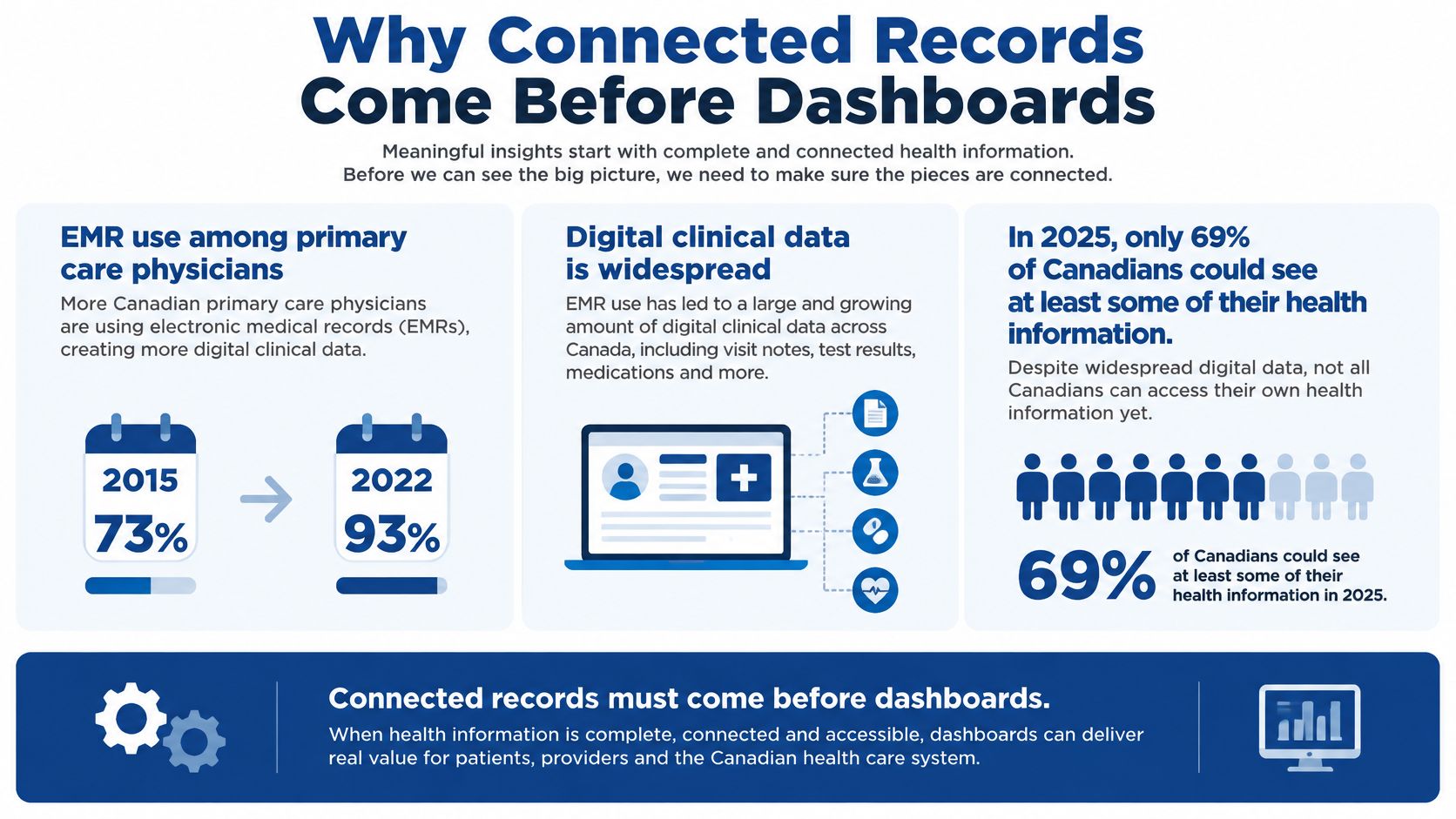
93% of Canadian primary care physicians reported using electronic medical records in 2022, up from 73% in 2015, according to Canadian evidence on EMR adoption. That's a substantial digital foundation, but a digital chart isn't necessarily a connected record. For healthcare analytics platform development, the difficult work starts when teams try to combine information across organisations without losing its meaning.
The highest-value first release may therefore be a standards-aware data layer, not another predictive model. Clinicians and administrators need to see which fields are missing, which records are delayed and which results can't yet be compared before they act on a dashboard.
Why Connected Records Come Before Dashboards
In 2025, 69% of Canadians reported access to at least one type of electronic health information, but only 13% could access all specified core components, laboratory and imaging results, immunisation records, and medication history and renewals, according to CIHI's health-system performance information. That 56-percentage-point gap separates partial visibility from access to the specified record components.
These measures describe different things: physicians' EMR use concerns clinical digitisation, while Canadians' online access concerns visibility into their information. Neither, by itself, proves that systems exchange usable records across care settings.
What a disconnected record looks like
Say a patient visits a community clinic, receives imaging at a hospital and fills a prescription elsewhere. Each organisation may hold a digital record, yet the clinic's analytics platform might receive only the consultation.
A dashboard could label the patient's investigation incomplete even though the hospital has finished it. Alternatively, it might count missing medication information as no medication use. Both interpretations could mislead the person deciding what to do next.
Healthcare analytics platform development means building the secure path from those separate records to an interpretable view. That involves ingesting information, normalising formats, matching identities, preserving provenance and enforcing role-based access, not designing charts.
For multi-site clinics, hospitals, insurers and healthtech startups serving Canada, the practical question is whether an authorised user has enough trustworthy information to make a defined decision. An insurer's analytical purpose and access rights, for example, shouldn't be assumed to match those of a treating clinician.
Start with an honest first release
A useful initial release should distinguish:
Known information: Validated records available for the intended workflow.
Missing information: Expected fields or sources that haven't arrived.
Incomparable information: Records whose definitions or coding still require reconciliation.
The healthcare data infrastructure guide provides further context for planning that foundation. Build through defined delivery phases, prove a pilot workflow and establish privacy gates before introducing AI.
Access to an electronic chart is not interoperability.
Six Phases from Source Systems to One Pilot
In 2024, 92% of Canadian healthcare providers had access to a digital health system, but only 52% used one to electronically share clinical information outside their main practice. The same reporting found that 78% experienced an external-sharing barrier, including insufficient integration for 50% and a lack of electronic sharing capability for 46%.
Those findings favour a delivery sequence that proves exchange before expanding analytics. Establish baseline definitions for match rate, duplicate rate, latency, completeness and cross-site exchange success during discovery, so teams don't change the meaning of success halfway through delivery.
The delivery sequence
Inventory sources, jurisdictions and workflows: Acceptance starts with every in-scope EMR, owner and export gap being named. Include provinces, contractual access restrictions and sites that can't export, rather than discovering them after dashboard design.
Define the canonical clinical model: Require lineage back to the source field before approving a derived measure. Agree what patient, encounter, referral and outcome mean across sites, and document how local values become shared concepts.
Implement standards-based ingestion: Measure the share of records that pass code and structural validation. Build terminology mapping into ingestion, including SNOMED CT where the applicable content specification calls for it, rather than treating a successful file transfer as completed integration.
Validate identity resolution: Baseline match and duplicate rates for patients, encounters, providers and organisations. Give uncertain matches a review path, because merging on a name alone can attach the wrong history to an otherwise plausible record.
Expose governed analytical datasets: Agree completeness and latency targets with the workflow owner. Publish approved tables with access rules and visible lineage, rather than allowing analysts to maintain uncontrolled copies.
Pilot a measurable workflow: Use referral completion or clinician-reviewed readmission flags, then record actual workflow use. Run parallel validation with clinicians and reconcile discrepancies before widening deployment.
Build phases, done tests and common slips
| Phase | What you finish | Acceptance metric | Common slip |
|---|---|---|---|
| 1 Inventory sources | System, jurisdiction and workflow list | Every in-scope EMR and export gap named | Starting with dashboards |
| 2 Canonical model | Clinical model plus provenance rules | Lineage documented to source field | Local codes left unmapped |
| 3 Standards ingestion | Terminology mapping and validation | Share of records with valid codes | Treating file drop as integration |
| 4 Identity resolution | Patient, encounter, provider, organisation match | Match rate and duplicate rate baselined | Merging on name alone |
| 5 Governed datasets | Analytical tables with access rules | Completeness and latency targets met | Copies outside the governed store |
| 6 One pilot workflow | Referral completion or readmission review | Clinician adoption, not API uptime | Scaling before the pilot holds |
For hospital connectivity, include healthcare software integration in the delivery scope rather than treating it as a reporting add-on. The contract should make source-level reconciliation, documented lineage and workflow adoption acceptance conditions.
Set targets after examining source quality and clinical consequences. An arbitrary technical threshold can encourage a team to declare success while staff still reconcile records manually.
Use Cases and the Layers That Serve Them
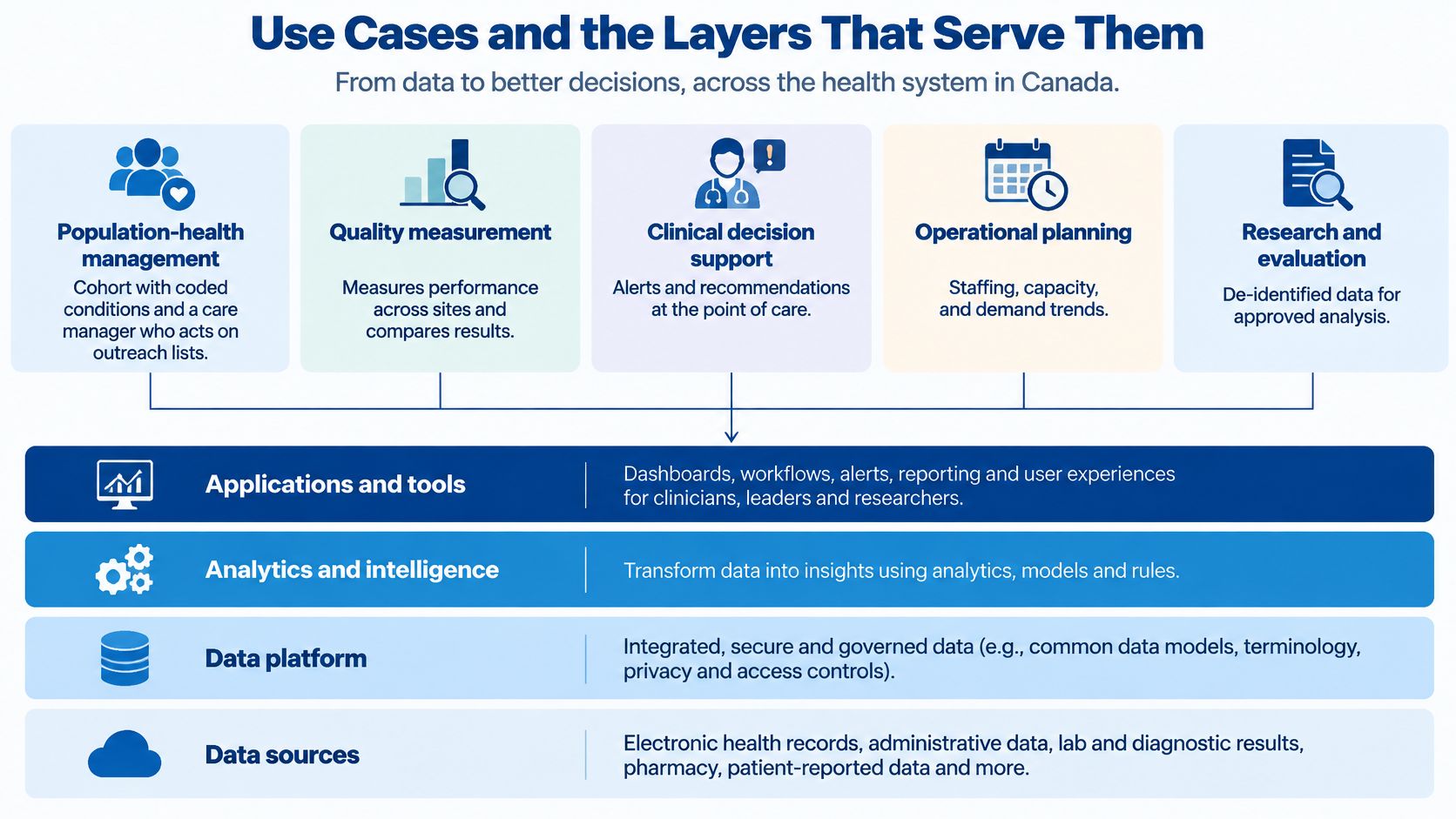
Choose the decision before choosing the dashboard. A care manager needs an actionable outreach list; an administrator needs evidence for changing capacity. They shouldn't receive the same analytical product just because their data sits in the same platform.
First workflows worth building
| Use case | Minimum data | First metric | Who acts |
|---|---|---|---|
| Population health | Problem list, encounters, demographics | Cohort size with complete codes | Care manager |
| Quality measurement | Standardised encounter and procedure codes | Measure completeness before publication | Quality lead |
| Readmission risk review | Admissions, discharges, prior utilisation | Share of flags a clinician reviews | Clinician |
| Operational reporting | Volumes, waits, staffing | Throughput or wait trend by site | Administrator |
| Referral completion | Referral order and receiving-site outcome | Closed-loop completion rate | Operations |
For population-health management, the care manager needs a defined cohort and a reason each patient appears. A diabetes outreach list, for example, should distinguish a coded diagnosis from an ambiguous mention in a note.
For quality measurement, the quality lead must establish whether sites count equivalent encounters and procedures. Publish the completeness assessment with the measure, so a reporting gap doesn't look like poor clinical performance.
Readmission risk review serves a different purpose: helping a clinician prioritise review. The first operational question is whether staff examine the flags and their supporting facts, not whether the software generates many scores.
Operational reporting supports decisions about rosters, appointment capacity and queues, not diagnoses. For referral completion, operations staff need a receiving-site outcome, because sending a referral doesn't establish that the patient received care.
Shared foundations, different permissions
These workflows can reuse the same architecture:
Source connectors retrieve authorised clinical and operational information.
A canonical store with provenance retains consistent records and their origins.
An identity service links the correct patient, encounter and organisation.
A semantic map translates source terminology into agreed concepts.
Governed marts provide purpose-specific analytical datasets.
A thin healthcare business intelligence layer presents measures and supports action.
Thin means that the reporting layer shouldn't contain hidden, conflicting versions of clinical definitions. Keep shared calculations and permissions in governed services, where teams can test and maintain them.
An attractive chart built from incomparable provincial codes is still a failed analytical product, even if it loads quickly. Smaller organisations should complete a workflow from ingestion to staff action rather than spread their budget across unfinished marts.
The guide to predictive analytics in healthcare operations offers further context for selecting an operational application.
Pilot measure: Track adoption of a defined decision, not the number of dashboard widgets.
Integrating Clinical Data Without False Precision
A combined dashboard can make incompatible records look comparable. Clinicians still report difficulty routinely accessing information from other care settings, so consistent exchange remains a practical challenge. The Pan-Canadian Health Data Content Framework and Canadian Core Data for Interoperability provide reference points for aligning data elements, value sets and formats, including SNOMED CT.
The work begins when those references become explicit validation rules. Adding standard names to an architecture diagram does not show whether two sites mean the same thing by a diagnosis or reporting period.
A plausible but misleading diabetes measure
Suppose one clinic records diabetes using local shorthand while another uses SNOMED CT. Grouping both under a single diabetes label can produce a combined rate that looks exact but compares different things. The shorthand might include suspected disease, while the mapped concept represents a confirmed diagnosis. The clinics may also define active patients differently.
Keep the measure marked as not yet comparable until a clinical owner approves the mapping and cohort definition. Retain the difficult records for review; excluding them could change who the measure represents.
Rules to implement in the sprint
Map local codes to a shared value set: Version each mapping, record clinical approval and quarantine unmapped rows from measures that depend on those codes. Use an exception report to track records that need resolution.
Attach provenance to analytical fields: Retain the source, event timestamp, ingestion timestamp and transformation history. Analysts should be able to trace where a value came from and how it changed.
Preserve missingness: A blank laboratory result is not a normal result, and an absent referral outcome does not confirm non-attendance. Show missing data explicitly rather than converting blanks to zeroes.
Align reporting windows: If sites report on different calendars or periods are incomplete, delay comparison. Display the covered period and latest completed refresh with each measure.
Reject invalid inputs before model use: Check for duplicate encounters, impossible dates and inconsistent event ordering. Route failures to an accountable owner so downstream calculations do not hide them.
These controls make healthcare data analytics and clinical data analytics easier to interpret. They also give support teams a clear explanation when a clinician questions a result.
For hospital connectivity work involving Cleffex, start with source contracts, clinical definitions and exception handling. A connector catalogue alone cannot show whether a combined measure is safe to interpret.
Privacy Engineering for Linked Health Data
De-identification is a statistical process, not a free pass to reuse health information. Federal de-identification guidance explains that it is a step towards anonymisation, that re-identification risk can remain and that de-identified information remains subject to obligations under the federal Privacy Act.
That federal guidance isn't a complete legal map for every Canadian clinic. Establish the applicable provincial, territorial and organisational obligations with a privacy reviewer before approving collection, linkage or secondary use.

Controls across the data lifecycle
Minimise collection: Collect the variables needed for the approved clinical or operational purpose, not everything the source can export.
Classify identifiers: Separate direct identifiers from quasi-identifiers, such as age, geography and dates, that can identify someone in combination.
Separate identity keys: Keep linkage keys in a restricted identity store rather than alongside broadly available analytical tables.
Apply appropriate transformations: Use suppression, generalisation, aggregation or tokenisation according to the audience and intended analysis.
Document residual risk: Assess re-identification risk against the information a recipient could reasonably combine with the dataset.
Enforce least privilege: Restrict access by role and purpose, and log access to sensitive records and exports.
Monitor downstream use: Review extracts, retention, deletion and any later use in model-training datasets.
Why removing names isn't enough
Consider a dataset containing a rare diagnosis, an exact appointment date, age, a small geographic area and a provider identifier. A recipient who knows about a local patient's treatment could potentially connect those details without seeing a name.
Tokenisation doesn't automatically solve that problem. It replaces an identifier, but distinctive clinical and demographic combinations can remain visible.
CIHI's privacy and security practices offer a useful architectural model: it generally analyses de-identified record-level data excluding names, health-care numbers, dates of birth and full postal codes, and aggregates publicly released information to reduce disclosure risk.
Set minimum-cell-size rules through a documented disclosure assessment rather than borrowing an unsupported universal threshold. Apply disclosure review to dashboards and APIs, including filtered views that could expose a small group.
For a clinic or startup without a dedicated privacy team, separate operational dashboards from research extracts. Keep purpose and consent or other legal-authority records close to access decisions, and prefer a transparent cohort definition over an unrestricted data lake.
The practical healthcare data governance guide helps organise ownership and review responsibilities. Where US patients or partners are involved, assess whether HIPAA creates an additional duty; it isn't a substitute for Canadian requirements.
AI Checks Testing and Steady Improvement
A clinician receives a readmission-risk flag and opens the supporting facts: recent admissions, discharge information and prior utilisation. The clinician checks whether the history is complete, considers the patient's circumstances and decides whether follow-up is appropriate. That is a workable starting point for AI healthcare analytics.
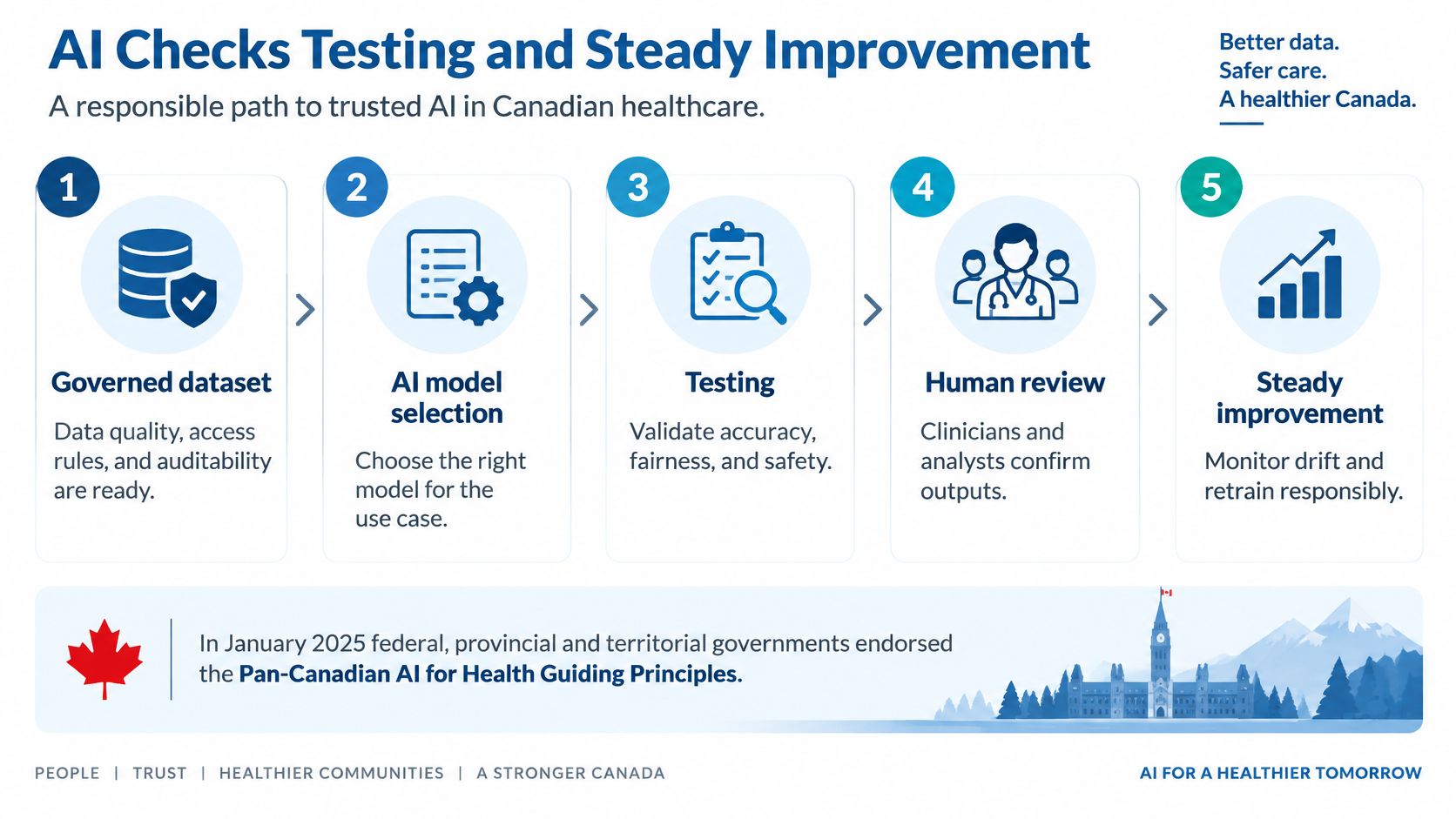
In January 2025, federal, provincial and territorial governments endorsed the Pan-Canadian AI for Health Guiding Principles, according to Health Canada's departmental results report. Translate those principles into intended-use documentation, provenance, validation evidence, limitations, human oversight and monitoring for performance or bias.
Make the model earn its place
A governed dataset should precede model selection. Keep training data separate from the identity vault, and exclude records that failed terminology or identity validation rather than expecting the algorithm to compensate.
Compare with simple rules: Test whether the model helps reviewers more than an understandable rules-based baseline.
Explain limitations: Place plain-language cautions beside the score, including missing inputs and unsupported uses.
Define operational value: Track reviewed flags and resulting actions, not model discrimination alone.
Preserve human responsibility: Name who reviews the output and who can authorise a clinical intervention.
A reviewed-flags measure is a workflow indicator, not proof of financial return. If the business case claims savings, separately define the costs, staff effort and outcomes needed to test that claim.
Test and release gates for the pilot
| Gate | What it checks | Pass signal |
|---|---|---|
| Source reconciliation | Platform counts against source extracts | Counts match within the agreed tolerance |
| Clinician parallel review | Flags reviewed alongside usual care | Reviewer agreement recorded for each flag |
| Access and penetration tests | Role limits and audit logs | No unauthorised access path found |
| Disclosure test | Small cells on dashboards and APIs | Minimum cell size enforced |
| Drift and bias check | Performance by site and patient group | Gaps explained or model held back |
| Rollback plan | Restore previous data and model state | Rollback rehearsed before pilot launch |
Unit tests aren't enough to establish clinical usefulness. Review disagreements with clinicians and distinguish model errors from incomplete records, unclear instructions or unsuitable workflow design.
Begin deployment at a pilot site and review latency, match rates and workflow uptake regularly. Expand only when the agreed workflow measure improves without unresolved safety or privacy issues.
When a jurisdiction changes a code set, revalidate affected mappings and model inputs. When a new source is linked, reassess disclosure risk and check whether the patient population has changed.
An opaque score with no supporting evidence is not a clinical action.
Questions to Settle Before You Commission the Build
Frequently Asked Questions
How long should a first release take?
Start with a defined workflow and a discovery-and-pilot slice. Agree on iterative demonstrations and clinician feedback, then set the timeline after the team understands source access and export limits. Cleffex's engagement with Axana used Agile, step-by-step MVP delivery so clinicians and stakeholders could provide early feedback.
Which rules apply?
Begin with the Canadian privacy requirements that apply to the organisation, jurisdiction and intended use. Assess GDPR where relevant and HIPAA when US covered data arrangements are in scope. A US checklist alone does not define a Canadian system. Cleffex built MDIS, a secure post-market compliance platform for MedQAIR that brings stakeholders together around MDR, UK and FDA requirements.
When should a team skip predictive AI?
Defer prediction if identity matching is unreliable, key codes remain unmapped, or no one is responsible for reviewing flags. An interpretable cohort list and a data-quality view can show where records are missing or incomparable. A model cannot resolve unclear clinical definitions or replace operational ownership.
Who needs to be involved?
Name a clinical owner, a source-systems lead, a privacy reviewer and a delivery team responsible for engineering, quality assurance and coordination. Assign each person a specific approval, such as validating a cohort or authorising an export. For Axana, Cleffex assembled full-stack developers, UI specialists, QA engineers and a project manager.
Before commissioning the platform, choose the pilot metric this month and inventory the systems that feed it. Reject plans that begin with a dashboard catalogue before they establish whether the underlying fields can be matched and compared.
Cleffex Digital Ltd provides healthcare software integration for North American healthtech companies, supporting hospital connectivity, compliance, AI diagnostics and scalable platforms. Visit Cleffex Digital Ltd to discuss a source-system assessment and a governed pilot built around a clinical or operational decision your team needs to improve.