


92% of Canadian healthcare providers have access to a digital health system, yet only 52% use one to send or share clinical information outside their main practice. That gap proves a hard truth in patient-centric HealthTech. Digitisation alone doesn't create a connected platform.
Patients feel that disconnect long before they see the architecture behind it. They repeat histories, carry printouts between appointments, and chase results across separate portals. A platform only becomes patient-centric when the information follows the person, not when the software is merely switched on.
The Myth of the Connected Patient
The most misleading phrase in healthcare technology is “we're already digital”. In practice, a digital system that can't exchange information outside its own walls still leaves patients doing the coordination work. In Canada, 92% of providers had access to a digital health system in 2024, but only 52% used one to send or share clinical information with providers outside their main practice, a 40-point gap that exposes the scale of the problem.
A patient-centric platform has to follow the journey, not just the appointment. A family member might use medication tracking for families to keep a relative's prescriptions aligned, yet that kind of support breaks down fast if the clinical record, the pharmacy, and the follow-up visit all sit in separate systems.
What fails in real deployments
The failure mode is usually familiar. One team builds a booking app, another team builds results access, and a third team owns messaging. None of them agrees on identity, data structure, or handoff logic, so the patient ends up repeating the same details at each step. The software looks modern, but the experience feels fragmented.
Practical rule: if a patient has to restate the same history after every digital interaction, the platform isn't connected; it's just distributed.
The internal pattern to avoid is siloed design from day one. A useful reference is this guide to breaking down healthcare data silos, because the core problem isn't just storing data; it's making that data usable across the care path. When the record can't move, the patient becomes the integration layer.
Understanding Hybrid Care Realities
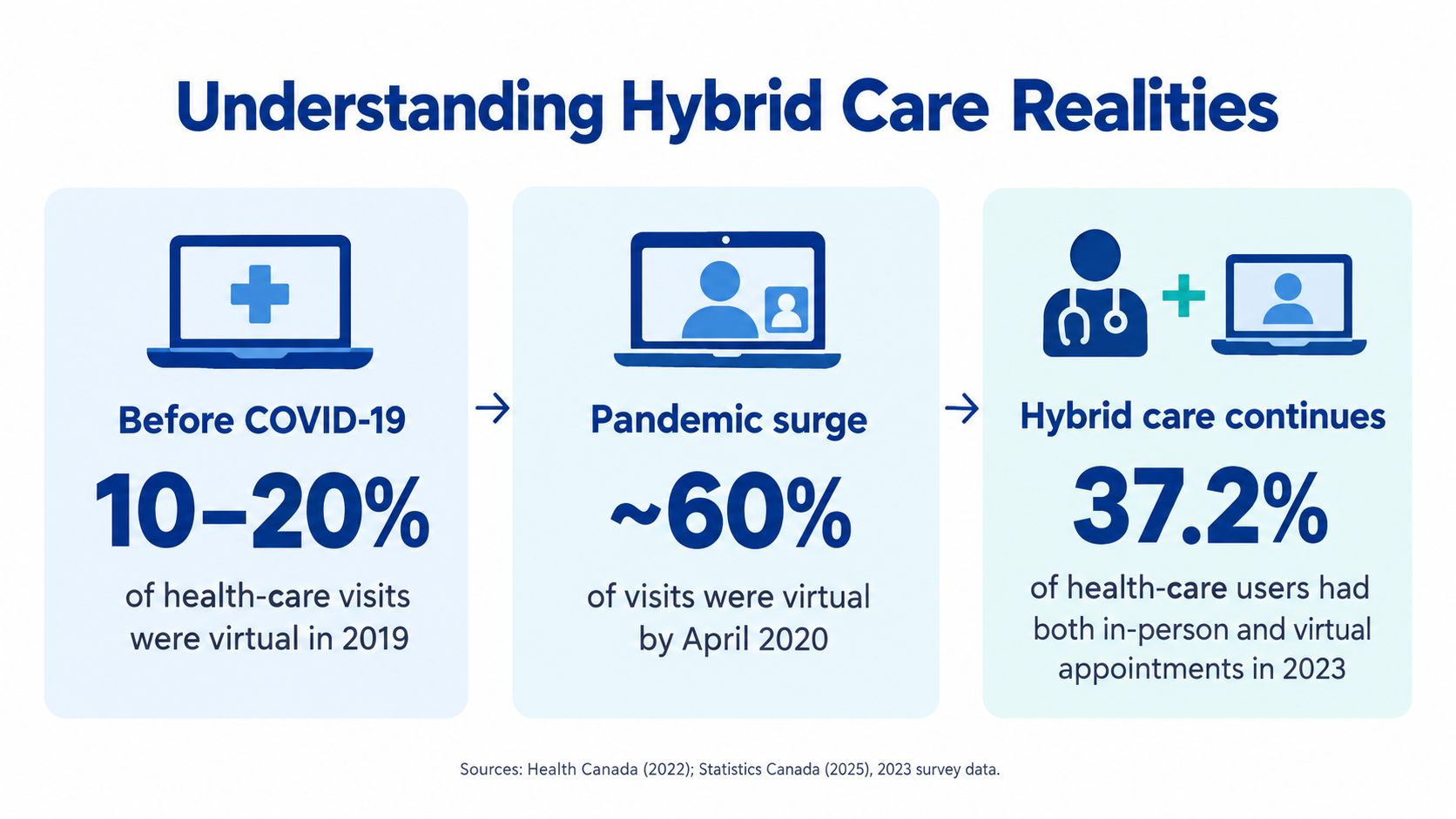
Before the pandemic, virtual services represented only about 2% to 11% of patient services in 2019, depending on the province. By April 2020, about 60% of visits were conducted virtually, and in 2023, 37.2% of healthcare users reported using both in-person and virtual formats, which shows that hybrid care has become the norm rather than a stopgap.
Why channel choice matters
That shift changes the design brief. A patient-centric platform can't assume video is the default, because virtual care has remained strongly low-bandwidth and practical. Telephone-only appointments represented 77.9% of virtual visits with family physicians or nurse practitioners in 2023, which is a clear signal that voice still matters as a primary channel.
The right architecture treats voice, video, messaging, scheduling, and follow-up as one journey with multiple entry points. If a patient starts by phone, uploads a document later, and then needs an in-person review, the platform should preserve context across each handoff. That's not a convenience feature; it's the core of patient data integration.
Designing for continuity
The technical question is simple, even if implementation isn't. Does the platform remember the last clinical context when the channel changes? If the answer is no, then the system is still organised around software modules instead of care delivery.
A useful mindset is to design for the least demanding channel first, then let richer channels build on top of it. That approach respects how people use care, especially when they need quick access, have unstable connectivity, or prefer a phone call over a portal login. It also prevents teams from overbuilding video-only features that look impressive in demos but don't move the patient experience forward.
Designing for Interoperability from the Start

Canada's Pan-Canadian Health Data Charter explicitly endorses a person-centric model in which health information follows the individual across points of care, while protecting privacy under existing legislation. That principle should shape the architecture, not sit in a compliance folder after the build is finished.
What the architecture needs
A connected healthcare platform needs standards-based exchange, identity matching, consent controls, audit trails, and data models that preserve meaning when records move. That's why interoperability can't be treated as an add-on. It has to be part of the data model, the workflow design, and the governance layer from the first sprint.
Build for the circle of care, not for a single application boundary.
This is also where integration partnerships matter. Teams that want to explore the technology behind modern exchange patterns should look for systems that can handle secure information flow without forcing every provider into the same interface. A platform can still support different roles and care settings, but only if the underlying exchange is standards-led rather than app-led.
A practical way to assess the design is to follow one patient record through referral, consultation, diagnostic review, medication reconciliation, and follow-up. If the data loses meaning at any handoff, the platform isn't interoperable enough for patient-centric care. In many teams, the login works and the appointment works, yet the care journey still breaks because the clinical context doesn't travel with the patient.
The internal benchmark worth reading alongside this is the FHIR integration guide for healthcare platforms. It helps clarify why standards-based integration is the difference between a usable system and a set of disconnected tools.
Beyond Device Ownership and Connectivity
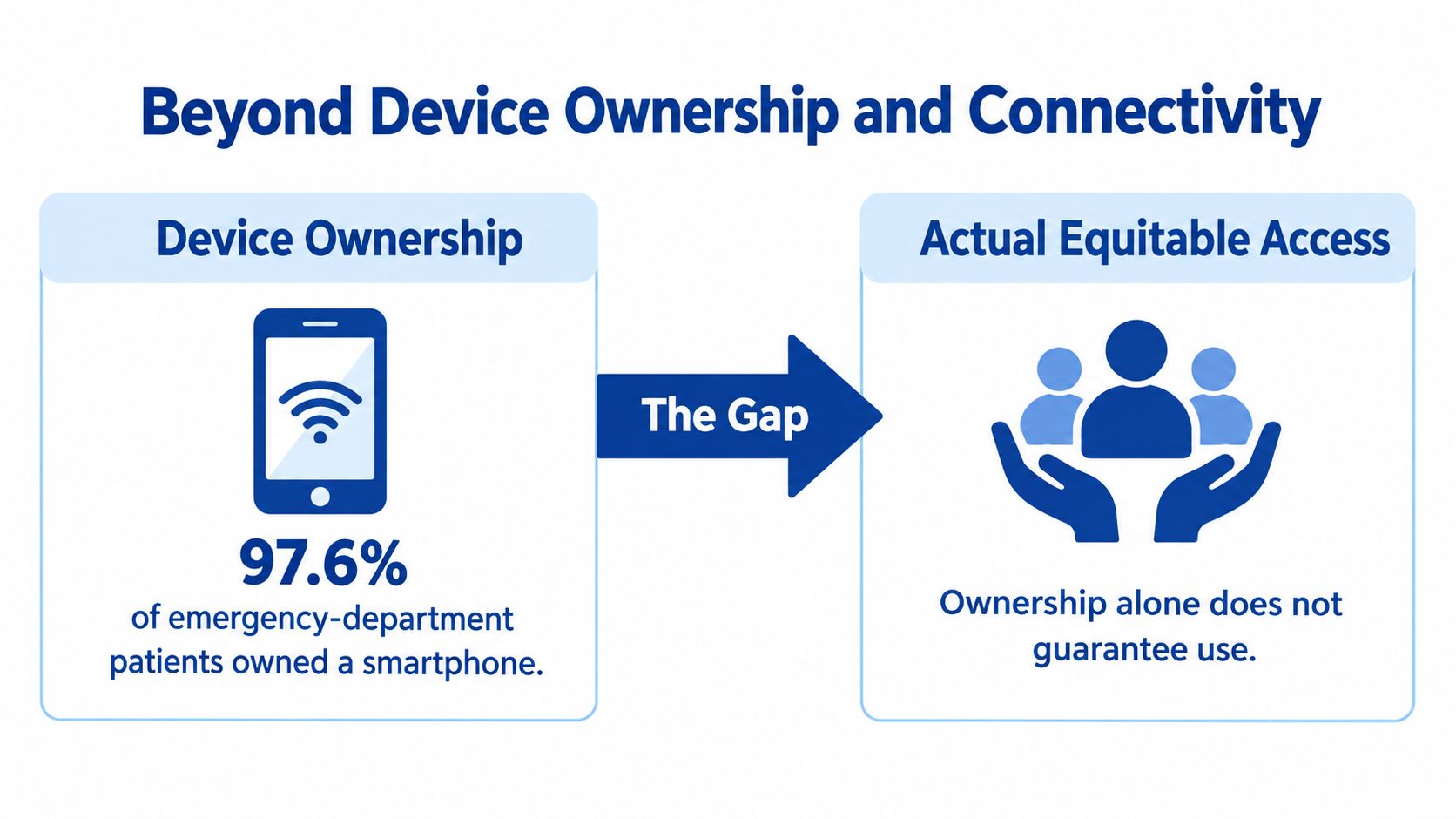
A common mistake in healthtech is assuming that device ownership equals access. A 2025 study of emergency-department patients found that 97.6% owned at least one digital device and 96.0% used smartphones, yet only 13% of adults could view all core components of a health record.
The real barriers
That gap usually has little to do with hardware. It comes from confusing interfaces, login friction, limited proxy access, inaccessible language, and fear about privacy or misuse. A platform can be technically available and still be unusable for a caregiver, a patient under stress, or someone who needs plain-language support.
The strongest teams test task completion, not just feature availability. Can the patient find the result, understand the medication change, share information with a caregiver, and book follow-up without phoning support? If the answer is inconsistent, the interface is adding friction rather than reducing it.
Design for assistance, not just self-service. Some patients want full digital control. Others need a phone option, a staffed helpline, or delegated access to make the system work at all.
What inclusive design looks like
A patient-centric system should support:
Plain-language summaries so clinical terms don't block understanding.
Delegated access so caregivers can help without workarounds.
Low-bandwidth pathways for people who can't rely on video.
Multilingual and accessible interfaces for broader comprehension.
Human fallback routes when the digital route fails.
The useful test is simple. If a platform only works for users who are confident, patient, and digitally fluent, it's not patient-centric. It's selective.
Building Multi-Channel Patient Access

Canadian virtual care still runs heavily on low-bandwidth channels. Telephone-only appointments represented 77.9% of virtual visits with family physicians or nurse practitioners in 2023, so any platform that treats phone support as secondary is already misaligned with reality.
Treat channels as one workflow
Voice, video, messaging, reminders, and booking should all be connected to the same patient record. That means the patient can start in one channel and continue in another without losing context. It also means clinicians don't need to reconstruct the story each time a message becomes a call or a call becomes an in-person visit.
The internal guide on digital patient engagement strategy is useful here because engagement should be operational, not cosmetic. Push notifications alone don't make care accessible. The workflow has to support action.
Build the handoffs deliberately
A good multi-channel design usually includes three rules:
Preserve context: Every channel should read from the same patient timeline.
Allow escalation: Phone to video, video to in-person, or message to call should be smooth.
Keep follow-up visible: Tasks, instructions, and next steps must stay attached to the encounter.
That's where a connected healthcare platform earns its name. Not by adding every possible feature, but by making each mode usable in everyday practice. One organisation may use video heavily, another may rely on scheduling and secure messaging, and a third may depend on receptionist-led phone triage. The platform should support all three without fragmenting the record.
Cleffex Digital Ltd is one example of a provider that builds healthcare software integration services and custom systems for clinical workflows, which can help when teams need to connect scheduling, records, and communication tools without creating another silo.
Selecting Partners for Scalable Integration
Health Canada's national recommendations say that members of a patient's circle of care must be able to exchange information on a need-to-know basis across different provider types and platforms, while recognising technical and data interoperability gaps as barriers to integrated, equitable care. That makes partner selection a design decision, not a procurement checklist.
Platform-first versus point solutions
A platform-first approach tries to keep identity, consent, data exchange, and workflow logic in one connected environment. A point-solution approach solves one problem quickly, but often creates a new handoff and a new silo. Both can help, but only one makes external sharing easier over time.
A practical comparison helps:
| Decision area | Platform-first approach | Point-solution approach |
|---|---|---|
| Patient record flow | More consistent across settings | Often fragmented between tools |
| Integration effort | Higher upfront, lower later friction | Faster start, more rework later |
| Governance | Easier to centralise consent and audit | Harder to keep policies aligned |
| Scale | Better for multi-site coordination | Useful for narrow use cases |
What to check before you buy
Look for:
API maturity that supports exchange beyond one organisation.
Consent management that's understandable to patients and staff.
Provenance-aware data models so records keep their source and meaning.
Identity matching that reduces duplicate charts and mismatched histories.
Workflow integration that extends into referral, discharge, and follow-up.
If a vendor can't explain how their product behaves outside the login screen, they probably haven't solved interoperability.
The best partners don't just sell features. They reduce the chance that every new module becomes another island. That matters more than a polished demo, because healthcare workflows break in the handoff, not in the homepage.
Measuring Success in Patient-Centric Care
The clearest measure of patient-centric care is not the number of digital touchpoints a platform creates. It is whether people can move through care without losing information, repeating work, or waiting for the system to catch up with them. CIHI shows the gap clearly: 89% of Canadians want electronic access to personal health information, yet only 13% reported online access to all three core parts of a health record.
What to measure instead
Track whether the platform is helping the care team and the patient. Focus on:
Data completeness, especially when information moves across settings.
Reconciliation errors, because mismatched medication or history data disrupts continuity.
Referral closure, so you can see whether the loop is closed.
Patient-reported coordination, which shows whether the journey felt joined up.
These measures are more honest than raw portal logins. They show whether the platform preserved meaning and reduced friction, which is the true test of patient data integration. A connected record that no one can understand still fails the patient.
The operational outcome
When platforms are built around continuity, patients carry less of the coordination burden. Clinicians spend less time rebuilding the same story, caregivers get clearer instructions, and organisations can spot where information drops out. That is what a patient-centric HealthTech system should do: make care feel connected even when delivery is distributed.
If you are reviewing your own stack, start with the handoffs. The gaps there will tell you more than any adoption dashboard.
Frequently Asked Questions
How do you make digital tools accessible to patients with different levels of tech literacy?
Start with the task, not the interface. A patient should be able to find a result, understand the next step, and reach help without having to learn a complex system first. Use plain language, keep the design consistent, and always provide a phone or staffed fallback for people who need it. For teams building or extending that kind of experience, Hire Developers can help when the work needs specialised software capability rather than generic app design.
How can legacy systems be integrated without creating new bottlenecks?
Don't force every system into one monolithic replacement plan. Build around identity, consent, and standards-based exchange, then connect older systems through the parts of the workflow that matter most, such as referral, results, medication reconciliation, and follow-up. That reduces disruption while still improving the patient journey.
What KPIs show that a platform is truly patient-centric?
Look beyond usage counts. Measure whether the patient can move through care with complete information, fewer reconciliation errors, stronger referral closure, and better coordination between settings. If those outcomes aren't improving, the platform may be digital, but it isn't patient-centric.
Cleffex Digital Ltd builds healthcare software and integration solutions that help clinics, hospitals, and healthtech teams connect records, workflows, and communication channels without creating more silos. If you're planning a connected healthcare platform or trying to repair a fragmented one, visit Cleffex Digital Ltd to see how their team approaches secure, interoperable healthcare systems.