

Automated intake can cut referral processing by roughly 21 days, yet the median wait from general-practitioner referral to specialist treatment in Canada remains 28.6 weeks, so automation must manage the full care journey rather than only the digital handover. The practical answer is to connect structured intake, completeness checks, urgency-aware routing, booking, queue visibility, patient updates and follow-up in one controlled workflow.
A referral can begin with a GP sending clinical notes, an order and patient details, then disappear into a shared inbox, fax queue or spreadsheet. The patient waits without knowing whether the specialist received the request. Meanwhile, administrative staff re-key information, chase missing documents and answer calls that a well-designed system could prevent.
That gap is why healthcare referral automation deserves a broader definition. It isn't just an electronic form or a faster way to transmit a referral. It is a connected operating model that follows the request from initiation to consultation, treatment planning and, where appropriate, the return of information to the referring provider.
Why Healthcare Referral Automation Matters Now
A patient with worsening symptoms contacts a primary-care office for an update. The coordinator searches through sent faxes, checks a spreadsheet and calls the specialist's office. Nobody can immediately confirm whether the referral was complete, accepted or placed in the right queue. The patient hears that someone will call back, while the clinical team spends time reconstructing a process that should have been visible.

That experience is not a minor administrative annoyance. Statistics Canada found that 34% of Canadians aged 18 and older living in the provinces, approximately 10.9 million people, had an initial consultation with a medical specialist during the preceding 12 months. Among those patients, 89% were referred by a health professional, while 11% saw a specialist without a referral. The same survey found that 35% waited less than one month, 30% waited between one and three months, and 36% waited three months or longer.
The referral is a journey, not a document
A useful referral workflow has several connected states:
Initiation: The referring clinician creates a request with the clinical context, requested service, urgency and patient details.
Validation: The system checks whether required information and attachments are present before submission.
Routing: The referral reaches the appropriate speciality, location or central intake queue.
Triage: A qualified team reviews urgency and requests clarification when the information is insufficient.
Booking: Staff or patients receive appropriate appointment options.
Monitoring: The system records status, ageing, cancellations and exceptions.
Completion: The consultation occurs and the relevant outcome returns to the referring organisation.
Referral management software should make each transition visible. It should also distinguish administrative automation from clinical judgement. A rules engine can identify a missing diagnostic report or route a request to an orthopaedic queue. It shouldn't automatically make a clinical decision that belongs to a qualified professional.
Practical rule: Measure the time between meaningful workflow states, not just the time taken to submit an electronic form.
Why patient communication belongs in the design
A fast internal workflow can still feel broken if patients receive no useful update. Patient referral technology should support clear notifications when a referral is received, clarification is required, an appointment is available, a cancellation changes the queue, or an exception needs staff attention.
The purpose isn't to send more messages. It is to reduce uncertainty while protecting privacy and giving patients a realistic next action. Referring providers also need visibility, because an unconfirmed handoff can become a lost referral, duplicated request or avoidable call.
Understanding the Technical Architecture
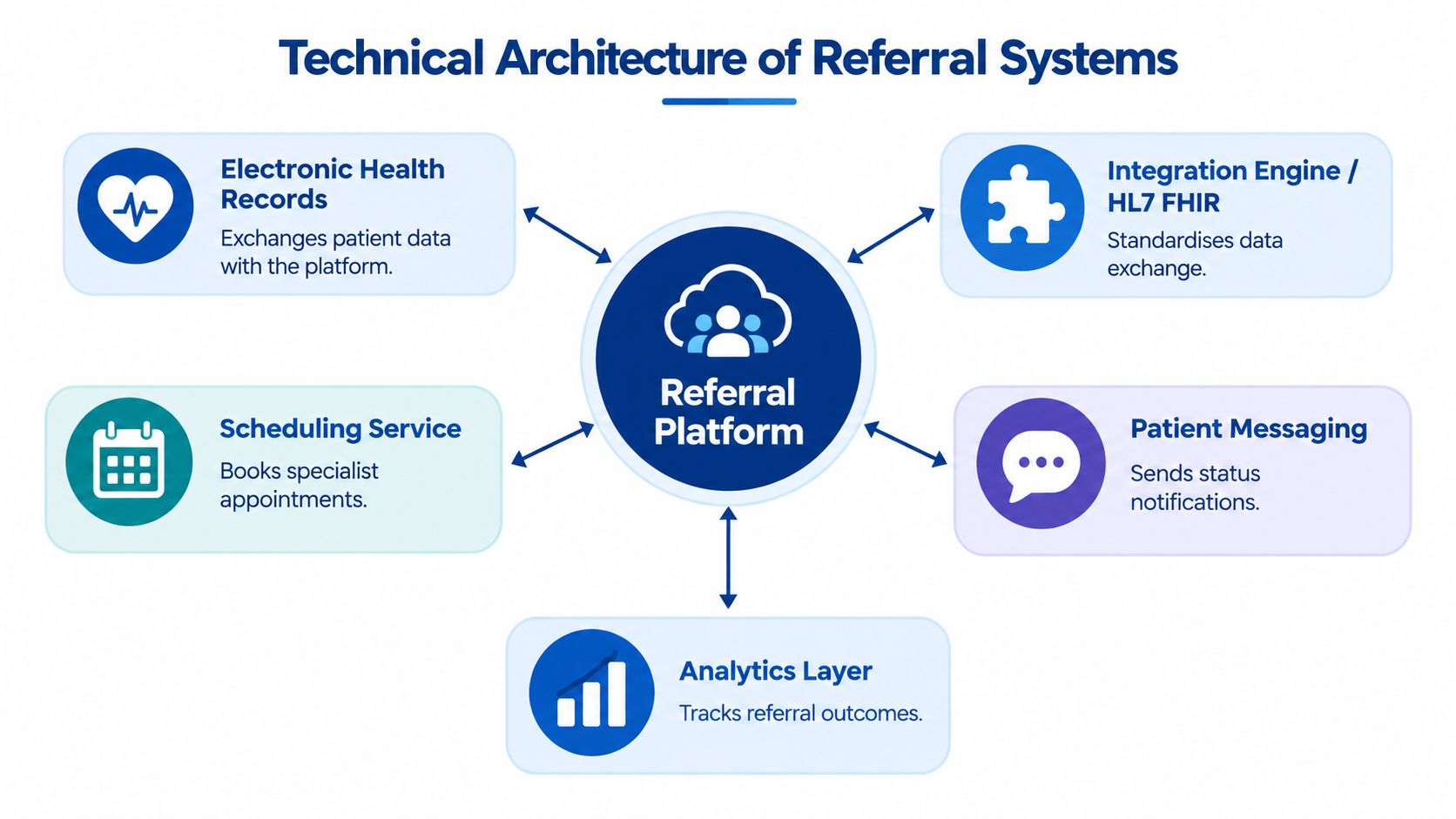
A dependable referral platform sits between systems of record and the people who perform the work. The architecture should preserve the original clinical material, transform relevant information into structured fields and write approved updates back to the appropriate record.
Start with the systems of record
Electronic Health Records and Electronic Medical Records normally hold the patient identity, clinical notes, orders, encounters and appointment information. Referral automation shouldn't create a parallel version of the patient that staff must maintain indefinitely. It should retrieve the required information, apply workflow logic and return relevant events to the organisation's authoritative system.
The integration layer then connects the referral platform to:
EHR or EMR systems, for patient matching, orders, documents and status updates.
Health Information Exchanges, where available, for controlled information sharing between organisations.
Scheduling services, for appointment availability, booking and cancellation handling.
Messaging services, for patient and provider notifications.
Analytics tools, for queue ageing, turnaround intervals, exceptions and outcomes.
Use standards to reduce custom fragility
HL7 FHIR, or Fast Healthcare Interoperability Resources, provides a practical framework for exchanging healthcare information through APIs. A referral platform can use standardised resources and interfaces to reduce the risk that every workflow change requires a separate point-to-point build.
FHIR doesn't solve governance, identity matching or poor data quality by itself. The implementation still needs clear definitions for referral creation, receipt, triage, booking, cancellation and completion. It also needs an agreed response when an external system is unavailable.
A sensible technical sequence is:
Capture the referral event and preserve the original source document.
Match the patient using controlled identity rules and route uncertain matches for review.
Extract structured fields such as speciality, urgency and referring organisation.
Validate completeness against workflow-specific requirements.
Send the referral through the approved interface and record the receipt acknowledgement.
Write back status changes without overwriting the clinical record incorrectly.
Clinical teams evaluating decision-support features may also benefit from this practical resource on Rx360 on safer proactive care. The important distinction is that referral orchestration manages workflow, while clinical decision support must operate within appropriate clinical governance.
The Evidence Behind Automating Referrals
The Canadian access problem provides a strong rationale for improving referral operations, but the evidence also demands precision. Automation can remove manual handling and improve visibility. It can't, by itself, create specialist capacity or guarantee faster treatment.
A peer-reviewed Canadian study reported a national median wait of 78 days for specialist consultation, with an interquartile range of 34 to 175 days. One quarter of patients waited at least 175 days. Another Canadian family-medicine study found that half of referred adult patients were seen within 42 days, 75% within 80 days, and that the observed range extended to 760 days.
Those distributions matter because an average can hide the patients at the end of the queue. A referral management dashboard should show the median and high-end waits by speciality, urgency and location. It should also identify referrals that have stopped moving, rather than reporting only the number submitted.
What electronic referrals can change
An Ontario musculoskeletal central-intake evaluation found that electronic referrals reduced central-intake processing time by an average of 21.76 days compared with paper referrals. The interval from referral initiation to the assessment-centre appointment was 50.30 days for eReferrals, compared with 71.72 days for paper referrals, a difference of 21.42 days.
The operational mechanism is straightforward. Structured submission reduces scanning, fax handling and re-keying. Central routing gives the receiving service a clearer queue, while timestamps show where a request is waiting. Those gains are valuable, but they describe the referral-to-appointment pathway, not the complete path to treatment.
The 2025 Canadian median wait from a general-practitioner referral to specialist treatment was 28.6 weeks, while the referral-to-specialist-consultation portion alone was 15.3 weeks. Median waits reached 49.9 weeks for neurosurgery and 48.6 weeks for orthopaedic surgery, according to reporting based on Canadian wait-time data.
That contrast defines the automation opportunity. A system that makes submission quicker but cannot show treatment-stage bottlenecks has improved administration without fully improving access.
For a broader operational framework, see this healthcare workflow automation guide. Teams should apply the same evidence-based discipline used in clinical improvement work, including the principles discussed in understanding EBP in clinical settings, by separating measured outcomes from assumptions.
Choosing Between Software and Custom Solutions
The choice between commercial referral management software and a custom build is less about technology preference than operational fit. A clinic with common workflows and limited internal engineering capacity may need a configurable product that can be implemented and supported quickly. A large network with unusual intake rules, several provincial interfaces or specialised governance requirements may need more control over the workflow layer.
The wrong choice creates a new bottleneck. An off-the-shelf product may force staff into workarounds. A custom system may reproduce existing inefficiencies while creating a permanent maintenance burden.
Referral Solution Comparison
| Factor | Referral Management Software | Custom Built Solution |
|---|---|---|
| Deployment | Usually quicker when existing connectors and workflows fit | Takes longer because the organisation owns discovery, design and build |
| Workflow fit | Configuration supports common referral patterns | Logic can reflect highly specific clinical and operational requirements |
| Integration | Depends on supported EHRs, APIs and vendor scope | Can target required systems, but each interface needs design and maintenance |
| Scalability | Vendor roadmap and infrastructure influence expansion | Organisation controls the architecture, capacity and release process |
| Compliance | Vendor evidence supports procurement review, but local configuration still matters | Organisation carries more responsibility for controls, testing and documentation |
| Cost profile | Subscription, implementation and configuration costs | Build, infrastructure, security, support and ongoing engineering costs |
| Best fit | Teams seeking standardisation and managed support | Organisations with distinctive workflows and sustained technical capacity |
Ask what the product actually completes
A product demo should follow a referral from receipt to outcome. Ask where staff intervene, how missing information is handled, what happens when patient matching is uncertain and which fields are written back to the EHR. A generic integration logo doesn't prove that the required referral status, attachment or consult note is supported.
Evaluate inbound and outbound work separately. Inbound work may include document intake, data extraction, eligibility checks, patient contact and booking. Outbound work may require confirmation that the receiving organisation accepted the referral, follow-up on appointment status and return of the consultation note.
Compliance can also shape the decision. Organisations comparing regulated practice-management workflows may find it useful to review how PracticeReady handles PsyBA compliance, then apply the same buyer discipline to referral software. Ask for current security documentation, data-processing terms, audit capabilities and the precise responsibilities assigned to the vendor and the healthcare organisation.
A custom build becomes more defensible when the workflow is strategically differentiating, and the organisation can fund product ownership beyond launch. Commercial software is often more practical when the priority is to replace manual handling with a supported, measurable process.
Implementing Automation Safely and Compliantly
Referral automation should start with workflow discovery, not vendor selection. Map every intake channel, handoff, review point, missing-information loop, booking action and escalation path. Include the staff who perform the work and the patients who experience the delays, because a process that looks efficient in an administrative diagram may be confusing at the point of care.
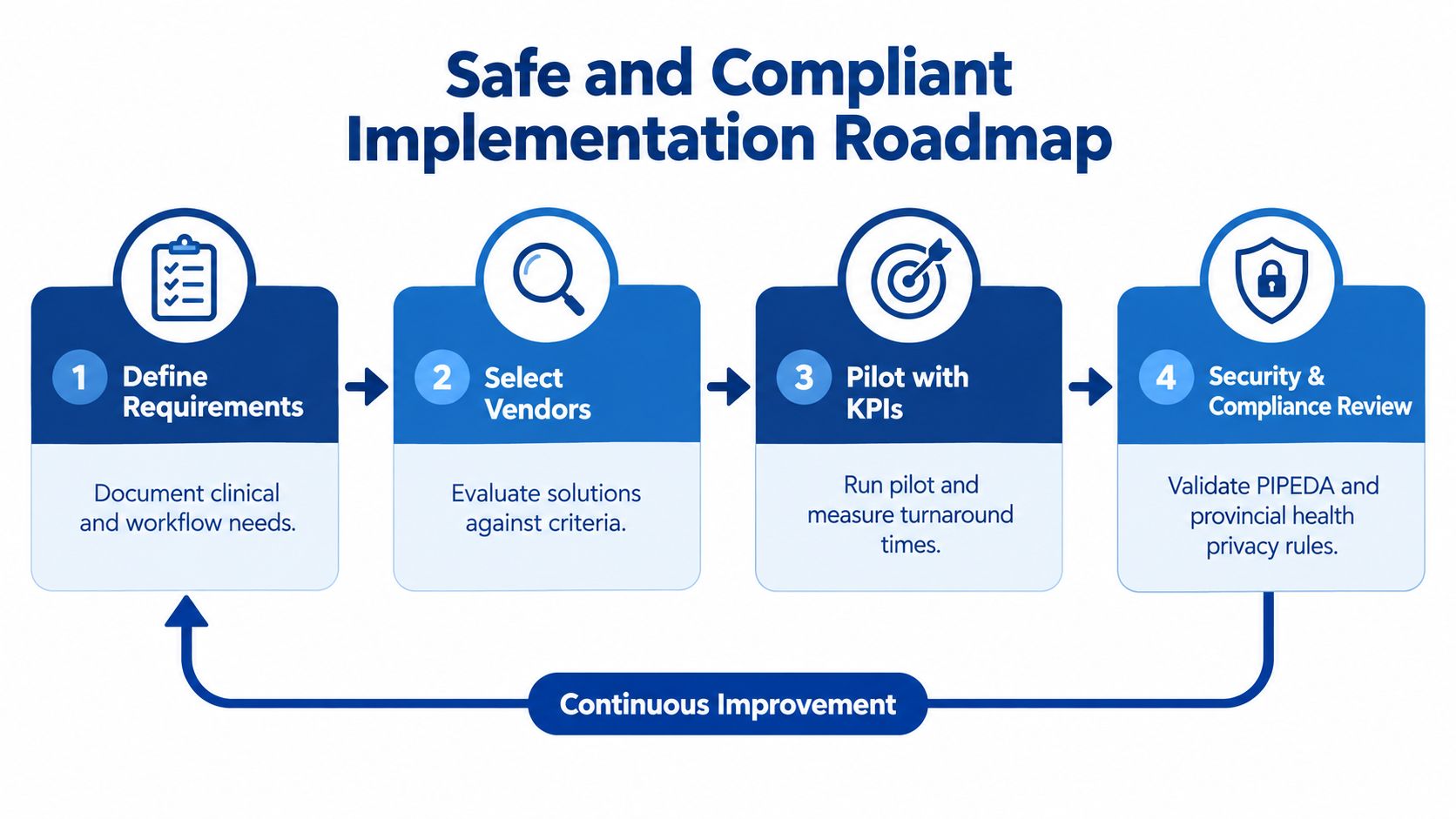
Build the rollout around four decisions
Define requirements: Specify the minimum information needed to accept, triage and book each referral type. Document urgency rules, speciality ownership, exceptions and the point at which a human must review the request.
Select vendors or delivery partners: Test the proposed workflow with real, appropriately governed examples. Confirm EHR actions, attachment handling, patient communication, audit logs, uptime expectations and support responsibilities.
Pilot with meaningful KPIs: Track referral receipt, triage, clarification, booking and completed consultation as separate events. Useful measures include incomplete-submission rates, queue age, referral-to-appointment intervals, exception volumes and the percentage of urgent referrals receiving the intended handling.
Review security and compliance: Validate role-based access, encryption, secure transmission, retention, audit trails and incident handling. Canadian deployments may involve provincial privacy requirements, PHIPA, PIPEDA and obligations relating to protected health information. HIPAA may also apply where a US covered entity, business associate or cross-border service arrangement is involved.
The HIPAA-compliant healthcare software guide offers useful context for evaluating controls, but no general guide replaces a jurisdiction-specific privacy and security review.
Keep people in the control loop
Human review isn't a failure of automation. It is the appropriate control for ambiguous patient matches, unclear urgency, incomplete clinical context, unusual referral destinations and suspected duplicate requests. The system should make those exceptions easy to find, explain why they were flagged and preserve the reviewer's decision.
Staff training should cover both the normal route and the failure route. Coordinators need to know how to correct extracted information, override an incorrect queue assignment, resend a failed handoff and communicate with patients when the system cannot complete the next step.
Overcoming Interoperability and Governance Challenges
Canadian referral automation operates across fragmented provincial, institutional and organisational boundaries. The Canadian Institute for Health Information reports that health records generally don't cross provincial or territorial borders and may not flow smoothly between hospitals and clinics in the same city. Statistics Canada's 2024 provider survey found that 50% of providers with access to a digital health system identified insufficient integration between systems as the most frequently reported barrier to sending and sharing patient information.
That means a referral platform can accelerate a handoff while still creating governance risk. A duplicate patient record, missing attachment or unacknowledged interface failure can turn speed into silent failure.

Define accountability before connecting systems
For each referral event, document:
Authority: Which system is the source of truth for identity, referral status, appointment and consultation outcome?
Consent: How is consent recorded, reviewed, limited or revoked when information moves between organisations?
Access: Which roles can view clinical content, edit administrative fields or release messages?
Failure handling: Who receives an exception when the interface fails, a message bounces or a receiving service doesn't acknowledge receipt?
Auditability: Which user, system or rule changed the referral, and when?
Use an exception queue rather than forcing every referral through an automated path. High-risk or unclear cases should move to a named team with a service expectation and a visible reason for escalation.
Teams planning API-based connections can use this HL7 FHIR interoperability guide as a technical starting point. The implementation still needs province-specific privacy advice, data-sharing agreements and operational ownership.
The safest model is automation with accountable review. Let software handle predictable validation, routing, reminders and timestamping. Let trained staff resolve ambiguity, clinical context and governance exceptions. That division improves efficiency without pretending that every referral is a standard transaction.
Next Steps and Frequently Asked Questions
Start with one referral pathway that has a clear owner and visible friction. Audit the current state, record where requests wait, speak with referring and receiving teams, then pilot a workflow that captures receipt, triage, booking and completion separately. Review the results with clinical, operational, privacy and IT stakeholders before expanding to another speciality.
Frequently Asked Questions
What should organisations measure first?
Measure referral-to-appointment intervals, incomplete submissions, clarification requests, queue ageing, urgent-referral handling and completed consultations. Report median and high-end waits separately, following CIHI's distinction between the 50th percentile and 90th percentile for referral waits.
Is full autonomy the goal?
Usually not. Automated checks, routing, notifications and status tracking are appropriate for predictable work. Human review remains important for ambiguous identity matches, unusual clinical information, uncertain urgency and failed handoffs.
How can success be shown beyond digitisation?
Compare the before-and-after workflow using consistent definitions. Look for fewer incomplete submissions, clearer queue ownership, shorter operational intervals, fewer lost referrals and better patient communication. Don't treat the number of electronic forms submitted as the outcome.
Ontario's experience also shows why adoption planning matters. The provincial health agreement recorded 7,500 sending clinicians participating in eReferral as of 31 March 2023, with a target of 11,000 by March 2026, and reported 17,067 participating sending clinicians in the first quarter of fiscal year 2025–26. A mature programme must support connected organisations while providing controlled handling for referrals that still arrive through less integrated channels.
Cleffex Digital Ltd helps healthcare organisations design secure workflow automation, integrate referral processes with existing systems and build patient referral technology around structured intake, completeness checks, priority routing, status tracking and notifications. Visit Cleffex Digital Ltd to discuss a practical referral automation roadmap that improves visibility across the full journey, not just the initial submission.