

Intelligent document processing combines OCR with AI classification and extraction to route claims materials automatically, and a Canadian commercial carrier benchmark reports a 98.5% straight-through processing rate. The same benchmark covers more than 3,000 claims items per day and loss-run reports processed up to 90% faster, while a compliant design preserves audit trails for regulators.
A claims adjuster opens the morning queue to find accident forms, repair estimates, invoices, policy schedules and photographs arriving through several channels. The documents need to be read, matched to the correct policy, checked for missing evidence and entered into core systems before a claimant or broker receives a useful answer. When that work stays manual, the queue grows faster than the team can clear it.
That's why insurance document automation has moved beyond scanning. The practical objective isn't to remove judgement from claims operations. It's to turn unstructured documents into reliable, traceable information so adjusters can spend more time on exceptions, investigation and customer communication.
The Claims Bottleneck and Why Automation Matters Now
A claims team can lose hours re-keying the same information from documents that look different but contain familiar fields. One broker's submission may arrive as a structured spreadsheet, another's as a PDF, and a claimant's evidence as a mobile photograph. The adjuster still has to identify the document type, find the policy number, verify dates and decide whether the file is ready for the next step.
That delay affects more than internal productivity. Missing information creates follow-up messages, inconsistent handling and uncertainty for policyholders waiting for a decision. During a surge in claims, experienced staff may spend their time on clerical checks rather than applying the judgement that difficult claims require.
Insurance document automation addresses the bottleneck at intake. It captures documents, classifies them, extracts relevant values and applies workflow rules before sending clean or questionable records to the appropriate queue. The best systems don't treat every extracted value as correct. They make routine work faster while making uncertainty visible.
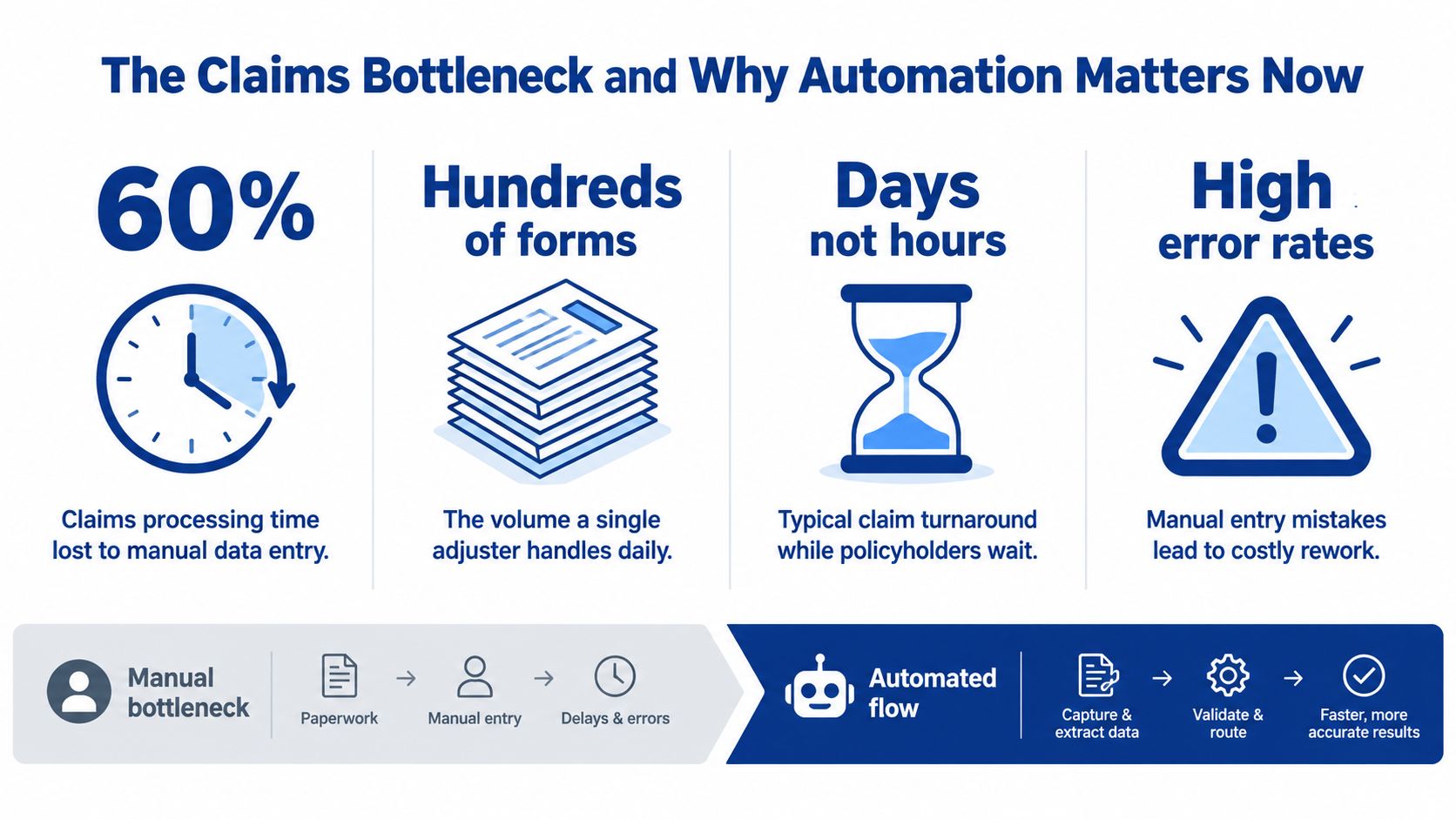
A Canadian commercial carrier benchmark describes automated indexing of more than 3,000 claims items per day, with a 98.5% straight-through-processing rate. It also reports loss-run reports processed up to 90% faster. The value comes from removing queueing and re-keying delays at the front of the workflow, not from scanning files for its own sake. PwC Canada's insurance automation benchmark provides the underlying example.
Practical rule: Automate the predictable path, but design the exception path before deploying the happy path.
A useful starting point is to map the journey from document receipt to indexed claim record. Cleffex's guidance on insurance claim automation is relevant for teams assessing where intake, validation and routing create the greatest operational friction.
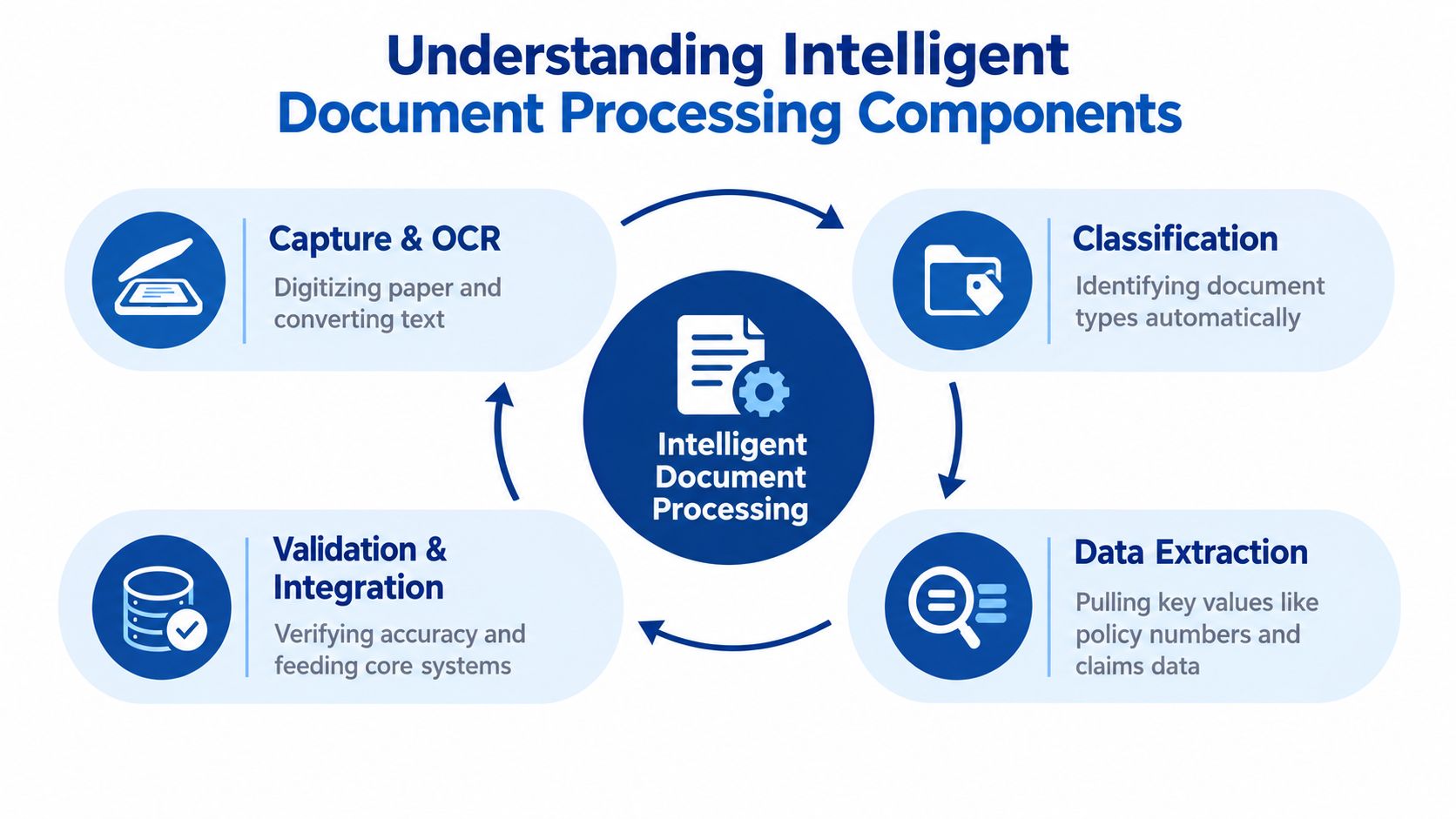
Understanding Intelligent Document Processing Components
Simple OCR converts the visible characters on a page into text. That's useful, but it doesn't understand whether a number is a policy identifier, an invoice total or a date of loss. Intelligent document processing insurance workflows add context, classification, extraction and validation around OCR.
Four connected capabilities
Capture and OCR bring documents in from email, portals, scanners and other intake channels. The original image should remain available because extracted text alone may not preserve the evidence an adjuster or auditor needs.
Classification identifies what each document represents. A document pack might contain a notice of loss, repair estimate, medical report and proof of ownership. Classification separates those items and assigns them to the right workflow.
Extraction pulls defined fields such as policy numbers, claimant details, dates, coverage limits and invoice totals. AI-based extraction can account for varying layouts, but the output still needs a confidence score and a source location.
Validation and integration compare extracted values with business rules and existing records. A system can check whether required fields are present, whether dates conflict and whether a policy reference matches the intended file. Validated data can then move into a claims or policy-administration system, while exceptions go to a human queue.
What a defensible pipeline retains
For Canadian insurers, the architecture should be an intelligent-document-processing pipeline rather than simple OCR. EY Canada's insurance outlook highlights OCR-based digitisation and AI-assisted automation while identifying privacy, security, bias, cyber-risk and output accuracy as governance concerns.
A technically sound implementation retains:
The original document: Preserve the evidence used to produce the extracted value.
The extracted field and location: Show what the system read and where it found it.
Confidence and validation results: Distinguish reliable values from those needing review.
Human decisions: Record corrections, approvals and overrides.
An immutable audit trail: Maintain a history of processing and model activity.
Teams comparing workflow patterns can also review these automated document processing tips for practical considerations around capture, routing and review. The important distinction is that automation should create a controlled record, not an opaque transformation that nobody can reconstruct later.
Governance and Compliance Requirements in Canada
Canadian insurers shouldn't treat compliance as a final approval step. It belongs in the data model, workflow design and vendor assessment from the beginning.
Canada established a federal legal foundation for electronic insurance records on October 28, 2010, when the Electronic Documents (Insurance and Insurance Holding Companies) Regulations were registered under the Insurance Companies Act. The regulations recognise electronic records used by federally regulated insurers when they meet requirements for reliability, accessibility and reproduction in intelligible written form, as set out in the federal electronic documents regulations.
That requirement has a direct technical consequence. A scanned document that cannot be retrieved, understood or reproduced reliably isn't a sufficient automation record. The workflow must preserve the original evidence, the resulting information and the process that connected one to the other.
Design for explanation and control
OSFI identifies AI as a source of efficiency and a potential amplifier of fraud and other financial-crime risks in its 2025–2026 Annual Risk Outlook. Its supervisory work includes reviews of insurers' AI use and oversight. That makes uncontrolled claims automation a poor design choice, even when extraction accuracy appears strong in testing.
OSFI's practical governance principles include explainability, data quality, governance and ethics. In an insurance workflow, those principles mean the system should be able to show:
The document received and the fields extracted.
The model or configuration used.
The confidence score and validation rules applied.
The person who reviewed or changed the result.
The reason a record was accepted, rejected or escalated.
Privacy and consent controls also need clear boundaries. Define which vendors can access documents, where processing occurs, how prompts and training data are handled, and when records are deleted or retained. Human escalation should be mandatory for low-confidence policy numbers, dates of loss, coverage limits and financial values rather than allowing uncertain data to enter a core system without review.
Real-World Insurance Use Cases and Workflows
The strongest early use cases have a clear document boundary, repeatable rules and a meaningful exception path. Claims intake often meets all three conditions.
Consider an Ontario motor-vehicle claim. The Ontario Automobile Policy requires written notice within 30 days of the accident, or as soon as possible when the insured cannot meet that deadline. It also requires supporting evidence, including details of the accident and resulting loss, within 90 days, subject to the same qualification.
A claims document processing workflow can identify the accident date, calculate the relevant deadlines, check whether evidence is present and route an incomplete or late submission to an adjuster. It shouldn't decide automatically that a claimant has forfeited coverage. The system should surface the condition and preserve the evidence for a qualified person to assess.
Where document intelligence fits
Policy intake can follow a similar pattern. The system classifies application forms, extracts named insured details and coverage information, checks required fields and sends inconsistencies to underwriting. Claims teams can use the same approach for repair estimates, invoices, statements and proof-of-loss forms.
Fraud controls benefit from comparison rather than automatic rejection. Extracted claimant, incident, payment and identity information can be compared with policy records and previous submissions. A mismatch becomes an investigation signal, not a final decision. That distinction protects both operational efficiency and procedural fairness.
| Use Case | Document Types | Processing Volume | Accuracy Target |
|---|---|---|---|
| Claims intake | Notices of loss, estimates, invoices and supporting evidence | High and variable | High confidence on required fields, with human review for exceptions |
| Underwriting intake | Broker submissions, applications, schedules and loss histories | High during renewal and submission periods | Reliable classification and field-level validation |
| Policy servicing | Endorsements, amendments, certificates and correspondence | Repetitive and ongoing | Consistent extraction against policy records |
| Fraud review support | Identity documents, statements, payment records and claim evidence | Variable and risk-driven | Traceable matches and explainable flags |
The operational benefit isn't just speed. Structured documents make it easier to see what is missing, apply the same rules to comparable files and give an adjuster a clear reason for every escalation.
Implementation Roadmap for Insurance Automation Projects
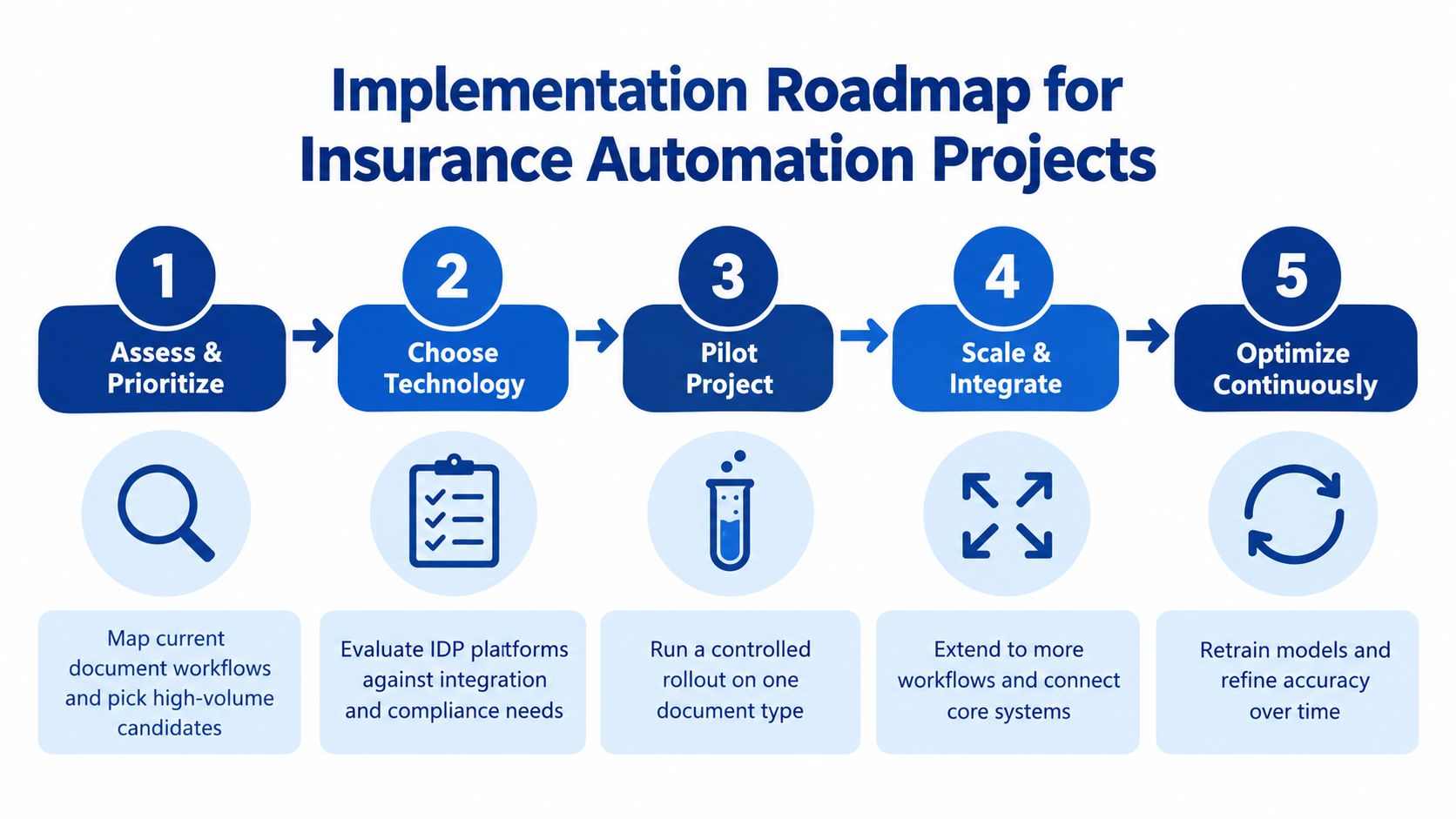
A successful implementation starts with workflow selection, not with a purchase order. Choose a process where documents arrive regularly, the desired fields are understood, and a human already knows how to resolve exceptions.
Start with evidence and scope
Assess and prioritise: Map each intake channel, document type, validation rule, downstream system and manual handoff. Record where staff re-key information and where missing documents cause delays.
Choose technology against the workflow: Test classification, extraction, confidence scoring, rules, audit trails, access controls and integration options. A polished demonstration using clean documents tells you very little about performance on your real archive.
Pilot one document family: Start with human-in-the-loop intake and evidence-preserving review. Don't begin with autonomous coverage interpretation or settlement decisions. Use a controlled sample that includes ordinary documents and difficult exceptions.
Integrate gradually: Connect validated outputs to the claims or policy system only after field mappings, exception queues and rollback procedures have been tested. Keep the source document accessible from the resulting record.
Optimise with feedback: Review corrected fields, misclassifications and recurring exceptions. Update rules and models under change control, and make sure staff understand when they must override automation.
Cloud, on-premises and hybrid deployments each involve trade-offs. Cloud services may simplify scaling and maintenance, while on-premises environments can offer more direct control over sensitive processing. A hybrid approach may separate document storage, model processing and core-system integration. The right choice depends on privacy obligations, vendor access, existing architecture and internal operating capability.
A specialist partner such as Cleffex's insurance and fintech development team can help connect document capture, extraction, workflow automation and policy-administration systems. Whatever route you choose, procurement should require demonstrable lineage, configurable thresholds and a workable human-review experience.
Measuring Success and Calculating ROI
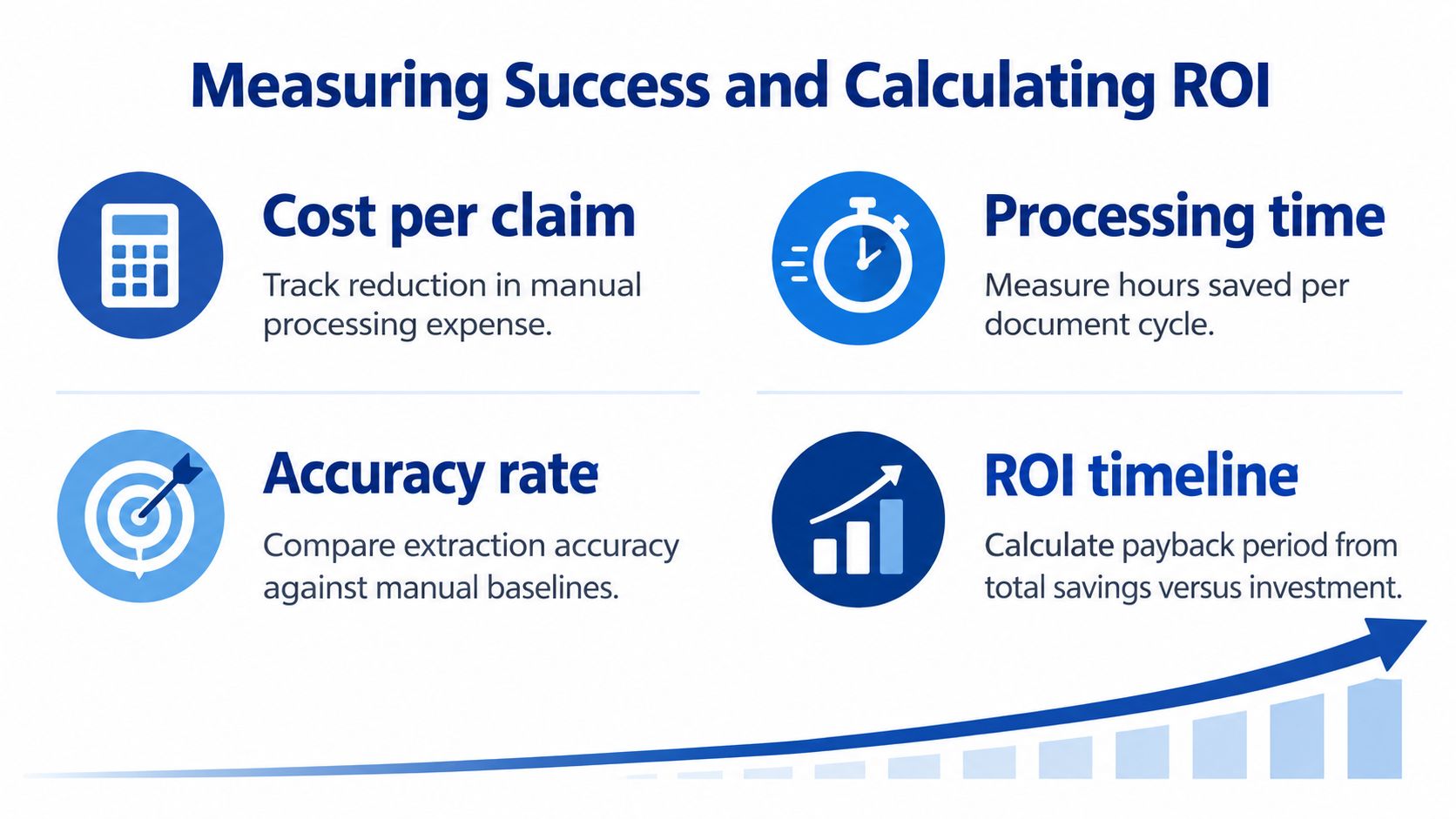
Automation projects lose credibility when they report only the number of documents scanned. Leaders need to know whether the system produced usable information, reduced avoidable handling and preserved operational control.
Track performance at field, document and workflow level:
Field-level extraction accuracy: Measure important fields separately. A correct document classification doesn't compensate for an incorrect policy number.
Auto-classification rate: Monitor how often documents reach the right workflow without manual sorting.
Straight-through-processing rate: Count records that complete the defined path without intervention.
Exception rate: Separate genuine uncertainty from avoidable system failures.
Median receipt-to-index time: Measure how quickly a document becomes available as a structured claim or policy record.
Correction and override patterns: Use human changes to identify model, layout or rule weaknesses.
The Canadian Employment Insurance system offers a useful insurance-adjacent reference point. In 2024–25, 98.2% of EI applications were submitted online, and employers issued nearly 12 million Records of Employment, with 98.2% issued electronically, compared with 98.1% in 2023–24. The system transfers claimant information into EI files, uses business rules across applications and databases, and automates routine processing and workload management, according to Employment and Social Development Canada's monitoring report.
Build the financial case
Calculate the baseline before implementation. Include manual handling time, re-keying, correction work, queue management and the cost of delayed downstream activity. Then compare those costs with software, integration, implementation, governance, training and ongoing monitoring.
Measure the exception path separately. A system that processes routine documents quickly but sends every difficult file to an overloaded queue hasn't solved the operational problem.
ROI should also account for less visible value. Better traceability can reduce time spent reconstructing decisions. Consistent validation can help teams find missing evidence earlier. A clearer work queue can allow experienced staff to focus on judgement rather than repetitive transcription.
Next Steps and Frequently Asked Questions
The practical lesson is straightforward. AI insurance automation works best when it augments controlled workflows rather than pretending that every document and decision is predictable. Start with intake, classification and evidence-preserving review, then expand when the data, controls and exception process are ready.
Canadian adoption is growing, but production readiness remains uneven. In 2025, 30.6% of Canadian finance and insurance businesses reported using AI, while 49% of organisations moving AI from pilots to production identified data quality and availability as the most common obstacle. 65% used vendor-provided AI tools. These findings from Statistics Canada's AI adoption analysis reinforce the need to assess data lineage and vendor controls before scaling.
Frequently Asked Questions
Can automation work with existing claims systems?
Yes, if the platform can map extracted fields to the system's data model and send exceptions to a queue your staff already use. Integration should be tested with real document variants, not just clean sample files.
Should an insurer automate claims decisions first?
No. Begin with document intake, classification, extraction and validation. Keep coverage interpretation, fraud investigation and settlement judgment with qualified staff until governance, evidence trails, and performance monitoring are mature.
How should complex or handwritten documents be handled?
Route them according to confidence and validation results. Preserve the original image, show the uncertain field to the reviewer, and record the correction. A controlled exception is safer than inserting unreliable data without review.
What should procurement teams ask vendors?
Ask how the vendor handles data residency, consent, access permissions, retention, model changes, audit records, human overrides and deletion requests. Require a demonstration of source-to-field traceability and failure handling.
For a small insurer, one document type and one measurable workflow can provide a sensible starting point. A larger carrier may need an enterprise data model, governance committee and integration plan, but the operating principle remains the same: automate repetitive handling while keeping people accountable for consequential decisions.
Cleffex Digital Ltd provides software development for insurance automation, including document capture, information extraction, workflow integration and intelligent processing for underwriting and claims operations. Visit Cleffex Digital Ltd to discuss a governed document automation workflow built around your systems, data and compliance requirements.