

Your ecommerce team has just found another order that the ERP never received. The customer saw stock available, paid successfully, and received an automated confirmation. Operations now has to enter the order manually, check the warehouse allocation, correct the inventory balance, and explain the delay to customer service. Meanwhile, finance is working from a different version of the transaction.
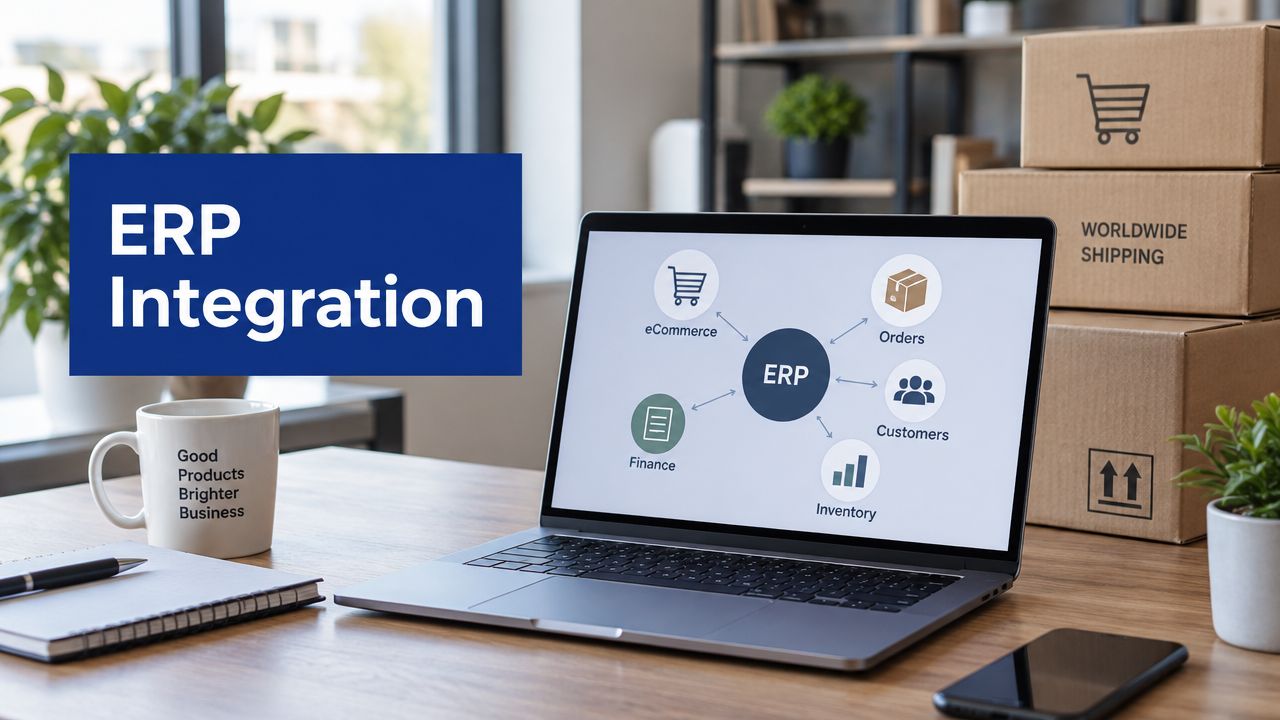
That scenario appears when a storefront and an ERP are treated as separate applications with a small connector between them. ERP integration with ecommerce is an operating model, not just an API project. The important decisions concern data ownership, failure handling, architecture, security, and the people responsible for keeping the connection reliable after launch.
Understanding ERP and Ecommerce Architecture Options
Mid-market businesses usually reach the same pressure point. The ecommerce platform is good at presenting products and taking payments, while the ERP manages purchasing, finance, fulfilment, and operational records. As order volume and catalogue complexity increase, staff begin copying orders, adjusting inventory, and reconciling customer records by hand. The systems still work individually, but the gaps between them create overselling, delayed fulfilment, and inconsistent answers.
A useful starting point is to distinguish application architecture from integration mechanics. Architectural patterns such as those described in this guide to enterprise application architecture patterns help teams decide whether systems should connect directly, communicate through middleware, or expose shared services through a broader composable design.
Headless commerce changes the integration question
A traditional storefront often assumes that the commerce platform owns most of the customer-facing experience. A headless model separates the presentation layer from commerce services, allowing web, mobile, marketplaces, partner portals, and other channels to use common APIs. That flexibility brings a different integration responsibility. The ERP connection must support more than a checkout order and a stock quantity.
Canadian enterprise guidance increasingly frames the stack around headless commerce, unified B2B and B2C experiences, ERP, CRM, PIM, WMS, and 3PL connectivity. The practical implication is clear. If the business expects new channels, customer-specific pricing, richer product content, or external fulfilment partners, the integration design should accommodate those requirements before the first production deployment.
Canada's commerce base makes control more important
Canadian retail ecommerce sales reached CAD 4.0 billion in November 2025 and represented 5.7% of total retail trade, while the Canadian ERP software market was valued at USD 7.06 billion in 2024 and is projected to reach USD 12.47 billion by 2030, at an 8.82% CAGR, according to Canada ecommerce and ERP integration market data. These figures describe a substantial online commerce environment alongside continued investment in the systems that control it.
That doesn't mean every company needs a complex composable stack. It does mean the team should assess its likely operating model, not only its present storefront. A direct integration may suit a single channel with straightforward products. A distributor serving business customers, multiple warehouses, sales representatives, and external logistics providers may need an orchestration layer that can enforce rules consistently.
Architectural rule: Design the integration around the business processes that must remain reliable when channels, products, and fulfilment partners change.
Mapping Core Data Models for Reliable Syncing
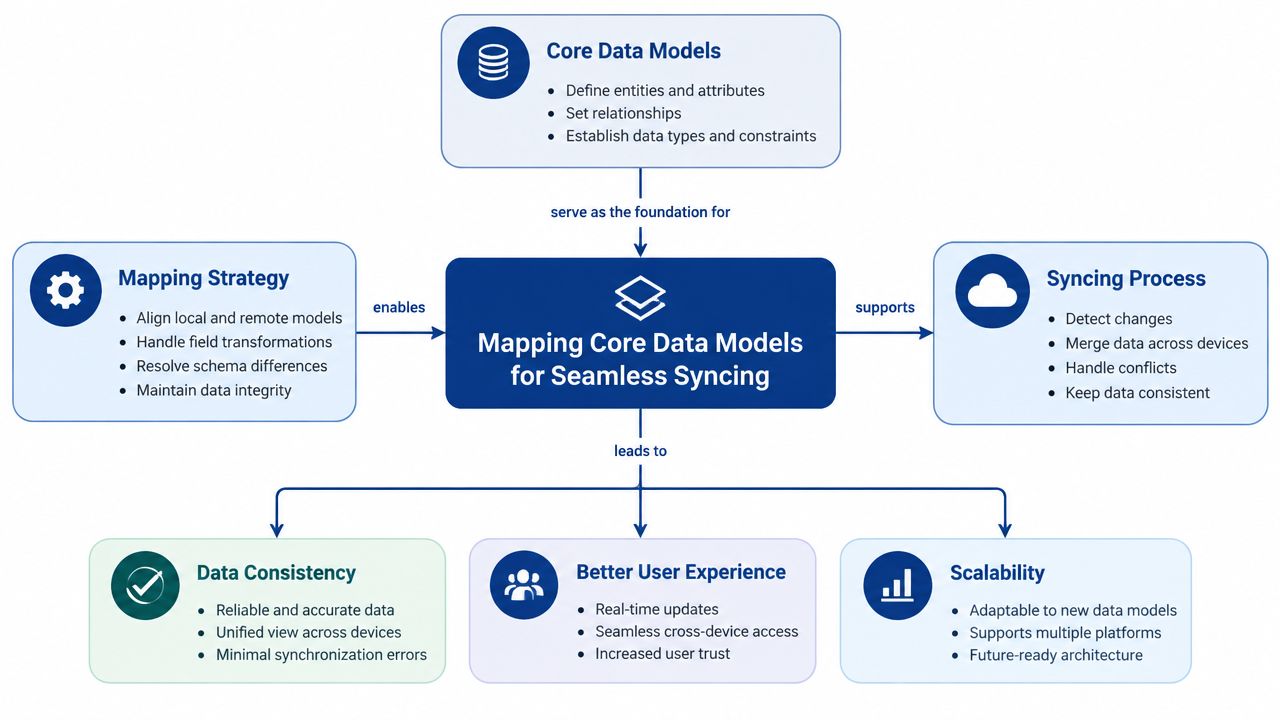
A connection can pass health checks and still move incorrect information. The hard work is defining what an order, product, customer, price, or inventory position means in each system. Field names alone cannot resolve ownership, timing, transformations, or exceptions. Those decisions also determine who will maintain the integration after launch and whether new channels or a headless storefront can be added without rebuilding every flow.
A canonical data model creates a shared structure between applications. Each ecommerce and ERP system maps to that structure instead of directly to every other system. This limits dependence on one platform's schema and gives the team a controlled place to manage changes. The trade-off is added design and governance work, which is usually easier to manage than a growing set of point-to-point mappings.
Establish ownership before mapping fields
Start with an entity register. For every object, record the system of record, permitted writers, update frequency, identifier, validation rules, and reconciliation method. Include the team responsible for changing the mapping and the vendor SLA that applies when a connector or endpoint fails.
Products: The PIM may own descriptions, images, attributes, and search content. The ERP may own accounting classifications, procurement details, and stock policy.
Inventory: The ERP or WMS normally provides the operational position. The storefront may need available-to-sell inventory after reservations, safety stock, and channel allocations.
Orders: The ecommerce platform captures checkout intent, payment status, discounts, and customer-facing details. The ERP or order management service creates the fulfilment and financial record.
Customers: A CRM may own relationship data, while the commerce platform owns account credentials and shopping context. Duplicate detection and a durable shared identifier are required.
Pricing: The ERP may own base prices, but B2B contracts, customer groups, currencies, tax treatment, and promotions may require a pricing service or explicit precedence rules.
Businesses connecting order workflows to wider operational systems can use this guide to order management system software to clarify which platform coordinates allocation, fulfilment status, returns, and exceptions.
Handle difficult objects explicitly
Bundled products need a defined mapping. The storefront may sell a kit as one item, while the ERP requires component lines for inventory and accounting. Preserve both the customer-facing bundle and its operational components, with rules for substitutions, partial availability, and refunds.
Tiered B2B pricing requires more than a product ID and price. Store customer or contract context, currency, effective period, unit of measure, and precedence against promotions. For multi-location inventory, transmit location, quantity type, reservation state, and allocation decision instead of one aggregate number.
Automated reconciliation should compare the canonical record with downstream responses. A failed acknowledgement, changed quantity, missing identifier, or unexpected status should create an actionable exception rather than disappear into a log. Teams evaluating automated data sync for attribution can also examine how connected data flows are monitored and maintained. The operating team should own these checks after launch, with documented escalation when vendor support does not meet its SLA.
Selecting the Best Integration Pattern for Your Stack
The right pattern depends on what must happen immediately, what can wait, and who will maintain the connection. A small retailer with a stable catalogue may value a supported connector over architectural flexibility. A growing B2B operation may accept middleware complexity because it needs routing, transformation, retries, and additional systems.
| Pattern | Latency | Complexity | Best Use Case |
|---|---|---|---|
| Direct API connection | Real-time or near-real-time | Moderate, but tightly coupled | A limited number of stable systems with a capable development team |
| Middleware or iPaaS | Real-time, near-real-time, or scheduled | Moderate to high, with central orchestration | Multiple systems, reusable workflows, transformations, and monitored exceptions |
| ETL batch processing | Scheduled | Moderate | Reporting, historical migration, and processes that don't require immediate updates |
| Event-driven webhooks | Event-based, near-real-time | High, because delivery and ordering must be managed | Order, payment, fulfilment, and inventory events that need responsive processing |
Direct APIs keep the path short
Point-to-point API work can be efficient when the business has few applications and the required data flows are straightforward. It avoids an additional platform and gives engineers precise control. The trade-off is coupling. A change in an ecommerce API, ERP endpoint, authentication method, or field structure can require code changes in the integration itself.
Vendor connectors reduce custom development further, but they often reflect common workflows rather than the company's exact rules. They may not handle complex bundles, multi-location allocation, custom status transitions, or unusual tax and pricing logic cleanly.
Middleware absorbs complexity, but creates ownership
Middleware provides a place to transform data, route messages, apply business rules, centralise logs, and manage retries. That makes it a strong fit for an expanding stack. It also creates another production service that needs credentials, monitoring, deployment controls, documentation, and support.
Canadian market research describes cloud and composable deployment as an increasingly important integration pattern, with one Canada market study projecting an 81% cloud/composable share in 2026, alongside 347,000 digitised merchant endpoints and 12.5% year-over-year market growth, as reported in Canada ecommerce platform and retail digitisation research. The same context supports a phased approach using middleware, canonical models, and automated reconciliation rather than a high-risk cutover that changes every flow at once.
Choose by failure tolerance, not fashion
Event-driven webhooks are useful for immediate reactions, but the receiver must handle duplicate delivery, out-of-order events, missing events, and provider retries. ETL remains appropriate for bulk migration and analytical loads, but it shouldn't carry a customer-facing process that requires timely confirmation.
A practical decision process asks four questions:
Which events require immediate action?
Payment capture, order creation, cancellation, and fulfilment changes usually need stronger responsiveness than catalogue enrichment.
How much custom logic exists?
Complex transformations favour middleware or an integration service.
Who will support the connection?
A pattern that requires specialist engineering isn't suitable if nobody owns production incidents.
What happens during an outage?
If the business can't queue, replay, reconcile, and explain transactions, the pattern isn't ready for launch.
Securing Data and Planning Rollback Strategies
Security starts before the first payload leaves the storefront. The integration moves customer, order, payment-related, pricing, and operational data between systems, so each connection needs a defined identity, permission boundary, encryption policy, and audit record.
Use OAuth 2.0 or an equivalent supported authentication method rather than embedding long-lived credentials in application code. Store secrets in a managed secret store, restrict access by role, rotate credentials under a documented procedure, and separate development, testing, and production accounts. Encrypt data in transit and protect sensitive data at rest according to the requirements of the systems and applicable obligations.
Test business failures, not just successful payloads
A sandbox should represent the conditions that cause operational damage. Test duplicate webhooks, expired tokens, rejected SKUs, partial fulfilment, cancelled orders, backordered items, invalid addresses, price changes between cart and checkout, and an ERP that accepts an order but delays its acknowledgement.
The team also needs traceability. Every transaction should carry a correlation identifier that appears in the ecommerce platform, middleware logs, ERP record, and support tooling. That lets an operator answer what happened without editing production tables manually.
Build recovery into every flow
Rollback doesn't always mean reversing a database transaction. A payment may already be authorised, a warehouse may have started picking, or a customer may have received a confirmation. Define compensating actions instead.
Queue temporarily unavailable work: Preserve the original payload and business timestamp so an operator can replay it safely.
Use idempotency keys: A retry must not create a second order, invoice, reservation, or shipment.
Apply exponential backoff: Temporary rate limits and network failures should trigger controlled retries rather than an immediate flood of requests.
Set a dead-letter path: Messages that exceed retry rules need a visible queue, reason code, owner, and replay procedure.
Trigger reconciliation alerts: A mismatch between ecommerce status and ERP status should be raised before staff discover it through a customer complaint.
For payment and card-data considerations, teams should align the design with their compliance obligations and consult this PCI DSS compliance guide for businesses. The safest implementation is the one that makes failures observable, reversible where possible, and safe to investigate.
Estimating Timelines and Avoiding Common Pitfalls
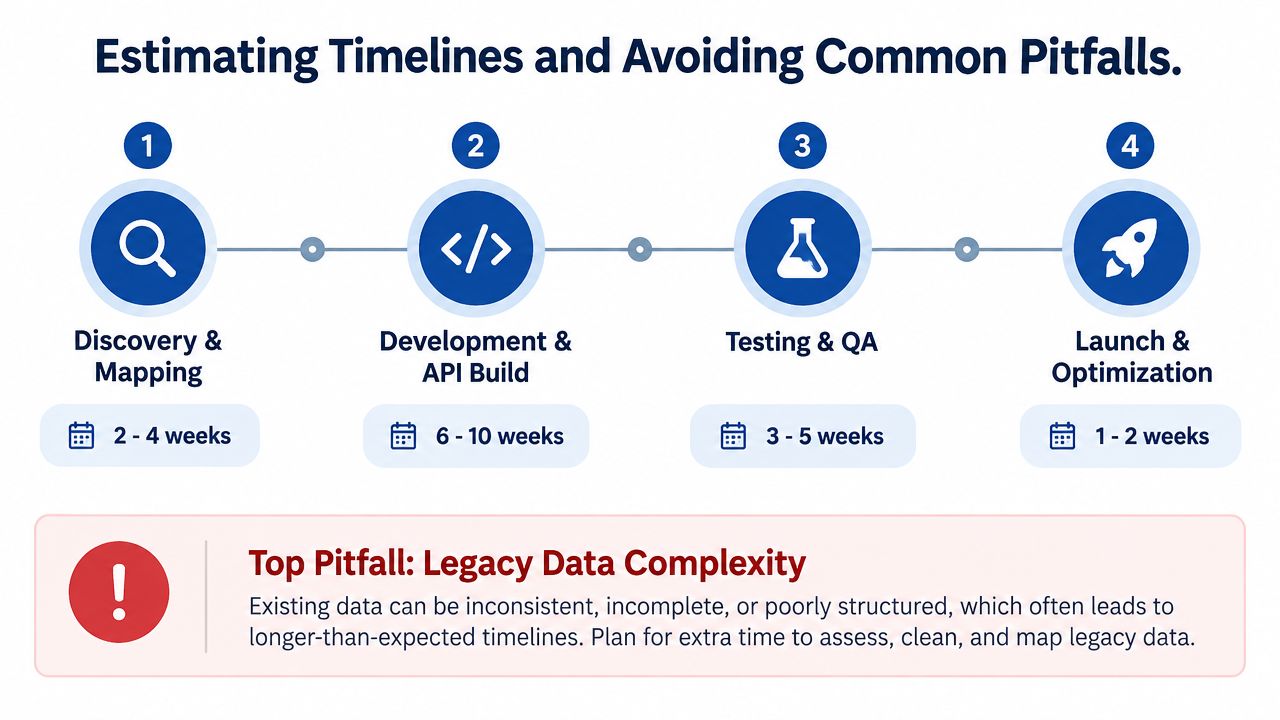
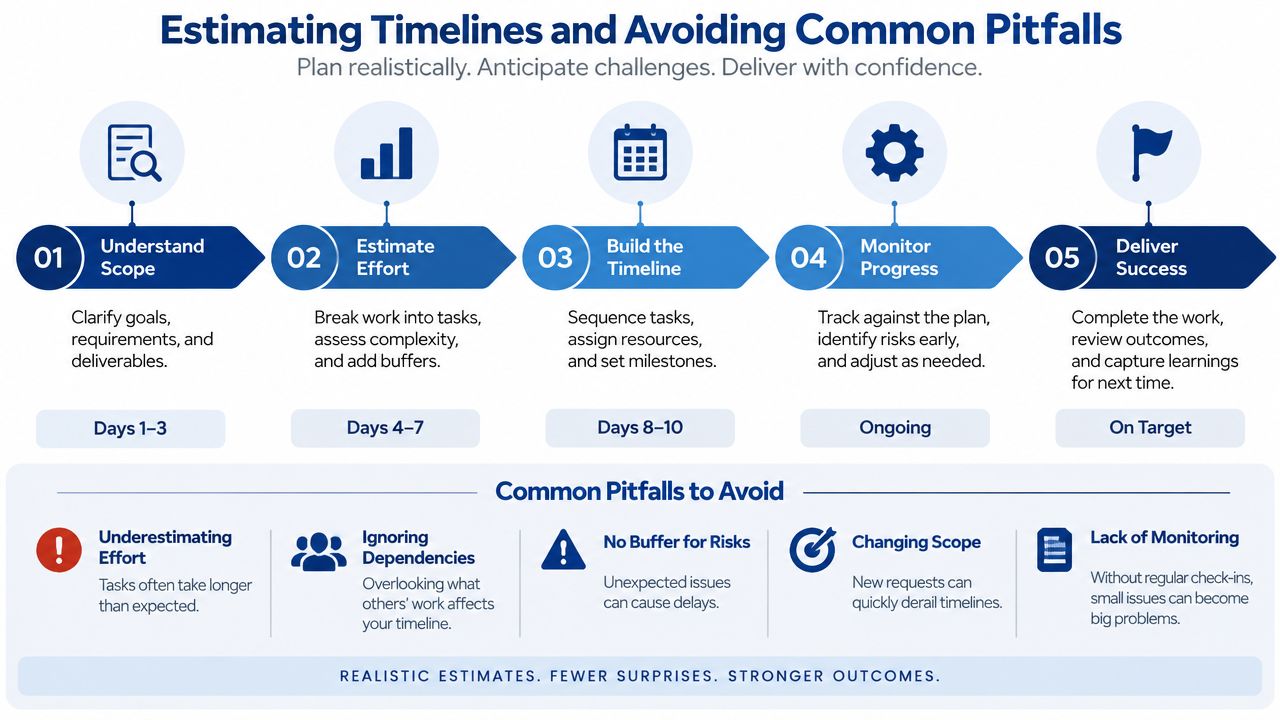
Integration schedules usually fail before development starts. Executives approve a plan based on visible endpoints, while the delivery team later discovers inconsistent product identifiers, undocumented ERP customisations, missing ownership decisions, and historical records that don't fit the new model.
The timeline should therefore be built around discovery and proof, not optimistic coding velocity. Start by inventorying systems, data owners, business rules, API limits, custom modules, and operational exceptions. Then validate the riskiest flow with representative records before committing to a full build.
Plan phases around evidence
A practical delivery sequence includes:
Discovery and mapping: Confirm entities, ownership, identifiers, transformations, exceptions, and acceptance criteria.
Data preparation: Profile legacy records, resolve duplicates, standardise units, retire invalid products, and agree on the migration boundary.
Development: Build interfaces, canonical models, authentication, business rules, queues, and observability.
Testing and rehearsal: Run functional, integration, performance, security, and operational tests using realistic edge cases.
Cutover and stabilisation: Freeze or control changes, migrate approved data, monitor transactions, and keep a rollback path available.
Don't present these as isolated handoffs. Data cleansing affects mapping. Mapping affects test coverage. Test results may expose an ERP limitation that changes the architecture. A delivery manager should maintain a dependency log and make unresolved decisions visible to the executive sponsor.
Common delays come from ownership gaps
Legacy data is often the largest hidden workload. Product variants may use different identifiers across systems, customer accounts may be duplicated, and old orders may contain fields that the new platform no longer supports. Custom ERP modules can create another obstacle when standard API endpoints don't expose the required business function.
Financial support can reduce the initial burden for eligible Canadian SMEs. The federal Canada Digital Adoption Program launched on March 3, 2022, with CAD 4 billion in funding over four years to support up to 160,000 businesses. One stream offered micro-grants of up to CAD 2,400 for ecommerce capabilities such as online ordering, electronic payments, and related digital tools. Funding doesn't remove the need for sound discovery, but it can make a properly scoped integration more attainable.
Managing Post-Launch Ownership and System Updates
Go-live is the beginning of integration operations. APIs change, certificates expire, products acquire new attributes, warehouses alter processes, and vendors release platform updates. A connection that worked during launch can fail later without any change to the original code.
The overlooked question is simple: who owns the integration on an ordinary Tuesday morning when an order stops moving? The answer shouldn't be “the implementation partner” unless the contract defines response times, access, monitoring, maintenance, and escalation in operational terms.
Define the service boundary
Vendors differ in how they handle updates, error visibility, retry logic, and audit trails. Before signing, ask for a written responsibility matrix covering:
Monitoring: Which party watches failed jobs, queue depth, authentication errors, and reconciliation exceptions?
Incident response: What severity levels, acknowledgement targets, resolution targets, and escalation routes apply?
Change management: Who tests ecommerce, ERP, middleware, and API updates before production release?
Environment access: Can the client use a sandbox, obtain test credentials, and validate changes without waiting for a vendor?
Data export: Can the business retrieve its mappings, logs, configuration, and transaction history in a usable format?
Recovery: Who performs replay, compensating actions, and reconciliation after a failed handoff?
These points matter because operational risk sits in the gaps between contractual assumptions. A vendor may maintain its connector while the client remains responsible for business rules. Another may manage the platform but exclude custom mappings from update support.
Treat monitoring as a business control
Technical uptime doesn't prove that orders are flowing correctly. Monitor business outcomes, including orders created without an ERP acknowledgement, inventory updates rejected by the storefront, fulfilment statuses that remain unchanged, and invoices without matching payments. Set alert thresholds that identify a developing queue before customers feel the impact.
Keep an integration runbook with named owners, escalation contacts, replay instructions, known failure codes, release procedures, and reconciliation steps. Review it after incidents, not only during annual planning. Internal staff should understand enough of the flow to challenge a vendor's diagnosis and protect the customer experience during an outage.
Operational standard: If nobody can explain how to detect, contain, replay, and reconcile a failed transaction, the integration isn't finished.
For businesses that need help designing or maintaining this operating model, Cleffex Digital Ltd provides ecommerce solutions that connect inventory, payments, logistics, and customer data, along with ERP, CRM, custom API, and middleware services. Visit Cleffex Digital Ltd to discuss an integration plan that covers architecture, data ownership, cutover, and long-term support.