

A growing fintech can look healthy right up until its first serious volume spike. Customers wait for payments to complete, reconciliation jobs fall behind, support tickets multiply, and a compliance team discovers that a process designed for a small pilot can't produce the evidence required at a larger scale. The product may still work in a demo, but the business has outgrown the platform beneath it.
That situation is common among SMB and mid-market fintechs. Growth doesn't just mean more users. It means more transactions, more payment channels, more integrations, richer data, stricter controls, and higher expectations for availability. A scalable fintech platform must absorb that complexity without turning every new customer, product, or regulatory requirement into a costly rebuild.
Canada makes the challenge more concrete. In 2024, Canadians completed 22.5 billion retail payment transactions worth $12.2 trillion, with transaction volume and value both rising 3% year over year, according to Payments Canada reporting. Digital payments represented 86% of transaction volume and 77% of value, while mobile contactless payments reached 3.4 billion transactions, up 28% year over year and projected to reach 5.7 billion by 2028. Customers already expect quick, frictionless digital experiences, so a Canadian platform can't treat scale as a distant cloud upgrade.
This guide looks at what it takes to build scalable financial applications that remain reliable, secure, and commercially disciplined. It covers FinTech architecture, financial software development, integrations, Canadian real-time payments, operational controls, and the measurements that tell leadership whether the platform is ready to grow. For teams assessing a build or modernisation programme, Cleffex Digital Ltd provides a useful starting point for exploring custom software delivery across regulated and operationally complex industries.
Introduction: What Scalable Really Means for FinTech Growth
A mid-market lender launches with a simple workflow. Customers apply online, an underwriting service checks the application, a payment provider moves funds, and a back-office team handles exceptions. The first version works well because the transaction path is short and the team can resolve problems manually.
Then demand changes the operating model. Customers want mobile contactless payments, online transfers, instant notifications, and connections to accounting systems. Finance wants reliable settlement records. Compliance wants traceable decisions. Product wants new financial products without waiting for a rewrite. The platform hasn't merely gained traffic. It has gained more states, more dependencies, and more consequences when something fails.
A scalable fintech platform handles that change deliberately. It preserves the integrity of balances and payment records while allowing customer-facing services to expand independently. It also keeps costs and operational work under control. A system that handles more requests by adding disproportionate infrastructure and support effort isn't scaling well, even if its response time looks acceptable.
Scale is a business capability
For SMBs and mid-market firms, scale should answer practical questions:
Can the platform process higher demand safely?
Capacity must be tested against realistic payment and account activity, not just page views.
Can the business add products without destabilising existing services?
A new wallet or financing workflow shouldn't create a failure in account access.
Can the team prove what happened?
Every material financial action needs an auditable record, clear ownership, and recoverable data.
Can costs remain predictable?
Selective investment makes wasteful infrastructure especially dangerous.
Canada's payments history reinforces the point. From 2019 to 2024, total transaction volume rose 9%, and total value rose 22%, while online transfers recorded the strongest growth, 175% in volume and 219% in value, as reported in the Canadian payments market overview. A platform built around older cash and card assumptions will struggle to serve customers whose behaviour is increasingly digital and transfer-led.
Practical rule: Design the transaction ledger, control model and integration boundaries before you optimise the user interface. Those decisions determine whether growth remains manageable.
The funding environment adds another constraint. KPMG reported US$996.7 million invested across 47 Canadian fintech deals in H1 2026, compared with US$1.7 billion across 82 deals in H1 2025, making the later period more selective by comparison. The KPMG Canada country analysis also recorded US$492.9 million across 33 venture capital deals in H1 2026. That environment favours platforms that demonstrate sound unit economics, regulatory readiness and technology capable of supporting growth without uncontrolled operating spend.
Designing FinTech Architecture That Scales Without Breaking
The right architecture depends on the product's risk profile, team size, and growth path. A small fintech rarely needs dozens of independently deployed services on its first day. It does need clear domain boundaries, reliable data ownership, and a transaction path that can be isolated when demand rises.
Choose the least complex structure that protects the core
A modular monolith can be the sensible starting point for a focused product. Separate modules for customers, accounts, payments, ledger, reporting, and notifications can share a deployment while keeping responsibilities clear. This approach reduces network failure modes and operational overhead, but it requires discipline. A poorly structured monolith becomes difficult to test and scale because every change touches the same release unit.
Microservices make more sense when domains have different capacity profiles, release cycles, or failure risks. Payment authorisation may need different scaling rules from document generation. A service split can also limit the blast radius of a fault, but it introduces service discovery, distributed tracing, version compatibility, and more complex data consistency.
An event-driven design is useful for work that doesn't need to block the customer response. A completed payment can publish events for notifications, risk scoring, reconciliation, and analytics. The payment state itself still needs a dependable source of truth. Events should extend the record, not replace a properly designed ledger.
Build for isolation and controlled failure
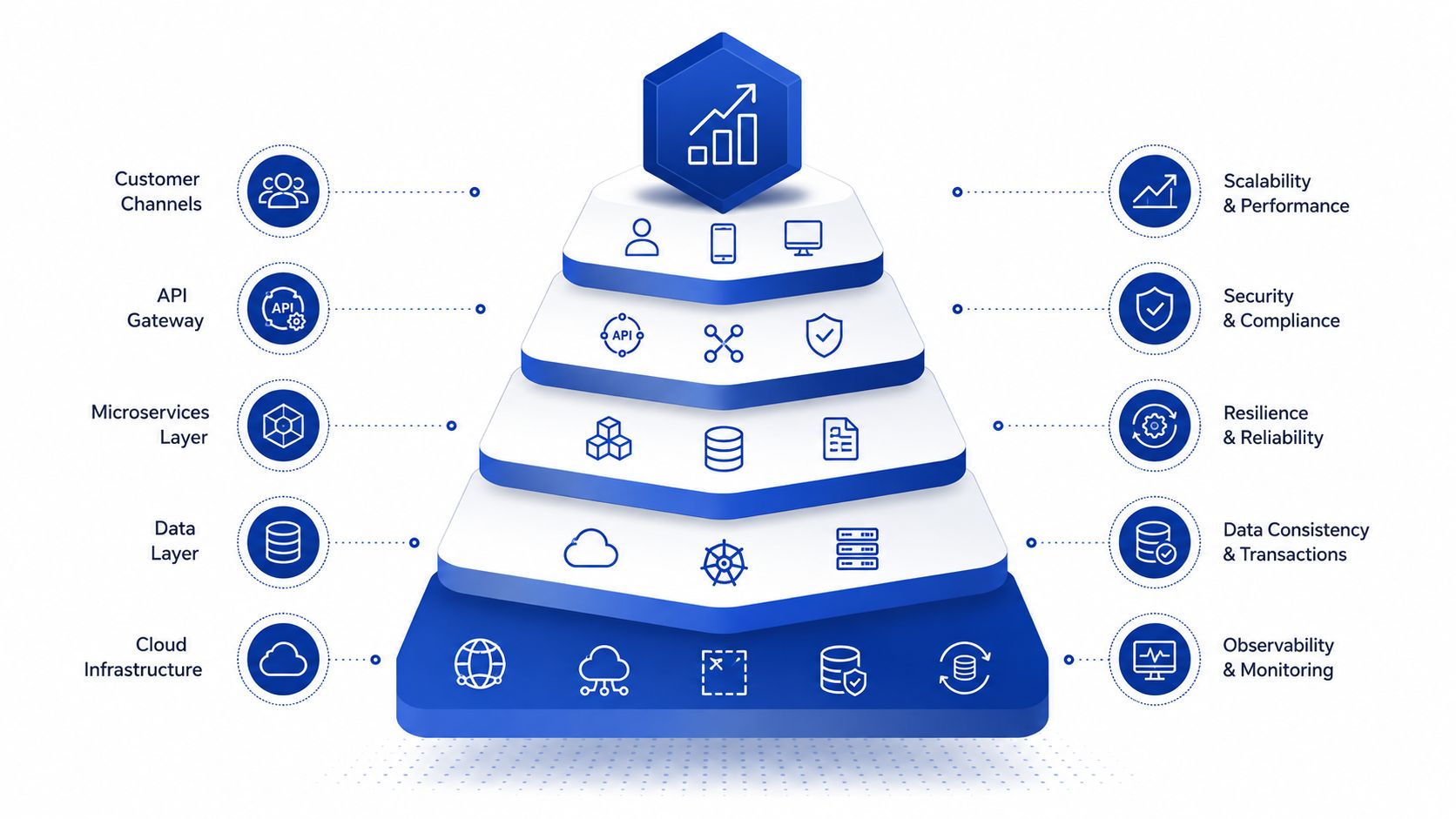
Horizontal scaling works when services are stateless or can safely distribute state. Place an API gateway in front of services, keep authentication and rate controls centralised, and scale application instances independently. Stateful components need more care. Partition data by a stable business key, such as account or customer ownership, and document how the system handles cross-partition queries.
Failure-domain isolation matters in payment systems. Canada's market processed 22.5 billion retail payment transactions worth C$12.2 trillion in 2024, so a platform serving high-volume flows needs more than extra servers. Payments Canada's market reporting highlights why capacity thresholds, operational risk reporting, safeguarding of end-user funds, and incident-management controls belong in the architecture from the start.
Use resilience patterns with purpose:
Timeouts and circuit breakers: Stop a slow dependency from consuming every application thread.
Idempotency keys: Prevent retries from creating duplicate payments or account actions.
Queues and back-pressure: Protect core services when downstream providers slow down.
Read replicas and caches: Reduce pressure on transactional storage without treating cached data as authoritative.
Audit-safe writes: Preserve immutable financial events even when a later correction is required.
Teams can use the enterprise application architecture patterns guide to compare structural choices before committing to a service model. Data ownership deserves the same attention. Concepts from data architecture for ecommerce teams are also useful when separating operational transactions from analytics, reporting and customer insight workloads.
Prepare for always-on processing
Payments infrastructure increasingly demands continuous availability and rapid response. The Real-Time Rail is scheduled to launch in Q4 2026, according to Payments Canada's Real-Time Rail information. A platform that plans to connect should keep real-time processing, richer transaction data, and recovery procedures in its architectural backlog rather than bolting them on after launch.
The pragmatic path is to define a stable ledger and payment orchestration layer, then expose channels through APIs and events. That gives mobile, ecommerce, and partner experiences room to evolve without allowing each channel to invent its own payment rules.
Choosing Your Tech Stack and Integration Strategy
Technology choices should follow the transaction model, not fashion. Python, Java, Go, TypeScript, and other languages can support financial software development when the team understands concurrency, data integrity, testing, and operational ownership. The expensive mistake is choosing a stack that nobody can run confidently or that forces every integration into the same release cycle.
Compare the trade-offs
| Option | Scalability Strength | Complexity and Cost | Best Fit |
|---|---|---|---|
| Modular monolith | Scales efficiently while domain boundaries remain clear | Lower operational overhead, but requires strong internal design | Early-stage products with a focused transaction model |
| Microservices | Independent scaling and deployment by business capability | Higher observability, networking and testing burden | Multi-product platforms with different risk and load profiles |
| Relational database | Strong transactional consistency and mature tooling | Scaling writes and cross-region operations requires planning | Ledgers, balances, settlements and compliance records |
| Event streaming | Decouples downstream work and supports near-real-time workflows | Requires ordering, replay, schema and consumer management | Notifications, reconciliation, risk signals and analytics |
| Managed cloud services | Reduces infrastructure maintenance and supports elastic capacity | Usage costs and provider dependency need active governance | Lean teams that need operational leverage |
| Direct provider integrations | Can expose specialised payment or identity capabilities | More vendor contracts, failure modes and data mappings | Products with distinctive compliance or payment requirements |
| Payment orchestration layer | Centralises routing, retries, token handling and provider rules | Adds a platform component that must be governed carefully | Multi-channel products serving mobile, ecommerce and partner flows |
A relational database remains the natural home for authoritative money records because transaction boundaries and auditability matter. Event streaming is valuable around that core, but shouldn't become an excuse to accept ambiguous balances. A managed service can reduce maintenance, yet the team still owns data classification, access policy, recovery, and cost controls.
Treat integrations as products
Payment providers, KYC services, fraud tools, open banking connections, and core banking systems all have different limits and error models. Put an adapter around each external service so the rest of the platform works with an internal contract. That makes provider changes less disruptive and allows routing rules to respond to availability, price, geography, or payment type.
Canada's payment behaviour makes orchestration particularly relevant. Digital payments already represented 86% of transaction volume and 77% of value in 2024, while contactless payments reached 13 billion transactions, or 58% of all payments, according to the Canadian payments data summary. Mobile contactless and ecommerce shouldn't be separate afterthoughts. They should use shared payment intents, consistent fraud controls, and a common reconciliation model.
For a practical overview of connecting SaaS tools and business systems, the guide to finance automation integration offers useful context on ownership, data flow, and integration maintenance. Teams working through API boundaries can also use this FinTech API development roadmap for CTOs when defining authentication, versioning, and operational responsibilities.
Design for change
Use versioned APIs, explicit schemas and contract tests. ISO 20022 readiness deserves early attention because Canada's Real-Time Rail is being built around structured ISO 20022 messaging and continuous instant clearing and settlement, as described in coverage of Canada's real-time payments infrastructure. Richer data fields affect storage, validation, monitoring, and downstream reporting.
The best integration is not the one with the fewest lines of code. It's the one the team can observe, reconcile, retry safely, and replace without interrupting customer funds.
Security Compliance and Real-Time Readiness in Canada
Security can't sit in a late-stage checklist. A scalable fintech platform increases the number of identities, transactions, integrations, and operational decisions that attackers or mistakes can affect. Controls must be part of the product flow, deployment process, and support model.
Protect data and financial actions
Start by classifying information. Customer identity data, payment credentials, account records, tokens, and audit evidence shouldn't all share the same access model. Encrypt sensitive data in transit and at rest, isolate secrets from application code, and use tokenisation where the platform doesn't need to retain raw payment details.
Access controls need more than a login screen:
Strong authentication: Require appropriate multi-factor authentication for privileged staff and sensitive customer actions.
Least privilege: Give services and employees only the permissions their work requires.
Segregation of duties: Separate payment approval, reconciliation, support access, and production deployment responsibilities.
Fraud controls: Combine velocity rules, device signals, transaction context, and manual review paths.
Tamper-evident audit trails: Record who performed an action, what changed, and which system initiated it.
PCI DSS obligations depend on the payment model and scope, but architecture should reduce unnecessary exposure. A tokenised provider integration usually creates a more manageable boundary than storing raw card data across multiple services. Privacy controls also need clear retention, deletion, and access procedures that fit Canadian obligations and the platform's operating regions.
Make operational resilience visible
Supervisory expectations aren't satisfied by a policy document that nobody can test. The platform should produce evidence about service health, incidents, access reviews, transaction exceptions, and recovery actions. Define incident severity levels, escalation owners, and communication procedures before a production event forces the team to improvise.
The RPAA and Bank of Canada supervisory path makes operational risk and safeguarding important design concerns for Canadian payment service providers. A Canadian scalability benchmark from CENGN demonstrates a practical validation approach: containerise the platform and stress-test it with 2.5 billion transactional data sets to examine peak capacity, concurrent-client limits, maximum load and failure points. The lesson isn't that every business needs the same test. It is that realistic transaction simulation exposes bottlenecks that ordinary virtual-machine scaling and untested monoliths can hide.
Control principle: If the team can't demonstrate how a payment is authorised, recorded, settled, reversed and investigated, the platform isn't ready for critical volume.
Plan for the Real-Time Rail
The Real-Time Rail changes the operating assumptions around transfer products. RTR participants and payment service providers seeking access must pre-fund accounts through the Lynx large-value payment system and maintain sufficient liquidity for settlement obligations, according to analysis of RTR liquidity requirements. Liquidity management therefore belongs in platform design.
Build mechanisms for:
Liquidity visibility: Show available, reserved, and committed funds with clear timestamps.
Settlement controls: Prevent the platform from accepting obligations it can't fund.
Exception handling: Manage rejected, delayed, duplicated, or disputed messages.
Structured messaging: Preserve ISO 20022 fields through validation, storage, and reporting.
Always-on monitoring: Alert teams to processing degradation, liquidity pressure, and message failures.
Teams reviewing their compliance operating model can also consult fintech compliance solutions from Cleffex for a practical reference point on embedding controls into modern financial platforms.
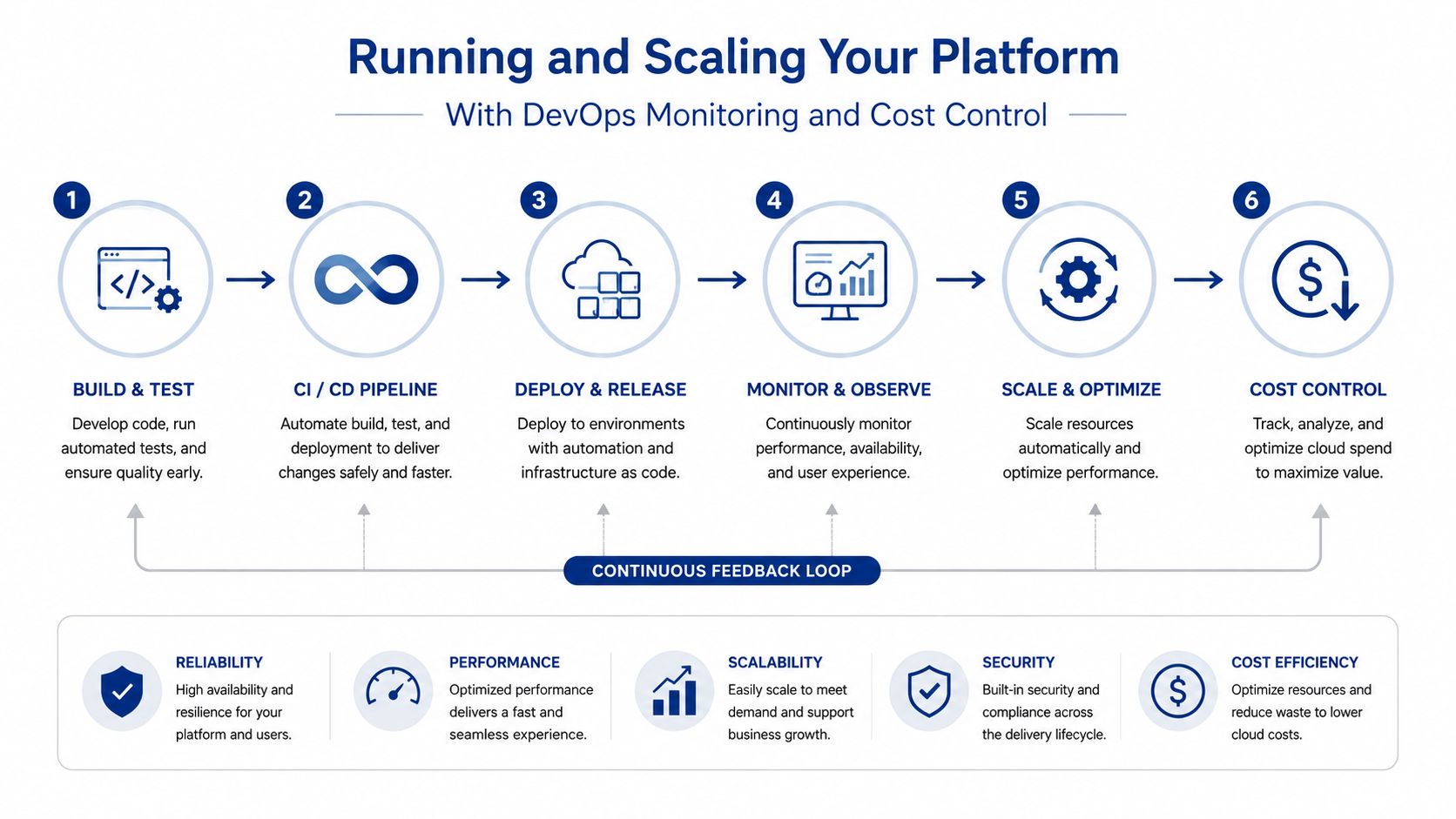
Running and Scaling Your Platform With DevOps Monitoring and Cost Control
A platform doesn't become scalable when the first container reaches production. It becomes scalable when the team can release, observe, recover, and control spending repeatedly without relying on a few people who understand undocumented production behaviour.
Establish a repeatable delivery path
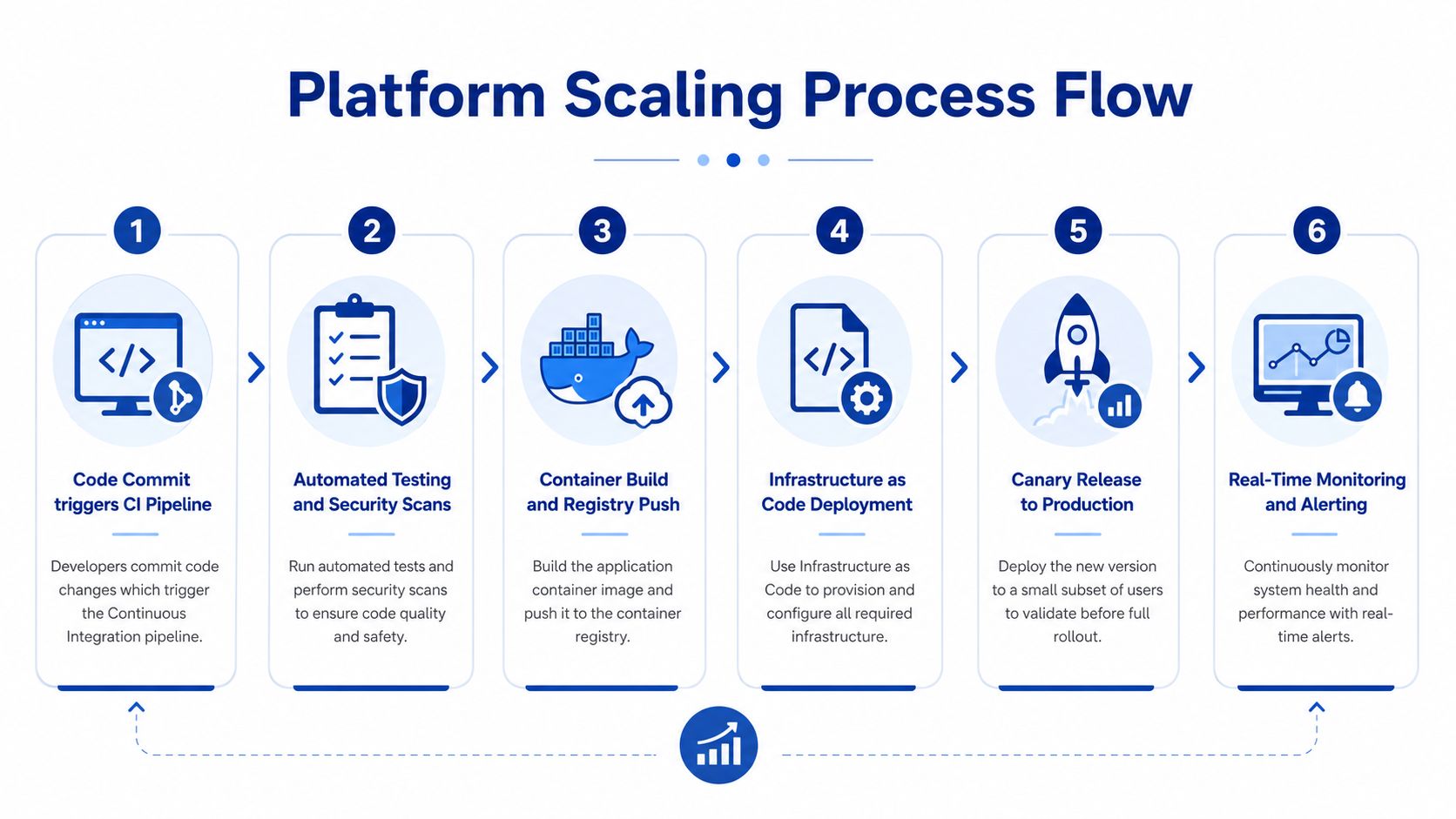
Use version-controlled infrastructure, automated testing, and security checks in the same delivery pipeline as application code. Container images should be reproducible, dependencies should be scanned, and deployments should support controlled rollback. Infrastructure as code makes environments reviewable, while secrets management prevents credentials from leaking into repositories or build logs.
A sound release process normally includes:
Code validation: Run unit, integration, contract, and financial invariant tests.
Security inspection: Scan dependencies, images, and infrastructure definitions.
Container packaging: Build a known image and store it in a controlled registry.
Progressive delivery: Release to a limited service slice before wider rollout.
Automated verification: Compare health, latency, and business outcomes against expected behaviour.
Rollback readiness: Restore the previous version without corrupting transaction state.
Test the workload that matters
Page-load testing won't tell you whether a payment platform can withstand a reconciliation backlog, transfer burst, or provider timeout. Model realistic transaction sequences, retries, concurrent users, message fan-out, and database contention. The CENGN validation described earlier used 2.5 billion transactional data sets to identify capacity limits and failure points, showing why transaction-shaped tests matter more than generic infrastructure benchmarks.
Set explicit thresholds before a test begins:
Capacity threshold: The load at which the system must add resources.
Degradation threshold: The point at which non-critical work should pause.
Failure threshold: The conditions that trigger isolation or traffic reduction.
Recovery threshold: The required time and data integrity after restoration.
Observability should connect technical signals to customer and financial outcomes. Track payment completion, duplicate prevention, ledger posting, reconciliation status, and provider errors alongside service latency, queue depth, database locks, and resource utilisation. Logs without correlation IDs make incident investigation slow. Metrics without business context can tell the team that a server is healthy while customers are waiting for funds.
Control cost as capital becomes selective
KPMG reported US$2.4 billion across 113 Canadian fintech deals in 2025, followed by US$996.7 million across 47 deals in H1 2026, according to its Canada fintech investment analysis. In a more selective market, infrastructure decisions need to support durable economics, not just technical ambition.
Use separate budgets for baseline capacity, burst capacity, data processing, third-party services, and observability. Review idle environments, oversized databases, excessive log retention, and duplicate data pipelines. Don't remove essential redundancy to lower a bill. Instead, identify which workload needs premium resilience and which can tolerate delayed processing.
Legacy migration requires the same discipline. Keep the existing system authoritative while new services consume controlled data, reconcile results, and take ownership in stages. Dual writes can create hard-to-diagnose divergence, so prefer an explicit migration ledger, repeatable reconciliation, and a tested rollback path. A modern platform should reduce operational risk, not move it into a less visible system.
Measuring Success and Planning Your Next Steps
A platform can pass load tests and still fail customers during a provider outage, a contactless payment surge, or a liquidity constraint. Scalability is proven by how the business behaves under pressure. Leadership needs a compact view of growth, customer protection, margins, and regulatory trust.
Measure the full operating outcome
Build a scorecard that connects engineering results to financial operations and control quality:
Latency: How quickly do critical customer and payment actions complete?
Throughput: How much transaction work can the platform sustain during normal and peak demand?
Availability: Can customers reach key services while a dependency is degraded?
Cost per transaction: Does added volume improve efficiency, or does complexity grow faster than revenue?
Recovery performance: Can the team restore service and reconcile state without manual guesswork?
Compliance posture: Are access reviews, audit evidence, incident records, and safeguarding controls complete?
Integration health: Which providers cause retries, delays, or reconciliation exceptions?
Review these measures together. Lower latency can require more infrastructure spending. Higher throughput can increase reconciliation work. Stronger controls can add friction to onboarding or payment flows, while weak controls expose the business to losses, investigations, and reputational damage.
The most useful scorecard also separates leading signals from outcomes. Rising retry rates, growing queue age, and unresolved exceptions warn of trouble before availability or cost reports deteriorate. A monthly review should assign an owner to each threshold and define the action that follows it.
Use decision signals, not vanity milestones
Faster onboarding or more active accounts show product progress, but they do not prove that the operating model scales. Finance leaders also need to know whether support effort per customer is falling, exceptions have clear causes, and the ledger remains trustworthy after a provider outage.
A mobile contactless product can add volume while routing each channel through separate business rules. If references differ between channels, reconciliation becomes manual, and the apparent growth creates operational debt. A different fintech may introduce an event bus for notifications and analytics while keeping a clear transactional ledger and idempotent payment commands. That design may look less ambitious, yet it gives the team a safer base for new products and Canada's evolving payment rails.
A practical next-step checklist
Before approving a major build or modernisation programme, confirm that the team can answer:
Which service owns each financial state?
What happens when an external provider times out after accepting a request?
How are retries prevented from duplicating a payment?
Which workloads can scale independently?
How will the platform support structured RTR messages and liquidity obligations?
What test will reveal the first meaningful bottleneck?
Which controls produce evidence for audits and incidents?
What infrastructure and vendor costs can the current funding plan support?
The strongest scalable financial applications keep money records accurate, expose failures quickly, support new channels without duplicated logic, and remain operable by a lean team. For Canadian fintechs, that means combining mature digital payment behaviour, Real-Time Rail readiness and capital-efficient growth.
Cleffex Digital Ltd develops custom fintech and insurance software, including secure APIs, platform modernisation and scalable architectures for regulated financial services. Visit Cleffex Digital Ltd to discuss the architecture, integrations, and delivery plan your growing platform needs.