

Only one thing is clear in Canadian healthcare right now: digitisation is not the same as integration. In 2025, more than 90% of health providers had access to a digital health system, yet only 52% said they electronically shared patient information outside their own practice, and 17% reported barriers to routinely accessing electronic information from other care settings because systems were not integrated. That gap is why healthcare software integration is no longer an IT nice-to-have; it's the operating system for healthcare scalability.
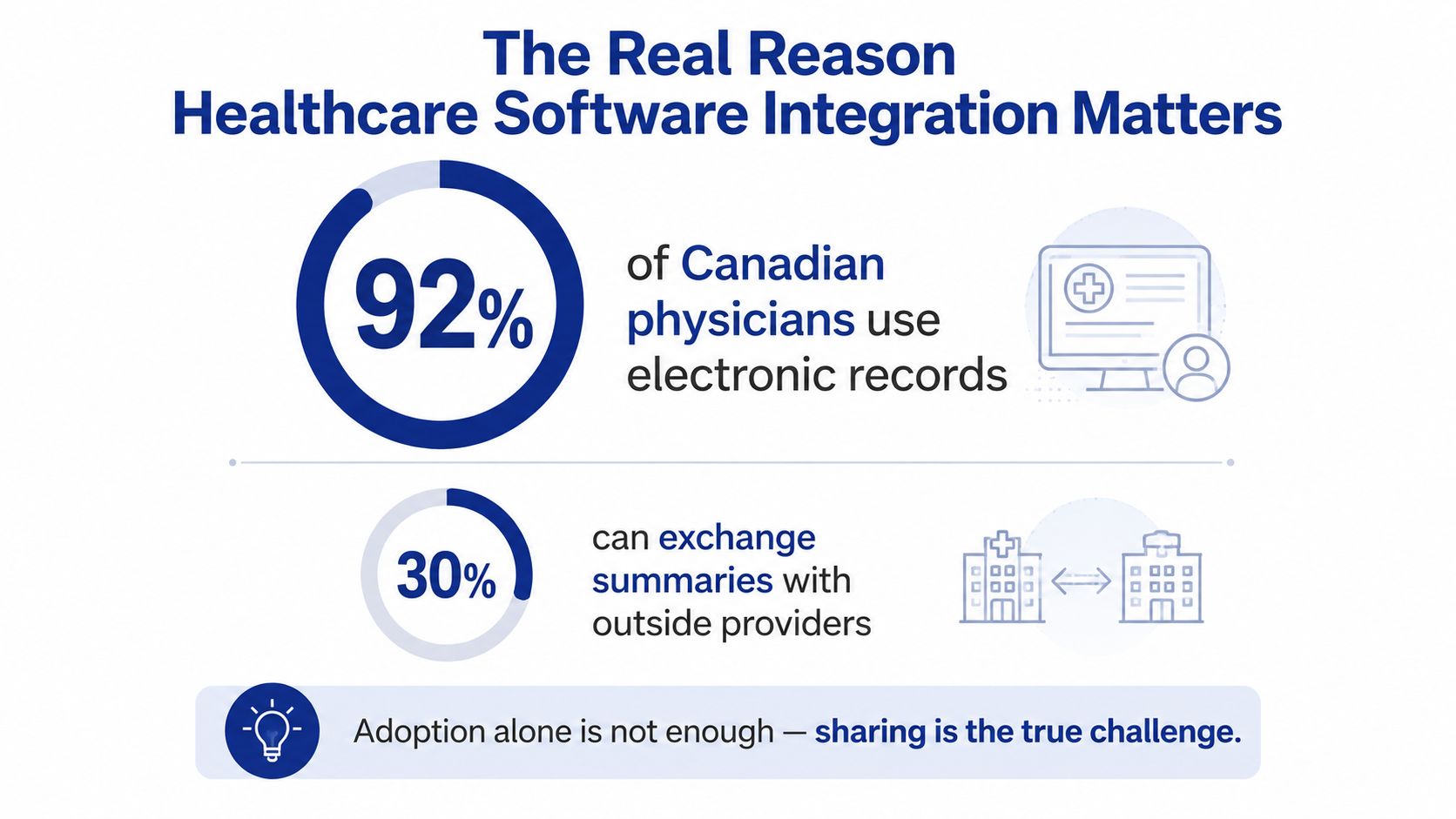
The Real Reason Healthcare Software Integration Matters
Canadian providers have spent years buying digital tools. The harder problem is making those tools work together across sites, teams, and handoffs. A 2026 report on Canada's EHR says regular physician use of electronic health records rose from 36% in 2009 to 95% in 2024, yet integrated health-data exchange still remains limited, with almost every jurisdiction still struggling to make hospitals, community specialists, and primary care systems talk cleanly to each other.
Executives should treat healthcare software integration as an operational scalability problem. Every new clinic, imaging partner, referral channel, or billing workflow adds another place where data can split, manual reconciliation can creep in, and staff can end up retyping information the organisation already has.
Integration is a scaling problem, not a software purchase
The failure point usually shows up when a clinic group adds one more site. Work starts to multiply through handoffs, approvals, and data mapping. If the organisation cannot exchange accurate data across systems, it pays for the same information to be entered, checked, corrected, and chased by different people.
Staff who still depend on fax, mailed letters, or copy-paste between systems are not working in an integrated operation. They are digitising documents and leaving the workflow broken.
Referrals get delayed. Claims need rework. Clinicians lose time hunting for missing context. Managers often blame “user adoption”, but the issue is simpler: the systems were never designed to move information cleanly across organisational boundaries.
The patient side exposes the same gap. Only 13% of Canadians reported online access to all core components of their health records, and nearly one-third reported no electronic access at all. That gap matters because access without exchange does not improve operations. If the data does not move, the clinic does not scale.
What Healthcare Software Integration Actually Means
A system can be connected and still fail clinically, operationally, and financially. That is the part vendors skip. Healthcare system integration has four separate jobs, and each one breaks in a different way if you ignore it.
The four building blocks that matter
Data exchange is the basic move. One system sends a record to another, such as a lab result flowing from an LIS into an EHR. The message can arrive on time and still be useless if the receiving team has to clean it up by hand.
Interoperability goes further. The receiving system must understand the data without a human translating it first. Canada's national stack is moving this way through CA Core+ and CACDI, which are meant to standardise a shared minimum dataset across systems and jurisdictions. That matters because meaning falls apart fast when every platform uses its own labels, codes, and field conventions.
Workflow integration is where the operational value shows up. A result lands, an alert fires, a referral is created, and billing is prepared. Without that chain, staff still complete the work manually even when the systems are technically linked.
Governance decides who owns the mapping, who approves changes, and who signs off when a partner updates an interface. Ontario's Digital Health Information Exchange framework is clear that interoperability needs controlled vocabularies, a provincial data model, and model-driven exchange standards such as HL7 FHIR, with compliance tied to governance and verification.
Finance cannot sit outside this model. A clinic that wants clean reconciliation has to connect its clinical and revenue systems on purpose, which is why the discussion of Sage Intacct healthcare financing is useful. The same applies to operations, where a practical healthcare API integration operations guide shows what breaks once real traffic, exceptions, and vendor changes hit production.
The useful question is not “is it connected?” It's “who has to intervene when the connection fails?”
Interoperability Standards You Need to Know
Standards only matter when they match the exchange partner in front of you. Clinics get into trouble when they choose a standard because it sounds modern, not because it fits the actual path between clinical, imaging, and payer systems.
The standards by job, not by hype
FHIR is the modern API approach. It fits clinical and administrative data that has to move through web-based services, patient portals, and app ecosystems. Use it when you need flexible access patterns and cleaner application development. It gets messy when teams treat implementation guides as optional, because every local variation adds drift. For a compliance-focused view of that drift, the FHIR integration services guide to compliance is worth a read.
HL7 v2 is still the workhorse in many hospital environments. It is built into EHR backbones and still carries much of the day-to-day messaging between systems. At scale, the weakness is mapping sprawl. Every added site or vendor tends to bring another custom interpretation.
DICOM is the imaging standard. Radiology and cardiology workflows depend on it because images and related metadata have different requirements from ordinary clinical documents. The failure point is often metadata consistency between PACS environments.
EDI is the payer and revenue-cycle standard. It carries eligibility, claims, and remittance transactions. It works well when transaction formats stay consistent, but clearinghouse quirks and payer-specific variations still create avoidable friction.
For buyers comparing implementation paths, the right test is simple. Which standard fits the systems you must exchange with today, not the one a vendor pitches hardest?
Healthcare Interoperability Standards Compared
| Standard | Primary Use | Scaling Weakness | Best Fit |
| FHIR | Clinical and administrative APIs | Implementation-guide drift | Modern app ecosystems and patient-facing tools |
| HL7 v2 | Core hospital messaging | Mapping sprawl | Legacy hospital backbones and internal messaging |
| DICOM | Imaging workflows | Metadata gaps between systems | Radiology and cardiology imaging exchange |
| EDI | Eligibility, claims, remittance | Transaction quirks across clearinghouses | Revenue cycle and payer connectivity |
Security and Compliance That Cannot Be an Afterthought
A clinic can ignore security while it has only a few trusted systems. The problem shows up during expansion, when telehealth, imaging, patient messaging, and revenue tools all start exchanging data. At that point, the question is whether the organisation can prove who accessed what, why they accessed it, and whether the connection was safe.
The controls that matter in daily operations
Patient data classification should come first. If a new telehealth vendor will receive clinical notes, that is a different risk from appointment reminders. The data type determines whether you need a Business Associate Agreement, what access rules apply, and how much scrutiny the connection deserves.
Encryption needs to be handled in two states. Data in transit should use strong transport security, while data at rest should be protected with storage-level and, where needed, field-level controls. If a vendor can explain only one of those, they are not ready for healthcare work.
Audit controls should function as operational tools, not compliance wallpaper. Logs that nobody reviews expire as expensive history. They matter when they feed alerts, escalation paths, and access review routines.
If you want a deeper look at the security side of implementation discipline, this data security in healthcare information systems piece is worth reading. For implementation teams, GitDocAI's page on input validation and rate limiting best practices is a useful reminder that secure APIs need both authentication and traffic discipline.
The controls that protect revenue first are RBAC, MFA, and automated log review. Those basics stop casual misuse, reduce the blast radius of a compromised account, and keep a small problem from becoming a breach notification.
A Multi-Site Clinic Walkthrough From Mapping to Monitoring
A regional clinic group usually discovers integration pain the hard way, during the first serious attempt to connect an EHR, a billing platform, and a radiology partner. The patient identifiers don't line up. Lab codes use slightly different naming rules. One team wants a point-to-point API, another wants an interface engine, and the vendor wants everyone to believe a connector will solve governance.
Week one is about mapping, not building
The first useful step is a mapping workshop. Someone has to compare patient IDs, provider IDs, lab codes, and referral fields across every system in scope. If the team skips this and jumps straight to build, the result is a shiny connection that corrupts data.
A sandbox catches the obvious mistakes before production does. Mismatched gender fields, missing reference values, and format errors show up quickly when test data is run through the proposed workflow. That is the point of the sandbox: to make the ugly failures cheap.
By the time the build is ready, the team should already know what belongs in the integration engine and what can stay as a direct API. The decision depends on whether the clinic is managing one clean exchange or many exceptions across multiple partners.
Cutover only works when ownership is clear
Integration tests need to check both message structure and business rules. A valid HL7 message that triggers the wrong downstream action is still a failure. That's why cutover sign-off should come from operations, not just IT.
Once live, monitoring matters more than enthusiasm. Latency spikes, failed retries, and endpoint changes from a partner should all appear in the dashboard quickly. If they don't, the team learns about the failure from a nurse, a billing analyst, or a frustrated patient.
For organisations building across multiple locations, the easiest mistake is to underestimate the on-call burden. Someone has to own the response when a partner changes an endpoint without notice, because that event will happen eventually. Cleffex Digital Ltd is one option for clinics that need API-led healthcare integration and secure connectivity work across clinical and patient-facing systems.
Common Integration Challenges and How to Mitigate Them
The biggest failures are usually organisational first and technical second. They show up when weak ownership meets clever shortcuts. A clinic can buy solid software and still end up with brittle, expensive integrations if every project is treated as a one-off exception.
The problems that compound as you grow
Healthcare Integration Challenges and Mitigations
| Challenge | Symptom at Scale | Mitigation Pattern |
| Vendor lock-in from proprietary APIs | Switching costs rise and every new tool needs a custom adapter | Mandate FHIR-based contracts where possible |
| Data silos from one-off links | Each department gets its own integration path | Centralise through an integration platform |
| Version drift | Interfaces break when standards or vendors change | Run quarterly standards reviews |
| Hidden custom code | No one owns the logic after the original team leaves | Require documentation as a deliverable |
Proprietary APIs look easy at the start because they promise a fast launch. The problem comes later, when the next system cannot reuse the same logic and the organisation pays twice. A central integration layer is less glamorous, but it gives operations a place to monitor, route, and govern change.
Version drift is especially harsh in healthcare because one update can break a chain of dependent workflows. If standards reviews are not scheduled, the result is partial compatibility and manual workarounds that never fully go away.
Integration debt is real. Buying more software does not fix a governance gap; it usually exposes it faster.
Documentation has to be treated as a deliverable. If no one can explain how a connection works, who owns it, and what happens when it fails, the organisation lacks an integration strategy and has accumulated unresolved risk instead.
A Practical Scalability Roadmap for Healthcare Leaders
Integration should be run like an operational programme, not a side project that only gets attention when something breaks. The right roadmap gives executives a way to fund sequencing, measure progress, and stop wasting effort on low-value connections.
The 90-day foundation phase
The first 90 days should inventory every system, identify identity and consent gaps, and name governance owners. The executive sponsor is usually the COO or CIO, because the work cuts across operations and technology. The budget assumption should be modest and targeted, focused on discovery, mapping, and design rather than broad build-out.
Success looks like a clean system inventory, a documented data ownership model, and agreement on the first workflow to integrate. A board should expect to see fewer unknown interfaces and a clear list of dependencies.
The 180-day execution phase
By day 180, the team should pilot one high-value FHIR workflow, retire the worst legacy interface, and launch monitoring. This phase often needs stronger engineering support and a dedicated product owner, because the work starts touching live operational flows.
The board-level metric is simple. Are duplicate data entry tasks falling? Is onboarding a new clinic getting easier? Are transactions passing automated reconciliation more reliably? If the answer is fuzzy, the programme is still in build mode, not value mode.
The 365-day scale phase
At 365 days, broaden the scope to analytics, partner APIs, and continuous optimisation. The sponsor should stay executive-level, because growth across sites and jurisdictions needs policy decisions, not just code changes. Budget should include support, monitoring, and periodic redesign, not only new development.
The cleanest sign of success is that each new connection costs less operational pain than the last one. If the team is still handholding every interface, the programme is not scaling; it's accumulating work.
Frequently Asked Questions for Healthcare Buyers
How much should a clinic expect to spend?
There isn't a single safe number, because spend depends on the number of systems, the complexity of mapping, and the amount of custom workflow logic. The useful split is between one-time build work and recurring interface support, licensing, monitoring, and vendor management.
How long does the first production exchange usually take?
The slow part is rarely the code. Data mapping, validation, partner sign-off, and test cycles usually take longer than stakeholders expect, especially when identity fields and clinical codes don't match cleanly.
How do I shortlist an integration partner?
Look for live FHIR endpoints, reference customers in a similar care setting, documented security practices, and a willingness to commit to measurable outcomes. If a vendor talks only in architecture diagrams and never shows how their implementation behaves in production, walk away.
When should we buy a packaged engine instead of building custom?
Choose a packaged integration engine when transaction volume is growing, internal engineering time is limited, or lock-in risk is becoming expensive. Custom builds can work for narrow use cases, but they're a poor fit when multiple partners, standards changes, and support obligations are piling up.
If you want healthcare software integration that holds up under real operational pressure, Cleffex Digital Ltd builds secure, API-led systems for clinics, hospitals, and health-tech teams that need data to move cleanly between platforms. Visit Cleffex Digital Ltd to discuss a practical integration roadmap for your next quarter.