

The popular advice is to start with a promising clinical use case, select a model, and connect it to the electronic health record. That sequence is backwards. In production, AI adoption is usually constrained by data exchange, identity, governance, system reliability, and workflow design, not by a shortage of algorithms.
The foundation is also more mature than many organisations assume, but less connected than their dashboards suggest. In Canada, regular physician use of electronic health records rose from 36% in 2009 to 95% in 2024, yet nearly all jurisdictions still lack interoperability between hospitals, community specialists, and primary care. Data exchange between these settings remains heavily dependent on fax or mailed letters, according to the Canadian EHR evidence. Digital storage is not the same as computable access.
This practical roadmap focuses on the unglamorous work that makes AI healthcare implementation reliable. It covers healthcare data infrastructure, privacy, interoperability, migration, clinical integration, and the operating discipline required to turn AI readiness into a sustainable capability.
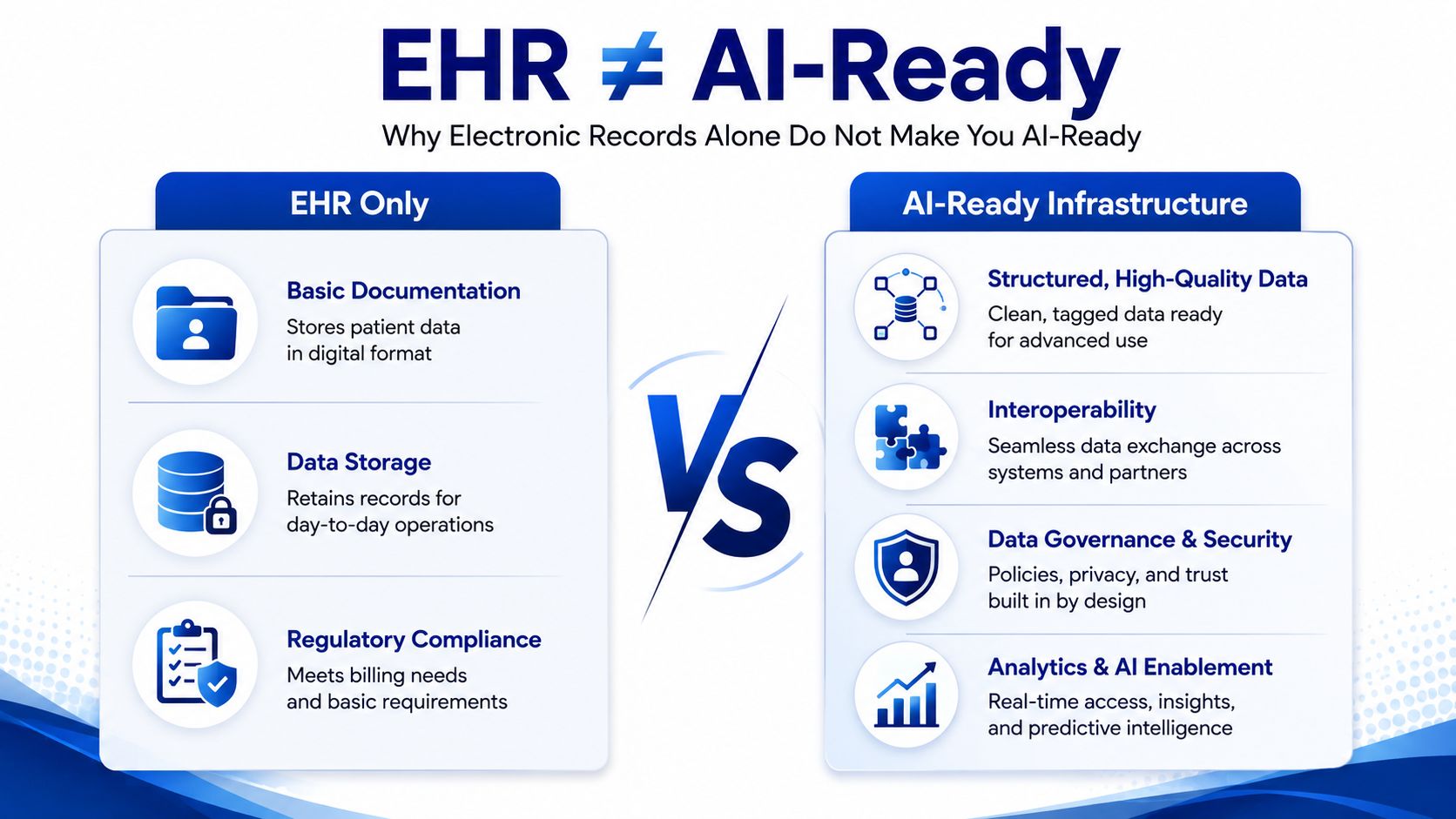
Why Electronic Records Alone Do Not Make You AI-Ready
An enterprise EHR gives an organisation a digital record. It doesn't automatically provide an AI-ready healthcare infrastructure. EHRs were largely implemented to support documentation, billing, compliance, scheduling, and clinical review by people. Machine learning pipelines need something different, including consistent identifiers, structured semantics, reliable timestamps, accessible interfaces, and clear permission to use the data.
The distinction matters. A hospital may have a medication list, laboratory results, progress notes, imaging reports, and claims data, but those assets can remain separated by department, vendor, site, or workflow. Clinical notes written for human readers often contain important context that isn't consistently coded. HL7 v2 feeds can move messages successfully while still creating brittle, point-to-point dependencies. FHIR can improve API-based exchange, but adoption and implementation quality remain uneven.
The interoperability gap
Canadian evidence shows why executives should test connectivity rather than infer it from EHR adoption. Fewer than 40% of Canadians access some of their health information electronically, and only 35% of physicians share patient information outside their practice, according to the Pan-Canadian digital health review. A separate analysis in that review found that 33% of Canadians had accessed their records online in the previous two years, with access ranging from 60% in Saskatchewan to 14% in Manitoba and Newfoundland and Labrador.
Those figures describe more than a patient portal problem. They point to gaps in portability, consent, cross-provider exchange, and provincial consistency. An AI workflow that needs a current specialist note, a recent laboratory result, and a community medication record can't operate safely if those inputs arrive late, arrive as documents, or never arrive at all.
What changes the readiness assessment
A credible assessment asks whether data can be discovered, interpreted, exchanged, governed, and monitored. It also checks whether the source systems can tolerate new interfaces without compromising core operations.
Practical rule: Treat “the EHR is connected” as a question to validate, not as an architecture decision.
AI readiness begins when data becomes standardised and computable across settings, with enough provenance for clinicians and governance teams to understand where each feature came from. That requires deliberate investment beyond the EHR implementation.
Assessing Your Current Healthcare Data Infrastructure
An AI assessment should begin with the data people rely on when official systems do not provide what they need. Inventory the primary EHR, laboratory and pharmacy systems, PACS and imaging archives, revenue-cycle platforms, patient portals, devices, spreadsheets, research repositories, departmental interfaces, and locally maintained worklists. Shadow systems often contain the operational detail that enterprise reports miss, especially during referrals, discharge follow-up, bed management, and exception handling.
Run the inventory as a source-to-use map, not a catalogue of applications. For each important data element, record its originating system, owner, format, update frequency, downstream users, permitted uses, and failure response. A patient's medication list may exist in the EHR, pharmacy system, discharge document, and a ward spreadsheet. Those copies can differ, and an AI workflow must know which one is authoritative for its task.
A useful assessment examines five dimensions: volume, quality, interoperability, architecture, and analytics capability. The objective is to identify constraints that could prevent a model from receiving timely, representative, and correctly interpreted inputs.
A working maturity model
| Dimension | Immature | Developing | AI-ready |
|---|---|---|---|
| Data availability | Records are distributed across inaccessible systems | Priority sources are catalogued and selectively extracted | Approved sources are discoverable through governed services |
| Data quality | Missing fields, duplicate patients, and inconsistent codes are common | Quality rules exist for selected domains | Completeness, consistency, provenance, and drift are monitored continuously |
| Interoperability | Point-to-point interfaces and manual exports dominate | HL7 and API connections support priority workflows | Standards-based exchange is reusable across sites and use cases |
| Storage and processing | Departmental databases and fixed reports | Warehouse or lake supports consolidated analytics | Governed lakehouse or equivalent supports batch and near-real-time workloads |
| Analytics operations | Ad hoc dashboards and manual files | Repeatable pipelines support selected teams | Versioned datasets, monitoring, access controls, and deployment processes are established |
The table is useful only when each rating has evidence. Attach interface logs, sample extracts, data-quality results, and named owners to the assessment. Record what the data means, not only where it resides. A diagnosis code, encounter type, discharge date, or provider identifier may follow different definitions across facilities.
Audit the shadow systems
Select one high-value workflow, such as discharge medication reconciliation, and trace it for several real cases. Compare the EHR record with the ward spreadsheet, pharmacy feed, scanned document, and reporting extract. Note who enters each field, when it changes, whether corrections overwrite history, and how the receiving team learns about an exception. If staff reconcile conflicting values manually, document that step as an ungoverned transformation rather than treating it as clerical work.
Interview representatives from clinical operations, health information management, integration, privacy, analytics, and frontline administration. Ask each person:
Which data do you trust for this workflow, and why?
Where do staff re-key, download, or reconcile information?
What arrives late, incomplete, or in the wrong format?
Which downtime process creates the largest backlog?
Who can approve a definition change or correct a source defect?
What evidence would make you reject an AI output?
Map the answers to risks: stale input, ambiguous meaning, missing provenance, duplicate identity, unavailable interface, and unassigned remediation. Rank each risk by clinical impact, frequency, detectability, and the effort required to fix it. This produces an implementation backlog grounded in production conditions, rather than a maturity score that hides local workarounds.
For a practical examination of disconnected repositories, use this guide to break down healthcare data silos. End the assessment with a specific decision for each blocker: improve the existing component, isolate it behind a controlled service, or replace it before the AI workflow proceeds.
Building the Data Governance and Privacy Foundation
Governance isn't a committee that approves a model after development. It's the operating system for deciding who may use which data, for what purpose, under which controls, and with what evidence. Without that structure, a pilot may run, but expansion becomes slow, contentious, and difficult to defend.
Start by assigning ownership at the data-domain level. Clinical leaders should define meaning and acceptable use, technology teams should operate platforms and controls, privacy and security teams should set safeguards, and research or analytics teams should document intended purposes. A named steward should resolve quality issues rather than allowing every department to assume someone else owns them.
Put policy into the pipeline
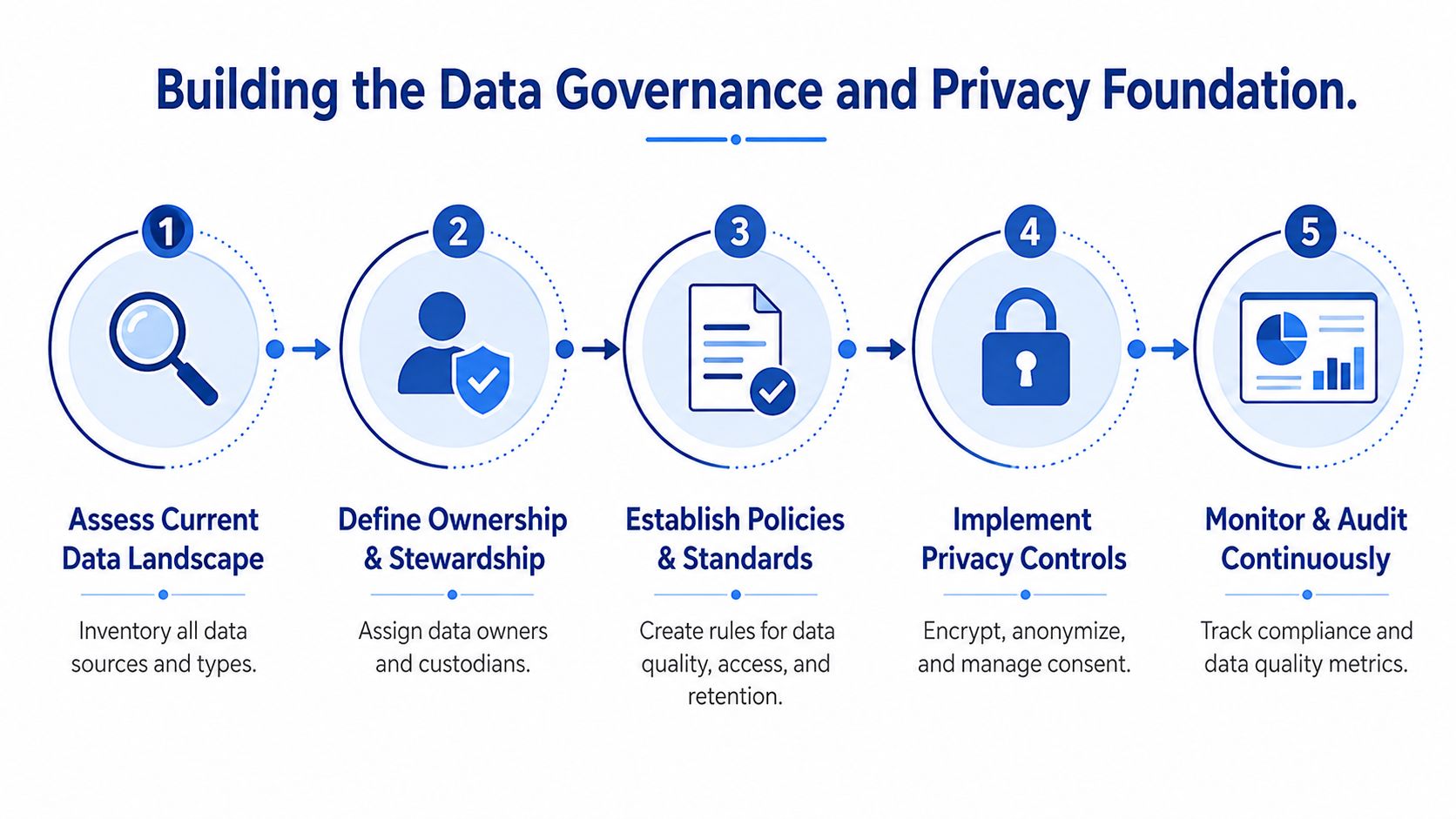
A practical governance foundation has five connected controls:
Inventory the environment: Record source, format, sensitivity, owner, retention requirement, and intended use.
Define stewardship: Establish who approves access, who corrects defects, and who signs off on semantic definitions.
Set standards: Create rules for coding, terminology, metadata, retention, lineage, and acceptable data quality.
Apply privacy controls: Use least-privilege access, encryption, audit logs, segmentation, and consent management.
Monitor continuously: Detect unexpected changes in volume, completeness, distributions, access patterns, and model inputs.
The Canadian AI for Health Guiding Principles call for data and data practices, including collaboration to improve data quality, secure access, and exchange of information representative of Canada's diversity. They also require Indigenous-led governance and respect for data sovereignty, as set out in the.
Privacy decisions need to be made before training data is assembled. Under PIPEDA, meaningful consent is generally required when identifying personal health information is used for AI model training, and Canada doesn't have a separate legal regime specifically authorising healthcare AI training data use. Existing privacy and health-information rules therefore govern secondary use, as explained in this Canadian healthcare AI legal analysis.
Make governance auditable
Maintain lineage from source record to transformed feature to model input and output. Keep a record of consent status, de-identification method, access decision, transformation logic, model version, and review outcome. Master data management should support patient identity resolution without turning matching into an opaque process that staff can't investigate.
Health Canada announced legislation in February 2026 that would require IT companies providing digital health services in Canada to adopt common standards for protected and secure information exchange, according to the government announcement. The direction reinforces a practical lesson: privacy, interoperability, and governance must be designed together.
For implementation details, use this practical guide to healthcare data governance. A strong foundation won't eliminate every approval, but it makes decisions repeatable and defensible.
Designing Cloud and Interoperability Architecture
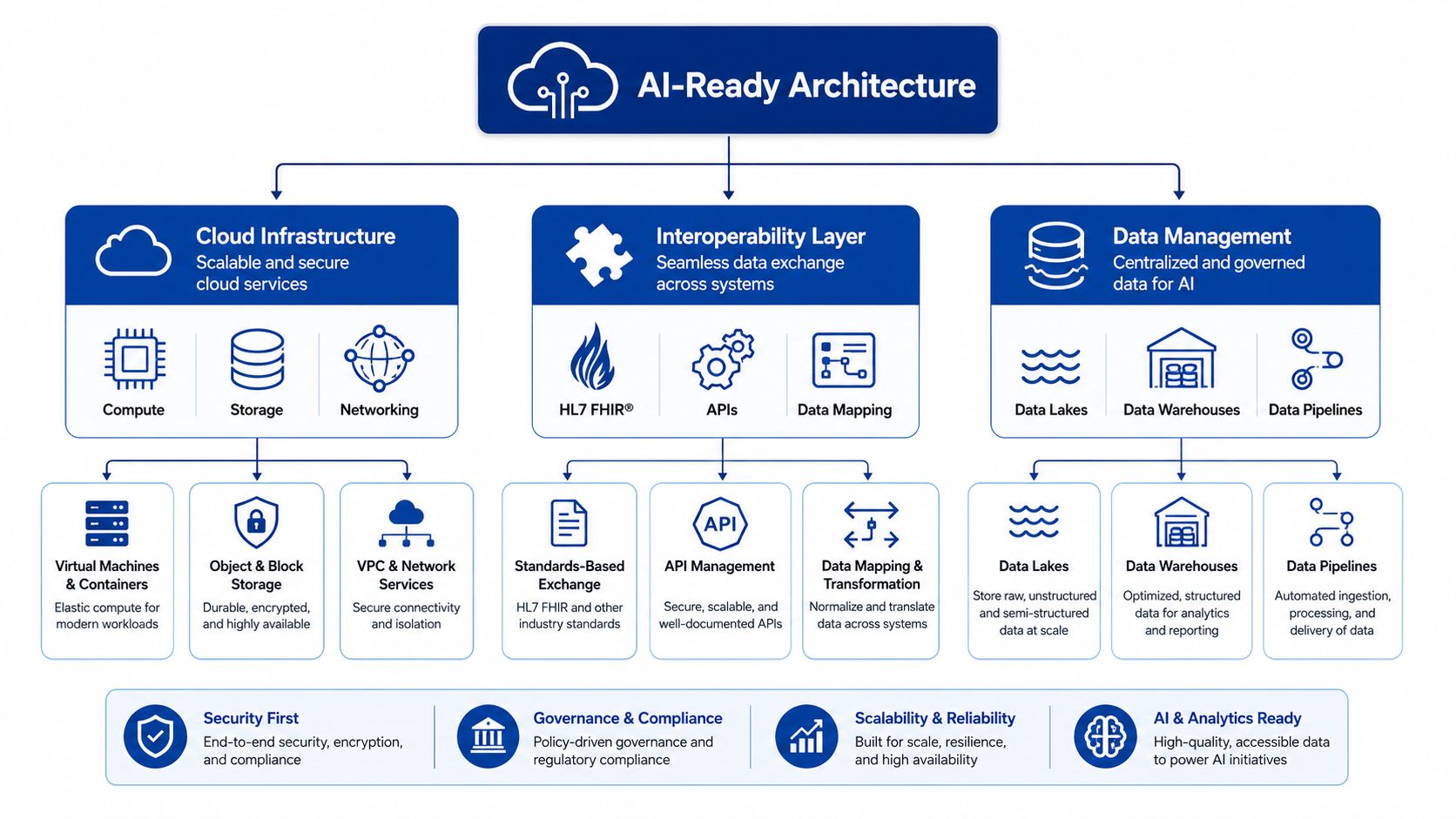
An AI-ready architecture is built around reliable data movement, not a fashionable cloud target. Hospitals must keep latency-sensitive workflows, regulated information, legacy interfaces, imaging workloads, local resilience, and existing contracts working while modernising. Separate those concerns, then preserve operational continuity across the estate.
Use cloud services for elastic storage, batch analytics, development environments, and model training when governance and connectivity support them. Keep selected workloads on premises or at the edge when local inference, device proximity, downtime tolerance, or network limits make central processing unsuitable. A hybrid pattern often fits better, provided security, identity, and observability are managed consistently across environments.
Build an exchange layer, not another web of interfaces
Place an interoperability layer between source systems and downstream applications. It should validate messages, map terminology, manage retries, expose APIs, record lineage, and stop every new application from creating a bespoke connection.
Choose standards according to the data and workflow:
HL7 v2 remains useful for event-driven feeds such as admissions, orders, results, and notifications. Wrap older feeds in reusable services rather than adding more point-to-point dependencies.
FHIR R4 provides resource-based APIs for patients, encounters, observations, medications, and other exchange patterns. Profile and test each implementation. A FHIR endpoint alone does not guarantee consistent meaning.
DICOMweb supports web-based imaging access and routing. Pair imaging metadata with clinical context so an imaging model receives the correct study, patient identity, and encounter relationship.
California's assessment of data exchange gaps illustrates why validation must precede model deployment. Map each source system to exchange standards, confirm event-level receipt with public health and health information exchange partners, then add AI workflows for surveillance, utilisation management, or care navigation, based on the California assessment of data exchange gaps.
Secure the path end to end
Apply zero-trust segmentation between clinical systems, integration services, data platforms, and model-serving endpoints. Encrypt data in transit and at rest, centralise audit logging, rotate credentials, and restrict service accounts to required resources. Design for failure with queues, replay, reconciliation, and a documented manual fallback.
Teams comparing architecture patterns can review a WebinOne unified data platform for broader data-platform context. It does not replace healthcare-specific governance or standards mapping, but it can frame decisions about consolidation, access, and pipeline management.
Connectivity is only the starting point. A source may answer an API request while returning incomplete, stale, or ambiguous data. Test the full path from clinical event to normalised record to model endpoint before approving the integration for production.
Integrating AI Systems with Clinical Workflows
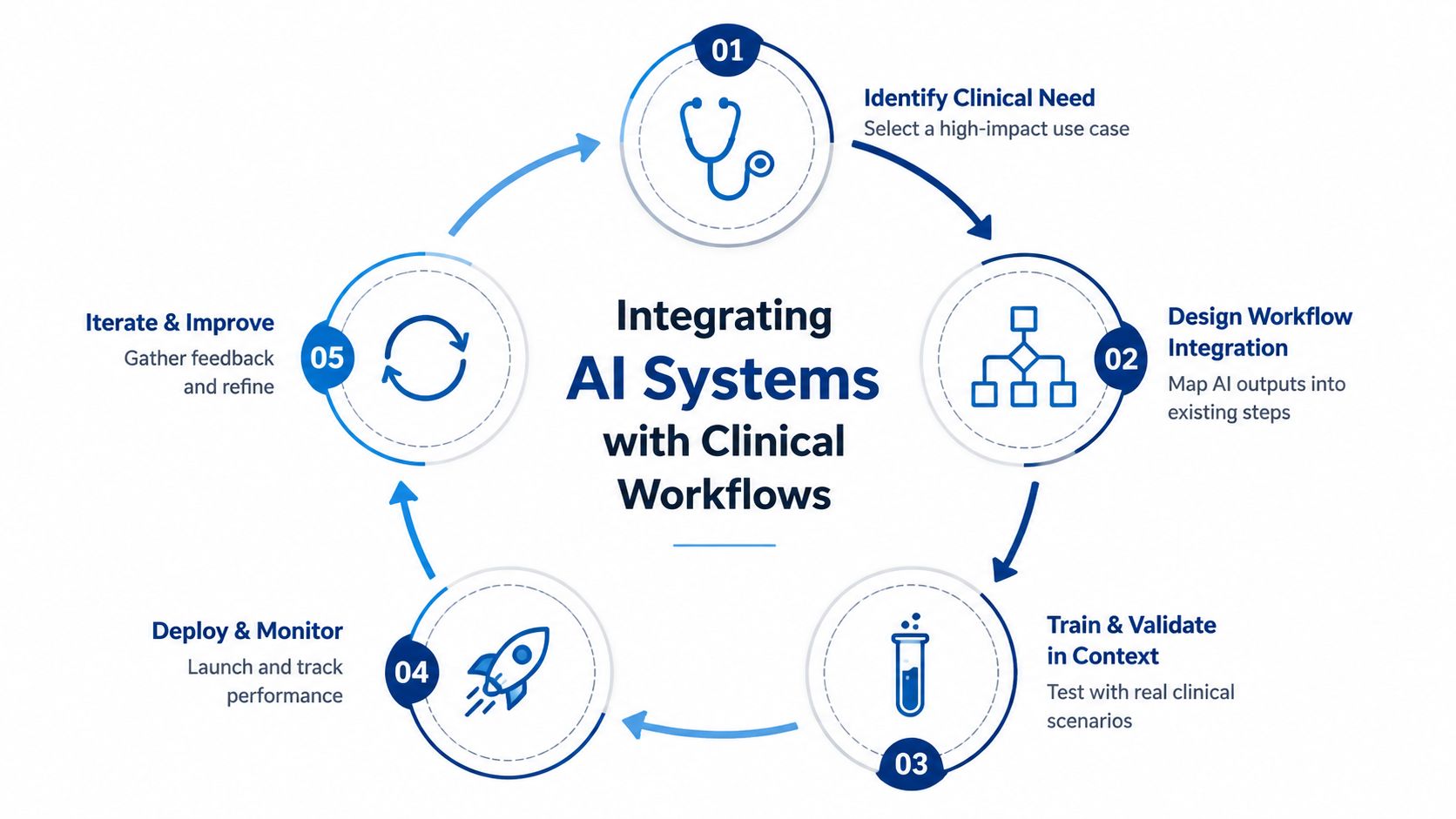
A validated model has no clinical value if its output arrives in the wrong screen, at the wrong time, or without enough context to support action. Workflow design should begin with the person who receives the recommendation and the decision they must make, not with the model's technical capability.
Start with a narrow use case. A care-navigation recommendation, imaging prioritisation signal, or documentation assistant may fit an existing process more naturally than an autonomous intervention. Define the intended action, escalation path, override reason, and fallback before building the interface.
Put outputs where work already happens
SMART on FHIR can support applications launched within an EHR context, with relevant patient and user information available to the application. CDS Hooks can trigger decision support at defined workflow moments. HL7 v2 ORU messages remain appropriate for distributing laboratory and imaging results where those channels are already reliable.
The integration pattern should reflect the urgency of the decision:
Passive display suits background risk summaries and longitudinal insights.
In-workflow guidance suits recommendations that support an existing order, referral, or discharge step.
Interruptive alerts should be reserved for situations where delay creates material risk, because excessive interruption trains clinicians to dismiss every alert.
Clinical informatics staff should test wording, placement, timing, and override behaviour with representative users. A technically correct recommendation can still fail if clinicians can't see why it appeared or if the workflow adds documentation without removing another task.
Operate the model after launch
Healthcare MLOps needs version control for models, prompts where applicable, features, reference data, and integration components. Establish a validation plan for each release, monitor drift in data and outcomes, define rollback authority, and retain the previous version until the replacement proves stable.
Vendor due diligence should include:
Regulatory status: Ask what claims the product is cleared or authorised to make, where relevant.
Liability allocation: Review responsibility for defects, downtime, harmful recommendations, and unauthorised use.
Data handling: Confirm training, retention, subprocessor, residency, and deletion practices.
Maintenance: Clarify who monitors performance, updates integrations, addresses vulnerabilities, and supports clinical review.
Exit planning: Require exportable data, documented interfaces, and a workable fallback if the contract ends.
Cleffex Digital Ltd is one option for organisations that need custom healthcare software and integration work, including connections between medical devices, software as a medical device applications, digital platforms, and hospital EHR workflows. The relevant service is healthcare software integration, where the technical scope should still be assessed against the organisation's clinical, privacy, and operational requirements.
Planning Your Migration and Implementation Timeline
Infrastructure modernisation needs a sequence that protects care delivery. A realistic programme may span 18 to 36 months, depending on the starting architecture, governance complexity, number of sites, and clinical scope. The exact duration matters less than the phase gates. Each gate should require evidence that the next layer can operate safely.
A four-stage delivery plan
Assessment and governance setup comes first. Catalogue systems and data domains, identify owners, document privacy purposes, define target terminology, and select a limited set of exchange journeys. The go or no-go test is whether leaders can name the source, owner, permitted use, quality risks, and fallback process for each priority dataset.
Infrastructure build-out follows. Establish the integration layer, governed storage, identity controls, observability, terminology services, and data-quality checks. Migrate a bounded domain first, run extraction and reconciliation in parallel, and verify that downstream reports still agree with source systems.
Pilot deployment should involve a limited clinical use case and a controlled user group. Measure data completeness, interface reliability, response latency, override patterns, user feedback, and safety incidents. Stop the pilot if the source data changes without detection, if users can't explain the output, or if the fallback process isn't practical.
Operationalisation expands proven patterns across sites and use cases. Formalise model release management, support ownership, incident response, training, supplier reviews, and recurring governance. Enterprise scale should follow repeatability, not enthusiasm.
Migration decisions that hold up in production
Avoid a single cutover when clinical operations depend on the old system. Use staged extraction, reconciliation reports, parallel runs, and explicit rollback criteria. Preserve raw source data, but don't allow it to become the only usable layer. Curated, versioned datasets need clear relationships to source records.
Budget for both capital and operating costs. Infrastructure acquisition is only one part of the financial picture. Cloud consumption, data remediation, interface support, model monitoring, security reviews, privacy assessments, clinician training, and vendor maintenance continue after launch.
Executive sponsorship also needs maintenance. Clinical leaders should review workflow impact, IT leaders should own reliability, privacy leaders should approve data use, and finance leaders should track whether operational benefits justify ongoing costs. The healthcare cloud migration practical playbook offers additional context for sequencing migration decisions without treating cloud adoption as the objective by itself.
Measuring ROI and Avoiding Common Pitfalls
AI infrastructure should be measured as an operating capability, not as a collection of impressive pilots. A useful scorecard connects technical health to clinical and financial outcomes:
Pipeline reliability: Track whether required data arrives, is processed, and can be reconciled.
Model responsiveness: Measure whether outputs appear within the time window required by the clinical workflow.
User adoption: Monitor meaningful use, overrides, abandonment, and support requests rather than log-ins alone.
Data integrity: Watch completeness, consistency, identity matching, terminology changes, and drift.
Patient and operational outcomes: Compare the intended effect against a defined baseline and account for workflow changes.
Total cost: Include cloud compute, storage, interface maintenance, remediation, audits, monitoring, training, and model updates.
The most common failure is underestimating the data work. Teams build a model against a convenient sample, then discover that production records use different codes, arrive at different times, or omit the context that made the sample useful. A second failure is replacing standards-based integration with a custom pipeline that only one team understands. The third is treating infrastructure as a one-time capital project, even though data definitions, vendors, models, threats, and clinical practices change.
A short readiness checklist can keep the programme honest:
Name the decision: Identify the clinical or operational action the AI will support.
Trace the inputs: Prove where each input originates and how quickly it arrives.
Assign accountability: Name the clinical, technical, privacy, and operational owners.
Test failure: Run downtime, missing-data, stale-data, and rollback scenarios.
Measure value: Define outcome, adoption, reliability, and total-cost indicators before launch.
Review continuously: Schedule governance and performance reviews as part of normal operations.
Canada's infrastructure agenda reflects this broader definition of readiness. The federal VITAL investment aims to connect 160 hospitals across Ontario, Alberta, and Quebec and serve more than 20 million Canadians, with planned expansion to rural hospitals and medical imaging integration, according to the Government of Canada announcement. The direction is clear. AI scale depends on dependable networks, not merely more models.
Canada also faces an edge-readiness problem. 99% of healthcare organisations rely on legacy infrastructure, 71% use outdated systems for telehealth and IoT devices, 73% report downtime or technical issues, and 51% of IT leaders say those systems increase network vulnerability, while security is the top concern for 53% of respondents, according to Canadian healthcare IT reporting. Those conditions make resilience, sovereign hosting, security, and integration as important as model accuracy.
An organisation is AI-ready when it can move trusted data to the right workflow, explain how the result was produced, protect the patient, and recover when a component fails. That standard is demanding, but it's also practical. Build the plumbing first, and model adoption becomes a controlled engineering and clinical operations problem rather than a high-profile experiment.
Cleffex Digital Ltd helps healthcare organisations design and deliver secure software integrations that connect EHRs, medical devices, digital platforms, and AI-enabled clinical workflows. Visit Cleffex Digital Ltd to discuss your interoperability assessment, healthcare data infrastructure roadmap, or AI implementation programme.