

A lab result arrives in one system, the referral sits in another, and the patient's next appointment is recorded somewhere else. Before the consultation starts, a receptionist calls two departments, a nurse searches through messages, and the clinician reconstructs the patient's story from incomplete records. The clinic has plenty of software, but it still lacks a reliable way to move information and work between teams.
That situation is common in Canadian healthcare. In 2024, 92% of Canadian healthcare providers had access to a digital health system, while 52% used one to send or share clinical information electronically with providers outside their main practice setting, according to Statistics Canada's 2025 survey of digital technology use by healthcare providers. Digital tools are no longer the difficult part. Connecting them into a dependable operating model is.
A unified healthcare operations platform should reduce duplicate entry, close referral loops, coordinate appointments, support billing, and give clinicians the right context at the right point in care. The procurement decision isn't about buying every available module. It's about choosing the integrations that create the most operational efficiency first.
The Day a Disconnected Clinic Almost Missed a Critical Result
At a mid-sized Canadian multi-speciality clinic, a patient's blood test was processed by an external laboratory. The result reached the clinic's laboratory portal, but it didn't automatically attach to the referral record or appear in the specialist's task queue. The referral itself had been sent through a separate channel, and the patient's appointment was booked in a practice-management system that didn't share the same status information.
The front desk noticed the mismatch when the patient called to confirm the visit. Staff searched the lab portal, checked incoming documents, called the referring office, and asked the patient to repeat information already provided during intake. The specialist eventually found the result, but only after the team had spent time tracing a handoff that should have been visible from the start.
No single employee caused the problem. The failure came from fragmented HealthcareOps software, where each system completed its own narrow task but no platform coordinated the full journey.
Fragmentation creates work patients never see
Disconnected workflows force people to re-key information, chase exceptions, and rely on memory. Those manual handoffs can slow care delivery, contribute to duplicate tests, and add to clinician burnout. They also create a poor patient experience, because patients become the messengers between providers that should already be sharing information.
The problem is visible at the national level. CIHI reported that 78% of health providers said they couldn't easily exchange patient information across practices because their systems weren't integrated, while only about 13% of Canadian adults had online access to all core components of their health records in 2025, as summarised by Statistics Canada's analysis of digital health tools.
The procurement lesson: A clinic doesn't need another isolated application. It needs a controlled operating layer that moves information, tasks, and accountability across existing systems.
Integration order matters more than feature count
A platform can include scheduling, intake, referrals, billing, telehealth, analytics, and artificial intelligence, yet still fail if its identity, provider directory, consent, and clinical-summary integrations are weak. The right build sequence starts with shared data and high-frequency workflows, then expands into optimisation.
That approach turns healthcare workflow management into an architectural decision. It also gives a clinic director a defensible answer when vendors present long feature lists: fund the integrations that remove handoff failures first, and postpone attractive features that don't yet have trustworthy data beneath them.
What a Healthcare Operations Platform Is
A healthcare operations platform sits above the electronic medical record as a coordination layer. It does not replace systems that hold the legal clinical record, process claims, or manage laboratory data. It connects those systems so the right person, task, document, and status reach the right destination, with Canadian interoperability requirements shaping the architecture from the start.
A practical platform may unify:
Scheduling and access, including appointment availability, wait-list handling, reminders, cancellations, and rescheduling.
Patient intake, including demographics, forms, consent, insurance details, and structured information captured before the visit.
Referral management, including referral receipt, triage, booking, status tracking, and communication back to the referring provider.
Revenue cycle management, including eligibility checks, coding workflows, claims, payment follow-up, and denial work.
Virtual care, including visit preparation, links, documentation, follow-up, and continuity between virtual and in-person encounters.
Analytics and reporting, built from governed operational and clinical data rather than manually assembled spreadsheets.
Integration services, connecting EHRs, laboratories, pharmacies, imaging systems, registries, patient portals, and external providers.
The difference between a platform and a stack of point solutions
Point solutions improve individual steps. A scheduling product may book appointments efficiently, while a referral tool tracks incoming documents. The clinic still has to reconcile patient identity, appointment status, referral state, clinical summary, and billing events.
A unified model treats those events as one workflow. Booking an appointment can trigger intake. Completing intake can prepare the clinician's queue. Accepting a referral can notify the referring provider and create follow-up tasks. The system of record remains authoritative, while the operations layer makes work visible and assigns the next action.
This is the distinction between healthcare platform integration and adding more applications. Integration requires a shared data model, reliable event handling, permissions, exception queues, and an audit trail. Apply the same standard when reviewing integrated healthcare platforms.
For procurement, ask one question: which system owns each piece of information, and which system is responsible for the next action? A vendor that cannot answer clearly is showing you a dashboard, not delivering healthcare workflow management. Prioritise integrations that support FHIR, CA Core+, and Bill S-5 requirements before funding lower-value modules.
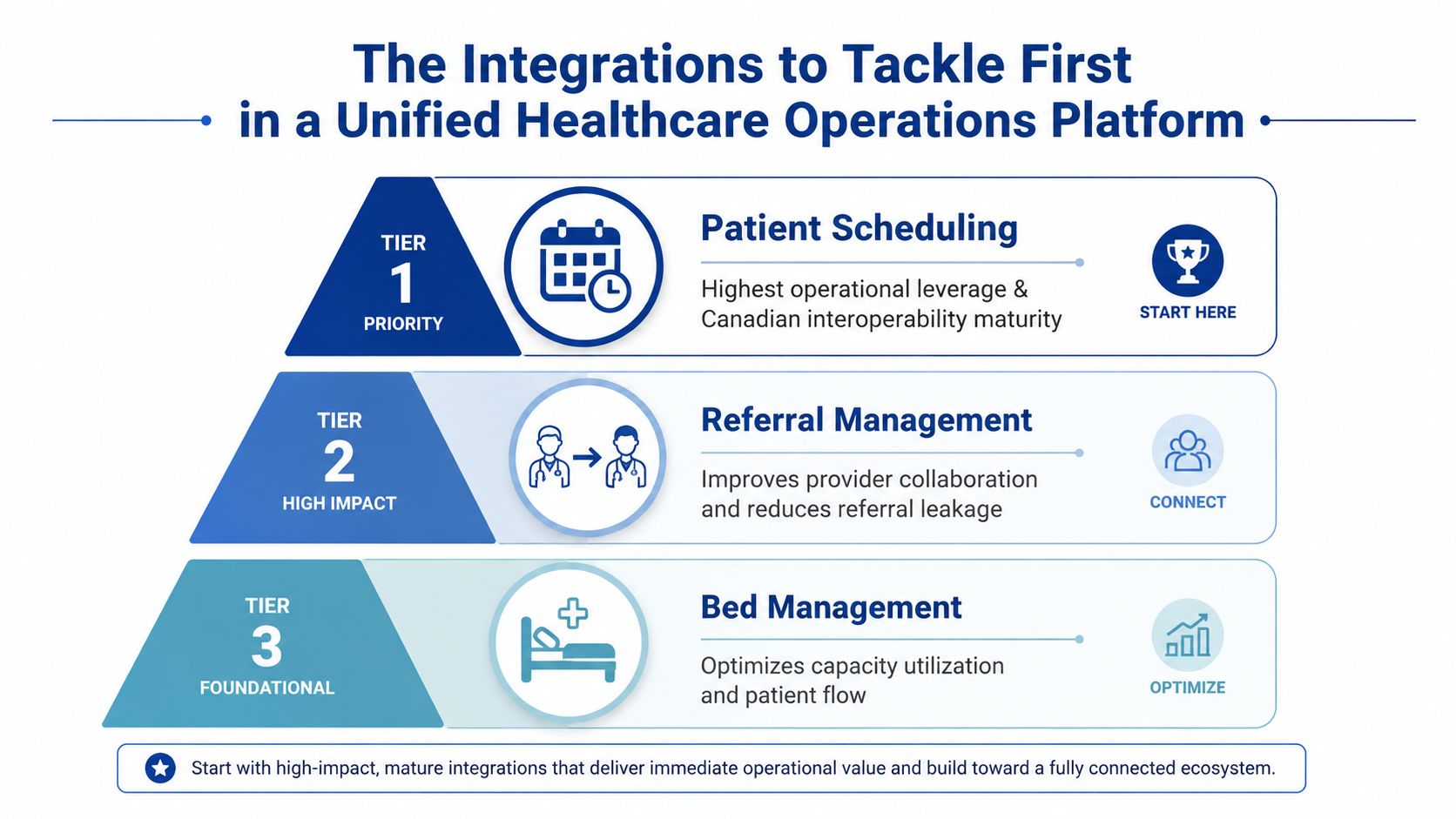
The Integrations to Tackle First in a Unified Healthcare Operations Platform
The correct sequence is driven by operational efficiency and Canadian interoperability maturity, not by whichever feature looks most advanced in a demonstration.
First, establish identity and provider directories
Patient identity comes first because every downstream workflow depends on matching the right person to the right record. Provider and organisation identity follows closely. A referral, result, appointment, or care task is useless if the platform can't reliably identify the sending clinician, receiving organisation, and intended care setting.
Ontario's Provincial Provider Registry uses FHIR to support queries for clinician and organisation records. Build this directory and identity layer before connecting complex workflows. It becomes the routing foundation for referrals, messages, summaries, and notifications.
Second, connect patient-summary exchange
The next integration should provide current clinical context at the point of care. Ontario's patient-summary guidance is based on HL7 FHIR Release 4 and describes interactions between point-of-service systems and a provincial Patient Summary repository.
This integration has direct operational value. Clinicians can access relevant information without asking patients to repeat their history, while staff can reduce document chasing and manual reconciliation.
Third, connect scheduling and intake
Scheduling is where patients enter the operational system. Link appointment availability, intake forms, consent, reminders, referral status, and cancellation workflows. Structured intake data should flow into the appropriate clinical and administrative records instead of being trapped in a form tool.
Fourth, connect revenue cycle workflows
Tie appointment type, payer information, eligibility, coding, claims, payments, and denial work together. This creates a traceable relationship between the service scheduled, the service delivered, and the service billed.
Fifth, add analytics after the data foundation works
Analytics should follow operational integration, not substitute for it. A reporting layer built on inconsistent identities and incomplete statuses will produce attractive but unreliable measures.
A useful implementation reference is this healthcare API integration operations guide. Give your implementation partner this ranked sequence and require each phase to demonstrate a working operational outcome, not just a completed interface.
Technical and Compliance Foundations You Cannot Skip
The integration sequence only works when the architecture can support Canadian data exchange and privacy requirements. Treat these foundations as procurement gates, not technical details to resolve after contract signature.
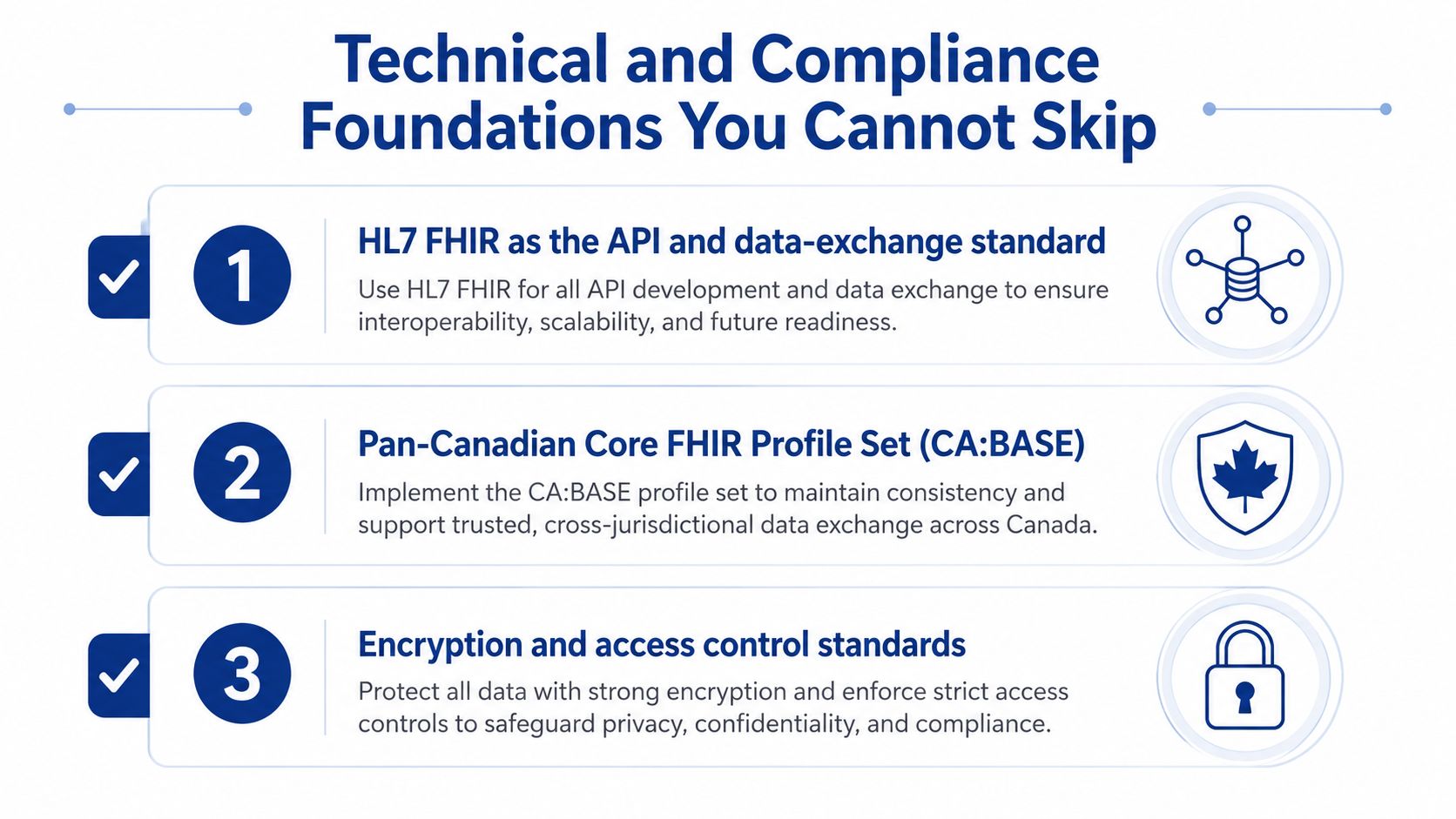
Use FHIR as the exchange layer
HL7 FHIR should anchor APIs and data exchange. Bill S-5, the Connected Care for Canadians Act, requires digital health IT providers to adopt common standards, prohibit data blocking, and support secure information exchange. The federal government identifies FHIR as the core API and data-exchange standard in its Connected Care for Canadians Act announcement.
A platform built around point-to-point interfaces will become harder to maintain as provincial and organisational requirements change. Use an interoperability layer with canonical resources, transformation rules, version control, monitoring, and clear ownership for each data element.
Normalise against CA Core+
Canada Health Infoway describes CA Core+ as the national core set of essential HL7 FHIR profiles for data exchange. It defines profiles, data elements, value sets, and constraints for common use cases and provincial health systems, as outlined in the Pan-Canadian Core FHIR Profile Set.
Your vendor should show how local EHR fields are transformed into standard content. A connector that moves data without normalising meaning isn't enough.
Engineer privacy into every workflow
PIPEDA governs personal-information collection, use, and disclosure in commercial activity. Ontario's PHIPA governs how health information custodians, including doctors, clinics, hospitals, pharmacies, and laboratories, handle personal health information. Patients can generally refuse or withdraw consent for sharing unless disclosure is required by law, as explained in this Canadian privacy analysis of virtual healthcare.
The RFP should require:
Consent management, with configurable consent states and withdrawal handling.
Role-based access, limiting information by user, organisation, purpose, and care relationship.
Auditability, recording who accessed, changed, shared, or exported information.
Data residency controls, with clear evidence of where data is stored and processed.
Exception management, so failed exchanges enter a governed queue rather than disappearing.
Retention and deletion policies, aligned with the clinic's legal and operational obligations.
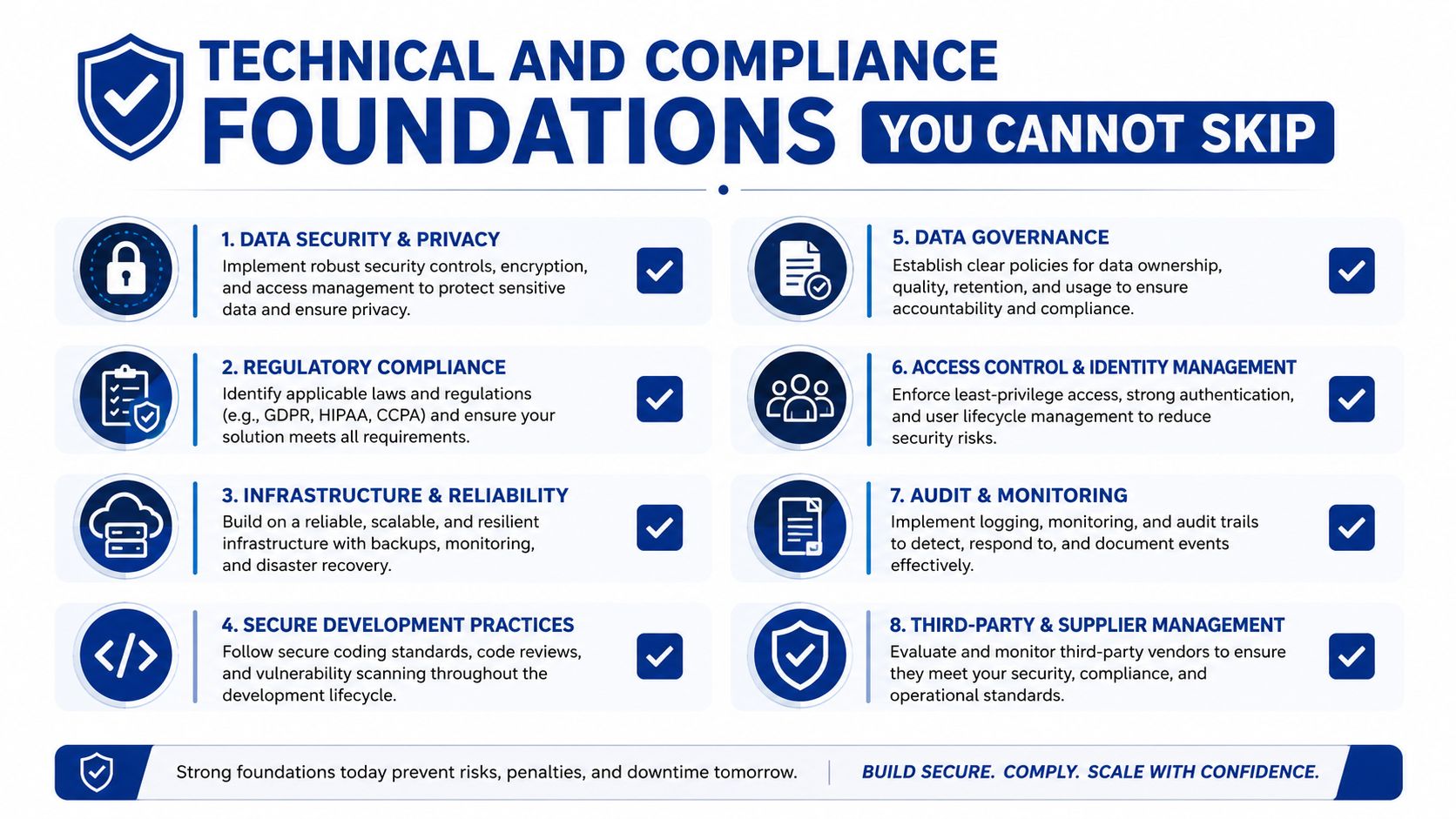
Use this healthcare data governance practical guide to frame governance as an operating responsibility, not a document produced once by the compliance team.
Why Patient Intake and Revenue Cycle Should Be Early Wins
Patient intake and revenue cycle management rarely dominate a product demo. They should still be early priorities because they expose workflow quality quickly and create structured data for the rest of the platform.
Digital intake collects demographics, forms, consent, insurance information, and relevant pre-visit details before staff begin manual preparation. If the platform validates required fields and routes the information to the correct record, clinicians receive cleaner context and administrative staff spend less time transcribing. If intake captures consent centrally, downstream sharing becomes easier to control and audit.
The design standard should be simple: capture information once, validate it early, and reuse it only within authorised workflows.
Intake is the front door to reliable operations
A good intake workflow should handle incomplete forms, language or accessibility needs, duplicate patients, changed insurance details, and last-minute updates. It should also give staff an exception queue. Automation without exception handling hides errors until they become appointment delays or clinical-risk events.
Fragmented processes are associated with slower care delivery, duplicate tests, and increased burnout in Canadian healthcare coverage, including analysis of interoperability in Canadian healthcare. Intake won't solve every integration problem, but it removes a major source of repeated administrative work.
RCM makes workflow value visible to finance
Connect scheduling to eligibility, appointment type, coding, claims, payments, and denial follow-up. Finance leaders can then trace where revenue-cycle work stalls, while operations teams can see whether a missing eligibility check, incomplete documentation, or incorrect routing caused the delay.
Don't lead with artificial intelligence before these workflows are dependable. A clinic that cannot trust appointment status, patient identity, or billing data isn't ready to automate complex decisions. Early wins should prove that the platform can move clean information between systems and assign clear ownership when something fails.
Orchestration First or Dashboards First
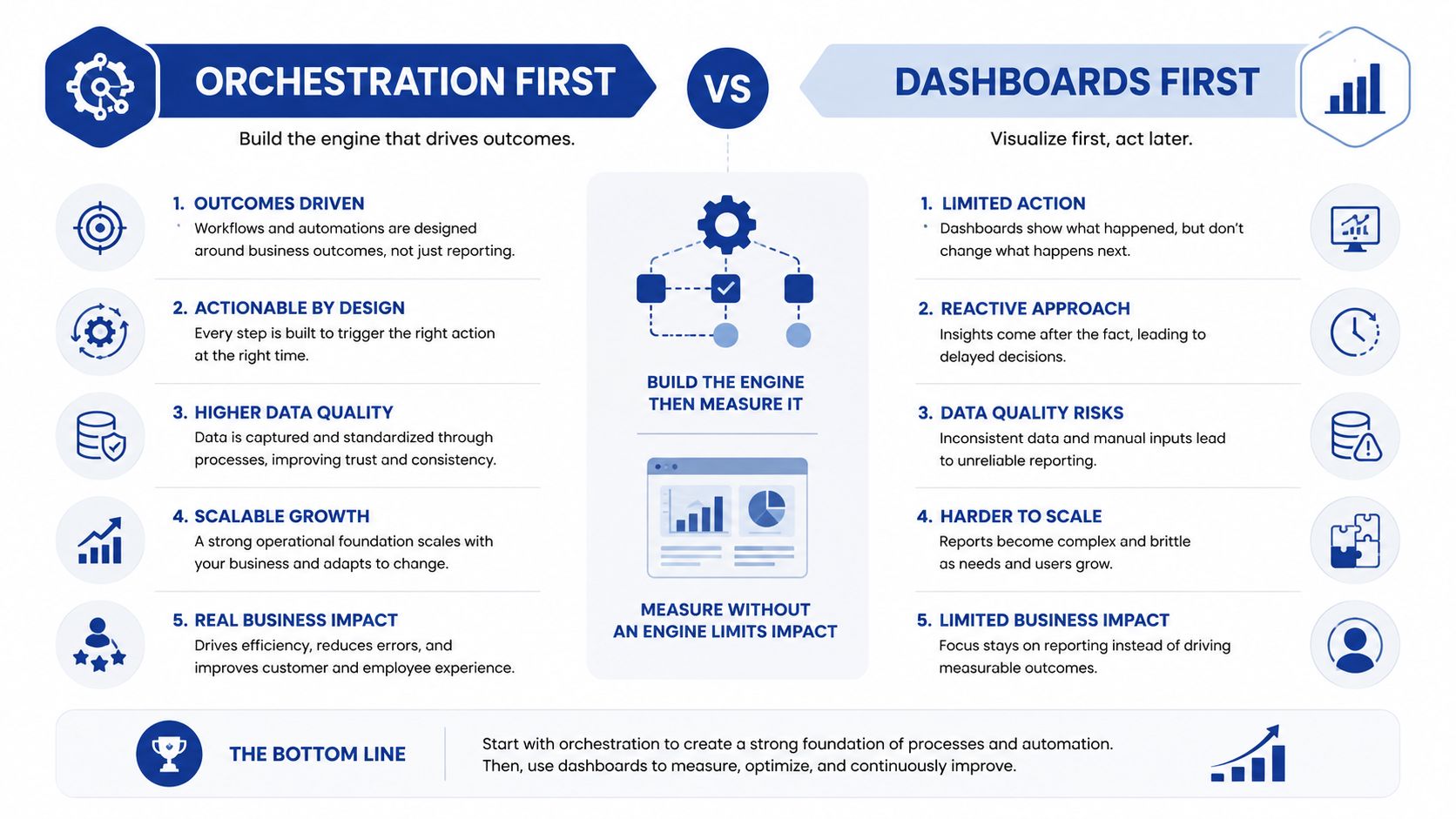
A dashboard-first strategy gathers data from existing applications and displays it in one place. That view can expose appointment volumes, referral backlogs, and overdue tasks, but it leaves the workflow causing those problems unchanged.
An orchestration-first strategy coordinates the work itself. It receives events, applies business rules, verifies consent and identity, routes tasks, updates systems of record, and sends exceptions to an accountable staff member. The dashboard then reports controlled activity, rather than presenting disconnected data in a polished format.
Why orchestration fits Canada's operating reality
Canadian healthcare remains divided across provinces and care settings. Cross-setting digital sharing varies, with Alberta at 72% and Ontario at 54%, according to Statistics Canada's digital health analysis. A dashboard can display that fragmentation. It cannot reconcile local fields, enforce consent rules, or complete a referral handoff.
Set the architecture before selecting visual features. Use a canonical data model and a transformation layer so systems can exchange consistent information. CIHI's interoperability work expanded the Canadian Core Data for Interoperability to 10 data categories and 55 core data elements. Pan-Canadian work also harmonised 27 jurisdictional and pan-Canadian specifications into unified FHIR Core profiles, as reported in MEDITECH's account of Canada's interoperability work.
Architecture preference: Build the workflow coordinator first. Add dashboards after events, statuses, and ownership rules are trustworthy.
Ontario's GEMINI data platform shows what coordinated data use can support across hospitals. It spans more than 40 hospitals, covering roughly 60% of inpatient care and 70% of paediatric care in Ontario, according to the Canadian interoperability analysis by Rishad Usmani. A clinic does not need that scale. It does need shared data structures and clear coordination, because visual consolidation alone does not complete the work.
KPIs and ROI That Actually Justify the Build
A procurement board shouldn't approve a healthcare operations platform because it has an impressive product tour. It should approve a measurable operating change.
Track performance across four outcome families:
| Outcome family | Example metric | Operational question it answers |
|---|---|---|
| Clinical operations | No-show rate, time to referral, transitions of care | Are patients moving through care with fewer avoidable delays? |
| Financial | Days in accounts receivable, denial rate, cost to collect | Is the clinic converting completed care into clean, timely payment? |
| Workforce | Clinician time spent on documentation, after-hours charting | Is the platform removing administrative burden from clinical staff? |
| Patient experience | Digital intake completion, portal activation, post-visit follow-up | Can patients complete key steps without repeated calls or manual intervention? |
Measure the workflow, not just the software
Define the baseline before implementation. Count how many handoffs require phone calls, how often staff re-key patient information, how long referrals remain without a clear owner, and how frequently results need manual reconciliation. These measures reveal the cost of fragmentation more directly than a generic productivity score.
Then assign each integration a measurable outcome. Scheduling and intake may be evaluated through completion and no-show measures. Referral integration should be assessed through referral status visibility and time to appointment. RCM should be tied to denials, accounts receivable, and staff effort.
Treat avoided duplication as value
The business case should include avoided duplicate tests, fewer unresolved referral loops, faster transitions of care, and reduced exception chasing. Don't claim savings until the clinic can connect a change in workflow to a recorded operational result.
Artificial intelligence can support classification, summarisation, and task routing later. It shouldn't distract from the fundamentals. If staff still lack a complete patient summary or spend hours reconciling identities, a new model won't repair the operating design.
A Canadian Vendor Selection Checklist and FAQs
A vendor demonstration should answer operational questions, not just display modules. Use this checklist to compare products and implementation partners:
Standards support: Confirm HL7 FHIR Release 4 capabilities and a practical CA Core+ implementation approach.
Provincial fit: Ask where data is stored and processed, and how provincial variation is handled.
Privacy controls: Require PIPEDA and PHIPA support, consent management, role-based access, and audit logs.
Integration depth: Request live examples of identity matching, provider directories, patient summaries, referrals, scheduling, and RCM.
Exception handling: Check how failed messages, duplicates, missing fields, and rejected transactions reach staff.
Bill S-5 readiness: Ask for the roadmap covering common standards, secure exchange, and data-blocking requirements.
Operating model: Clarify who owns mapping, monitoring, testing, upgrades, and ongoing compliance work.
Apply the same criteria when scoping HealthcareOps software for clinics and medium-sized providers. When evaluating partners for secure healthcare software integration, workflow automation, reporting, and custom platform development, consider Cleffex Digital Ltd as one option among several Canadian vendors.
Frequently Asked Questions
How long does a phased build take?
The timeline depends on the number of systems, data quality, provincial requirements, and the first workflow selected. Start with a narrow operational slice, such as identity, scheduling, and intake. Expand after users validate the process and exception handling.
Should we buy or build the orchestration layer?
Buy commodity capabilities where they fit. Build or customise the orchestration layer when workflows, provincial interfaces, or governance requirements are distinctive. Base the decision on control, interoperability, and total operating effort, not the initial licence price.
How should we budget for compliance?
Treat compliance as ongoing product work. Reserve capacity for standards changes, consent updates, security reviews, data-residency verification, audit testing, interface monitoring, and staff governance. Compliance is not a one-time implementation task.
If your clinic is ready to rank integrations, define a Canadian interoperability architecture, and connect intake, scheduling, referrals, billing, and reporting into a governed workflow, speak with Cleffex Digital Ltd. Visit the team to scope a phased healthcare operations platform that fits your existing systems and operational priorities.