

A hospital never gets to pause for a software project. The emergency department still needs admissions, the lab still needs orders, and nurses still need patient histories that make sense at 2 a.m. That is why healthcare legacy system modernisation has to be built around continuity, not heroics.
In Canada, that pressure is especially real. Public-sector systems are still carrying a heavy modernisation burden, and health information remains fragmented enough that patients and clinicians feel the gap in daily work. The practical answer is not a dramatic cutover. It is a phased, interoperability-first approach that keeps services live while old and new systems learn to work together.
The real business case is simple: keep care moving while you modernise the parts behind it.
The organisations that do this well don't start by ripping out everything that looks old. They start by protecting clinical flow, then they modernise the pieces that most clearly reduce risk, improve access, and make data travel cleanly between settings. That is the difference between a successful programme and a very expensive interruption.
Modernising Without Disrupting Patient Care
A hospital never gets to pause for a software project. The emergency department still needs admissions, the lab still needs orders, and nurses still need patient histories that make sense at 2 a.m. That is why healthcare legacy system modernisation has to protect care first and treat technology change as a controlled clinical risk.
In practice, the safest path is usually an interoperability-first one. Keep the service live, modernise the layers around it, and let old and new components run side by side until the handoff is clean. That approach fits the way Canadian teams already work, with governance, standards, and phased integration carrying more weight than a hard cutover.
Why downtime is the wrong target
Legacy healthcare software often survives because it is already embedded in routines people trust. Clinicians know the workarounds, administrators know where the gaps are, and support teams know what to do when the application misbehaves. A rushed replacement can break those tacit rules quickly.
A safer standard is to design for continuity while the platform changes around the edges. That usually means keeping core transactions stable, adding integration layers where possible, and using parallel FHIR/HL7 support to connect new services without forcing a full cutover on day one.
What a safer starting point looks like
A live-site programme starts with observation, not replacement. Map where the legacy system sits in the care journey, then decide which parts must stay untouched while surrounding layers are improved. That usually means preserving core transactions first, then wrapping them with newer interfaces or data services.
Useful starting questions include:
What stops patient movement if this system fails?
Focus on the points that would delay care, not just the systems that are most dated.
Which workflows can run in parallel?
Some modules can be modernised beside the old system, while others need to remain stable until the team is ready.
Where do staff already use workarounds?
These gaps usually reveal the highest-friction processes and the best first candidates for improvement.
For teams that need a practical view of how connected healthcare systems support this kind of phased change, the core lesson is simple. Modernisation works best when systems keep talking to each other while the underlying platform is rebuilt.
Assessing Your Legacy Estate and Mapping Risk
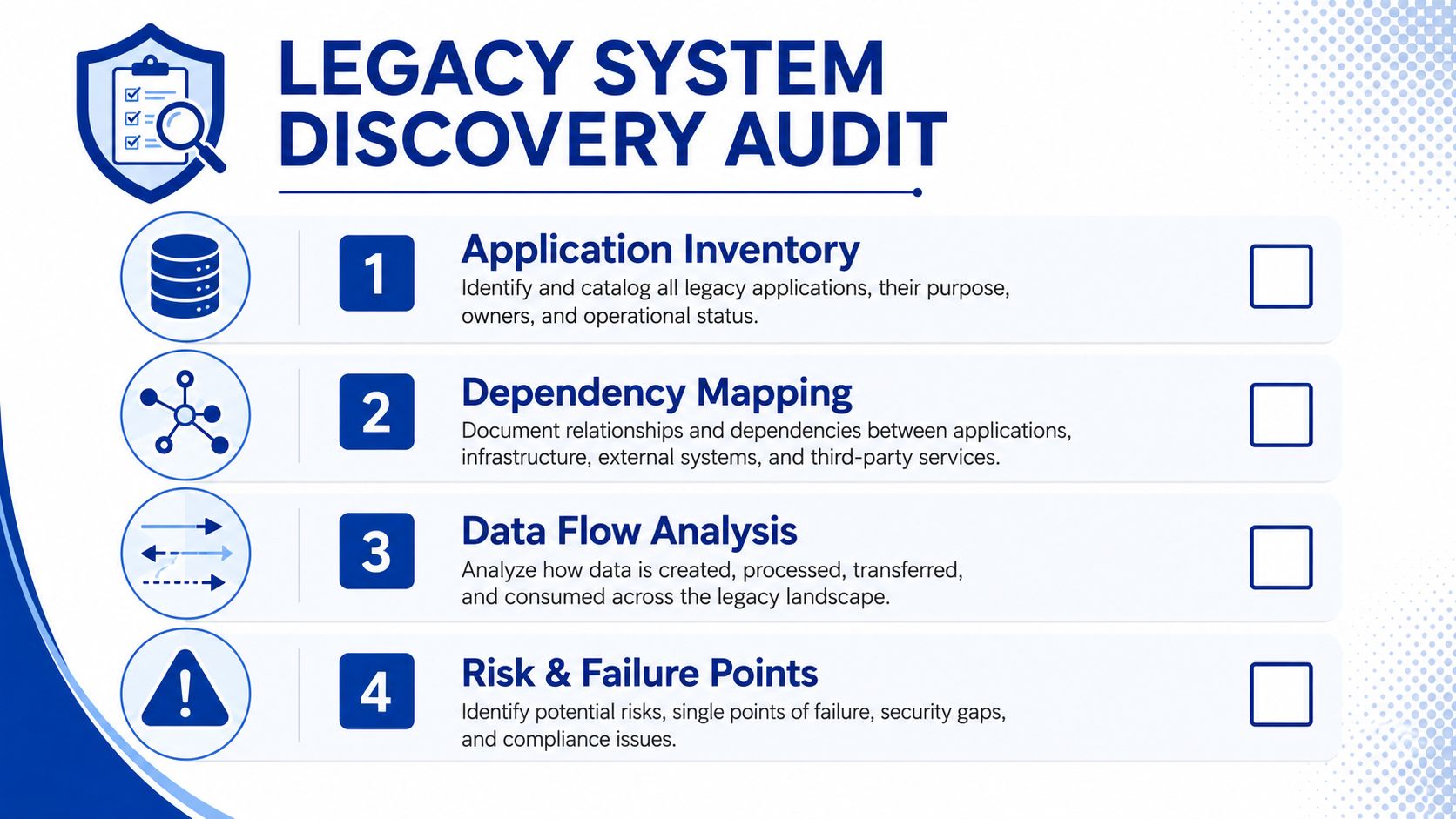
A reliable assessment starts with inventory, not opinions. In a live hospital environment, teams often think they know which systems are old, fragile, or business critical until they have to document every dependency and handoff. That is usually when hidden interfaces, shadow spreadsheets, and informal manual workarounds surface.
The goal is to produce a prioritised modernisation backlog and a risk register. Those two artefacts give you a practical basis for deciding what to rehost, what to replatform, what to retire, and what must stay stable until the rest of the estate is ready.
Build the inventory around actual dependencies
A useful assessment goes beyond naming applications. It traces how patient, financial, and operational data moves between systems, teams, and external partners. In healthcare, that matters because a system that looks low-risk in isolation can become a choke point once you see how many services depend on it.
A provincial health authority can expose the same problem in a smaller footprint. One common pattern is a mix of ageing scheduling tools, lab feeds, and reporting databases that all work until a vendor patch, interface failure, or manual queue backlog interrupts the chain. That is the kind of dependency map leaders need before they approve any modernisation sequence.
Use a simple inventory discipline and tie it to healthcare data governance basics. That keeps the assessment grounded in ownership, data quality, and control points, not just application names.
Use a risk triage that clinicians can recognise
The most useful scoring model is the one clinical and operational leaders can read quickly. Rank each system by what happens if it fails, how hard it is to recover, and how much manual work staff would need to absorb during an outage. Then separate systems into three practical buckets.
Stabilise now: These are the applications closest to patient flow or safety, and they need immediate controls.
Modernise in place: These systems still work, but they need interfaces, governance, or infrastructure changes before deeper replacement.
Retire or consolidate: These are redundant, low-value, or duplicate tools that create more operational drag than benefit.
That triage also helps you decide where rehosting is enough and where rearchitecting is justified. The key is to avoid treating every old application as a rewrite candidate. Some are better left in place behind cleaner exchange layers, especially when the clinical workflow is still dependable, and the integration path is the primary weakness.
Designing a Compliant and Interoperable Target Architecture
The target state should make old and new systems easier to connect, not harder to govern. In healthcare, that means designing for interoperability, security, and controlled coexistence from the beginning. Cloud, APIs, and microservices are useful only if they sit on a shared standards base that clinicians and administrators can support.
Start with governance, then standardise the data
Canada's Shared Pan-Canadian Interoperability Roadmap is a federal-provincial-territorial initiative, endorsed by all jurisdictions except Quebec, that sets common data, technical, and policy standards to help health information move securely across systems and between providers. That is the right architectural signal for any organisation trying to modernise without creating new silos.
Canada Health Infoway's guidance breaks that into three concrete building blocks: a Data Foundation and Portability Framework, an Access and Exchange Framework, and a Trust Framework. Taken together, they point to a practical rule: align governance first, then move to standards-based data models and exchange rules.
Practical rule: If the governance model is unclear, a new interface layer will only automate confusion.
Shape the architecture around coexistence
A modern target architecture doesn't need every legacy module replaced on day one. It needs a clean boundary between core systems of record and the services that present, transform, and exchange data. That is where API gateways, integration services, and controlled data models do their best work.
For compliance-minded teams, it can also help to use an external governance reference such as DevArmor for healthtech compliance. The value there is not marketing polish; it's having a structured lens for policy, auditability, and controlled access when multiple systems have to coexist.
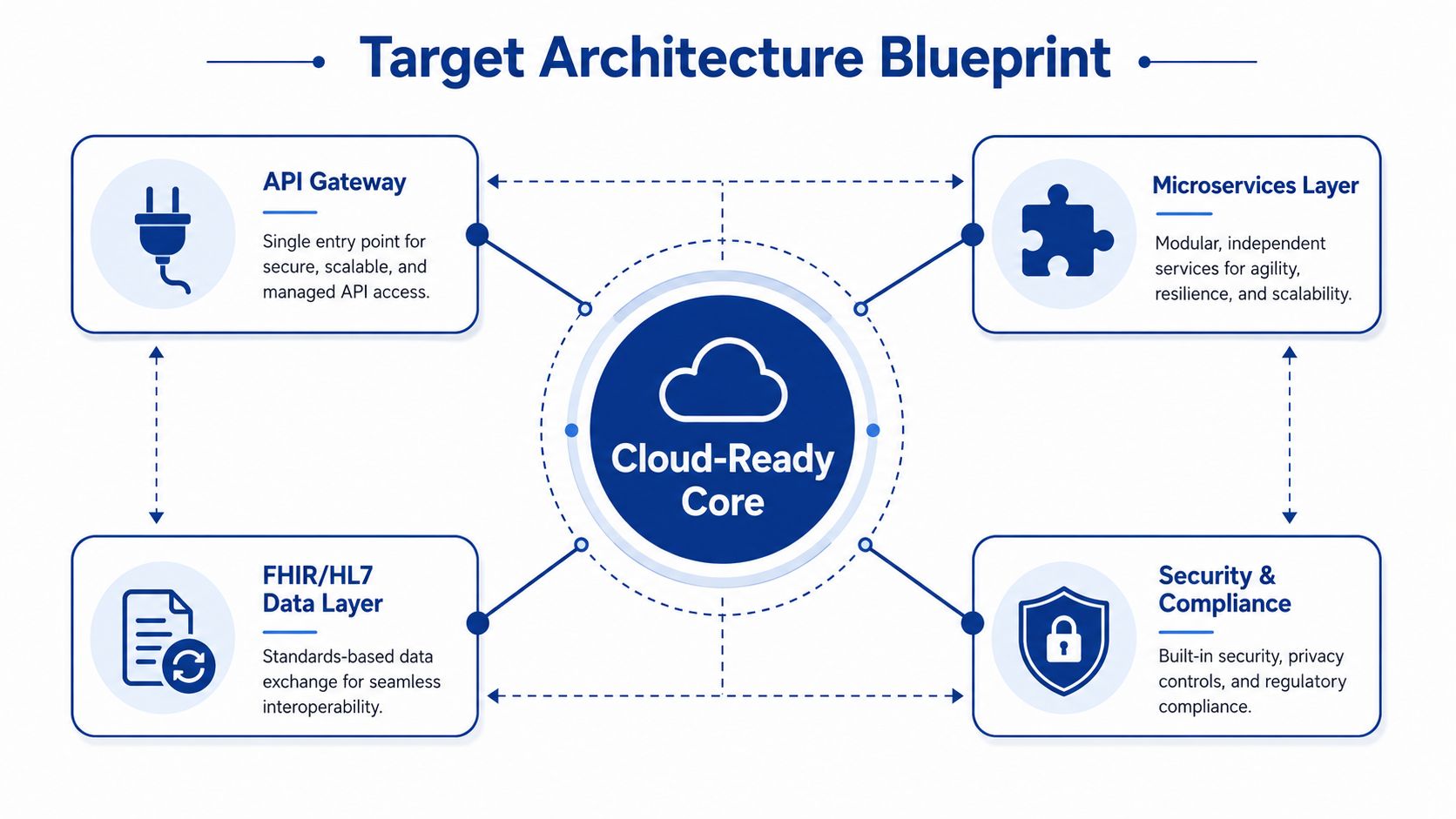
A simple architecture decision set looks like this:
Cloud-ready core: Keep the hosting layer flexible so parts of the estate can move without forcing a full rebuild.
API gateway: Centralise access so legacy and modern services don't each create their own exposure surface.
Microservices layer: Split only where independence is useful, not because microservices sound modern.
FHIR and HL7 data layer: Treat standards as the shared language that keeps exchanges predictable.
Security and compliance controls: Make logging, access, and audit rules part of the design, not a post-launch fix.
For implementation teams, Cleffex's healthcare software integration service fits naturally into this kind of phased architecture work, especially when the goal is to connect older systems without forcing a full stop to daily operations.
Migrating Data and Connecting Systems with HL7 and FHIR
Data migration is where many programmes get too confident. Teams clean up a spreadsheet of field mappings, test a few records, and assume the rest will behave. In healthcare, that's rarely enough, because the risk sits in how clinical context survives the move, not just whether rows appear in the target database.
The safer model is a parallel-run playbook. Keep the legacy path alive, add the new path beside it, and validate both until the organisation is comfortable consolidating interfaces and workflows.
Run old and new paths side by side
Ontario's interoperability plan gives a useful operational example. The province's PCR will continue to support HL7 v2, v3 and FHIR interfaces for data contribution and consumption until stakeholders are ready to consolidate onto a single standard. That is a textbook low-disruption pattern, because it lets the organisation move forward without forcing a hard cutover.
The sequencing matters. First, define the minimum data set that must move without loss. Then standardise the data definitions so older applications and newer services interpret records the same way. After that, validate the interfaces in a controlled environment before any live cutover.
Test the exchange, not just the export
A migration that only checks whether data left the old system is incomplete. You also need to verify that the receiving system can use the data correctly, that downstream applications preserve the right relationships, and that clinicians can still find the information they expect. That means testing with real workflows, not only synthetic records.
A practical migration checklist looks like this:
Profile the source data: Identify duplicates, missing values, and inconsistent codes before the move.
Standardise field meanings: Map the old labels to shared definitions so teams aren't translating on the fly.
Validate interface behaviour: Confirm that messages, acknowledgements, and error handling work on both sides.
Schedule around clinical peaks: Avoid cutovers during periods where admissions, discharges, or clinic throughput are already under pressure.
Keep rollback paths live: If a validation rule fails, the team needs a way back that doesn't disrupt patient care.
For teams building the technical pipeline, the guide to integrate FHIR with EHR systems is a useful reference for thinking through the connection layer.
Don't let a successful data transfer become a failed clinical handover. The data has to arrive in a form that staff can trust and use immediately.
If your programme also needs a broader migration planning lens, a resource on enterprise data migration strategy 2026 can help frame sequencing, validation, and cutover control.
Testing, Validating, and Rolling Out Change Safely
Modernisation programmes don't fail because teams forgot to build features. They fail because rollout was treated as an IT event instead of an operational change. The safest deployments are governed, rehearsed, and boring in exactly the right ways.
That means clear approval gates, clinical validation, non-regression testing, and a rollback plan that people can execute under pressure. It also means vendor selection should be based on implementation discipline, not just feature lists.
Use governance to protect uptime
Canada's healthcare interoperability gap shows why this matters. Despite near-universal EHR adoption, nearly all jurisdictions still lack interoperability between hospitals, community specialists, and primary care, and information exchange often still depends on fax or mailed letters. The main bottlenecks identified were weak governance with no single accountable oversight, lack of interoperability legislation and standards, misaligned incentives for clinicians, and jurisdictional technical and funding constraints.
That is a blunt reminder that technical readiness isn't the same as operational readiness. A system can be installed and still not be usable across care settings. Governance closes that gap by defining ownership, escalation paths, and go-live criteria that clinical leaders trust.
Choose rollout controls that match real workflows
A safe rollout isn't just about training slides. It is about making sure staff can recognise what changed, where to go for help, and how to revert if something behaves unexpectedly. The best change plans are simple enough to use during a busy shift.
Strong rollout controls usually include:
Clinical sign-off: Nurses, physicians, and administrators validate the workflow, not just the screen layout.
Non-regression testing: Old functions still need to work after the new component goes live.
Rollback rehearsals: Teams practise the return path before they need it.
Targeted training: Staff get role-specific guidance, not a generic demonstration.
Hypercare coverage: The early support window should be staffed by people who can fix the problem, not just log it.
I've seen projects fail when leaders assumed staff resistance was the issue. Often it's just that people were asked to trust a new workflow that hadn't been validated against their day-to-day reality. If you want adoption, prove that the new path is as reliable as the old one before you ask anyone to change habits.
Measuring Success and Sustaining Healthcare Modernisation
The easiest mistake after go-live is to measure the wrong thing. A new system being installed is not the same as a new system being used effectively. In healthcare, success should be tied to connected access, information sharing, and the stability of live services, not just the presence of modern software.
Canada's patient-access numbers make that clear. In 2023, only 39% of Canadians reported accessing health records online, up just 3 percentage points from 2022, with variation from 60% in Saskatchewan to 14% in Manitoba and Newfoundland and Labrador. That kind of gap shows why modernisation has to be judged by real access, not project completion.
Track outcomes that reflect patient and staff experience
A sensible dashboard should combine operational, clinical, and adoption measures. Keep the list short enough that leaders review it, then use it consistently enough to spot drift early. The goal is sustained capability, not one celebratory launch.
Good indicators include:
Online access to records: Are patients able to see what they need?
Cross-setting information sharing: Can clinicians retrieve and send data across care sites without workarounds?
Service reliability: Are critical workflows staying stable after each change?
User adoption: Are staff using the new pathway, or defaulting back to legacy shortcuts?
Exception volume: Are error queues and manual interventions going down over time?
Treat modernisation as a standing capability
The best healthcare system modernisation programmes become part of how an organisation runs, not a one-off project with a finish line. That means a maintained roadmap, a governance group that still meets after go-live, and a backlog that continues to reflect operational pain, not just technical debt. It also means the organisation is honest about which pieces should be rehosted, which should be replatformed, and which should be retired.
For organisations that want outside support, Cleffex Digital Ltd can help plan and deliver healthcare legacy system modernisation with a phased integration approach, especially where older platforms need to stay live during transition. They work with healthcare teams that need practical software delivery, integration, and modernisation support without turning operations upside down.
If your organisation is carrying old healthcare software, start with a discovery audit, not a rewrite. Cleffex Digital Ltd helps healthcare teams modernise legacy systems, connect data safely, and keep live services stable during change. Visit Cleffex Digital Ltd to discuss a phased modernisation plan that fits your current clinical and operational reality.