

Healthcare operations automation is no longer about shaving a few clicks off a form. In healthcare, the administrative machine already has a large automation footprint, with McKinsey estimating 36% automation potential across healthcare overall, 43% technical automation potential in payer activities such as claims administration and member enrolment, and 33% likely automatable tasks in those workflows, while the 2024 CAQH Index said electronic transactions and automation helped the U.S. healthcare system avoid $258 billion in administrative costs in 2024, up 17% year over year. That is the point where manual work stops being a harmless nuisance and starts becoming a structural cost problem.
The practical question is no longer whether clinics, hospitals, and payers should automate. It is how to modernise without creating brittle workflows, hidden governance risk, or another layer of software that staff have to fight every day. The organisations that get this right treat healthcare process automation as an operations discipline, not a software purchase. They map the work, pick the right workflows, connect the systems properly, and keep human review where judgement still matters.
The Manual Healthcare Back Office Is Quietly Failing
A scheduler retypes eligibility details from one screen into another. A billing clerk calls a payer to chase prior authorisation. A lab result lands in one system, then sits until someone re-enters it somewhere else. None of these steps looks dramatic on its own, but together they create delay, rework, and frustration that spill into patient care.
That is the actual shape of manual healthcare operations. The visible problems are long calls, queue backlogs, and late claims, but the hidden cost is that staff spend their day moving information instead of using it. In practice, the work becomes fragmented, and every handoff is another chance for something to be missed.
Small Frictions Add Up Fast
Manual operations fail because the same task gets touched more than once. A form is filled out at registration, reviewed again in billing, then checked once more when a payer questions it. Each extra touch creates a chance for an error, and every error adds another round of chasing.
Practical rule: if a task can be described as “copy, check, send, wait, and re-enter”, it is probably a candidate for healthcare workflow optimisation.
That doesn't mean every workflow should be automated. It means the back office should be judged by how much of its time is spent on repetitive movement rather than clinical or financial judgement. Once you look at the operation that way, automation stops sounding like a technology trend and starts sounding like basic process hygiene.
Why The Pain Shows Up In Different Places
Clinics feel it at the front desk, where staff are answering the same access questions repeatedly. Revenue teams feel it in denials and rework. Nurses and coordinators feel it when administrative lag pushes patient work into the next day.
The lesson is simple. Healthcare operations automation is not just about speed; it's about reducing the number of times a human has to rescue a process that should have moved cleanly in the first place. That is why modernisation starts with the messiest handoffs, not with the flashiest tool.
What Healthcare Operations Automation Really Means
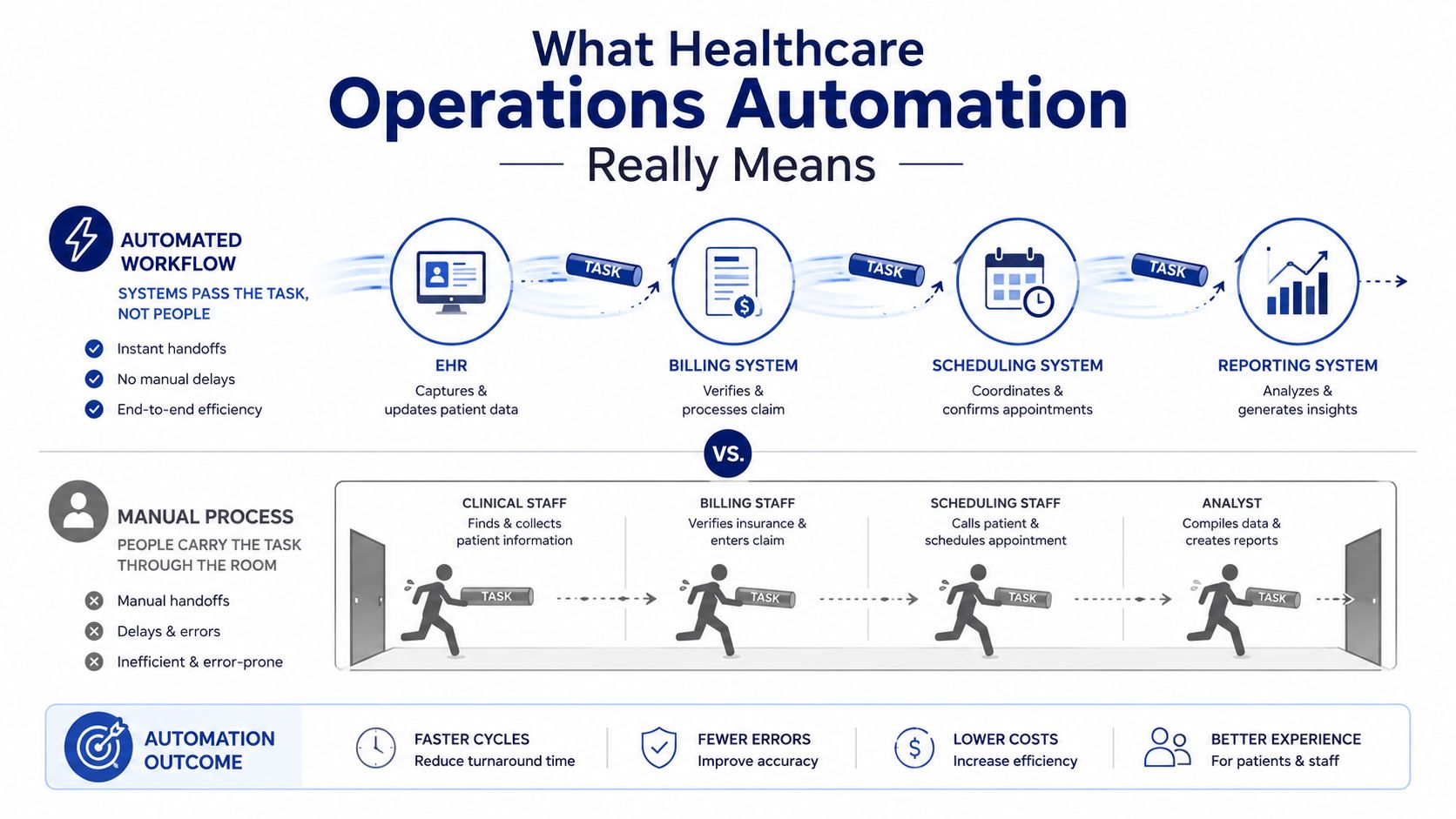
Think of automation as a relay runner, not a courier walking paperwork across the room. In a manual process, a person picks up the task, carries it to the next department, and then repeats that journey again and again. In a connected workflow, the baton moves between systems, and people step in only when the case needs judgement.
That distinction matters because digitising a form is not the same as automating a workflow. A digital intake form can still leave staff copying the same data into billing, the EHR, and a scheduling tool. Healthcare process automation starts when those systems are connected so the task moves once, not five times.
The Event Driven Layer Matters More Than The Tool Name
The strongest automation setups usually connect appointment scheduling, document capture, patient intake, and billing into one event-driven layer. That means an appointment can trigger a reminder, an intake packet, a document check, and a billing step without someone re-keying data between systems. The result is less waiting and fewer handoff failures.
If you are trying to make interoperability real, practical steps matter more than platform branding. A useful guide on practical steps for interoperability can help teams think through integration as an operational problem instead of a slide-deck promise.
If the workflow still depends on someone remembering to move the task, it's not automated yet.
That's also why a basic software feature and true HealthcareOps automation aren't the same thing. The first digitises a touchpoint. The second removes a handoff.
For teams that want a deeper view of the technology stack, the internal guide on healthcare operations technology is a useful companion to this model.
Why Automation Is Already A Cost Control Lever
The scale of administrative automation in healthcare is already large enough to influence operating costs, not just software budgets. McKinsey's healthcare automation research says healthcare overall has about 36% automation potential; payer-related activities such as claims administration and member enrolment have about 43% technical automation potential and 33% likely automatable tasks, and the 2024 CAQH Index reported $258 billion in avoided administrative costs in 2024, up 17% year over year. Those numbers matter because they show automation is already embedded in payer and provider workflows, not waiting on some future maturity curve.
Where The Money Still Sits
The same CAQH material says fully automating administrative transactions such as eligibility checks, claims, and prior authorisations could save an additional $20 billion annually. Another CAQH-linked summary says eight revenue-cycle administrative transactions could save $18.3 billion annually if fully automated, with the biggest savings coming from eligibility and benefits verification, claims status inquiries, and prior authorisation. That is a structural operating lever, not a gadget.
The important takeaway for healthcare workflow optimisation is that the biggest gains sit in the boring work that happens every day. High-friction manual verification, claims follow-up, and prior auth management consume time because they are repetitive and rule-heavy. That is exactly why the savings show up at scale.
Why This Changes The Financial Conversation
Once automation is tied to administrative cost avoidance, the conversation shifts from “Can we afford this?” to “Can we afford to keep doing this manually?” That is a healthier question for finance leaders and operations teams alike. It also pushes projects away from vanity pilots and towards workflows where the spend is already measurable.
For a cost-focused view of what this can look like in practice, the internal article on cutting costs with healthcareops solutions aligns closely with this operating model.
And if reimbursement accuracy is a major pain point, a useful external reference is boost reimbursement with AI coding, which sits in the same category of revenue-cycle automation rather than generic software improvement.
The Architecture Behind Intelligent HealthcareOps
The strongest healthcare automation setups are usually not a single app. They are a connected architecture built around FHIR and HL7 integrations tied to EHR, billing, and lab systems. That design lets workflows move as events, so a registration update, lab result, or billing trigger can travel through the process without a staff member acting as the bridge.
Isolated point tools tend to create new silos. A scheduling bot that can't talk to the EHR still leaves someone copying data. A billing tool that doesn't receive structured clinical context still forces manual correction. Event-driven orchestration removes those handoffs and makes healthcare operations automation behave like one system instead of a pile of features.
Why Connected Workflows Outperform Tool Sprawl
The practical benefit is that modern healthcare automation can link appointment scheduling, document capture, patient intake, and billing into one flow. That is where the operational lift comes from. NetSuite's healthcare automation overview notes that this kind of orchestration can support 7–11% fewer no-shows and 20–30% lower revenue-cycle cost in administrative workflows, which is exactly the kind of cross-functional gain that isolated tools rarely achieve. The same architecture view is reflected in the internal analysis on predictive operations.
A good architecture also makes exceptions easier to manage. The system can route straightforward cases automatically and flag edge cases for review, instead of forcing every task through the same path. That saves staff from drowning in exceptions that don't need a human until the last step.
Design principle: automate the handoff, not just the form.
The teams that struggle usually buy tools before they define the event flow. The teams that succeed define the workflow first, then wire the system around the work. That is the difference between a digital shelf of tools and a usable HealthcareOps automation layer.
Which Workflows To Automate First And Which To Avoid
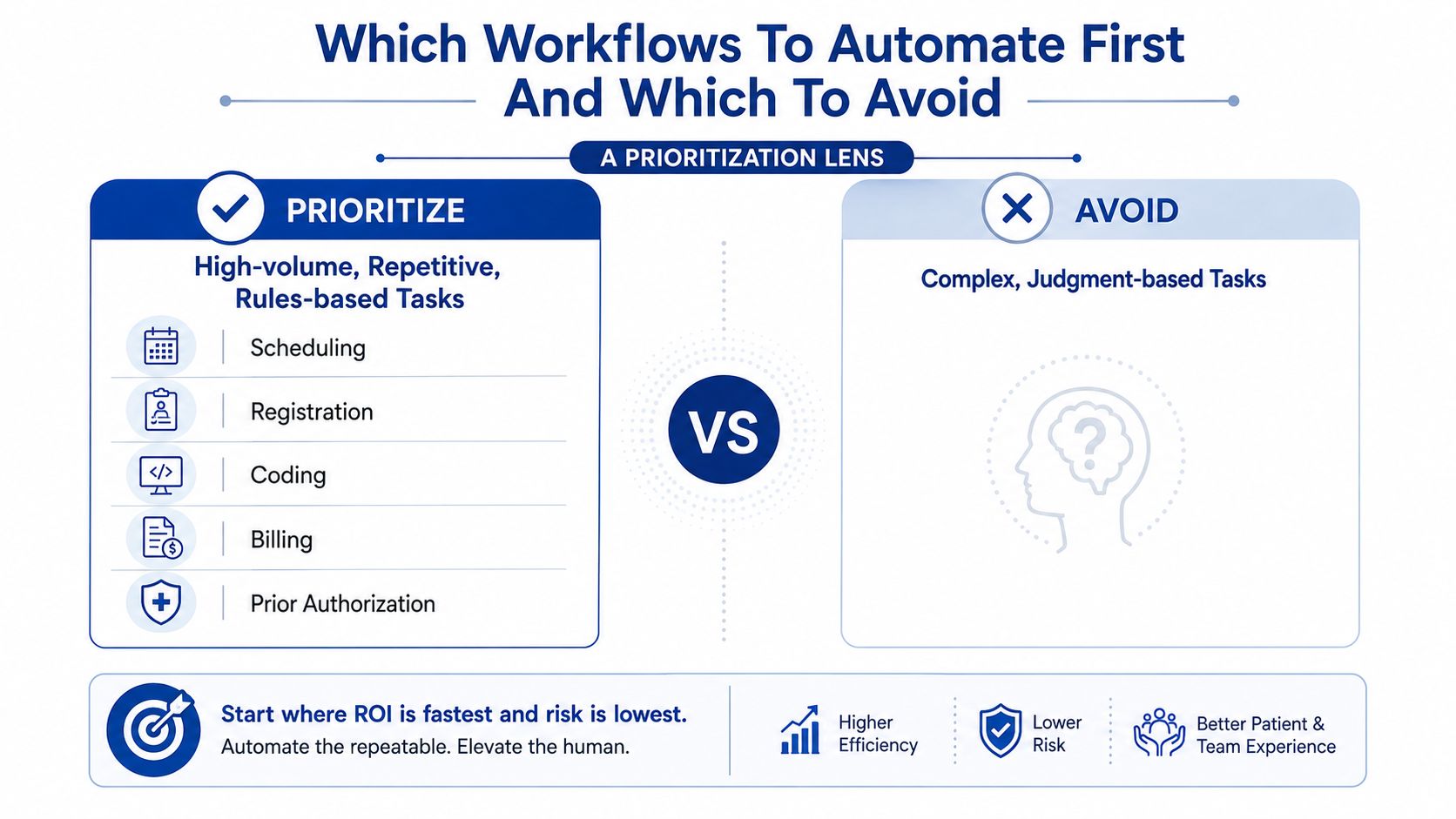
The safest starting point is not the trendiest use case. It is the workflow with the clearest rules, the highest volume, and the least ambiguity. A peer-reviewed review of health-care workflow automation says automation is most suitable for high-volume, repetitive, rules-based tasks such as scheduling, registration, coding, billing, and prior authorisation. Those are the jobs where structured inputs and clear decision rules make automation safer.
Prioritise The Work That Repeats
The best candidates usually share the same traits.
Scheduling: Repeated intake, reminder, and rescheduling logic is predictable and easy to track.
Registration: Identity and coverage checks are structured enough to benefit from automation.
Coding: When documentation is consistent, the task becomes more rules-based.
Billing: Repetitive validation steps can be made more efficient without removing human oversight.
Prior authorisation: This is a strong fit because it is high-volume and process-heavy.
A recent review on workflow design also stresses that mixed-risk automation needs a formal prioritisation framework, not a simple hunt for quick wins. In practice, that means looking at impact, feasibility, readiness, and governance together. If one of those is weak, the workflow is probably not ready.
Avoid The Work That Needs Judgement
Low-volume, ambiguous, multi-department workflows are a poor place to start. They often depend on context that is hard to codify and harder to audit. Those cases still benefit from digital support, but they usually need a person in the loop.
The right roadmap is less about “where can software help?” and more about “where can software safely remove friction without hiding risk?”
That's the dividing line in healthcare workflow optimisation. Automate the predictable. Review the ambiguous.
A Safe Roadmap To Pilot Healthcare Automation
A workable pilot starts with a simple filter: impact, feasibility, readiness, and governance. Impact asks whether the workflow meaningfully affects cost, speed, or experience. Feasibility asks whether the data and rules are structured enough to automate. Readiness checks whether staff, systems, and owners are aligned. Governance asks whether the workflow can be controlled, audited, and escalated properly.
Once a candidate clears those four tests, start with one contained workflow and one accountable owner. Keep the pilot small enough to measure and large enough to matter. A phased approach also gives compliance, IT, and operations time to agree on controls before the pilot grows in scope.
A Pilot Sequence That Doesn't Break Operations
A useful pattern looks like this.
Define the workflow boundary: Know exactly where the process starts and ends.
Map the handoffs: Find every place where a person currently re-enters or checks data.
Set the exception rules: Decide what automation can handle and what must route to review.
Run a controlled pilot: Keep the scope narrow, then measure what changes.
Expand only after review: Add the next workflow only when the first one is stable.
That staged approach turns healthcare process automation into a repeatable operating method instead of a one-off project. It also protects staff trust, which drops quickly when automation is rolled out too broadly or too casually.
For organisations building the stack around this work, Cleffex Digital Ltd, Cleffex Digital Ltd, and the service page for healthcare software integration are relevant starting points for teams planning integrated workflows rather than standalone tools.
A pilot should never feel like a leap of faith. It should feel like a controlled operational change with clear boundaries, clear owners, and a clear rollback plan.
Measuring ROI And Choosing The Right Vendor
ROI in healthcare automation should show up in operational metrics, not just software dashboards. The strongest signals are fewer denials, shorter processing times, and lower cost-to-collect. Evidence from verified data shows why that matters: AI-driven automation reduced claim denials by at least 10% within six months at 83% of organisations that deployed it; mature implementations achieved 30% to 40% denial-rate reductions. McKinsey estimates AI in the revenue cycle can cut cost-to-collect by 30% to 60%, and early adopters reported a 27% drop in cost-to-collect. A separate hospital automation study reported 40–50% shorter billing and claims processing time, 20–30% lower manual diagnostic time with AI support, and 22–30% overall operational-cost reductions when AI and RPA were used together.
What To Measure First
If the vendor can't help you measure the baseline, that's a warning sign. You want a before-and-after view of denial rates, cycle time, and manual touch points. Those are the numbers that tell you whether the workflow is improving or just moving the problem elsewhere.
Vendor selection should also focus on how the platform behaves in a real healthcare environment.
Scalability: Can it handle more volume without collapsing into manual work?
Integration capabilities: Does it connect cleanly to EHR, billing, and lab systems?
Security and compliance: Can it handle protected health information properly?
Support and training: Will your team get help when the workflow changes?
Proven track record: Has it worked in similar operational settings?
A vendor that looks polished in a demo can still fail in production if it can't fit local rules, governance, and change management. That is why interoperability and pilot flexibility matter as much as feature depth. In healthcare, the tool that wins is usually the one staff can adopt without a second layer of work.
For enterprise buyers, HealthcareOps automation should be judged on whether it reduces friction without reducing control. If it needs heavy hand-holding to stay accurate, it's not mature enough for a live clinical or revenue-cycle workflow.
Frequently Asked Questions On Healthcare Automation
Will automation replace staff in clinics and hospitals?
No, not in the areas that matter most. The strongest automation use cases target repetitive administrative work, not clinical judgement. That means staff often move to exception handling, patient support, and higher-value coordination instead of disappearing from the workflow.
How should mixed-risk workflows be governed?
Use a formal review path. High-volume and rules-based tasks can be automated more aggressively, but any workflow with ambiguity, multi-department dependency, or clinical sensitivity needs human oversight, auditability, and clear escalation rules. If the team can't explain who owns the exception, the workflow isn't ready.
Should smaller providers start before they have enterprise scale?
Yes, if they start with the right workflow. Small providers don't need a giant programme to benefit from healthcare workflow optimisation. They need one contained process, one owner, and one measurable result; then they can scale from there.
What usually goes wrong in the first pilot?
Teams often automate the visible task but ignore the handoff behind it. That leaves staff still doing the same back-and-forth work in a new interface. The better pilots remove a real administrative burden, then prove that the burden stayed removed after the rollout.
Where should a provider begin if revenue cycle is the biggest pain point?
Start with the steps that are repetitive, structured, and easy to audit. Prior authorisation, eligibility checks, and claims follow-up are often better starting points than broad, cross-functional change. They create cleaner feedback, which makes the next phase easier to justify.
Can automation help without removing human review?
Yes, and that is usually the safest approach. Let software handle the routine sequence, then route exceptions, low-confidence cases, and policy-sensitive decisions to staff. That gives you the efficiency of healthcare operations automation without pretending every healthcare decision can be reduced to a script.
Cleffex Digital Ltd helps healthcare teams design secure, integrated automation for workflows that still depend on manual handoffs, re-keying, and exception chasing. If you're planning a safer path from fragmented processes to intelligent HealthcareOps, visit Cleffex Digital Ltd and explore how its healthcare software integration and automation capabilities can support your roadmap.