

A Tuesday morning in a FinTech or insurance team rarely stays tidy for long. An underwriter wants to know why a pricing model nudged a case into a different band, compliance has asked for documentation, and a vendor has just pushed a new fraud-score API into the queue. None of those questions is optional, and they all land on the same problem: how to make AI risk assessment visible, repeatable, and defensible before the next release goes live.
That pressure is why AI risk assessment has moved out of the model-validation corner and into the centre of product, legal, compliance, data science, and board conversations. In Canada, the policy direction is already concrete, with the proposed Artificial Intelligence and Data Act introduced in 2022 as part of Bill C-27 and framed around high-impact systems, so governance expectations are no longer abstract in regulated markets. For teams building predictive analytics financial services workflows or insurance risk analytics tooling, the practical question is simple: how do we score what matters, document it properly, and keep shipping?
Why AI Risk Assessment Matters Now
A pricing model needs sign-off, a regulator wants evidence, and a vendor says the new feature will “just slot in”. That is not only an operations problem. It is a governance problem, because each change can affect customers, losses, complaints, and the firm's ability to explain decisions later.
AI risk assessment now sits across the full delivery chain. It touches procurement, data governance, product approval, model review, and incident response. It also has to handle a messy reality many teams miss at first: AI is often hidden inside software, analytics layers, and shadow IT rather than arriving as one obvious model to review. The inventory step matters as much as the scoring step.
Practical rule: if a system can influence price, approval, prioritisation, or escalation, it deserves a named owner and a documented assessment.
The commercial case is straightforward. A disciplined process helps teams move faster because the review path is clear, and the evidence is ready when legal or regulators ask. It also gives the board a cleaner answer when someone asks whether the firm can trust a vendor model, a claims triage tool, or a credit decision engine.
If you want a useful external perspective on integrity controls, the AI risk framework for integrity resource is a practical companion to the governance questions raised here. The point is not to collect frameworks for their own sake. The point is to turn them into decisions that fit live product workflows.
What AI Risk Assessment Means
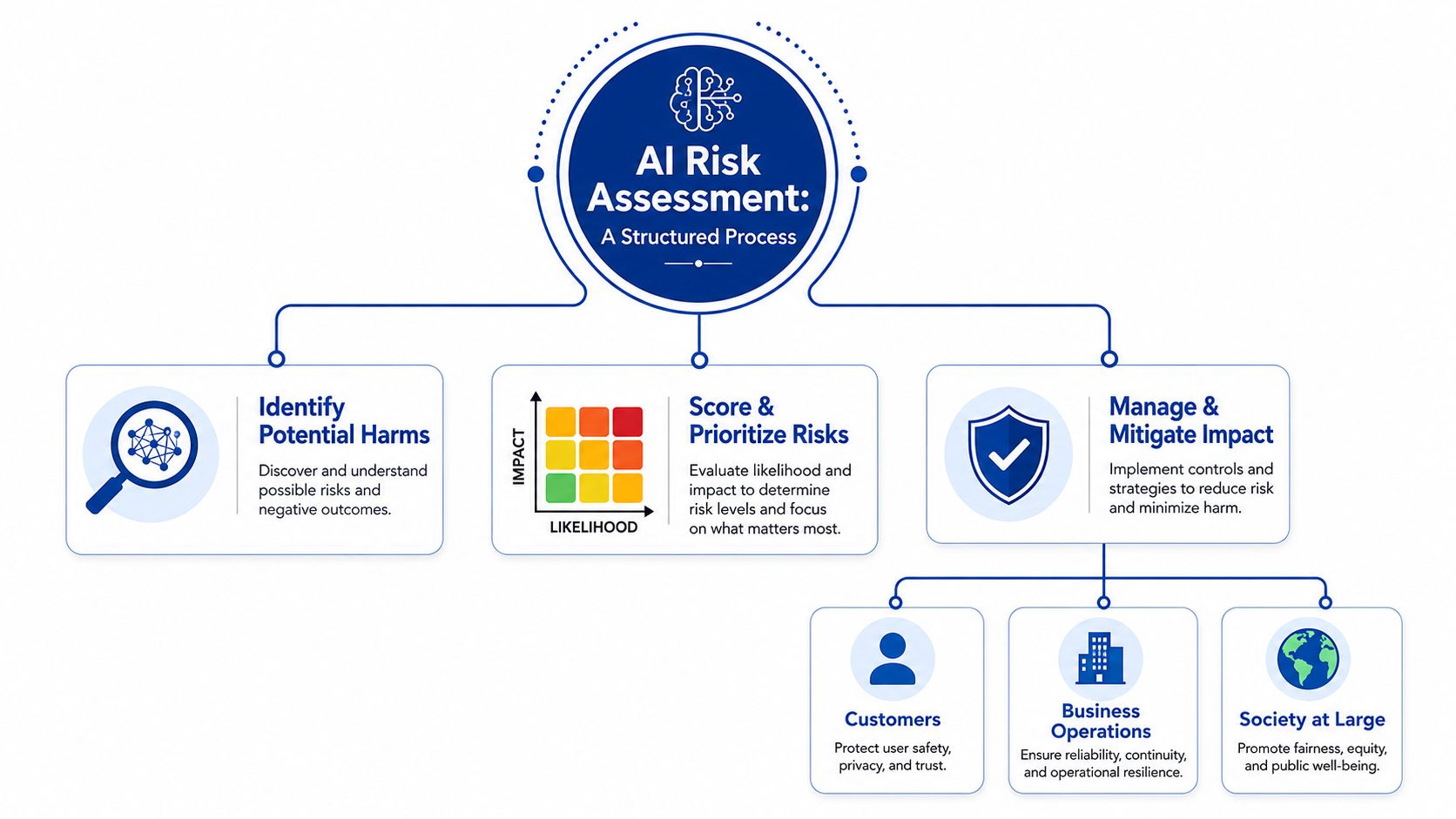
A lending team rolls out a model that speeds up approvals. A claims team adds an AI triage tool to reduce manual review. Both teams still need the same answer: where can this system hurt customers, the business, or the market, and what will we do about it before and after launch? That is AI risk assessment in plain terms.
For risk teams, the work is more structured. Start with the use case, map the data and dependencies, score each credible harm, assign controls, then keep watching for drift, misuse, and new failure modes. A one-time model review is not enough, because a system can look acceptable on day one and become problematic later if the data changes, the user base shifts, or human reviewers begin to trust the output too much.
The NIST attributes give the technical floor
NIST's AI Risk Management Framework is the clearest baseline in the provided sources because it defines trustworthy AI systems as valid and reliable, safe, secure and resilient, accountable and transparent, explainable and interpretable, privacy-enhanced, and fair with harmful bias managed. That matters because it turns “good AI” into testable attributes instead of a slogan.
A useful way to explain this to a non-technical stakeholder is simple. A model can be accurate and still fail a regulated use case if nobody can explain why it made a decision. A model can also be understandable and still be too risky if it exposes personal data or behaves unpredictably under pressure. The score depends on context, not on the model's reputation.
A simple definition people can use in meetings
Identify harms by asking what could go wrong for a real user.
Score the exposure by judging how serious the harm would be and how likely it is.
Decide controls by choosing what to fix in data, model behaviour, or human review.
Review continuously because production use changes the risk profile.
That four-part explanation is clear enough for an executive and detailed enough for an audit trail. It also shows the difference between a checklist and a governance loop. For teams looking at fraud use cases, a practical example is how this discipline supports AI-powered fraud detection in fintech, where the same model may affect alerts, customer friction, and investigator workload.
The Risk Categories FinTech and Insurance Teams Face
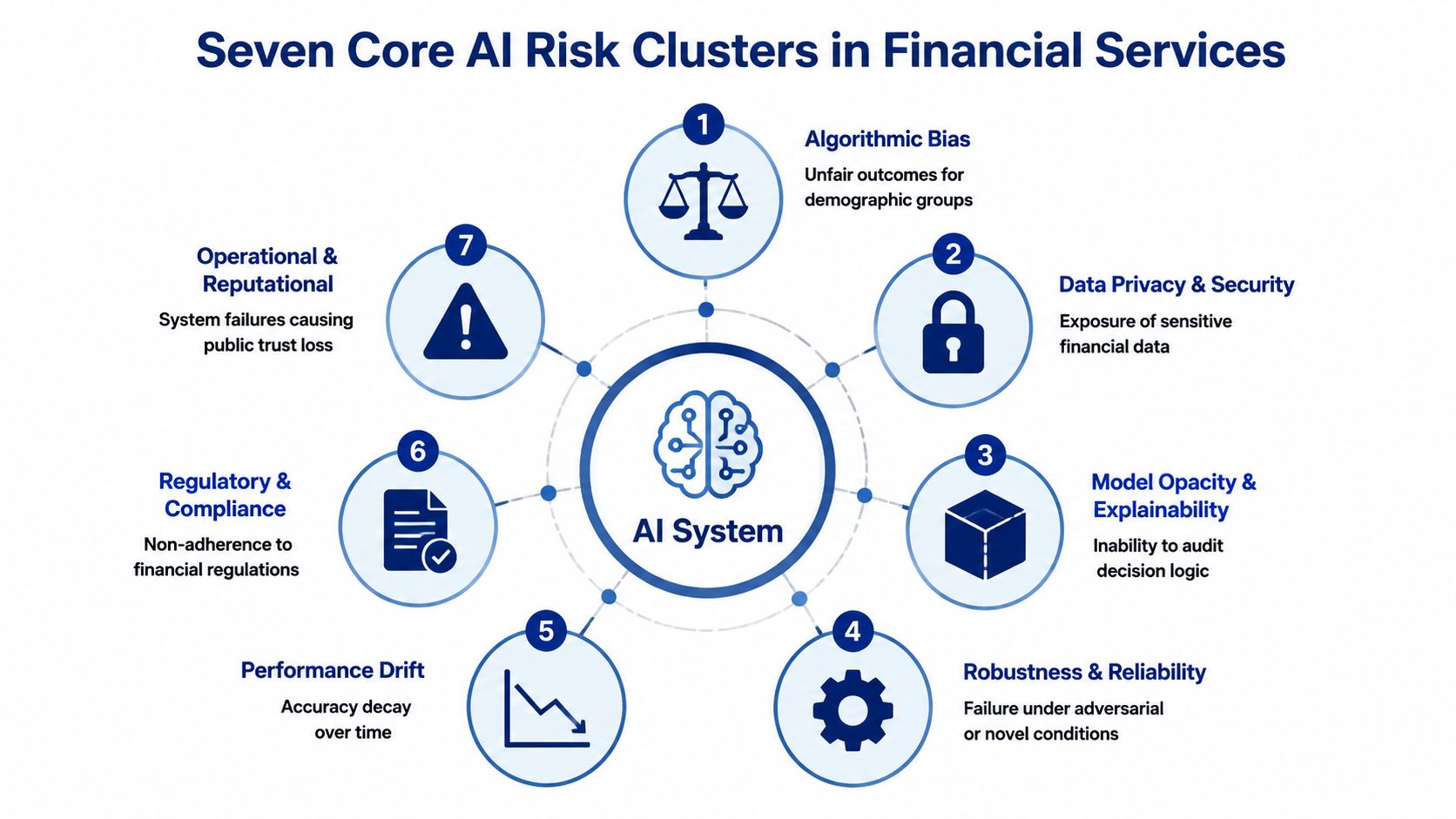
A loan decision can look sound on paper and still fail in production because the input data is stale, the fraud score is skewed, or a claims reviewer trusts the model too much. That is why AI risk assessment works best when FinTech and insurance teams group risk by how it appears in daily workflows, not by abstract labels.
Seven clusters show up again and again. Each one points to a different control decision.
The recurring clusters
Data quality and lineage risk means the model is built on incomplete, stale, or poorly traced inputs. A claims model can look strong until a missing data feed changes the whole pattern.
Model performance and drift risk appear when the system behaves well during testing, but decays once live traffic, market behaviour, or policyholder mix changes.
Bias and fairness risk show up when the model gives different outcomes to different groups without a defensible reason. Consumer credit and pricing models tend to need especially careful review here, especially where fraud decisions or alert queues can shape who gets extra scrutiny. Teams building AI-powered fraud detection in FinTech need to watch this closely because the same score can influence both security and customer treatment.
Privacy and data-protection risk matters whenever the system uses personal or confidential data, especially where staff, vendors, or downstream apps can see outputs they should not see.
Security and adversarial risk includes prompt injection, manipulation, model theft, and other attempts to exploit the system's behaviour rather than its infrastructure.
Third-party and vendor model risk arises when a lender, insurer, or broker depends on an outside score, API, or embedded function it cannot fully inspect.
Human-factor risk is the one many frameworks underplay, even though a review of the field found current work “lacks consideration for human factors” and does not offer metrics for socially related or human threats.
The human side matters because staff can overtrust a recommendation, ignore a warning, or hand off a case too early. In insurance, a claims handler may accept a triage score that needs a second look. In lending, an operator might follow a model output without checking whether the underlying data fits the applicant's profile. A model can be technically sound and still produce the wrong operational outcome if the reviewer treats it like a final answer.
Use this test: if the risk only appears when a person interacts with the system, it's still a model risk, just one with a human failure path attached.
The point is not that all seven clusters deserve the same weight. The point is that they give teams a shared vocabulary for triage. Once the team can name the risk, it can decide whether the right fix is data cleansing, threshold changes, reason codes, stronger review, or a narrower use case. For teams that need to map these categories back to policy requirements, the guide to the EU AI Act helps translate regulatory language into practical controls.
Frameworks That Shape the Assessment Process
Frameworks help most when teams use them for different decisions instead of treating them like rival religions. For FinTech and insurance leaders, the useful question is not which framework sounds strongest in theory. It is which one helps the team score, document, and govern a model inside a live workflow, where product, compliance, and operations all need a common language.
In North America and Europe, four references show up repeatedly in regulated AI conversations: NIST, the EU AI Act, Washington State AI risk guidance, and the Canadian policy direction around AIDA.
What each framework is good for
NIST's AI RMF is the best baseline for lifecycle thinking because it treats risk as a continuous process across mapping, measuring, managing, and governing. That matters for FinTech and insurance because the problem is rarely just deployment. Data collection, feature engineering, training, validation, and post-launch monitoring all create different failure points, and each one needs a decision about ownership, review, and evidence.
The EU AI Act matters because it draws hard lines around prohibited behaviour. Its high-level summary explicitly bans certain high-risk uses, including assessing whether an individual will commit criminal offences solely from profiling or personality traits, unless human assessment is being augmented with objective facts directly linked to criminal activity. For fraud, behavioural scoring, or adverse action review, that boundary is a design constraint, not just a legal footnote.
Washington State's guidance is especially helpful where underwriting logic is already familiar to business teams. It treats a system as high-risk when it creates a high risk to people's health, safety, or fundamental rights, and it asks assessors to consider both magnitude and likelihood of impact, plus intended use, operating context, data characteristics, and safeguards. That structure is close to how many insurance and lending teams already evaluate decision risk, even if they do not use the same vocabulary.
For Canadian teams, the policy direction around AIDA is a reminder that governance expectations are not hypothetical. The introduced framework for high-impact systems in 2022 tied AI oversight to accountability and compliance, which means documentation and procurement controls are part of the operating model, not a side project.
If you want a practical EU-facing explainer to pair with internal policy work, the guide to the EU AI Act is a helpful companion for separating prohibited use, high-risk use, and general governance expectations.
A Step-by-Step Methodology for AI Risk Assessment
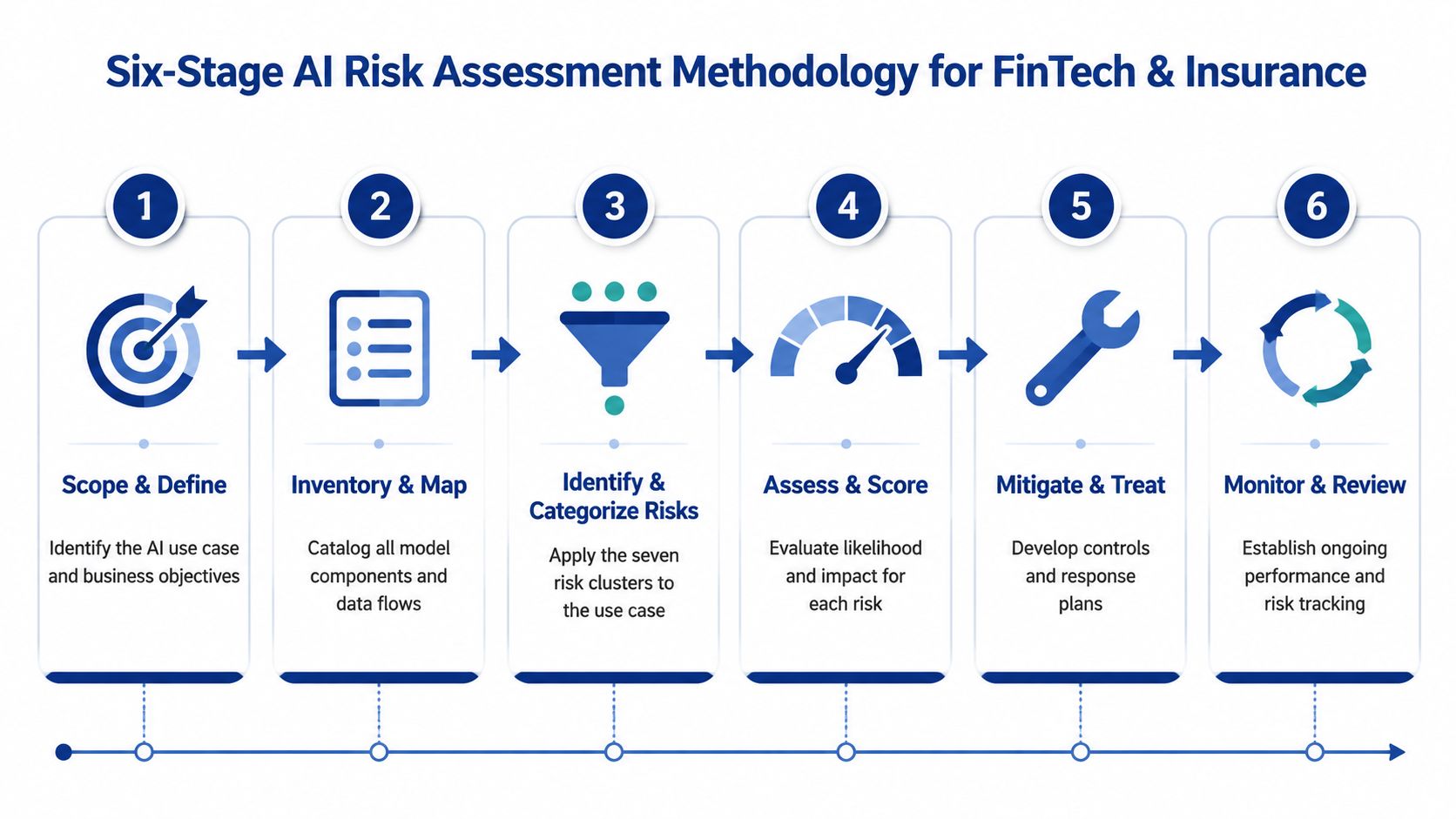
A workable methodology has to survive a live product meeting. It needs enough structure for auditors and enough speed for product teams. A six-stage flow does that well in regulated environments because it keeps the conversation tied to the same questions every time.
A good test is simple. If a claims lead, a model owner, and a compliance reviewer can all use the same process without rewriting it from scratch, the method is practical.
1. Scope and define the use case
Start with a plain description of what the system does, who uses it, and what decision it affects. A fraud alert engine, a pricing model, and a customer-service assistant do not carry the same risk, even if all three use machine learning.
Ask: What decision changes if the model is wrong? Who can override it? Which customer group is affected first?
Output: A one-page use-case brief with owner, purpose, and decision impact.
Common failure mode: The team scopes the model too broadly, which makes every later control vague.
A narrow scope helps here. If a lending model supports manual review, that is a different assessment from a model that directly drives approval or decline.
2. Inventory data, models, and downstream decisions
List every material input, output, and handoff. Include vendor APIs, spreadsheets, human review points, and any hidden AI embedded in tools the business already uses.
Ask: Where does the data come from? Who touches it? Where does the score go next?
Output: A simple inventory map that shows sources, systems, users, and downstream actions.
Common failure mode: Shadow IT stays invisible until an incident or audit reveals it.
This step is where many teams discover the process is wider than the architecture diagram. A score may start in one platform, get copied into another, and then shape a final decision in a separate workflow. For a practical example of how those handoffs show up in regulated settings, the AI solutions in insurance page is a useful reference point.
3. Score risks with magnitude and likelihood
Use a matrix, not a fuzzy high, medium, low label. The point is to compare the seriousness of harm with the chance it will occur.
Ask: What is the worst credible harm? How likely is it in this use case? What makes it worse or better?
Output: A ranked list of risks with rationale.
Common failure mode: Teams give every issue a medium rating and make nothing actionable.
Practical rule: if two risks receive the same score, the review team should be able to explain why in one sentence each.
This is also where teams should separate technical failure from business impact. A model can be statistically stable and still create a poor customer outcome if the decision it supports is too sensitive to small errors.
4. Design mitigations across data, model, and human layers
Controls should not all sit in the model. Some belong in data checks, some in threshold tuning, and some in human review or escalation rules.
Ask: Can we reduce the risk before the model runs? Can we change the model behaviour? Can a person catch the failure?
Output: A mitigation plan with named owners and dates.
Common failure mode: The team assumes a policy document is a control.
A useful way to think about this is in layers. Data controls stop bad inputs early. Model controls shape how the system behaves. Human controls catch cases the system should not decide alone. If one layer fails, the next layer should still have a clear job.
5. Monitor continuously
Post-deployment review is not optional. NIST's lifecycle view makes it clear that assessment continues through use, not just before go-live. Drift, bias, and performance changes belong on a live dashboard.
Ask: What will we watch weekly or monthly? What triggers re-review? What happens when thresholds break?
Output: A monitoring plan with alert rules and escalation paths.
Common failure mode: The dashboard exists, but nobody owns the response.
Monitoring should also reflect the workflow, not only the model score. If a claims queue starts sending too many cases to manual review, or a credit model begins clustering outcomes in one segment, the assessment should force a response. That is the difference between a model that is watched and a model that is governed.
6. Document decisions and approvals
Auditors and regulators do not just want the final score. They want the reasoning chain, the owner, the sign-off, and the evidence that the team revisited the system when it changed.
Ask: Can we reconstruct why this model was approved? What evidence shows the controls worked?
Output: A decision record that links the assessment to approvals and reviews.
Common failure mode: The team stores evidence in separate folders that no one can reconcile later.
Documentation should be usable during an incident review, not only during procurement. If a vendor model changes behaviour, the record should show what changed, who reviewed it, and what decision followed.
For teams that want operational support around regulated delivery, Cleffex Digital Ltd works with insurance and FinTech use cases that need risk assessment tied to product development, not detached policy writing. Used well, this kind of support helps the assessment live inside the delivery process instead of sitting beside it.
Industry Examples in Insurance and FinTech
A good test of any methodology is whether it changes behaviour in familiar workflows. In insurance and FinTech, the same assessment method can land very differently depending on whether the system is underwriting, triaging claims, or screening borrowers.
Insurance underwriting and claims triage
Take an underwriting model for small commercial property. The likely risk focus is data quality, explainability, and fairness. A broker or underwriter needs to understand why the score moved, especially if the model changes pricing or pushes a case into manual review. That usually means reason codes, tighter feature governance, and clear override rules.
Claims triage is different. Here, the model is often sorting work, not making the final entitlement decision. The risk assessment still matters, but human-factor risk rises because adjusters may lean too heavily on a queue priority or miss an unusual claim that falls outside the training pattern. A clean mitigation is a human-in-the-loop threshold with escalation for edge cases.
FinTech lending and fraud scoring
Consumer lending is usually where bias and explainability receive the most scrutiny. If a model combines bureau, open-banking, and behavioural signals, the team has to think about how those inputs interact and whether the explanation given to the applicant is meaningful. The assessment should also check whether a vendor score is being used in a way that the lender can defend.
Fraud scoring creates a different balance. A false positive can block a legitimate customer, but a false negative can expose the business to direct loss. The assessment therefore needs to look at both customer friction and operational exposure, not just model accuracy.
A simple walkthrough helps. Suppose a lender uses a third-party score plus internal transaction signals to flag applications for manual review. The highest risks are likely privacy, explainability, and vendor opacity, while the first mitigations are threshold review, reason codes, and a documented fallback path if the vendor service fails.
For a broader look at adjacent insurance applications, the AI solutions in insurance article is useful because it shows how AI often sits inside live operational choices rather than isolated lab work.
Governance Roles, Metrics, and Tooling
Good governance fails when ownership is vague. A model can have a strong score and still drift into trouble if nobody knows who checks it, who approves changes, or who responds when the alert fires. That is why the governance stack needs named roles, measurable indicators, and tools that support evidence rather than just storage.
Roles that should be visible
Executive Sponsor owns the business risk and backs the operating model.
Risk Owner manages the specific AI system and its controls.
Model Validator provides independent review.
Compliance Officer acts as the regulatory liaison.
Metrics worth putting on a dashboard
Risk residual score shows what remains after mitigation.
Mitigation task completion confirms the actions are closed.
Model performance drift flags changes in behaviour that need review.
Regulatory review cycle keeps the governance cadence from slipping.
The numbers in the dashboard should be tied to decisions, not vanity reporting. If a model drifts, someone should know whether to pause, retrain, reweight, or narrow its use. If mitigation tasks are late, the business owner should know whether the delay affects launch approval.
Tooling that supports evidence
Model registries help track versions, owners, and approvals.
Monitoring and alerting tools surface drift, latency, and unusual outputs.
Governance workflow dashboards make review status visible.
Document repositories keep assessments, decisions, and sign-offs in one place.
Hidden AI still deserves a place in the inventory. Recent practical guidance notes that organisations often discover more AI exposure than expected because systems are embedded in platforms, security tools, and business-intelligence software rather than standing alone. That makes discovery part of governance, not just an IT asset task.
If you are building the governance layer for a regulated organisation, the fintech compliance solutions page is worth a look because it sits close to the evidence, workflow, and control problems that show up during assessment.
Putting It All Together
A useful programme doesn't need to be perfect on day one. It needs to be clear enough that the team can repeat it and defend it. If you want a practical next-week checklist, use this:
Pick the top three AI use cases that can affect pricing, approval, triage, or fraud handling.
Score each one using magnitude and likelihood, not vague labels.
Assign a real owner for each risk and each mitigation.
Document the controls in a form that legal, product, and audit can all read.
Set a review cadence so the assessment happens again when the model, data, or use case changes.
The usual objections don't hold up for long. “This will slow us down” usually means the current process is unclear, not that governance is impossible. “We don't have AI yet” is often wrong once teams inventory hidden scoring, embedded vendor tools, and decision automation. “Regulators haven't asked” is a weak defence in financial services, where good governance is often expected before a specific question arrives.
For teams comparing vendors and AI governance support, how LegesGPT compares to other AI legal can help frame how different tools handle legal review, but the bigger point remains the same. The winning approach is the one that fits product delivery, leaves a paper trail, and keeps people accountable.
Cleffex Digital Ltd helps financial and insurance teams translate AI risk assessment into working software, workflow design, and governance-ready documentation. If you need support building AI features while keeping risk, compliance, and product delivery aligned, visit Cleffex Digital Ltd to explore how its insurance and FinTech services can fit your programme.