

USD 14.66 billion in 2024, projected to reach USD 250.81 billion by 2033. That's the scale of the North American AI in healthcare market, with a projected 37.17% CAGR from 2025 to 2033 according to Grand View Research's North America AI in healthcare market analysis.
For a hospital CTO, that number shouldn't read like hype. It should read like pressure. Your clinicians are already experimenting with AI, your vendors are already pitching it, and your board is already asking what your organisation's position is. The core question isn't whether AI belongs in healthcare. It's whether your organisation will adopt it deliberately or let it spread informally through procurement workarounds, public chatbots, and disconnected pilots.
That's where AI healthcare consulting matters. Done properly, it isn't a slide deck, a model demo, or a generic “innovation strategy”. It's a disciplined way to tie AI investments to concrete outcomes such as shorter care delays, cleaner workflows, stronger compliance posture, better data use, and lower operational friction. In Canada, that discipline matters even more because the biggest risks aren't only technical. They're organisational and regulatory.
The New Imperative for AI in Healthcare
Canadian healthcare leaders are under pressure from two directions at once. AI adoption is accelerating inside hospitals, and control is not. Staff are testing public chatbots, vendors are adding AI features into existing platforms, and provincial privacy obligations do not line up neatly across jurisdictions. For a hospital CTO, that makes AI a governance problem before it becomes a technology programme.
The immediate risk is Shadow AI. A clinician pastes patient information into a public tool to draft a note. A department manager uses a consumer chatbot to summarise incident reports. A vendor turns on a generative feature by default inside a workflow product. None of this shows up in a formal roadmap, but all of it creates exposure. You inherit privacy risk, inconsistent outputs, weak audit trails, and new procurement obligations without making a single approved enterprise decision.
That is why AI healthcare consulting now matters at the executive level. You are not buying a trend. You are buying control over where AI is used, which use cases deserve investment, and which ones need to be blocked until policy, data, and oversight are in place.
What executives buy when they buy AI consulting
A strong consulting engagement helps hospital leadership answer four business questions fast:
Where is unsanctioned AI already in use?
You need an inventory of tools, workflows, departments, and data exposure before you approve anything new.
Which use cases justify enterprise investment?
Prioritise projects tied to wait times, documentation burden, capacity constraints, revenue leakage, or quality metrics.
What can be deployed under Canadian compliance rules?
A model that fits one province's interpretation of privacy, data residency, or consent may create problems in another.
What foundation needs fixing first?
Poor data quality, weak identity controls, and unclear workflow ownership will derail implementation long before model performance does.
This work is operational. It is not a branding exercise for the innovation committee.
Hospitals that approach AI as a series of software purchases usually create three avoidable problems. They spread budget across disconnected pilots, let vendors define governance through contract language, and push privacy review to the end of the process. The result is predictable: slow approvals, low clinician trust, and tools that never make it into daily use.
The better approach is stricter and more practical. Start with policy. Set rules for approved tools, protected data handling, vendor review, and human oversight. Then build a shortlist of use cases with measurable impact and clear executive ownership. If the data layer is messy, fix that before scaling any model. Resources such as AI-ready data for healthcare are useful for that reason. They focus on the input quality, structure, and governance work that determines whether an AI programme produces value or expensive noise.
AI in healthcare succeeds when the hospital treats it as an operating model decision. In Canada, that means handling Shadow AI early and designing for provincial compliance differences from the start.
From Concept to Clinic: The Core Value of AI Consulting
In a hospital, a good AI consultant plays the same role a specialist physician plays in a complex case. They don't replace the care team. They diagnose the operating problem, isolate the highest-impact intervention, and help the organisation avoid doing the wrong thing quickly.
That matters in Canada because the AI services segment, including consulting and integration, is projected to grow at a 34% CAGR from 2025 to 2033, driven by the need to scale operations and comply with complex Health Canada guidelines, according to Market Data Forecast's North America AI in healthcare overview.
Strategic alignment comes first
Most failed AI programmes start with a technology search instead of a business problem. A vendor offers an ambient scribe, imaging assistant, or triage model. The hospital buys it because the demo looks impressive. Then reality shows up. Clinical leaders disagree on workflow ownership, privacy officers raise concerns, and the data team discovers the required inputs aren't reliable.
A consultant who knows healthcare won't start with the tool. They'll start with questions like these:
Which service line has the most operational pain?
Where do delays create clinical or financial consequences?
Which use case has an executive sponsor with actual authority?
Can the outcome be measured in workflow time, throughput, coding quality, or patient experience?
That approach protects capital and political goodwill. Hospitals don't need more pilots. They need fewer, better bets.
Implementation excellence is operational, not cosmetic
AI projects rarely fail at the proof-of-concept stage. They fail when they collide with reality inside the clinic. Integration with EHR workflows, user trust, escalation logic, downtime handling, and testing discipline determine whether the tool becomes useful or ignored.
The core implementation questions are practical:
| Area | What leadership should ask |
|---|---|
| Workflow fit | Does this reduce clicks, duplication, or decision delay for clinicians? |
| System fit | Can it integrate cleanly with current systems and data flows? |
| Validation | Who signs off on clinical reliability before rollout? |
| Support model | Who owns monitoring, retraining decisions, and incident handling? |
Risk mitigation is part of ROI
Some executives still treat compliance as a downstream legal task. That's a mistake. In healthcare, governance is part of delivery. If privacy, auditability, notice requirements, and vendor controls aren't designed in from the start, the project will either slow down later or create avoidable exposure.
Practical rule: If your AI vendor can explain the model but can't explain the escalation path, logging controls, data residency posture, and user notice model, they're not ready for a hospital environment.
The best consulting work creates value in three ways at once. It improves outcomes, lowers friction, and reduces the chance that your organisation will end up cleaning up a preventable compliance mess.
Real-World AI Applications Transforming Patient Care
The most persuasive AI use cases in healthcare aren't futuristic. They solve problems your teams already deal with every day. Long waits. Slow decisions. Administrative clutter. Disconnected information. The point of AI healthcare consulting is to turn those pain points into systems that help staff move faster and with more confidence.

Predictive operations in emergency care
A strong Canadian example comes from emergency departments using custom wait-time predictors. Patients scan a QR code at triage and receive a personalised wait time, while the AI system also pre-emptively orders tests to accelerate care.
That use case matters because it solves two problems at once. It improves the patient experience through clearer expectations, and it cuts operational delay by moving parts of the diagnostic process forward earlier. Many hospital leaders, however, misread AI; they look for a single dramatic clinical breakthrough when the bigger value often comes from coordinating the steps around care.
Clinical decision support that fits the workflow
Hospitals don't need another dashboard that clinicians ignore. They need decision support that appears where care teams already work. That could mean surfacing relevant imaging flags, highlighting patient deterioration risk, or recommending the next operational action inside an existing workflow.
A practical benchmark is whether the tool changes behaviour at the point of care. If it requires staff to leave the EHR, interpret a separate interface, or remember a new process under pressure, adoption will be weak. That's why many CTOs evaluate AI with the same rigour they apply to core platform work. The design has to support clinical action, not curiosity. Teams exploring this area often look at examples of AI clinical decision support in healthcare delivery to assess workflow fit before selecting vendors.
Administrative automation that clinicians actually feel
The fastest route to visible value often sits outside the model itself. It sits in the tasks around it.
Documentation support: AI can reduce repetitive charting and summarisation work.
Triage assistance: Intake workflows can become more structured and consistent.
Routing and coordination: Referrals, follow-ups, and case prioritisation can move with fewer manual handoffs.
The best early AI deployments don't ask clinicians to trust a black box. They remove irritating work, shorten delays, and make the next step obvious.
When that happens, the conversation changes. AI stops being an abstract innovation programme and starts looking like operational improvement with software attached.
Navigating the Canadian AI Compliance Maze
Canadian healthcare leaders are dealing with two compliance failures at once. Formal rules differ by province, and informal AI use is spreading faster than policy.
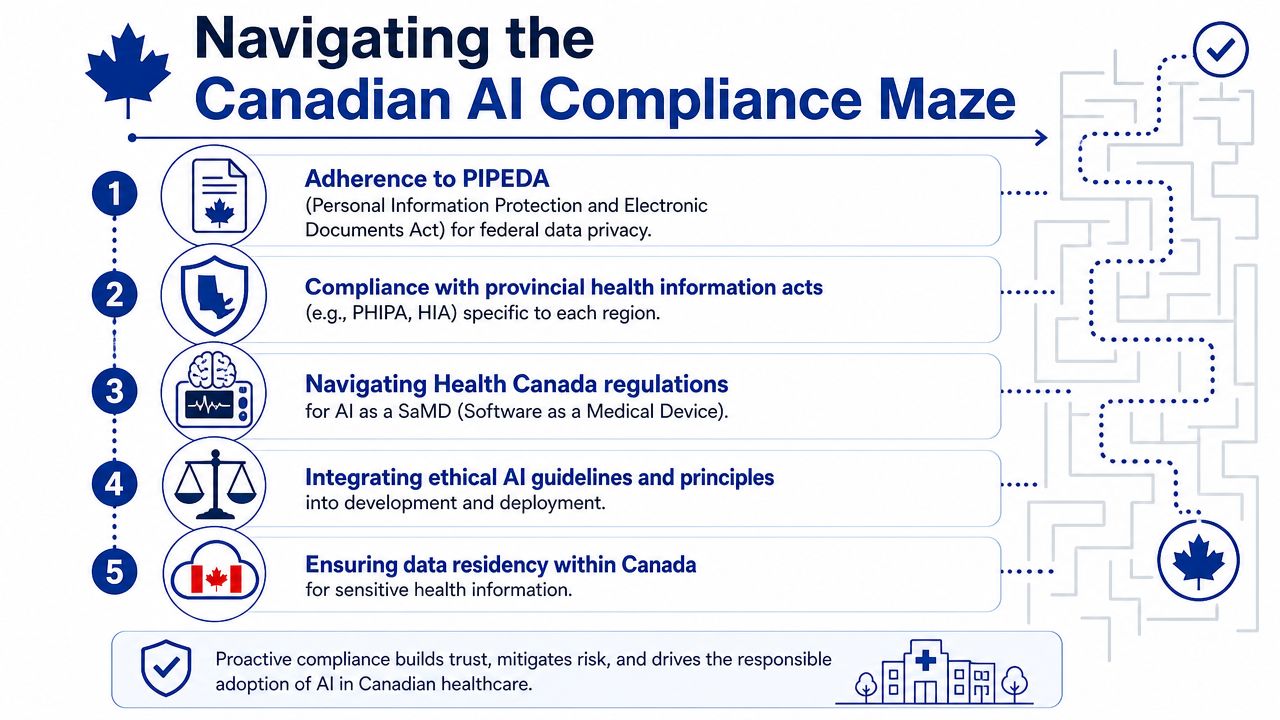
That combination creates real exposure. A hospital can approve one AI pilot through the right committees while staff in multiple departments are already pasting sensitive information into public tools with no review, no audit trail, and no retention control. CTOs who treat compliance as a legal checkbox miss the operational problem. The issue is control.
Shadow AI is already inside the organisation
Shadow AI deserves the same attention as shadow IT. Clinicians and administrative teams use public assistants to summarise notes, draft patient messages, clean up documentation, and test ideas. The motive is speed. The risk is uncontrolled handling of personal health information, weak logging, unclear residency, and no reliable way to investigate an incident later.
Assume it is happening now.
Start with visibility, then put approved alternatives in place. Staff will not stop using AI because policy says no. They will stop using unsanctioned tools when the sanctioned option is faster, easier, and clearly safer.
What to implement immediately
Treat this as an operating model decision.
Build an AI tool inventory: Identify which public and vendor tools are already in use by clinicians, operations teams, and administrative staff.
Set clear use classes: Separate harmless drafting or scheduling support from any use involving PHI, clinical documentation, triage, or decision support.
Approve a small set of sanctioned tools: Give teams a defined path for common tasks so they do not create their own.
Create an incident response procedure: If PHI enters an unapproved system, staff need a reporting path, containment steps, and accountable owners.
Update patient-facing disclosures: Notice language must reflect actual AI use in care delivery, operations, and communications.
A blind organisation is not a safe organisation.
Provincial rules conflict in practice
The second mistake is assuming one Canadian standard covers AI scribes, copilots, documentation tools, and workflow automation. Ontario organisations may need to satisfy PHIPA, IPC guidance, and CPSO expectations. Quebec adds a different set of obligations under Law 25. Cross-border processing introduces another layer of review through contracts, privacy impact assessments, and institutional policy.
This is why generic vendor claims fail procurement review. “HIPAA-ready” does not answer the questions a Canadian hospital must answer.
Use a review framework like this before any purchase or pilot expansion:
| Question | Why it matters |
|---|---|
| Where is PHI processed and stored? | Residency, subcontractors, and cross-border transfers affect legal exposure and procurement terms. |
| What notice, consent, or disclosure applies? | Patient communication rules vary by province and by use case. |
| Who is accountable for the output? | Clinical responsibility and documentation obligations still sit with the provider and institution. |
| What can you audit after an incident? | Logging, version history, access records, and prompt tracking determine whether you can investigate and defend decisions. |
For security teams with US-connected systems, it helps to understand how organisations achieve continuous HIPAA compliance across monitored environments. That does not solve Canadian requirements, but it does improve discipline around access control, evidence collection, and continuous monitoring.
The right goal is not a perfect policy binder. The goal is a control system that can handle provincial variation, vendor sprawl, and staff behaviour in practical settings.
If your organisation is approving tools across multiple provinces, review the practical issues around AI in healthcare data privacy in Canada before signing any long-term vendor agreement.
A Practical Roadmap for AI Implementation
Most healthcare AI programmes don't fail because the idea is wrong. They fail because the sequence is wrong. Leaders rush to procurement before defining the use case, launch a pilot before fixing the data, or scale a tool before clarifying ownership.
A workable roadmap is disciplined and boring in the best way. It moves from priority to proof, then from proof to control.
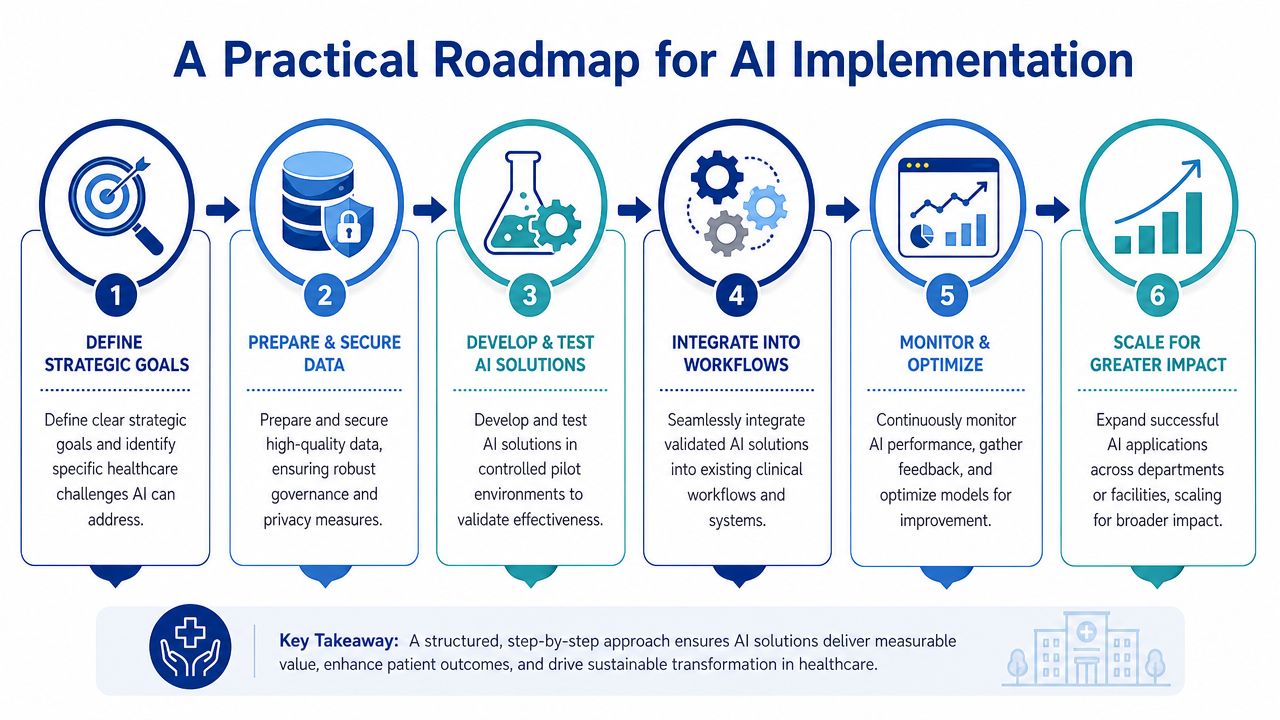
Phase one to three
Discovery and assessment
Start with one operational or clinical bottleneck that leadership agrees is painful and measurable. Good candidates include documentation burden, triage delay, referral handling, or imaging workflow friction. Bad candidates are broad mandates like “use AI across the hospital”.Strategic planning and vendor selection
Define what success looks like before you issue an RFP. Decide which system integrations are required, which stakeholders must sign off, and which compliance conditions are mandatory. A hospital building an AI-enabled service layer often benefits from the same planning discipline used in enterprise healthtech platform development.Pilot and validation
Keep the pilot narrow. Select one department, one workflow, one owner. Validate not just technical performance but clinical usability, escalation rules, and exception handling. If staff can't explain when not to trust the system, the pilot isn't ready.
Phase four and five
The move from pilot to production is where governance matters most.
Scaled deployment and integration: Expand only after support workflows, training, monitoring, and rollback paths are defined.
Governance and optimisation: Review usage patterns, false positives, staff feedback, and privacy controls on a regular cadence.
A simple operating model helps:
| Phase | Executive focus | Common mistake |
|---|---|---|
| Assessment | Pick one high-value use case | Starting with a vague transformation agenda |
| Planning | Tie scope to systems and policy | Letting procurement drive architecture |
| Pilot | Test usability and safety | Treating a demo as validation |
| Scale | Standardise support and training | Expanding before workflows stabilise |
| Optimise | Monitor outcomes and risk | Assuming go-live equals success |
Start with a problem that staff complain about weekly. If nobody feels the pain today, the AI project won't earn support tomorrow.
This roadmap isn't glamorous. It works because it forces the organisation to earn the right to scale.
How to Choose the Right AI Consulting Partner
Most hospitals don't need another generalist IT vendor with an AI slide in the deck. They need a partner who understands what makes healthcare implementation different. In this environment, “good at software” is necessary but nowhere near sufficient.
The shortlist test
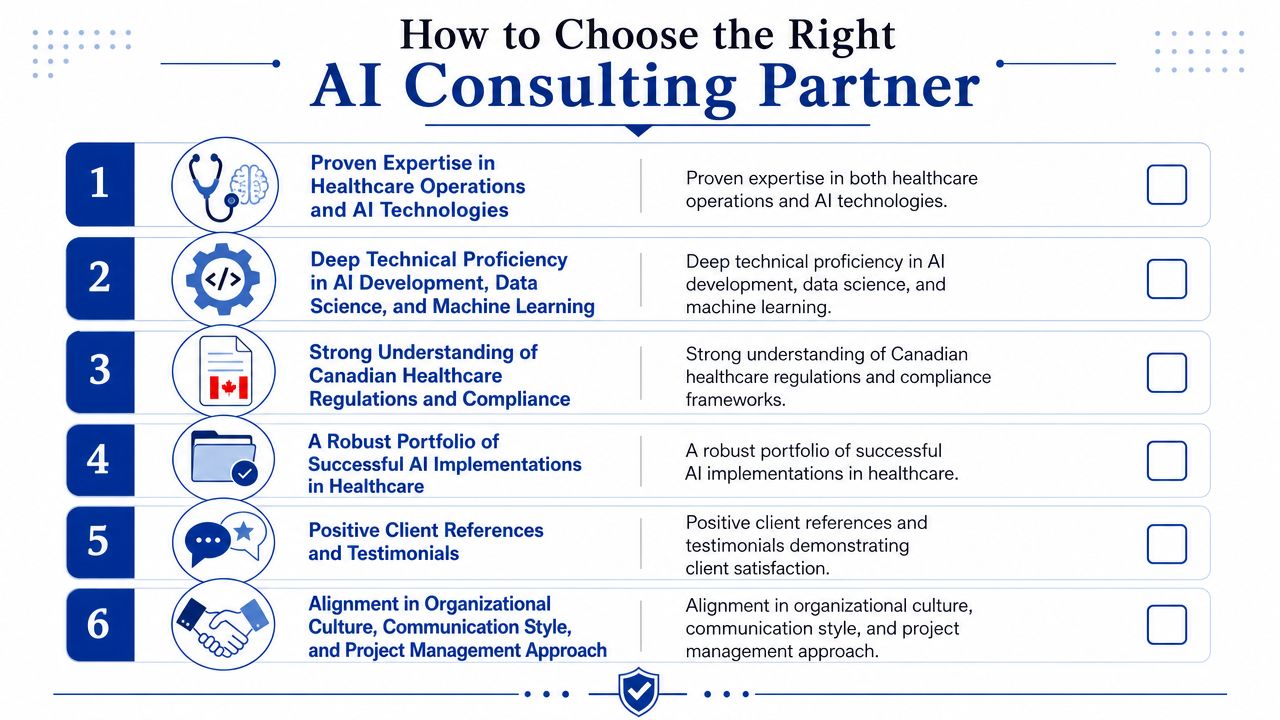
If a consulting firm can't discuss clinical workflow, privacy obligations, testing discipline, and integration constraints in the same conversation, remove them from the shortlist. You're not buying a prototype. You're buying execution inside a regulated care environment.
Use this lens when evaluating firms:
Healthcare fluency: Can they speak credibly about patient flow, documentation burdens, clinician adoption, and operational bottlenecks?
Canadian compliance awareness: Do they understand provincial variation, data residency questions, and professional accountability issues?
Interoperability skill: Can they work with your existing EHR, imaging platforms, and operational systems rather than forcing a replacement agenda?
Validation method: Do they have a clear process for testing reliability, usability, and failure handling before wider rollout?
Governance maturity: Can they help define ownership, escalation, auditability, and model monitoring?
Questions worth asking in vendor interviews
Many CTOs ask for technical architecture first. Ask these questions before you get there.
Where have you seen adoption fail in clinical environments, and why?
This reveals whether the firm has lived through real implementation friction.How do you handle a use case that delivers value but creates a privacy concern?
The answer should show trade-off thinking, not sales optimism.What does your testing process look like before production?
You want discipline around reliability, workflow fit, and exception management.Who on your team can talk to privacy officers, CMIOs, and operations leaders without translation?
Healthcare AI projects break when business, clinical, and technical groups operate in silos.
A credible AI consulting partner should be able to say “no” to a bad use case, a weak dataset, or an unsafe rollout plan.
What to avoid
Some warning signs are easy to miss in polished procurement cycles:
Tool-first selling: They push a platform before understanding your workflow.
Generic compliance language: They rely on broad security claims without jurisdictional detail.
No post-launch model: They can build, but they can't support governance after go-live.
Weak change management: They underestimate training, adoption, and operational ownership.
The right partner reduces ambiguity. If their process creates more of it, keep looking.
Measuring the ROI of Your AI Investment
If you can't measure the value of an AI initiative, you shouldn't scale it. In healthcare, ROI has to be broader than pure cost reduction, but it still needs discipline. Boards will ask whether the spend improved operations, reduced risk, or changed care delivery in a meaningful way.
Focus on three ROI categories
Operational ROI is often the fastest to measure. Look at turnaround times, documentation workload, case routing speed, backlog reduction, and staff time reclaimed from repetitive tasks. If the tool doesn't remove friction from a real workflow, the business case will weaken quickly.
Clinical ROI requires tighter collaboration with medical leadership. Track whether the system helps clinicians act earlier, decide faster, or follow a more consistent process. Don't overcomplicate it. Start with one or two clinical-adjacent indicators tied to the workflow you changed.
Risk-adjusted ROI is where many organisations are too passive. A governed AI deployment can reduce exposure by replacing ad hoc tool usage, improving auditability, and standardising how sensitive data is handled. That value is real, even if it doesn't show up as a line item in the first quarter.
A practical scorecard
Use a scorecard that mixes hard metrics with operational evidence.
| Dimension | Example signal |
|---|---|
| Efficiency | Less manual documentation or fewer handoffs |
| Throughput | Faster movement through triage, intake, or review |
| Quality | More consistent outputs and fewer avoidable omissions |
| Adoption | Regular use by frontline staff without workarounds |
| Governance | Stronger oversight of tools, data, and access |
The trick is to baseline before implementation. Too many AI projects launch with enthusiasm and no measurement discipline, then struggle to prove value later.
For leaders building broader automation programmes beyond a single healthcare use case, this guide for effective AI automation for companies is useful as a planning reference for operating model questions, ownership, and implementation scope.
Good ROI conversations aren't about proving AI is magical. They're about proving a specific deployment solved a specific problem better than the status quo.
Frequently Asked Questions About AI Healthcare Consulting
Should we build an in-house AI team or hire a consultant?
Hire for speed. Build for control.
Use a consultant first to set priorities, pressure-test use cases, and prevent expensive sequencing errors. Build your internal team around product ownership, data governance, enterprise architecture, procurement standards, and clinical change management. Your hospital should own the operating model and decision rights. It does not need to hire every specialist before the first deployment goes live.
What's a sensible place to start?
Start with a workflow that already frustrates staff and produces measurable waste.
Documentation burden, referral intake, patient scheduling, prior authorisation, and other repetitive administrative tasks usually deliver better early returns than ambitious diagnostic programs. The goal of the first project is not technical prestige. The goal is to prove that AI can remove friction, reduce cycle time, and gain frontline trust without creating new compliance problems.
How should we think about AI pilots?
A pilot should answer one business question. Can this tool improve a specific workflow in our environment at an acceptable level of risk?
Keep the scope tight. Assign one executive owner. Define success metrics, failure thresholds, and stop criteria before launch. If the pilot is trying to test the model, the workflow, the integration, the policy, and the vendor all at once, you are not running a pilot. You are running an uncontrolled experiment.
What's the biggest hidden risk right now?
Shadow AI.
Many Canadian healthcare organisations still review approved vendors carefully while ignoring what staff are already using on their own. Clinicians and administrators adopt public AI tools because they save time. That creates privacy exposure, weak audit trails, and inconsistent handling of patient information long before the formal AI program reaches procurement. If your team has not assessed unsanctioned usage, your governance model is incomplete.
How do we handle AI scribe rules across provinces?
Stop treating Canada as one compliance zone. It is not.
An Ontario deployment can trigger one set of expectations around privacy, recordkeeping, and professional accountability. A Quebec deployment can raise different requirements, especially if data leaves the province or the vendor's hosting model is unclear. Add cross-border processing, college guidance, patient notification practices, and local retention rules, and a “standard national rollout” quickly falls apart.
Approve a specific workflow with a specific vendor under a specific policy. Review province, data residency, consent or notice requirements, human review expectations, and incident response obligations together. As noted earlier, many AI healthcare programs often stall at this stage. The technology is not the hard part. The hard part is configuring one operating model that can handle conflicting provincial rules without slowing the entire organisation.
What should the CTO own personally?
Own governance, sequencing, and integration standards.
Delegate delivery details, but keep direct control over architecture decisions, approved use categories, vendor review criteria, identity and access expectations, and post-launch monitoring. Set the rules for what can connect to clinical systems, what data can be exposed to third-party models, and what evidence a business unit must provide before a tool is approved.
If those controls are fragmented, the AI program will fragment too.
If your organisation needs a partner that can turn AI ambition into secure, compliant, production-ready healthcare systems, Cleffex Digital Ltd can help. As a Canada-based software development company, Cleffex works with healthcare and life sciences teams on custom platforms, AI-driven solutions, and regulated digital products that have to work in actual environments, not just in a demo.