

Healthcare leaders often talk about innovation as if it's optional. It isn't. In 2020, the U.S. healthcare sector accounted for 18% of the nation's GDP, and virtual care adoption jumped from 11% to 76% between 2019 and 2020, according to Investopedia's healthcare sector overview. That's not a technology story. It's an operations story.
When an industry this large shifts this fast, the winners aren't the organisations with the flashiest pilots. They're the ones that can redesign scheduling, intake, billing, referrals, follow-up, privacy controls, and supply workflows without breaking care delivery. That's what modern healthcare operations really mean.
Most clinics and hospitals don't need more disconnected tools. They need a tighter operating model. If your teams are still moving data by hand, chasing denials after the fact, and treating compliance as a final review step, you're running a fragile system. A practical guide to digital transformation in healthcare starts with that reality, not with AI demos.
The New Imperative in Healthcare Delivery

Modern healthcare operations aren't a rebrand for digitisation. It's the discipline of making care delivery, revenue flow, compliance, and workforce coordination function as one system. That matters because healthcare no longer has the luxury of separating clinical excellence from operational discipline.
A hospital can deliver excellent care and still bleed margin through poor authorisation workflows, fragmented data, delayed documentation, and inconsistent supply controls. A clinic can offer telehealth and still frustrate patients if follow-up, lab ordering, and billing aren't connected. Technology doesn't fix that by itself. Better operating design does.
Practical rule: Don't modernise channels first. Modernise workflows first, then choose the channels and tools that support them.
The post-pandemic shift made this unavoidable. Virtual care moved from a niche service line to a core delivery capability. That forced organisations to confront questions they'd postponed for years. Who owns patient flow across in-person and remote visits? How is data shared between clinical, financial, and front-desk teams? Which tasks should staff handle, and which should software handle?
Why leadership teams need to treat operations as strategy
Modernisation fails when executives delegate it entirely to IT. This is a leadership issue because operations sits at the intersection of money, risk, and care quality.
If you're leading a first major modernisation effort, focus on three immediate outcomes:
Reduce friction across handoffs: Every referral, claim, prior authorisation, and discharge transition should have a defined owner.
Tighten data movement: Staff shouldn't re-enter the same information across systems.
Protect speed with governance: Fast access to data matters, but uncontrolled access creates privacy and audit risk.
That's the new imperative. Healthcare delivery now depends on whether your organisation can operate as a connected enterprise, not a loose collection of departments.
Defining Modern Healthcare Operations
Think of your organisation like a city. Traditional operations resemble ageing infrastructure. Separate roads, separate utilities, separate control rooms. Things still move, but slowly, and every failure creates a traffic jam somewhere else. Modern healthcare operations are the upgrade to an integrated grid where information, decisions, and resources move in a coordinated way.
That definition matters because many leadership teams still confuse modernisation with software replacement. Replacing one application with another isn't a transformation if the underlying workflows stay fragmented. Real progress shows up when registration, clinical documentation, referral management, billing, staffing, and reporting stop working as isolated functions.
What changes in practical terms
Traditional operations are reactive. Staff spot problems after they hit the schedule, the claim queue, or the patient experience. Modern operations are designed to surface bottlenecks earlier and route work more reliably.
Here's the simplest way to see the shift:
| Aspect | Traditional Operations | Modern Operations |
|---|---|---|
| Data flow | Departmental silos, duplicate entry, delayed updates | Integrated data movement with current records across workflows |
| Scheduling | Manual coordination, limited visibility, reactive rescheduling | Centralised scheduling logic with better capacity management |
| Revenue cycle | Denials handled after submission, fragmented billing handoffs | Cleaner front-end processes, automated checks, tighter claim workflows |
| Compliance | Periodic reviews and manual access oversight | Built-in permissions, auditability, and policy-driven controls |
| Patient communication | Phone-heavy, inconsistent follow-up | Structured digital communication across reminders, intake, and follow-up |
| Reporting | Static reports created after the fact | Operational dashboards that support daily decisions |
| Staffing | Fixed models and manual adjustments | Demand-aware planning and workflow support |
| Improvement model | Department-by-department fixes | Cross-functional redesign tied to organisational goals |
The operating mindset that separates progress from chaos
The biggest change is cultural. Modern healthcare operations ask leaders to stop optimising one department at a time. The registration team may hit its target while the billing team absorbs the fallout. The telehealth team may grow volume while in-person teams lose control of follow-up. Local optimisation creates system-wide waste.
A workflow isn't modern because it's digital. It's modern when data moves once, decisions happen in the right place, and staff don't need workarounds to get through the day.
That means leadership has to map the care journey and the money journey together. Intake affects coding quality. Referral management affects leakage and delays. Supply ordering affects both clinician time and margin. Documentation affects claims and care continuity.
What to aim for first
Don't try to create a perfect enterprise architecture on day one. Aim for a cleaner operational baseline:
Standardise core workflows: Start with scheduling, intake, authorisations, and billing handoffs.
Clarify ownership: Assign accountable leaders for end-to-end processes, not just departmental tasks.
Use data operationally: Reports should help managers act this week, not explain last quarter.
Design for scale: Build workflows that can handle new service lines, sites, and digital channels without major rework.
If your teams can't explain how work moves from patient request to payment, you don't have modern healthcare operations yet. You have software sitting on top of old habits.
The Core Pillars of Modernisation
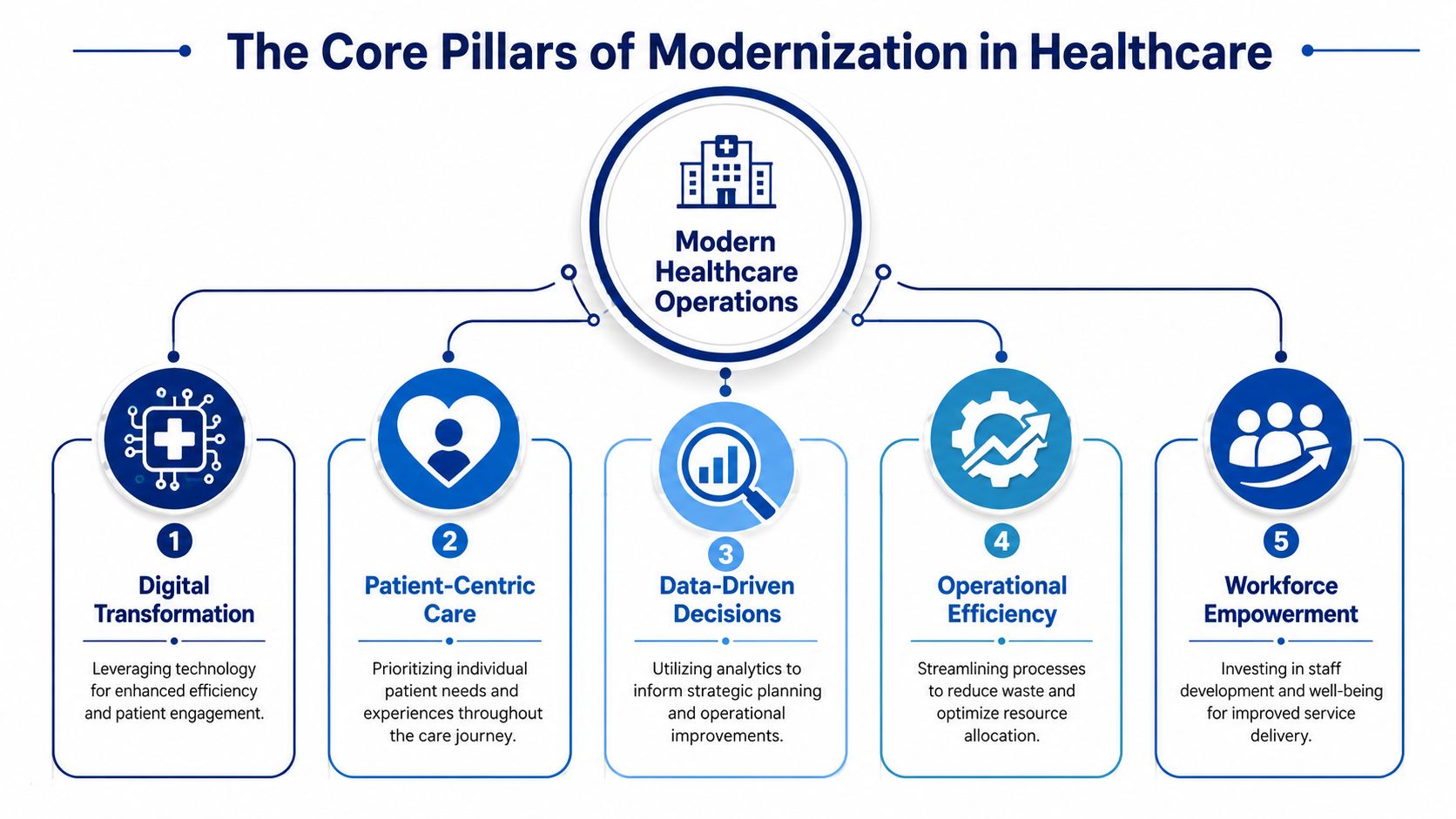
The strongest modernisation programmes are built on a few essential pillars. Miss one, and the rest wobble. Start with buzzwords, and you'll waste budget. Start with operating priorities, and the technology choices become much clearer.
Data interoperability
Interoperability is the foundation because every broken workflow eventually turns into a data problem. Referral delays, duplicate outreach, claim errors, poor utilisation review, and weak care-gap follow-up often start with systems that can't exchange information cleanly.
Modern platforms increasingly rely on HL7 FHIR because it supports cleaner data exchange, reduces implementation complexity, and helps closed-loop workflows such as prior authorisation, referrals, and care-gap closure move faster, as outlined in this FHIR-focused healthcare interoperability review. For operators, the practical lesson is simple. If data exchange isn't standardised, teams compensate with manual work.
What should leadership push for?
Shared workflow data: Scheduling, claims, patient engagement, and clinical systems need aligned records.
Current information: Daily syncs and rapid retrieval matter when teams are coordinating active care.
Closed-loop design: A referral isn't complete when it's sent. It's complete when the receiving action is visible.
Intelligent automation
Automation should start where staff time is wasted, not where vendors make the best demo. Good targets include eligibility checks, document routing, claims status handling, scheduling confirmations, task escalation, and work queue prioritisation.
AI can help, but only when paired with process discipline. If your front-end registration quality is poor, AI won't rescue your revenue cycle. If your inboxes are unmanaged, AI summarisation just accelerates disorder.
Where automation pays off first
Revenue cycle tasks: Front-end validation, cleaner billing workflows, and denial-prevention logic.
Administrative throughput: Appointment reminders, intake collection, and routing repetitive requests.
Operational triage: Prioritising queues based on urgency, missing information, or downstream risk.
Patient-centred digital experiences
Telehealth, remote patient monitoring, digital intake, and mobile communication matter because patients experience your operations directly. They don't care whether your problem is a siloed EHR field or a handoff between teams. They care whether the appointment happened, whether instructions were clear, and whether someone followed up.
A lot of organisations stop at access. That's too shallow. The operational challenge is making virtual care fit into staffing, escalation rules, and in-person capacity planning. If your telehealth model generates extra callbacks, duplicate documentation, or unclear follow-up, it isn't improving operations. It's just moving friction around.
Operational test: If a virtual visit creates more downstream manual work than an in-person visit, redesign the workflow before you scale it.
Value-based care enablement
Modern healthcare operations should help organisations perform better under outcome-focused models, not just increase throughput. That means building workflows that support continuity, timeliness, documentation quality, and care coordination.
This pillar is less about a single tool and more about operational alignment. Leaders need data that shows whether care plans are followed, referrals are completed, and gaps are closed before they become more expensive problems.
Workforce empowerment
No system is modern if staff hate using it. Teams need tools that reduce clerical burden, clarify handoffs, and make decision-making easier during a busy day. Training matters, but workflow design matters more. Staff resistance often signals poor implementation logic, not a bad attitude.
A modern operating model supports clinicians, front-office staff, billers, managers, and analysts with the right level of information at the right time. That's what keeps modernisation from becoming another layer of administrative drag.
Navigating Organisational and Regulatory Hurdles
Here, most programmes get exposed. Leaders approve platforms, sign implementation contracts, and expect adoption to follow. Then reality shows up. Clinical teams keep side processes alive, compliance officers push back on data sharing, and managers discover that the new workflow doesn't match how work gets done.
Compliance isn't a final checkpoint
In California, healthcare organisations face state-level obligations on top of HIPAA. CMIA and related health IT privacy expectations require fine-grained access control, auditability, and minimum-necessary disclosure in operational data pipelines, as described by HealthIT.gov's interoperability and privacy guidance. If your architecture can't support role-based permissions and clear audit trails, you're creating future operational drag.
That doesn't mean compliance should slow everything down. It means compliance has to be built into workflow design from the start.
Use a simple rule set:
Limit access by role: Give teams the data they need for the task, not broad access by default.
Log material actions: Access, changes, disclosures, and approvals should be auditable.
Design for minimum necessary use: Especially across claims, patient engagement, and clinical coordination workflows.
Resistance usually signals a workflow mismatch
Staff don't resist change just because they dislike technology. They resist when the new process adds clicks, hides context, or shifts work onto already overloaded teams. A scheduling redesign that looks efficient on paper can fail if it creates more call-backs for reception. A digital intake tool can create chaos if nurses still need to re-check key fields manually.
Run change management as an operational exercise, not a communications campaign. Bring frontline staff into workflow mapping. Test edge cases. Identify where exceptions happen. Then build escalation paths before go-live.
The fastest way to lose clinician buy-in is to ask them to compensate for a bad process with more effort.
Workforce adaptation needs structure
Labour pressure is already forcing organisations to rethink how work gets allocated. That includes role design, training, queue ownership, and support for clinical and non-clinical staff. Teams trying to make progress on addressing clinician staffing issues should tie workforce planning directly to workflow redesign. Hiring alone won't fix broken processes.
A practical adaptation plan usually includes:
Task redistribution: Move repetitive, rules-based work away from scarce clinical capacity.
Scenario-based training: Train staff on real cases, exceptions, and handoffs, not feature lists.
Local champions: Use respected frontline leaders to pressure-test new workflows.
Early issue capture: Set up a short feedback loop during rollout so problems get fixed quickly.
The hurdle isn't regulation. The hurdle is pretending that operations, compliance, and people can be modernised separately.
Measuring Success with Actionable KPIs
Most modernisation programmes fail in the same way. They define success as deployment. That's the wrong standard. Success is measured by whether work moves faster, cleaner, and with fewer expensive errors.
For leadership teams, KPIs need to connect directly to operational decisions. If a metric doesn't change staffing plans, process design, payer follow-up, or purchasing behaviour, it's probably vanity.
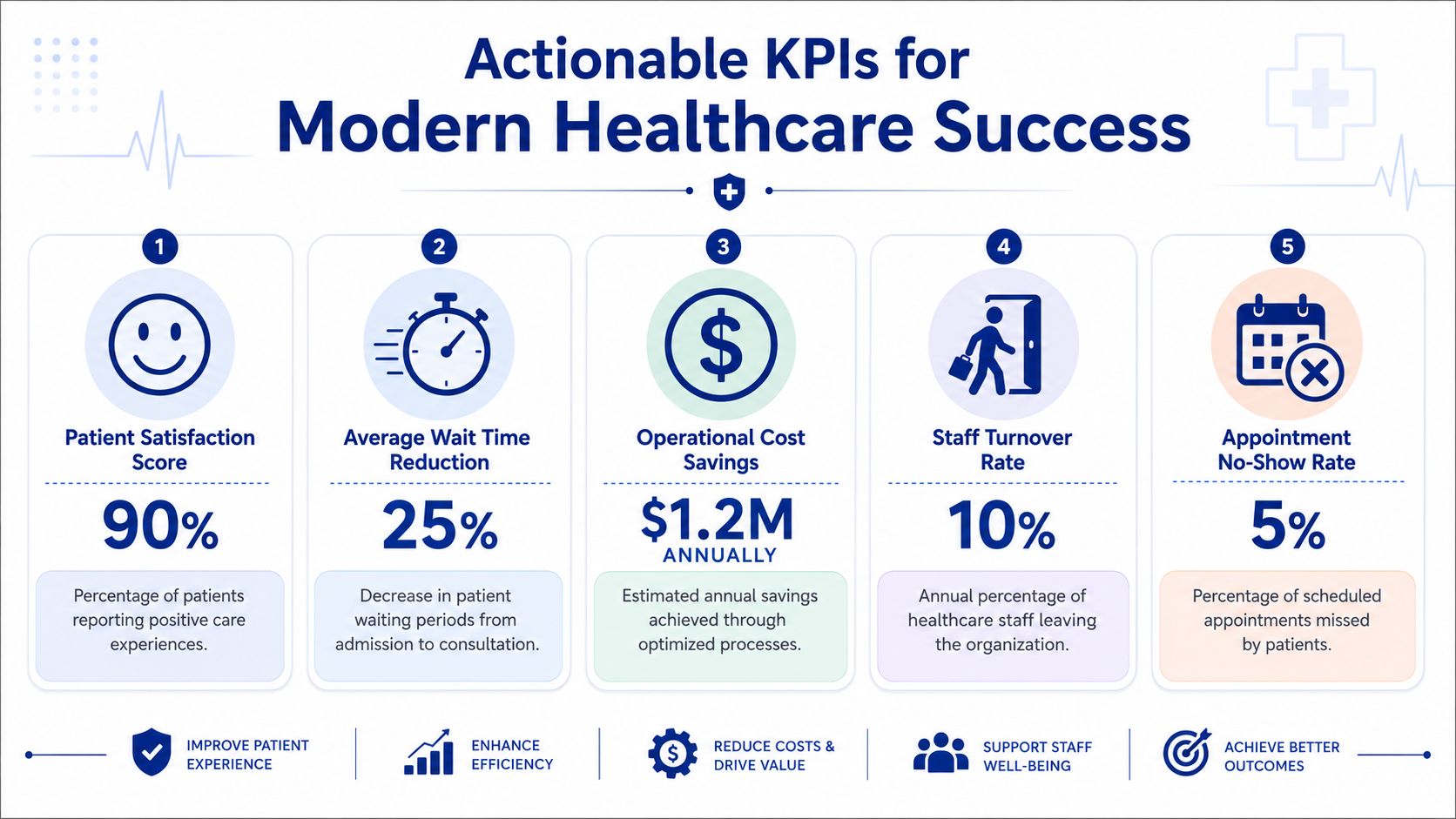
Financial health metrics
Start with the measures that tell you whether the operating model is supporting margin.
A hospital supply-chain analysis cited by Modern Healthcare estimated a $25.4 billion unrealised opportunity and a 17.7% average supply-chain expense reduction through better purchasing and standardisation, according to this supply-chain savings analysis summary. That's the clearest reminder that modern healthcare operations aren't only about AI. It's also about disciplined purchasing, inventory visibility, and standard product use.
Track metrics such as:
Claims denial patterns: Focus on preventable denials tied to registration, authorisation, coding, or documentation gaps.
Days in accounts receivable: Use this to spot process breakdowns between clinical completion and billing follow-through.
Supply variation: Monitor category-level purchasing consistency and exception buying.
Cash leakage points: Measure missed charges, delayed submissions, and write-offs tied to workflow failure.
Operational efficiency metrics
Operations KPIs should help managers run the week better, not just explain the month.
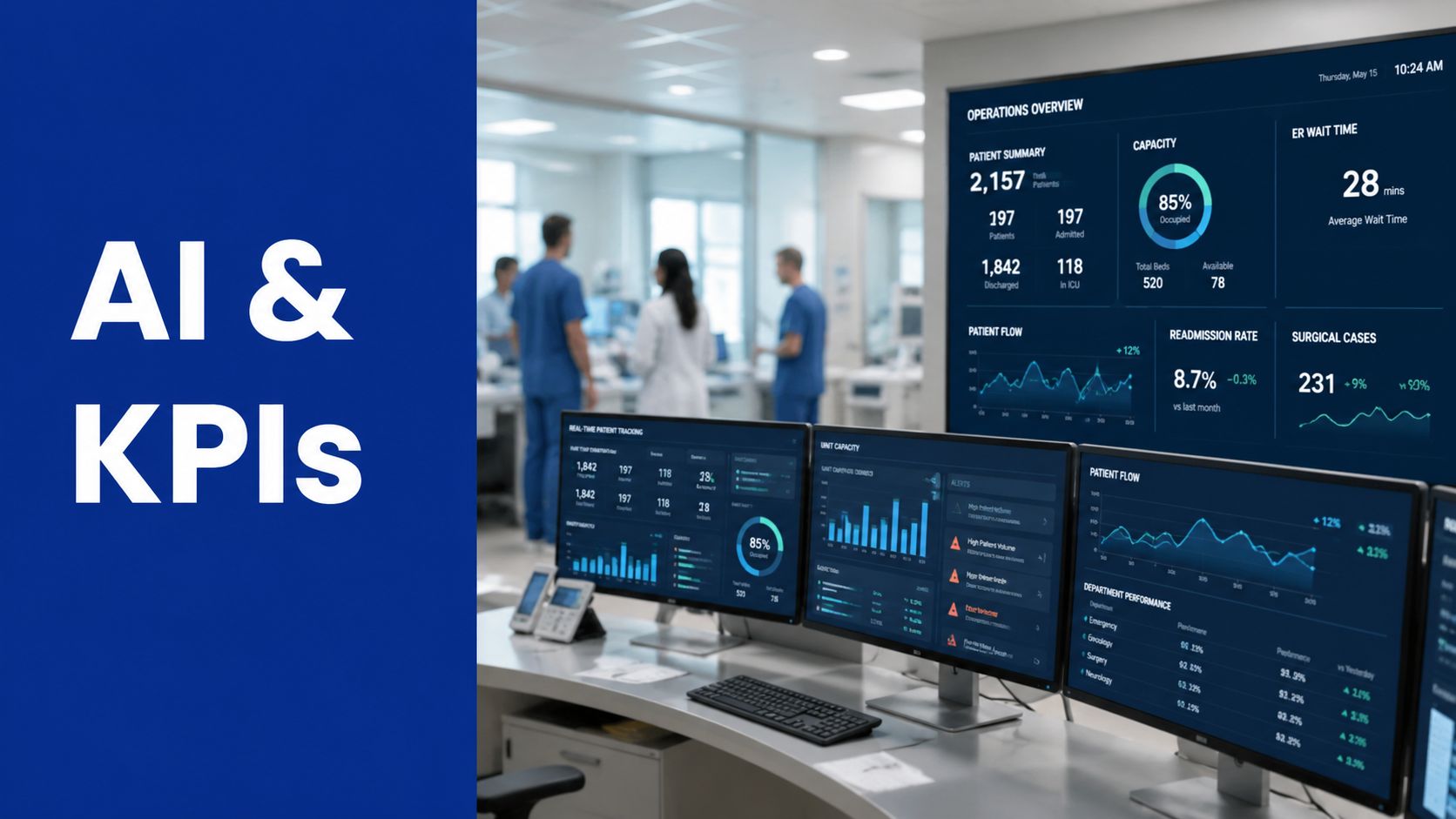
A strong dashboard usually includes:
| KPI area | What to watch | Why it matters |
|---|---|---|
| Access flow | Patient wait times, scheduling lag, referral turnaround | Shows whether patient access is improving or stalling |
| Staff productivity | Queue ageing, rework volume, documentation burden | Reveals where teams are spending time on avoidable work |
| Throughput | Visit completion to claim submission, discharge to follow-up task completion | Connects process speed to revenue and care continuity |
| Data reliability | Missing fields, duplicate records, unresolved exceptions | Highlights where automation will fail without cleaner inputs |
If your organisation needs a clearer framework for building these dashboards, this overview of efficient healthcare operational analytics is a useful reference point.
Clinical and patient outcome metrics
Operational modernisation should improve the patient journey, not just internal efficiency. Watch measures tied to follow-up completion, care-plan adherence, closed referrals, communication responsiveness, and avoidable service friction.
Measure the handoff, not just the event. A completed appointment means less if no one tracked what happened next.
The key is balance. Don't let a narrow financial dashboard drive behaviour that hurts experience or quality. The best KPI set forces leaders to evaluate margin, speed, and patient impact together.
A Practical Roadmap for Modernisation
Healthcare leaders often overcomplicate modernisation at the start and underinvest in execution later. Keep it phased. You need a roadmap that proves value early, reduces risk, and builds operational credibility with staff.
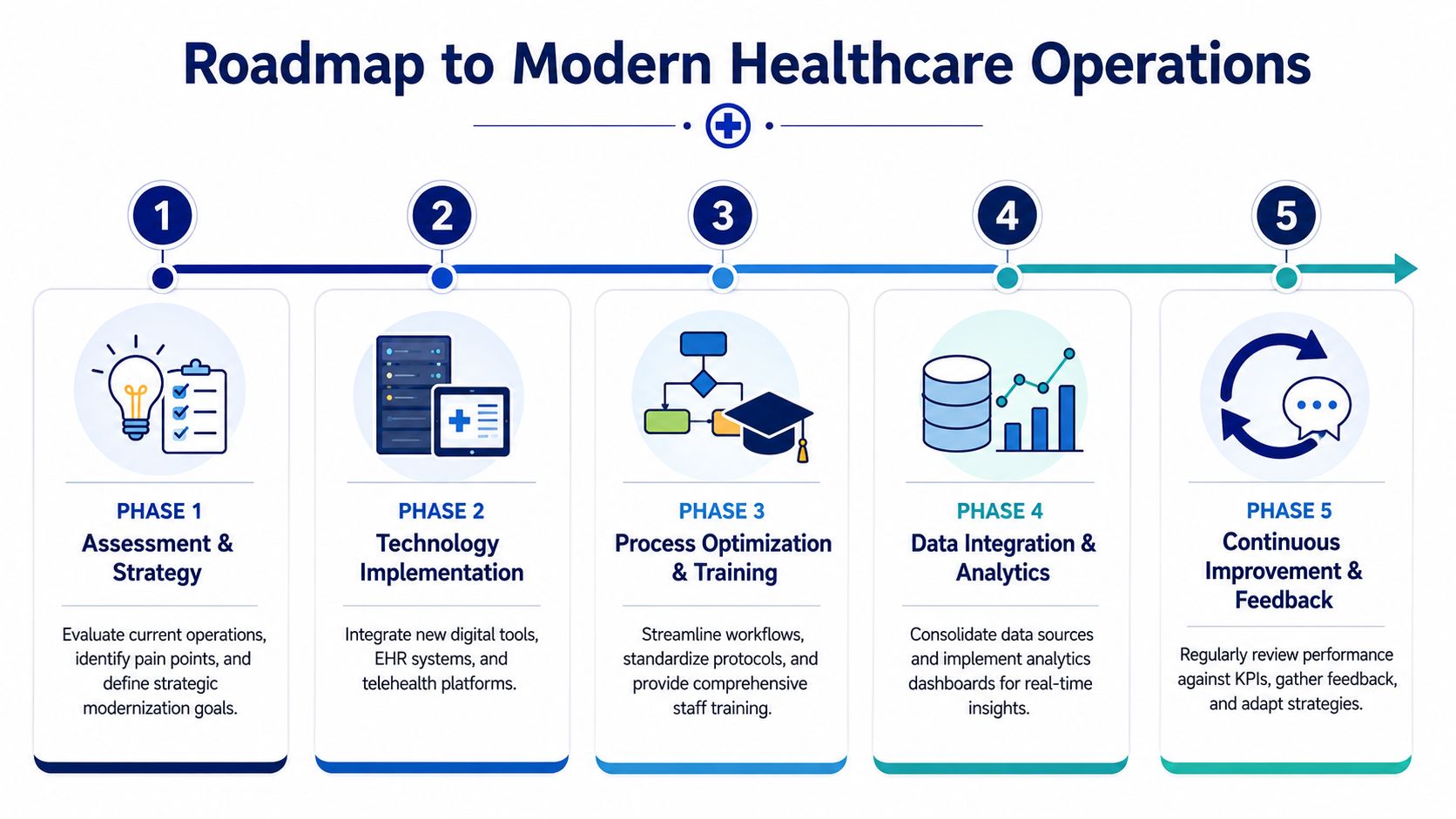
Assess and strategise
Begin with a hard look at where work breaks. Map core flows such as intake to appointment, visit to claim, referral to completion, and order to inventory use. Identify where staff re-enter data, where approvals stall, and where exceptions accumulate.
This step matters because margins are tight. U.S. health system operating margins fell to 0.2% in April 2024, according to Strata Decision Technology's financial benchmarks. Organisations don't have room for broad, unfocused transformation programmes.
Pilot and refine
Choose one or two workflows with clear pain and measurable upside. Good early targets include referral management, front-end revenue cycle, scheduling optimisation, or supply request handling. Keep the pilot bound. One site, one service line, or one function.
Use the pilot to answer practical questions:
Where does the workflow fail in real use?
Which exceptions need manual review?
What training do staff need?
Which measures will prove the change is worth scaling?
Scale and integrate
Once the pilot works, integrate it properly. This is the stage where weak technical decisions become expensive. If you're moving core workflows to cloud environments, leadership should insist on architecture choices that can be defended on security, compliance, resilience, and integration grounds. Teams evaluating infrastructure shifts may find this perspective on defensible cloud modernisation decisions useful.
One practical software option in this space is Cleffex Digital Ltd, which offers custom healthcare operations software for scheduling, billing and claims workflows, staff coordination, reporting, patient communication, telehealth, EHR-related systems, and cloud-based digital health transformation. The point isn't to buy everything from one vendor. The point is to choose tools and partners that fit the workflow you're scaling.
Optimise and keep improving
Modernisation isn't finished at rollout. Review KPIs, compare site-level adoption, inspect exception queues, and keep tuning permissions, prompts, automations, and staffing models. The organisations that gain the most don't treat implementation as the finish line. They turn operations into a continuous management discipline.
Choosing Your Technology Partner
Most healthcare organisations don't fail because they chose no technology partner. They fail because they chose a generalist. Modern healthcare operations demand a partner that understands care delivery, revenue logic, privacy controls, and integration realities at the same time.
What to evaluate without compromise
Start with domain fit. If a partner can't talk clearly about patient access, authorisations, claims workflows, audit trails, and role-based access, keep looking. Healthcare isn't a standard SaaS workflow problem.
Use this checklist:
Healthcare process fluency: They should understand scheduling, referrals, billing, documentation, and patient communication as connected workflows.
Compliance capability: Ask how they handle secure data movement, auditability, permissions, and privacy constraints.
Integration maturity: They need a credible approach to EHR connectivity, APIs, data mapping, and workflow orchestration.
Analytics and AI readiness: Not hype. Practical ability to support automation, monitoring, and decision support.
Delivery model: You want iterative implementation with operational feedback, not a black-box build.
Questions leadership should ask in the first meeting
A serious partner should answer questions like these without hand-waving:
| Question | What a strong answer sounds like |
|---|---|
| How do you approach PHI access control? | Clear role-based model, logging, and minimum-necessary design |
| How do you reduce workflow disruption during rollout? | Pilots, phased cutover, frontline testing, and exception handling |
| How do you support long-term improvement? | KPI dashboards, optimisation cycles, and change backlog management |
| How do you handle healthcare-specific integrations? | Structured approach to data exchange, workflow mapping, and validation |
Don't buy a demo
A polished interface can hide weak implementation logic. Ask for workflow examples. Ask how they handle exceptions. Ask what happens when a referral stalls, a claim lacks documentation, or a patient switches from virtual to in-person care mid-journey. Those answers matter more than presentation polish.
If you're evaluating options in North America, this guide to selecting a healthcare technology partner in Canada gives a useful lens for partner assessment.
The right partner won't just ship software. They'll help your organisation decide what should be standardised, what should be automated, and what should remain under human review. That's the difference between buying tools and building a functioning modern operating model.
Cleffex Digital Ltd can support healthcare organisations that need custom software for operational modernisation, including secure workflow systems for scheduling, billing, patient communication, analytics, telehealth, and cloud-based healthcare platforms. If your clinic or hospital is planning its first serious modernisation effort, explore Cleffex Digital Ltd as one practical option for designing compliant, operations-focused solutions.