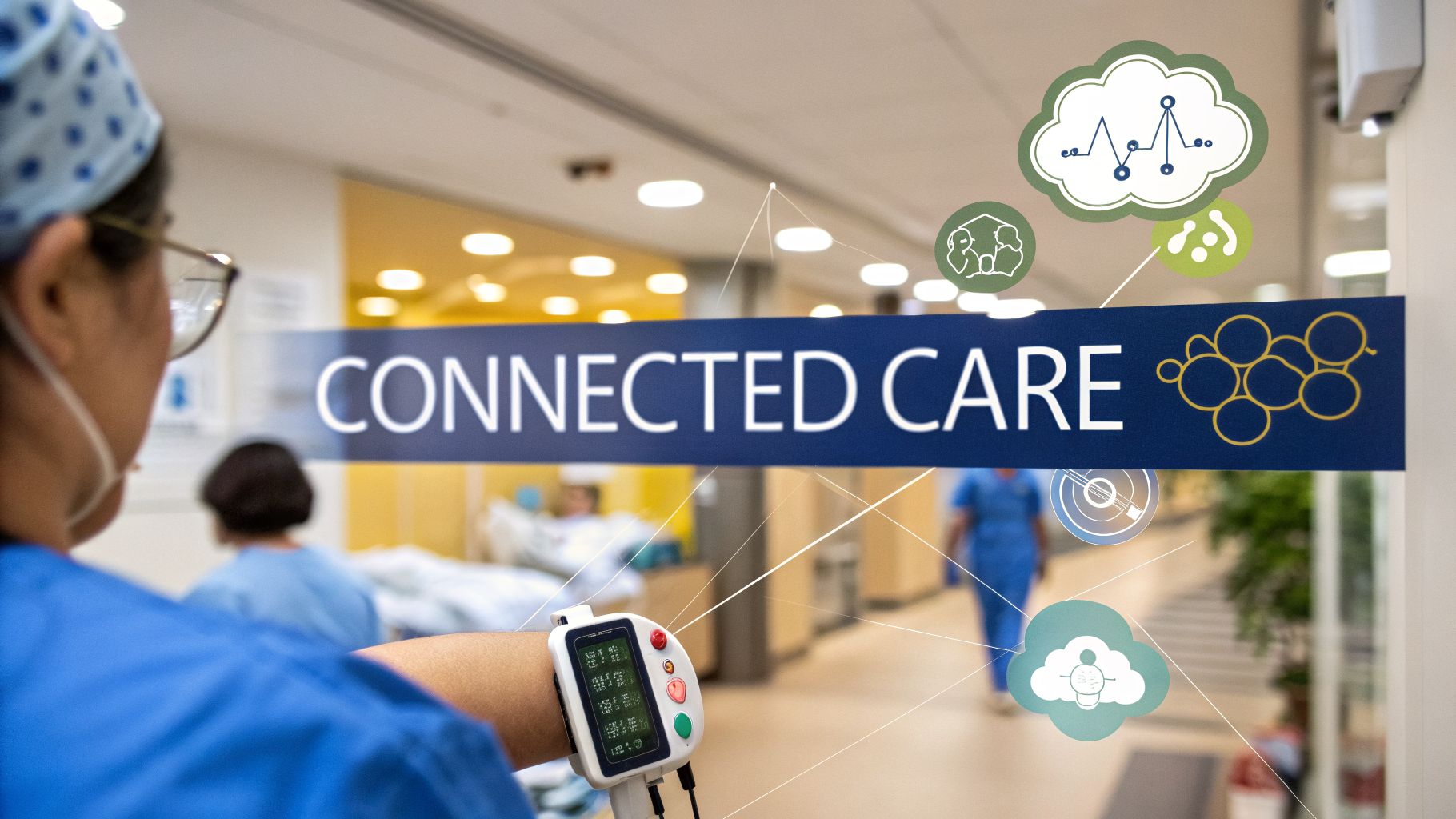


At its core, an IoT healthcare solution is a network of smart devices, sensors, and software designed to collect and share patient data in real time. Think of it as creating a digital nervous system for a clinic or hospital, one that helps shift care from being reactive to truly proactive and personalised.
The Future of Patient Care Is Connected
Picture a hospital where vital patient information flows instantly between devices and care teams, flagging potential issues before they become emergencies. This isn't a far-off dream; it's what IoT in healthcare is making possible right now. We're moving away from a system bogged down by manual data entry and delayed responses toward a smarter, more connected model of care.
This network might include anything from wearable sensors that monitor a patient's chronic condition at home to intelligent hospital beds that can help prevent falls. All these devices work in concert, feeding a continuous stream of actionable information to clinicians. So, instead of a nurse doing manual vitals checks every few hours, a continuous monitor can alert staff the second a patient's readings enter a dangerous range.
From Reactive to Proactive Healthcare
The traditional approach to healthcare has always been reactive; we wait for a problem to show up, then we treat it. IoT completely flips that script. By providing a constant feed of health data, clinicians can spot negative trends early and intervene, stopping a minor issue from becoming a major health crisis.
By connecting patients, providers, and medical devices, IoT fosters a collaborative environment where data-driven decisions lead to better health outcomes, enhanced patient safety, and improved operational workflows.
This continuous monitoring doesn't just make patients safer; it gives them the tools to take an active role in their own health. A person with diabetes using a smart glucose monitor, for example, gets immediate feedback that helps them make better choices about their diet and lifestyle. We explore this further in our guide to patient care technology, but this kind of proactive engagement is a cornerstone of effective, modern healthcare.
The benefits also ripple out to the operational side of clinics and hospitals. Automating data collection frees up nurses' time, allowing them to focus on more complex care needs. At the same time, using IoT tags to track medical equipment can save countless hours of searching and reduce costly equipment loss. Ultimately, IoT healthcare solutions are making personalised and predictive care the new standard.
How IoT Technology Works in Healthcare
To get a real sense of how IoT healthcare solutions operate, it helps to think of them as a digital version of the human body’s nervous system. This complex network has a surprisingly simple job: to sense what’s happening, communicate that information, get it processed, and then trigger an action.
This whole process breaks down into four key layers, each with a distinct role but all working together in a continuous loop.
At its core, any IoT healthcare solution is built on a simple architecture. Understanding these four layers helps clarify how a simple sensor reading can eventually lead to a life-saving clinical decision.
The Four Layers of an IoT Healthcare System
| Layer | Function | Examples in Healthcare |
|---|---|---|
| 1. Device Layer (The Senses) | This is the hardware that gathers data directly from the patient or the surrounding environment. It's the "thing" in the Internet of Things. | Wearable heart rate monitors, continuous glucose monitors (CGMs), smart hospital beds that detect patient movement, and temperature sensors in medication fridges. |
| 2. Connectivity Layer (The Nerves) | This layer acts as the communication highway, securely sending the data collected by the devices to a central platform. | Wi-Fi, Bluetooth, cellular (4G/5G), or LoRaWAN, chosen based on the required range, battery life, and data volume. |
| 3. Platform Layer (The Brain) | This is the central hub, usually a cloud-based platform, that receives, stores, and analyses the massive streams of incoming data. | An analytics engine that processes raw heart rate data, identifies an abnormal pattern (like arrhythmia), and correlates it with the patient's activity level. |
| 4. Application Layer (The Action) | This is the user-facing part of the system. It presents the analysed insights to people who can act on them. | A nurse's dashboard showing real-time vitals for every patient on the ward, a mobile app for a diabetic patient to view their glucose trends, or an alert sent to a facility manager about a failing fridge. |
Each layer builds on the one before it, creating a chain of events that transforms raw data points into meaningful, actionable health insights. This isn't just about collecting data; it's about making that data work for clinicians and patients.
The ultimate goal of this entire structure is to shift healthcare from being reactive to being proactive, predictive, and much more personalised.

As you can see, it’s a progression. By building a foundation of personalised data, we can start to spot trends, intervene proactively before a condition worsens, and eventually even predict health events before they happen.
Understanding this four-layer architecture, sense, communicate, process, and act, is the key to seeing how IoT healthcare solutions create a truly intelligent and responsive care environment.
Real-World Applications Transforming Patient Care

While the technical blueprints are impressive, the real magic of IoT healthcare solutions happens when you see them improving people's lives. This is where the technology stops being an abstract concept and becomes a genuine partner in a patient's wellness and a clinician's daily work. Whether it's in a patient's own living room or a bustling hospital ward, these connected devices are setting a whole new standard of care.
These applications are turning routine medical duties into dynamic, data-rich workflows. What you get is more personalised care for patients and far more powerful tools for clinical teams, creating a healthcare system that’s both more efficient and more human.
Empowering Patients With Remote Monitoring
One of the most powerful applications we're seeing is Remote Patient Monitoring (RPM). For anyone managing a chronic condition like diabetes, heart failure, or hypertension, RPM is a complete game-changer. It extends a clinician's reach far beyond the four walls of the clinic.
Think about a patient with diabetes who uses a smart glucose metre. Instead of scribbling down blood sugar levels in a notebook and waiting for their next appointment, the device automatically sends real-time data to their care team. If a reading is dangerously high or low, the system can fire off an immediate alert, letting a nurse or doctor step in before a crisis hits.
This constant connection gives patients and their families incredible peace of mind. It also provides clinicians with a steady stream of data, helping them spot trends and fine-tune treatment plans on the fly. We're moving from periodic check-ins to continuous, proactive care management.
Smart Inhalers: These track usage for asthma and COPD patients, giving doctors crucial data on medication adherence and helping pinpoint environmental triggers for attacks.
Wearable ECG Monitors: Patients at risk of cardiac events can wear small, discreet patches that monitor heart rhythms around the clock, catching abnormalities that a quick in-office test would almost certainly miss.
Connected Blood Pressure Cuffs: These devices let patients take readings at home that are instantly uploaded to their electronic health record, giving their doctor a much clearer picture of their day-to-day blood pressure.
Remote monitoring does more than just collect data; it empowers patients to become active participants in their own health. By giving them real-time feedback and a direct line to their care team, IoT solutions turn passive patients into engaged partners.
Optimising In-Hospital Care and Safety
Inside the hospital, IoT is quietly making the environment safer and operations much smoother. These solutions are the unsung heroes working in the background, freeing up staff to focus on what they do best: direct patient interaction and critical decision-making.
Smart beds are a perfect example. These are no longer just places for patients to rest; they're sophisticated data-gathering hubs. Embedded sensors can detect when a patient at risk of falling is trying to get out of bed and send an instant alert. The bed can also monitor a patient's weight, movement, and even vital signs, sending updates directly to the central nursing station.
This automates many routine checks and gives nurses a kind of sixth sense, alerting them to a patient's needs without them having to be in the room 24/7. It's a huge boost for patient safety, and it also dramatically improves staff efficiency by reducing alarm fatigue and allowing for more focused, hands-on care.
This trend is picking up serious momentum right here in Canada. In the nation's smart hospitals market, Ontario now holds a dominant 40% share of revenue, thanks to major provincial efforts to digitise healthcare. Leading institutions like the University Health Network (UHN) are using IoT-connected monitors and smart command centres to get real-time data flowing, optimise patient flow with predictive analytics, and have already shown they can cut wait times by up to 30% and lower readmission rates by 15-20% in pilot projects. You can discover more insights about Canada's smart hospital growth and its impact.
Enhancing Medication Adherence and Wellness
Beyond the hospital and chronic disease management, IoT healthcare solutions are also making a huge difference in everyday wellness and medication compliance. We all know how easy it is to forget to take medication, and it's a serious problem, especially for elderly patients or those juggling complex prescriptions.
Smart medication dispensers offer a simple, effective solution. These devices can be programmed to dispense the right pills at the right time, using lights or sounds as reminders. If a dose is missed, the device can ping a family member or caregiver, making sure the patient stays on track with their treatment.
At the same time, consumer wearables like smartwatches and fitness trackers are playing a bigger role in promoting general wellness. By encouraging physical activity, monitoring sleep, and tracking heart rate, they provide valuable data that helps people lead healthier lives and spot potential health issues before they become serious. It's all about bridging the gap between clinical care and daily life.
Boosting Efficiency With Operational IoT Solutions

While patient-facing technology gets most of the attention, the real unsung heroes of a modern hospital are often the IoT healthcare solutions working behind the scenes. These systems are all about streamlining operations, the complex, often invisible logistics that keep a facility running safely and efficiently.
Think of it this way: the clinical side is the star of the show, but operational IoT is the stage crew. It handles the countless small tasks that, if left unmanaged, can lead to huge costs, staff burnout, and even risks to patient care. By automating these background processes, hospitals can unlock surprising gains in efficiency and create a much smoother environment for everyone.
Smart Asset Tracking and Management
Ask any nurse about their biggest daily frustration, and you’ll likely hear about the "great equipment hunt." Hospitals are sprawling places filled with thousands of mobile, high-value assets like IV pumps, wheelchairs, and portable vital-sign monitors. A significant amount of a clinician's valuable time can be wasted just trying to track down a needed piece of gear.
This is a perfect problem for an IoT solution. By attaching small, discreet IoT tags to this equipment, their location appears in real time on a central map. A nurse who needs a specific pump can simply look at a screen and see the three closest ones, instead of searching floor by floor.
The benefits here are immediate and measurable:
Smarter Purchasing: You get a clear picture of how equipment is actually used. This stops you from over-ordering devices that sit in a closet while others are in constant demand.
Fewer Losses: Misplaced or hoarded equipment is a multi-million-dollar problem for health systems. With asset tracking, you can set up alerts if a tagged item leaves a designated area, dramatically cutting down on loss and theft.
Proactive Maintenance: Instead of waiting for a critical device to break down mid-procedure, IoT sensors can track usage hours and automatically flag equipment for preventative maintenance, ensuring it’s always ready and reliable.
When you eliminate all that wasted time spent searching, you give nurses and technicians more time to focus on what they do best: caring for patients. It’s a simple change that makes the entire hospital work better.
Ensuring Safety With Environmental Monitoring
Certain medical supplies, vaccines, blood products, tissue samples, and many pharmaceuticals are incredibly fragile. They have to be stored within a very strict temperature and humidity range. If a refrigerator fails overnight, the financial loss can be staggering, but worse, it can disrupt patient treatments and compromise safety.
Traditionally, this meant someone had to walk around with a clipboard, manually checking and logging temperatures several times a day. It’s a tedious process that’s wide open to human error.
Environmental monitoring with IoT sensors takes this risk completely off the table. Small, wireless sensors are placed inside refrigerators, freezers, and storage rooms to provide constant, 24/7 monitoring.
If the temperature in a vaccine fridge creeps even slightly out of its safe zone, the system instantly sends an alert to the right people via text or email. This gives them a chance to intervene long before thousands of dollars' worth of inventory is spoiled. It’s not just about saving money; it’s about ensuring that you meet regulatory standards from bodies like Health Canada and that every product you use is safe and effective.
Optimising Staff Workflow and Safety
Finally, let's talk about people. Hospitals are incredibly dynamic places where every second can count. Knowing where your staff are and getting them to the right place quickly can be a game-changer.
IoT-enabled ID badges can provide real-time location data that transforms how a hospital responds to emergencies. For example, during a "code blue" (cardiac arrest), the system can instantly see which members of the crash cart team are closest and dispatch them, shaving precious time off the response. The same logic applies when you need to find a specific on-call specialist for an urgent consultation.
These badges also bring a powerful safety element. Many now come with a discreet "panic button." If a nurse or doctor ever feels threatened or is experiencing a medical emergency themselves, a simple press of the button can silently alert security and send help to their exact location. It’s a simple feature that provides enormous peace of mind and fosters a safer working environment for the people we depend on most.
Navigating Critical Security and Compliance Challenges
The promise of IoT healthcare solutions is enormous, but so is the responsibility that comes with it. Every connected device, from a bedside monitor to a remote glucose sensor, creates a new potential doorway into your network. This isn't just a technical detail; it's a fundamental shift that demands a rock-solid security and compliance strategy from day one.
Frankly, it's natural to have concerns about data security and patient privacy. The key isn't to shy away from these challenges but to tackle them head-on with a proactive framework. A single breach involving patient health information can trigger massive financial penalties, but even worse, it can shatter the patient trust you've worked so hard to build.
The Foundation of Trust and Compliance
In Canada, the legal framework is clear. The Personal Information Protection and Electronic Documents Act (PIPEDA) dictates exactly how private-sector organisations must handle personal information. For any IoT healthcare solution, sticking to PIPEDA isn't optional. Across the border, the American HIPAA (Health Insurance Portability and Accountability Act) has set a global standard for protecting sensitive health data.
Security in healthcare IoT is about more than just technology; it's about building and maintaining patient trust. Every security measure you implement is a direct promise to your patients that their most personal information is safe with you.
These regulations require stringent controls over who can access patient data and why. Because medical devices have their own unique vulnerabilities, you need specific strategies to enhance network security in healthcare. Your security plan has to be built with compliance baked in from the very beginning, ensuring every byte of data is protected wherever it goes.
Core Security Risks in Healthcare IoT
The risks are real, and understanding them is the first step toward building an effective defence.
Data Breaches: Connected devices can be the weakest link in your security chain. Cybercriminals actively target protected health information (PHI) because it's incredibly valuable on the dark web.
Device Integrity: This is where it gets truly frightening. An attacker could potentially tamper with a device's function, imagine them altering a dosage on an infusion pump or changing the readings on a patient monitor. The consequences could be life-threatening.
Network Infiltration: A single compromised IoT device can act as a beachhead, allowing an attacker to move deeper into your hospital network. This can lead to anything from a widespread system shutdown to a crippling ransomware attack.
These aren't just hypotheticals; they are scenarios that keep healthcare IT leaders up at night. They underscore why a multi-layered security approach is the only way forward. To learn more, our article on the importance of cybersecurity in the healthcare industry offers a much deeper look at this topic.
Essential Security Best Practices
So, how do you defend against these threats? It comes down to implementing a robust set of security fundamentals. Think of these as the non-negotiable pillars of any secure IoT deployment.
End-to-End Encryption: Data must be scrambled and unreadable at all times. This means it needs to be encrypted both "in transit" (as it travels from a device to the cloud) and "at rest" (when it's being stored). If data is intercepted, it’s useless to an attacker.
Strong Authentication and Access Control: Every single user and device needs to prove who they are before getting access to the network, ideally using multi-factor authentication (MFA). Once inside, role-based controls ensure people can only see the specific data they need to do their jobs, nothing more.
Regular Vulnerability Assessments and Patching: No software is perfect. You must have a formal process for regularly scanning IoT devices for weaknesses. When a manufacturer releases a security patch, it needs to be applied quickly to close that window of opportunity for attackers.
Your Roadmap to Implementing IoT in Your Practice
So, you're ready to bring IoT healthcare solutions into your practice? That’s a great move, but a successful rollout isn't just about buying the latest technology. It’s about having a smart, strategic plan that ties every new device and sensor directly to a real-world outcome.
Before you even look at a vendor catalogue, you need to answer one question: what specific problem are you trying to solve? A vague goal like “improving patient care” won't cut it. Get specific. A much better objective would be to reduce hospital readmission rates for congestive heart failure patients by 15% within a year by using remote monitors. Now you have a clear target and a way to measure success.
Start Small With a Pilot Project
It’s tempting to go for a big, facility-wide launch, but that’s a recipe for headaches. The far smarter approach is to start with a small, manageable pilot project. Think of it as a test run in a controlled environment, letting you see what works and what doesn't, without a massive upfront investment or risk.
This is also your chance to win over your team. When clinical staff see for themselves how a handful of remote devices are helping real patients stay out of the hospital, they become your biggest advocates. A successful pilot gives you the hard data and positive stories you need to get buy-in from management for a larger rollout.
When setting up your pilot, focus on these steps:
Define Scope: Choose one specific area or patient group, like post-operative orthopaedic patients, to focus your efforts.
Set Metrics: Decide what you'll track. This could be patient adherence, the number of alerts generated, or even the amount of time staff save.
Gather Feedback: Talk to everyone involved, nurses, doctors, and patients. Their firsthand experiences are invaluable for ironing out kinks before you expand.
Ensure Seamless System Integration
Your new IoT devices can't be an island. For any of this to work, the data they collect has to flow directly into your existing systems, especially your Electronic Health Record (EHR). What good is a warning from a patient's wearable if it doesn't appear in their chart, right where a clinician needs it to make an informed decision?
When done right, an IoT implementation should feel like a natural extension of your team’s existing workflow, not another screen to check or another password to remember.
This kind of smooth integration depends on interoperability standards like HL7 and FHIR, which let different software systems speak the same language. When you're evaluating potential IoT platforms, one of your first questions should be about their ability to connect with your specific EHR. It's a deal-breaker. Digging into the things to consider during IoT development can give you a better grasp of the technical details involved here.
Focus on Scalability and Staff Training
Finally, you need to plan for the future. Your pilot project might only involve 20 patients, but what happens when you’re ready to support 200? Or 2,000? Choose a platform that can scale with you, so you aren't forced to start from scratch when your program grows.
Just as important is training. Your people are the ones who will make this technology work. They need to understand more than just which buttons to press; they need to understand the why behind it. Frame your training around how the IoT healthcare solution makes their jobs easier and helps them provide better care. When they see the value, adoption stops feeling like a chore and starts feeling like an upgrade.
Of course. Here is the rewritten section, crafted to sound human-written, natural, and expert-led, while adhering to all your formatting and content requirements.
Frequently Asked Questions About IoT in Healthcare
Whenever healthcare leaders look at bringing in new technology, a lot of practical questions come to mind. It’s only natural. Getting a handle on common concerns around cost, integration, and getting your team on board is a vital first step in successfully planning for IoT healthcare solutions. This section gives you straightforward answers to help you sort through these topics and get your organisation ready for what’s next.
By thinking through these key areas upfront, you can build a stronger strategy and set clear, achievable goals for your team.
How Much Does It Cost To Implement an IoT Solution?
There’s no simple answer here; the cost of implementing an IoT healthcare solution really depends on the scale and complexity of what you’re trying to achieve. It’s not a one-price-fits-all situation.
A smaller pilot project, maybe something like giving 20 cardiac rehab patients remote heart monitors, could start in the low thousands of dollars. On the other hand, a full-blown, hospital-wide system for tracking assets with thousands of sensors is a much bigger investment, potentially running into six figures.
The best way to approach it is to start small. Pinpoint one specific, high-value problem you want to solve. From there, you can work out the potential return on investment (ROI) by looking at things like efficiency gains, direct cost savings from no longer losing equipment, or better patient outcomes that reduce readmission penalties.
Can IoT Solutions Integrate With Our Existing EHR System?
Yes, absolutely. In fact, this integration isn't just a "nice-to-have", it's essential for any real success. An IoT platform that can’t talk to your Electronic Health Record (EHR) system is a non-starter. The whole point is to enrich the clinical records you already have, not create another data silo that your staff has to log into and check separately.
A successful integration means data flows automatically and securely into the patient's chart, putting vital information right where clinicians are already working.
Modern IoT platforms are built specifically for interoperability. They use established healthcare data standards like HL7 (Health Level Seven) and FHIR (Fast Healthcare Interoperability Resources) to make sure they can "speak the same language" as your EHR. A good implementation partner will make this seamless data flow their number one priority.
What Is the Biggest Challenge When Adopting IoT?
While the technical setup and security are definitely big hurdles, the single biggest challenge often comes down to organisational change and staff adoption. The technology itself can be flawless, but if your clinical teams don’t use it, the project won’t deliver on its promise. It’s a fundamental shift in how people do their jobs day-to-day.
Success really depends on focusing on the people. This means communicating clearly and consistently about why this change is happening. It means providing thorough training that explains the benefits, not just how to push the buttons. Most importantly, it's about showing staff how this new tool makes their jobs easier and directly helps them provide better patient care.
When your clinicians see the solution as a powerful assistant, rather than just another task on their to-do list, that's when you know you've achieved genuine adoption.
Ready to see how a custom IoT healthcare solution could solve your organisation’s specific challenges? The team at Cleffex specialises in developing secure, compliant, and scalable software that fits right into your existing systems. Get in touch with us today to start a conversation about your goals.