

Imagine having an expert right at your elbow, capable of sifting through millions of data points in an instant to give you evidence-based insights for the patient right in front of you. That's the promise of AI clinical decision support (CDS). This isn't about replacing clinicians; it's about giving them a sophisticated digital co-pilot to enhance their expertise at the point of care.
How AI Is Your New Clinical Co-Pilot
Let's be honest, modern healthcare is incredibly complex. Clinicians are drowning in administrative tasks, struggling to keep up with an avalanche of new medical research, and facing growing pressure to deliver highly personalised care. It's a recipe for burnout and makes it tough to consistently achieve the best possible outcomes. This is precisely where AI clinical decision support systems come in as a powerful ally.
Think of an AI CDS like the co-pilot in an aeroplane cockpit. The pilot is always in charge, making the final, critical calls. But the co-pilot – the AI – is constantly monitoring the systems, processing huge amounts of data, and providing real-time alerts and recommendations to make the journey safer and more efficient.
Augmenting Human Expertise
The fundamental goal of AI CDS isn't to do a doctor's job, but to make their job easier and more effective. By taking on the heavy lifting of data analysis, these systems free up clinicians to focus on what humans do best: applying critical thinking, empathy, and providing hands-on care.
Here’s how these platforms help in practice:
Sharpening Diagnostic Accuracy: AI algorithms can spot subtle patterns in medical images, lab results, or patient histories that the human eye might miss, flagging potential diagnoses for a clinician to investigate.
Improving Clinical Workflows: By giving timely alerts for potential drug interactions, suggesting evidence-based treatment plans, or identifying patients at high risk, AI CDS cuts down on manual checks and reduces cognitive load.
Powering Personalised Medicine: The system can analyse a patient’s specific genetic, lifestyle, and clinical data to recommend treatments that are tailored just for them, finally moving us beyond the one-size-fits-all model.
By weaving intelligent support directly into the clinical workflow, AI CDS helps ensure that every decision is informed by the latest evidence and a complete data picture. It turns raw information into actionable insight.
The Human and Machine Partnership
Grasping this partnership between human intelligence and machine efficiency is the first step toward building a truly smarter healthcare future. The aim is to create a symbiotic relationship where technology handles the sheer scale and speed of data, while clinicians provide the wisdom, context, and ultimate judgment.
As we look ahead, adopting these tools will become less of a choice and more of a necessity. They represent a fundamental shift from simply reacting to illness to proactively predicting health issues before they become critical, creating a more resilient and effective healthcare system for everyone.
So, how do these AI clinical decision support systems actually work? To really get a handle on their value, it helps to pop the hood and see what’s going on inside.
At their heart, these systems operate like a highly specialised team. You can think of them as having three core parts working together: a "brain" that holds the knowledge, a "reasoning" process that connects the dots, and a "communicator" that shares the findings with the clinical team. Getting a grip on how these pieces fit together is the key to understanding the leap from simple pop-up alerts to sophisticated predictive tools.
The Three Core Components of AI CDS
Every AI CDS, no matter how simple or complex, is built on three fundamental pillars. Each one has a specific job, but they all work in concert to turn raw patient data into clear, actionable advice for clinicians.
The Knowledge Base (The 'Brain'): This is the system's digital library. It’s packed with a massive amount of medical information – think clinical guidelines, the latest peer-reviewed research, drug interaction databases, and proven treatment protocols. In older, rule-based systems, this knowledge is hard-coded as a series of "if-then" rules. But in modern systems, it's a dynamic dataset that machine learning models use to find patterns and learn on their own.
The Inference Engine (The 'Reasoning'): If the knowledge base is the library, the inference engine is the expert researcher who knows exactly where to look. It takes a specific patient's data: their symptoms, lab results, vitals, medical history, and meticulously sifts through the knowledge base to find relevant connections. This engine uses either logical rules or complex algorithms to draw conclusions, flag potential risks, or suggest a differential diagnosis.
The User Interface (The 'Communicator'): This is the crucial link between the AI’s powerful analysis and the busy clinician on the floor. It has to present the system's insights clearly and intuitively, usually through alerts, dashboards, or notifications that appear right inside the Electronic Health Record (EHR). The whole point is to get the right information to the right person at the right moment, without adding clicks or disrupting their workflow.
From Simple Rules to Adaptive Learning
It's important to know that not all AI CDS systems are built the same. Their capabilities can range from basic checklist-style functions to incredibly adaptive models that get smarter over time, much like a seasoned physician gains experience with every new case.
The first generation of these systems was mostly rule-based. They operated on a fixed set of instructions programmed by developers. A classic example would be: "IF a patient is prescribed drug X AND is also taking drug Y, THEN trigger an alert for a potential adverse interaction." These systems are dependable and easy to understand, but they aren't very flexible.
Today's more advanced systems are powered by machine learning (ML) and deep learning. These models are trained on enormous clinical datasets and can spot subtle, complex patterns that would be nearly impossible for a human to see. Instead of just following pre-written rules, they actually learn and adapt, constantly improving their accuracy as they encounter more real-world patient scenarios. This is the kind of technology that fuels sophisticated predictive analytics, which our AI development services specialise in building.
Standalone vs. Integrated Systems
Another critical difference lies in how these tools are deployed in a hospital. Some are standalone applications that run separately from the main hospital information systems. Others are fully integrated right into the EHR, embedding decision support directly into the clinician's existing workflow. This deep integration is quickly becoming the gold standard because it makes the experience seamless for the end-user.
To get a better sense of how these two approaches stack up, let's compare them side-by-side.
A Comparison of AI Clinical Decision Support Architectures
This table breaks down the key differences between standalone and integrated AI CDS systems, helping you weigh the pros and cons for your organisation.
| Feature | Standalone AI CDS | Integrated EHR with AI CDS |
|---|---|---|
| Deployment | Separate software, often accessed via a web portal or its own application. | Embedded directly within the existing EHR interface and workflows. |
| Data Access | Requires manual data entry or complex, often clunky, data-sharing interfaces. | Automatically pulls real-time patient data directly from the EHR. |
| Workflow Impact | Can be disruptive, forcing clinicians to switch between different applications. | Seamless and non-disruptive, presenting insights within the natural workflow. |
| Implementation Speed | Generally faster to deploy since it doesn't require deep EHR modification. | More complex and time-consuming to implement due to deep integration needs. |
| Best For | Niche, highly specialised tasks or organisations testing out AI CDS concepts. | Organisations seeking to drive wide-scale adoption and improve system safety. |
| Primary Challenge | Low user adoption due to workflow friction and "alert fatigue." | Higher upfront cost, vendor dependency, and technical complexity. |
Ultimately, the choice between a standalone or integrated system depends on your specific goals, but the market trend is clear.
The numbers back this up. The Canadian clinical decision support systems market, for example, reached USD 311.1 million in 2023 and is expected to climb to USD 793.9 million by 2030. While standalone systems held the revenue lead in 2023, the integrated EHR model is the fastest-growing segment for a simple reason: it taps into existing patient data to make care safer and more efficient. You can discover more insights about these healthcare AI trends in Canada to see where the industry is headed.
By demystifying the technology, from its core components to its deployment models, healthcare leaders can make much better decisions about which type of AI clinical decision support fits their organisation's needs. The choice really comes down to balancing your current infrastructure with your long-term clinical ambitions.
Seeing AI Clinical Decision Support in Action
Theory is a great starting point, but seeing AI clinical decision support in the real world is where you grasp its true value. These aren't just abstract concepts; they’re practical tools making a tangible difference in patient care and clinical operations every single day. From sharpening diagnostic imaging to untangling hospital logistics, AI CDS is tackling high-stakes challenges across the entire healthcare spectrum.
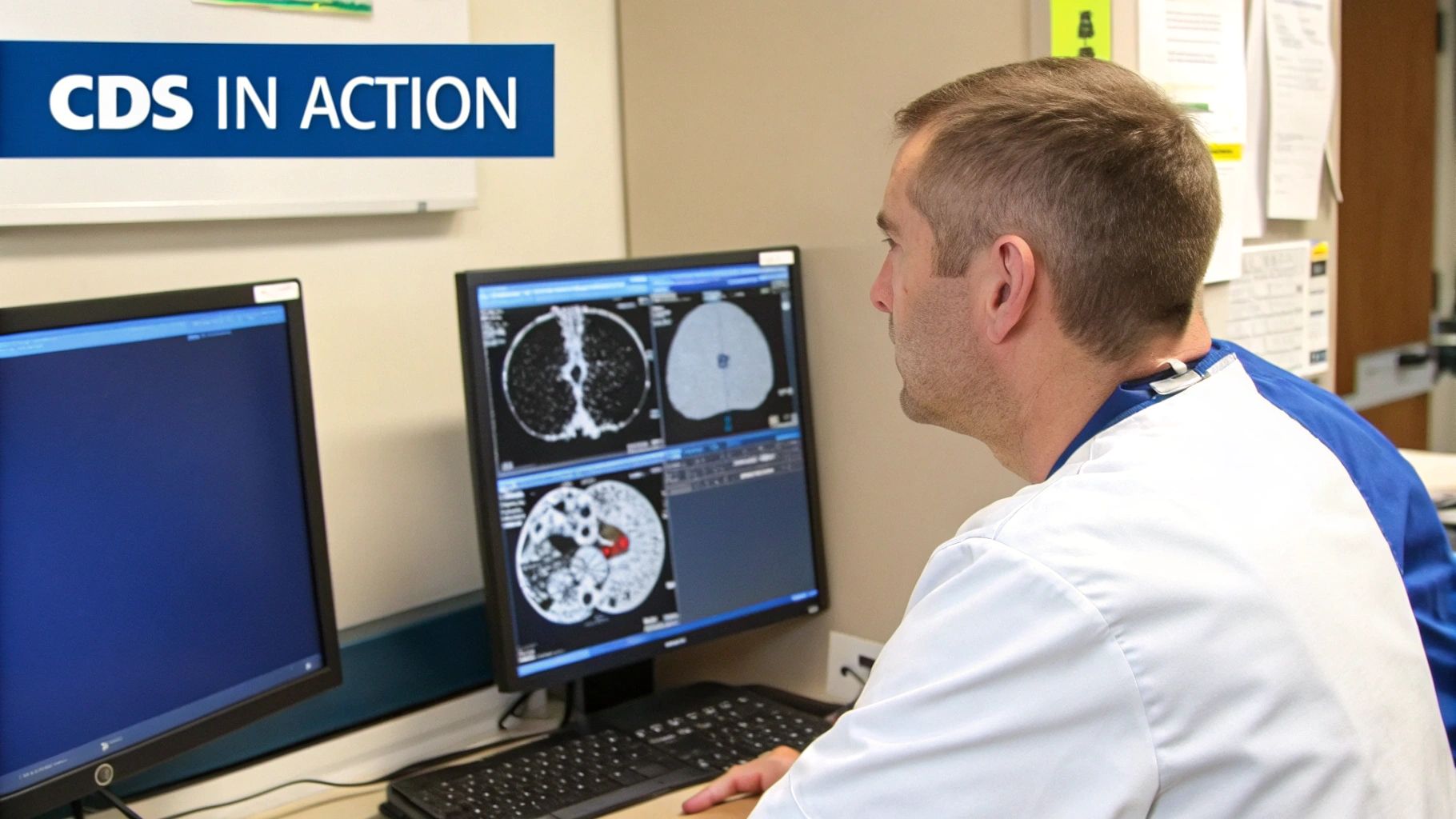
So, let's shift from the 'how' to the 'what' and look at concrete examples of AI CDS transforming clinical practice. These stories really bring home the positive impact on both clinicians and the patients they serve.
Enhancing Diagnostic Accuracy in Radiology
Medical imaging is the bedrock of modern diagnosis, but the sheer volume of scans can be overwhelming. Radiologists are under immense pressure to spot minuscule abnormalities in incredibly complex images, where a tiny oversight can have massive consequences. This is where AI CDS steps in as a second pair of expert eyes, flagging subtle patterns that might point to early-stage disease.
Think of it this way: an AI algorithm trained on thousands of mammograms can identify suspicious microcalcifications or lesions that are almost invisible to the human eye. It doesn’t make the final call. Instead, it directs the radiologist’s attention to areas of concern, ensuring potentially critical findings aren't missed. This teamwork between the human expert and the AI tool leads to earlier cancer detection, right when treatment is most effective. We've gone into more detail on this topic in our guide on AI for medical imaging and diagnostics.
Personalising Oncology Treatment Plans
Oncology is another area where AI CDS is making huge strides. Cancer isn't one disease; it’s a universe of complex, unique conditions. A treatment that works wonders for one patient might do nothing for another, even with the same cancer type. The future is all about personalised medicine, guided by a patient's unique biological blueprint.
AI CDS platforms can take a patient's genomic data, tumour characteristics, and clinical history and cross-reference them all against a massive database of treatment outcomes and clinical trials. The system can then suggest personalised therapy options, predicting which drug combinations are most likely to work while minimising side effects. This gives oncologists the power to move beyond one-size-fits-all protocols and design treatment strategies truly tailored to the individual. For a hands-on feel of how such tools function in a clinical setting, you can even explore a domain-specific free AI assistant.
These use cases show the real power of custom AI development services in building solutions for specific, high-stakes clinical problems. The goal is always to augment the clinician’s expertise, not replace it, by delivering sharp, data-driven insights right at the point of care.
Streamlining Hospital Operations and Reducing Burnout
The impact of AI CDS goes far beyond patient diagnosis and treatment. It’s also having a massive effect on operational efficiency and, just as importantly, clinician well-being. Administrative overload is a primary driver of burnout, with doctors and nurses losing precious hours to documentation instead of patient care. AI is proving to be a powerful antidote here.
A fantastic example comes from The Ottawa Hospital's trial of Microsoft's DAX Copilot. This AI-powered tool dramatically reduced documentation time for clinicians, who often spend around 10 hours per week just on charting. The results were incredible: 70% of clinicians reported feeling less burnout, and the emergency department was able to see about two extra patients per physician, per shift. That's time shifted directly from paperwork back to people.
But the operational wins don't stop there. Other uses for AI CDS include:
Predicting Patient Admissions: By analysing A&E data in real-time to forecast admissions, hospitals can manage bed capacity and staff rotas far more effectively.
Optimising Surgical Scheduling: AI can look at surgical backlogs and operating theatre availability to build smarter schedules, cutting down patient wait times.
Identifying At-Risk Patients: These systems constantly monitor EHR data to flag patients at high risk of developing sepsis or hospital-acquired infections, allowing for proactive intervention.
These applications demonstrate how our data and AI services deliver value across the entire healthcare ecosystem, improving not only patient outcomes but also the long-term sustainability of the system itself.
Navigating the Ethical and Regulatory Landscape
Bringing an AI clinical decision support system into a healthcare setting isn't just a tech project. It’s a deep dive into a complex world of ethical standards and regulatory hurdles. In Canada, this means any tool you implement has to do more than just work well; it needs to align with frameworks from Health Canada and strictly follow data privacy laws like the Personal Information Protection and Electronic Documents Act (PIPEDA).
Getting this right is all about building trust: with regulators, with your clinical teams, and most importantly, with patients. It all comes down to solid governance, ensuring that every insight the AI provides is fair, transparent, and serves the patient's best interest.
Confronting Algorithmic Bias
One of the biggest ethical minefields we have to navigate is algorithmic bias. Think about it: if an AI model learns from data that doesn't reflect the true diversity of your patient population, it can easily start making skewed recommendations. It might even make existing health inequities worse.
For instance, an algorithm trained mostly on data from a single demographic could be less accurate for everyone else, potentially leading to missed diagnoses and a lower standard of care for certain groups. Tackling this head-on is a non-negotiable part of responsible AI development.
Curating Diverse Datasets: This means you have to be proactive about sourcing and balancing training data across different ethnicities, genders, ages, and socioeconomic backgrounds.
Continuous Auditing: You can't just "set it and forget it." The model needs regular check-ups to see how it's performing for various subpopulations, so you can spot and fix biases as they emerge.
Transparency in Performance: Be upfront with clinicians about the model’s known limitations and where its performance might vary. They need to know what they're working with.
Fixing bias isn't just about tweaking code; it's a fundamental commitment to providing equitable care for everyone. For a closer look at this topic, our article on AI in healthcare and data privacy in Canada goes into much greater detail.
The Non-Negotiable Human in the Loop
No matter how sophisticated these AI tools get, the principle of human-in-the-loop oversight is here to stay. An AI CDS system is designed to be a co-pilot, not the pilot. It’s there to enhance a clinician's expertise, not to replace their hard-earned professional judgement. The final call must always rest with a qualified person.
This approach guarantees that the nuanced, contextual understanding that only a human can bring remains at the heart of the care process. The AI delivers data-driven insights; the clinician provides the wisdom, empathy, and ultimate accountability.
This partnership is absolutely critical for patient safety. It creates a vital checkpoint where a clinician can weigh the AI’s suggestions against their own knowledge of the patient’s history, their unique situation, and the bigger picture – stopping potential errors before they can do any harm.
Bridging the Trust Gap Between Clinicians and Patients
Building a fair and accountable system is only half the puzzle. The other half is earning the trust of the very people it’s meant to help. There’s often a huge gap in perception between clinicians, who see the incredible potential of AI, and patients, who might feel nervous about an algorithm playing a role in their health.
The 2025 Philips Future Health Index for Canada puts this divide in sharp focus. It found that while 84% of healthcare professionals are convinced AI can save lives, patients are 37 percentage points less optimistic – one of the widest trust gaps in the world. Clinicians are worried that moving too slowly on AI will lead to more burnout (44%) and missed chances for early disease detection (35%). You can read the full research about these findings on AI perceptions to see just how big this challenge is.
Closing this gap comes down to clear and honest communication. We need to talk to patients about how AI is being used, how their data is kept safe, and why the "human-in-the-loop" model ensures a skilled clinician is always in charge. The successful future of AI in healthcare depends entirely on our ability to earn and keep that trust.
Your Practical Implementation Checklist
Bringing an AI clinical decision support project to life can seem overwhelming. The key is to break it down into a structured, phased approach, turning a massive undertaking into a series of clear, manageable steps. This checklist is your blueprint, designed to guide your organisation from the initial idea all the way to a successful and sustainable deployment.
Getting the foundation right is everything. A solid plan ensures your AI CDS tool not only provides real clinical value but also fits neatly into the fast-paced reality of patient care. This is how you drive adoption and, ultimately, improve outcomes.
Phase 1: Define Your Clinical and Strategic Goals
Before you even think about code or vendors, you need to define what success actually looks like. A vague goal like "we want to use AI" is a recipe for failure. Instead, you need to pinpoint a specific, measurable clinical problem you're trying to solve.
Identify a High-Impact Use Case: Are you trying to cut down on diagnostic errors in radiology? Predict sepsis risk in the ICU? Or maybe streamline medication reconciliation? Start with one distinct problem.
Establish Key Performance Indicators (KPIs): How will you know if it's working? Your success metrics could be a reduction in patient length-of-stay, better diagnostic accuracy rates, or a drop in adverse drug events.
Secure Stakeholder Buy-In: Get your clinicians, IT team, and administrative leaders in the same room from day one. Their insights are absolutely critical to building a solution that solves real-world pain points and is actually practical to use.
This first phase sets the entire strategic direction. It ensures your investment in technology is directly tied to a tangible improvement in patient care or operational efficiency.
Phase 2: Select the Right Technology and Partner
With clear goals in hand, it's time to find the right technology – and, more importantly, the right partner. Not all AI solutions are built the same, and the team you choose will have a huge impact on your project's outcome. As we’ve covered in our guide to AI in medical software development, a partner with deep healthcare expertise isn't just a nice-to-have; it's a necessity.
When you’re vetting potential partners for their AI development services, dig into these areas:
Proven Healthcare Experience: Do they genuinely understand the ins and outs of clinical workflows and Canadian data security standards like PIPEDA?
Technical Capability: Can they show you concrete examples of building, validating, and deploying machine learning models in a highly regulated environment?
Collaborative Approach: You want a true partner, not just a vendor. Look for a team that’s invested in understanding your unique challenges and is willing to co-create a solution with you.
Choosing a partner is a long-term commitment. You need a team that can not only build the initial tool but also support its evolution with ongoing monitoring, maintenance, and updates as your clinical needs change.
Phase 3: Focus on Data and Integration
An AI CDS system is only as smart as the data it’s trained on and as useful as its ability to fit into existing workflows. This is the phase where you lay the technical groundwork for a tool that clinicians will actually want to use.
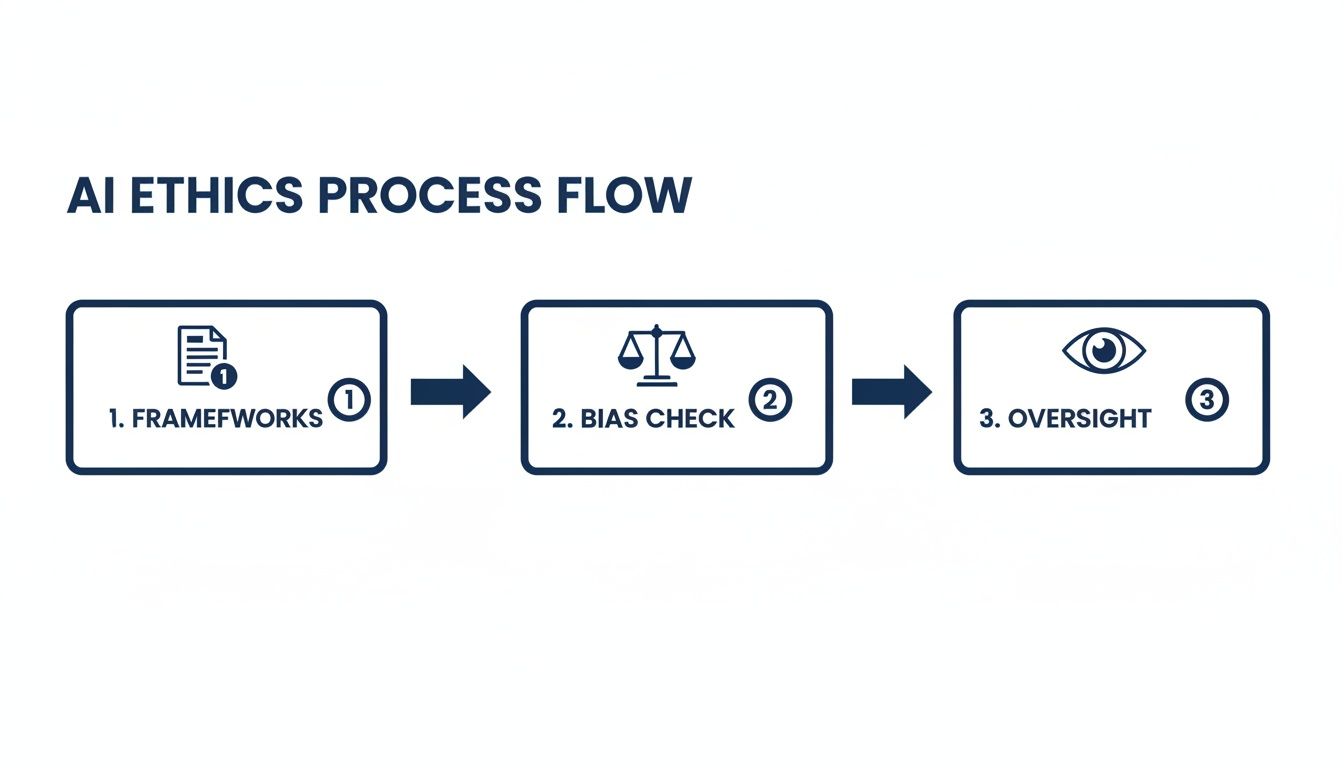
A clear process for maintaining ethical standards, from defining frameworks to ongoing oversight, is essential for building and maintaining trust in the system.
First up is data governance. You have to ensure your data is clean, secure, and truly representative of your patient population to avoid baking in algorithmic bias. Next, plan for a completely seamless EHR integration. If your tool forces clinicians to jump between different applications, it will be abandoned. The goal is to embed the AI’s insights directly into their point-of-care workflow, making it feel like a natural part of their existing toolkit.
Phase 4: Implement a Phased Rollout and Monitor Performance
Whatever you do, avoid a "big bang" launch. A much smarter strategy is a phased rollout, starting with a pilot group of enthusiastic champion users. This gives you a chance to gather priceless real-world feedback and iron out any wrinkles before a full-scale deployment.
Launch a Pilot Programme: Pick a specific department or clinical team to test the AI CDS tool in a controlled setting.
Gather Continuous Feedback: Set up formal channels for users to report bugs, suggest improvements, and share their success stories.
Monitor KPIs and Validate Models: Keep a close eye on your AI model's performance against the KPIs you set back in phase one. Models can "drift" over time, and ongoing validation is non-negotiable for ensuring safety and accuracy.
Scale Incrementally: Use what you learn from the pilot to refine the tool and your training process before expanding it across the rest of the organisation.
Following a structured checklist like this transforms a complex project into a manageable, value-driven success story. This is the kind of work we specialise in, and our team has the deep experience needed to bring these projects to life.
What's Next for Augmented Clinical Intelligence?
The story of AI clinical decision support is really just getting started. We're moving beyond simply making today's workflows a bit better and are now on the cusp of fundamentally reshaping how healthcare is delivered tomorrow. The future isn't about replacing clinicians; it's about creating a true partnership – a system of augmented intelligence where technology amplifies human expertise. This will allow us to make healthcare more predictive, more personalised, and far more efficient, tackling deep-rooted problems like clinician burnout and the ever-increasing complexity of patient care.
We're already seeing glimpses of what's to come. Generative AI, for example, is poised to take a huge bite out of clinical documentation and the mountain of administrative work that bogs down a clinician's day. That means more time freed up for actual patient conversations. At the same time, when you combine sophisticated AI analytics with genomic data, you start to make hyper-personalised medicine – treatments designed for a person's unique biology – a real and accessible option, not just a futuristic concept.
A More Connected and Proactive System
But maybe the most exciting frontier is how we'll soon integrate real-time data from wearables and remote patient monitoring tools. Think about it: AI models that continuously analyse this constant stream of data, spotting health risks long before symptoms even surface. This allows for truly proactive, preventative care, shifting the entire healthcare model from reacting to sickness to actively maintaining wellness.
This is the vision that gets us excited – a system that’s not only more efficient and effective but also more human-centric. It’s what motivates our work in creating custom AI development services that help healthcare organisations lay the groundwork for this future. We’re convinced that by applying technology with care and intention, we can empower clinicians and dramatically improve patient lives.
The road ahead demands a deep understanding of both the technology itself and the real-world clinical needs, and that’s a balance our team lives and breathes every day. If you want to see the values and expertise guiding our work in this space, we invite you to learn more about our team and our mission.
Frequently Asked Questions
As you explore bringing AI clinical decision support into your organisation, a lot of practical questions are bound to come up. Let’s walk through some of the most common ones we hear from healthcare leaders about implementation, safety, and the role of the clinician.
Will AI Clinical Decision Support Replace Doctors and Nurses?
Absolutely not. The goal here is augmentation, not replacement.
Think of an AI CDS tool as a highly advanced co-pilot for your clinical team. It can sift through mountains of data in seconds, spotting patterns and flagging potential risks that might otherwise be missed. This frees up doctors and nurses to do what they do best: focus on nuanced patient care, complex decision-making, and the human side of medicine.
The "human-in-the-loop" model is non-negotiable. A qualified clinician always, always makes the final call. It’s about putting better tools in their hands, not taking the work out of them.
How Do You Ensure AI CDS Tools Are Safe and Unbiased?
This is a critical question, and the answer isn't a one-and-done checkbox. Ensuring an AI clinical decision support tool is safe and fair is a continuous, multi-layered process.
It all starts with the foundation:
Diverse Training Data: We begin by training the AI on broad, representative patient datasets. This is the first and most important step to prevent embedding biases right from the start.
Rigorous Validation: Before a tool ever touches a live clinical setting, it’s put through its paces with exhaustive testing and validation to prove it’s both accurate and safe.
Continuous Monitoring: Once deployed, the work doesn't stop. We constantly monitor performance, fairness, and accuracy to catch and correct any issues, like model drift, before they can impact care.
This combination of proactive design, strict validation, and ongoing oversight is how we ensure these powerful systems are used responsibly and ethically.
What Is the Biggest Challenge When Implementing an AI CDS System?
From our experience, the single biggest hurdle is workflow integration.
You can have the most brilliant AI algorithm in the world, but if it disrupts how a clinician works, it’s destined to fail. If it means more clicks, another screen to check, or a clunky interface, nobody will use it. It’s that simple.
A successful rollout hinges on a deep partnership between the technology team providing the AI development services and the clinical staff on the front lines. As we explored in our AI solutions guide, this collaboration ensures the tool feels like a natural part of their day, delivering insights exactly when and where they're needed. Strong change management and proper training are the final pieces that turn a technical project into a true clinical asset.
Our team has spent years building and deploying custom data and AI services, and we’ve learned these lessons firsthand. To see how our experience and values shape our approach, we invite you to learn more about our company and our commitment to building trustworthy healthcare solutions.