

AI fraud detection for online stores in Canada is less about rigid rules and more about teaching a smart system to spot trouble. Think of it as a dynamic defence that uses machine learning to sift through transaction data and customer behaviour in real-time. Its job is to identify and shut down fraudulent activity before it can hit your bottom line, giving modern ecommerce businesses a much-needed security boost.
The Escalating Threat of Ecommerce Fraud in Canada
Watching your sales numbers climb should be a moment of pride, not a source of anxiety. But for too many Canadian online store owners, the shadow of sophisticated fraud hangs over every single transaction. As the digital marketplace grows, so do the creative ways criminals find to exploit it, turning your hard-earned profits into a nightmare of chargebacks and operational chaos.
In this environment, having strong security isn't just a "nice-to-have"; it's fundamental to your survival and growth.
Traditional, rule-based systems just aren't cutting it any more. These old-school methods, which might flag a simple mismatch between a billing and shipping address, are easily outsmarted by fraudsters who are constantly evolving their tactics. They struggle to catch complex schemes and, even worse, often end up blocking legitimate customers, which just leads to frustration and lost sales.
The True Cost of Inaction
Ignoring the problem isn't an option, and the damage – both to your finances and your reputation – can be severe. The latest data paints a grim picture for Canadian retailers. For every $1 of fraud a merchant has to deal with, the real cost balloons to an average of $4.52. That number includes the lost merchandise, painful chargeback fees, and the staff time spent on manual reviews.
Making matters worse, mobile transactions are a huge source of this pain, now accounting for 41% of Canadian ecommerce fraud costs. This really highlights how outdated security measures are failing in a world where everyone shops on their phone.
To put the current situation into perspective, here’s a quick look at the major fraud challenges Canadian merchants are up against.
Key Fraud Challenges for Canadian Online Stores
| Challenge | Impact on Canadian Merchants | Relevance of AI Solution |
|---|---|---|
| High Cost of Fraud | For every $1 lost to fraud, merchants lose $4.52 in total costs (goods, fees, labour). | AI reduces false declines and stops fraud before the transaction completes, directly cutting these associated costs. |
| Mobile Fraud Vulnerability | Mobile channels account for 41% of all ecommerce fraud costs in Canada. | AI analyses mobile-specific data points (device ID, location, app behaviour) to better distinguish legitimate users from fraudsters. |
| Over-reliance on Manual Review | A shocking 41% of businesses still rely on manual processes, with only 3% fully automated. | AI automates the vast majority of transaction reviews, freeing up human teams to handle only the most complex, high-risk cases. |
This heavy dependence on manual review isn't just inefficient; it's a gaping hole in your defences that fraudsters are more than happy to exploit.
Why AI Is the Modern Solution
This is exactly where AI fraud detection for online stores in Canada steps in. Instead of just ticking boxes off a static checklist, an AI system acts like a hyper-aware security expert who learns from every single interaction on your site.
In the blink of an eye, it can analyse thousands of data points: everything from typing speed and mouse movements to device information and transaction history, to build a rich, detailed picture of every user. This allows the system to spot subtle red flags that would be completely invisible to a human reviewer or a simple rule-based filter.
The benefits are immediate and tangible:
Reduced Chargebacks: By catching fraudulent transactions at the door, AI dramatically cuts down on the number of expensive chargebacks you have to deal with.
Improved Customer Experience: Legitimate customers get a smooth, hassle-free checkout because the system is smart enough not to block them by mistake.
Lower Operational Costs: Automating the fraud review process lets your team focus on what really matters – growing the business, not chasing down crooks.
To get a handle on these risks, it’s worth exploring some proven ecommerce fraud prevention best practices. In today's market, bringing in an AI-driven approach isn't just a forward-thinking move; it's a core part of building a secure and successful online business in Canada.
How AI Works as Your Digital Security Guard
Think of an AI fraud detection system less like a bundle of code and more like a seasoned security guard for your online store. This guard never sleeps, never takes a coffee break, and learns from every single person who walks through the virtual door. It’s like an experienced shopkeeper who can spot suspicious behaviour a mile away, while a new employee might miss the subtle signs.
Instead of just ticking boxes on a checklist, this digital guard sifts through thousands of data points in the blink of an eye. It builds a rich, detailed picture of every user, instantly telling the difference between a loyal customer and a fraudster trying to blend in. This smart, self-improving shield for your revenue is built on a few core technologies working in perfect harmony.
Machine Learning: The Brain of the Operation
The engine driving any modern AI fraud detection tool is machine learning (ML). This is the part that actually learns. The system is trained on mountains of historical transaction data, from your store and thousands of others, to understand the DNA of both legitimate purchases and fraudulent ones.
Every new transaction feeds the system more information, making it smarter and sharper over time. It's like a detective who gets better with every single case, quickly recognising new tricks and tactics as they pop up. This ability to constantly adapt is what leaves old-school, static rule-based systems in the dust. You can get a deeper look into this technology by exploring our guide on artificial intelligence for threat detection.
An AI doesn’t just follow the rules; it writes them. By finding hidden patterns across millions of transactions, it develops its own deep understanding of normal customer behaviour. This allows it to flag even the slightest, most subtle oddities with startling accuracy.
Behavioural Analytics: Reading Digital Body Language
If machine learning is the brain, then behavioural analytics provides the eyes and ears. This technology focuses on a user's "digital body language" as they move through your online store. It’s not just about what they buy, but how they go about it.
For example, a real customer usually browses a bit, adds items to their cart, and types out their address at a natural pace. A fraudster using a stolen credit card? Their behaviour often tells a very different story.
Here are a few of the digital tells AI is looking for:
Typing Speed and Cadence: Unnaturally fast or robotic typing, especially when entering payment details, is a major red flag.
Mouse Movements: Jittery, erratic, or perfectly straight mouse movements often point to an automated bot, not a person.
Copy-Pasting Information: Criminals frequently copy and paste stolen card numbers and addresses – a simple action that AI can easily spot.
Time Spent on Pages: A user who lands on a high-value product and rushes to checkout without a second thought is acting outside the norm.
The diagram below breaks down the common pain points of fraud, like high costs and endless manual reviews, and shows exactly where an AI solution steps in to help.
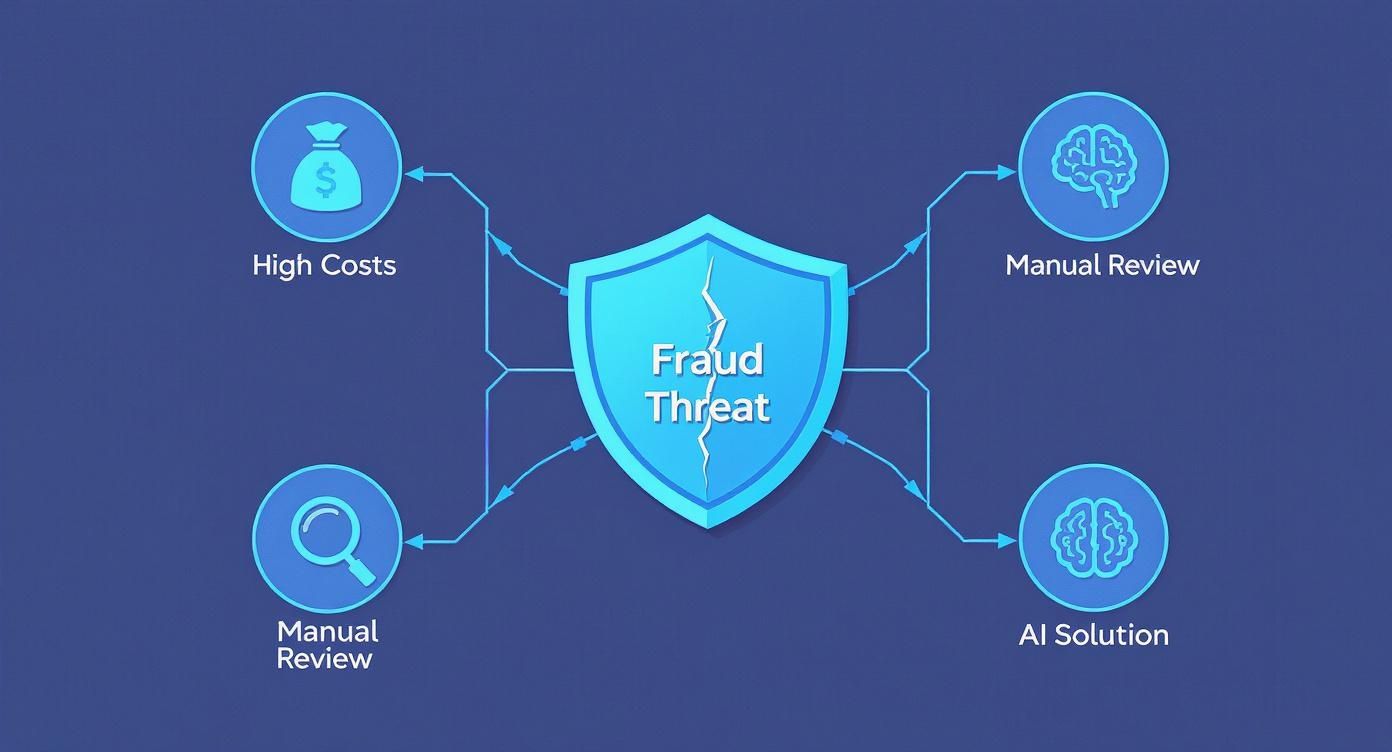
It’s clear that while the cost and effort of manual reviews can be overwhelming, a smart AI provides a direct and powerful defence.
Anomaly Detection: Spotting What Doesn't Belong
Finally, anomaly detection is the part of the system that raises the alarm. After analysing all the behavioural and transactional data, the AI gives each order a risk score. If a transaction strays too far from what's considered "normal," it gets flagged as an anomaly.
This might be a first-time customer placing an unusually massive order and shipping it to another country. Or it could be someone who tries five different credit cards before one finally works. The stakes are incredibly high; the Canadian Anti-Fraud Centre (CAFC) reported that Canadians lost over $530 million to fraud in 2022 alone. With online stores being a prime target, it's no wonder that fighting fraud has become a top priority.
By weaving together machine learning, behavioural analytics, and anomaly detection, an AI system acts as a complete, intelligent security detail for your business – a powerful defence that adapts in real-time to protect your revenue and your hard-earned reputation.
Getting to Know the Most Common Online Store Fraud Schemes
To build a solid defence for your online store, you have to get inside the mind of a fraudster. They're not just relying on simple stolen credit cards any more; their methods have become incredibly sophisticated, designed to outsmart both merchants and old-school security systems.
For Canadian ecommerce businesses, this means learning to spot the unique fingerprints of different types of attacks. When you understand how these schemes work, you start to see how a smart AI system can pick apart their plans, turning what looks like a legitimate order into a massive red flag. This knowledge is your first and best line of defence.

Synthetic Identity Fraud: The Meticulous Deception
One of the most dangerous threats out there is synthetic identity fraud. This isn't your typical identity theft. Instead, a criminal painstakingly builds a completely new, fake identity from scratch. They'll often combine a piece of real, stolen data, like a legitimate Social Insurance Number, with totally made-up details, like a fake name and address.
They play the long game. Over months, they'll build a credit history for this "synthetic" person, applying for small loans or a credit card to make them look like a real, trustworthy consumer. Once the fake identity seems legitimate, they'll use it to target online stores for big-ticket items.
This is a fast-growing problem in Canada. A recent study highlighted that synthetic identity fraud had the biggest year-over-year jump of all fraud types, with a jaw-dropping 68% surge in suspected digital fraud attempts in certain online sectors. You can dig into the full study on these rising fraud rates and their business impact.
How AI Catches the Ghost: An AI system looks deeper than just a single data point. It analyses the entire digital footprint, or the lack of one. It can flag an account that has a decent credit score but no social media history, a very thin transaction record, or odd behaviours, like using a brand-new email for a major purchase.
Account Takeover: The Digital Hijacking
Account Takeover (ATO) is a direct attack on your best customers. Fraudsters get their hands on a real customer's login details, usually through phishing emails or by using passwords stolen from data breaches at other websites.
Once they're in, they’ve hit the jackpot. They can change the shipping address, place orders with the saved credit card, and even cash out loyalty points. Because the order is coming from a familiar, trusted account, it sails right past most basic, rule-based fraud filters without a second glance.
Friendly Fraud: The Buyer's Remorse Weapon
Interestingly, not all fraud is committed by shadowy criminals. "Friendly fraud" happens when a real customer buys something, receives it, and then calls their bank to dispute the charge. They'll claim they never got the item or that the transaction was fraudulent. This is also known as chargeback fraud.
While some cases are genuine mistakes, it’s often a deliberate attempt to get a product for free. For you, the merchant, this is a triple blow: you lose the product, the revenue, and you get hit with a painful chargeback fee from your payment processor.
To give you a clearer picture, let's break down how AI stacks up against these common schemes.
AI Detection Methods vs Common Fraud Types
| Fraud Type | How It Works | How AI Detects It |
|---|---|---|
| Synthetic Identity | Criminals create a new, fake identity using a mix of real and fabricated data to appear legitimate. | AI detects the lack of a deep digital history and flags inconsistencies across data points that a human would miss. |
| Account Takeover | A fraudster gains access to a real customer's account to place unauthorised orders. | AI spots sudden, uncharacteristic changes in behaviour, such as a new shipping address, a different device login, or an unusual purchase time. |
| Friendly Fraud | A real customer disputes a legitimate charge, claiming it was fraudulent to get a refund. | AI analyses the customer's purchase history and behavioural patterns to identify users with a high statistical likelihood of filing false chargebacks. |
By understanding these common tactics, it becomes crystal clear why AI fraud detection for online stores in Canada is no longer a nice-to-have, but a necessity. It moves beyond just checking the boxes to understanding the story, context, and behaviour behind every transaction, giving you the intelligent shield your business needs to thrive.
How to Get AI Fraud Detection into Your Canadian Store

Knowing the threats is one thing, but actually doing something about them is what counts. For Canadian store owners, putting AI fraud protection in place is a crucial step to protect their bottom line and earn their customers' trust. The great news? You’ve got options, and they can be matched to your store's size, your technical comfort level, and your budget.
Whether you're running a small boutique on Shopify or a growing business on a custom platform, stronger security is more accessible than you might think. It’s all about finding the right fit – a solution that delivers the power you need without breaking the bank or being a headache to manage.
Choosing Your Integration Path
When it comes to adding AI fraud detection for online stores in Canada, you generally have two main routes. The most popular path for most businesses is using a third-party application. The other, more complex route is building a custom, in-house system from scratch.
For the vast majority of merchants, especially those using well-known ecommerce platforms, third-party apps are the fastest and most effective way to get protected.
Third-Party Apps for Popular Platforms
Think of this as the "plug-and-play" option. Marketplaces for platforms like Shopify, WooCommerce, and Magento are packed with powerful, AI-driven fraud detection tools. These apps are built to integrate seamlessly, often getting you up and running with just a few clicks.
Common Platforms in Canada:
Shopify: The Shopify App Store is your first stop. You'll find dozens of highly-rated fraud prevention apps that plug right into your store's data. They analyse orders as they happen, giving you a risk score and a clear recommendation: approve, review, or deny.
WooCommerce: Since it's a flexible WordPress plugin, WooCommerce can connect with all sorts of third-party security services. These solutions can be fine-tuned to match the specific risks your business faces.
Magento (Adobe Commerce): Known for handling huge volumes, Magento is a favourite of larger businesses. Its marketplace offers advanced fraud management extensions that use sophisticated AI to shield high-volume stores from complex attacks.
The biggest win here is speed and simplicity. You get access to a powerful AI brain that has learned from millions of transactions worldwide – all without writing a single line of code.
By opting for a third-party app, you are essentially renting a world-class security team. These systems are constantly updated by experts to combat new fraud tactics, giving you enterprise-level protection at a fraction of the cost.
Custom In-House AI Systems
For massive retailers with unique fraud problems and their own data science teams, building a custom AI model can be a smart long-term move. This approach gives you total control, letting you tailor the fraud detection logic precisely to your products, customer behaviour, and risk tolerance.
Be warned, though, this path is extremely resource-intensive. It demands a serious investment in development, infrastructure, and ongoing maintenance. The process involves collecting huge amounts of clean data, training machine learning models, and building systems that can analyse transactions in milliseconds. Exploring the ins and outs of AI-powered ecommerce development can give you a better idea of just how big this undertaking is.
Weighing Your Options
So, which way should you go? It really comes down to a few key questions about your business's current reality and future plans. For a deeper dive into protecting your store, especially if you're in a high-risk industry, this strategic guide to ecommerce fraud prevention is an invaluable resource.
Here’s a straightforward comparison to help you decide:
| Factor | Third-Party App | Custom In-House System |
|---|---|---|
| Cost | Low monthly subscription fees, predictable costs. | High initial investment and ongoing maintenance expenses. |
| Technical Skill | Minimal; basic configuration is often all that's needed. | Requires a dedicated team of data scientists and engineers. |
| Speed to Deploy | Fast, often deployable within minutes or hours. | Slow, can take many months or even years to build and test. |
| Scalability | Excellent, managed by the provider to handle growth. | Scalability depends entirely on your own infrastructure. |
Ultimately, for the vast majority of Canadian online stores, a reputable third-party app hits the sweet spot. It offers the ideal blend of advanced protection, affordability, and ease of use, letting you focus on growing your business while a powerful AI works around the clock to keep it safe.
Meeting Canadian Compliance and Payment Processor Rules
Running an online store in Canada is about more than just great products and smooth sales. You're also operating within a specific framework of data privacy laws and financial rules. When you bring an AI fraud detection system on board, you're not just adding a security tool; you're taking a critical step to stay compliant. The right system helps you handle customer data with care and meet the tough standards set by Canadian payment processors.
Getting this right is crucial for earning customer trust and making sure you can process payments without a hitch. For any Canadian business, compliance isn't just a legal box to tick; it's the foundation of a healthy, long-lasting company.
Navigating PIPEDA with AI
In Canada, the big piece of privacy legislation for private businesses is the Personal Information Protection and Electronic Documents Act (PIPEDA). It sets the rules for how you collect, use, and protect your customers' personal information. Every time a customer buys something, they're trusting you with their data, and PIPEDA is your guide to protecting it properly.
A modern AI fraud detection for online stores in Canada is built from the ground up with these rules in mind. Here’s how it helps you stay on the right side of the law:
Focused Data Use: The AI system is designed to do one thing: analyse data to spot and stop fraud. This lines up perfectly with PIPEDA's rule that you can only use customer information for the specific, clear purpose you collected it for.
Airtight Data Security: Trustworthy AI vendors use powerful encryption and security measures to protect customer data, whether it's being sent across the internet or stored on a server. This directly meets PIPEDA's requirement to shield personal info from prying eyes.
Less is More: The system works its magic by looking at transaction details and behavioural patterns, not by digging through unnecessary personal information. It finds risk by spotting anomalies, not by invading privacy.
By using a compliant AI tool, you're doing more than just stopping crooks. You're showing your customers that you take their privacy seriously, which is a huge factor in building loyalty.
Meeting Payment Processor Standards
Beyond government regulations, you also have to play by the rules set by the major payment processors in Canada, like Moneris, Stripe, and Square. These companies have their own strict anti-fraud requirements to manage their risk. If you don't meet their standards, you could be hit with fines, higher fees, or even lose your ability to accept payments altogether.
Processors expect merchants to keep their chargeback ratio low – usually under 1% of all transactions. An AI system is your best defence for staying below that critical number by stopping fraudulent orders before they turn into expensive chargebacks.
An AI-powered solution helps you meet these processor demands in a few smart ways. It adds an automated, intelligent security layer that processors value, proving you're being proactive about protecting your sales. It scores transactions in real-time and can automatically block high-risk orders, slashing your fraud exposure. In the end, this keeps your relationship with your payment partners strong and protects a vital part of your business.
Measuring the Success of Your AI Fraud Prevention
So, you've put an AI fraud detection system in place. That's a great first step, but how do you know it's actually working? To see the real-world impact on your business, you need to move beyond just hoping for the best and start tracking the right numbers. The whole point is to see a clear return on your investment, not just in fraud stopped, but in smoother operations and a better experience for your customers.
Success isn't about a single number. It’s about seeing a positive shift across several key performance indicators (KPIs). Think of these numbers as telling the story of your store's financial health and customer satisfaction, showing exactly how your investment is paying off.
Key Metrics to Monitor
To really get a handle on how effective your AI fraud detection for online stores in Canada is, you'll want to keep a close eye on three main metrics. Each one gives you a different piece of the puzzle, showing you how the system is performing and what it means for your bottom line.
These are the essential KPIs you should have on your dashboard:
Chargeback Rate: This is the big one, the most direct measure of fraud hitting your business. Your goal here is simple: a significant drop in the percentage of transactions that end up as a chargeback. For instance, a Montreal-based fashion retailer might see their rate fall from 1.2% to below 0.4% in just a few months, saving them thousands in lost revenue and painful fees.
Manual Review Queue: A smart AI system should be doing the heavy lifting for you, automating the vast majority of decisions. Keep track of how many orders your team has to manually check each day. A Calgary-based subscription service, for example, could slash its manual review queue by over 85%. That's the time your staff gets back to focus on genuine customer service instead of playing detective.
False Positive Rate: This metric is all about the customer experience. It tracks how many perfectly good orders from legitimate customers get incorrectly declined. A lower rate is what you're after because it means you're not turning away good customers and damaging your reputation. Reducing that friction is crucial for keeping people coming back.
A well-implemented AI creates a fantastic feedback loop. As fraud and chargebacks go down, your team spends less and less time slogging through manual reviews. That new efficiency, combined with a higher approval rate for good customers, leads directly to a healthier, more profitable business.
Seeing the Broader Business Impact
The benefits don't stop with just those core metrics. When your chargeback rate drops, you start to look a lot better to your payment processors, which can even lead to better processing rates down the line. Plus, a seamless checkout experience for legitimate customers builds the kind of trust that encourages repeat business.
Understanding how all these pieces fit together is key. You can get a much clearer view by exploring how AI-driven ecommerce analytics in Canada paint a complete picture of your store’s performance. By tracking these indicators, you’ll have the hard, data-backed proof that your AI fraud prevention system isn't just a security cost; it's a serious engine for growth.
Your Questions Answered
If you’re thinking about using AI to fight fraud in your Canadian online store, you probably have a few practical questions. Let’s tackle some of the most common ones head-on, covering everything from cost and customer experience to data privacy.
How Much Does AI Fraud Detection Cost for a Small Canadian Business?
The good news is that AI fraud detection is surprisingly scalable, so you don't need a massive budget to get started. Many top-tier providers offer pricing plans that grow with you, usually based on your number of monthly transactions or total sales volume.
For a small business, you can often find entry-level plans starting around $50 to $100 per month. These typically cover all the essentials, like automated analysis and risk scoring. It’s a model designed to make sure you’re only paying for what you need, turning a potentially unpredictable expense, like fraud losses, into a manageable operational cost.
Will This Slow Down My Checkout Process?
This is a huge concern for merchants, and rightfully so. No one wants to lose a sale because of a clunky checkout. But modern AI fraud detection tools are built for speed. They analyse dozens of data points in milliseconds, a timeframe completely invisible to your customer.
The entire process happens in the background, almost instantly. For your legitimate customers, the experience is seamless; they just click "buy" and get their confirmation. The result is a secure checkout that builds trust without adding any friction.
What Data Does the AI Need, and Is It Secure?
The AI isn't snooping on your customers' personal lives; it's looking for patterns in transactional and behavioural data to spot anomalies. Think of it as a digital detective, not a spy.
Here's what it typically looks at:
Transaction Details: Things like the order total, the specific items purchased, and the payment method used.
Device and Location Info: The IP address, the type of device being used, and where the order is being shipped.
Behavioural Signals: How someone interacts with your site, for instance, do they copy-paste card details suspiciously fast?
Any reputable provider serving Canadian businesses will be fully compliant with privacy laws like PIPEDA. They use heavy-duty encryption and strict security measures to keep this data safe. The information is used for one thing and one thing only: preventing fraud and protecting your store.
Ready to protect your online store with intelligent, real-time security? Cleffex Digital Ltd builds custom software solutions that integrate powerful AI to safeguard your revenue and enhance customer trust. Discover how we can help secure your Canadian ecommerce business at Cleffex.com.