At its core, predictive analytics in ecommerce is about using your past and current data to make highly educated guesses about the future. Think of it as the digital version of a seasoned shopkeeper who knows customers so well they can anticipate exactly what they'll want the moment they walk through the door. This moves your business from reacting to what’s already happened to proactively shaping what happens next, turning raw data into a real strategic advantage.
Why Predictive Analytics Is Reshaping Ecommerce

Picture that old-fashioned shopkeeper who remembers a customer's favourite colour, their kids' birthdays, and when they're about to run out of their usual order. That kind of service builds loyalty because it's personal and anticipates needs. Predictive analytics is how you deliver that same master-level service, but at the scale of a modern online store.
Instead of just relying on gut feelings, it uses machine learning algorithms and statistical models to find meaningful patterns in the data you already have. It digs into everything: past purchases, browsing history, cart abandonment rates, and even customer support chats – all to answer critical questions about what's coming.
This shifts your business from simply looking in the rearview mirror (descriptive analytics) to looking ahead through the windscreen (predictive analytics). It’s the difference between knowing sales dropped last month and knowing which specific group of customers is about to leave next month, giving you the chance to step in and win them back.
The Core Business Value
The real magic of predictive analytics in ecommerce is how it directly boosts your bottom line. When you know what’s likely to happen, you can make smarter decisions that improve efficiency, delight customers, and drive growth.
This table breaks down how predictive analytics delivers tangible results across your business.
Core Benefits of Predictive Analytics in Ecommerce
| Benefit Area | Impact on Business | Example Metric Improved |
|---|---|---|
| Personalisation | Delivers highly relevant, one-to-one shopping experiences. | Average Order Value (AOV) |
| Inventory Management | Prevents stockouts and reduces overstock on unpopular items. | Inventory Turnover Rate |
| Customer Retention | Proactively identifies and engages customers at risk of leaving. | Customer Churn Rate |
| Dynamic Pricing | Maximises revenue by adjusting prices based on real-time factors. | Profit Margin |
| Fraud Detection | Identifies and flags suspicious transactions before they cause loss. | Chargeback Rate |
Each of these benefits translates into a more resilient and profitable operation, turning your data from a simple record of the past into a roadmap for the future.
For instance, consider the Canadian market, where ecommerce accounts for over CA$52 billion in retail spending. A significant 51% of shoppers here are open to AI-powered tools that offer personalised recommendations. It's no surprise that businesses using machine learning to analyse customer behaviour see up to a 30% higher customer lifetime value.
By forecasting future trends, businesses can move beyond reactive problem-solving and begin proactively shaping customer experiences. This shift is fundamental to gaining a competitive edge.
Ultimately, this isn't just about number-crunching; it’s about building a smarter, more responsive business. While our focus is on ecommerce, these same principles are transforming the broader field of predictive analytics in marketing. You can also explore our guide on AI-driven ecommerce analytics Canada to see how local businesses are putting these ideas into action.
Putting Predictions into Practice to Drive Growth
Understanding the theory behind predictive analytics is a great start, but the real magic happens when you apply it to generate actual revenue. This is where abstract data points get turned into concrete business actions that make customers happier and boost your bottom line.
Let's dive into the most impactful ways you can use predictive analytics in ecommerce, moving from concepts to real-world scenarios. Each one tackles a common challenge that online retailers face, transforming potential headaches into genuine opportunities for growth.
Crafting Hyper-Personalised Experiences
Generic, one-size-fits-all marketing just doesn't cut it anymore. Shoppers expect you to get them, and predictive analytics is the key to delivering that personal touch without having to do it all by hand. It works by digging into a customer's browsing history, past purchases, and even the products they’ve lingered on, building a unique profile for each person.
Instead of just showing everyone your "top sellers," a predictive model can suggest the perfect accessory to go with a customer's recent purchase. Imagine a customer in Vancouver buys a raincoat. The system could predict they'll probably need waterproof boots for the wet season and feature them on the homepage the next time they visit. It’s smart, relevant, and feels helpful.
According to Salesforce, a whopping 73% of customers now expect companies to understand their unique needs. Predictive personalisation isn't just a nice-to-have; it's a must-have for building loyalty.
This level of detail makes the entire shopping experience feel curated and almost intuitive. You're anticipating their needs, strengthening the relationship, and directly improving metrics like Average Order Value (AOV) with cross-sells that make sense.
Forecasting Demand to Optimise Inventory
There are few things more frustrating than selling out of a hot product during a sales rush – or, on the flip side, having your cash tied up in inventory that just won't move. Predictive demand forecasting is like an early warning system for your supply chain, helping you dodge both stockouts and costly overstock situations.
By sifting through historical sales data, seasonal trends, and even external market shifts, these models can predict future demand with impressive accuracy. This lets you make sharp, data-driven decisions on what to buy and when.
Prevent Stockouts: Pinpoint which items are about to surge in popularity so you can stock up before big events like Black Friday.
Reduce Overstock: Avoid ordering piles of a product that's predicted to lose steam, freeing up warehouse space and capital.
Improve Cash Flow: When your inventory is optimised, your money is actively working for you, not just sitting on a shelf.
Getting forecasting right is a game-changer for operational efficiency. For a deeper dive, understanding how AI in inventory management for ecommerce fits into the picture can show you how these systems work together to streamline everything.
Winning Back Customers with Churn Prediction
Everyone knows it costs way more to acquire a new customer than to keep an existing one. Predictive analytics gives you a fighting chance by identifying customers who are at risk of "churning", leaving your brand for a competitor, before they actually walk away.
Churn prediction models look for the subtle red flags that often pop up before a customer leaves:
A drop in how often they buy
Less engagement with your marketing emails
A recent negative customer service experience
Long gaps between visits
As soon as an at-risk customer is flagged, you can automatically launch a proactive retention campaign. Maybe it’s a personalised "we miss you" email with a special discount, a quick survey to see what went wrong, or a targeted ad showcasing new arrivals they might love. This targeted approach is far more effective and wallet-friendly than blasting out discounts to everyone.
Implementing Dynamic and Strategic Pricing
Your pricing shouldn't be set in stone. It needs to react to market demand, what your competitors are doing, and even what a specific customer might be willing to pay. Predictive analytics unlocks dynamic pricing strategies that squeeze maximum revenue and profit out of every single sale.
The models analyse real-time data to find the sweet spot for a product's price. For example, your prices could automatically shift based on:
Demand Levels: Bumping up the price slightly on a high-demand item.
Competitor Actions: Reacting instantly when a rival launches a sale.
Time of Day: Offering a small discount during off-peak hours to attract more traffic.
Inventory Levels: Marking down overstocked products to clear them out quickly.
This isn't about constantly jacking up prices. It's about finding the perfect balance that matches market conditions, so you're not leaving money on the table or pricing yourself out of a sale.
Detecting and Preventing Fraud
Finally, protecting your revenue is just as crucial as earning it. Ecommerce fraud is a constant headache, but predictive analytics offers a powerful defence. It can spot and flag sketchy transactions in real time, often before the payment is even processed.
The system learns what normal buying behaviour looks like on your site and then flags anything that deviates from that baseline. A fraud alert might be triggered by signals like a brand-new account making an unusually large purchase and shipping it to a different country than the billing address. By catching these fraudulent orders before they become expensive chargebacks, you protect your revenue and keep your store safe for legitimate shoppers.
The Engine Behind Your Ecommerce Predictions
To get predictive analytics right, you need two things working in perfect harmony: high-quality ingredients (that’s your data) and a solid recipe (your models and technology). Think of it like a master chef preparing a gourmet meal. Without fresh produce and the right spices, even the best recipe will fall flat. In the same way, the most advanced algorithm is pretty much useless without clean, relevant data to learn from.
Predictive analytics isn't some mystical art; it's a methodical process of finding patterns in the information your business already generates every single day. The trick is knowing what data to collect and which tools can turn that raw information into genuine foresight.
Fuelling the Engine with the Right Data
Your ecommerce store is a data goldmine. Every click, search query, and purchase tells a story about your customers and your business. To build models that actually work, you need to gather and organise a few key types of data that paint a complete picture of customer behaviour and business operations.
These are the most valuable data sources you can tap into:
Transactional Data: This is your foundation. It covers every detail about past purchases: order dates, products bought, quantities, prices, and payment methods.
Behavioural Data: This is all about how users interact with your site. It includes the pages they visit, how long they stay, the products they view, and what they add to their cart (or abandon).
Customer Demographics: This is the "who." It includes information like age, gender, location, and any other details you collect during sign-up or through surveys.
Marketing Engagement: This data reveals how customers respond to your campaigns. Think email open rates, click-throughs on your ads, and social media interactions.
Bringing these different datasets together is where the magic happens. A model might notice, for example, that customers in a certain region who view a specific product category are highly likely to buy after receiving a targeted email. Just like that, you have a clear, data-backed path to boosting conversions.
This diagram shows how various data inputs are processed through a predictive model to generate business-oriented predictions.
As you can see, historical and real-time data are the essential fuel. Your analytical models then refine that fuel into valuable forecasts for inventory, customer behaviour, and a whole lot more.
Choosing the Right Technology Stack
Once you have your data, you need the right tools to make sense of it all. The technology you choose will depend on your business size, in-house technical expertise, and, of course, your budget. Luckily, the options range from simple, plug-and-play solutions to incredibly powerful, custom-built platforms that can scale with your growth.
For many businesses, especially those just starting out, the journey begins with tools baked right into their ecommerce platforms. Platforms like Shopify offer built-in analytics and a marketplace of apps that provide predictive capabilities for recommendations or inventory forecasting, often without needing a data scientist on payroll.
As your needs become more complex, you might look to more dedicated solutions. This is where cloud services from providers like Amazon Web Services (AWS), Google Cloud, or Microsoft Azure enter the picture. These platforms offer scalable databases, machine learning tools, and the raw computing power needed to build and deploy your own custom predictive models. For a deeper dive into building out the data infrastructure for your predictions, check out this guide on setting up a real-time ecommerce analytics solution.
The goal isn’t to build the most complicated system possible, but the one that best fits your business needs and delivers a clear return on investment.
Leading Canadian retailers like Loblaws and Canadian Tire are great examples of this in action. They use machine learning algorithms to analyse purchasing behaviour from their massive transactional databases. By processing data from sales history, social media, and even machine logs, they create models that can forecast trends with 85-90% reliability during peak shopping seasons like Black Friday.
Your Practical Implementation Roadmap
Putting predictive analytics into motion can feel like a massive undertaking, but it really doesn't have to be. The secret is to start with a clear, manageable plan that actually fits your company's size and resources. One size definitely does not fit all.
We'll break down two distinct paths – one designed for nimble small and medium-sized businesses, and another for larger enterprises ready for a more significant investment. This approach takes the guesswork out of the equation, giving you a concrete plan to get started.
A Roadmap for Small and Medium-Sized Businesses
For small and medium-sized businesses (SMEs), the name of the game is high impact without a huge upfront cost. You want to start small, prove the value, and then scale up. You don't need a full-blown data science team to start making smarter decisions.
The focus here is on using the tools you already have or can easily plug into your existing setup. Think of it as a "crawl, walk, run" strategy.
1. Start with a Single High-Impact Project
Instead of trying to predict everything at once, pick one specific, nagging problem to solve. A fantastic starting point is often personalised product recommendations. Why? Because they directly influence sales and are often supported by ecommerce platforms right out of the box.
Define the Goal: Aim to increase the average order value (AOV) by suggesting relevant add-on items.
Use Platform Tools: Many platforms, like Shopify, have built-in analytics or affordable apps that can generate recommendations based on a customer’s purchase history.
Measure and Learn: Track the results obsessively. Did AOV go up? Did people actually click on the recommendations? This first win builds crucial momentum and makes the case for doing more.
2. Focus on Data Quality Over Quantity
You don’t need petabytes of data to begin. What you do need is clean, reliable data. Make sure your ecommerce platform is accurately tracking the fundamentals: purchase history, customer browsing behaviour, and basic demographic info. Garbage in, garbage out.
3. Use an Incremental Approach
Once you've had success with recommendations, move on to the next project. A logical next step could be using historical sales data to create a basic demand forecast for your top-selling products. This can be a lifesaver, helping you avoid stockouts during your busiest season.
An Enterprise-Level Implementation Plan
For larger enterprises, implementing predictive analytics is a much more strategic, foundational project. It means building internal muscle, choosing scalable infrastructure, and weaving predictive models deep into core business systems like your ERP or CRM.
This path demands more resources, but the payoff is also much bigger, unlocking company-wide benefits.
1. Build a Cross-Functional Data Team
Success at this scale requires a dedicated crew with a mix of skills:
Data Scientists: The ones who build and tune the predictive models.
Data Engineers: The architects who create and maintain the data pipelines that feed the models.
Business Analysts: The translators who turn business needs into technical requirements and help make sense of the model outputs.
Project Manager: The person who keeps the entire initiative on track and tied to real business goals.
2. Select Scalable Infrastructure
Enterprise-level predictions run on serious technology. This usually involves a cloud-based stack that can handle massive volumes of data and complex calculations. You'll need to make key decisions on data warehousing, processing engines, and machine learning platforms.
At its core, any predictive engine follows this simple logic: it takes in data, runs it through a model, and spits out a useful prediction.
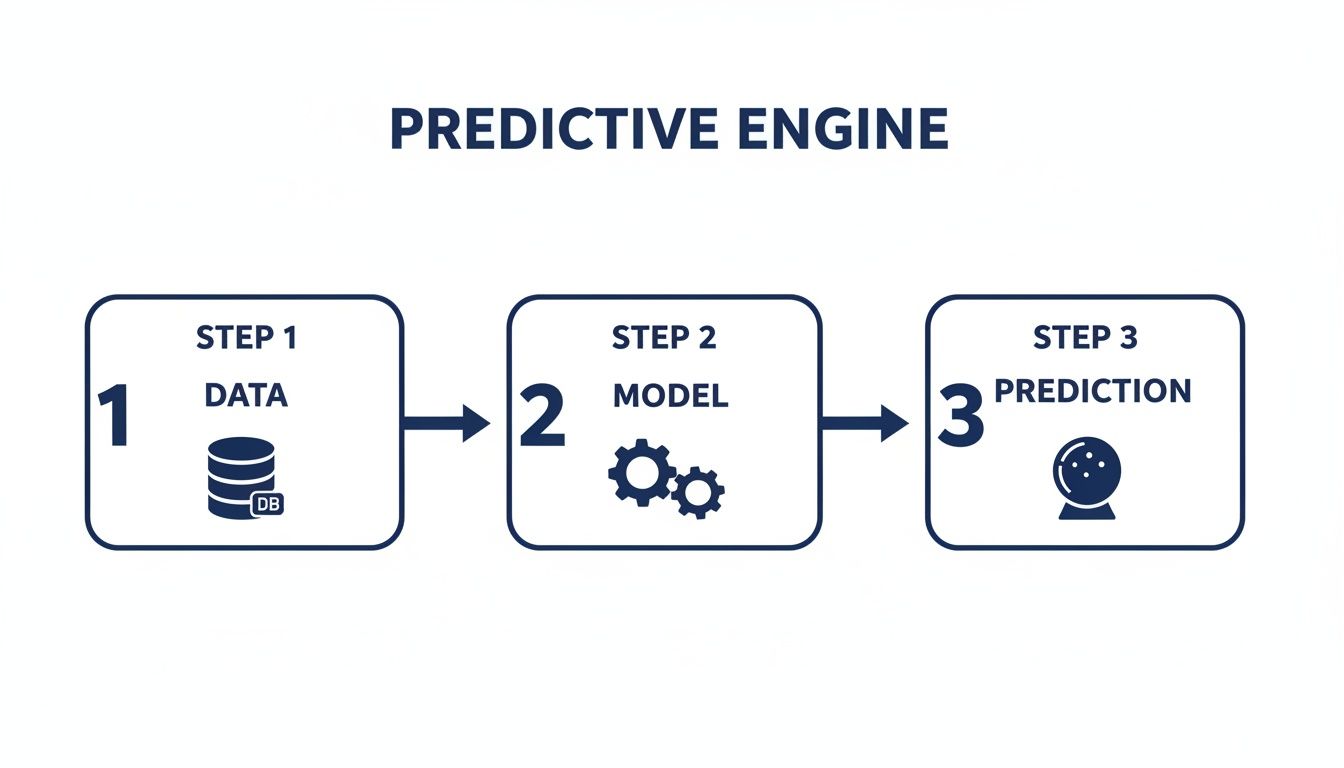
This visual boils down the technical flow, showing how raw data gets transformed into a forecast that can actually guide your business strategy.
3. Develop and Integrate a Pilot Model
Just like the SME approach, you’ll want to start with a single, high-value use case. A classic example is customer churn prediction. The difference is in the execution. An enterprise team will build a custom model, tailored to the business's unique data, and integrate its outputs directly into the CRM system.
When a customer is flagged as a high churn risk, the system could automatically trigger a retention workflow. This might mean alerting a customer success manager to reach out personally or sending a tailored "we miss you" offer to win them back.
4. Establish a Governance Framework
With great data power comes great responsibility. It's absolutely critical to establish clear rules for data quality, security, and ethical use from day one. This ensures your predictive analytics program is not just effective but also compliant and trustworthy.
Steering Clear of Common Pitfalls and Staying Compliant
Bringing predictive analytics into your ecommerce business is a huge step forward, but let's be real; it's not a plug-and-play solution. Like any major project, it’s filled with potential roadblocks. Knowing what these are ahead of time is the difference between a project that fizzles out and one that delivers real value.
Success here isn't just about having cool tech. It's about navigating the messy realities of data, people, and privacy laws. Getting this right from the start is what separates the winners from the rest.
Dodging the Usual Implementation Mistakes
It’s easy to get excited and jump straight into building models, but many projects stumble because the groundwork wasn't laid properly. The most common slip-ups usually trace back to issues with data, a fuzzy strategy, or teams not being on the same page.
You’ve heard it a million times: "garbage in, garbage out." Nowhere is this truer than in data science. Your predictive models are completely dependent on the quality of the data you feed them. It is, without a doubt, the most critical piece of the puzzle.
A classic mistake is racing to build a model with data that's a mess – inconsistent, incomplete, or just plain wrong. This path leads to predictions you can't trust, which ultimately undermines the entire effort and erodes confidence in the team. Another big one? Creating a brilliant model that nobody uses. If your churn prediction model spits out a list of at-risk customers but that list just sits in a dashboard, you've gained nothing.
Thinking about these issues early on helps you sidestep them entirely. Here’s a look at some of the most frequent traps and how you can proactively avoid them.
Common Implementation Pitfalls and How to Avoid Them
| Common Pitfall | Why It Happens | Proactive Solution |
|---|---|---|
| Poor Data Quality | Data is pulled from different systems with no single standard, creating a jumble of errors, gaps, and duplicates. | Create and enforce a data governance policy. Make data audits and cleaning a regular, non-negotiable part of your routine. |
| Choosing the Wrong Model | The team picks an overly complex model for a simple problem or one that doesn't actually answer the key business question. | Start simple. Always. Define the business objective with crystal clarity before you even think about which algorithm to use. |
| Lack of Integration | The insights are fascinating, but stay locked away with the data team instead of getting into the hands of people who can act on them. | Weave the model outputs directly into the tools your teams already use. Think automated alerts in your CRM or audience segments in your marketing platform. |
| Ignoring the Human Element | People on the front lines are hesitant to adopt the new tools because they don't get it, don't trust it, or fear it will replace them. | Invest in proper training. Clearly explain the why behind the change and show your team how these insights make their jobs more effective, not obsolete. |
Staying on the Right Side of Data Privacy and Compliance
Beyond the technical hurdles, how you handle customer data is everything. Your customers give you their information with the expectation that you'll protect it. Breaking that trust isn't just bad for business; it can land you in serious legal trouble.
In Canada, the Personal Information Protection and Electronic Documents Act (PIPEDA) sets the rules for how private businesses handle personal information. This isn't just legal fine print; it directly impacts how you run your predictive analytics program.
Here’s what it means for you in practical terms:
Consent is Everything: You need explicit and informed permission from your customers to use their data for predictive modelling. Burying it in your terms and conditions isn't enough.
Stick to the Purpose: If a customer gives you their address for shipping an order, you can't just repurpose that data for a new marketing model without their consent.
You're Accountable: Your business is on the hook for protecting the data you collect. You need to be transparent about what you’re doing and why.
Building an ethical foundation isn't just about ticking boxes to avoid fines; it's about basic respect for your customers. Be open about how you use data, give them easy ways to opt out, and work tirelessly to ensure your models are fair and free of bias. A compliant, ethical approach isn't a barrier; it's the bedrock of a long-lasting and successful predictive analytics strategy.
How to Measure Success and Calculate ROI
So, you're investing in predictive analytics. That’s a big step, and like any major business decision, you need to know if it's actually paying off. Proving its worth isn't about a gut feeling that things are getting better; it’s about tracking hard numbers that connect directly to your bottom line.
The first thing you have to do is establish a baseline. Before you roll out a single predictive model, you need a crystal-clear snapshot of how your business is performing right now. This means getting a firm handle on your key performance indicators (KPIs): things like your conversion rate, customer lifetime value (CLV), and inventory turnover. Without this "before" picture, you have no real way to measure the "after."
Key Performance Indicators to Track
To properly measure the impact of predictive analytics in ecommerce, you need to focus on the metrics that are most influenced by the specific models you're using. For example, if you've built a personalisation engine, you’ll be watching different numbers than you would for a fraud detection system.
Here are the most common KPIs to keep an eye on:
Increased Revenue and Conversions: This is the big one. Are your Average Order Value (AOV) and overall conversion rates climbing? A well-tuned recommendation engine should give these a direct lift.
Improved Customer Retention: Look closely at your customer churn rate and Customer Lifetime Value (CLV). A solid churn prediction model should help you keep more customers from walking away.
Enhanced Operational Efficiency: How are your inventory holding costs and stockout rates looking? Good demand forecasting should result in a leaner, more responsive inventory.
Reduced Costs: For models focused on risk, like fraud detection, the proof is in the pudding. You should see a clear drop in chargeback losses and the hours spent on manual reviews.
For a deeper dive into the metrics that truly matter for online stores, check out this great introduction to ecommerce analytics, metrics, and KPIs.
A Simple Framework for Calculating ROI
Once you have your "before" and "after" data, calculating the return on your investment is a pretty straightforward comparison of gains versus costs. While a full-blown financial analysis can get complicated, a simple formula is often all you need to see if you're on the right track.
The core idea is simple: Quantify the financial lift generated by the predictive models and subtract the total cost of implementing and running them. A positive result means the investment is paying off.
Here’s a simplified formula to get you started:
ROI (%) = ( [Financial Gain from Analytics] – [Total Cost of Investment] ) / [Total Cost of Investment] x 100
Let’s quickly break down what goes into that:
Financial Gain from Analytics: This is the total value you've generated. It could be the extra revenue from a higher AOV, the money saved by preventing churn, or the reduced losses from fraudulent transactions.
Total Cost of Investment: This includes everything you spent to make it happen. Be sure to account for software licenses or subscription fees, data storage costs, and the salaries of the team members dedicated to the project.
By tracking these figures consistently, you can build a powerful business case that doesn't just feel right – it proves the tangible value of your predictive analytics work and makes it much easier to justify future investments in data-driven strategies.
Common Questions Answered
How Much Data Do I Actually Need to Start?
This is probably the most common question we hear, and the answer is often less than you think. You don't need a mountain of data to get started with predictive analytics; what you really need is clean, reliable data.
For a task like demand forecasting, having about a year's worth of solid sales history is a fantastic starting point. If you're looking at something like predicting customer churn, you can start seeing meaningful patterns with as little as six months of customer interaction data. The golden rule here is quality over quantity.
Is This Technology Only for Big Retailers?
Not anymore. It's a common misconception that predictive analytics is out of reach for smaller businesses. The truth is, the tools have become incredibly accessible and affordable.
Many ecommerce platforms, like Shopify, now have built-in analytics features or offer apps in their marketplace that do a lot of the complex work for you. This gives small and medium-sized businesses a way in without the massive overhead of hiring an entire data science team right off the bat.
What’s the Difference Between Predictive and Prescriptive Analytics?
It's easy to get these two mixed up, but a simple analogy clears it up.
Think of predictive analytics as your local weather forecast. It tells you there's an 80% chance of rain tomorrow. It gives you the probability of a future event.
Prescriptive analytics is like your GPS rerouting you to avoid a traffic jam it knows is coming. It doesn't just predict the problem; it tells you what to do about it. For example, it might say, 'To prevent this customer from leaving, automatically send them a 15% off coupon.'
In short, predictive analytics tells you what's likely to happen. Prescriptive analytics tells you what you should do about it.
At Cleffex Digital Ltd, we help businesses solve complex challenges with innovative technology. Discover how our software development solutions can help you unlock the power of your data by visiting us at Cleffex.com.