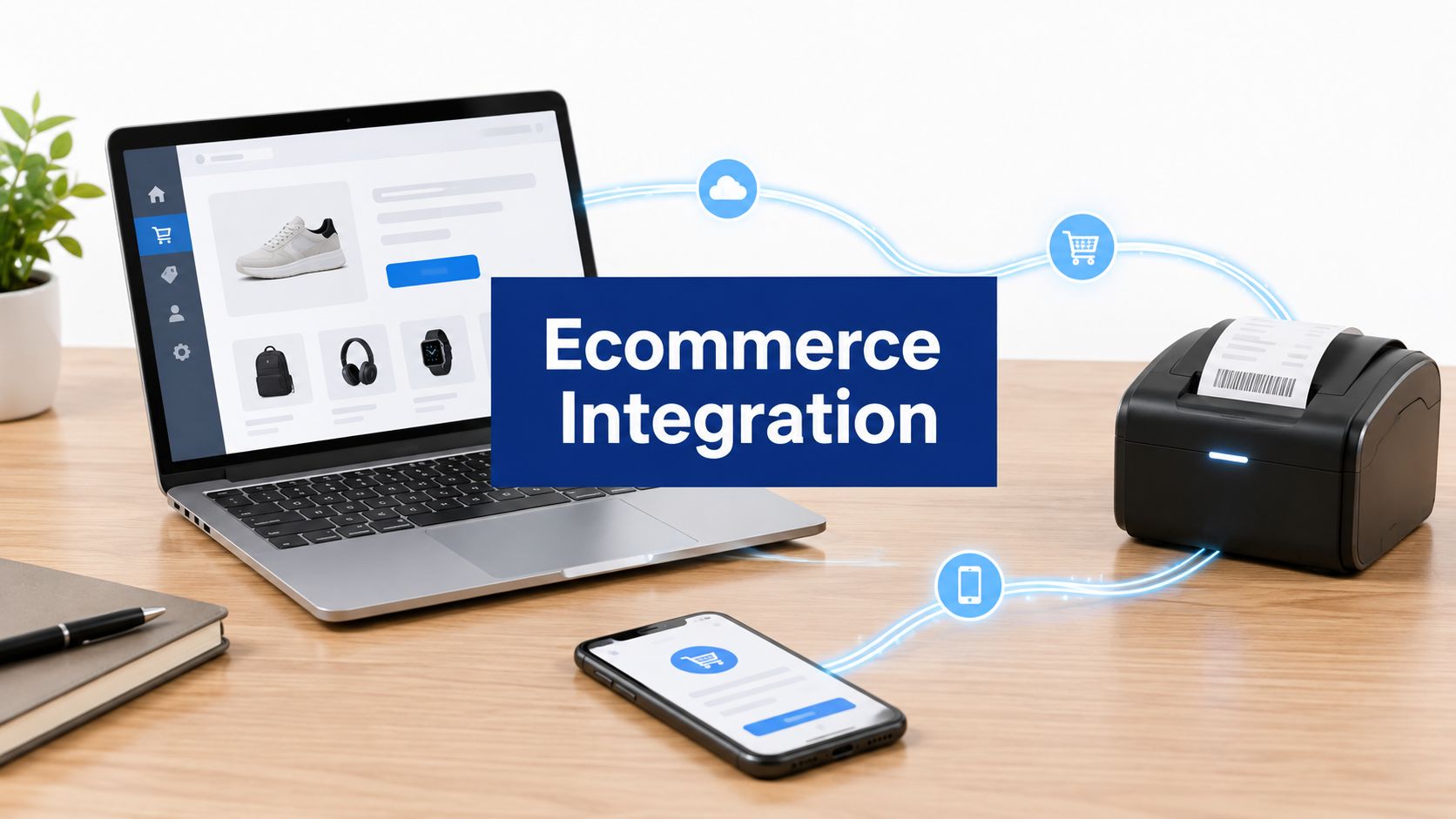


You know the feeling. A clinician opens one system for the appointment note, another for the lab result, and a third for the referral. The patient repeats the same story, a duplicate test gets ordered because the result never arrived, and the operations team is left trying to work out which system is telling the truth.
That is the starting point for healthcare system integration. In a Connected HealthcareOps model, clinical, administrative, and operational work sits around a single, trusted view of the patient, so teams can act on the same information instead of reconciling fragments after the fact. The issue is not only technical. It is organisational, because every hand-off across hospital, primary care, community, and specialist services adds room for delay, error, and avoidable effort.
Why Connected HealthcareOps Starts With Integration
A connected operating model is easiest to understand when you watch the same patient move through a broken journey. A referral lands in one inbox, the imaging result sits in another system, and a care coordinator spends half the morning phoning around to confirm what the clinician already assumed was visible. In that kind of environment, integration is not a side project for IT; it is the working fabric of care delivery.
The patient journey is the unit of value
The World Health Organization says integrated health services require shared accountability for the quality of care and health outcomes. That matters because it changes the question from, “Can these systems talk?” to, “Can the people using them jointly own the outcome?” In practice, a Connected HealthcareOps approach tries to join up the tasks that usually sit apart: scheduling, clinical documentation, referrals, discharge, follow-up, and reporting.
A useful way to think about it is a railway timetable. If each station runs its own clock, passengers miss connections. If everyone uses the same schedule, the whole network becomes more reliable. Healthcare interoperability solutions do the same job for data and workflows, but the value only appears when the operational process is aligned too.
Shared data without shared accountability still leaves teams guessing.
That is why the business case for integrated healthcare platforms is not just less admin. It is fewer information gaps at transitions, better continuity for complex patients, and cleaner coordination across settings. Canada's health system shows why this matters, because provinces and territories deliver care independently, so integration depends on cross-jurisdiction coordination rather than a single national rollout.
Why Canada is a useful lens
Canada's integration strategy has been shaped by Canada Health Infoway, launched in 2001 as a federally funded not-for-profit to accelerate interoperable digital health records across provinces and territories. In 2003, Infoway received another C$1.2 billion in federal funding, bringing the total commitment to C$2.1 billion at that point. The important lesson is structural, not historical trivia. Canada pursued integration through a national accelerator funding model inside a federated system, not through one central EHR replacement.
For leaders, that framing helps explain why healthcare API integration is rarely enough on its own. APIs can move data, but the operating model decides whether that data is trusted, acted on, and measured. Connected HealthcareOps starts when clinical and operational leaders stop treating integration as plumbing and start treating it as the way care gets delivered.
Healthcare Interoperability Standards Explained Simply
Standards sound abstract until you compare them with the post. The post office needs an address format, a transport route, and a shared language for what the package contains. Healthcare system integration works the same way, because the message needs to move, the structure needs to be readable, and the meaning needs to be consistent.
Transport, structure, and vocabulary sit in layers
HL7 v2 is still common inside hospitals because it is built for routine messaging between clinical systems. It is the messenger that carries events such as admissions, orders, and results. FHIR is newer and better suited to modern healthcare API integration, because it exposes data through web-friendly resources that are easier to query and reuse across apps. The distinction matters, because many teams think they are choosing between old and new, when they are choosing between different jobs in the stack.
DICOM belongs in imaging. It handles the movement and handling of medical images, where the file itself and the associated metadata have to travel together. Then there are the vocabulary standards, SNOMED CT and LOINC, which do not move data by themselves. They make sure two systems mean the same thing when one says “blood glucose” or “heart failure”.
If the transport is right but the vocabulary is loose, the receiving system may get the message and still misunderstand it.
A simple way to remember the standards
A practical summary helps teams avoid the acronym fog:
HL7 v2 carries routine clinical messages, especially in legacy hospital environments.
FHIR supports modern, API-based exchange and is central to many healthcare interoperability solutions.
DICOM handles imaging objects and the context around them.
SNOMED CT gives clinical concepts a shared meaning.
LOINC standardises lab and observation names.
The Harvard Institute for Strategy and Competitiveness describes systems integration as connecting related activities so different parts of the system work together around a common goal. That definition is useful because it reminds technical teams that standards are not the goal; coordinated care is. The same point shows up in Canada's integration work, where technology adoption has always been tied to cross-province coordination and interoperable records rather than isolated software buys.
For a non-technical colleague, the key message is simple. Transport standards move the package, structure standards organise the contents, and vocabulary standards make the contents understandable. Without all three, the receiving team still ends up asking the patient to repeat the same story.
A practical caution for decision-makers
The California Health and Human Services Agency's Data Exchange Framework is designed to require secure data exchange across health and social service participants, which shows how governance now sits alongside interoperability in real programmes. That means standards are necessary, but not sufficient. They need to be paired with rules about identity, consent, and auditability before anyone can safely use the exchanged information in a workflow.
Common Integration Patterns and When to Use Them
Standards tell you what should be understood. Architecture tells you how the traffic moves. In healthcare, that choice matters because the wrong pattern can turn every new connection into another bottleneck, which is why many teams eventually redesign their integrated healthcare platforms instead of just adding more interfaces.
Match the pattern to the shape of the network
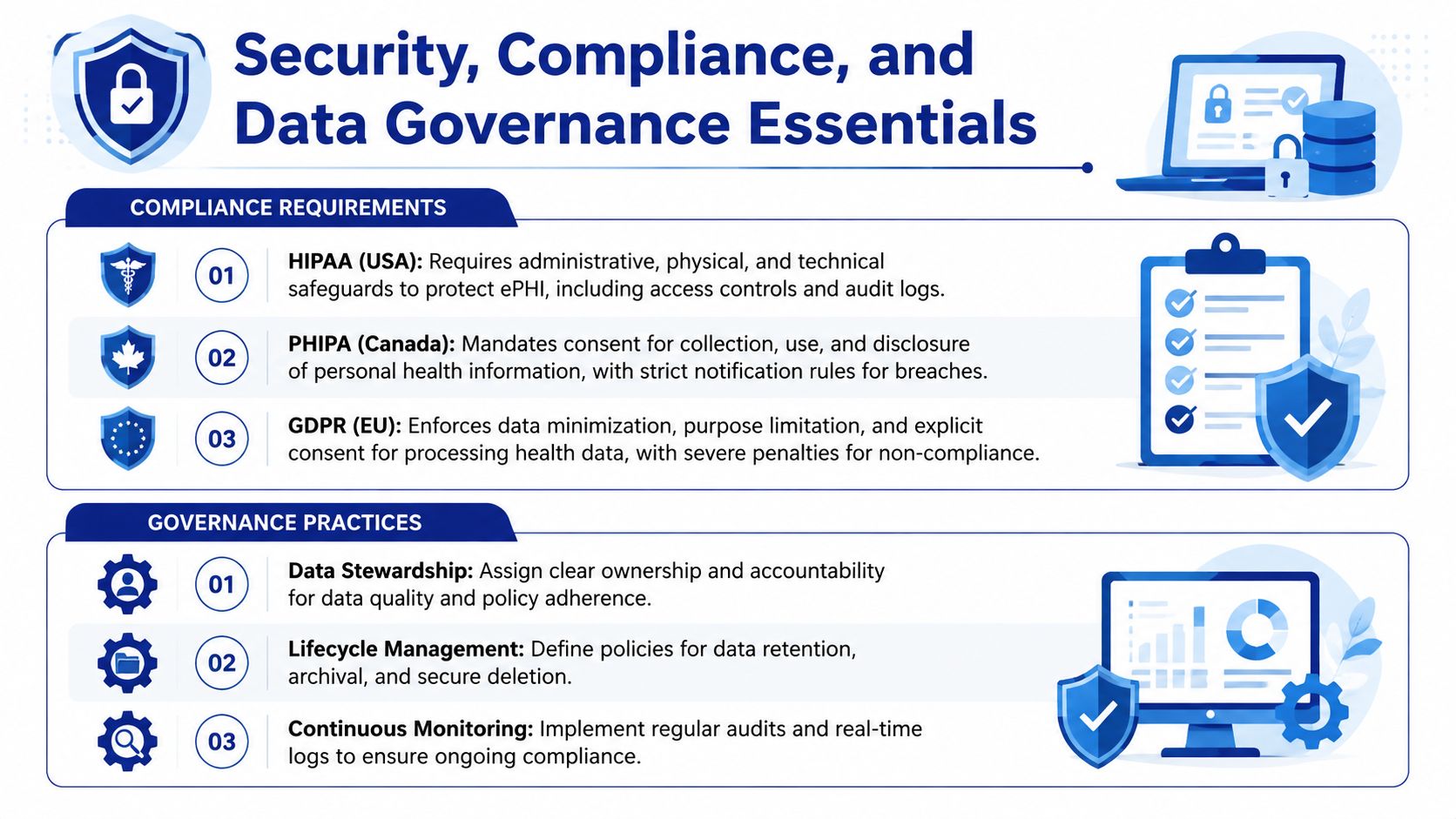
A point-to-point model is the simplest. One system talks directly to another, which works fine when the network is small. The trouble starts when every new clinic, lab, or partner adds a fresh route, because the map becomes harder to maintain than the service itself.
An ESB, or enterprise service bus, acts like a central junction. It can route and transform messages, which helps older estates, but it can also become a dependency if everything waits on the same hub.
iPaaS works more like a managed integration layer in the cloud, useful when teams want faster deployment and less infrastructure overhead.
API-led connectivity puts reusable services behind clear interfaces, which is a good fit when multiple digital products need the same clinical or operational data.
Event-driven architecture pushes updates when something changes, which suits operational alerts, care coordination, and downstream automation.
How to choose without chasing trends
The right pattern usually depends on four things.
Number of systems: A small practice can often live with a modest point-to-point setup. A regional network usually needs a more managed pattern.
Transaction volume: If messages are frequent, routing and monitoring become more important than convenience.
Latency needs: A workflow that depends on immediate updates needs a faster path than an overnight reconciliation feed.
Team capability: A lean team may need a hosted platform, while a mature integration group can run more of the stack itself.
Don't choose an architecture because it sounds modern. Choose it because your team can operate it on a busy Tuesday.
The California Health and Human Services Agency's Data Exchange Framework is a good reminder that healthcare interoperability solutions now sit inside a governance layer, not outside it. In other words, architecture has to support not only data movement, but policy-enforced exchange rules, identity resolution, and auditability across systems.
A 3-clinic practice usually needs the least complex option that keeps referrals, labs, and billing connected without creating an admin burden. A multi-hospital network usually benefits from API-led or event-driven approaches where reusable services and alerting matter. A regional health authority often needs a mix, because it must coordinate across many organisations, many workflows, and many data owners at once.
The image above shows the same logic in visual form. Point-to-point is fast to start, but management gets harder. ESB centralises control. Adapters help older systems fit the layer. Queues protect reliability. API gateways create a safer front door for microservices.
The operational lens matters as much as the technical one
Canada's integrated care history is useful here too. OECD benchmarking shows integrated care outcomes improved across member countries from 2013 to 2023, with average adverse outcome rates after hospitalisation falling by about 6 percentage points for congestive heart failure and 5 percentage points for stroke OECD integrated care reference. Those figures don't tell you which architecture to buy, but they do explain why the architecture needs to support reliable transitions and follow-up. In Connected HealthcareOps, the network design matters because it shapes the clinical outcomes the organisation can sustain.
Security, Compliance, and Data Governance Essentials
The moment data starts moving, protection has to move with it. Healthcare system integration lives inside consent, identity, logging, retention, and breach response, not outside them. If that sounds restrictive, it should. In healthcare, the safest architecture is the one that can prove who saw what, when, and why.
Governance controls solve real clinical risks
A wrong record attached to the wrong patient is not a minor technical defect. It can change a clinical decision, delay care, and undermine trust in the whole workflow. That is why identity resolution is a clinical control as much as a data control. If the integration layer cannot match people reliably, every downstream system inherits the mistake.
Consent is just as important. In Canada, the Data Exchange Framework in California illustrates the direction of travel clearly, because secure exchange is being shaped by policy, routing, and governance, not just by point-to-point connectivity. The design lesson is that data sharing needs a traceable reason, not just a technical path. Teams need to know who granted consent, what scope it covers, and how that decision is enforced across systems.
The World Health Organization frames integrated services around shared accountability for the quality of care and health outcomes. That same principle applies to governance. If several providers share a patient journey, they also share a duty to maintain the integrity of the data that drives that journey.
The governance checklist that keeps integrations usable
A solid programme usually has five controls in place.
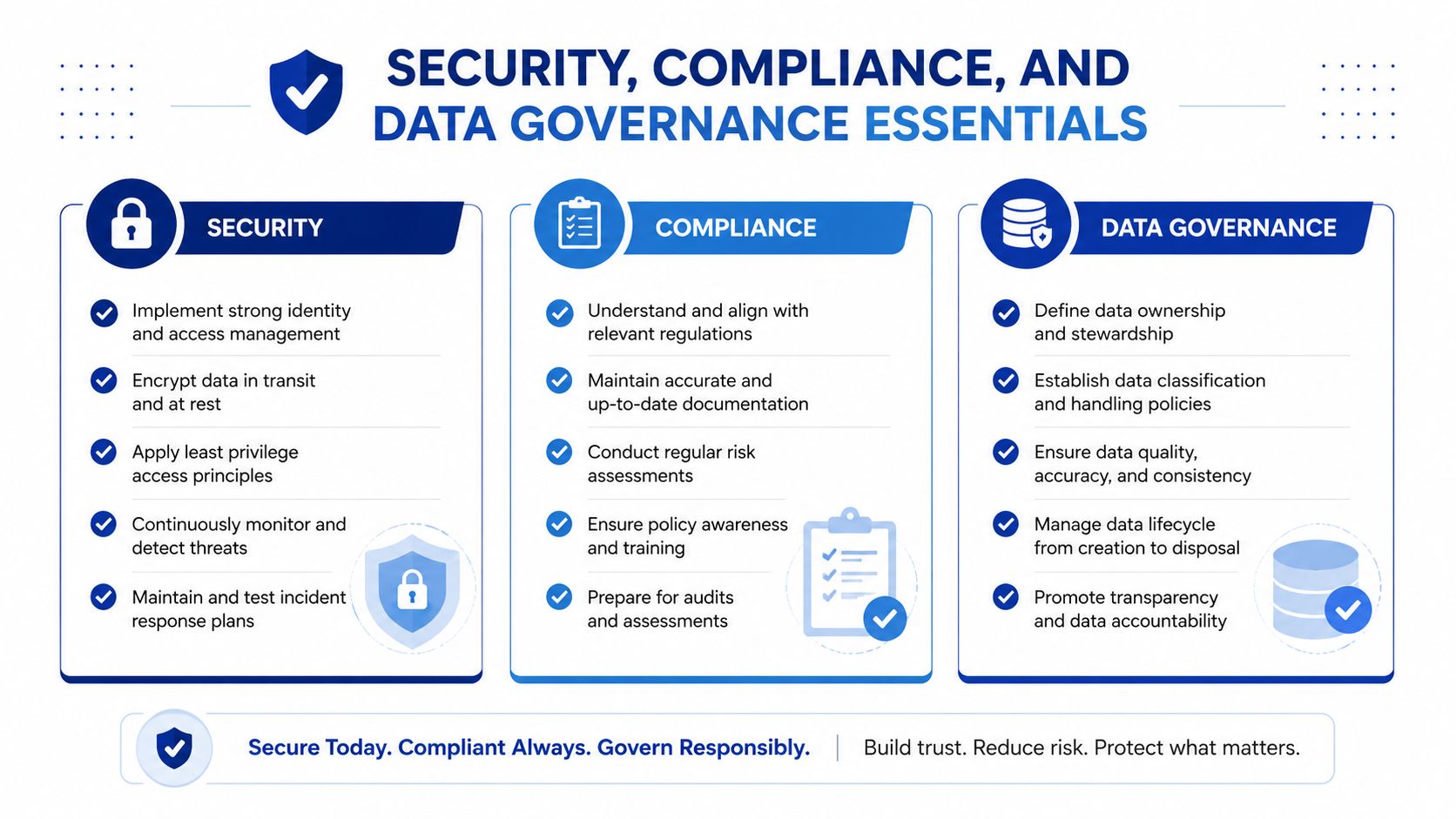
Consent management: The system records permission and applies it consistently across connected tools.
Audit trails: Every access and change can be traced without guesswork.
Data minimisation: Only the fields needed for the workflow are shared.
Lifecycle management: Retention, archival, and secure deletion are defined before go-live.
Continuous monitoring: Teams review logs and exceptions, not just build interfaces and walk away.
If you cannot explain why a data element is flowing, it probably should not be flowing.
The internal discipline matters because healthcare data integration failures are often semantic as well as technical. Research on heterogeneous source systems shows that inconsistent implementation of standards such as HL7 FHIR, SNOMED CT, and LOINC can create interoperability gaps that raise latency and reduce the reliability of exchanged records. That is exactly why governance and semantic mapping belong in the same conversation. A compliant system that sends unclear data is still a poor system.
For Canadian leaders, the message is direct. Compliance is not a bolt-on policy document; it is a design constraint. If the integration layer cannot support consent, logging, retention, and identity controls from day one, the organisation will spend more time patching risk than improving care.
Common Integration Challenges and How to Mitigate Them
Most integration programmes do not fail because the team lacks enthusiasm. They fail because the scope grows faster than the operating model. Once the first interface works, everyone wants their own workflow included, and the programme drifts from a focused use case into an expensive web of exceptions.
The traps that catch experienced teams
Scope creep is the easiest one to recognise. A project that began with referrals, lab results, and discharge summaries can end up carrying every possible data feed. The fix is a use-case inventory before build starts, with a hard line between what is needed now and what belongs in a later release.
Vendor lock-in is harder to see early. If one supplier owns all mappings, transformations, and routing logic, the organisation loses flexibility when contracts change. The practical countermeasure is to demand portable interfaces and to keep semantic mapping visible in your own architecture, not hidden inside a black box.
Patient-matching errors and semantic mismatches are the quiet killers. Two systems can exchange a message successfully and still attach the wrong person or the wrong meaning. That is why the integration layer must reconcile schemas and coding systems early, not after users complain that the records look odd. Research on healthcare data integration notes that fragmented boundaries, proprietary models, and inconsistent standards implementation create exactly these gaps.
Cost, coordination, and the politics of consolidation
There is also a less comfortable issue. Integration can improve coordination while increasing provider bargaining power and prices. Harvard Medical School researchers found physician-hospital integration was associated with higher prices and no clear reduction in utilisation. That doesn't mean integration is a bad idea; it means leaders need to separate care coordination from market consolidation.
Better coordination is not the same thing as lower cost, and procurement teams need to test that assumption early.
That trade-off matters in Canada because policy and operations often assume integration will reduce fragmentation and improve access. It may do that, but only if the programme is designed around outcomes, not ownership. In underserved regions, that distinction is especially important because teams are trying to improve access without shifting the burden onto patients and caregivers.
How to keep the programme grounded
A practical mitigation plan usually includes three moves:
Start small and measurable: Choose one or two high-friction workflows, then prove the value before expanding.
Map data semantics early: Build terminology and identity matching into the data layer, not as an afterthought.
Set exit criteria: Decide in advance what “good enough to scale” looks like, including stability, adoption, and support readiness.
Integration is never just a technical rollout. It is a change programme with data contracts, workflow redesign, and governance decisions all moving at once. Teams that acknowledge that reality tend to build systems people can live with.
Choosing Vendors, Platforms, and Partners With Confidence
Once the concepts are clear, vendor selection becomes much less fuzzy. A good shortlist should not be built on marketing claims; it should be built on how well the supplier supports healthcare interoperability solutions in your real environment. The right question is not “Can they integrate?” It is “Can they integrate in a way your clinicians, IT team, and operations staff can sustain?”
Questions that separate capability from slideware
Ask vendors how they handle FHIR alongside legacy interfaces, because most healthcare estates are mixed rather than pure. Ask whether their platform supports consent management, audit logs, and role-based access without custom code. Ask how they deal with terminology alignment across DICOM, SNOMED CT, and LOINC, because that is where many supposedly connected systems still break.
Deployment model matters too. Some organisations need cloud-first speed, others need tighter control over where workloads run. Either way, the platform should fit the security posture and support model already in place. If the supplier cannot describe their interoperability roadmap in plain language, they probably haven't thought sufficiently about your operating reality.
What a serious evaluation should cover
Use a simple scorecard:
Standards support: Does it work with the protocols and vocabularies you already use?
Clinical workflow fit: Will it reduce clicks, hand-offs, and re-keying?
Security posture: Can it support access control, auditability, and consent?
Future readiness: Can it adapt to version changes, including FHIR R5 transitions?
Total cost of ownership: What will support, change requests, and maintenance look like after go-live?
One option in this space is Cleffex Digital Ltd, which provides healthcare software integration services that connect medical devices, SaMD apps, and digital platforms with hospital EHRs, using HL7 FHIR with DICOM, SNOMED CT, and LOINC in its integration work. That kind of capability matters when you need both domain awareness and engineering discipline in the same delivery team.
The strongest partners don't just wire systems together. They help the organisation decide what should be shared, when, and by whom.
The practical test is simple. If the vendor can talk clearly with clinicians, IT leads, and operations managers without hiding behind jargon, you're probably looking at a team that can support an actual programme rather than a demo.
A Practical Roadmap for Your Integration Programme
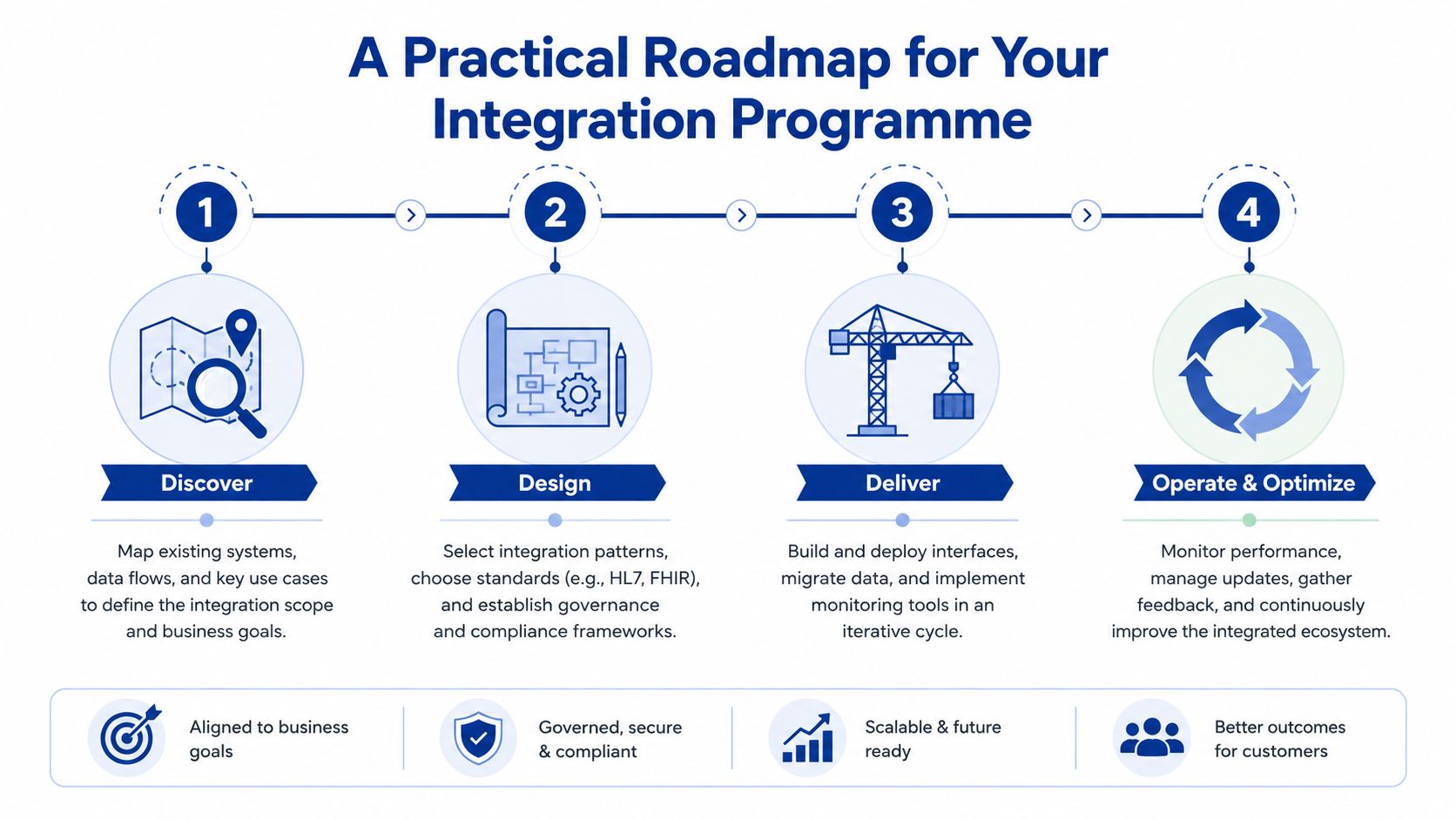
The best integration plans are staged, not heroic. A connected ecosystem comes together more reliably when leaders move through discover, design, deliver, and operate in order, with clear exit criteria for each step. That discipline matters because Connected HealthcareOps is about repeatable coordination, not one-off interface wins.
Start with what you can prove
In discovery, map the systems, the data flows, and the use cases that cause the most friction. The exit criterion is a ranked list of workflows, owners, and risks.
In design, choose the integration pattern, standards, and governance controls that fit the use case. The exit criterion is a signed-off solution shape, not just a technical wishlist.
In deliver, build, test, and pilot the interfaces with real users. The exit criterion is not only that data moves, but that the right people can act on it without extra work.
In operate and optimise, monitor performance, review exceptions, and tune the ecosystem as needs change. The exit criterion is a stable service that can scale without losing trust.
Keep the outcomes visible
A strong roadmap should always point back to operational results. That means fewer duplicate tests, faster referrals, cleaner discharge follow-up, and better chronic disease management. Canada's integrated care trend is a reminder that the prize is not just information exchange; it's better transitions and better outcomes over time.
If you want a final gut check, use this question. Will the programme make life easier for the people who touch the patient journey, or will it just move complexity somewhere else? If the answer is the first one, the roadmap is on the right track.
Cleffex Digital Ltd helps healthcare organisations plan and build integration work that connects systems, data, and workflows across clinical and operational teams. If you're ready to move from isolated interfaces to a connected HealthcareOps model, visit Cleffex Digital Ltd and explore how their healthcare software integration services can support your next phase.