

17% of Canadian healthcare providers said they didn't routinely access electronic information from other care settings because of barriers such as poor system integration, according to the Canadian Institute for Health Information. A patient's records can exist digitally and still be unavailable to the clinician who needs them.
Designing secure healthcare data sharing means solving that practical problem without creating new privacy risks. Start with a specific flow: who sends the information, who receives it, why they need it and which consent or legal rule permits the exchange. Then build the safeguards into that flow, rather than adding them after systems are connected.
Who Shares What, With Whom
Healthcare data sharing is the controlled movement of patient and operational health information between people and organisations. It includes a patient sending readings to a clinic, a hospital sending a discharge summary to a family doctor and a provider submitting a claim to an insurer.
Think of an exchange as a parcel delivery. The sender needs to know what belongs in the parcel, the route must be suitable for its contents, and the delivery address must identify the right recipient. Healthcare adds another requirement: the recipient must have a legitimate reason to open it.
Common healthcare data sharing flows
| Flow | Typical senders and receivers | Main purpose | Example |
|---|---|---|---|
| Patient to provider | Patient or carer to a clinic | Sending readings or symptom notes before a visit | Glucose log sent to a diabetes clinic through a portal |
| Provider to provider | Clinics, hospitals and specialists | Referrals, discharge summaries and lab results | Discharge summary sent to a family doctor on the day of release |
| Provider to payer | Clinics, labs and insurers | Eligibility checks and claims | Insurer confirms coverage before a planned procedure |
| Public health reporting | Providers and labs to health authorities | Notifiable disease and immunisation reporting | Lab reports a notifiable infection to the regional health authority |
| Research and secondary use | Health systems to researchers | Analysis of de-identified or aggregated data | Anonymised records used to study readmission rates |
These flows shouldn't share one unrestricted permission. A glucose log supports a clinical review; an eligibility request supports a coverage decision. The insurer doesn't automatically need everything the diabetes clinician needs.
Similarly, a public health report follows its applicable reporting authority, while research requires its own authorisation and safeguards. De-identification means reducing the ability to connect information to a person, not merely removing a name.
Practical test: Before approving an exchange, complete this sentence: this sender may send this information to this receiver for this purpose under this rule.
If the project team can't complete that sentence clearly, it isn't ready to choose software.
Standards and Technologies That Make Sharing Work
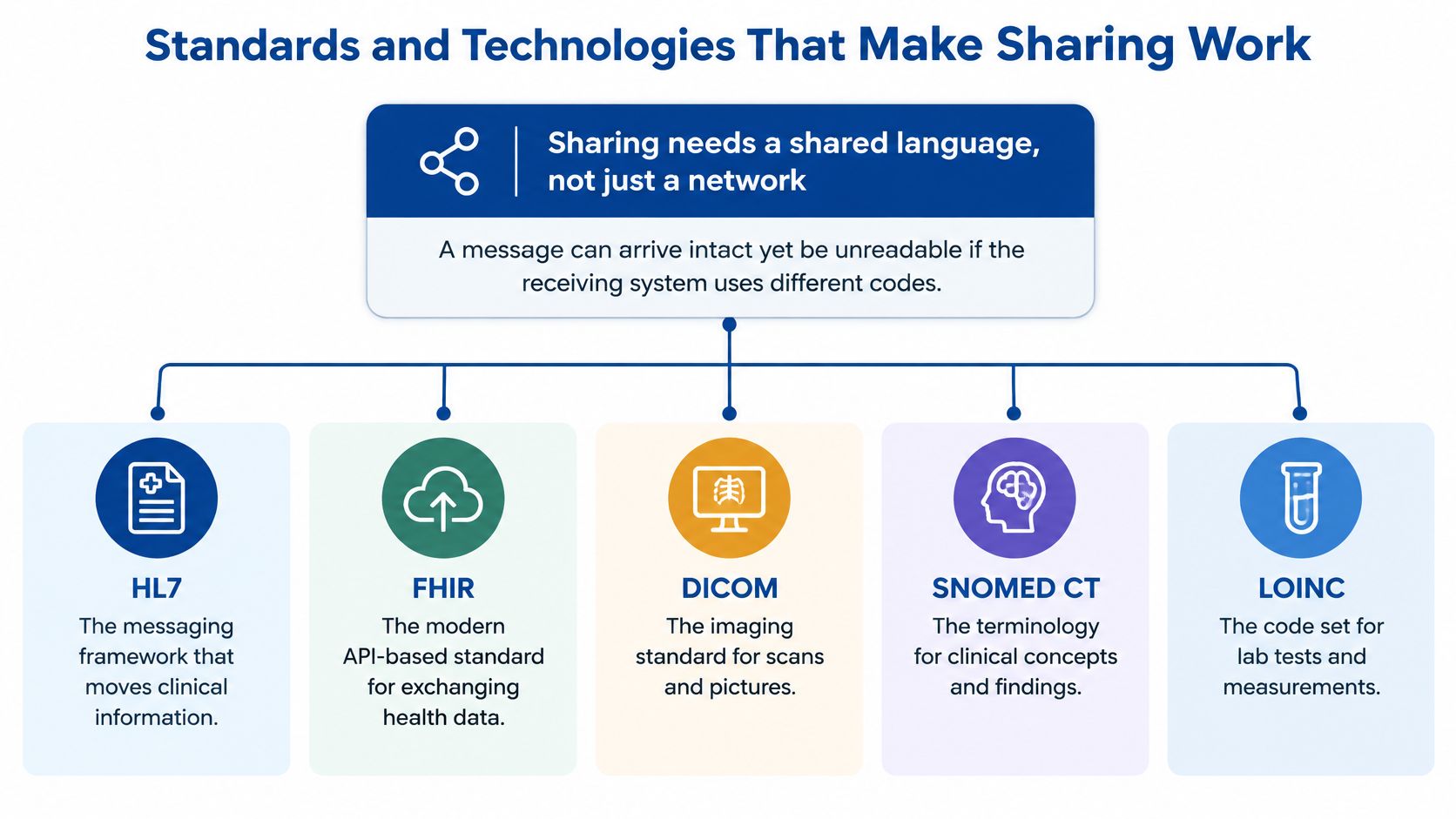
Sharing needs a shared language, not just a network. A message can arrive intact yet remain unusable if the receiving system interprets its codes, units or document structure differently.
An application programming interface, or API, is a controlled way for software systems to request or submit information. Standards describe how that information should be organised, but different standards suit different jobs.
Healthcare data standards and their best uses
| Standard | Best used for | Data format | Typical example |
|---|---|---|---|
| HL7 v2 | Messages between hospital systems | Pipe-delimited text messages | Admission, discharge and lab result messages |
| HL7 CDA | Structured clinical documents | XML documents | Discharge summary with coded diagnoses |
| FHIR | App and API access to discrete data | JSON or XML resources over REST | Patient app reading a medication list from an EHR |
| DICOM | Medical images and their metadata | Binary image files with headers | CT study sent to a specialist for review |
| IHE document sharing | Finding and retrieving documents across a network | Shared registry plus stored documents | Regional network where clinics publish and retrieve reports |
FHIR data exchange organises information into resources, such as a patient, medication or observation. JSON and XML are machine-readable formats; REST describes a common approach to web-based requests. IHE profiles, by contrast, specify how systems use standards together for defined workflows.
Terminology matters too. SNOMED CT represents clinical concepts and findings, while LOINC identifies laboratory tests and measurements. A test result needs both an understandable structure and an agreed meaning.
Choose the content standard and the delivery channel
Canadian privacy authorities identify encrypted email, secure patient portals, electronic referrals and electronic prescribing as practical sharing mechanisms in their joint resolution on secure digital health communication. Each channel still needs appropriate authentication, configuration and monitoring.
For implementation detail, the guide to healthcare interoperability with HL7 and FHIR APIs explains the integration choices. Freeform Company's governance compliance guidance for IT leaders provides useful context for assigning responsibility alongside those technical decisions.
Choose the standard for the content and the channel for the route. Neither replaces governance.
How to Plan a Secure Sharing Project
In 2024, 92% of Canadian healthcare providers had access to a digital health system, but only 52% used one to share clinical information outside their main practice, according to Statistics Canada's digital health overview. Digitising a record doesn't make it usable across organisational boundaries.
Canadian provider sharing indicators, 2024
The following indicators are reported in the Statistics Canada overview linked above.
| Indicator | Value | What it signals |
|---|---|---|
| Providers with access to a digital health system | 92% | Access is already widespread |
| Providers who used a system to share clinical information outside their main practice | 52% | Sharing lags well behind access |
| Providers reporting at least one barrier to sharing beyond their practice | 78% | Barriers are common, not rare |
| Providers citing insufficient integration between systems | 50% | Integration gaps affect a substantial share of providers |
| Providers whose systems lacked the technical ability to send information externally | 46% | Some systems cannot send data outside at all |
The integration problem also appears in Statistics Canada's detailed release on providers' digital systems. Treat healthcare interoperability solutions as part of the architecture, not an extra portal placed over disconnected records.
For example, a referral PDF may reach the specialist's inbox successfully but still require a receptionist to retype its contents. Delivery succeeded; usable exchange did not.
Build around a defined pathway
Define the purpose and minimum data set: Specify what the recipient needs to act. A referral might require the presenting problem, relevant history and recent results, not the full chart. Sharing everything by default increases exposure and makes important details harder to find.
Map senders, receivers and authority: Document each organisation, the responsible team and the consent or legal rule governing the transfer. Don't assume permission for treatment also permits an unrelated insurance or research use.
Choose compatible standards and channels: Use FHIR resources for appropriate app requests and document standards for clinical summaries. Confirm which versions and local implementation rules both parties support before development begins.
Plan patient matching and terminology mapping: Compare approved identifiers and demographic fields, with a review process for uncertain matches. Names alone aren't enough. Check units, reference ranges and local clinical codes before information enters the receiving record.
Build controls into the first test: Apply least-privilege permissions, encryption in transit and at rest, and audit logging. Use synthetic test records wherever possible so developers don't need routine access to identifiable patient information.
Pilot a referral pathway: Include rejected messages, duplicate submissions, missing attachments and incorrect recipients. Ask receiving staff whether they can use the information within their normal workflow, rather than merely confirming that it arrived.
Assign continuing maintenance: Schedule access reviews, risk audits and incident drills. Give named owners responsibility for failed exchanges, expired credentials and changes to partner systems.
A successful pilot ends with the right information usable by the right person, not with a successful send notification.
Measure the share of outbound transactions that are machine-readable, correctly patient-matched, acknowledged and usable without manual re-entry. Track each condition separately so the team can locate failures rather than hide them inside a single delivery score.
Benefits for Patients, Clinicians and Payers
A patient with chest pain arrives at an emergency department. In a well-designed exchange, the cardiology team can review the ECG, medication list and relevant prior imaging before the consultation. That information may help clinicians avoid unnecessary repeat investigations and make a better-informed treatment decision.
The demand is clear: more than four in five Canadians surveyed wanted their personal health information shared electronically among all their providers when care decisions were being made, yet only 29% of physicians in a 2024 national survey shared clinical summaries electronically outside their practice.

Where connected information helps
Patients: A reconciled medication list can reduce confusion after discharge. Referral updates can also help patients understand whether a specialist has received their information.
Clinicians: Relevant history at the point of care reduces the need to reconstruct events from separate portals, telephone calls and patient recollection.
Payers: A focused eligibility exchange can resolve coverage questions without requesting an entire clinical record.
Public health teams: Reliable reporting helps authorised staff receive the information needed for their reporting and response workflows.
Use cases that make the benefit visible
Referral management connects the referral, supporting results, acceptance decision and appointment status. It prevents staff from treating a sent document as proof that the receiving service has accepted responsibility.
Medication reconciliation after discharge lets a clinician compare the hospital's changes with the pre-admission list. The task is to resolve discrepancies, not append another list.
Multidisciplinary meetings let specialists review the same scans and notes while discussing treatment. Clear source details and timestamps help participants distinguish current findings from older information.
These benefits depend on information arriving complete, correct and on time. A fast exchange carrying an outdated medication list can create false confidence, so secure healthcare data exchange must preserve clinical context as well as availability.
Privacy and Security Risks to Manage
Health information is highly sensitive. The Office of the Privacy Commissioner of Canada's PIPEDA safeguards guidance requires protection against loss, theft, unauthorised access, disclosure, copying, use and modification, with safeguards adapted as risks and technologies change.
The guidance calls for a combination of physical, technological and organisational protections, rather than one prescribed technology. Determine which federal, provincial and sector-specific obligations apply to each participating organisation before translating them into system rules.
Healthcare data sharing risks and controls
| Risk | Control | Example |
|---|---|---|
| Unauthorised access by outsiders | Multi-factor authentication and least-privilege roles | Login from an unknown device is blocked until verified |
| Interception in transit | TLS encryption and certificate checks | Referral sent to a hospital over an encrypted channel only |
| Exposure at rest | Encryption at rest and key management | Backup of a clinic server is unreadable if stolen |
| Excessive data sent | Data minimisation before sending | Referral carries the relevant history, not the full chart |
| Insider misuse | Role-based access, access logging and periodic reviews | Staff access is logged and reviewed on a quarterly schedule |
| Slow incident response | Documented plan, tested drills and breach reporting | Team contains and reports a misdirected message within the applicable window |
Multi-factor authentication asks for more than a password. TLS, or Transport Layer Security, protects information during transmission. Neither prevents every disclosure: a verified user can still select the wrong recipient, and an encrypted message can still contain excessive information.
Encryption at rest also depends on key management. Keep decryption keys separate from protected backups, restrict who can use them and test recovery. Otherwise, a backup may be protected against theft but unavailable when the clinic needs to restore care systems.
Test failures before patients depend on the exchange
Simulate a misdirected referral, a revoked account and a compromised partner connection. Check whether staff can stop further disclosure, identify affected records and reach the incident owner without searching through informal messages.
Design checkpoint: Treat a failed access test or an untraceable disclosure as a defect to fix before launch, not a training issue to defer.
Written policies, staff training, physical access controls, firewalls and security patching belong beside the technical design. RDE Technologies' guide to protecting patient data in health informatics offers further operational context, while this overview of data security in healthcare information systems explores related safeguards.
In our development process, we prioritise compliance with global standards such as GDPR and HIPAA through strong encryption, secure storage, anonymisation techniques and access controls. Those priorities don't replace the jurisdiction-specific assessment a Canadian sharing project needs.
Core Components of a Secure Sharing System
A secure exchange needs components with distinct responsibilities. Combining every decision inside one interface makes it harder to investigate why a request was allowed, rejected or misrouted.
Checks before information leaves
Authentication gateway: Verifies users and connecting systems. Human users can complete multi-factor sign-in; system connections need managed credentials and narrowly scoped permissions.
Consent registry: Records patient decisions by purpose, recipient and relevant data category. It must also represent the applicable authority where sharing doesn't rely on consent.
Identity-matching service: Checks whether records refer to the same patient before linking or merging them. Uncertain matches go to review rather than being accepted.
Terminology layer: Maps local codes to shared vocabularies while preserving the original value and its source.
Delivery and accountability
The standards-based API layer exposes approved information, such as FHIR medication resources, without giving an application unrestricted database access. Validate incoming requests and outgoing responses against the agreed implementation rules.
An audit log records who accessed what, when and for which purpose. A patient-facing disclosure view can translate appropriate entries into understandable language without exposing security-sensitive technical details.
Acknowledgements and error queues distinguish receipt from processing. A receiving system may accept a connection but reject the payload, so staff need visible failures, named owners and a safe retry process that avoids duplicate records.
Downtime procedures provide an approved fallback, such as encrypted email with a logged manual step. Define how staff reconcile those exchanges once the main service returns.
Consider a pharmacy application requesting a medication list. The gateway validates the application, the permissions and consent checks evaluate the request, and the identity service confirms the patient. The API returns the permitted information, records the disclosure and tracks the response.
FHIR supplies structure and access patterns, not organisational trust. Participating organisations still need agreements covering responsibilities, permitted uses, corrections and the handling of failures.
Consent, Access and Patient Trust
Privacy isn't an obstacle that patients place in the way of connected care. A Canadian qualitative study described by the University of New Brunswick's DataNB health data-sharing publication found support among patients and families for sharing and secondary use for patient safety when purposes and safeguards, including anonymous formats, were clear.
Access remains incomplete: in 2025, only 13% of Canadians aged 18 and older reported online access to all three core record components, while 69% could access at least one type electronically. Those core components were laboratory and imaging results, immunisation records other than COVID-19, and medication history or renewals.
Make permissions understandable
Explain the purpose: Describe what the recipient will do, rather than presenting a broad request to share data.
Offer meaningful choices: Where the law permits, distinguish sharing with a family doctor from sharing with an insurer.
Show disclosures: Let patients understand who viewed or received their information and how to raise a concern.
Explain changes: State how a consent change affects future exchanges and what happens to information already lawfully disclosed.
Organisations need named data owners, retention rules and a workable process for correcting records. The practical guide to healthcare data governance provides a framework for assigning these responsibilities.
Collaborate without unnecessary record movement
Insurers, providers and startups should ask whether collaboration requires identifiable records to move into a central or foreign environment at all. Federated analysis sends approved analytical work to locally held data and returns controlled outputs, rather than routinely centralising patient records.
Controlled de-identification reduces identifying detail before approved use, but teams must still assess re-identification risk. Indigenous data-sovereignty principles also belong in governance decisions, including community authority over access, purposes and subsequent use, not merely technical storage choices.
Common Questions About Sharing Health Data
Is FHIR enough to make healthcare data sharing secure?
No. A correctly formatted request can still come from an unauthorised application or seek information for an inappropriate purpose. Test the surrounding authentication, encryption, permission and audit controls, including requests that the system should reject.
What is the difference between interoperability and integration?
Integration is the engineering work that connects systems. Interoperability is the outcome: the receiving system and its users can interpret and use the information correctly. Ask the receiving team to complete a real workflow with the exchanged record, not just confirm that a connection works.
How long should a receiving organisation keep shared records?
Set retention rules in the data-sharing agreement and follow applicable provincial, national and professional requirements. Distinguish the clinical record from temporary exchange copies, logs and backups, because they may need different schedules. Delete unnecessary copies when permitted, while preserving records subject to retention duties or legal holds.
Where should a small clinic, insurer or startup begin?
Choose a referral pathway with a clear operational problem, then document its purpose, minimum data set and receiving team. Agree on acceptance criteria before connecting production systems, and expand only after staff can handle both successful and failed exchanges.
For implementation support, review our healthcare software integration services or explore Cleffex's wider capabilities. We provide healthcare software integration for North American healthtech companies, enabling hospital connectivity, compliance, AI diagnostics and scalable platforms, alongside cybersecurity compliance services addressing security posture, data confidentiality and compliance.
Cleffex Digital Ltd offers healthcare software integration and cybersecurity compliance services to help organisations connect systems while protecting sensitive information. Visit Cleffex Digital Ltd to discuss a specific sharing pathway, its consent rules and the controls needed before your network expands.