

Your marketing campaign finally works. Paid traffic rises, email clicks land, returning customers come back for the promotion, and then the site slows to a crawl right when buyers reach the cart and checkout.
That moment is where many ecommerce leaders realise growth has a technical ceiling. The problem isn't demand. It's that the platform was built for normal days, not for success.
In Canada, this isn't a niche issue. Statistics Canada reported that Canadian consumers spent about CAD 84.3 billion online in 2023, and ecommerce accounted for 6.1% of total retail sales, which is why small failures in speed and reliability can quickly become expensive business problems for online sellers (Bridge Global on Canadian ecommerce scale).
When Success Becomes a Problem
A familiar version of this story plays out every peak season.
A retailer launches a Black Friday offer. Traffic rises faster than expected. Product pages still work, but search starts lagging. Then the cart takes too long to update. Checkout throws intermittent errors. Customer support gets flooded with “Is your site down?” messages while the ad budget is still running.
This is what a scalability problem looks like from the CEO's chair. You don't see database locks or overloaded workers. You see abandoned carts, stressed staff, and revenue leaking out minute by minute.
Why the Failure Often Starts Before the Crash
Most stores don't fail because every part of the system is weak. They fail because one narrow path breaks under pressure. It might be inventory updates during a promotion, discount logic at checkout, or a search index that can't keep up with sudden demand.
That's why ecommerce scalability consulting matters. It treats the store like an operating business, not just a website. A good consultant looks at where growth creates friction across browsing, buying, fulfilment, and release velocity.
Practical rule: If your best sales day would also be your most fragile operating day, you don't have a marketing problem. You have a scaling problem.
A lot of teams make the same mistake at this point. They assume the answer is a replatform. Sometimes it is. Often it isn't. In many cases, the problem is poor architecture around an otherwise workable platform, which is why articles on ecommerce replatforming best practices are useful only when paired with a hard analysis of what is failing.
What the Business Feels First
The technical symptoms usually arrive disguised as business complaints:
Support volume rises: Customers report slow pages, failed payments, or duplicate actions.
Marketing efficiency drops: Paid traffic becomes less profitable because the site can't convert peak intent reliably.
Merchandising slows down: Teams hesitate to launch campaigns because they don't trust the platform under load.
Development gets defensive: Engineers spend more time patching incidents than shipping improvements.
The worst part is that these failures often happen during the exact moments meant to accelerate growth. Strong demand exposes weak architecture. That's why scalability work isn't a luxury for ambitious ecommerce teams. It's business insurance.
What Is Ecommerce Scalability Consulting
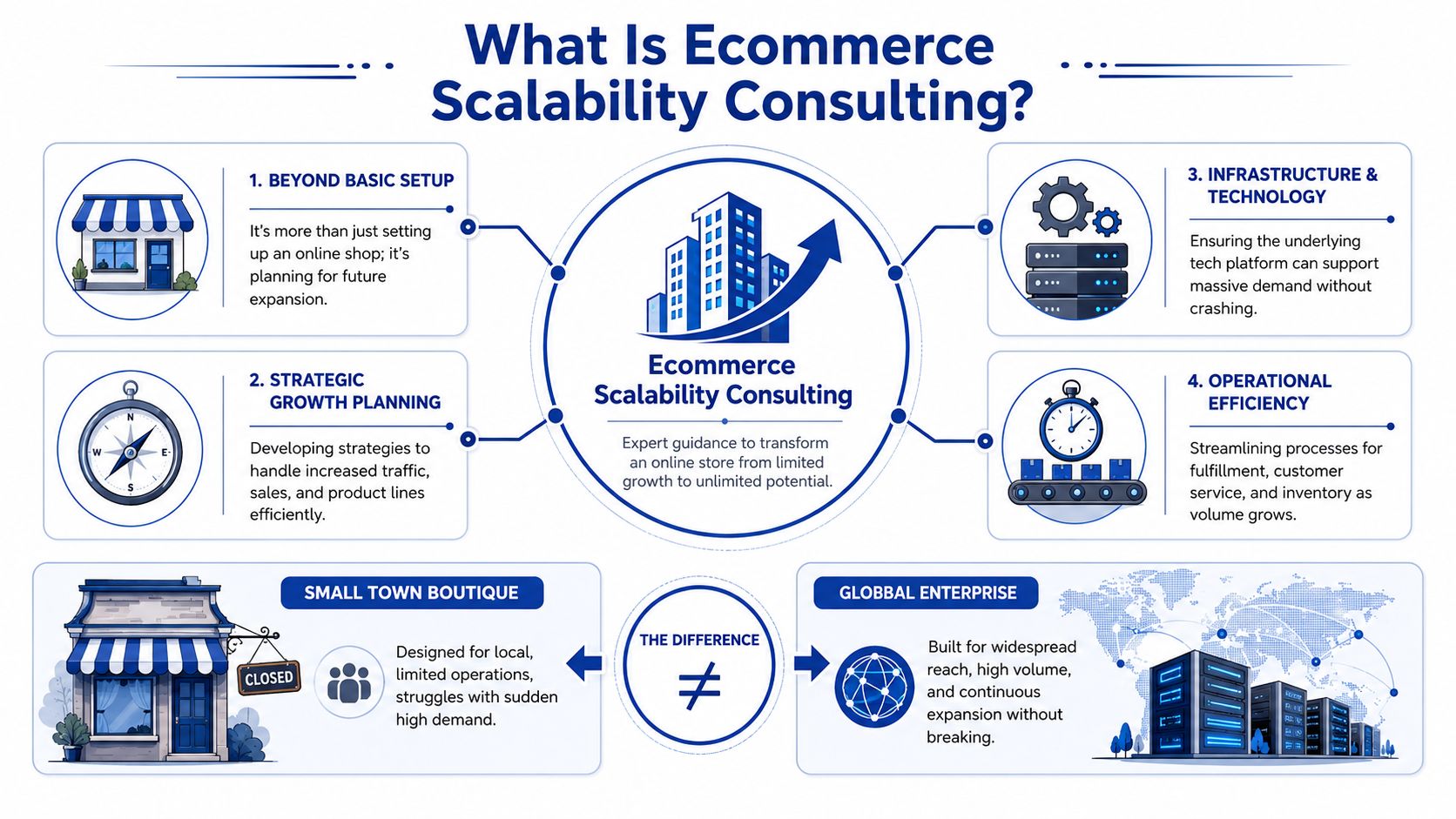
At a simple level, ecommerce scalability consulting is the work of making sure your online store can grow without breaking, stalling, or becoming too costly to operate.
Consider the difference between opening a small-town boutique and building a busy city shopping centre. Both sell products. But one can operate with a single till and a back room. The other needs loading bays, security, power planning, wayfinding, tenant management, and clear traffic flow. Digital commerce works the same way.
The Consultant’s Real Job
A scalability consultant isn't just there to make pages load faster. The role is closer to an architect and city planner combined. They decide what needs to scale, what shouldn't, and what can stay simple.
That usually means working across three practical concerns:
| Area | What it means in plain English | Why a CEO should care |
|---|---|---|
| Performance | The site responds quickly under pressure | Slow experiences reduce completed orders |
| Availability | The store stays up when demand spikes | Downtime wastes campaign spend and damages trust |
| Maintainability | The team can change the system safely | If every launch is risky, growth slows down |
A strong consultant also separates urgent fixes from structural work. Some problems need query tuning or better caching. Others need backend separation, event-driven processing, or changes to how promotions and inventory are handled.
More Than Hosting and Hardware
Many leaders get bad advice on this subject. Better hosting can help, but hosting alone doesn't solve weak application design. If the store's core workflows are tightly coupled, a larger server only gives you a larger bottleneck.
A scalable ecommerce operation is built so that pressure can be distributed, isolated, and observed. If pressure concentrates in one place, the business feels it everywhere.
There's also an operational side. As order volume grows, customer service, fulfilment, and analytics workflows need to stay clean. A slow support queue or messy order state can do as much damage to customer lifetime value as a slow product page.
For revenue teams that also run booked demos, service consults, or sales-assisted commerce, adjacent operational metrics matter too. A practical resource like this guide on reducing no-show rates is useful because missed appointments create the same kind of hidden waste that failed checkouts do. Demand exists, but the system doesn't convert it efficiently.
Signs Your Online Store Is Nearing Its Breaking Point
Most ecommerce systems don't collapse without warning. They send signals for months. Leaders miss them because the symptoms show up in different departments.
One team sees campaign volatility. Another sees rising support tickets. Engineering sees recurring incidents. Finance sees cloud costs drifting upward without a matching improvement in customer experience.
Business Signals Leaders Notice First
If you're hearing these complaints, your store may be close to its practical limit:
Peak-day conversion feels unpredictable: Campaigns perform differently depending on time of day or traffic intensity.
Feature launches keep getting delayed: The team says every release needs extra caution because the system is fragile.
Customer complaints cluster around checkout or account actions: Buyers don't usually report architectural issues. They report frustration.
Operations teams create manual workarounds: Staff export data, re-enter orders, or reconcile inventory by hand because systems don't stay in sync.
These aren't isolated annoyances. They usually point to a platform that can still function, but only with increasing effort and risk.
Technical Red Flags That Sit Underneath
On the technical side, the same pattern appears in different forms.
A store near its breaking point often has one or more of the following:
Slow database behaviour: Product, cart, pricing, or order queries take too long under load.
Intermittent server errors: Failures appear during bursts, then disappear when traffic settles.
Caching that helps browsing but not buying: Pages may look fast, while cart and checkout remain unstable.
A team stuck in reactive mode: Developers spend their week dealing with incidents, retries, and hotfixes.
If your engineers can keep the site alive only by watching it constantly, the architecture is already charging interest on its technical debt.
Why This Is Now a Board-Level Issue
Canada's policy environment has made this more visible. The Canada Digital Adoption Program, launched in 2022, was created to help SMEs adopt digital technologies, reflecting a national view that many firms need outside expertise to modernise systems and scale operations effectively (Bloom Consulting Group on CDAP and digital modernisation).
That matters because the issue isn't just technical hygiene. It's competitiveness. If your store can't absorb growth, every marketing win becomes riskier, every operational process becomes more brittle, and every new channel adds stress instead of an advantage.
A consultant's value starts here. Not by prescribing trendy architecture, but by telling you which symptoms are cosmetic, which are dangerous, and which ones are already costing the business real money.
The Consultant's Playbook From Assessment to Optimisation
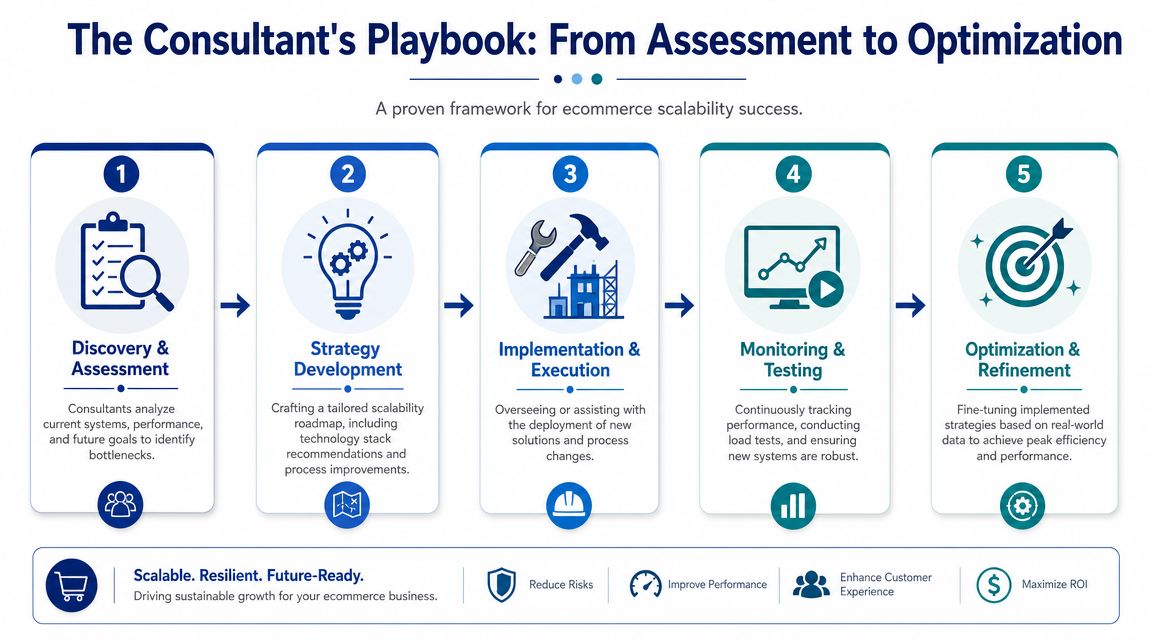
The work usually starts with measurement, not redesign.
Too many teams jump straight to migration plans, autoscaling settings, or infrastructure upgrades before they know what is failing. That's backwards. A consultant's first job is to make the system observable enough to diagnose.
Start With Instrumentation
A common failure mode in ecommerce is a database that works under average traffic but collapses under burst concurrency. The right remediation sequence is to instrument first, measure p95 and p99 response times and cache hit rate, then optimise the database, then add stateless horizontal scaling, and finally introduce autoscaling rules tied to real demand signals (SWK Technologies on scaling sequence and database bottlenecks).
That sequence matters because it prevents expensive guesswork.
A typical assessment looks at:
Traffic shape: Which pages, APIs, and jobs spike together
Critical paths: Product detail, search, cart, checkout, payments, order creation
Stateful bottlenecks: Databases, queues, session stores, search clusters
Operational friction: Release process, rollback safety, incident response, support load
If your leadership team needs a clearer understanding of infrastructure capacity, even a basic explainer on Server Scheduler on cores and threads helps frame why throwing compute at the problem often doesn't fix contention deeper in the stack.
Then Build a Roadmap That Respects Trade-Offs
Once the bottlenecks are visible, the roadmap gets more practical. Good consultants don't recommend a full rebuild if query tuning, caching, or service separation will remove the actual constraint.
A sensible plan often follows this order:
Stabilise measurement
Add dashboards, tracing, and alerts around revenue-critical flows.Fix the hot path
Improve the database, reduce lock contention, cache read-heavy content, and move slow background work off customer-facing requests.Decouple what changes fastest
Promotions, search, inventory sync, and support tooling often deserve clearer boundaries.Right-size infrastructure
Only after the application behaves properly should autoscaling and cloud spend be tuned.
Buy time before you buy complexity. The fastest route to scale is often removing a bottleneck, not adding a new platform.
For teams preparing larger architectural changes, a practical ecommerce backend modernisation guide can help frame where selective modernisation makes sense and where it increases moving parts.
What the Deliverables Should Look Like
A credible consultancy engagement should leave you with more than recommendations in a slide deck.
Look for outputs such as:
| Deliverable | What it should answer |
|---|---|
| Scalability audit | Where the system breaks and why |
| Prioritised roadmap | Which fixes matter first for revenue and risk |
| Target architecture | What the system should look like after remediation |
| Monitoring plan | How the team will detect regression before customers do |
That's how technical work turns into business control.
Measuring Success KPIs for Scalability Projects
If the project ends with “the site feels faster,” you don't have enough accountability.
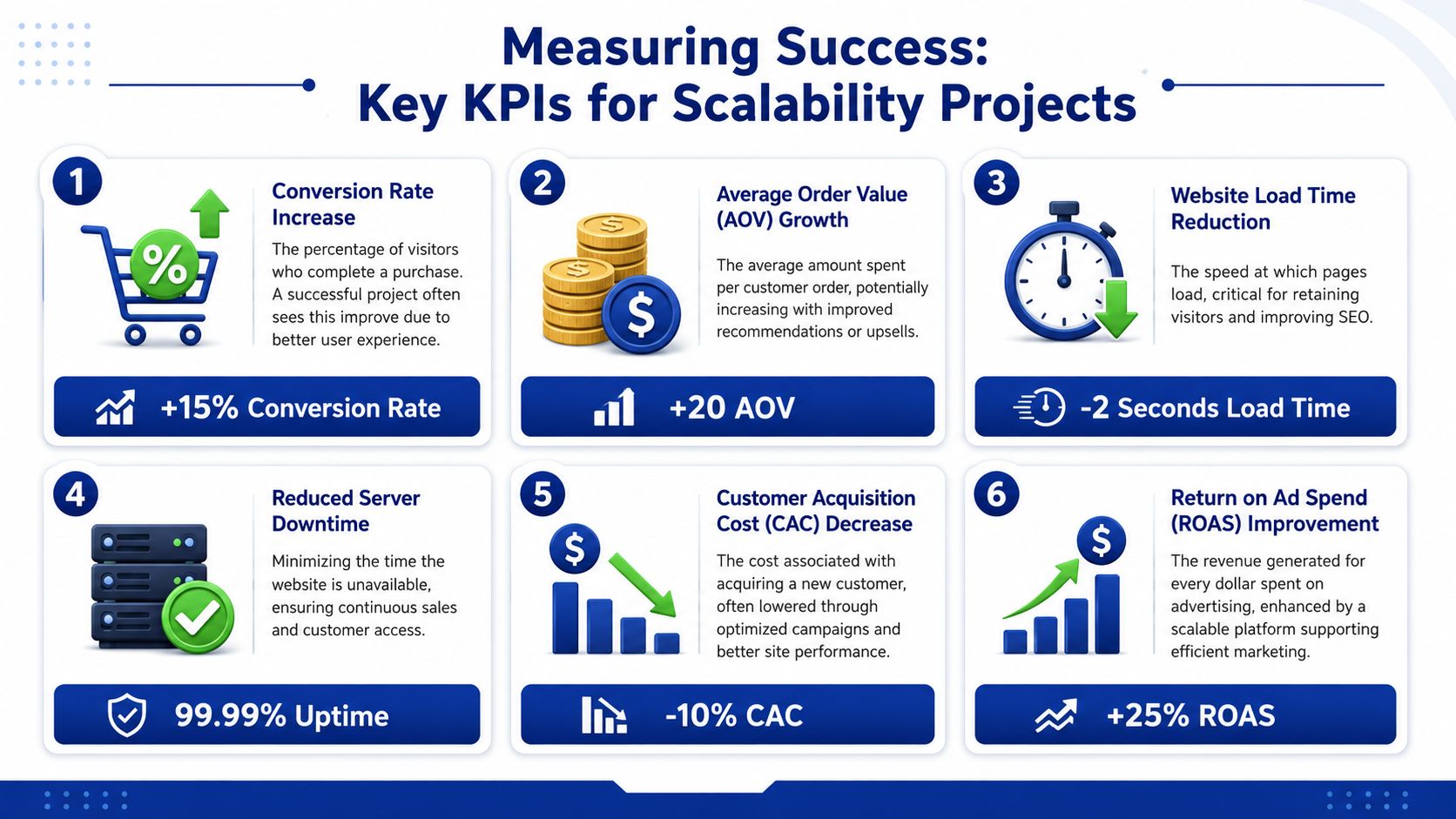
Scalability work has to be measured in both technical and commercial terms. A page that loads faster matters only because more people complete product discovery, trust the checkout, and finish their purchase without friction.
The Metrics That Actually Matter
I separate KPIs into two groups. The first group tells you whether the platform is healthier. The second tells you whether the business benefits.
Technical KPIs usually include:
p95 and p99 latency: Not the average experience, but the slow edge cases that hurt real buyers.
Error rate: Especially around cart, checkout, authentication, and payment callbacks.
Cache effectiveness: Whether the system is reducing load on expensive components.
Background job lag: Delays in syncs, inventory updates, notifications, or order workflows.
Business KPIs should include:
Peak-period conversion quality: Not just conversion overall, but conversion during campaign pressure.
Cart completion consistency: Whether the checkout stays reliable when traffic rises.
Revenue efficiency from paid traffic: Better site performance should reduce wasted acquisition spend.
Customer support friction: Fewer speed and order-state issues usually reduce avoidable service contacts.
Tie Every Technical Change to a Commercial Outcome
This is the part many projects miss. If a consultant improves response times but can't explain how that protects margin, conversion, or lifetime value, the work stays trapped in the IT budget.
For example, faster product and category pages don't just help “performance.” They help buyers compare options without delay. Cleaner cart behaviour doesn't just reduce errors. It preserves purchase intent at the most fragile stage of the journey.
Boardroom test: Every major technical KPI should map to one business outcome. If it doesn't, either the metric is vanity or the project scope is unclear.
If you run on Shopify, resources on tracking key Shopify metrics can help leadership teams organise the measurement layer around store performance, conversion behaviour, and operational quality instead of watching disconnected dashboards.
What a Good Reporting Rhythm Looks Like
You don't need a giant analytics programme. You need a disciplined one.
A useful reporting cadence compares before and after across:
Normal trading periods
Promotion windows
Release periods
Operational incidents
That's how you tell whether the platform is merely stable in calm conditions or resilient when revenue is on the line.
How To Choose the Right Scalability Partner
Hiring the wrong partner creates a second problem on top of the first. You're not just buying engineering time. You're making a judgment under uncertainty.
Some firms are excellent implementers but weak diagnosticians. Others produce polished recommendations and leave your team with a roadmap nobody can execute. You need a partner who can connect architecture, operations, and commercial risk.
What To Ask Before You Sign
The fastest way to evaluate a consultancy is to ask how they think, not just what they build.
Here's a practical shortlist.
| Evaluation Area | Key Question to Ask | Why It Matters |
|---|---|---|
| Platform experience | Have you worked on Shopify, Magento, headless, or custom stacks like ours? | Stack-specific bottlenecks vary a lot |
| Diagnostic process | How do you identify the real constraint before proposing solutions? | Good partners measure first, then prescribe |
| Business alignment | How do you tie technical priorities to conversion, uptime, and operating cost? | You need commercial judgement, not only code |
| Delivery model | Do you advise only, implement only, or do both? | Scope confusion creates delays and finger-pointing |
| Communication | Who translates technical findings for leadership? | The CEO needs clarity without sitting in every engineering call |
| Post-launch support | How do you monitor regressions after changes go live? | Scale work fails if the gains don't hold |
Pricing Models and Their Trade-Offs
Most ecommerce scalability consulting falls into three commercial structures.
Project-based work suits defined audits, targeted remediation, or a platform review before peak season. It gives budget clarity, but it can encourage shallow scope if the brief is poorly written.
Hourly or day-rate support works when the problem is still fuzzy. It gives flexibility, but it needs strong oversight or priorities drift.
Retainers make sense when the business expects ongoing optimisation, frequent releases, or continuous traffic pressure. They work best when both sides agree on KPIs and operating rhythm.
Don't choose the cheapest proposal. Choose the firm that can explain what it will leave behind after the engagement ends.
Signs You’ve Found a Practical Partner
A good partner usually does four things early:
Challenges vague goals: They push you to define what “scale” means for your business.
Requests evidence: They ask for logs, analytics, hosting bills, release notes, and incident history.
Talks in trade-offs: They explain what can be fixed quickly and what requires structural change.
Respects internal teams: They don't treat your developers like blockers.
If you need a partner that also handles cloud operations after remediation, a managed cloud service model can be relevant because scaling doesn't stop once the immediate bottleneck is removed.
One option in the Canadian market is Cleffex Digital Ltd, which works on software development, cloud, and ecommerce solution delivery as part of broader digital transformation engagements. That kind of blended capability can be useful when your scaling issue crosses application, infrastructure, and process boundaries.
Case Studies and Your Next Steps
You don't need dramatic numbers to recognise the pattern. The business cases tend to look similar even when the platforms differ.
Three Common Scenarios
A fashion retailer runs frequent campaigns on a mature ecommerce platform. Browsing is acceptable on ordinary days, but promotions create instability in the cart and checkout. The underlying issue isn't homepage traffic. It's discount logic, inventory lookups, and order writes all hitting the same constrained backend path at once. The fix is usually a mix of database tuning, caching read-heavy content, and moving non-essential synchronous work out of checkout.
A B2B parts supplier has a custom portal with complex search and account pricing. The leadership team assumes they need a full rebuild because customers complain that the site is slow. After assessment, the problem turns out to be inefficient queries, oversized payloads, and weak caching around catalogue data. The right move is staged optimisation, not a rushed replacement.
A growing Shopify-based brand launches faster than its operations can absorb. The site itself performs reasonably well, but order processing, support tagging, and inventory visibility create customer-facing friction. In this case, scale is partly an architecture problem and partly a workflow problem.
The best scalability projects don't start with “What technology do we want?” They start with “Where does growth currently break the business?”
What To Do Next
If you're considering ecommerce scalability consulting, prepare for the conversation properly.
List Recent Pain Points
Note slow periods, failed launches, support complaints, and operational bottlenecks.Gather Evidence
Bring analytics, cloud invoices, app lists, release history, and incident notes.Map Critical Journeys
Identify the flows that matter most: search, product page, cart, checkout, payment, and fulfilment updates.Separate Urgent from Structural
Decide what must be fixed before the next campaign and what can be redesigned later.Ask for a Prioritised View
A good consultant should tell you what to do now, what to delay, and what not to touch.
That preparation alone often saves weeks of confusion and helps avoid expensive, unfocused rebuilds.
Frequently Asked Questions About Scalability
Isn’t This Just Something My Hosting Provider Should Handle?
Not fully. A hosting provider can supply compute, storage, and network capacity. It usually won't redesign weak checkout flows, remove database contention, fix poor caching strategy, or clean up release processes. Hosting can support scale. It doesn't create it on its own.
Is Ecommerce Scalability Consulting Only for Large Enterprises?
No. Smaller businesses often feel the pain earlier because they have less room for operational waste. A mid-market brand can lose just as much momentum from checkout instability or slow fulfilment workflows as a much larger retailer. The difference is that smaller firms need tighter prioritisation.
How Long Does an Assessment Usually Take?
It depends on system complexity, how much observability already exists, and how many integrations sit around the store. A straightforward setup can be reviewed relatively quickly. A custom environment with several third-party dependencies, legacy code, and weak monitoring takes longer because the first task is making the system legible.
Can’t We Just Buy a Bigger Server?
Sometimes that buys time. It rarely fixes the underlying issue. If the bottleneck sits in a locked table, inefficient query, overloaded queue, or tightly coupled checkout process, a larger infrastructure just lets the same flaw consume more resources.
Can AI Solve Scalability Problems for Us?
Usually not at the start. Statistics Canada found that 12.2% of Canadian businesses reported using AI in spring 2024, and adoption was much higher in some sectors than in retail-facing operations, which is a useful reminder that AI readiness is uneven (Orienteed on Canadian AI adoption and ecommerce practicality).
For many ecommerce teams, the smarter path is to automate basics first:
Inventory visibility: Keep product availability accurate across channels
Support workflow automation: Route and resolve common customer issues faster
Instrumentation: Make system behaviour measurable before adding more complexity
Data discipline: Clean up catalogues, order states, and event tracking
Advanced personalisation and forecasting can help later. But if your data is noisy and your operations are inconsistent, AI often amplifies confusion instead of enabling scale.
If your store is growing faster than your current setup can safely handle, Cleffex Digital Ltd can help assess bottlenecks, modernise ecommerce architecture, and align technical scaling work with business goals across cloud, software, and digital commerce initiatives.