

The most popular advice about healthcare AI starts in the wrong place: choose a powerful model, connect your records, and build a helpful assistant. That order skips the hardest questions. Can your team assemble the right patient record, confirm what's missing, restrict how it's used, and stop an unsafe output before someone acts on it?
AI-ready HealthTech platforms start with interoperability, data quality and clinical workflow, not model selection. For Canadian clinics, insurers and health technology companies, readiness means building a dependable route from authorised information to a reviewed action. A convincing demonstration isn't enough.
What AI-Ready Actually Means in 2026
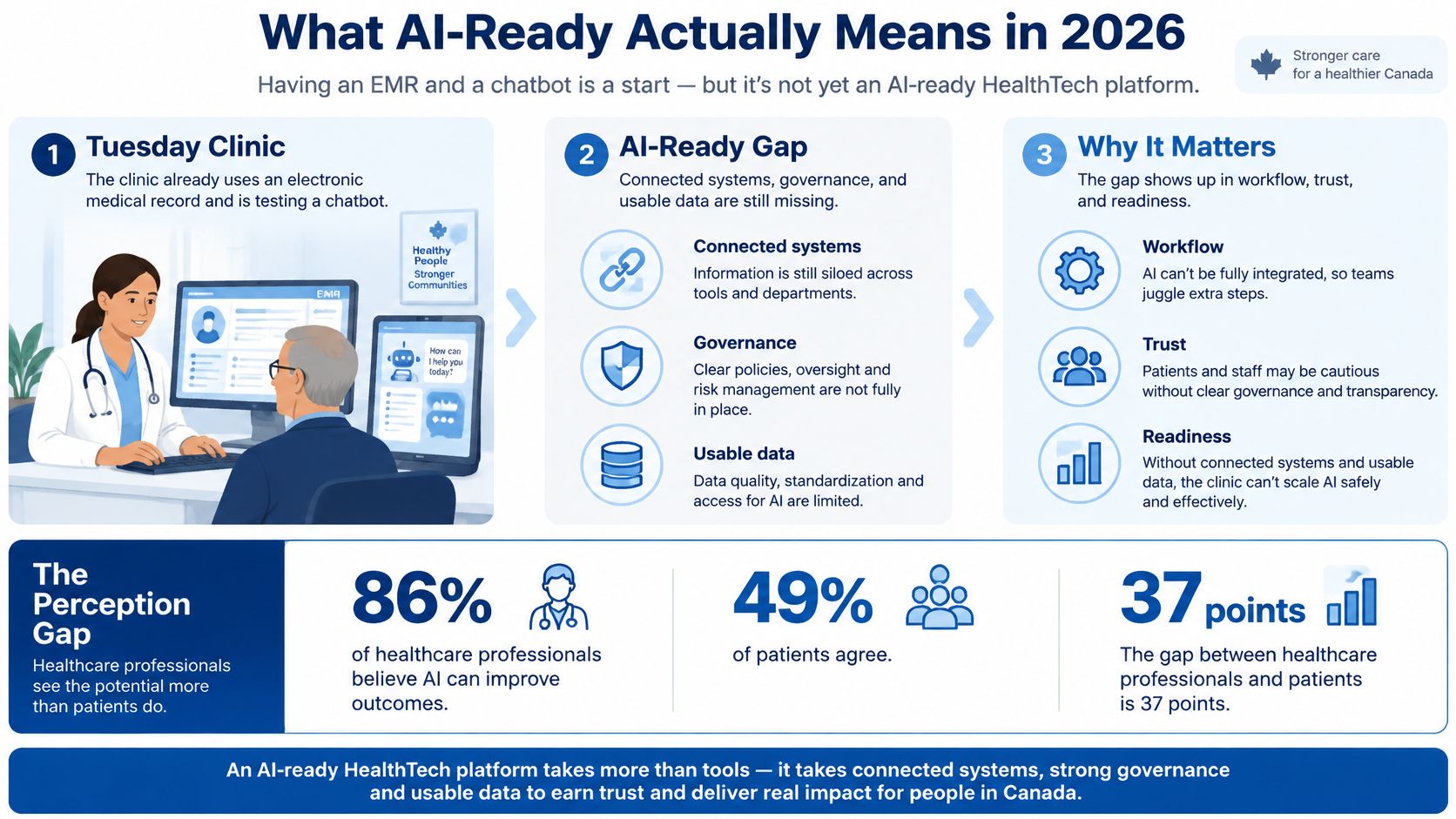
On a hypothetical Tuesday morning, a family clinic has an electronic medical record, an online booking system and a trial chatbot. A physician asks the chatbot to summarise a patient's recent care. The answer reads well, but the clinic hasn't received the latest hospital discharge note, and nobody can tell whether the medication list is current.
The clinic has digital tools. It doesn't yet have an AI-ready platform.
That distinction matters because experimentation can run ahead of operational controls. The Safety Mag's account of Canadian healthcare digitisation reports that 97% of surveyed healthcare organisations still rely on legacy technology, 87% report some AI use, and only 36% have AI-specific security measures; a separate survey described in that account found that 85% of healthcare professionals lose clinical time because patient information is incomplete or inaccessible, with almost half losing more than 45 minutes per shift.
An AI-ready HealthTech platform assembles an authorised record, makes its limitations visible, runs a model within a reviewed workflow, and records who accessed information and what happened next.
A demonstration answers a prompt
A demonstration usually begins with selected information and ends with an impressive response. The demonstrator knows which files were uploaded and can avoid difficult cases.
A production platform can't rely on that arrangement. Patients move between organisations, records arrive late, permissions change, and clinicians need to understand whether an answer reflects current information.
The difference becomes visible in the clinic's workflow:
Identity: The platform confirms that incoming information belongs to the correct patient.
Exchange: It receives relevant information through maintained interfaces rather than manual copying.
Audit: It records the information accessed, the model interaction and the reviewer's decision.
Human stop: A clinician can reject the draft, request missing information or prevent release.
Readiness doesn't require replacing everything
Legacy software isn't automatically unusable. A stable older system with a well-managed interface can be more dependable than a newer application with undocumented exports.
The practical question is whether your team can maintain the connection, detect failures and explain the resulting output. Start with a bounded workflow, such as drafting a visit summary, and establish those controls before widening its scope.
A polished chatbot can sit beside records the organisation still cannot share. Use the assessment below as a working document for a vendor discussion or architecture review, rather than accepting an AI feature list as evidence of readiness.
What to Assess Before You Add a Model
In 2024, 97% of Canadian healthcare providers could access some patient clinical information, and 92% had access to a digital health system, but only 52% used one to share information electronically outside their main practice setting, according to Statistics Canada's digital health findings. The same findings report that in 2025, 69% of Canadians could access at least one type of electronic health information, only 13% of adults had online access to all core record components, and about 32% used connected digital tools to understand and manage their health.
Assessment areas for an AI-ready HealthTech platform
| Area | Pass signal | Warning sign | Minimum control |
|---|---|---|---|
| Data quality | Coverage logged by domain, time, source and patient; gaps shown to the user | A summary is produced with no medication or laboratory history | Coverage score and an uncertainty flag on the output |
| Interoperability | Clinical information can be shared outside the main setting | A digital system exists but outside providers still rely on fax or portals | Standards-based APIs, identity matching and provenance |
| Privacy | Direct identifiers are removed or encrypted before prompts and training | Chart or health-card numbers reach a model by default | Field tags, purpose limits and a log of every transformation |
| Security | Controls exist for model use, not only for the hospital network | Unlogged prompts and shadow tools sit beside the record | Encryption, role-based access and an audit of model calls |
| Compliance | Care-time inference is separate from secondary training | One consent is assumed to cover model improvement | Residency, retention, disclosure and opt-out settings |
| Scalability | A curated store serves more than one use case | Each feature gets its own extract of personal health information | Monitored pipeline, lineage and a shared serving layer |
Score evidence, not assurances
Assign red, amber or green to each row before shortlisting AI healthcare software development work. Green means the control has been demonstrated in the intended workflow. Amber means a documented limitation has an owner and a safe workaround; red means the team cannot yet establish a dependable boundary.
For data quality, ask someone to demonstrate a record with missing medication history. Does the application withhold the summary, or clearly identify the missing domain? A generic confidence score won't answer that question because fluent wording says nothing about record completeness.
For interoperability, follow information across an organisational boundary. A successful upload into your own database doesn't prove that another provider can receive, interpret and reconcile the same information.
Buying rule: Ask vendors to demonstrate an incomplete record and a denied permission, not just their best answer.
Privacy and security need separate evidence. Inspect what may enter a prompt, what remains in the clinical record, and whether a reviewer can trace a model call without exposing unnecessary sensitive content in logs.
For teams evaluating American deployments alongside Canadian ones, Ares offers a resource to compare HIPAA-compliant AI platforms. Use that comparison to sharpen questions about vendor safeguards, not as proof that a product satisfies Canadian obligations.
Finally, test the platform's reuse. Ask whether a new use case can use the existing curated store under a different permission policy, or whether developers must create another uncontrolled extract. That answer often reveals more about scalability than a model benchmark.
HealthTech Architecture That Can Carry AI
Think of HealthTech architecture as a building with separate rooms, not a database with a model attached. Information needs a receiving area, an inspection point, a controlled preparation space and a serving area. Each boundary should have an owner.
Canada's National Artificial Intelligence Strategy commits $100 million to launch a Health Sector Data Space with the Canadian Institute for Health Information, intended to link secure, private and standardised datasets for clinical trials, health-services research and performance measurement. For product teams, the useful architectural principle is separation between raw arrival and approved use.
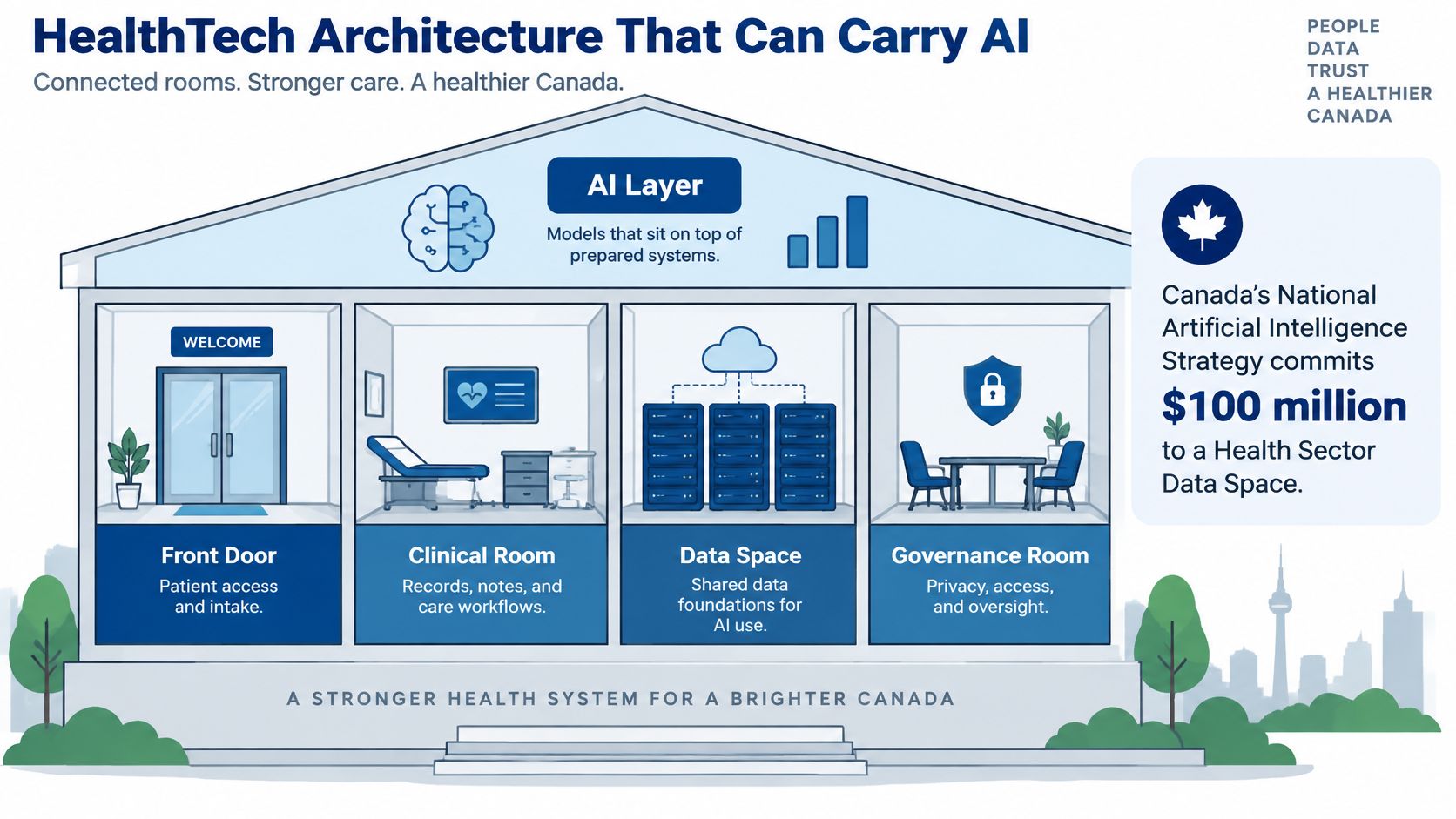
Draw the layers before choosing the model
Receive information through stable interfaces: Connect EMRs, laboratories, imaging systems, devices and administrative applications. Preserve the original message and arrival time so an integration team can investigate failures without guessing what changed.
Validate before declaring completeness: Check formats, units, timestamps and required fields. Match patient identities carefully, and attach provenance that identifies the originating system. Quarantine ambiguous matches rather than merging records without review.
Apply policy before downstream access: De-identify or pseudonymise information according to its approved purpose. Keep the policy service separate from application prompts so developers can't accidentally bypass restrictions by changing a user interface.
Maintain a curated analytical store: Store approved, quality-checked information with lineage linking it to its source and transformations. Represent unavailable, stale and explicitly absent information differently.
Control model serving: Give models access only to approved views for the task. Record the dataset version, retrieval context, model version and access decision needed to reconstruct an evaluation or patient-facing result.
Design for failures you can explain
Suppose a documentation assistant reads a nightly CSV export. An empty medication field might mean the patient takes no medication, the source omitted the list, or the export failed. Without explicit status information, the assistant cannot reliably distinguish those cases.
That's why healthcare data pipelines should favour reusable FHIR-style resources and event logs over isolated extracts. Events help developers track corrections and arrivals; structured resources help them preserve clinical meaning across applications.
The healthcare data infrastructure guide provides a complementary foundation for planning those connections. Keep the implementation diagram readable enough that clinical, security and engineering leads can identify the same boundaries.
A useful build test is to add a population-level view after implementing note summaries. It should reuse approved information with purpose-specific permissions, not require another copy of personal health information. That reusable foundation is the healthcare AI infrastructure underneath AI healthcare software development.
Privacy, Security, and Cross-Province Rules
A health-card number and a postal code create different privacy problems. The first directly identifies a person within a health system. The second only becomes identifying when combined with other information, which is why privacy controls have to treat the two differently.
The Canadian Institute for Health Information's privacy policy supports removing or encrypting direct identifiers, replacing indirect identifiers with derived variables, and using generalisation or suppression to reduce foreseeable re-identification risk. In practice, a development dataset might use an age band instead of a date of birth, provided the change remains appropriate for the clinical task.
Make privacy a controlled route
Privacy-by-design should work like a locked service corridor. Only approved information moves through it, for a recorded purpose, and each transformation leaves an auditable record.
Build that route into the platform:
Classify fields: Tag direct identifiers, indirect identifiers and sensitive clinical attributes.
Restrict model inputs: Block raw personal health information from prompts and training by default, allowing only explicitly approved exceptions.
Record transformations: Capture the policy applied, the authorised purpose and the resulting dataset.
Reassess linkage: Review re-identification risk when teams add new sources or enrich existing records.
De-identification reduces risk; it doesn't erase it. Treat it as statistical risk reduction rather than a guarantee. De-identified health information can still carry privacy obligations, and it deserves the same review as identifiable records before it leaves a controlled environment.
Prefer synthetic or appropriately anonymised information for development when it preserves the clinical properties you need to test. Don't assume synthetic examples adequately test rare presentations, missingness patterns or demographic differences without checking them. A model trained on clean synthetic records can still fail the first time it meets a real chart full of gaps.
Govern access and releases together
The Pan-Canadian AI for Health guiding principles emphasise appropriate consent, de-identification, confidentiality, integrity, availability and patient control, alongside coordination across jurisdictions. Translate those principles into role-based permissions, encryption, retention limits and recorded consent or another applicable legal basis.
Provincial implementation needs its own review. PIPEDA and provincial health-information laws don't create an interchangeable national rulebook, and teams should not assume identical treatment of de-identified and anonymised information in Ontario, Quebec, Alberta and British Columbia. A platform serving hospitals in multiple provinces needs privacy rules configured per jurisdiction, not a single policy written once and applied everywhere.
Use a privacy impact assessment as a release gate, with unresolved risks assigned to named owners. The guide to AI healthcare data privacy in Canada can help teams organise those technical and governance questions.
Finally, separate care-time inference from secondary-use training. A clinician requesting support within an authorised care workflow is not the same as developers retaining those records to improve a model. Keep training information behind its own authorisation, minimisation and risk-review gate.
Healthcare Uses That Need a Ready Platform
Reported enthusiasm for AI and actual readiness are two different things. The Philips Future Health Index discussion of healthcare AI reports that 86% of healthcare professionals believe AI can improve patient outcomes, compared with 49% of patients, a 37-point gap; it also places Canadians near the bottom among 47 countries in willingness to rely on AI-generated information.
That gap makes sense when you look at the plumbing. Clinicians see AI layered onto systems they already know are incomplete: a discharge summary that never arrived, a medication list that ends at one pharmacy, an imaging study locked in another organisation's archive. High reported AI use can sit on legacy systems that still cannot exchange a complete record. Read each use case below as a test of interoperability, data quality and workflow fit, because a fluent answer built on a partial record fails exactly where it matters most.

A family clinic drafts an after-visit summary
The assistant prepares plain-language instructions from the encounter and available records. Before drafting, the platform checks medication and laboratory coverage, and labels any missing history on the draft. If a specialist's letter or a hospital stay never reached the record, the clinician sees that gap flagged instead of discovering it in a confident paragraph.
The clinician corrects and approves the instructions before release. The patient should see that AI assisted, which relevant information was unavailable, and how to request a correction or clinician review.
Specialists discuss a treatment plan
A multidisciplinary team needs shared access to large imaging files on a desktop or tablet. The platform's job is coordinated viewing, controlled access and traceable discussion. Interpretation stays with the specialists.
An AI assistant might organise the meeting material or highlight unanswered questions. Specialists remain responsible for reading the images and agreeing the plan, while the patient receives an understandable explanation of AI's role and a route to challenge the recommendation.
An insurer reviews a prior-authorisation packet
The model groups documents and identifies supporting information for a reviewer. It should distinguish an absent document from evidence that a clinical criterion was not met, because those two findings lead to different outcomes for the member.
A reviewer accepts, changes or rejects the recommendation. Members need disclosure of AI assistance, visibility into material gaps and a route to request clinical reconsideration; using identifiable files for training requires separate authorisation.
For research teams evaluating these workflows, PlotStudio AI's discussion of reproducible analytics for clinical research is a useful companion when planning inspectable analytical work. For care-facing products, the clinical decision-support guide helps frame where assistance should stop, and clinician judgement should begin.
The human review point must function as a working control, with real authority to stop an answer before release.
Connected-device monitoring belongs later, as another governed feed into the same pipeline. Give it the same treatment as every other source: validation of the feed, reliable patient matching and an agreed escalation pathway before a model ever sees the readings.
Frequently Asked Questions
Does having an EMR mean we're AI-ready?
No. An EMR establishes a digital record, but it doesn't prove that information can be exchanged, assessed for completeness or safely supplied to a model. A clinic can document encounters electronically while still missing important information from outside organisations.
Use the assessment table to test the actual workflow, particularly information arriving from elsewhere. Ask for a demonstration using incomplete and conflicting records rather than a carefully prepared sample chart.
May we train AI on identifiable health information?
Generally, informed consent is required when identifying information is used, subject to the applicable legal context. The Chambers Canadian legal survey published in 2025 explains that healthcare AI training is not specifically authorised by jurisdictional privacy or health-information statutes, that PIPEDA or provincial legislation may apply, and that British Columbia guidance warns combined de-identified datasets can enable re-identification.
Keep training behind the privacy gate described in the privacy and security discussion. Confirm the proposed purpose, authorisation, dataset boundaries, supplier access and withdrawal implications with qualified counsel before releasing information to a training process.
Which exchange standard should we choose?
Prefer FHIR-style APIs where source systems support them. They provide a practical way to exchange structured clinical resources, but choosing a standard doesn't eliminate mapping, terminology or identity problems.
Keep HL7 v2 interfaces at the integration edge where older hospitals or devices still emit those messages. Preserve provenance whichever interface you use, and apply the layered architecture to prevent transport-specific details from spreading into every application.
For imaging, plan the image-access workflow separately from text summarisation. A model's ability to describe text doesn't establish its suitability for interpreting clinical images.
Does this checklist work outside Canada?
The technical assessment travels; the legal mapping doesn't. Data quality, interoperability, privacy, security, compliance and scalability remain useful review areas, but the permitted processing purpose and contractual duties require local analysis.
Use the assessment as an engineering starting point, then confirm requirements with local counsel and the relevant regulator before information moves. Review hosting, subprocessors, retention, patient disclosures and secondary uses for each market rather than treating Canadian or American compliance language as universal approval.
Start with an AI Readiness Assessment
A platform can report heavy AI use and still fail to exchange a complete record with the hospital next door. Treat the assessment like a building inspection before adding a floor: the model is new weight, and the report shows which parts of the structure can carry it.
If interoperability or data quality comes back red, fund the connection and record-completeness work before buying a larger model. Pick a bounded workflow, such as visit summaries or a shared treatment plan, and let the lowest-rated area set the next release.
The lowest score gets funded first.
Next spend by readiness outcome
Each outcome maps to a specific spending decision and a control that must hold before output reaches a patient or a training process.
| Assessment outcome | Next spend | Guardrail |
|---|---|---|
| Interoperability or data quality is red | Exchange, identity matching and coverage flags before a larger model | No patient-facing output until coverage flags are live |
| Interoperability and data quality are amber, privacy is red | Freeze training use | Keep the pilot inside care delivery with a clinician accept or reject step, subject to privacy approval |
| All six areas are green or amber | Pilot a second use case on the same curated store | Re-score the six areas at each release |
Set a bounded delivery scope
A practical initial work package maps sources, measures the gap between digital access and external sharing, tags identifiers and pilots a human-reviewed output. Define acceptance evidence before development begins: which coverage flags must be live, who reviews the draft, and what result would justify expansion or require a pause. Without that evidence agreed in advance, a pilot drifts into a permanent demo that nobody can sign off or shut down.
At Cleffex, we conduct AI readiness assessments examining data availability, technical infrastructure, business needs and organisational maturity. The same discipline runs through delivery work such as MDIS, a secure post-market compliance platform we built for MedQAIR that unifies stakeholders and MDR, UK and FDA requirements.
Start a conversation through the Cleffex homepage, or review our healthcare software integration scope. We provide healthcare software integration for North American healthtech companies, enabling hospital connectivity, compliance, AI diagnostics and scalable platforms.
For the product itself, make the next decision equally concrete: name the workflow, identify the weakest control and fund the work that makes the output dependable.
Cleffex Digital Ltd offers AI readiness assessments and healthcare software integration to help teams build connected, governed AI-ready HealthTech platforms. Visit Cleffex Digital Ltd to discuss your proposed workflow, existing systems and the controls needed before a clinical or insurance pilot.