


At its core, using AI for insurance compliance means bringing in smart systems to handle the heavy lifting. Think of it as a way to automate regulatory monitoring, make reporting a breeze, and get ahead of risks before they become major problems. For insurers drowning in new regulations and a sea of data, it’s the only way to move past outdated manual processes with the speed and accuracy required today.
The New Reality of Insurance Compliance

The insurance industry is caught in a perfect storm. On one side, regulatory bodies are tightening their grip with increased scrutiny. On the other hand, the sheer volume of data is exploding, making spreadsheets and manual checks feel completely archaic. The old ways of doing things just aren't cutting it anymore.
This pressure-cooker environment is forcing insurers, especially small and medium-sized ones, to find a smarter way forward. A single slip-up, a missed filing deadline, a misread rule, or a suspicious transaction that flies under the radar can lead to massive fines and a serious hit to your reputation.
The Shift Towards Proactive Compliance
Staying competitive today means moving from a reactive, "check-the-box" approach to a genuinely proactive and predictive strategy. It’s all about spotting risks before they blow up into full-fledged problems. This is exactly where AI for insurance compliance stops being a nice-to-have and becomes a critical tool for survival.
To get a handle on this dynamic environment, insurers are starting to use AI-driven compliance risk assessment to get ahead of the curve. This approach is all about identifying, analysing, and mitigating potential issues before they can escalate.
This guide is designed to be a practical roadmap for any insurer looking to make that leap. We'll break down how AI can help you:
Automate Monitoring: Keep a constant, intelligent eye on all your transactions, policies, and communications without needing a massive team.
Streamline Reporting: Generate precise regulatory reports in a tiny fraction of the time it used to take.
Reduce Costly Errors: Catch the kinds of human errors that are almost inevitable in manual compliance work.
Build Resilience: Create a stronger, more flexible compliance framework that can adapt to whatever comes next.
Why Now Is the Time for AI
The urgency isn't just a feeling; it's being driven by real regulatory trends. By 2026, Canadian regulators like the Office of the Superintendent of Financial Institutions (OSFI) are expected to ramp up their oversight of AI-powered decision-making in the industry.
It's no surprise that in a recent survey of Canadian insurance leaders, 80% said AI was a key priority for 2026, with nearly half calling it their number one focus. The message is loud and clear: the industry is moving past small pilot projects and into full-scale implementation.
By transforming compliance from a cost centre into a strategic asset, AI enables insurers to not only meet their obligations but also to build a foundation for more efficient and competitive operations.
This isn't some far-off concept. These are practical tools available right now, ready to solve the immediate and pressing challenges facing insurers of all sizes.
What's Really Powering AI Compliance?
To get a real handle on AI for insurance compliance, you need to peek under the bonnet and see the technologies that make it all work. These aren't just buzzwords; they’re practical tools, each with a specific job. Think of them as a highly specialised crew, working together to automate and fortify your entire compliance setup.
The heart of this crew is Machine Learning (ML). Picture an incredibly sharp auditor who can sift through millions of documents, transactions, and customer interactions in the blink of an eye. ML models are trained on your historical data to spot patterns, both good and bad, that are simply invisible to the human eye.
This isn't about old-school, rigid rules. ML actually learns and adapts. For example, it can analyse thousands of past insurance claims to pinpoint the subtle tells of fraudulent activity. When a new claim comes in that fits that pattern, it gets flagged with uncanny accuracy. This is a game-changer, turning compliance from a reactive chore into a proactive defence.
The Language Expert on Your Team
If ML is the pattern-finder, then Natural Language Processing (NLP) is the language expert. NLP is what gives the system the power to read and truly understand human language from all sorts of places, such as policy documents, customer emails, and dense regulatory updates.
It’s like having a super-powered legal assistant. An NLP algorithm can scan thousands of policy contracts overnight to confirm they all include the latest mandatory clauses from a new regulation. It can also analyse customer complaints for certain keywords that might signal misconduct or a compliance breach, alerting your team right away. Getting a basic grasp of how AI for legal documents is changing the game provides a great backdrop for its role in insurance.
These two technologies are powerful on their own, but they often work together to create a formidable compliance engine.
How It All Comes Together
The real magic happens when these AI components team up, often with the help of Robotic Process Automation (RPA). RPA acts as the digital "hands" of the operation, handling all the repetitive, rule-based grunt work of pulling and moving data.
Here’s a quick look at how they collaborate in a real-world scenario:
Data Collection (RPA): An RPA bot logs into your various systems, claims platform, CRM, and policy software, to gather all the necessary data for a new client.
Document Analysis (NLP): The NLP model then gets to work, reading the unstructured data like application forms and ID documents, pulling out key information, and checking if anything is missing.
Risk Assessment (ML): Finally, the ML model crunches all that data, comparing it against historical patterns and regulatory watchlists to calculate a risk score. If it spots any red flags, it immediately sends the file to a human for review.
This seamless integration means that a process that once took days of painstaking manual effort can now be wrapped up in minutes, with better accuracy and a perfect, auditable trail.
This teamwork is what allows AI to take on complex, multi-step compliance headaches. For those curious about what's next, you might want to check out our guide on generative AI in the insurance industry, which dives into how newer models are pushing these capabilities even further.
By blending pattern recognition with language comprehension and automated execution, insurers can finally build a compliance system that’s not just efficient, but also intelligent and ready for whatever the regulators throw at it. This is the core of modern AI for insurance compliance.
How Insurers Are Putting AI to Work for Compliance Today
The theory behind AI for insurance compliance is interesting, but its real power is in solving the practical, day-to-day headaches that teams face. This isn't just abstract technology; it's a tool that takes over repetitive tasks, spots risks more accurately, and gives your experts time back to focus on work that actually requires their judgment. Insurers are already seeing a significant impact from these solutions.
So, let's look at four areas where AI is genuinely changing the game, turning compliance from a necessary chore into an intelligent, automated advantage.
Bolstering the First Line of Defence: Automated AML and KYC
Anti-Money Laundering (AML) and Know Your Customer (KYC) checks are the bedrock of compliance. They're also notoriously slow and riddled with potential for human error. For years, this meant people manually checking customer data against long, constantly changing global watchlists.
AI flips the script on this. Machine Learning algorithms can now screen new applicants against thousands of data points from around the world in an instant. The system can verify identities, flag politically exposed persons (PEPs), and spot unusual transaction patterns as they happen.
Think about it: an AI system can take a new customer’s details, run them through multiple identity checks, and cross-reference them with international sanction lists, all in the few seconds it takes to process an application. This makes onboarding much faster while building a solid, auditable shield against financial crime.
Taking the Pain out of Regulatory Reporting
Getting accurate reports to regulatory bodies on time is a constant source of stress for compliance teams. It's a scramble of pulling data from different, often disconnected systems, trying to mash it together in spreadsheets, and just hoping a mistake didn't slip through the cracks.
AI-powered platforms, often pairing Robotic Process Automation (RPA) with Machine Learning, can handle this entire workflow from start to finish.
Data Gathering: Bots can go into your claims, policy, and financial systems to pull exactly the data needed, no manual exports required.
Report Building: The system then arranges that data into the precise formats regulators like OSFI demand, making sure every field is filled out correctly.
Sanity Checks: Before anything is sent, algorithms run a final scan for oddities or inconsistencies that might attract unwanted regulatory attention.
This approach doesn't just save hundreds of staff hours; it significantly lowers the risk of expensive reporting errors and penalties. The whole process becomes quicker, more precise, and frankly, a lot less agonising for your team.
Making Sure Policies and Documents Are Watertight
Every insurance policy is a dense legal document that needs to follow strict consumer protection laws and regulatory guidelines. Trying to manually review thousands of policies to make sure they're all aligned with the latest rule changes is a Herculean, if not impossible, task.
This is a perfect job for Natural Language Processing (NLP). NLP algorithms are trained to read and actually understand the text inside policy documents, endorsements, and even customer emails.
By treating regulatory rules and policy wordings as data, NLP can scan your entire book of business to find non-compliant clauses, old-fashioned terminology, or missing disclosures. It's about spotting problems before they ever get in front of a customer or a regulator.
Imagine a new provincial regulation comes out requiring a specific phrase in all auto policies. An NLP tool could scan every active policy in minutes, flag the ones that need an update, and even suggest the compliant wording to drop in.
Finding Fraud That Hides in Plain Sight
Insurance fraud is a multi-billion-dollar problem, and the schemes are always getting more creative. A human reviewer might catch an obviously fake claim, but sophisticated fraud rings operate by creating subtle patterns across dozens of seemingly unrelated claims. These are almost impossible for a person to see.
AI, on the other hand, is built for this. Fraud detection systems powered by AI comb through massive datasets of claims, looking for the faint connections and odd patterns that scream "coordinated fraud." It might connect the dots between a group of claims that all use the same doctor, body shop, and lawyer, a classic sign of an organised ring.
As you can learn more about in our guide, AI integration in insurance is transforming these core functions. By finding these hidden relationships, AI gives investigators the high-quality leads they need to stop fraud before it turns into a major loss.
AI Use Cases in Insurance Compliance
To bring it all together, here’s a quick summary of how these technologies are being applied on the ground.
| Use Case | Primary AI Technology | Key Benefit |
|---|---|---|
| AML & KYC Screening | Machine Learning (ML), Data Analytics | Faster, more accurate customer onboarding and real-time risk identification. |
| Regulatory Reporting | Robotic Process Automation (RPA), ML | Reduced manual effort, fewer errors, and guaranteed on-time submissions. |
| Policy & Document Review | Natural Language Processing (NLP) | Proactive identification of non-compliant language across thousands of documents. |
| Fraud Detection | Predictive Analytics, Network Analysis | Uncovering sophisticated fraud rings and patterns invisible to human analysts. |
These examples show that AI isn't a futuristic concept anymore. It's a practical set of tools that insurers are using right now to make their compliance functions stronger, smarter, and far more efficient.
Calculating the Real ROI of AI Compliance
When you’re thinking about bringing in any new technology, the first question is always the same: what’s the payback? It’s no different for AI in insurance compliance. But to really understand the value, you have to look past the fancy features and get to the heart of its return on investment (ROI). This isn't just one single number; it's a mix of hard cost savings, much stronger risk management, and just plain smoother operations.
For most insurers, the most obvious win is cutting costs. Just think about the sheer amount of time your compliance team spends manually combing through documents, pulling together regulatory reports, or running AML checks. AI takes over these repetitive, time-sucking tasks, letting your highly skilled (and expensive) compliance experts focus on the strategic work they were hired for, not data entry.
That automation immediately lowers your operational costs. On top of that, you have the very real threat of non-compliance penalties, which can easily climb into the millions. An AI system that catches a potential problem before it escalates is an investment that can pay for itself many times over, just by helping you dodge a single major fine.
Strengthening Your Risk Mitigation Armour
Beyond just saving money, AI brings a level of accuracy and risk detection that humans simply can't match. Even the most careful and experienced teams get tired and make mistakes, especially when they're digging through mountains of data. AI systems, on the other hand, work 24/7 with unwavering precision.
These systems are brilliant at spotting subtle, complex patterns that might signal fraud or a compliance breach, patterns that are almost invisible to the human eye. This heightened accuracy effectively builds a much stronger defensive wall around your entire operation.
AI fundamentally shifts compliance from a reactive, "check-the-box" function to a proactive, real-time defence. You’re not just catching yesterday's mistakes; you're actively preventing tomorrow's violations.
This proactive approach is more important than ever. With new regulations like Canada's Artificial Intelligence and Data Act (AIDA) aiming at 'high-impact' AI systems, the pressure is on to prove you have a solid risk management framework. Given that a quarter of Canadian insurers are already using AI for core functions, being able to manage these risks and keep meticulous records is a serious competitive edge. You can explore more about these regulatory developments and their impact on Canadian financial institutions.
Accelerating Business Through Efficiency
Finally, the boost in operational efficiency sends positive ripples throughout the entire business. When compliance workflows move faster, everything else can move faster, too. For instance, automating your KYC and client onboarding means you can get new customers approved and signed up in minutes, not days.
That kind of speed does more than just make customers happy. It shortens your business cycles, which means you can start recognising revenue much sooner. In the end, faster compliance isn't just an internal improvement; it's a real advantage out in the market.
To get a rough idea of your own potential ROI, you can think about it in three main buckets:
Cost Savings: Figure out the hours saved by automating manual work and multiply that by your team's average hourly rate. Don't forget to factor in the potential savings from fines you'll avoid.
Risk Reduction: Put a number on what a single major compliance failure or a significant fraud event would cost your business. Even reducing that risk by a small percentage delivers a huge return.
Efficiency Gains: Look at the time saved in key areas like onboarding or policy issuance. How does that translate into better customer satisfaction and faster revenue?
By looking at AI for insurance compliance through these three lenses, you can build a powerful business case that shows its true value, not as a cost centre, but as a strategic tool for growth and stability.
Navigating the Ethical and Regulatory Hurdles of AI
Bringing sophisticated AI into your compliance framework isn't just a technical upgrade; it introduces a whole new set of responsibilities. It’s not enough for these systems to be fast and accurate. They have to be transparent, fair, and secure. Getting this right is absolutely critical to a successful rollout; it’s how you build trust instead of creating new risks.
One of the biggest hurdles you'll face is model explainability. Regulators, customers, and even your own team will want to know why an AI system flagged a claim or denied an application. You can’t just shrug and blame the “black box” algorithm anymore.
This isn’t just a best practice; it’s quickly becoming law. Take Canada's proposed Artificial Intelligence and Data Act (AIDA), for example. It’s set to place strict requirements on what it calls "high-impact" systems, pushing insurers to be upfront about their automated decision-making. In practice, this means your compliance team needs to be able to clearly explain the logic behind any AI-generated decision.
Confronting Data Bias Head-On
A huge ethical minefield with AI is data bias. At the end of the day, an AI model is only as objective as the data it’s trained on. If your historical data carries subtle, baked-in biases related to things like postal codes, age, or gender, the AI will learn those same prejudices and, worse, apply them at scale.
This can easily lead to discriminatory outcomes where the AI system unfairly flags certain customer groups more often than others. That kind of situation doesn't just hurt your customers; it exposes your company to serious regulatory fines and can do lasting damage to your reputation.
A biased AI compliance system isn’t just a technical problem; it's a fundamental business risk. Mitigating bias requires a deliberate strategy that goes beyond simply feeding the machine more data.
To get ahead of this, you need to be proactive.
Conduct Data Audits: Before you even think about training a model, dig into your datasets. Look for any skews or imbalances that could lead to unfair results down the road.
Implement Fairness Testing: Use specialised tools to stress-test your models against different demographic groups before you let them go live.
Establish Human Oversight: Make sure there's always a clear process for a person to review sensitive AI-driven decisions. This provides a vital check and balance against the machine.
Safeguarding Privacy and Security
AI compliance systems are built on mountains of sensitive personal and financial data. A data breach isn’t just a technical glitch; it’s a complete breakdown of the trust you have with both your customers and the regulators. This makes top-notch data privacy and security measures completely non-negotiable.
This goes way beyond standard cybersecurity. You need a solid data governance framework that clearly defines who can access data, what it can be used for, and how it’s protected from start to finish. Things like strong encryption, tight access controls, and regular security audits are the bare minimum. As you design your systems, staying current on the relationship between AI and data privacy in insurance is key to making sure every possible safeguard is in place.
Ultimately, this is about building a culture of responsible AI. It means training your people, setting clear ethical ground rules, and making sure that every use of AI for insurance compliance is designed to be as trustworthy as it is powerful. By tackling explainability, bias, and privacy from day one, you can use AI to build a stronger, fairer, and more resilient compliance function.
A Practical Roadmap for Implementing AI in Compliance
Jumping into an AI for insurance compliance project can seem daunting. The trick is to treat it less like a massive, one-time overhaul and more like a series of deliberate, well-planned steps. You want to build momentum with small, measurable wins that prove the value and justify scaling up.
The journey doesn't start with algorithms or fancy software; it starts with an honest look in the mirror at your current processes.
Phase 1: Find the Real Compliance Headaches
Before you can fix anything with AI, you need to know exactly what's broken. Start by walking through your compliance workflows, from the first step to the last. Where are the bottlenecks? What tasks eat up the most time or lead to the most frustrating errors?
Maybe your team is bogged down for weeks pulling together data for quarterly regulatory reports. Or perhaps new client onboarding grinds to a halt because of sluggish KYC checks. Getting specific about these pain points is the most important thing you can do. Pick the one bottleneck that, if you could solve it, would make the biggest, most immediate difference. That’s your target for your first AI project.
Phase 2: Get Your Data House in Order
AI is fuelled by data. The quality of that data directly dictates how well your system will perform. If your information is locked away in different systems, messy, or full of gaps, your AI initiative will stumble right out of the gate. This phase is all about a thorough data audit.
Data Accessibility: Can your teams actually get their hands on the data needed for your chosen use case, like claims histories or customer profiles?
Data Quality: Is the information accurate and complete? Is it formatted consistently across the board?
Data Governance: Do you have clear, established rules for handling data privacy and security?
Tackling your data infrastructure isn't glamorous, but it's absolutely critical. Think of it like pouring the foundation before building a house; a strong data strategy is non-negotiable.
This visual guide breaks down the three core hurdles, bias, explainability, and privacy, that your roadmap absolutely must address.
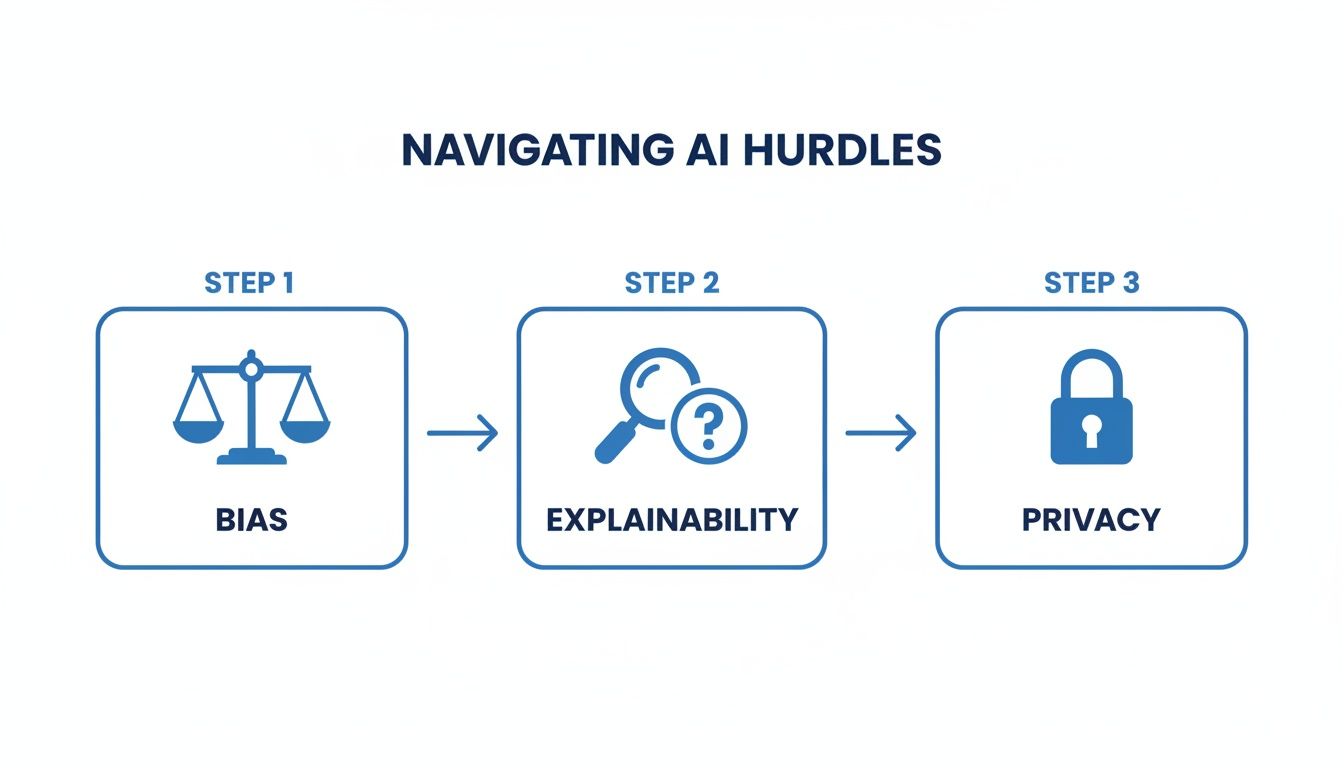
Getting these three areas right is fundamental to building a compliance program that is both responsible and effective.
Phase 3: Pick the Right Partner, Not Just the Right Tech
You don't have to build this from the ground up. The market for AI compliance tools is growing fast, but not every vendor is on the same level. When you're looking at potential partners, dig deeper than the flashy tech specs.
The right partner understands more than just algorithms; they understand the nuances of insurance regulations. Their solution should be a compliance tool first and a technology product second.
Ask them pointed questions about their experience with Canadian insurance regulations, their specific approach to data security, and how their platform can grow with you. A great partner acts more like a consultant, working with you to tailor a solution that fits your real-world needs and budget, not just selling you an off-the-shelf product.
Phase 4: Start Small with a Pilot Project
Forget about a company-wide rollout right away. The smart move is to launch a focused pilot project. Take the AI solution and apply it directly to that single, high-impact bottleneck you found back in Phase 1. This gives you a controlled environment to prove the technology’s worth on a manageable scale.
Be crystal clear about what success looks like. Your goal might be to cut the time spent on KYC checks by 50% or slash reporting errors by 90%. A successful pilot does more than just solve a problem; it creates a powerful internal case study that builds the trust and buy-in you'll need to expand the program later.
Your Top Questions About AI in Insurance Compliance, Answered
When insurers start exploring AI for their compliance programs, some very good questions always come up. It's smart to tackle these concerns directly to get a real sense of how this technology can fit into your day-to-day operations. Here are straightforward answers to the questions we hear most often.
Is AI Compliance Just for the Big Players?
Not anymore. It used to be that only the largest carriers could afford the massive upfront investment AI required, but that world has completely changed. With the growth of flexible, cloud-based AI platforms, this technology is now well within reach for small and medium-sized insurers.
The best part is that modern systems are built to be customised. A smaller firm can start by automating a single, high-priority task, like AML screening or policy document checks, without paying for a suite of tools they don't need. It really levels the playing field, allowing them to manage risk just as effectively as the industry giants.
Will AI Replace Our Compliance Team?
This is a common worry, but the answer is a firm no. Think of AI as a powerful new member of your team, not a replacement for it. Its real strength is chewing through the mind-numbing, high-volume data analysis that humans simply can't do at that scale or speed.
AI takes over the tedious, repetitive work, freeing up your skilled compliance professionals to focus on what they do best: applying their judgment to tricky edge cases, interpreting new regulations, and handling the nuanced situations that always require a human touch.
This partnership makes your whole compliance function sharper and more effective. Your team’s expertise actually becomes more valuable, not less.
How Do We Know the AI's Decisions Are Fair?
Building a trustworthy and fair AI system is non-negotiable, and it's a very deliberate process. It all starts with the data. The models must be trained on diverse, high-quality datasets and then put through rigorous testing to sniff out and correct biases before the system is ever deployed.
Beyond that, the industry is moving toward Explainable AI (XAI). This means the systems are no longer a "black box"; they're designed to show their work, providing clear, understandable reasons for their decisions. This transparency, combined with constant human oversight and regular independent audits, creates a system you can actually trust. It's how you ensure the AI operates ethically and stays aligned with crucial standards like the NAIC's FACTS principles.
At Cleffex Digital Ltd, we specialise in creating intelligent software solutions that solve real-world business challenges. If you're ready to see how AI can strengthen your compliance framework, contact us today to explore a tailored solution.