

Picture this: a sales associate who works around the clock, speaks every customer's language fluently, and has your entire product catalogue memorised. That, in a nutshell, is an AI chatbot for ecommerce. It's like having a superpowered digital concierge for your online store, ready to guide shoppers from their first click to the final checkout, 24/7.
Meet Your New Best Salesperson: The AI Chatbot
At its heart, an AI chatbot is a piece of software that mimics human conversation. But for an online store, it's so much more than a simple Q&A tool. Forget rigid, pre-programmed scripts; think of it as an intuitive, helpful assistant that actually learns as it goes. Thanks to modern artificial intelligence, these bots can finally understand what a customer really means, not just the exact keywords they type.
This ability to grasp intent is what truly changes the game. A customer might ask, "Got any waterproof jackets for hiking in the Rockies?" A basic bot would probably stumble. An AI chatbot, however, understands the context: the need for durability, weather resistance, and a specific activity. It can then offer up smart recommendations, compare different options, and even suggest complementary gear, just like a seasoned human expert would.
Here’s a great example from Shopify showing a bot helping someone pick out the perfect running shoes.
You can see how the bot steers the conversation, asking clarifying questions to narrow down the choices and deliver a truly personalised recommendation.
The Modern Digital Concierge
In a crowded market, a standout customer experience isn't just a nice-to-have; it's essential. An AI chatbot acts as your store's front-line ambassador, offering instant support and personalised guidance that can scale to any number of customers. It beautifully solves one of the biggest challenges in ecommerce: closing the gap between the convenience of online shopping and the personal touch of an in-store visit.
An AI chatbot doesn’t just answer questions; it creates conversations. It turns passive browsing into an active, engaging shopping experience that builds trust and drives sales.
The benefits for any online business are tangible and almost immediate. These tools are built to deliver:
24/7 Instant Support: Field customer questions about orders, shipping, and products anytime, day or night. This drastically cuts down on support tickets and eliminates frustrating wait times.
Personalised Shopping Journeys: Become a personal shopper for every visitor. The bot can recommend products based on browsing history, stated preferences, and direct questions.
Higher Conversion Rates: Proactively engage shoppers who seem hesitant, nudge customers with abandoned carts by offering a timely discount, and generally make the path to purchase as smooth as possible.
Throughout this guide, we'll dig into exactly how you can put this technology to work and start seeing these results for yourself.
How AI Chatbots Drive Real Ecommerce Growth
Think of an AI chatbot as more than just a pop-up window on your site. It's a tireless, data-driven engine that directly fuels business growth. By handling key customer interactions and making the shopping experience feel personal, an AI chatbot for ecommerce moves the needle on the metrics that actually matter to your bottom line.
Its value really shines across three core areas: boosting sales, building loyalty, and making your operations a whole lot smarter.
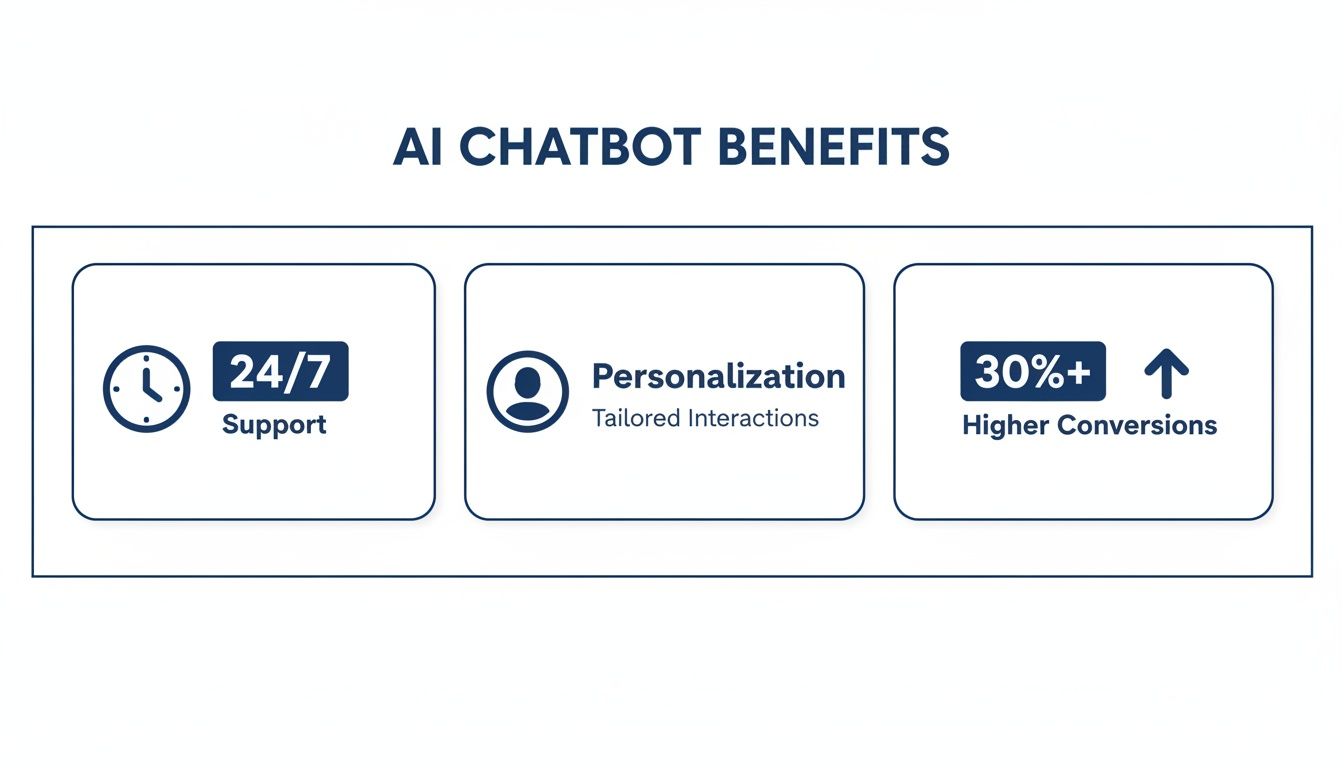
This really brings it home: constant availability, one-on-one experiences, and proactive sales support all work in tandem to create a smoother customer journey and, ultimately, drive more revenue.
Boosting Conversions and Revenue
One of the first things you'll notice after implementing an AI chatbot is its effect on your conversion rate. It acts like an ever-present, expert sales associate: engaging hesitant shoppers, answering those last-minute questions, and gently guiding them toward the checkout.
For example, a bot can be set up to pop up when someone has been lingering on a product page, offering to clarify features or compare models. That simple, well-timed interaction is often the nudge a customer needs to add an item to their cart.
And chatbots are absolute masters of cart recovery. When a shopper leaves items behind, the bot can re-engage them with a quick message, maybe offering a small discount or answering a nagging question about shipping that was holding them back.
Data shows that AI-powered bots can recover up to 35% of abandoned carts through these proactive nudges, directly turning lost opportunities into completed sales.
Recent figures from the Canadian market are especially telling. AI chatbots are delivering an 18% average lift in conversions, with shoppers who interact with them converting at an incredible 4X the rate of those who don't. That massive difference, 12.3% completing a purchase versus just 3.1%, shows just how powerful a guided conversation can be.
Building Lasting Customer Loyalty
Loyalty is built on trust and consistently good experiences. An AI chatbot strengthens this foundation by giving customers instant, reliable support, 24/7. No more waiting until Monday morning to get answers about an order, a return, or product availability.
This immediate help is critical. One study found that AI support can speed up the whole purchasing process by 47%, making the journey less of a hassle and far more satisfying. Happy customers are far more likely to come back.
What's more, these bots remember past conversations. A returning customer can be greeted by name and offered recommendations based on their last purchase, making them feel seen and understood. Over time, this consistent, high-quality support builds the kind of loyalty that really grows customer lifetime value. For a wider perspective, we have a detailed guide on other AI-powered ecommerce solutions in Canada that work hand-in-hand with chatbot technology.
Creating New Operational Efficiencies
Beyond the direct sales impact, AI chatbots bring serious operational efficiencies to the table, saving you both time and money. They automate the endless stream of routine, high-volume questions that can bog down a human support team.
By taking over tasks like:
"Where is my order?" updates
Questions about shipping costs
Inquiries on return policies
Your human agents are freed up to focus on the complex, high-value issues where they can truly make a difference. This might be handling a tricky return, helping a high-value customer with a custom order, or resolving a sensitive complaint. This strategic use of your team’s talent not only boosts job satisfaction but ensures your best problem-solvers are right where you need them.
To see a powerful real-world example of this in action, just look at Vodafone's success in achieving 80% First Contact Resolution with Chatlingual. It’s a fantastic case study that shows the immense potential of this technology to improve customer service and drive growth.
The following table breaks down exactly how AI chatbots can influence the numbers that define success in ecommerce.
Key Ecommerce Growth Metrics Impacted by AI Chatbots
This table quantifies the direct impact of implementing an AI chatbot on crucial ecommerce performance indicators, based on aggregated industry data.
| Metric | Average Improvement with AI Chatbot | How It's Achieved |
|---|---|---|
| Conversion Rate | 15-30% Increase | Proactive engagement, 24/7 sales assistance, and instant answers to product questions reduce friction in the buying journey. |
| Cart Abandonment | 20-35% Reduction | Timely pop-ups with discount offers, shipping info, or support can re-engage users who are about to leave their carts. |
| Customer Lifetime Value (CLV) | 10-25% Increase | Personalised recommendations and consistent, reliable support build loyalty, encouraging repeat purchases and higher-value orders over time. |
| Support Ticket Volume | 40-60% Decrease | Automation of common, repetitive queries (like order status) frees up human agents for more complex and valuable customer issues. |
Ultimately, these numbers show a clear picture: integrating a smart chatbot isn't just a tech upgrade; it's a strategic move that directly strengthens your customer relationships and your financial results.
Choosing the Right AI Chatbot for Your Online Store
Picking the perfect AI chatbot for your online store can feel a bit like wading through a crowded market. There are so many options out there, all promising the world. The secret is to look past the shiny features and get to the heart of what will actually help your business grow. The "best" choice isn't always the most advanced one; it's about finding the right tool for the job you need done.
Before you even start looking at platforms, you need a clear picture of what you want to achieve. What’s the number one headache you’re trying to solve with a chatbot? Are you swamped with support tickets and need to automate common questions? Or is your main focus on boosting your average order value by recommending products at the right time?
Nailing down that primary objective is your most important first step. It becomes your North Star, guiding every other decision you make down the line.
Define Your Primary Business Goals
The purpose you set for your chatbot will dictate everything: its design, its conversation style, and the features you absolutely need versus the ones that are just nice to have. A good place to start is by pinpointing your biggest operational pain points and what a successful outcome looks like.
For most ecommerce businesses, the goals tend to fall into one of these buckets:
Slash Support Costs: Think about all the time your team spends answering questions like "Where's my order?" or explaining your return policy. Automating those common queries can free up a massive amount of time and resources.
Lift Conversion Rates: A well-designed bot can act like a virtual personal shopper. It can help guide customers who aren't sure what to buy, answer those last-minute questions that stop a sale, and generally make the whole buying process smoother.
Increase Average Order Value (AOV): By making smart upsell and cross-sell suggestions ("Hey, people who bought that jacket also loved these hiking boots"), a chatbot can add more value to each and every sale.
Generate and Qualify Leads: If you have a more consultative sales process, a bot is fantastic for gathering initial information from potential customers and qualifying them before passing the conversation over to a human.
Once you’ve identified your main goal, you can start evaluating different chatbot platforms based on how well their features support that specific outcome. This keeps you from getting distracted and overpaying for a bunch of bells and whistles you’ll never use.
Must-Have Features for an Ecommerce Chatbot
While every shop is different, there are a few non-negotiable features that any solid AI chatbot for ecommerce needs. These are the foundational elements that ensure the tool can actually do its job well and grow with your business.
At a minimum, look for a solution that offers:
Seamless Platform Integration: Your chatbot absolutely must connect cleanly with your ecommerce platform, whether that’s Shopify, WooCommerce, or something else. This is how it pulls real-time data on orders, products, and customer history to give accurate answers.
Powerful Natural Language Processing (NLP): This is the brain behind the bot. Good NLP means the chatbot can understand what customers are asking for, even if they use slang or make typos. It allows for natural conversation, not just rigid, keyword-based responses.
Robust Customisation Options: You need to be able to tweak the bot’s look, personality, and conversation flows to perfectly match your brand. A generic, out-of-the-box bot can feel cold and might even hurt your customer experience.
Human Handover Capability: Let's be realistic – no bot can handle every single query. A smooth, easy process for escalating a complex or sensitive chat to a live person is essential for keeping customers happy.
It's no surprise that these tools are catching on fast across Canada. Some projections suggest that AI bots could power 95% of all customer interactions by 2025, and 76% of online retailers are already planning to bring them on board. As this report on AI in ecommerce shows, choosing the right platform isn't just an advantage anymore; it's becoming a necessity to stay competitive.
Comparing Different Chatbot Architectures
Not all chatbots are built the same way. The technology running under the hood determines what they can do, how much they cost, and how much work they are to manage. Getting a handle on these differences is the key to making a smart decision that fits your budget and your team's capacity.
The best chatbot isn't always the most complex one. A simple, well-designed rule-based bot can outperform a poorly implemented AI if it solves the customer's problem quickly and efficiently.
Let’s take a look at the main types of chatbot technology you’ll come across.
Comparing Chatbot Architecture Models
Here's a breakdown of the different types of chatbot technology to help you decide which model best suits your business needs and budget.
| Chatbot Type | How It Works | Best For | Typical Cost |
|---|---|---|---|
| Rule-Based | Follows a pre-defined script or decision tree. Uses buttons and structured menus to guide the user. It cannot understand free-form text. | Simple, predictable tasks like answering FAQs, tracking orders, or scheduling appointments. Ideal for businesses on a tight budget. | Low (often included in marketing platforms or available for a small monthly fee) |
| AI (NLP-Powered) | Uses Natural Language Processing and Machine Learning to understand user intent, learn from conversations, and provide more dynamic, human-like responses. | Personalised product recommendations, complex query resolution, and creating a more engaging, conversational shopping experience. | Medium to High (requires a subscription to a specialised AI platform) |
| Hybrid Model | Combines rule-based flows for simple tasks with AI capabilities for more complex queries. Often includes a seamless human handover. | The majority of ecommerce stores. It offers the perfect balance of cost-effectiveness, control, and intelligent automation. | Medium (provides the most flexibility and is often the best starting point) |
For the vast majority of online stores, a hybrid model offers the best of both worlds. It lets you automate the simple, repetitive stuff with cost-effective rules, but brings in the power of AI for those more nuanced conversations that build trust and drive sales. It's the perfect way to start small, prove the value, and then scale your bot's capabilities as your business grows.
Your Step-By-Step Implementation Roadmap
Launching an AI chatbot isn't some massive technical hurdle. Think of it less like building an engine from scratch and more like following a clear, well-marked trail. By breaking the process into four distinct phases, you can move methodically from a rough idea to a fully functional, sales-driving assistant.

This structured approach makes sure you cover all your bases, from nailing down your chatbot's personality to actually measuring its impact after it goes live. Let’s walk through each stage.
Phase 1: Pre-Launch Planning and Scoping
Before you even think about code or platforms, you need a crystal-clear vision. This initial planning phase is absolutely critical because it lays the foundation for everything else. Rushing this step is like starting a road trip without a map – you'll definitely be moving, but probably not toward your destination.
First, define the chatbot's main job. Is it a support agent, a sales assistant, or a bit of both? This decision directly shapes its persona, which is just the voice and tone it uses. A bot for a high-end fashion boutique should sound worlds apart from one selling auto parts.
Next, you'll want to map out the key conversation flows. Don't try to make it do everything at once. Pick the top 3-5 most common and impactful interactions to start.
Order Status Inquiries: To handle the endless "Where is my order?" questions.
Product Discovery: For guiding shoppers who aren't quite sure what they're looking for.
FAQ Automation: To answer all the routine questions about shipping, returns, and store policies.
Lead Capture: For grabbing an email address in exchange for a discount code.
Documenting these core functions gives your project a clear scope. If you're looking for a structured way to outline your project's stages and goals, exploring a technology roadmap template can provide the clarity you need for a successful implementation.
Phase 2: Technical Integration
With a solid plan in hand, it’s time to actually connect the chatbot to your digital storefront. For most ecommerce businesses, especially if you're on a platform like Shopify, this has become surprisingly simple. Modern chatbot tools are built for easy, no-code or low-code integration.
The most common ways to hook it up are:
Platform-Specific Apps: Many chatbot providers have dedicated apps in marketplaces like the Shopify App Store. This is usually the easiest route, often just a few clicks to install and link the bot to your store’s data.
API Integration: If you have a more custom setup or a bespoke ecommerce platform, you'll use an Application Programming Interface (API). This gives you a lot more flexibility but usually needs a bit of developer help to connect your product catalogue, order system, and customer database.
The goal of integration is to give your chatbot real-time access to information. An AI chatbot for ecommerce is only as useful as the data it can access. Without a live link to your inventory and order systems, it can’t provide accurate, helpful answers.
Phase 3: Training and Testing
Once your chatbot is connected, it’s time for it to go to school. An AI model isn’t smart right out of the box; you have to train it on your specific products, policies, and brand voice. This means feeding it your FAQ documents, product descriptions, and shipping policy pages. The better the data you give it, the smarter and more accurate its answers will be.
After that initial training, testing begins. This isn't just about finding bugs. It's about feeling out the user experience from your customer's point of view.
Crucial Testing Steps:
Internal Testing: Have your own team play around with the bot. Get them to try to trick it or ask questions in weird ways.
User Acceptance Testing (UAT): Find a small group of real customers to test-drive the chatbot. Their feedback is pure gold, revealing confusing conversational paths or frustrating dead ends you would have otherwise missed.
Phase 4: Launch and Continuous Optimisation
Going live isn't the finish line; it’s really just the start of the learning process. After launching your chatbot, your main focus will shift to monitoring its performance and using real-world data to make it better over time.
You'll want to track key metrics like its containment rate (how many problems it solves on its own) and the conversion rate for users who chat with it. Spend time reviewing the chat logs to see where customers get stuck or where the bot misunderstands them. Every one of those interactions is a lesson you can use to refine its knowledge base and sharpen its conversational skills, ensuring your AI chatbot becomes an even more valuable asset for your business.
Measuring Success and Calculating Your ROI
So, you’ve decided to bring an AI chatbot into your ecommerce operation. That’s a solid move, but it's an investment, and every smart investment needs to be measured. To really grasp the value it's adding, you have to look past the obvious metrics and pinpoint the Key Performance Indicators (KPIs) that directly tie back to your operations and, most importantly, your revenue.
This isn't about counting how many chats it had in a day. It’s about digging into the data to see the story it tells: a story of improved efficiency, happier customers, and more sales. When you track the right numbers, you get a crystal-clear picture of the chatbot's contribution, which lets you make smart, data-driven tweaks to make it even better.

Key Performance Indicators To Track
You don't need to track dozens of metrics. Just focus your attention on a few critical KPIs that, together, paint a complete picture of how your chatbot is really doing. These numbers show you how the bot is actually influencing customer behaviour and making a real difference to your bottom line.
Here are the essentials I always tell clients to monitor:
Containment Rate: What percentage of customer questions does the bot solve all on its own, without needing to hand off to a human agent? A high containment rate is your first sign of success; it means the bot is handling the routine stuff, freeing up your team for more complex issues.
Chatbot-Influenced Conversion Rate: This one is huge. It measures how many users end up buying something after they’ve chatted with your bot. Tracking this lets you directly connect revenue to the bot’s ability to answer product questions, suggest the right items, and smoothly guide shoppers to the checkout.
Customer Satisfaction (CSAT) Score: At the end of a chat, a quick survey asking, "How did we do?" provides incredibly valuable feedback. A strong CSAT score is proof that your bot isn't just closing tickets; it's delivering a genuinely helpful and positive experience.
Getting a handle on these numbers is fundamental to understanding your store's performance. For a bigger picture, our guide on ecommerce analytics, metrics, and KPIs is a great place to start.
A Simple Framework for Calculating ROI
Figuring out the Return on Investment (ROI) for your chatbot doesn't have to be some complex financial puzzle. At its core, it's a simple comparison: weigh the money you've saved and the new revenue you've generated against what the chatbot costs. This straightforward calculation makes it easy to justify the investment and show its value to anyone in your business.
Think of ROI as the chatbot's report card. It's the ultimate proof that this technology isn't just a fancy feature; it's a revenue-generating, cost-saving asset for your online store.
You can get started with this simple two-part formula:
Calculate Your Total Gains:
Support Cost Savings: Take the number of queries the bot handled and multiply it by the average time a human agent would spend, then by their hourly wage. That’s your direct savings in support costs.
Increased Revenue: Add up all the sales that came directly from chatbot interactions. Don't forget to include recovered abandoned carts and successful cross-sells or upsells.
Calculate Your ROI:
The Formula: (Total Gains – Chatbot Cost) / Chatbot Cost * 100%
This gives you a clean percentage. If it’s a positive number, your chatbot is officially paying for itself and contributing to your profit.
To really dial things in and squeeze every last drop of value from your chatbot, you might want to dive even deeper. A comprehensive revenue optimisation course can give you advanced strategies to boost sales even further and maximise the return on all your tools.
Your AI Chatbot Questions, Answered
Jumping into any new technology brings up questions, and that’s a good thing. It means you’re thinking strategically. Let’s tackle some of the most common queries we hear from ecommerce owners about bringing an AI chatbot into their business.
Will an AI Chatbot Replace My Team?
Absolutely not, and that shouldn't be the goal. Think of it less as a replacement and more as a super-powered assistant for your team. The best approach is a hybrid one.
Let the bot handle the repetitive, high-volume stuff around the clock – things like "Where's my order?" or questions about your return policy. This frees up your human agents to dig into the complex, sensitive issues where real empathy and creative problem-solving make all the difference. The chatbot becomes the first line of support, seamlessly handing off to a person when a human touch is needed.
What’s the Real Cost to Get Started?
The price tag on an AI chatbot can swing pretty widely, all depending on what you need it to do. You can find simpler, rule-based bots on app marketplaces that might only cost $20-$50 a month.
For more sophisticated AI that understands natural language and integrates deeply with your store, you're looking at a range of $100 to over $1,000 monthly. This depends on the features you need and how many conversations it will handle. A smart move is to start with a solution that solves your biggest headache right now and then scale up once you see the return.
Key Takeaway: Don't try to boil the ocean. Start with a chatbot that tackles one key problem, like cutting down support tickets or saving abandoned carts. You can always level up to a more advanced system as your business and budget grow.
How Fast Will I See a Return on Investment?
You'd be surprised how quickly you can see a payback. Many online stores see a positive ROI within just 3 to 6 months. The first wins usually come from saving money on support hours and getting a clear sales bump from recovering abandoned carts.
Think about it: if your chatbot convinces just a few customers a month to complete their high-value purchase, it can often pay for itself right there. The long-term value comes from building happier, more loyal customers who stick around and buy more over time.
This isn't just a hunch; the market backs it up. In Canada, the ecommerce chatbot market is forecast to grow at a massive compound annual growth rate (CAGR) of 25.6% from 2025 to 2030, reaching a projected USD 1,750.9 million. This boom is happening because AI chatbots are becoming essential for managing the high volume of online shoppers in Canada's ecommerce scene. You can read more about the 2025 technological trends shaping Canada's ecommerce to see the bigger picture.
Ready to see how an AI-powered solution can make a real difference for your business? The team at Cleffex specialises in developing custom software that drives growth and efficiency. Contact us today to explore your options.