

Your sales team updates a customer's address in the CRM on Tuesday morning. By Thursday afternoon, finance has still sent the invoice to the old location, and operations is chasing a duplicate record in the ERP. Someone on your team spends two hours every Friday exporting CSV files to patch the gap.
That's the exact moment most business owners ask their technical lead a blunt question: should we wire these platforms together with enterprise API integration, or do we need custom middleware sitting between them? Vendors will happily pitch whichever option they sell. One insists that direct APIs solve everything; another claims you need a custom orchestration layer before you connect a single tool.
Both pitches miss the starting point. This isn't a beauty contest between two technologies. It's a governance decision first. Once you settle your data rules, privacy boundaries, and legacy system limits, the right technical path becomes obvious, and five simple tests will tell you where direct APIs belong, where custom middleware earns its keep, and where you need both.
Enterprise API Integration and Custom Middleware at a Glance
Disconnected software is no longer a niche problem reserved for multinational banks. According to Statistics Canada, 85% of Canadian businesses used at least one information and communications technology in 2021, up from 80% in 2019, and 45% used cloud computing over the same period. Most growing firms now run a mix of cloud software, customer databases, and back-office tools that must exchange records accurately every day.
Both approaches sit inside the broader discipline of enterprise application integration, the set of system integration solutions used to make separate business platforms work as one coherent operation. The difference comes down to how those systems speak to each other.
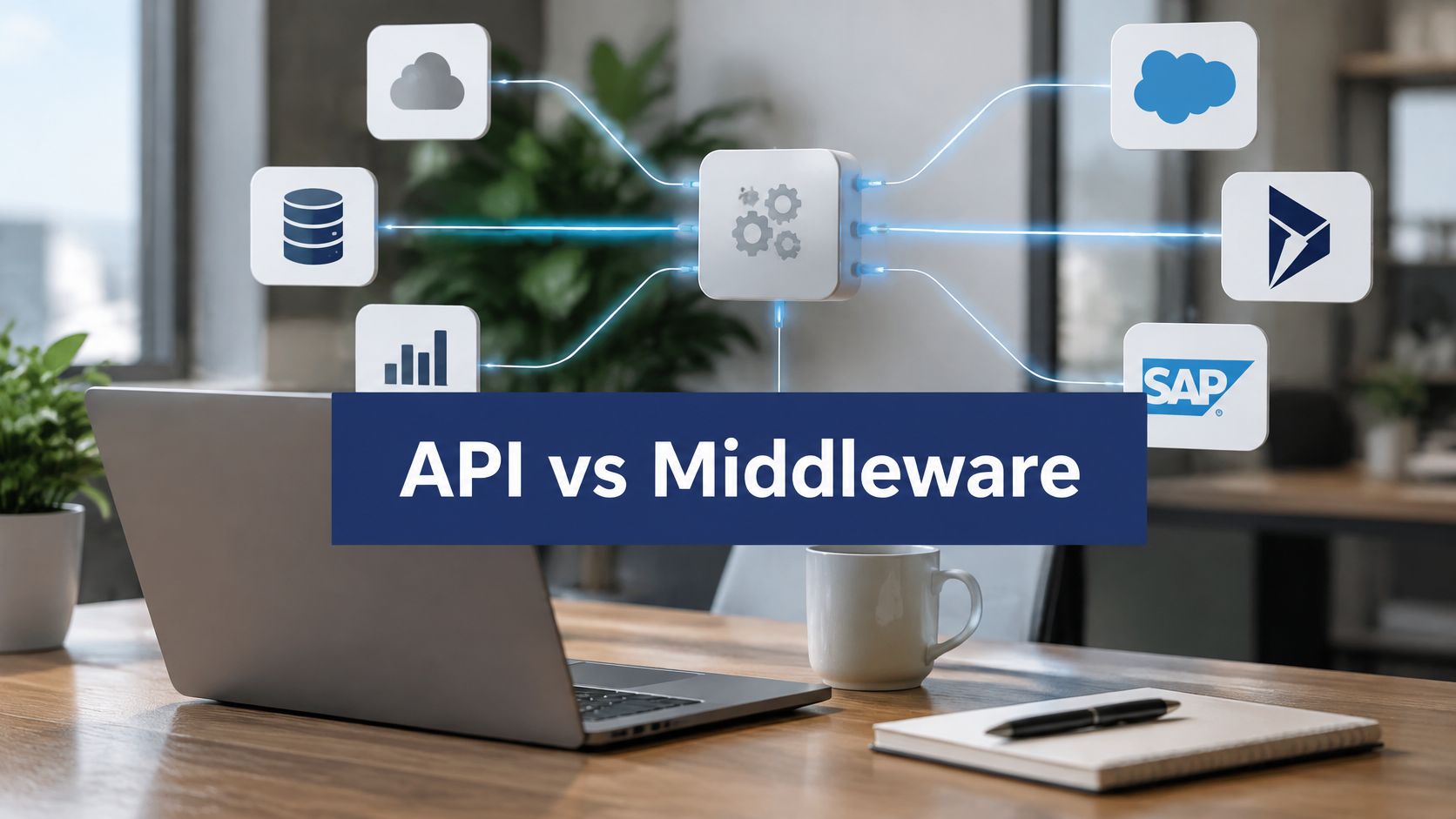
Enterprise API integration connects applications directly through published, governed interfaces that each system exposes. When your platforms already offer clean, documented endpoints, an API-first architecture lets them exchange structured requests without building a heavy intermediary. Custom middleware, by contrast, is a purpose-built software layer placed between applications to translate mismatched formats, route messages, and coordinate multi-step workflows.
| Trait | Enterprise API integration | Custom middleware |
|---|---|---|
| Where the logic lives | In each system's published APIs | In a dedicated layer you build and run |
| Best fit | Systems with stable, documented interfaces | Legacy platforms, mismatched formats and multi-system workflows |
| Build effort | Lower where APIs already exist | Higher, because the layer must be designed, built and tested |
| Who maintains it | Each API owner, through versioning and contracts | Your team or partner, for the whole layer |
| Where governance is set | API catalogue and gateway policy | Inside the middleware, applied centrally |
| Most likely failure point | A single API or its consumer | The middleware itself, which becomes a shared dependency |
Read this table one connection at a time, not as an all-or-nothing verdict for your entire company. Real business estates are messy. A commerce brand might rely on direct APIs to sync product data across sales channels while still using a bespoke bridge to feed an ageing warehouse platform.
The decision isn’t about which technology sounds newer. It’s about where your integration logic should live so your team can support it without constant firefighting.
How Enterprise API Integration Connects Systems Directly
Direct integration works best when you treat APIs as managed business products rather than quick wiring jobs. Even public institutions rely on this discipline: Statistics Canada’s data platform exposes structured JSON endpoints, SDMX REST services, and reference data interfaces so external systems can pull institutional datasets directly while preserving metadata, confidentiality, and data integrity.
To get that same reliability inside your own business, follow five design steps in sequence. Skipping straight to coding is how teams end up with undocumented point-to-point scripts that nobody dares to touch.
Five Steps to Build Governed Direct Connections
- Publish an API catalogue. List every interface, its business purpose, its data format, and its named owner in one searchable place. Without a catalogue, developers rebuild connectors that already exist and lose track of which downstream tools depend on a given endpoint.
- Separate transactional and analytical interfaces. The Government of Canada’s API standards direct teams to keep operational requests separate from reporting workloads, advising against GraphQL for business transactions while allowing it for analytics and statistical queries. Operational calls, such as creating a claim or confirming an order, need narrow, versioned endpoints with strict validation, authorisation, idempotency, and audit logs. Reporting dashboards belong on read-optimised pipelines so a heavy finance query never slows down live customer checkouts.
- Set service-level objectives upfront. Define clear targets for response latency, error rates, and uptime before any consumer connects. Explicit targets stop integration disputes from turning into finger-pointing between application owners.
- Reserve bulk transfers for reconciliation. Live traffic should move small, event-driven or request-based payloads. Keep bulk file exchanges strictly for scheduled synchronisation or overnight reconciliation jobs so massive batch runs don’t choke operational systems.
- Instrument end-to-end observability. Track latency, error rates, throttling, retries, schema-version usage, and data freshness across every endpoint. Good telemetry lets engineers tell a synchronisation defect apart from an underlying application fault in minutes instead of days.
A direct API design is working when a team can release a new version of an endpoint on a Wednesday afternoon without breaking a single downstream consumer.
How Direct Integration Looks in Practice
Consider an insurance firm linking a web quoting tool to its core policy administration system. The policy team publishes a versioned REST endpoint that accepts a validated quote request, checks authorisation, and returns a structured policy reference. Because the interface is strictly scoped and documented, the quoting tool never reaches into internal database tables.
Product teams adopt the exact same pattern in retail and distribution. Guides on using direct ERP endpoints to keeping product data and orders synchronised highlight how narrow, well-versioned calls keep stock counts and order statuses aligned without bloated intermediaries. When you build new digital products from scratch, starting with an API-first product development approach ensures those clean interfaces exist from day one rather than being bolted on years later.
What Custom Middleware Adds Between Your Systems
Now consider the opposite situation. Suppose a French-speaking supplier emails weekly invoices to an English-speaking accounts team, and neither side can read the other’s language. You don’t force both offices to spend two years learning a new tongue before paying a bill. You hire a skilled translator to sit in the middle, convert the terms accurately, and check that nothing was lost.
Custom middleware plays that exact translator role in software. Under the Government of Canada’s Guideline on Service and Digital, departments are expected to rely on common vocabularies and standard APIs wherever possible, yet the guidance acknowledges that legacy platforms often can’t meet those standards directly. When older applications lack modern endpoints or speak proprietary dialects, middleware development bridges the gap without forcing a risky core system replacement.

A well-built middleware layer earns its keep through three specific jobs.
Data Transformation
Legacy platforms rarely output clean, modern JSON. They export fixed-width flat files, nested XML, or proprietary database rows. Custom middleware intercepts those outputs, cleans inconsistent fields, and maps them into the exact structure the receiving system expects.
Healthcare provides a sharp example. Canada Health Infoway’s digital health standards offer national Fast Healthcare Interoperability Resources (FHIR) tools, including a FHIR Terminology Server and Terminology Service API, which favour direct integration for modern clinical apps. Older clinic or lab systems that don’t speak FHIR natively still need a middleware layer to translate local records into approved Canadian FHIR payloads before exchanging data safely.
Multi-Step Orchestration
Direct APIs shine on simple A-to-B requests, yet real business processes often span four or five platforms. Say a new customer signs a contract. Your systems must create a profile in the CRM, run an eligibility check, provision a portal login, and open a billing account.
Custom middleware coordinates that sequence from start to finish. It handles partial failures cleanly. If the billing step fails after the CRM record was created, the middleware executes a single rollback or retry path so your operations team isn’t left cleaning up half-finished customer profiles.
Legacy System Isolation
Older operational platforms are often fragile. Exposing an ageing policy or accounting database directly to mobile apps, partner portals, and analytics tools invites outages and security headaches. Middleware wraps that legacy core in a controlled boundary, absorbing traffic spikes, enforcing rate limits, and hiding messy internal schemas behind a stable facade.
Exploring broader enterprise application architecture patterns helps teams decide where to draw that protective boundary before writing code.
The Honest Trade-Off
Middleware is never free, even when the licensing cost looks modest. You are adding a brand-new production system that your team must host, monitor, patch, test, and secure. If every department routes its traffic through one central hub without clear limits, that layer turns into a single point of failure and an organisational bottleneck.
Use this rule of thumb: custom middleware earns its place when genuine translation, multi-system coordination, or legacy isolation is required, never when a straightforward API call would do the job.
Governance, Security and Data Rules to Settle First
Most stalled integration projects don’t fail because developers picked the wrong programming language. They stall because nobody settled the governance rules before opening the data pipes. Governance decides your architecture long before software quotes do.
Under the Government of Canada’s Target Enterprise Architecture white paper, information architecture must account for data provenance, quality, and legal obligations, starting with a strict line between personal and non-personal information. Personal data triggers privacy law and internal compliance duties around collection, use, and disclosure. In many regulated settings, sharing personal records across boundaries also requires formal information-sharing agreements.

Governance rule: A direct API without a written contract becomes a fragile dependency, and a custom middleware layer without a contract becomes a hidden point of failure.
What Every Integration Contract Must Define
Look at Canada’s framework for consumer-driven banking for a practical blueprint. The federal framework insists on a single technical standard governing the data-sharing pipes rather than leaving banks and fintechs to invent bespoke adapters for every pair of systems. Your internal and partner integrations need the same contract discipline before a single line of code is written:
- Canonical identifiers: Agree on one authoritative customer, policy, or account ID across systems so records don’t splinter into duplicates.
- Consent scope and expiry: Record exactly what data a user or partner allowed you to share and when that permission expires.
- Delegated authentication and key hygiene: Enforce OAuth-style delegated authorisation rather than passing static credentials around, and tighten credential handling with practical controls like Fetchin’s API key protection checklist.
- Encryption and abuse controls: Require encryption in transit and at rest, replay protection, rate limits, correlation IDs for tracing requests, and immutable audit events.
- Named ownership: Assign one real person to own each interface and each dataset, so questions about data accuracy or access requests never bounce between departments.
Make Compliance Automatic in Delivery
Paper policies gather dust the week after launch. Treat contract enforcement as an automated engineering check inside your continuous integration pipeline. Every time a developer changes an interface, automated conformance tests should verify that the live payload still matches the agreed schema and security rules.
Don’t stop at happy-path testing. Rehearse consent revocation and partner offboarding as ordinary, repeatable test cases. When a third-party vendor leaves or a customer withdraws permission, your team should know within seconds that tokens are revoked and data flows have stopped. Building these habits into compliance-driven software development keeps audits calm and predictable whether you choose direct APIs or custom middleware.
Five Tests That Decide Which Approach Fits
Here’s the direct answer before you score a single spreadsheet. Start with direct enterprise API integration for every connection where both systems already publish stable, documented interfaces. Choose custom middleware only where data formats need translation, multiple systems must be coordinated, or a legacy platform needs isolation.
Most established companies end up running both patterns side by side. The Government of Canada’s Enterprise Architecture Framework captures the underlying logic cleanly: design modular, loosely coupled services exposed via discoverable APIs aligned to shared standards, and introduce dedicated mediation layers only when transformation, orchestration, or isolation demands it.
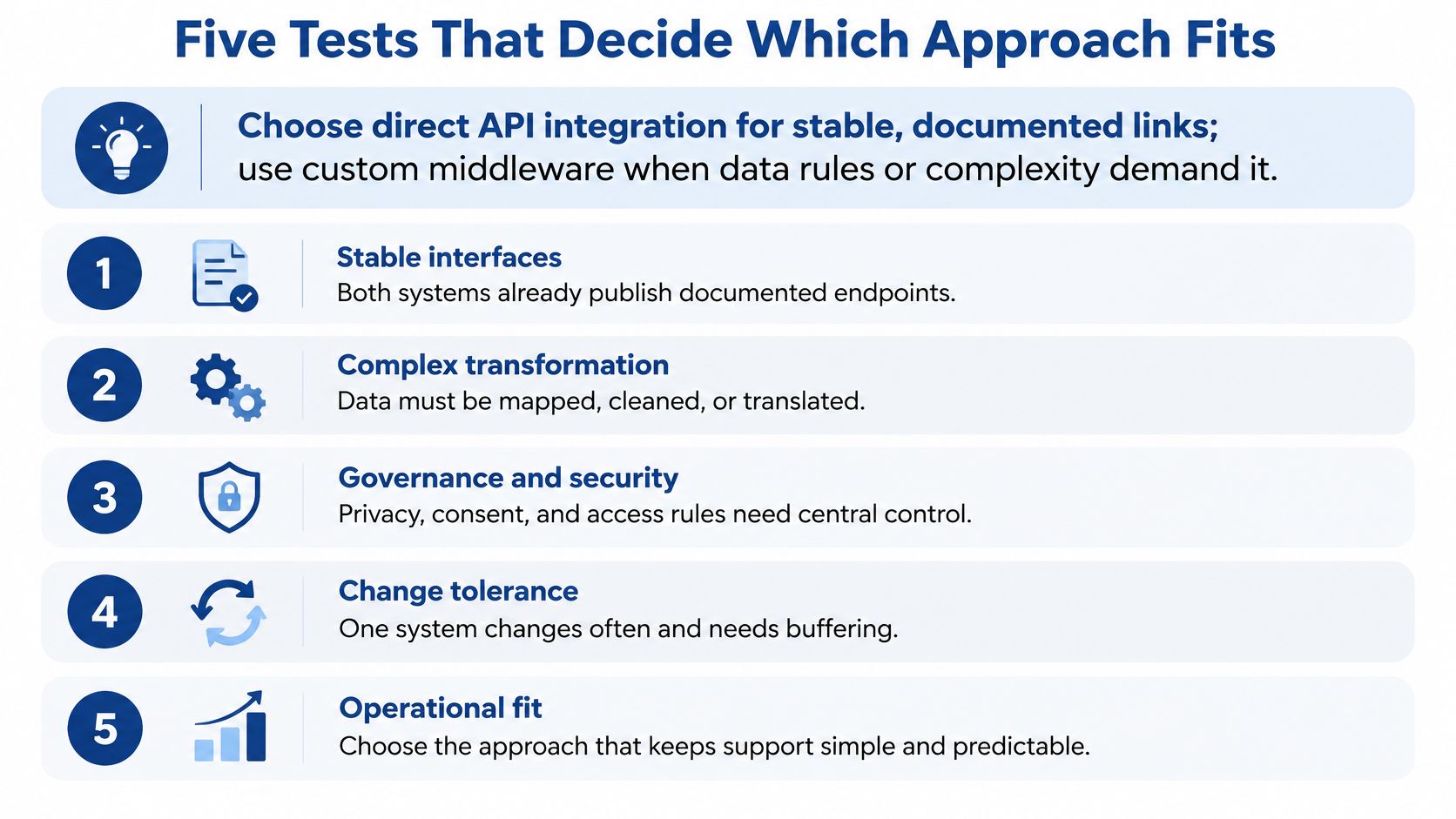
Use the five tests below to evaluate each individual system link rather than debating your whole architecture in the abstract.
| Test | Points to direct API integration | Points to custom middleware |
|---|---|---|
| Standards | Systems share stable, discoverable interfaces | Data formats differ and need translation |
| Legacy systems | Systems expose modern, documented APIs | Older applications cannot meet API standards without mapping |
| Workflow complexity | Simple, point-to-point requests | Coordination across several systems with rollback needs |
| Governance needs | Data classified and contracts agreed | A central boundary is needed for privacy or security control |
| Reuse | One consumer or a few stable consumers | Many consumers depend on a shared, transformed service |
How to Score Each Connection
Run through these three steps with your technical lead and business system owners in the same room:
- Score one connection at a time. Map a specific link, such as CRM to billing or claims portal to policy core, against all five rows in the table.
- Default to direct APIs when most signals align. If the platforms share modern standards, simple request flows, and agreed contracts, connect them directly. Add lightweight mediation only on the single row that fails.
- Lead with middleware when legacy and governance dominate. If an older core platform can't meet your security boundary or several downstream tools need the exact same transformed data, build the middleware layer first instead of writing duplicate workarounds in every consuming app.
Compare Three-Year Ownership Instead of Initial Quotes
Business owners often make the wrong financial call by comparing only the initial build invoice. Direct APIs usually look cheaper upfront because no extra server layer is required. Over three years, however, direct links demand ongoing owner attention whenever a SaaS vendor deprecates an endpoint version or alters a payload.
Custom middleware flips that profile. You pay more on day one to architect, build, test, and secure the layer, and you commit to operating it continuously for the whole organisation. Yet when five different applications need data from one cranky ERP, maintaining one central translation layer over three years often costs far less than repairing five fragile point-to-point scripts every quarter.
Record every verdict in a simple integration decision register. Log four columns: the two system names, the chosen path, the named owner, and a review date. Software estates evolve, and a connection that needs middleware today may become a clean direct API once you retire a legacy platform next year.
Where Each Approach Succeeds and Where It Fails
Theory looks tidy on a whiteboard. Real operations expose the cracks fast. Looking at three everyday business scenarios shows where direct APIs shine, where custom middleware rescues a project, and where cross-jurisdictional rules change the game altogether.

Three Real-World Integration Scenarios
The online retailer connecting storefront to ERP. Say a mid-sized retailer runs a modern eCommerce storefront alongside a cloud ERP. Both platforms publish well-documented REST endpoints. The team connects them through direct APIs, keeps real-time stock checks strictly scoped to individual SKU lookups, and runs a scheduled nightly batch to reconcile full warehouse counts. Orders flow cleanly without extra infrastructure. Next time, the team would add automated schema-change alerts from day one so an ERP update never surprises the storefront team during peak season.
The insurer modernising claims on a legacy core. Now take a regional insurer launching a self-service claims portal while its core policy ledger runs on a platform built decades ago. The legacy core can't validate modern OAuth tokens or output clean JSON. The insurer builds a custom middleware layer to translate records, enforce strict field validation, and shield the old database behind a controlled boundary. Policyholders get a fast digital experience without risking a core outage. Next time, the insurer would split high-volume document uploads out of the main middleware queue earlier so heavy attachments never slow down routine policy lookups.
The healthcare organisation operating across Canadian provinces. Cross-jurisdictional healthcare is the toughest integration test in the country. As an OECD report on the digitalisation of public health highlights, Canada operates across 13 health jurisdictions with distinct differences in system functionality and data standards. Even as national efforts advance around Canada Health Infoway's CA Core+ specification and the pan-Canadian conformance platform launched in December 2025, a single hard-coded mapping still won't fit every province.
A clinic network expanding across provinces must map provincial privacy and residency rules first, build middleware adapters that reconcile inconsistent local schemas, manage patient consent per jurisdiction, and structure outward-facing APIs so they can evolve cleanly toward CA Core+ conformance. Next time, that organisation would maintain a formal jurisdictional policy matrix before onboarding its second province rather than patching schema rules clinic by clinic.
Treating API-first as a shortcut to skip governance doesn't reduce risk; it merely lets inconsistent, poorly controlled data travel faster across your business.
Four Failure Points That Break Both Approaches
Regardless of whether you pick direct APIs or custom middleware, four mistakes cause the vast majority of production headaches:
- Semantic mismatch: Two systems pass technical validation while disagreeing on business meaning, such as one platform treating "active customer" as anyone with a signed quote and another counting only paid accounts.
- Uncontrolled API-first rollouts: Teams expose internal databases through fast APIs before settling data ownership, consent rules, and accountability, creating working connections that leak inaccurate or restricted records.
- Unchecked middleware sprawl: Every department dumps unrelated business logic into one central middleware hub until a single minor deployment risks taking down billing, shipping, and support simultaneously.
- Missing catalogues: Engineers build integrations without a shared inventory, leaving the company paying to maintain three slightly different connectors that pull the exact same customer table.
Confirm Your Integration Path Before You Build
Good architecture isn't complicated once you put the steps in the right order. Before approving a vendor proposal or assigning sprint capacity, walk through this five-step plan with your team:
- Inventory every connected system. Write down every platform that must send or receive data and assign a single named business owner to each one.
- Score each link against the five tests and governance rules. Check standards, legacy constraints, workflow steps, privacy classification, and reuse for every pair of systems.
- Label every path explicitly. Mark each connection as direct API, custom middleware, or a hybrid of both so nobody guesses during implementation.
- Lock down the data contract before coding. Agree on canonical identifiers, consent boundaries, error handling, and security controls before the first endpoint is written.
- Put a review date on the calendar. Schedule an annual check-in so your architecture adjusts as legacy tools are retired or regulations evolve.
For most organisations, the right recommendation is clear: begin with the stable APIs your platforms already expose, and treat custom middleware as the exception that must earn its place through genuine translation, orchestration, or legacy isolation needs.
One practical caveat on timelines: no honest integration partner will throw out a delivery date before seeing your systems. Before giving an accurate timeframe for API development, we review your specific business objectives, legacy constraints, and compliance requirements in a structured scoping session. If an internal skills gap is what's slowing you down, our API developers and integration specialists can serve as a third-party alternative to a full-time in-house hire, giving you immediate access to experienced engineers without a drawn-out recruitment cycle. We also design enterprise-grade security directly into the build, covering end-to-end encryption, strict access control, secure cloud infrastructure, and anonymisation of sensitive data.
When you're ready to map your system estate and choose the cleanest path for each connection, explore our enterprise API integration and development services or visit the Cleffex Digital homepage for a full overview of how we support modernisation projects.
Frequently Asked Questions
What is enterprise API integration?
It's the practice of connecting business applications directly through published, versioned, and governed interfaces rather than manual exports or fragile database scripts. Each platform exposes well-defined operations with clear ownership, security policies, and monitoring.
Is custom middleware always more expensive?
Not over the long run. While middleware costs more to design, build, and host upfront, it can lower your three-year ownership costs when several downstream applications need the exact same transformed data from a legacy platform.
Can a business use both approaches?
Yes, and most growing businesses do. You score each connection individually, keeping direct APIs between modern SaaS tools while placing custom middleware in front of legacy cores or complex multi-system workflows.
What does API-first architecture mean for a small team?
It means designing new services and choosing commercial software that exposes clean, documented, discoverable endpoints from the start. That habit keeps routine connections lightweight so your team only invests in middleware when translation or orchestration requires it.
Why do governance rules come before the technical choice?
Data classification, privacy obligations, and consent boundaries dictate what information can move across systems at all. Settling those rules first prevents you from wiring up fast connections that violate compliance standards or spread conflicting customer records.
How long does an integration take?
Timelines vary widely depending on the number of systems, legacy data mapping, security reviews, and workflow complexity. A short scoping conversation covering your business objectives and technical requirements always comes before a reliable schedule estimate.
Cleffex Digital ltd builds secure custom APIs, ERP and CRM integrations, and middleware layers for insurance, healthcare, commerce, and enterprise teams that need their systems working as one reliable operation. Whether you're untangling legacy platforms or launching a governed API programme, our experienced engineers can scope your architecture and deliver without a lengthy hiring cycle. Visit Cleffex Digital ltd to start a scoping conversation about your integration roadmap.