

A patient arrives on time, checks in, and then waits 90 minutes. The front desk has one list, the lab has another, and the physician is working from a third. Nobody can see where the patient is stuck, so nobody fixes the delay.
That is rarely an effort problem. It's a handoff problem. Staff re-enter details, call names that get missed, and guess which room or test is ready next. Good patient flow management software makes those handoffs visible, so teams can act before a queue turns into a complaint.
The scale in Canada explains why visibility matters. The Canadian Institute for Health Information emergency department access analysis recorded approximately 16.1 million emergency department visits in 2024–2025, with 7.7% of patients leaving before seeing a physician. Most visits end in discharge, but a smaller group needs an inpatient bed, and both paths compete for the same staff and space.
This comparison judges each platform by care setting, not by a long feature list. Some tools suit outpatient queues, others suit inpatient bed flow, and a few suit a hospital-wide command centre. I also flag the integration questions to settle before you buy. For clinics that also need support outside the visit itself, services such as Medical Virtual Assistants sit alongside flow software; they don't replace it.
1. Slot IQ by TSB Healthcare
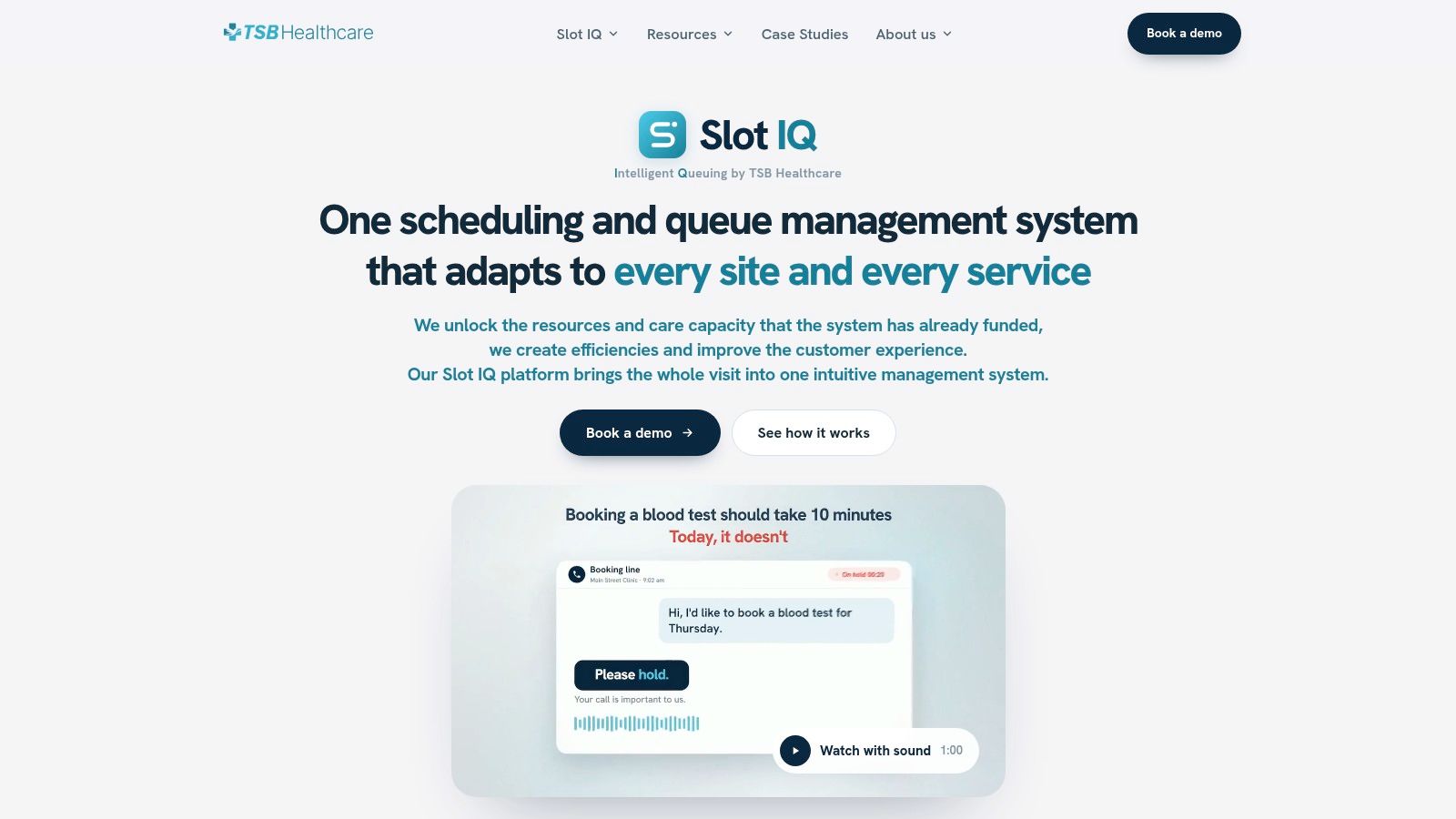
Slot IQ by TSB Healthcare is built for outpatient flow across Canadian health authorities, hospitals, diagnostic labs, and clinic networks. It combines booking, check-in, queuing, patient calling, and operational analytics in one flow. Patients don't need to install a new app, which removes a common adoption barrier.
TSB reports deployments across more than 70 outpatient sites and says data is stored in Canada. Confirm privacy, security, and retention terms for your own deployment, because requirements differ by province and organisation.
Where Slot IQ Fits Best
Online booking: Supports booked, walk-in, and referred patients in one shared queue.
Kiosk and QR-code check-in: Cuts front desk lines at peak times.
Live flow dashboards: Show where patients wait and which department is backing up.
The trade-off is scope. Slot IQ focuses on the outpatient journey, not full inpatient bed management. EMR or lab-system integration may need careful scoping, especially across multiple sites. Public pricing isn't listed.
If you're linking queue data to forecasting, our guide to predictive analytics in healthcare operations covers what to measure first. For multi-site outpatient networks, Slot IQ is a strong starting point.
2. Oculys by VitalHub
Hospitals coordinating emergency, inpatient, and bed-management work need a shared view of operations. Oculys by VitalHub is an operational visibility platform for hospitals and regional systems.
The bottleneck often extends beyond triage. The Canadian Institute for Health Information analysis of longer emergency department stays found that waiting for an inpatient bed represented an average of 59% of the total emergency-department stay for admitted patients in 2024–2025. A queue screen alone cannot address that delay.
Oculys brings operational data into shared views, helping teams work from the same information.
Real-time operational dashboards: Show capacity, bed use, and throughput.
Discharge-barrier tracking: Surfaces what is holding a bed.
Housekeeping coordination: Connects cleaning status to bed assignment.
Practical rule: If admitted patients board in emergency for hours, prioritise bed and discharge visibility over a nicer waiting-room display.
Oculys is an enterprise product, not a simple clinic queue tool. Before purchase, clarify how it will connect with existing hospital systems and what implementation work that requires. Public pricing isn't listed.
3. GE HealthCare Command Center
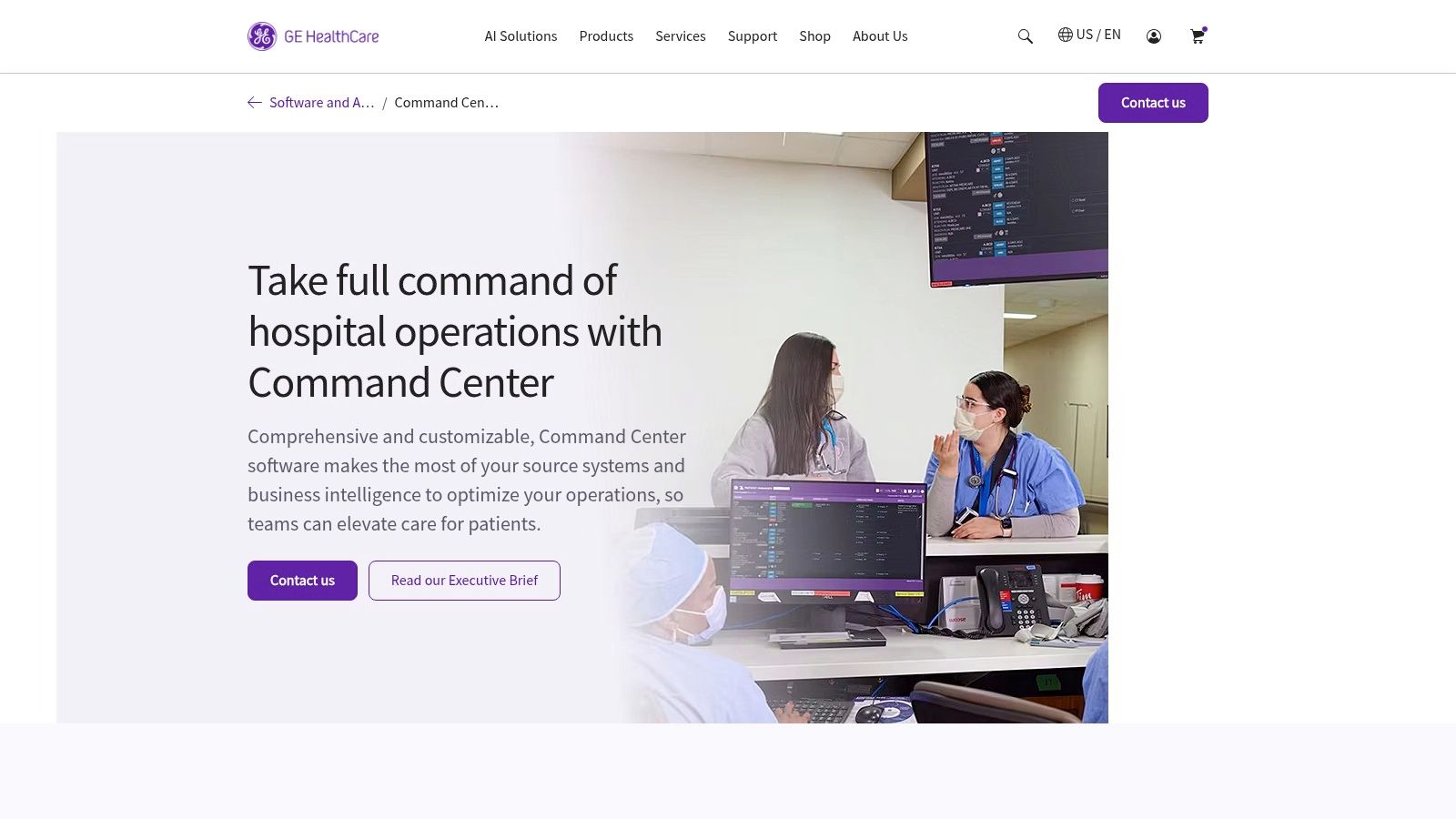
Large systems that want a centralised command centre should look at GE HealthCare Command Center. It pulls information from multiple systems into operational views of bed capacity, patient status, and predicted census or staffing needs. GE cites a Nova Scotia Health Authority example among its global deployments.
Configure any command centre around distinct timestamps, not one average. The Canadian Institute for Health Information emergency department data export reports that in 2024–2025, half of patients were assessed by an emergency department physician in just under 2 hours, while 10% waited more than 5 hours. Percentiles expose tail delays that averages hide.
What the Modules Cover
Capacity and patient-status views: Give leaders a shared picture.
Predictive census and staffing tools: Flag pressure before it peaks.
Patient manager and boarder expediter modules: Target patients waiting for beds.
Digital-twin simulation: Supports what-if planning before you change a process.
The cost of that breadth is commitment. You need command-centre ambitions, governance, and implementation resources. Pricing isn't publicly listed, and vendor-reported outcomes need local validation. Our healthcare operations dashboard guide explains which metrics belong on those shared views.
4. TeleTracking Operations IQ
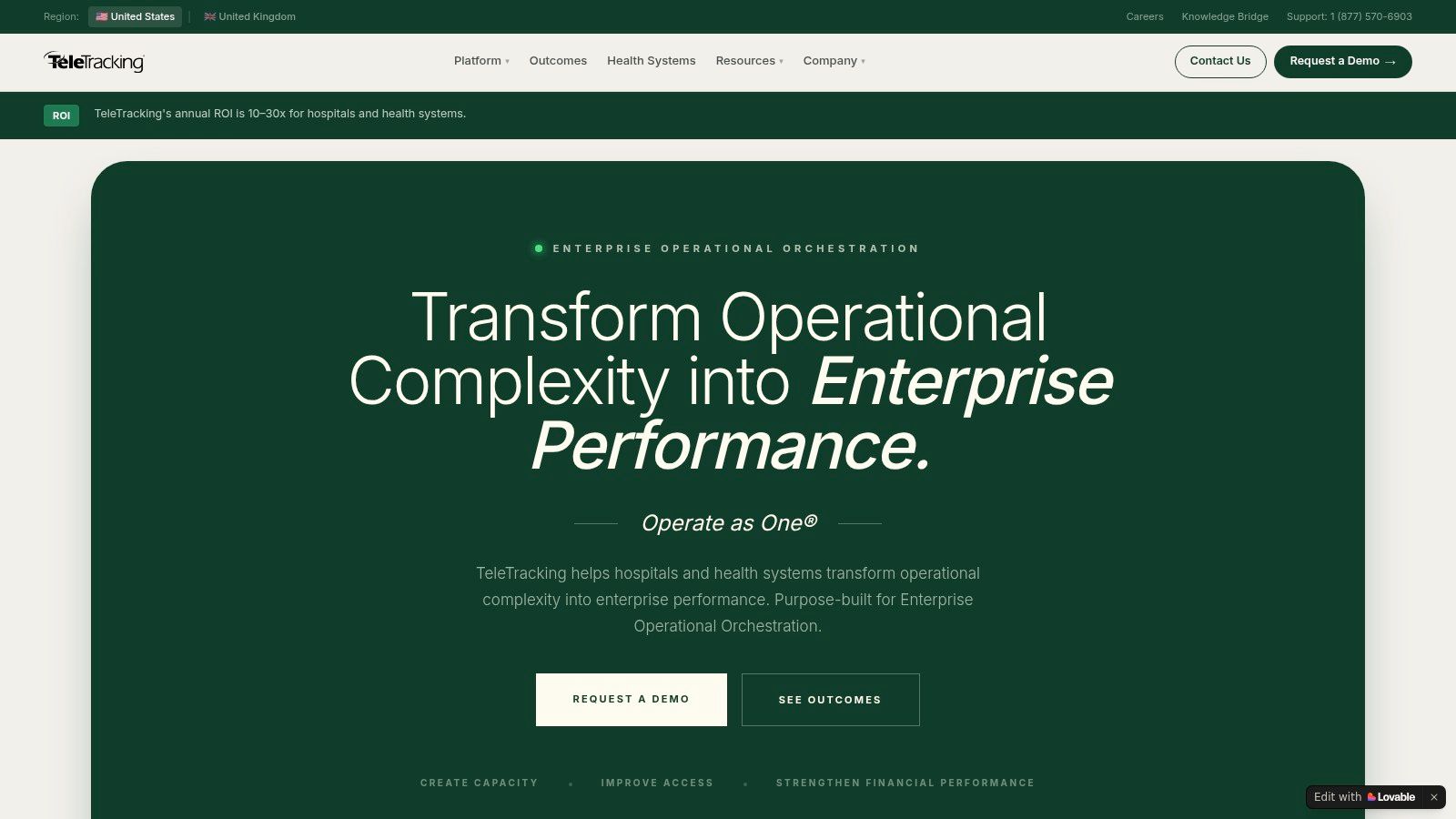
TeleTracking Operations IQ is an enterprise operations platform for hospital networks. It connects bed placement, discharge, transport, environmental services, and transfers, which is useful when delays sit between departments rather than inside one team.
Think about a discharged patient waiting for transport while an emergency patient waits for that bed. TeleTracking aims to make that chain visible and actionable in one place.
Canadian buyers should treat cross-setting coordination as a core requirement. The Canadian Institute for Health Information review of digital health innovation in Canada notes that Ontario's Project AMPLIFI has supported more than 150,000 secure hospital-to-long-term-care transfers. Transfers work at scale when systems exchange information cleanly.
Patient placement and bed management: Match patients to available capacity.
Discharge and transport coordination: Reduce idle time between steps.
Environmental-services workflows: Link room cleaning to bed readiness.
TeleTracking suits large, complex systems. It can require substantial workflow redesign and integration planning, and pricing isn't publicly posted. Don't buy it to solve a single clinic queue.
5. iQueue for Inpatient Flow by LeanTaaS
iQueue for Inpatient Flow by LeanTaaS focuses narrowly, and that's its strength. It targets inpatient capacity, admissions, care progression, staffing, and discharge. The aim is to forecast constraints early and surface patient-level barriers so teams act before beds run out.
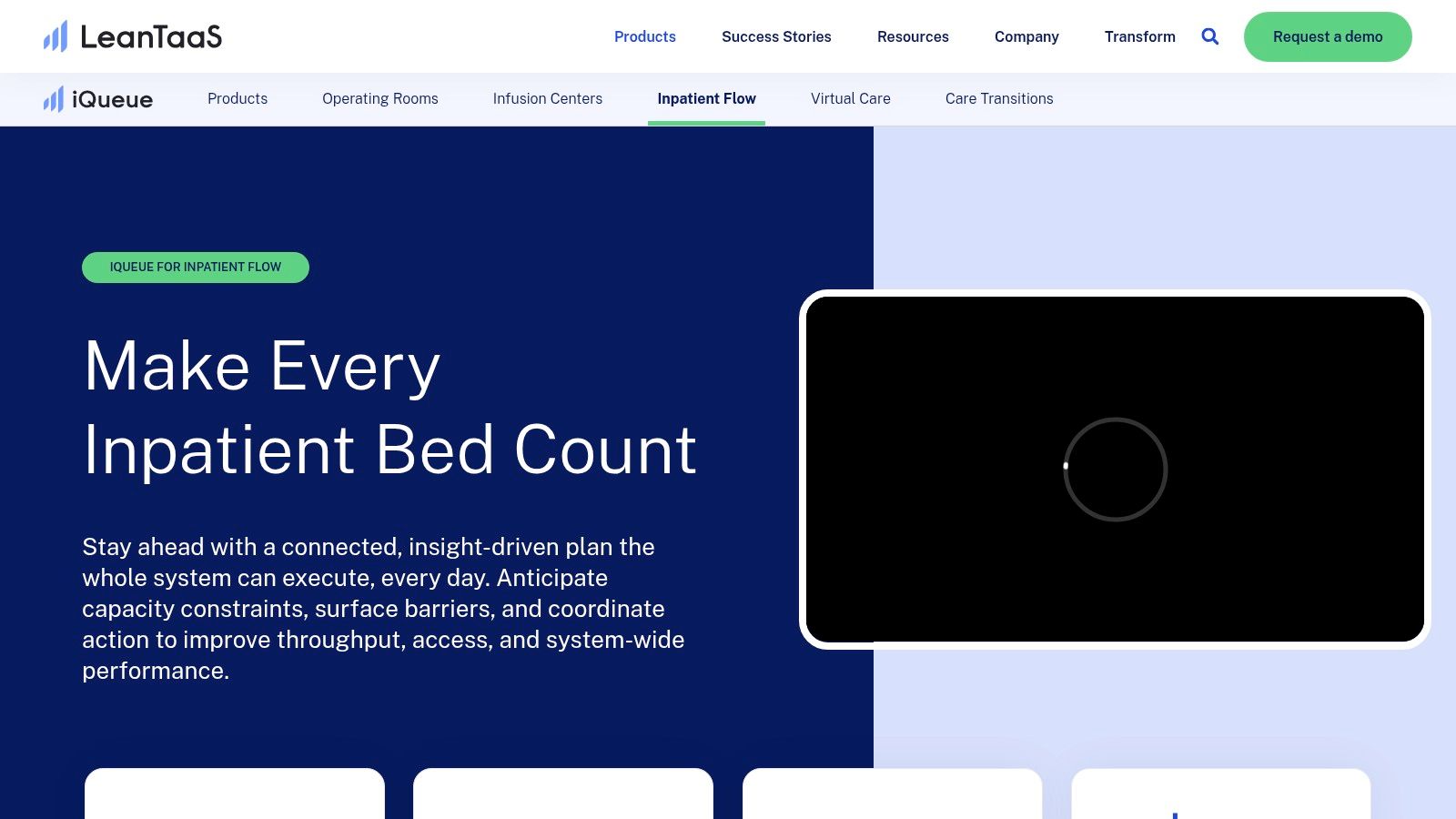
Hospitals drowning in discharge delays will find the feature set direct.
Capacity forecasting: Predicts where pressure will land.
Discharge planning and barrier visibility: Shows what blocks each patient.
Patient-flow dashboards: Turn forecasts into daily actions.
Staffing and workload insights: Connect demand to available staff.
Published case studies describe deployments at major health systems. Read them closely. Check how outcomes were measured, over what period, and whether the setting matches yours.
A vendor case study is a starting point for questions, not proof that your hospital will get the same result.
iQueue isn't a general clinic booking or queue system. Pricing, data requirements, and implementation scope all need vendor discussion. If your main problem is patient wait time reduction in outpatients, look elsewhere on this list.
6. Qventus Inpatient Capacity Solution
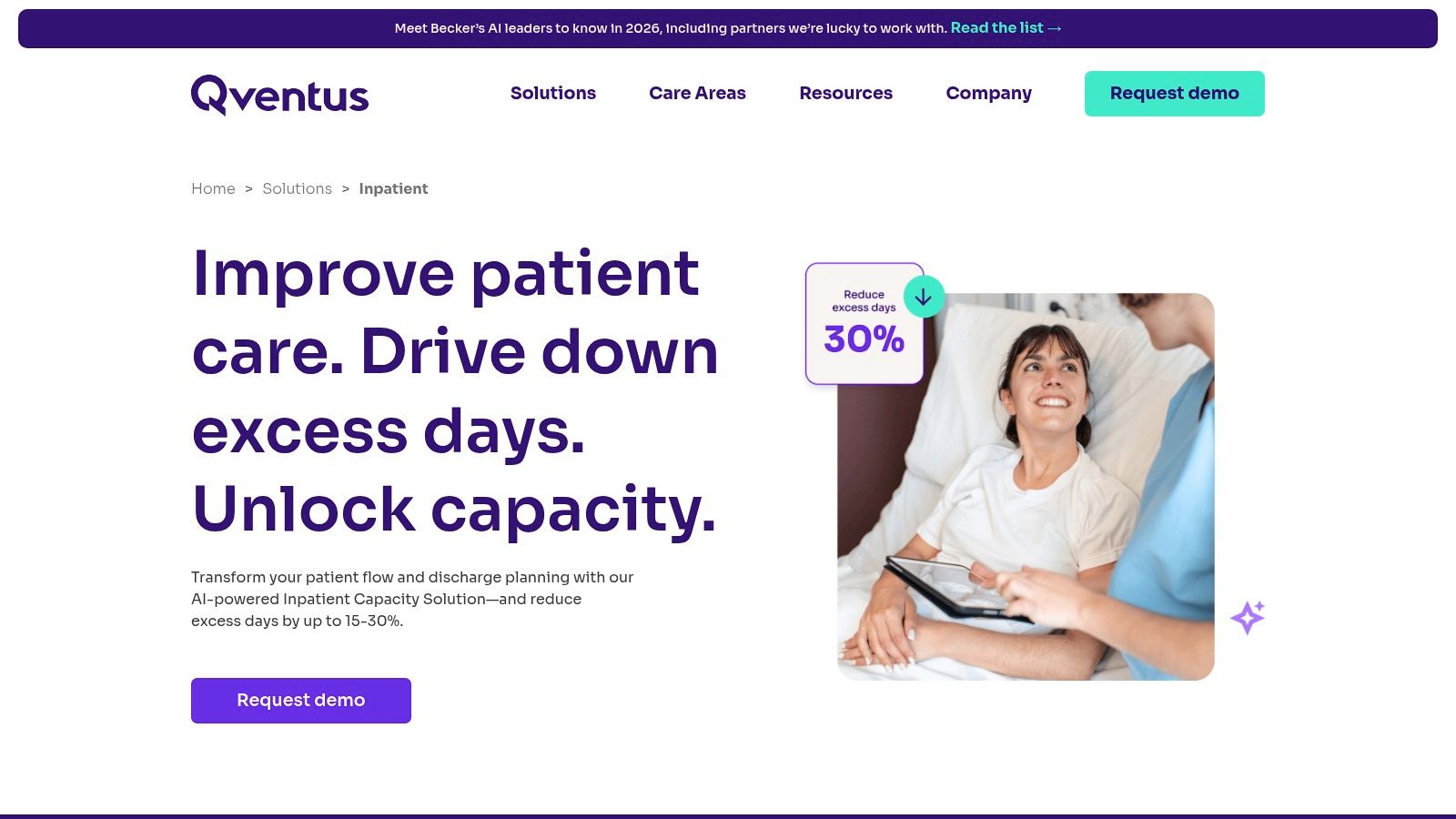
Qventus Inpatient Capacity Solution targets care progression and discharge planning inside the inpatient stay. It uses workflow automation and predictive insights to identify care-plan gaps, prioritise work that affects discharge, and operate within EHR workflows.
That EHR fit is the key buying question. Confirm compatibility with your specific EHR version and local configuration before you assume a smooth rollout. A tool staff must leave their main system to use will get ignored on busy shifts.
Strengths and Limits
Discharge-barrier identification: Flags gaps that extend length of stay.
Ancillary order prioritisation: Puts discharge-critical work first.
Operational dashboards: Keep capacity work visible to leaders.
Qventus focuses on inpatient capacity and discharge. It doesn't emphasise end-to-end bed control, transport, or outpatient queue management. Pricing is custom, and published performance figures are vendor claims.
If discharge is your constraint, pair this evaluation with our overview of healthcare capacity management to define ownership and escalation rules. Software can surface a barrier, but a named team still has to clear it.
7. Epic Hospital Patient Flow
For hospitals already running Epic, Epic Hospital Patient Flow keeps flow work inside the EHR environment. That reduces context switching and can simplify training, access control, and reporting.
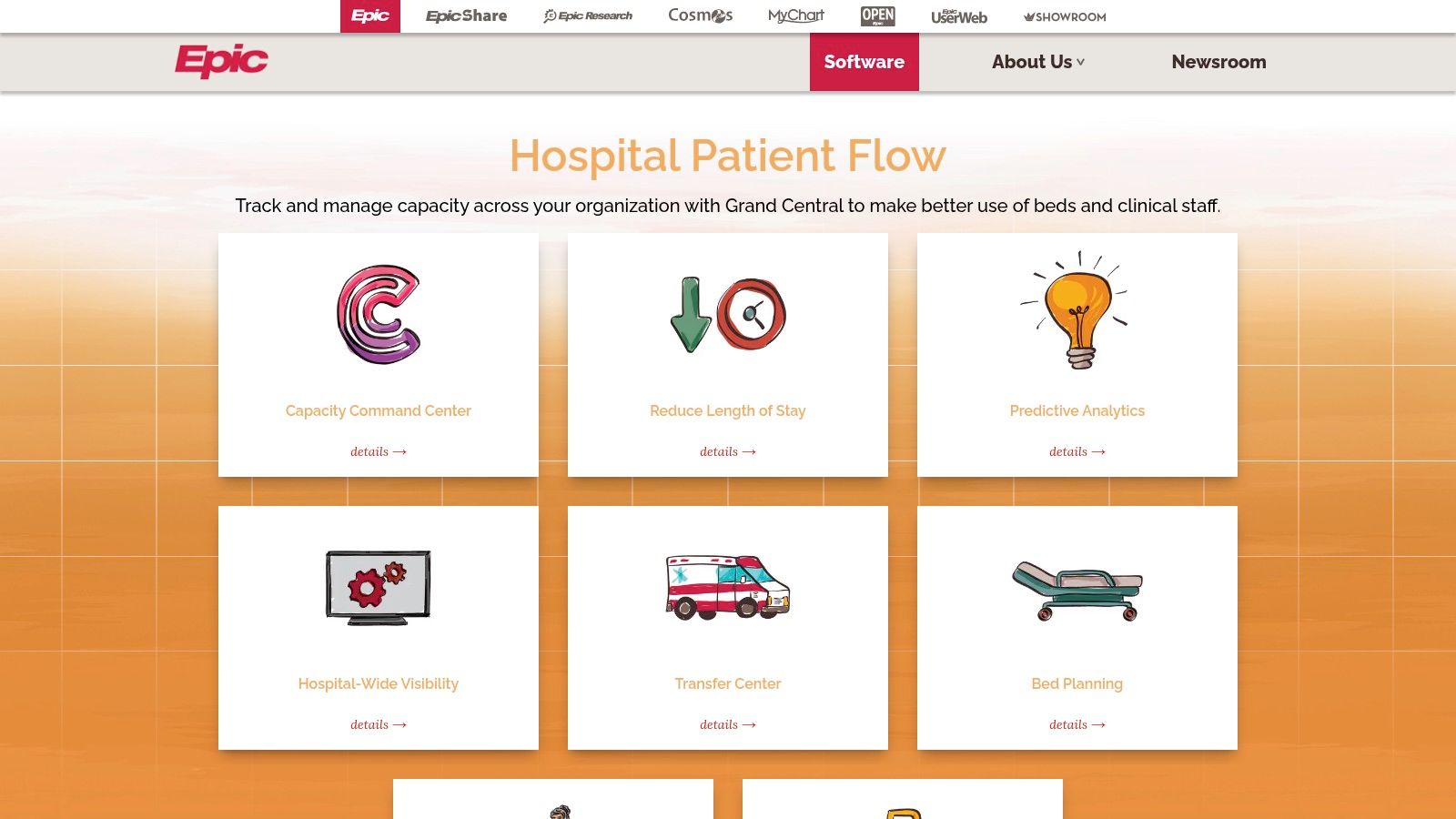
The coverage spans several inpatient movement workflows.
Hospital-wide patient and capacity visibility: Gives clinical and operational teams one view.
Transfer-centre workflows: Coordinate incoming and internal transfers.
Bed planning: Supports placement decisions.
Transport assignment and status updates: Track movement between units.
The trade-off is obvious. This is most relevant if Epic is already your core system. If you're on another EHR, compare the integration effort against a standalone healthcare operations software platform built to be system-agnostic.
Epic customers should still test depth. Ask whether the native tools meet your needs for forecasting, escalation, and cross-facility visibility, or whether you need a dedicated flow layer on top. No public standalone pricing is listed, so cost discussions sit inside your broader Epic relationship.
I recommend starting here if you're an Epic shop, then benchmarking one specialist vendor before you commit.
8. Altera Patient Flow
Altera Patient Flow is an integrated hospital suite for bed status, patient movement, housekeeping notifications, and transport operations. Altera has a Canadian product page, which helps local buyers start the conversation.
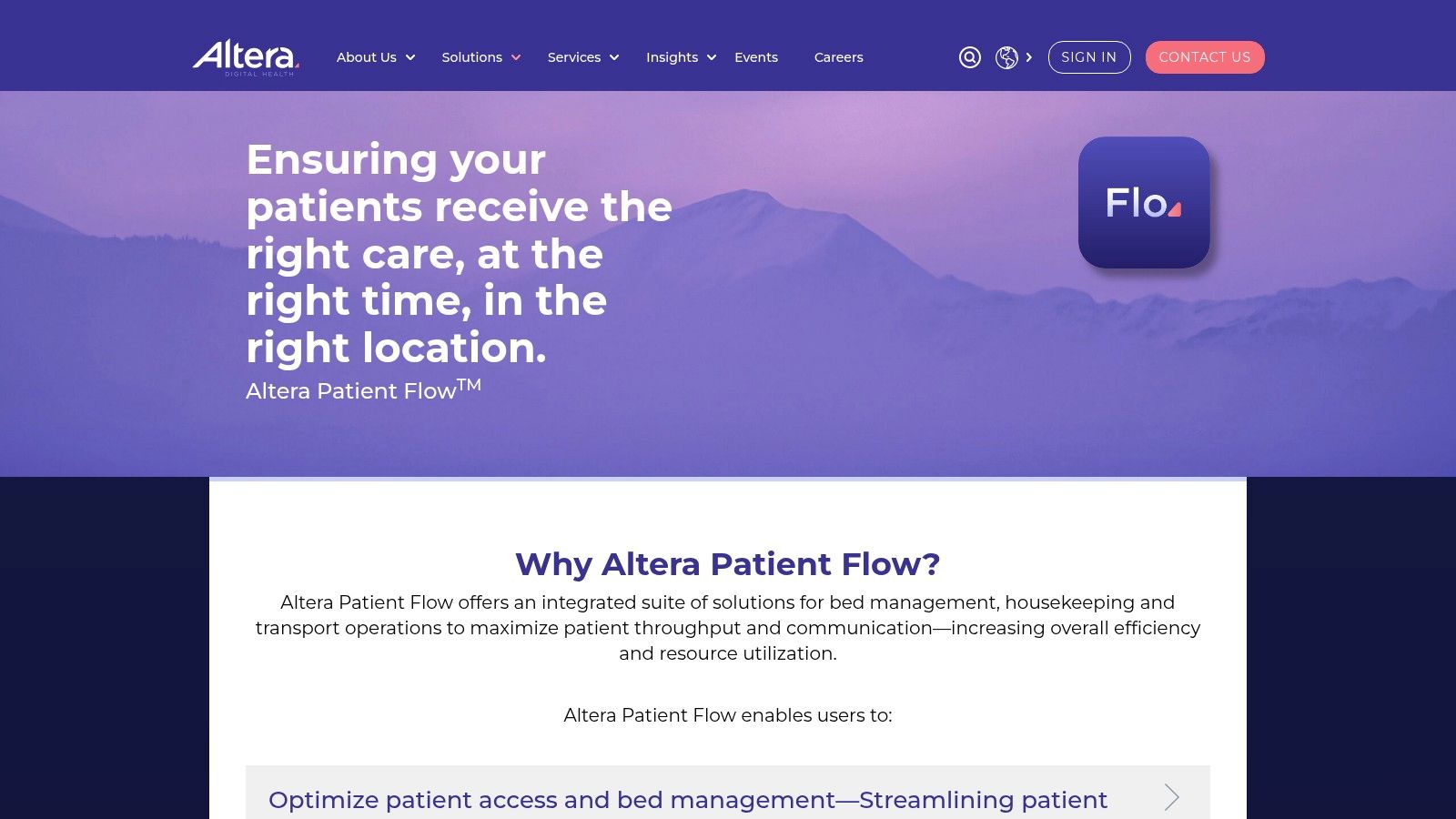
Bed turnover is where this suite earns its keep. A bed isn't available when a patient leaves. It's available when the room is cleaned, checked, and released, and when transport can move the next patient.
Bed and capacity management: Track availability in real time.
Automated housekeeping notifications: Trigger cleaning without phone tag.
Transport coordination: Reduce delays in admissions, transfers, and discharges.
Patient movement visibility: Show where patients are between units.
Public detail is the weak point. Pricing information is limited, and public customer feedback and implementation details are also limited. Ask for references in a similar Canadian setting and confirm compatibility with your existing hospital systems early.
Altera suits hospitals that want several operational workflows in one suite and are willing to do extra diligence to fill the public information gaps.
9. WaitWell
WaitWell serves the other end of the market. It's a Canadian-focused option for clinics, community health centres, and labs managing appointments, walk-ins, and virtual queues. Published plans make it easier for smaller organisations to budget without a long sales cycle.
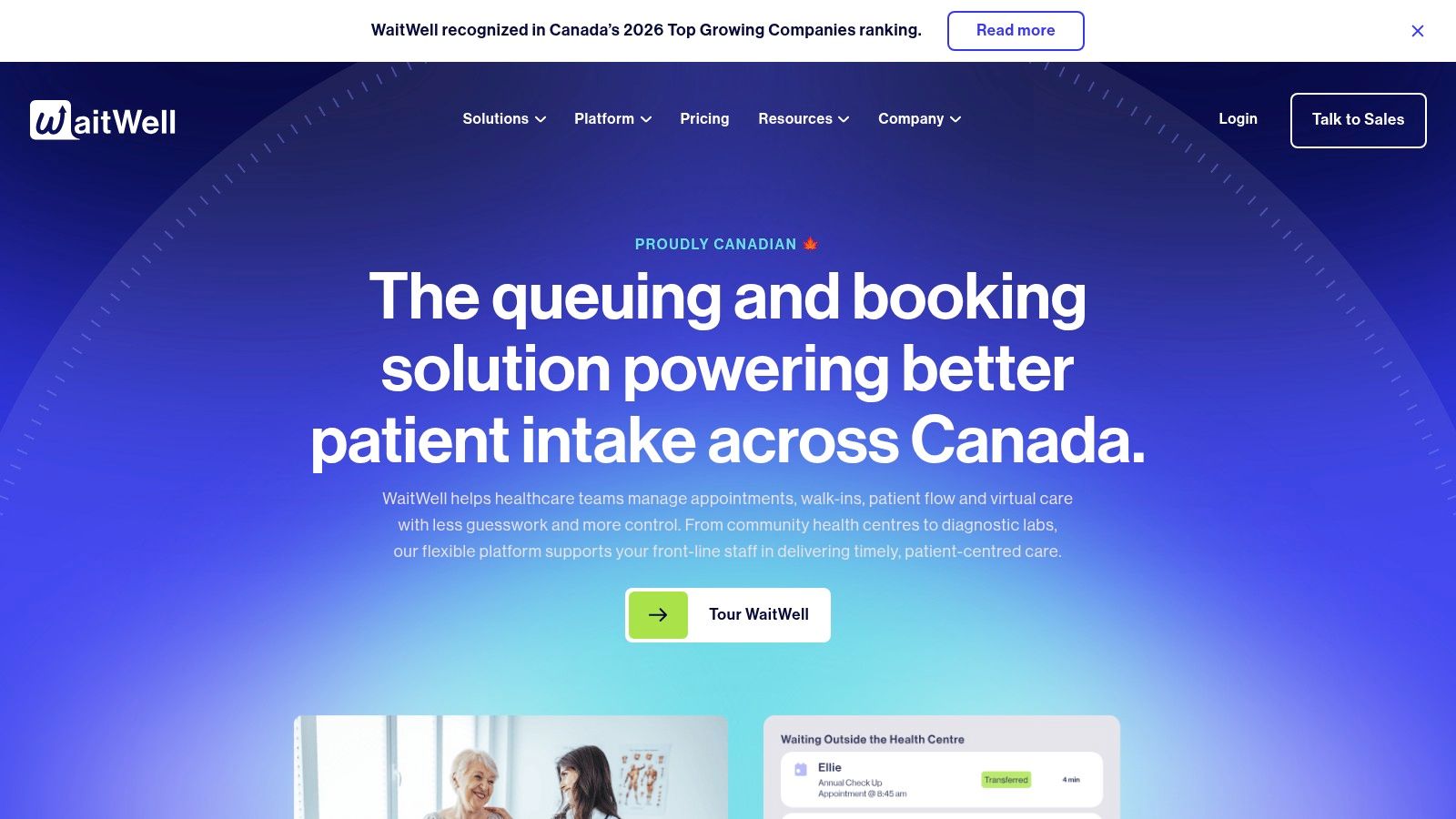
Real-time queue visibility helps staff spot patients at risk of leaving. The Canadian Institute for Health Information's national emergency department findings show that 88% of patients who saw a physician were not admitted in 2024–2025, so efficient assessment and discharge workflows carry most of the demand.
Appointment booking: Supports planned visits.
Virtual queues: Blend booked and walk-in patients.
Two-way messaging: Keep patients informed while they wait.
Multi-location management and reporting: Available on higher tiers.
Entry plans limit locations, queues, and notifications. Advanced integrations and enterprise functions sit on higher tiers. WaitWell supports patient scheduling automation well, but it isn't a substitute for inpatient bed control or a command centre.
10. Intouch with Health by VitalHub
Hospitals managing outpatient clinics can use Intouch with Health by VitalHub to coordinate ambulatory journeys from check-in through patient calling and clinic reporting. The product can integrate with hospital information systems, so buyers should confirm which local systems and workflows are covered before implementation.
For emergency department queues, acuity must shape prioritisation. The Canadian Institute for Health Information analysis of wait times by patient acuity reports that for CTAS levels 1–2, the median physician-assessment wait was 1.1 hours and the 90th-percentile wait was 4.3 hours in 2024–2025. A first-come, first-served queue alone cannot account for clinical urgency.
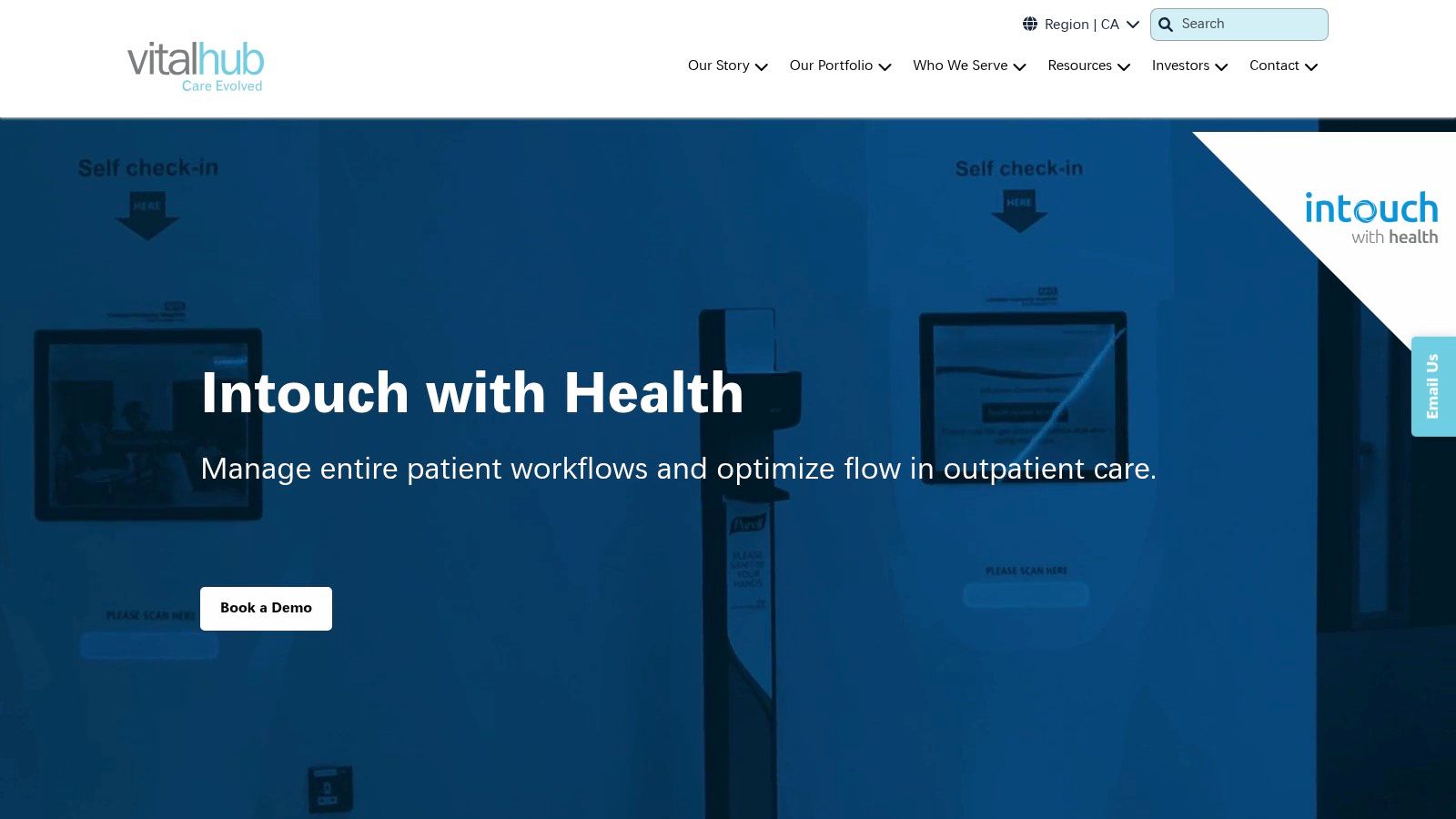
Real-time outpatient flow management: Track patients through clinic steps.
Self-service check-in: Reduce routine work at the front desk.
Patient calling and waiting-room displays: Help staff reach patients when appointments are ready.
Activity, room, and resource management: Support clinic planning.
This is an outpatient and ambulatory tool, not a system for inpatient bed capacity or hospital-wide command-centre operations. Kiosks and displays may add cost, so confirm hardware needs and integration scope before purchase. Public pricing isn't listed.
How the 10 patient flow management software options compare on setting, pricing and best fit
| Item | Primary setting | Public pricing | Best for | Integration note |
|---|---|---|---|---|
| Slot IQ by TSB Healthcare | Multi-site outpatient clinics, hospitals, and labs | Not publicly listed | Booking, check-in, and outpatient queue management | EMR and lab integrations may require scoping |
| Oculys by VitalHub | Hospitals and regional health systems | Not publicly listed | Operational visibility, bed capacity, and patient throughput | Connects operational systems; assess integration and implementation needs |
| GE HealthCare Command Center | Large hospitals and health systems | Not publicly listed | Centralised capacity and care coordination | Combines data from multiple systems; implementation details require vendor discussion |
| TeleTracking Operations IQ | Large, complex hospital networks | Not publicly listed | Coordinating bed placement, discharge, transport, and environmental services | Requires workflow and integration planning |
| iQueue for Inpatient Flow by LeanTaaS | Hospital inpatient care | Not publicly listed | Predictive capacity, discharge, and staffing insights | Data requirements and implementation scope require vendor discussion |
| Qventus Inpatient Capacity Solution | Hospital inpatient care | Custom pricing | Discharge planning and reducing inpatient delays | Designed for EHR workflows; confirm compatibility with the local EHR |
| Epic Hospital Patient Flow | Hospitals using Epic | No public standalone pricing | Managing capacity, beds, transfers, and transport within Epic | Strongest fit when Epic is the core system |
| Altera Patient Flow | Hospitals | Public pricing details are limited | Coordinating beds, patient movement, housekeeping, and transport | Confirm compatibility with existing hospital systems |
| WaitWell | Clinics, community health centres, and labs | Public plans available; plan limits apply | Appointment booking and virtual queues for booked and walk-in patients | Advanced integrations require higher-tier plans |
| Intouch with Health by VitalHub | Hospital outpatient and ambulatory services | Not publicly listed | Managing check-in, patient calling, and outpatient flow | Can integrate with hospital information systems; scope hardware and integration needs |
Choosing the Right Fit Before You Commit
Start with care setting, not features. A clinic queue tool and an inpatient command centre solve different problems, and buying the wrong category is the most expensive mistake on this list. If patients wait at check-in and between clinic rooms, shortlist Slot IQ, WaitWell, or Intouch with Health. If admitted patients board in emergency, shortlist Oculys, TeleTracking, LeanTaaS, Qventus, Epic, or Altera. If you need system-wide forecasting and escalation, evaluate GE HealthCare Command Center and comparable command-centre platforms.
Next, test integration before you debate dashboards. Map the systems that must exchange data on day one, usually the EHR, lab, radiology, bed management, housekeeping, and transport. Ask each vendor who builds each interface, who maintains it, and what happens when your EHR upgrades. Vague answers here become delays later.
A Short Buyer Action List
Map current handoffs: Walk one outpatient and one admitted journey, and time every wait between steps.
Define three timestamps: Measure arrival, assessment, and disposition separately, using medians and 90th percentiles.
Confirm data residency: Document where data is stored and processed, and who can access it.
Scope integrations early: Get interface owners, timelines, and costs in writing.
Request validated references: Speak to a similar Canadian organisation and ask how outcomes were measured.
Don't rely on vendor-reported outcomes alone. A strong reference will tell you what broke during rollout, which workflows staff resisted, and which reports leaders use. That is more useful than a polished case study.
Also plan the operating model. Assign an owner for queue rules, escalation thresholds, and discharge barriers. Without ownership, even good hospital workflow optimisation software becomes another screen nobody acts on. The same discipline applies downstream, including automating revenue cycle workflows so discharge and billing steps don't stall bed release.
Where custom connections are needed, we provide healthcare software integration for North American healthtech companies, enabling hospital connectivity, compliance, and scalable platforms. Explore our healthcare software integration services and the Cleffex homepage for further information.
Frequently asked questions tend to repeat across buyers.
Can the platform handle walk-ins and booked patients together?
Does it support acuity-aware prioritisation rather than a simple list?
Can patients check in without downloading an app?
Ask those three questions in every demo, and compare the answers side by side.
Cleffex Digital Ltd builds software for regulated healthcare systems and workflows, including secure integrations that connect patient flow tools with the EHR, lab, and operational systems your teams already use. If you're evaluating platforms and need custom connections, dashboards, or workflow automation to make them work in your setting, visit Cleffex Digital Ltd to discuss your requirements.