

A claimant has just phoned about a cracked windscreen. Your adjuster opens the claims screen, then opens policy administration to check the limit, then billing to see whether the premium is paid, then email to find the repair estimate. The policy number gets typed three times before anyone books the glass.
That's the problem insurance claims system integration solves. It connects claims software with the systems around it, so agreed data moves at agreed moments and staff stop copying figures between screens. Done well, claims management software integration also makes governance, data ownership and human handoffs part of the design, not repairs you add after the APIs go live.
Where Claims Sit Among Your Insurance Systems
Follow that one windscreen claim. Before it's paid, the file touches policy administration for limits and endorsements, billing for premium status, document management for photos and estimates, a repair vendor for the assignment, a payment system for settlement, and analytics for cycle times. If any link is manual, the adjuster becomes the integration.
| Connected system | Data exchanged | Example exchange | Typical trigger |
|---|---|---|---|
| Policy administration | Policy status, limits, coverage, endorsements | Get policy details before a claim opens | Claim creation |
| Billing | Billing schedule, premium status | Get Billing Schedule | Before settlement or on dispute |
| Payments | Reserves, payment details, payment status | Get Payment Details, Get Payment Status | After each payment event |
| Document management | Photos, estimates, letters, proof of loss | Electronic document exchange | When a document arrives |
| Adjuster and vendor systems | Adjuster details, repair estimates | Get Adjuster Details | At assignment |
| Analytics | Claim volumes, cycle times, fraud flags | Event or batch feed to dashboards | Daily or continuous |
Why volume makes this urgent
The Insurance Bureau of Canada reported extreme weather produced approximately 694,000 insured claims during 2004 to 2013, rising to more than 1.3 million claims in the subsequent 10-year period, an increase of 93%. Manual capacity built for the first decade can't absorb the second, especially when several regions are hit at once. Connected systems let you prioritise urgent files, route work to available adjusters and give customers timely status updates during a surge.
Every row in that table also raises an ownership question. Which system holds the authoritative copy of a coverage limit? Who approves when billing and claims disagree on premium status? Where does a person, rather than an API, confirm a payment before it releases? Integration that answers these questions up front builds consent, privacy and oversight into the data flow. Integration that ignores them recreates the old silos inside new software.
Integration isn't a plumbing job you finish before the real work starts. It's how the claim stays accurate while it moves.
Canadian insurers already rank this highly. In 2025, the PartnerRe Canadian Life Claims Survey interviewed representatives from 15 Canadian insurers and identified system integration, cross-functional collaboration and technology modernisation as central claims management issues.
Choosing an Integration Method for Claims Data
Point-to-point links are like private phone lines between two offices. They're quick to set up, but tangled once a third office joins. That analogy explains most failed policy administration system integration projects. The first link works. The fifth breaks the second.
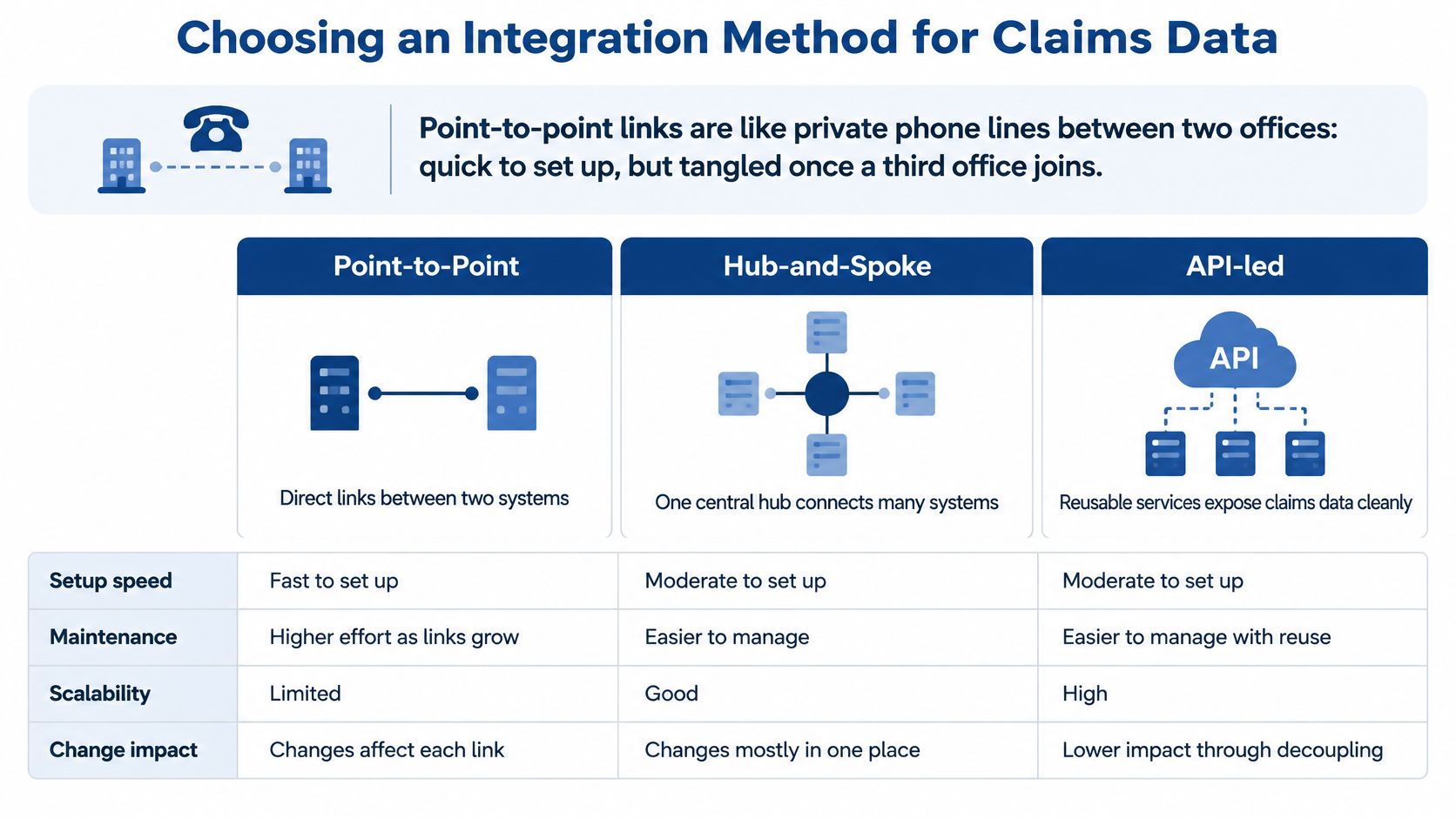
| Method | Best for | Main risk | Status updates |
|---|---|---|---|
| Point-to-point links | Two systems with one partner | Breaks when either side changes its fields | Often overnight in batch |
| File-based exchange (XML or EDI) | Bulk, low-frequency data such as billing | Stale data between runs | Hours to days |
| API layer or gateway | Several systems sharing one claim | Needs governance and versioning | Near real time |
| Event-driven messaging | High volumes of claim events | Duplicate or out-of-order messages | Seconds to minutes |
Most insurers end up mixing methods
That's normal, and often sensible. Use batch files for bulk billing data that doesn't change minute by minute. Use insurance API integration for claim creation and status checks where an adjuster is waiting on an answer. Use events for payment changes, where several systems need to react as soon as money moves.
Our detailed walkthrough of insurance API development in practice covers contracts, security and sequencing if you want the technical layer in full. Loopfour's overview of application integration governance and observability is also worth reading before you choose tooling, because monitoring decisions made early are hard to retrofit.
Three questions to answer first
How many systems must share the same claim within three years?
Count vendors and portals, not just internal platforms.
Do adjusters need live status?
If a customer can phone and ask, the answer is usually yes.
Do partners already support standard interfaces?
Check for CSIO-style XML or JSON before you design anything bespoke.
Practical rule: Put an API layer in front of the claims system once three or more systems must share the same claim object. Keep file transfers only where a partner can't yet support an API, and treat each one as temporary.
Don't pick a method because a vendor demo looked clean. Pick it because the claim volume, the number of consumers and the freshness your adjusters need all point the same way.
How to Connect Policy Administration and Claims Step by Step
Build in this order. Each step protects the next one, and skipping ahead is where most claims management software integration work unravels.
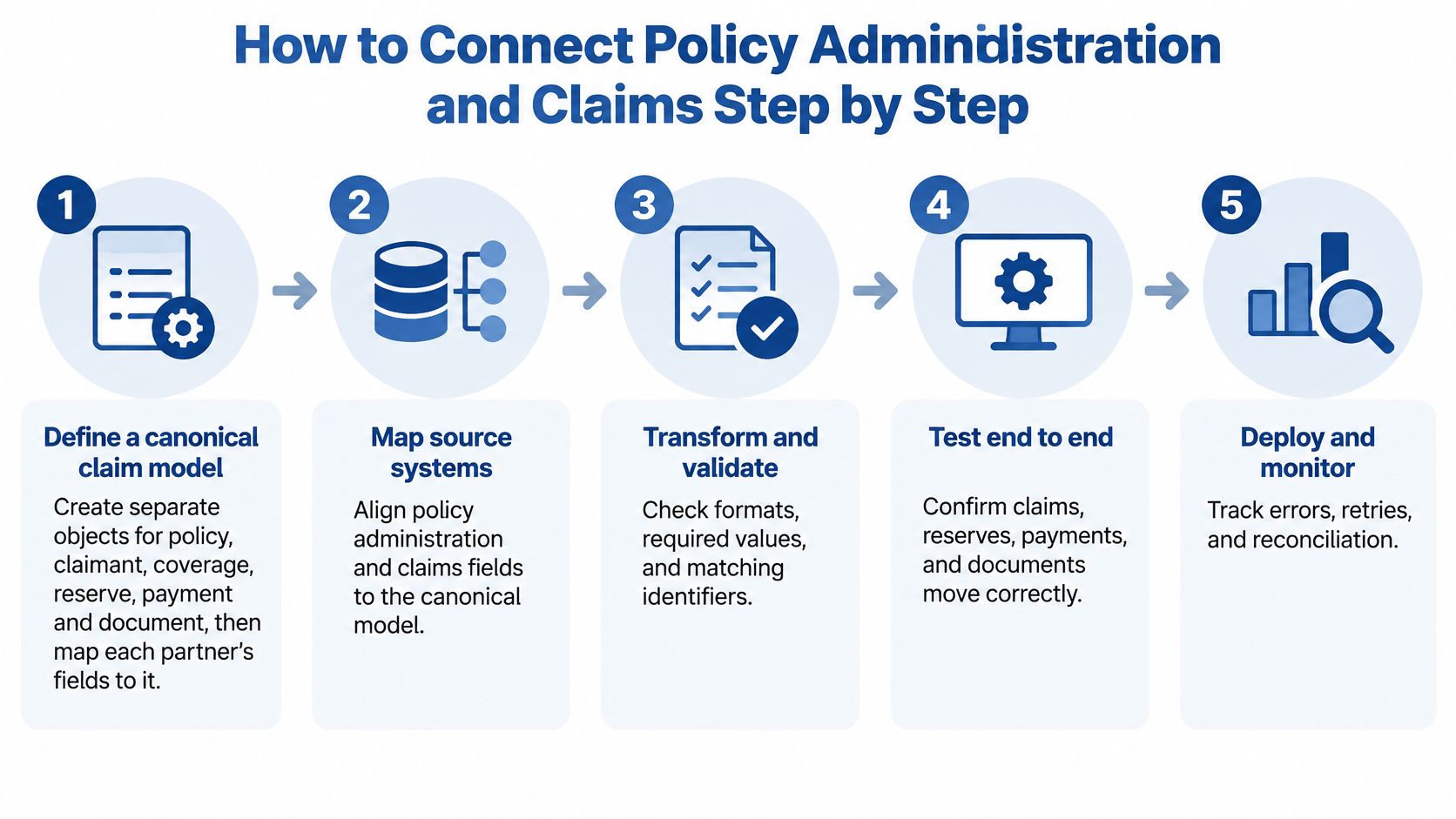
Steps 1 to 3 build the safe foundation
Define a canonical claim model: Create separate objects for policy, claimant, coverage, reserve, payment and document, then map each partner's fields to that shared model. Don't synchronise vendor tables directly, because every vendor change then becomes your outage.
Agree data ownership: Name the system that's the record for policy status, and the one that's the record for payments. Skipping this decision doesn't avoid disputes. It schedules them for the first time two systems disagree.
Build read-only retrieval first: Let the claims team confirm an active policy, its limits and endorsements before a claim opens. Reading is low risk, easy to test, and it proves your field mappings before money is involved.
Canada gives you a head start here. Reporting on the Centre for Study of Insurance Operations JSON API and security certifications describes CSIO supporting bidirectional XML and JSON API standards, with CSIO aligned use cases including First Notice of Loss, Get Adjuster Details, Get Billing Schedule, Get Payment Details and Get Payment Status. Scope your first contracts around events like those. Don't expose the whole legacy database and hope consumers behave.
Steps 4 to 6 add movement, then writes
Add status and document events: Push updates to the adjuster's queue when a document arrives or an assignment changes, so nobody logs in to a second system to check. Test that events arrive in order, and that a duplicate event changes nothing.
Enable write operations last: Reserve changes and settlement updates go live only after controlled testing with realistic claim files, including endorsements mid-claim. Writing before reading is stable is the common slip, and it turns small mapping errors into wrong reserves.
Reconcile every write: Compare what the claims system sent with what the system of record accepted, every day, and route mismatches to a named person. An unreconciled write isn't finished work. It's a future audit finding.
Our guide to policy management system integration goes deeper on the policy side of these contracts if your administration platform needs its own cleanup first.
What success looks like after phase one
Policy checks run automatically at claim opening. The adjuster sees status, limits and endorsements on one screen. Nobody types a policy number twice, and nobody phones another team to ask whether cover was active on the loss date. That's a modest-sounding result, and it's the right one. It proves the model, the ownership rules and the security controls before you automate a single decision.
Keeping Payments and Records Accurate Across Systems
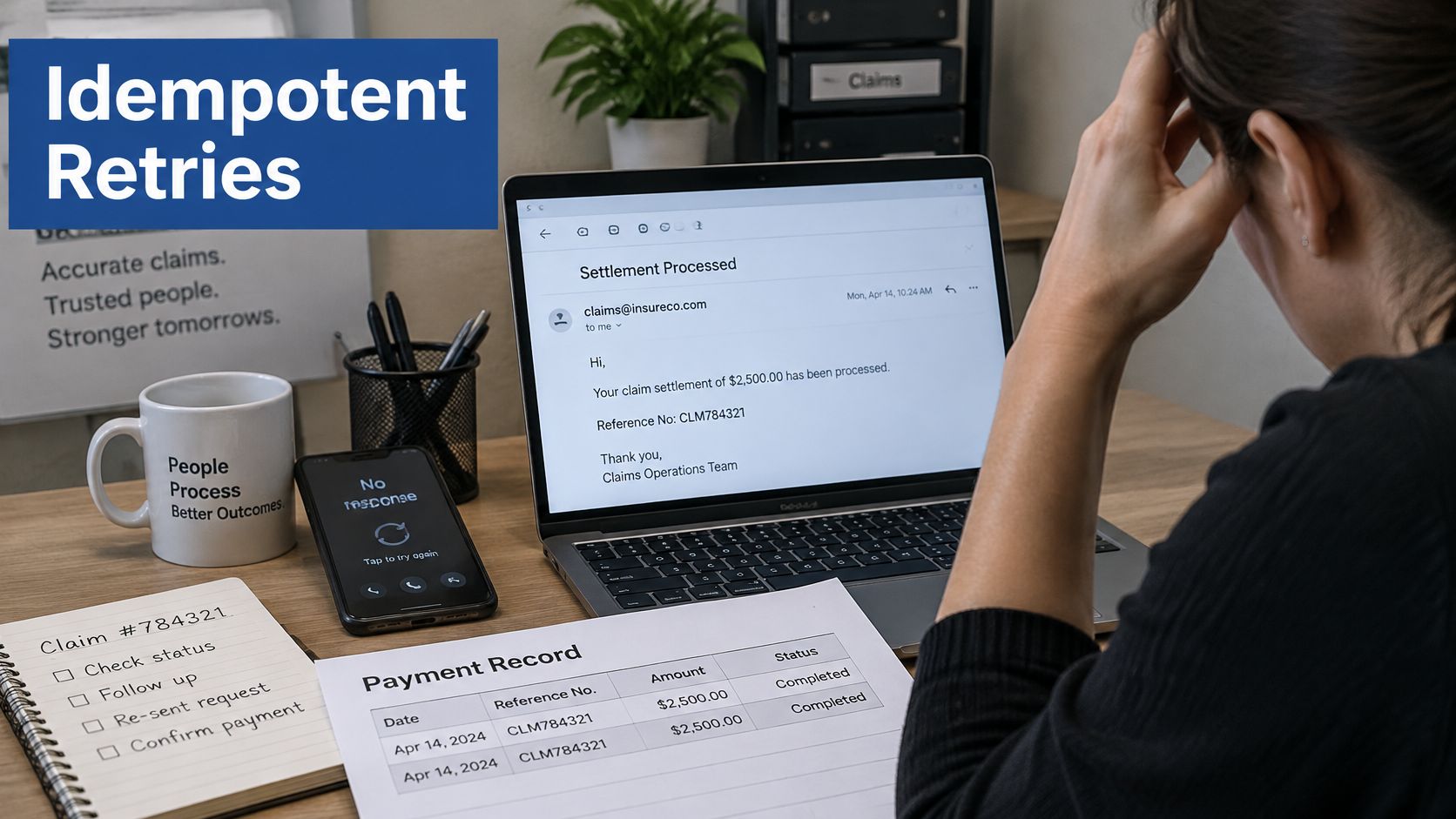
Say a repair network sends a settlement request. The reply is delayed, the network assumes it failed, and it retries. Without controls, the same payment arrives twice and leaves twice. Most accuracy work in insurance claims system integration exists to stop ordinary failures like that one.
Controls that address specific failures
Idempotency keys answer the retry problem. Each write carries a unique key, so when the duplicate request arrives, the receiving system recognises it and returns the original result instead of paying again. Put a key on every payment, reserve and settlement write, no exceptions.
Correlation IDs answer the lost thread problem. One identifier follows every message for a claim across policy, claims, documents and payments. Months later, an adjuster or auditor can rebuild the full timeline from immutable event logs instead of hunting through inboxes.
Schema validation answers the malformed message problem. Reject a message with a missing loss date or an invalid coverage code before it reaches the claim file, and tell the sender exactly which field failed. Dead letter queues then hold failed messages for review rather than dropping them. A dropped message looks like a quiet system. It's missing claim data.
Daily reconciliation catches what's left
Compare claim totals in the claims system with payment totals in finance each day. When there's a gap, don't adjust it away. Assign it, find which message or manual entry caused it, and fix the cause in the contract or the process. Document handling matters here too, and our guide to insurance document automation explains how to keep files matched to the right claim as volumes grow.
Access controls complete the picture. Give staff role-based permissions matched to their job, require multi-factor authentication for vendor accounts, and set clear retention rules for claim documents.
Review your own design against six items: versioned API contracts, idempotency keys on every write, correlation IDs, dead letter handling, daily reconciliation, and an audit trail nobody can edit. Missing one is a known risk you have chosen, so choose it on purpose.
Automating Claims Workflows Without Losing Human Judgement
Start claims workflow automation where judgement isn't needed. A small glass claim with an active policy, a clear limit and complete documents doesn't need an adjuster's morning. A rules engine can check policy status, coverage, limits and completeness, then approve the file or route it onward. That's straight-through processing, and it's the right first target.

A Canadian benchmark, read carefully
The federal Employment Insurance automation and modernisation evaluation reported that 58.9% of initial claims were fully or partially automated in 2011 to 2012. It also reported that end-to-end fully automated claims achieved 100.0% accuracy in 2011 to 2012, up from 96.5% in 2007 to 2008.
Employment Insurance isn't a private policy system, so treat those figures as direction, not a promise. The useful lesson is the model. Structured checks run automatically, and cases that fail validation or need judgement go to staff.
Where a person must stay in charge
Suspected fraud: Patterns need interpretation, and an accusation needs a human owner.
Incomplete evidence: A missing document is a conversation, not a rejection.
Disputed coverage and bodily injury: The financial and human stakes are too high for a rules-only decision.
Catastrophe surges: Rules still help with triage, but priorities shift faster than configuration does.
Three everyday examples show the line. A glass claim under its limit with a matched invoice gets auto-approved. A bodily injury claim goes straight to a senior adjuster with the policy details already attached. A repair invoice that doesn't match the estimate gets flagged, with both documents side by side for review.
Track three measures from day one: accuracy rate, exception rate and time to first contact. If accuracy holds while exceptions fall, your rules are learning the right boundary. If exceptions fall but accuracy slips, you've automated past it.
Automation should check what rules can verify and route what needs judgment. Keep that sentence on the wall, and most design arguments settle themselves.
Common Integration Problems and How to Fix Them
Most integration failures aren't exotic. They're the same six problems wearing different claim numbers.
Duplicate claimant records: The same person gets entered twice, often once by a broker and once at intake. Fix it with match rules on name, date of birth and address, plus a merge process that preserves the audit trail instead of deleting one record.
Mismatched policy versions: An endorsement changes cover, but the claim reads stale policy data. Use effective-dated checks against the loss date and versioned contracts so old field meanings can't sneak back in.
Provincial differences: Forms and deadlines vary, and teams fork the code for each province. Use a configuration table per province instead. One code path, many rule sets.
Bilingual workflows in Québec: French templates and status messages often drift from the English versions. Map both languages to the same claim codes, so a status means one thing in either language.
Delayed status updates: Overnight batch files leave adjusters answering customer calls with yesterday's information. Move status to events wherever the team needs it during the working day.
Digital-only intake: Some policyholders, particularly older ones, prefer human service and abandon app-only journeys. Provide an assisted channel with an authenticated handoff, so the claimant never repeats their story to the adjuster.
Duplicate payments from vendor retries belong on this list too, and the idempotency controls in your payment design are the fix. On effort, be honest with stakeholders. Configuration tables and matching rules often take a sprint. Moving status to events or redesigning intake can take a quarter.
Plan Your Claims Integration Before You Commit
You don't need a full architecture programme to start. You need an honest picture of one claim's journey and a short list of decisions made before code is written.
A readiness checklist
Map the claim: List every system one claim type touches, and name an owner for each system.
Standardise the core objects first: Policy, claimant, coverage and payment usually come before correspondence or supplier data.
Pick one read-only use case: Policy checks at claim opening is the safest proof of value.
Define the exception queue: Failed messages and unclear cases need named reviewers, not a shared mailbox.
Set three test measures: Decide what accuracy, reconciliation and cycle time must look like before any write operation goes live.
Specialist help fits where your team lacks integration depth or spare capacity. At Cleffex Digital, we offer custom API development services that build stable and reliable APIs so applications can integrate, share data and improve connectivity. We also integrate AI capabilities into existing platforms, including CRMs, ERPs and custom software, without disrupting current workflows, with solutions designed for auditability, transparency and accountability. Our insurance and fintech services are the natural starting point for planning work of this kind.
Here's a practical next step you can do without any vendor. Run a 30-day audit of one claim type. Record every system it touches, every manual rekey and every wait between teams. That list, ranked by frequency, tells you which connection to build first and gives you the baseline to prove it worked.
Frequently Asked Questions About Claims System Integration
What is insurance claims system integration?
It's the work of connecting claims software with policy, billing, payment, document and analytics systems so they share agreed data at agreed moments. Staff stop rekeying information, and each system stays the record for what it owns.
Which method should a mid-sized insurer start with?
Usually an API layer for claim creation and status checks, with batch files kept for bulk billing data where partners can't yet support APIs. Add events later for payment changes that several systems must react to quickly.
Can claims be fully automated?
Only simple, complete and low-risk claims. Bodily injury, suspected fraud, disputed coverage and incomplete evidence should always reach an adjuster, with the automated checks attached to the file to save them time.
How do you prevent duplicate payments?
Use idempotency keys on every write so retries return the original result, correlation IDs to trace each message, dead letter queues for failures, and daily reconciliation between claims and finance totals.
How long does integration take?
Matching rules and configuration often take a sprint. Bigger changes, such as event-based status updates or a redesigned intake journey, can take a quarter. A read-only first phase usually proves value well before that.
Do CSIO standards apply?
For Canadian property and casualty insurers, yes, commonly. CSIO exchange standards support XML, EDI and JSON workflows, so check what your brokers and vendors already support before choosing a method.
Cleffex Digital Ltd builds governed API layers that connect claims, policy administration, billing and document systems, so your adjusters work from one accurate claim file instead of five partial ones. If you're planning your first read-only connection or untangling years of point-to-point links, talk to Cleffex Digital Ltd about a staged integration that proves value before it writes a single payment.