

Your claims manager has a payout total, finance has a different figure, and the underwriting team is working from yesterday's spreadsheet. Before anyone can decide what to do, someone has to work out which number to trust. If that sounds familiar, the problem probably isn't a shortage of dashboards. It's the absence of a shared, controlled foundation underneath them.
Insurance data platform development connects those disconnected records, but putting everything in one database isn't enough. The key test is whether your team can prove where a figure came from, how it changed, who accessed it and whether it's fit for the decision being made. That evidence should determine whether a platform goes live.
What an Insurance Data Platform Is and Why Insurers Need One
Say your finance director asks how much the business paid in claims last quarter. The claims system shows approved payments, billing records show completed transfers, and a spreadsheet includes adjustments that haven't reached either system. Each total may be understandable, but nobody can confidently explain the difference without investigating.
An insurance data platform is the shared foundation that gathers policy, claims, billing, customer and risk data, cleans and links it, and makes it available for business decisions. It doesn't necessarily replace the systems that issue policies or process claims. It provides a controlled view across them.
A shared supply rather than separate wells
Think of a city water network. Reservoirs, pumps and homes connect through pipes and controlled valves, so each street doesn't need to dig its own well. Insurance data integration works similarly: systems remain distinct, but teams draw from a consistent, managed supply.
That matters when separate systems hold different versions of the same policyholder. A claims handler needs the coverage that applied when the loss occurred, while a service adviser may need the customer's current details. A unified platform preserves both views instead of overwriting history.

The scale is substantial: the Canadian Life and Health Insurance Association reports a record $143.3 billion in benefits and retirement solutions during 2024, including $53.3 billion in health claims, up from $48.2 billion in 2023. These are sensitive transactions that need consistent classifications, payment histories and reconciliation.
Cross-border products make context equally important. Amigo Mex Insurance's explanation of when Mexican car insurance is needed illustrates why a platform should preserve jurisdiction and coverage details, rather than treating every motor policy as interchangeable.
Mid-sized insurers, managing general agents and brokers, benefit when reporting depends on repeated manual comparisons.
Practical test: Count the separate places your team checks to answer how much it paid out last quarter. Every additional reconciliation point deserves investigation.
Core Components and How They Connect
Source systems feed an ingestion layer, records land in storage, a canonical model gives them shared meaning, and integrations and reports consume the results. Governance and security apply across that entire flow, not just at the reporting screen.
Core components of an insurance data platform
| Component | Main job | Typical data | Risk if missing |
|---|---|---|---|
| Ingestion layer | Pulls data from policy, claims, billing and CRM systems on a schedule or in near real time | Policy transactions, claim events, payment files | Manual extracts and reports that are days out of date |
| Storage, warehouse or lakehouse | Holds history in consistent, queryable structures | Policies, exposures, claims, payments, raw documents | Teams cannot trace history or compare periods reliably |
| Canonical data model | Gives one agreed meaning to policy, claim, customer and third-party fields | Shared definitions and stable identifiers | Departments report conflicting figures from the same claim |
| Integration and APIs | Shares governed data with underwriting, pricing and partner tools | Quote requests, eligibility checks, claim status | Duplicate copies spread across spreadsheets and inboxes |
| Governance and lineage | Records source, owner, quality status and retention for each critical field | Field metadata, validation results, change history | Auditors and regulators cannot follow a figure back to its source |
| Analytics and reporting | Delivers dashboards, models and regulatory returns from validated data | Aggregated, reconciled datasets | Insight arrives after the decision has already been made |
| Security and access control | Limits who sees which data and logs access | Encryption keys, role assignments, audit logs | Sensitive policyholder data is exposed or cannot be audited |
Use this table to diagnose gaps rather than compile a shopping list. A team with dashboards but no lineage needs traceability, not another visualisation tool. A team with functioning APIs but conflicting customer identifiers needs a shared model before it connects more applications.
Warehouse or lakehouse
A data warehouse is suited to structured, validated tables, such as premium transactions and claim payments. A lakehouse can also accommodate less structured material, including documents, call transcripts and images, alongside analytical tables.
Many insurers need both capabilities, though not necessarily separate products. For example, a warehouse might support financial reporting while a controlled raw layer preserves the original claim file for investigation. Retaining raw material must still follow approved retention and deletion rules.
The trade-off is operational complexity. Storing documents is straightforward compared with classifying them, controlling access and connecting extracted fields to the right policy.
The canonical model matters more than the storage label. A fast database containing conflicting definitions of earned premium produces conflicting answers faster. Business owners need to agree on what each field means and which system is authoritative for it.
For more detail on the connections themselves, Cleffex's guide to insurance data integration for policyholder management addresses the relationship between connected systems and usable customer records.
A small broker can begin with ingestion, a governed model and reporting. Add live APIs when a defined partner workflow needs them, rather than paying to maintain interfaces nobody uses.
Use Cases That Justify the Investment
A platform earns its budget when someone makes a better decision with less reconciliation. Start with a decision that already has an accountable owner, not a broad ambition to become data-driven.
Decisions worth connecting
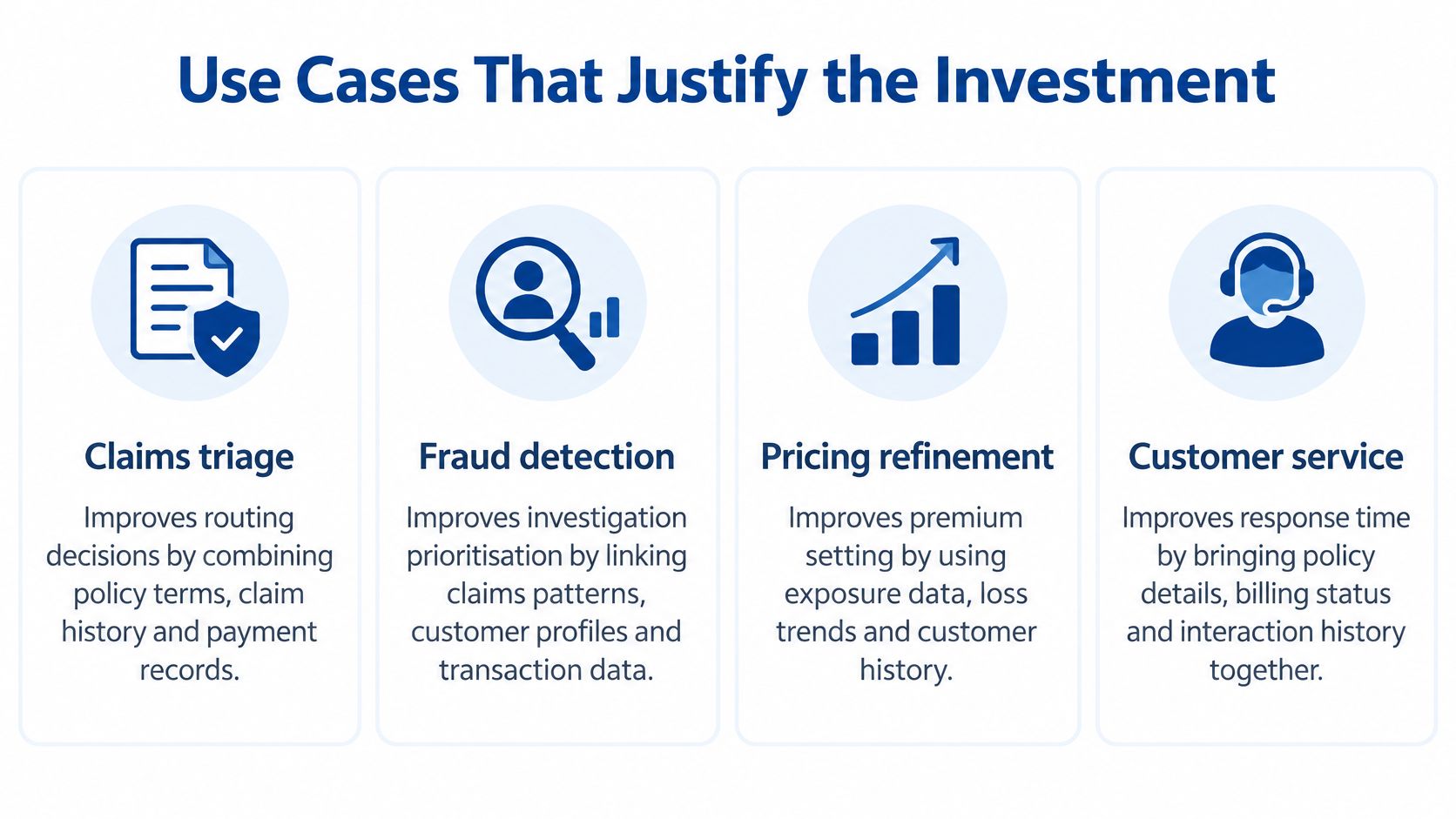
Claims triage: Combine policy terms, claim history and payment records to decide which claims need specialist attention. Duplicate-payment indicators should prompt review, while missing coverage information should create an exception rather than an automatic rejection.
Underwriting exposure: Connect insured locations, industry classifications and customer segments to show where the portfolio is concentrated before renewal. Underwriters can then distinguish growth within appetite from an accumulation they haven't deliberately accepted.
Fraud pattern detection: Link claims, customer identities, payment destinations and third-party records to prioritise investigations. A shared address or supplier can be a useful signal, but it isn't proof of fraud.
Regulatory and management reporting: Produce returns and management packs from the same approved dataset. Finance and compliance can then discuss the interpretation of a result instead of repeatedly rebuilding its inputs.
An insurance analytics platform can also support pricing refinement and customer service, provided the underlying records are suitable for those purposes.
A concrete cyber underwriting example
Statistics Canada reported that 16% of Canadian businesses were affected by a cyber-security incident in 2023, while recovery spending doubled from approximately $600 million in 2021 to $1.2 billion in 2023. For a cyber underwriter, incident history and recovery costs are therefore useful inputs to an exposure assessment, not merely background information.
Consider a business that declares tested backups on its application but later submits a claim involving an unsuccessful recovery. An underwriter needs the application version, assessment date, incident timeline and relevant policy wording together to understand the discrepancy.
Without shared identifiers, an analyst might accidentally compare a parent company's controls with a subsidiary's incident. The resulting dashboard could look convincing while supporting the wrong conclusion.
Cleffex's insurance analytics solutions guide offers further context for matching analytical capabilities to business needs.
Choose the first use case by recording where staff spend the most effort reconciling information. Then establish whether the required records are accessible and sufficiently reliable. A valuable decision with unavailable data isn't yet a practical pilot.
Building Governance and Security Into the Platform
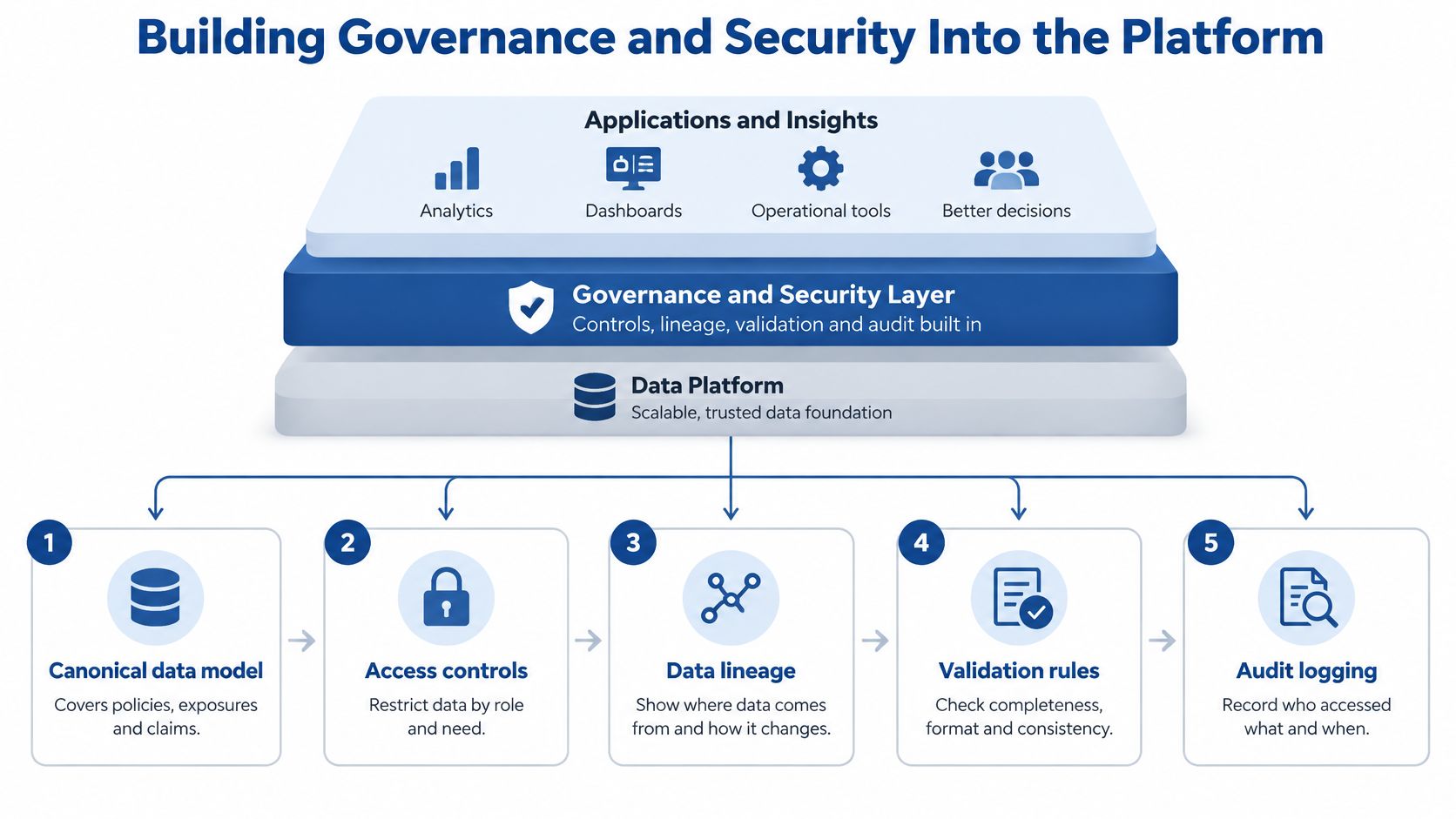
Governance isn't a document stored beside the platform. It's the way the platform decides which records to accept, who can use them and what evidence must accompany an output.
For federally regulated insurers, OSFI's data-risk expectations cover potential loss arising from collecting, storing, processing, using, sharing or disposing of data, and call for enterprise-wide collection, aggregation, lineage tracing and reporting of critical data. These expectations apply to federally regulated institutions, not automatically to every Canadian broker.
Make ownership visible in the data
Begin with a canonical model covering policies, exposures, claims, payments, customers and third parties. Assign a business owner who approves definitions and a data steward who manages quality issues and exceptions for each domain.
Attach practical metadata to critical fields:
Origin: Source system, source record and ingestion timestamp.
Meaning: Business definition, permitted values and responsible owner.
Quality: Validation results, unresolved exceptions and approval status.
Lifecycle: Retention class, authorised uses and downstream consumers.
Validation checks should run when records enter the platform. Reconciliation should run when they are combined into totals, so an analyst can trace a reserving output through its transformations to the underlying transactions.
Protect information without preventing useful work
Classify records by sensitivity before granting access. Encrypt stored data and transfers, mask or tokenise development copies, and monitor privileged activity in production analytics. Developers should be able to test a claims transformation without receiving unrestricted medical records.
Visbanking's discussion of trusted data practices for banking leaders provides a useful financial-services comparison for ownership and accountability. Insurance teams should adapt such practices to their own product, customer and regulatory context.
At Cleffex, we prioritise compliance with global standards such as GDPR and HIPAA, and our development process includes strong encryption, secure data storage, anonymisation techniques and access control measures. The applicable obligations still need to be determined for each organisation and workflow.
The wider operational context is addressed in our guide to cybersecurity in the insurance industry.
Before go-live, require a demonstrable control check:
Trace a result: Reconstruct a selected report figure from its source transactions.
Test permissions: Confirm that an unauthorised role cannot retrieve sensitive records.
Exercise response: Rehearse incident escalation, breach assessment and recovery responsibilities.
Retrieve evidence: Produce access logs, validation results and approved retention settings.
A correct-looking report isn't sufficient. The launch team must also demonstrate why it should be trusted.
Confirm Your Readiness Before You Commit Budget
Approve a readiness assessment before approving a broad technology purchase. A platform can fail even with capable engineers if nobody can obtain the necessary records or settle competing business definitions.
Check data, infrastructure and ownership
Use a short assessment to establish whether a pilot is feasible:
Data availability: Can the team obtain the records needed for the chosen decision, including historical versions and permitted external inputs?
Infrastructure: Can existing systems support extraction without disrupting policy servicing or claims processing?
Organisational readiness: Are business owners available to approve definitions, resolve exceptions and accept the result?
At Cleffex, our AI readiness assessments examine data availability, technology infrastructure, business needs and organisational maturity. These questions are equally useful when a data platform is intended to support future AI rather than an immediate model deployment.
Choose a delivery route you can maintain
Building in-house gives your team direct control, but it also requires ongoing engineering, security and operational capacity. Bringing in a partner for the first phase can address capability gaps, provided ownership and handover are explicit.
A proof of concept or minimum viable platform offers a narrower route: test a defined decision before committing to wider implementation. We offer PoC and MVP development to validate AI ideas, minimise risks and demonstrate ROI before full-scale implementation; our insurance and fintech solutions provide the wider service context.
For general enquiries, visit the Cleffex homepage. Keep the initial discussion focused on the reporting problem, available systems and evidence needed for approval.
This month, choose the use case with the greatest reconciliation burden, name its owner and propose a 90-day pilot with a measured outcome. Treat that duration as a planning target, not a delivery promise. A bounded test gives the business something concrete to approve.
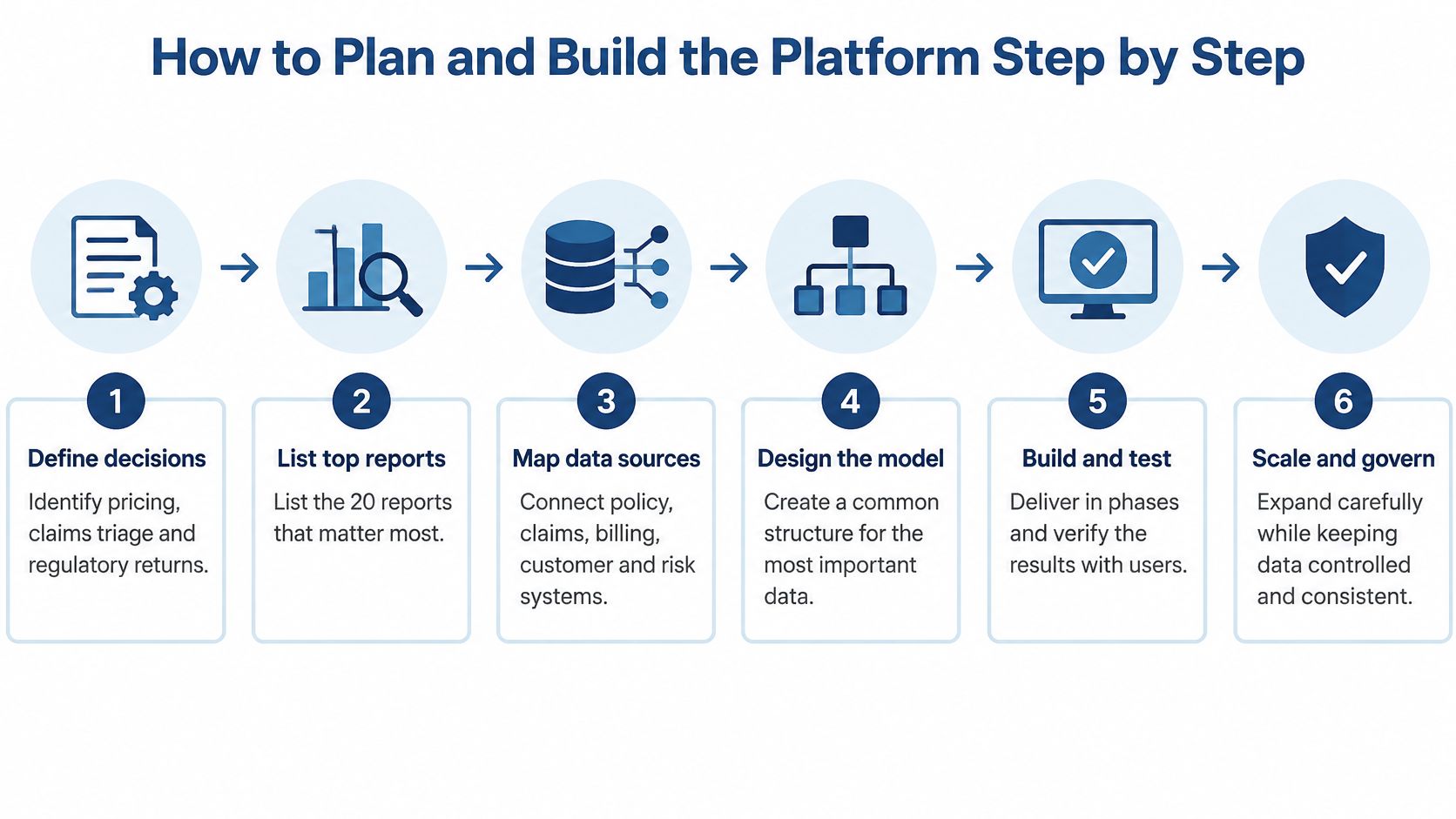
How to Plan and Build the Platform Step by Step
Insurance data architecture becomes manageable when each stage produces something the business can inspect. Don't accept a completed pipeline as proof that the resulting information is usable.
Build around recorded acceptance checks
Define the decisions: Identify the pricing, claims-routing or regulatory decisions the platform must support, and, as a practical scoping exercise, list the 20 reports that matter most. Record each report's owner, intended action and acceptance criteria so the team doesn't build for every possible future question.
Inventory the sources: Document the owner, format and update frequency of each policy, claims, billing and CRM source, including extraction restrictions and historical coverage. The recorded check is an inventory that both system owners and the delivery team approve.
Agree the canonical model: Have business owners approve definitions for policy, exposure, claim, payment, customer and third party, with a steward assigned to each domain. Keep a signed-off definition sheet, including effective dates and rules for matching records across systems.
Build validated ingestion: Check required fields, identifiers, timestamps and transaction totals, then reconcile each run against the relevant source ledger. A material mismatch should block publication of the affected dataset, with an exception record showing who investigated and authorised any release.
Choose storage and integration patterns: Select warehouse or lakehouse capabilities according to the reporting and document workflows already identified, and expose APIs only for confirmed consumer needs. Record the architecture decision, expected workload and interface tests so future changes have an explicit basis.
Activate governance before live data: Configure access roles, audit logging, and lifecycle controls before production records enter the environment. Acceptance requires evidence from permission tests and operational rehearsals, not just screenshots showing that settings exist.
Pilot a bounded business area: Release to a selected line of business and compare report turnaround, reconciliation effort and error rate with an agreed baseline. Extend only when users accept the output and the team can operate, recover and support it.
Keep architectural choices proportionate
The visual groups the work into broader phases, while the acceptance checks separate the delivery responsibilities. Neither a diagram nor a backlog replaces evidence that users can retrieve the right information and explain its meaning.
For shared cloud services, discussions on platform architecture for SaaS products are useful context for modular interfaces and platform boundaries. Insurance teams must add the product history, access restrictions and decision evidence their workflows need.
Avoid making every feed real time. A claim-status enquiry may justify event-driven updates, while a management report may work well with a scheduled, reconciled load. Faster delivery adds little value if the business cannot act on the information sooner.
Release gate: Promote a dataset when its business owner accepts both the result and the evidence behind it, not merely when the engineering team finishes its tasks.
Common Pitfalls and How to Fix Them
Platform symptoms, causes and fixes
| Symptom | Likely cause | Fix |
|---|---|---|
| Two departments report different loss ratios | No agreed definition of earned premium or claim status | Agree definitions and map them into the canonical model before building dashboards |
| Monthly reports take days to reconcile | Manual extracts and no reconciliation checks | Add automated reconciliation totals at each aggregation step |
| Pipelines break after a source system upgrade | Ingestion depends on fragile field positions | Use schema validation and versioned data contracts with each source |
| A vendor holds copies of client records | Contract lacks scope, isolation and deletion terms | Renegotiate scope, isolation, monitoring rights and deletion evidence |
| An AI pricing or fraud decision cannot be explained | No lineage or model-version record for the decision | Log inputs, model version and reviewer for every automated decision |
| Analytics slows during peak claims periods | Warehouse sized for overnight batch reports only | Separate operational and analytical workloads and scale ingestion independently |
When reports disagree, inspect definitions before replacing technology. Check whether both teams use the same accounting period, claim status and premium basis. A technically correct query can still answer a different business question.
Security investment doesn't remove that need: in the second quarter of 2025, 37.1% of finance and insurance businesses planned new or additional cyber-security actions over the following year, and 29.7% planned security-software adoption, according to Statistics Canada.
Treat vendor-held copies as part of the platform
Vendor arrangements require particular scrutiny because your organisation may not directly operate every environment containing its records. For federally regulated institutions, OSFI's third-party risk guidance addresses contractual provisions covering data scope, timely access for the institution and OSFI, monitoring rights, security responsibilities, breach notification, liability and isolation of client records during transfer and service disruption.
Translate those provisions into testable questions. Can your team identify which records the vendor holds? Can it obtain them during an outage, verify client separation and retrieve evidence that expired copies were deleted?
Insurance platforms may join health, financial, telematics, identity and claims information. An untracked export can expose a broader picture of a policyholder than any individual source system holds. Contract wording without operational verification leaves that exposure unresolved.
Build discovery scans, periodic access reviews and deletion evidence into vendor oversight. Use the governance checks to verify implementation rather than repeating a security questionnaire and treating completed answers as proof.
Evidence may also help explain the platform's controls during a cyber-insurance application or claim investigation. It doesn't guarantee coverage or acceptance, which depends on the relevant policy and circumstances.
Start with the symptom your reporting team already complains about. Resolve its cause, record the improvement and use that evidence to justify the next change.
Frequently Asked Questions About Insurance Data Platform Development
How long does an insurance data platform take to build?
There's no dependable timetable without checking source access, historical quality and approval responsibilities; use a quarter as a possible planning window for a tightly bounded governed report, not a promised delivery benchmark. The acceptance checks in the step-by-step build plan help distinguish a useful first release from a platform that is merely connected.
A wider programme should expand according to demonstrated readiness rather than an arbitrary completion date.
Should an insurer build or buy its platform?
Buy mature ingestion, storage and reporting capabilities where they meet your requirements, but keep business ownership of the canonical model and governance rules, even when a partner implements them. Compare the delivery routes in the readiness assessment against your team's ability to maintain integrations, investigate failures and manage upgrades.
The important distinction isn't custom versus packaged software, but whether your organisation can control definitions, retrieve its information and change providers without losing essential evidence.
Do small brokers need the full architecture?
No, a small broker can begin with controlled ingestion, a governed policy-and-claims model and reporting, while implementing proportionate access and traceability from the outset. Use the component comparison to separate essential capabilities from features that only become useful when partners need live data or analytical workloads grow.
A smaller implementation should reduce scope, not remove accountability for sensitive policyholder information.
How do AI models fit into platform governance?
For automated decisions, record the input snapshot, model version, output, explanation and any human review, with a rollback route and escalation to qualified staff for high-impact cases. Apply the governance launch checks to the complete decision workflow, including permitted use, retention, monitoring and outcome testing across relevant provinces and customer segments.
Keep experimentation separate from production: a promising fraud score in a test environment isn't sufficient evidence to change how a live claim is handled.
What drives the cost of insurance data platform development?
The main drivers are the source systems being integrated, data-quality remediation, time spent agreeing business definitions, and governance and access tooling, alongside ongoing operation and support. Costs vary with scale, so use the readiness and budgeting checks to distinguish essential pilot work from optional expansion rather than relying on an unsupported price estimate.
The sound investment is the smallest platform that improves a meaningful decision and can demonstrate that its information is trustworthy.
Cleffex Digital Ltd offers readiness assessments, custom insurance software, API integration and proof-of-concept development to help turn disconnected records into a governed decision-making foundation. Visit Cleffex Digital Ltd to discuss a bounded pilot, bringing your most time-consuming reconciliation problem, its business owner and the systems involved.