

Canadian ecommerce revenue grew 7.0% in 2023, compared with 3.2% growth in total retail spending, according to Statistics Canada's annual retail trade report. Faster online growth makes a familiar problem harder to ignore: customers can only buy confidently when product descriptions, prices and availability agree.
Connecting a product information management system, an enterprise resource planning system and an ecommerce platform isn't a matter of moving a feed. It means deciding which team owns each fact, how changes reach customers and which personal information should never enter the product catalogue.
Why Connected Product Data Now Matters
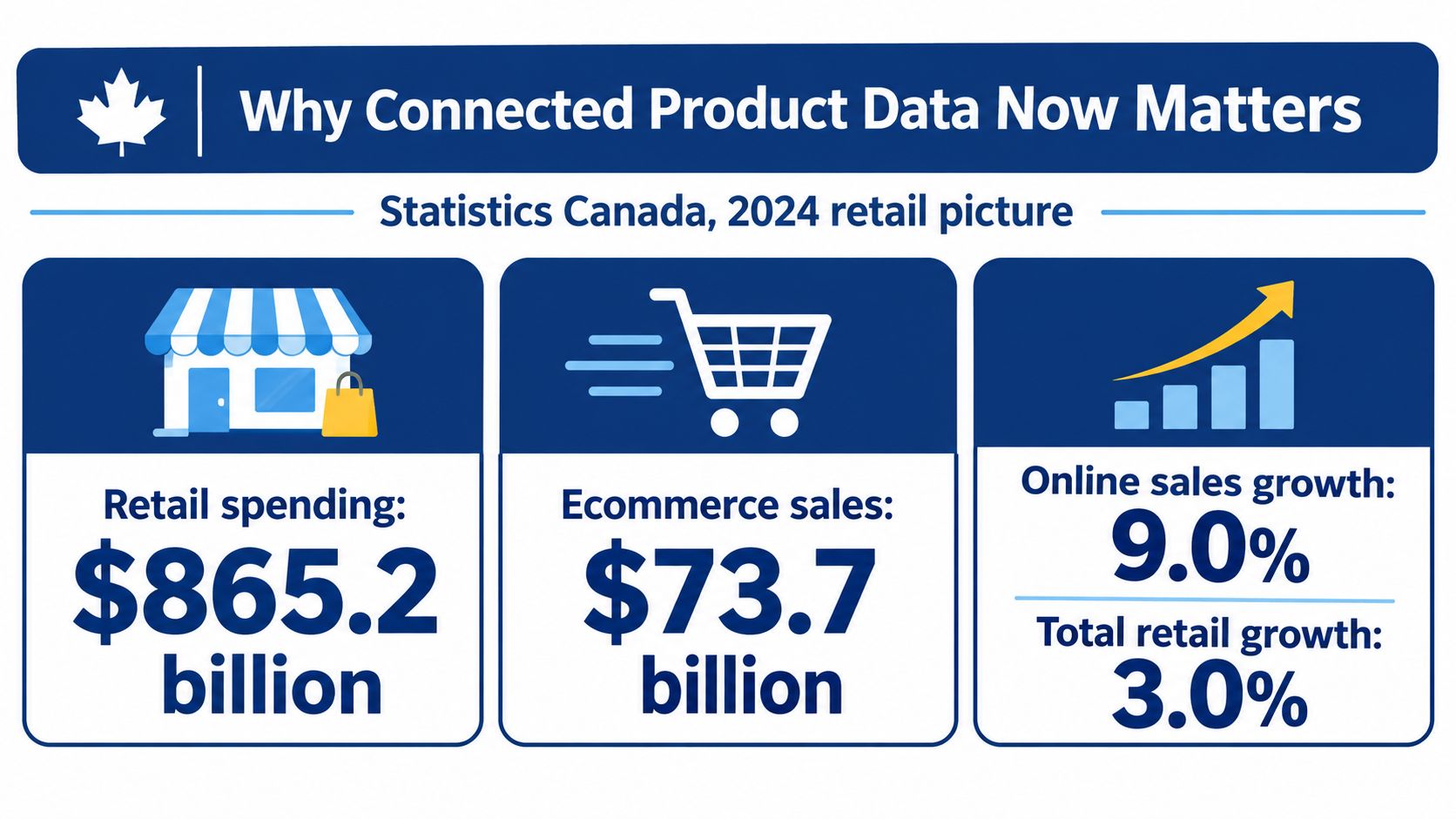
Canadian retail spending reached C$865.2 billion in 2024, including C$73.7 billion in ecommerce revenue, while ecommerce sales increased 9.0%, compared with 3.0% for total retail spending, according to Statistics Canada's 2024 retail report. That growth makes reusable, approved product records more valuable than another spreadsheet import.
Consider a winter jacket after a promotion. The website displays the sale price, a marketplace retains the original price, and a customer-service agent sees a different amount in an exported catalogue. Meanwhile, the warehouse has stock, but the website still marks the jacket unavailable.
Each team may have entered accurate information at some point. The problem is that nobody controlled which version reached which destination.
Ecommerce product data integration is the controlled movement of approved product facts between a PIM, an ERP and selling channels.
Connect facts rather than duplicate records
A useful integration lets a merchandiser approve jacket imagery without touching warehouse quantities. It lets an operations team change availability without accidentally replacing the approved description.
The same principle applies across automotive parts, food, general merchandise, electronics, health products and apparel. These catalogues need different attributes and checks, not a single undifferentiated feed.
Availability: Publish stock customers can order.
Discovery: Supply structured categories and specifications for site search.
Checkout: Preserve approved tax classifications and commercial values.
Service: Give agents the same product facts customers see.
A unified commerce architecture connects these responsibilities without requiring every application to become a product master. Reliable product data management starts with an ownership decision, not a connector purchase.
What Each System Owns and How Often It Updates
The ERP owns operational values, the PIM owns enriched product information, and the ecommerce platform presents the channel-specific version. Treat this as a working agreement between teams, with documented exceptions rather than competing edits.
A PIM, or product information management system, helps people prepare and approve product content. An ERP, or enterprise resource planning system, manages operational records such as costs, stock and fulfilment. The storefront combines their approved outputs for customers.
System ownership and typical refresh for product data
| Data class | Source of truth | Example fields | Typical refresh |
|---|---|---|---|
| Identity | PIM with GS1 keys | GTIN, internal SKU cross-reference, variant and pack level | On create or identifier change |
| Enriched content | PIM | Title, bullets, specs, images, categories, translations | On approval, often daily or on publish |
| Commercial operations | ERP | Cost, base price, tax class, available stock, warehouse | Event-driven or every few minutes |
| Channel presentation | Ecommerce platform | SEO title, badges, local promo text, sort order | On merchandising change, never back to ERP as master |
| Trading-partner share | GDSN or ECCnet via PIM | Standard attributes and images partners require | On validated publish to partners |
These refresh patterns are design starting points, not universal service guarantees. A team should choose intervals by considering how quickly an incorrect value could affect an order.
Read the commercial row carefully. On-hand stock isn't the same as available stock: reserved, damaged or otherwise unavailable units shouldn't automatically become sellable. Publish the ERP's approved availability calculation rather than asking the storefront to reconstruct it.
Likewise, a local promotional badge belongs in presentation, but the price charged needs an agreed commercial authority. If the PIM and ERP both submit a base-price change, accept the ERP value and reject or flag the unauthorised PIM edit.
Practical rule: Assign ownership at field level. Owning a product record doesn't mean owning every value inside it.
Match update speed to customer risk
Statistics Canada recorded C$4.3 billion in seasonally adjusted Canadian retail ecommerce sales in December 2024, representing 6.1% of retail trade and an increase of 3.1% from November, in its December retail trade release. Those figures don't prescribe a refresh interval, but they illustrate why peak trading deserves deliberate capacity planning.
Price, availability and promotional status may need event-driven updates. Approved images and translated copy can follow a publication workflow instead of constant polling.
For terminology around keeping applications aligned, the agentcentral guide to data synchronisation offers useful background. In PIM ERP integration, the important decision is which changes require immediate delivery and which require human approval first.
Orders should return through the order-management flow so the ERP can reserve or decrement inventory. Customer-service and customer-management systems may consume product facts, but they shouldn't become additional product masters.
Before building a connector, mark one authorised owner per field, including who resolves rejected updates.
Attributes and Quality Gates Before Publication
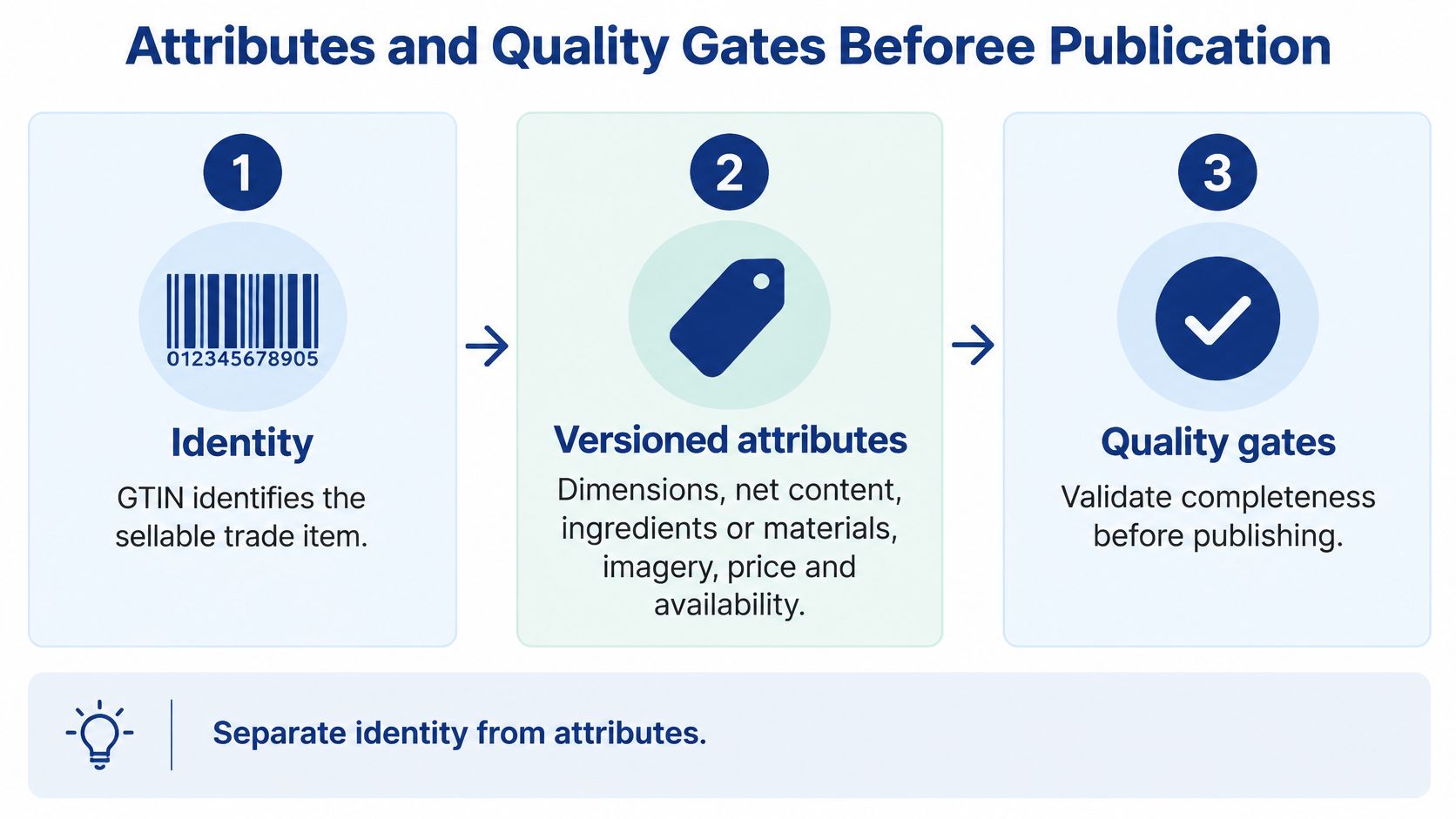
A product's identity must remain separate from its editable attributes. Changing a description doesn't create a new product, while changing a sellable pack can require a distinct identity.
GS1 Canada's product listing checklist describes highly specific product identification through Global Trade Item Numbers, or GTINs, and supports standardised product information and images through ECCnet. Its quality principle is straightforward: information should be complete, current and correct.
Use the GTIN as a stable trade-item key where applicable. Map supplier SKUs and internal item codes to it through a cross-reference table rather than matching records by name.
Separate identity from versioned attributes
Say a supplier offers a bottle individually and in a case. A marketplace import that matches only the product name could attach the case photograph to the individual bottle's price.
Give trade-item variants and packaging levels their appropriate identifiers. Keep the each, case and pallet relationships explicit, with the correct GS1 identifier for the entity being identified.
Version the attributes separately:
Descriptive content: Titles, feature bullets, materials, ingredients and approved imagery.
Commercial values: Price and availability received from their authorised source.
Logistics: Dimensions, measurement units, net content and pack hierarchy.
Compliance content: Warnings, label text and bilingual information where required.
Channel extras: Marketplace attributes and presentation-specific content.
A millilitre-to-fluid-ounce mismatch isn't cosmetic. It changes the product information customers use to compare items, so units need controlled values and conversion rules.
Publish gates for product records
| Gate | Trigger | Action |
|---|---|---|
| Block | GTIN, title, price or stock blank | Record does not publish |
| Warn | Images, bullets or units thin | Record publishes with a flag for the field owner |
| Hold | Two channels disagree on package size | Record held until the field owner resolves the conflict |
These are practical baseline controls, not a substitute for category-specific requirements. A missing optional lifestyle image may justify a warning; missing mandatory safety content must block publication.
Also distinguish blank stock from zero stock. Zero is a valid operational value, while a blank means the integration doesn't know the quantity.
Keep essential facts in the primary product presentation rather than relying on a digital label to explain them. A fuller ecommerce product information management workflow should make approval status and unresolved exceptions visible.
For a catalogue review this week:
Trace identity: Follow a SKU family from supplier code to sellable item.
Inspect packaging: Compare each and case quantities across destinations.
Check local content: Verify units, language and warnings.
Test rejection: Submit an incomplete record and confirm it can't publish without notice.
Category Examples from Parts to Apparel
A product record becomes useful only when its details agree with fulfilment operations. A well-formatted catalogue can still mislead customers if delivery, returns or stock information is out of date.
Operational consistency is part of the product-information problem: product details and service promises need to match across the systems that maintain them.

Automotive parts need compatibility and fulfilment
For a brake rotor, the PIM should link fitment details, including year, make, model and installation position, to the correct trade item. Supersession relationships identify the approved replacement when a part is discontinued.
The ERP owns warehouse availability and operational status. Use those current values to shape delivery messaging rather than copying a fixed promise into every product description.
A listing might promise delivery within two days while the supplying warehouse cannot meet that window. Correct fitment does not make the fulfilment promise accurate.
Grocery and health items need packaging agreement
For a grocery item, connect net content, ingredients, warnings and approved images to the correct packaging level. Prepare partner content through the appropriate ECCnet or GDSN workflow so each destination receives consistent supplier information.
A label change should prompt a content review, including a check for images that show the previous packaging. QR-linked content and shelf information should use the same approved product facts as the product page.
If a website makes a dietary claim that the current physical label does not support, the records conflict. Keep necessary product facts visible rather than relying on customers to open a QR code or supplementary page.
Apparel needs distinct variants
For a winter jacket, colour and size identify the variant and its matching images. Bilingual descriptions can follow a slower approval process while operational updates continue separately.
A marketplace may call a colour “navy” while the company catalogue calls it “midnight blue.” Map the approved labels explicitly. Do not merge distinct variants or create new inventory records to resolve a naming difference.
If the marketplace treats different sizes as one SKU, an order for one size can reduce the displayed availability of another.
Across categories, model condition, warranty and return eligibility are product information. Where regional policies differ, publish the approved wording for each region so service agents are not left reconciling conflicting pages manually.
Customers need the description, package and fulfilment promise to describe the same purchase.
Privacy Limits on Product Data Synchronisation
More connections aren't automatically better. Product descriptions can be distributed to approved destinations, but customer behaviour, consent and suppression requests require a separate set of controls.
The Canadian Marketing Association's consumer privacy report reports that 87% shop online, 90% are at least somewhat concerned about online privacy, and 59% feel more comfortable sharing data when they understand its use, can control preferences and can opt out. Relevance doesn't remove the need for meaningful control.
Keep product facts and customer permissions separate
A jacket's material belongs in the product record. A customer's browsing history doesn't. A recommendation service may combine approved product facts with permitted customer signals, but that doesn't justify copying customer profiles into the PIM.
Maintain distinct records for:
Product master data: Specifications, images and approved commercial references.
Customer-linked activity: Behaviour or preferences used for an authorised purpose.
Permission state: Consent, purpose, applicable restrictions and suppression status.
Audit evidence: When a preference changed and which destinations acknowledged it.
A public-facing preference page can help teams understand the customer interaction.
An email unsubscribe and a broader personalisation opt-out aren't necessarily equivalent. Route each request according to its scope, ensuring that applicable restrictions reach analytics, advertising and on-site personalisation rather than indiscriminately changing unrelated permissions.
Measure whether privacy choices actually work
Set a target propagation time for each suppression flow and record acknowledgements from receiving systems. If a destination is unavailable, retain the request for retry and prevent prohibited processing while the state remains unresolved.
Healthcare, insurance and automotive journeys deserve particular care because a viewed product or service may reveal sensitive circumstances. Keep province-aware warranty or return text in product data management without attaching customer identities to those content records.
Measure success alongside conversion:
Consent accuracy: Whether processing matches the recorded permission and purpose.
Opt-out propagation time: How long applicable destinations take to honour a change.
Auditability: Whether staff can reconstruct what happened.
Explainable personalisation: Whether the merchant can explain why a module appeared.
A clean catalogue with contradictory privacy states is still a failed integration. Design those controls before connecting recommendation tools.
How to Connect PIM ERP and the Storefront
Start with a bounded category and a documented operating model. Product information management integration becomes easier to test when the team can trace a changed value from its authorised source to its final display.
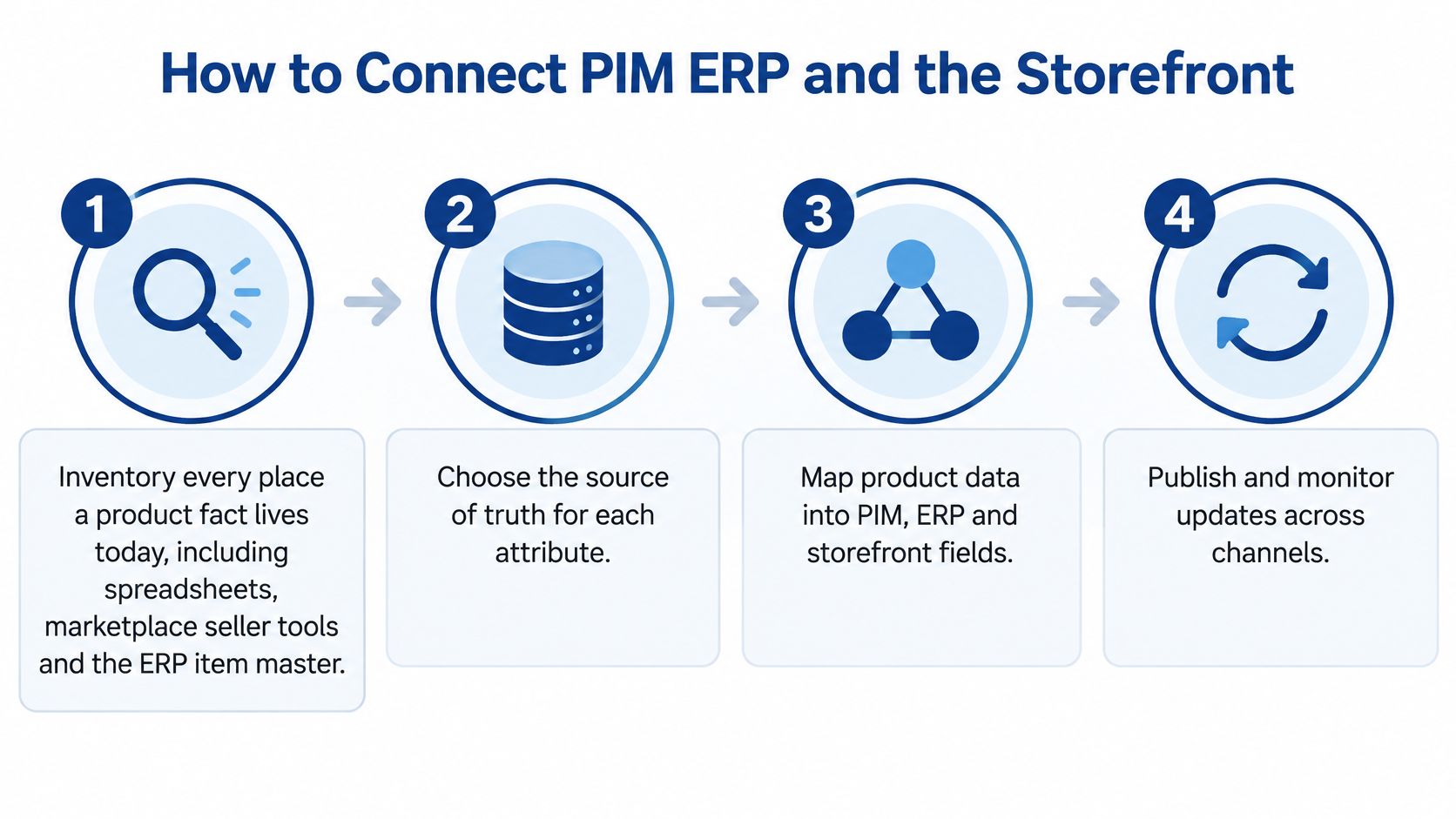
The implementation sequence below separates modelling decisions from connector work. That distinction prevents developers from automating disagreements that the business hasn't resolved.
Build the model before the transport
Inventory every location containing product facts: Include spreadsheets, supplier files, marketplace seller tools, the ERP item master and storefront extensions. Record who edits each location and which exports other teams rely on, because an overlooked spreadsheet can reintroduce obsolete values after launch.
Choose an immutable key and build the cross-reference: Use GTINs where appropriate, or another controlled stable identifier when a GTIN doesn't apply. Resolve supplier codes, internal SKUs and channel identifiers before mapping descriptions, so a matching title can't accidentally join unrelated products.
Assign field owners and freeze competing edits: Turn the ownership agreement into permissions and validation rules. A documented policy won't prevent an overwrite if both applications still have unrestricted write access.
Model content and operations separately: Configure approval states for descriptive content and explicit operational fields for stock, cost and price. Let the storefront consume the approved outputs rather than asking it to reconcile conflicting masters.
Deliver changes and make failures visible
Build delivery paths for different update speeds: Use APIs or middleware to carry event updates for urgent commercial changes and approved publication events for copy and media. If a receiving API can't support events, use a controlled schedule with alerts for stale values.
Validate, log and retry safely: Reject incomplete records and capture mismatches with the identifier, field, attempted value and owning team. Use version checks to reject older updates, and make retries idempotent so repeating a message doesn't create duplicate products or apply the same stock adjustment again.
Pilot a category before adding channels: A practical test can compare storefront, warehouse and marketplace values over a working week, including a promotion, a stock reservation and a rejected publication. Test failure recovery as well as successful delivery, because a connector that works only when every system is available isn't ready.
Monitor business exceptions, not just completed jobs: Track failed messages, stock drift, unresolved content holds and applicable suppression acknowledgements. Give each error a named resolver and escalation path instead of leaving it in an unattended technical log.
A marketplace may require a category tree that doesn't resemble your internal taxonomy. Map outward to its required categories, and store that mapping as channel configuration. Don't let an incoming marketplace category replace the company's master classification.
The guide to ERP integration with ecommerce provides additional context for planning operational connectivity. During implementation, also check existing blog URLs and customer-facing product URLs before publishing changes, so renamed categories don't create avoidable broken destinations.
Pilot acceptance: Every field has an owner, staff no longer paste prices manually, and the team can see and resolve rejected updates.
Keep the error queue accessible to content and operations staff, not only developers. A useful exception includes enough context for the responsible person to correct the source record and republish it.
Confirm Ownership and Answer Common Questions
Before approving a wider rollout, make three checks: every field has an authorised owner, identifiers survive channel mapping, and urgent commercial changes don't wait behind editorial approval. Include privacy permissions in acceptance testing whenever customer-linked recommendations are involved.
Run a two-week pilot on the category generating the most complaints. Measure stock mismatches, price disputes and unpublished records rather than counting connector features.
Make the first meeting a decision meeting
Bring catalogue, operations, ecommerce and privacy stakeholders together with a short agenda:
Field owners: Resolve disputed editing rights.
Identifier gaps: Assign responsibility for unmatched items.
Peak trading: Agree acceptable freshness for prices and stock.
Error handling: Name the person responsible for each exception class.
For custom connectivity, Cleffex offers stable custom API development and ERP integrations through our ecommerce development practice, helping applications share data and improve connectivity. We also integrate AI capabilities into existing CRMs, ERPs and custom platforms without disrupting current workflows.
Frequently Asked Questions
Do we need a PIM if the ERP has item records?
Yes, once enriched descriptions, images, specifications and translations outgrow the item master. A small catalogue may remain manageable without a separate PIM, but introducing one doesn't transfer stock ownership away from the ERP.
How fast should synchronisation run?
Price and stock should be event-driven or near real-time during peaks when delayed updates could affect orders. Copy and media should wait for approval; faster delivery isn't useful if the content hasn't been checked.
Should marketplaces write back to the PIM?
Return channel errors and publication feedback to the integration workflow, but route orders to the order or ERP system. Don't automatically accept marketplace titles or categories into the PIM master, because that can create conflicting versions of the same product.
What breaks most often?
Common failure points include missing GTIN mappings, competing price owners and personalisation tools copying customer information into product feeds. Test those failure modes explicitly instead of assuming a successful initial import proves the integration is sound.
Freeze a field-owner list before buying another tool. Clear authority, traceable identifiers and visible exceptions provide a stronger foundation than adding another application to an unresolved process.
Cleffex Digital Ltd offers custom API development, ecommerce solutions and ERP integrations to connect product content with operational systems. Bring your field-owner list, catalogue exceptions and current system map to Cleffex Digital Ltd to discuss a controlled integration that keeps approved product facts consistent and customer permissions separate.