

Healthcare data infrastructure is the integrated set of systems, standards, and governance processes that lets clinical data move securely and meaningfully across care settings. In Canada, 92% of healthcare providers had access to a digital health system in 2024, but only 52% used one to share clinical information outside their main practice setting.
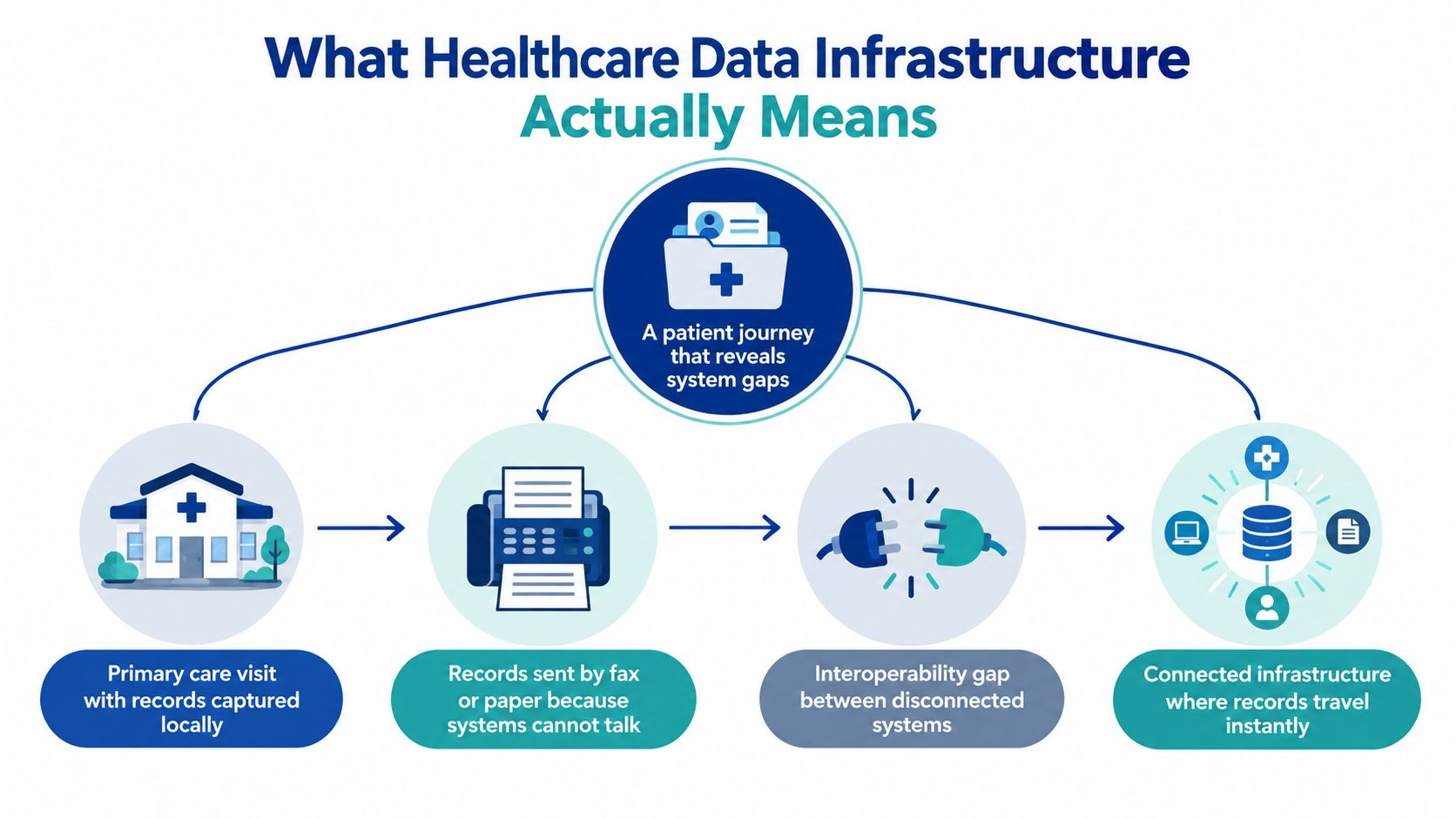
A patient can leave a family doctor's office with a referral, arrive at a specialist's clinic, and still have their history travel by fax or paper. The problem isn't that either organisation lacks software. The problem is that their software, data definitions, permissions, and operating procedures don't line up.
That distinction matters for clinic administrators, insurers, and health-tech founders. A healthcare data platform isn't successful because it stores records in a modern database. It succeeds when the right information reaches the right person, in a usable format, at the right point in a workflow, with a clear record of who was allowed to access it and why.
What Healthcare Data Infrastructure Actually Means
Consider a patient whose medication list was updated at a family practice but never reached a hospital specialist. The specialist may request information manually, the clinic may print or fax a chart, and administrative staff may re-enter details into another system. Each handoff creates an opportunity for delay, transcription mistakes, missing context, or duplicate work.
The same weakness affects more than referrals. A laboratory result may sit in one application, an imaging report in another, and a medication renewal request in a third. Clinicians can still provide care, but they spend time reconstructing a patient story that should have travelled with the patient.
The infrastructure is larger than the EHR
Healthcare data infrastructure includes the visible applications, but it also includes the less visible controls that make those applications useful:
Systems: EHRs, laboratory platforms, imaging repositories, claims systems, scheduling tools, patient portals, and analytics environments.
Data movement: APIs, integration engines, event streams, file transfers, and carefully managed interfaces with older systems.
Shared meaning: Data models, terminology services, validation rules, and standards that help different systems interpret a result consistently.
Governance: Privacy policies, consent decisions, ownership responsibilities, retention rules, audit requirements, and processes for secondary use.
People and operations: Administrators, clinicians, privacy officers, data stewards, integration teams, and support procedures.
Canada's foundations are older than the current wave of cloud platforms. Health-related statistical collection formally began in 1847, and the Canadian Institute for Health Information was created in 1994 to consolidate national health databases. Its Discharge Abstract Database represented approximately 75% of all inpatient discharges by 2002, according to this historical overview of Canada's health information infrastructure.
Practical rule: Treat data infrastructure as part of care delivery, not as a back-office IT upgrade.
The quality of this infrastructure directly shapes organisational risk. If records can't be exchanged, staff duplicate entry, clinicians work with incomplete histories, and leaders can't trust reports. A useful definition is simple: healthcare data infrastructure is the operational backbone that captures, protects, interprets, exchanges, and uses health information across organisations.
Core Components of a Modern Healthcare Data System
A functional platform has several connected layers. None works in isolation. Strong encryption can't compensate for unreliable identity matching, and an excellent API can't repair inconsistent clinical terminology.
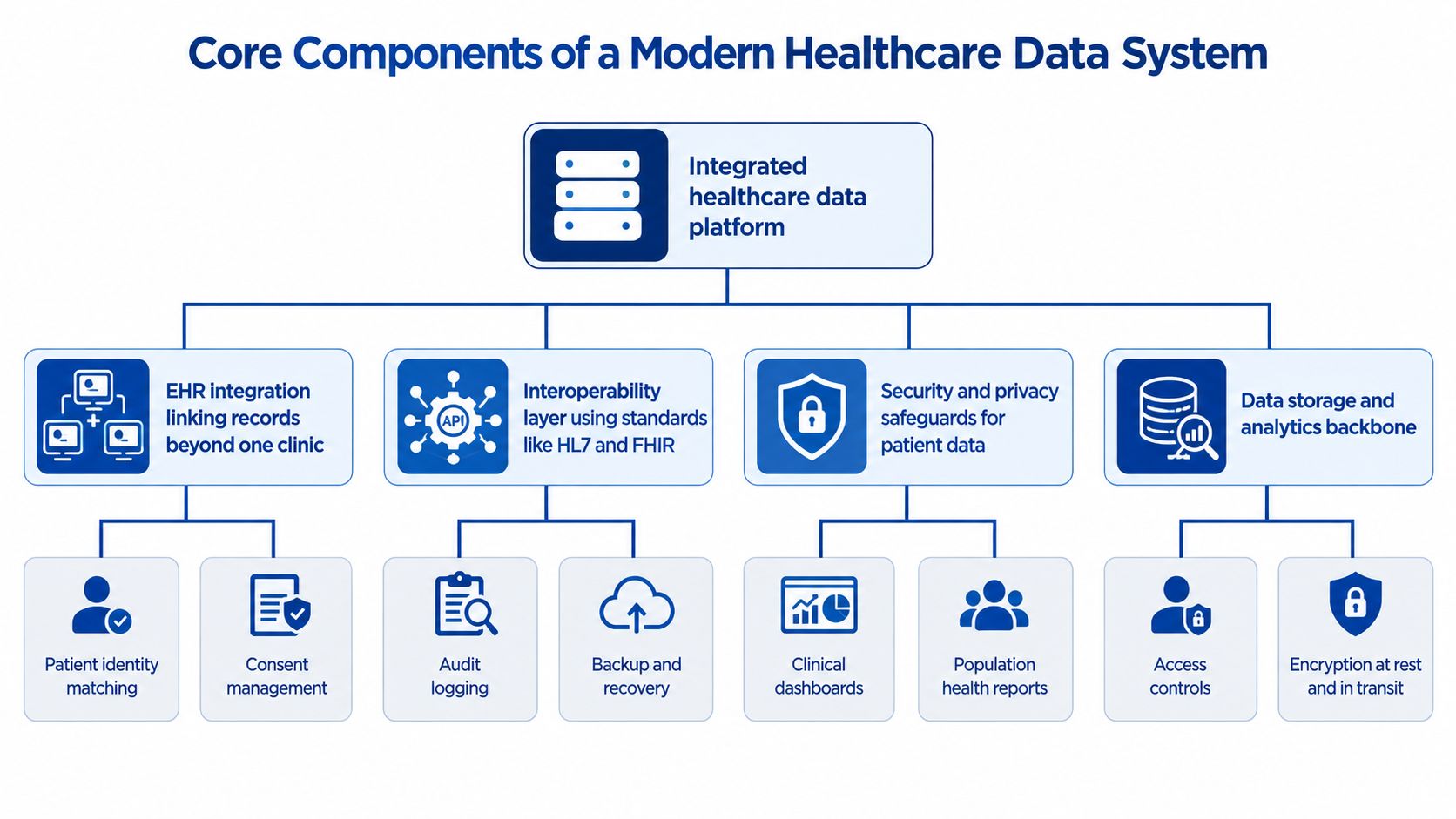
The six layers that make the plumbing work
1. EHR integration connects records beyond one clinic. An EHR can manage appointments, notes, orders, and medications locally, but useful continuity requires links to laboratories, hospitals, pharmacies, specialists, insurers, and patient-facing services. Integration should preserve context, not merely copy isolated fields.
2. Data pipelines and storage move and retain different forms of information. Structured medication fields and coded laboratory results can support reliable queries, while scanned referrals, clinical notes, images, and correspondence require separate handling. A healthcare data lake can bring these sources together for controlled analysis, as described in this guide to healthcare data lakes, but storage alone doesn't create trustworthy data.
3. The interoperability layer translates between systems. HL7 and FHIR exist because machines need consistent ways to represent and exchange clinical information. FHIR APIs can support modern, granular exchange, while HL7 interfaces may remain essential for established hospital environments. The design question is how to combine standards with local mappings and legacy constraints.
4. Identity and access management answers two separate questions: which person or organisation does a record belong to, and who may view or change it? Patient identity matching, provider authentication, role-based permissions, consent management, and session controls reduce the risk of attaching information to the wrong chart or exposing more information than a role requires.
5. Security and privacy controls protect information throughout its lifecycle. Encryption in transit and at rest, audit logging, backup procedures, incident response, and environment separation are technical controls. PIPEDA and applicable provincial health-information rules shape the surrounding policies, contracts, and accountability model. HIPAA may also matter when a Canadian organisation serves an American customer or handles data subject to United States requirements.
6. Analytics and clinical-use layers turn governed records into dashboards, quality reports, decision support, and other applications. These outputs are only as reliable as the source data, its lineage, and the rules applied during transformation.
Why the layers must be designed together
A disconnected architecture often looks adequate in a diagram. Data enters an EHR, moves through an interface, lands in a warehouse, and appears in a dashboard. In practice, a missing consent decision can block an otherwise valid exchange, while an inconsistent code can make two equivalent results appear different.
Cloud Versus On-Premises Healthcare Architecture
Cloud and on-premises hosting solve different operational problems. The right choice depends on control requirements, staff capability, integration patterns, data residency decisions, and how quickly demand changes.
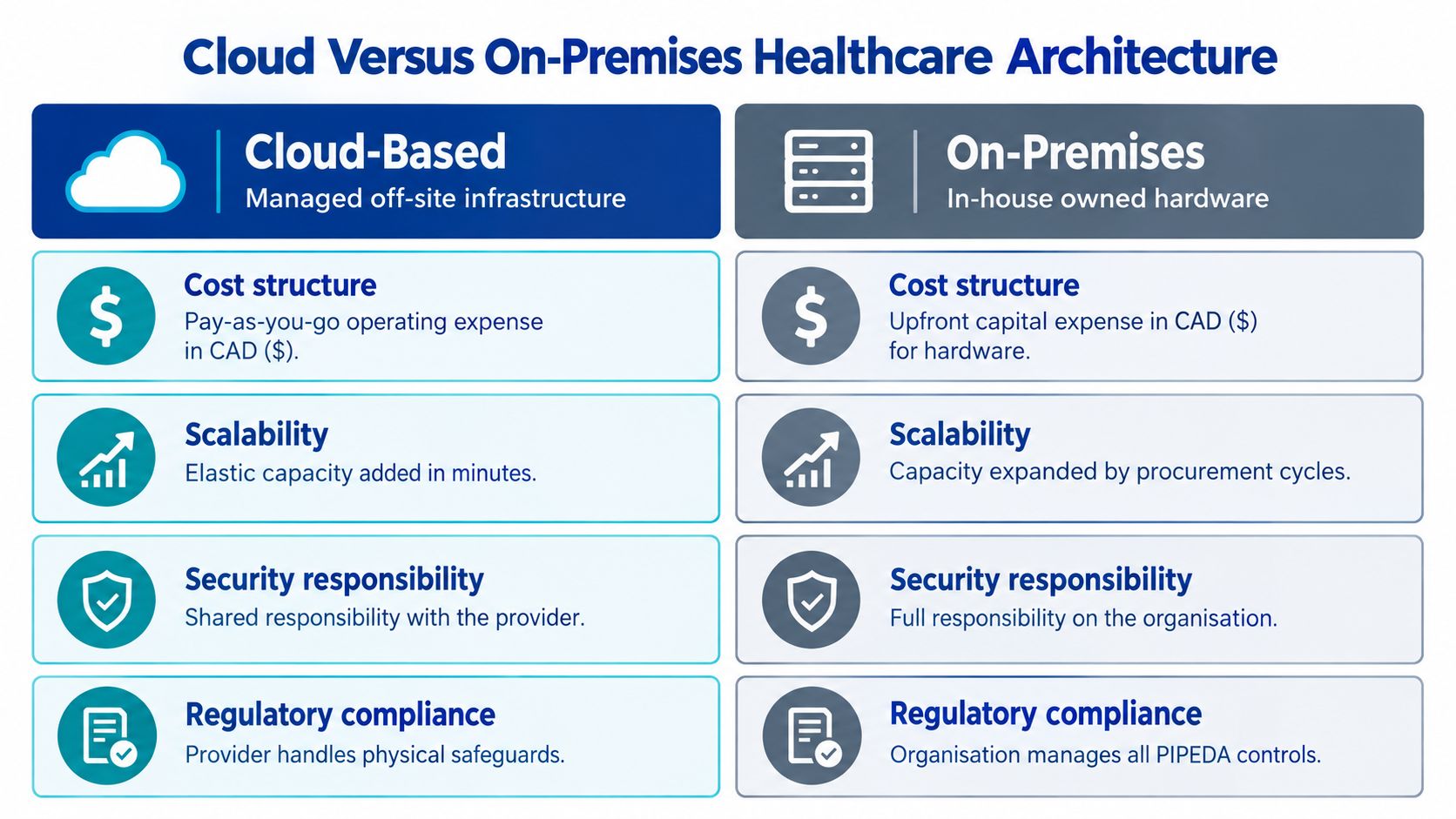
Cloud-based infrastructure
Cloud platforms let an organisation provision computing, storage, monitoring, and managed security services without owning every physical component. That can help a startup support new customers, or allow an analytics team to increase processing capacity without waiting for hardware procurement.
The trade-off is shared responsibility. The provider may secure the underlying facilities and core services, while the healthcare organisation remains responsible for configuration, identity, permissions, application code, data classification, retention, and incident response. A cloud contract doesn't transfer accountability for an inappropriate disclosure.
On-premises infrastructure
On-premises systems give an organisation direct control over hardware, network boundaries, maintenance windows, and some operational decisions. That control can suit a hospital with established facilities, specialised equipment, or integration dependencies that are difficult to move.
Ownership also means ownership of the workload. Internal teams must plan capacity, replace failed equipment, test recovery, patch systems, monitor threats, and document controls. Hardware can feel tangible and secure, but physical control doesn't automatically produce better privacy or availability.
| Decision factor | Cloud | On-premises |
|---|---|---|
| Capacity | Resources can be expanded through provider services | Expansion depends on equipment and facilities |
| Operating model | Shared responsibility with the provider | Responsibility sits primarily with the organisation |
| Staffing | Requires cloud architecture and configuration expertise | Requires infrastructure, hardware, and facilities expertise |
| Change speed | Often supports faster environment provisioning | Procurement and installation can take longer |
| Control | Strong control through configuration and contracts | Direct control over owned infrastructure |
Why hybrid architecture is common
A hybrid design may keep sensitive or tightly coupled workloads in an organisation's environment while using cloud services for development, disaster recovery, analytics, or selected application functions. That arrangement can be sensible, but it adds network paths, identity relationships, monitoring duties, and data movement rules.
Small clinics usually need a managed model that reduces infrastructure administration, provided the contract, access controls, backup approach, and provincial obligations are clear. Larger hospitals may retain local components because of clinical dependencies and existing investments. Health-tech platforms should choose based on customer requirements rather than assuming every tenant can use the same deployment pattern.
A disciplined healthcare cloud migration playbook can help teams sequence discovery, classification, architecture, testing, and cutover without treating migration as a simple hosting change.
Why Interoperability Remains the Real Challenge
Digital adoption is not the same as useful exchange. Physician EHR use in Canada increased from 36% in 2009 to 95% in 2024, yet a national assessment found that nearly every province and territory lacked integrated exchange among hospitals, community specialists, and primary care. Information transfer still frequently depends on fax or mailed letters, as documented in this assessment of Canadian healthcare interoperability.
The more revealing figure is outside-the-system exchange. Statistics Canada reported that 97% of Canadian healthcare providers had access to some form of patient clinical information in 2024, while only 52% used a digital system to send or share clinical information with providers outside their main practice setting. Among providers with access, 50% identified insufficient integration between systems as the most common barrier, according to Statistics Canada's healthcare technology findings.
The missing layer is meaning and accountability
Two systems may both support FHIR and still fail to exchange useful information. One may represent a medication using a local code; another may use a different vocabulary, and neither may record the same meaning for status, timing, or provenance. An interface can deliver a message successfully while the receiving clinician gets an incomplete or misleading record.
Interoperability therefore needs several controls at once:
Semantic alignment: Map local fields and codes to shared models and value sets.
Identity resolution: Confirm that the patient, provider, organisation, and encounter match the intended entities.
Consent management: Apply the patient's permissions and the jurisdiction's disclosure requirements to each flow.
Provenance: Preserve where information originated, when it changed, and how it was transformed.
Workflow triggers: Send information when a referral, admission, discharge, result, or medication event requires action.
Canada's jurisdictional reality
Canada's healthcare system adds a governance problem that a single API can't solve. Provincial privacy and health-information laws differ in areas such as consent, disclosure, security, and accountability. A 2026 Senate policy brief identifies fragmented provincial privacy and health-information legislation as a major barrier to cross-border data exchange, requiring customised agreements and compliance processes, as described in this policy brief on Canadian healthcare data governance.
This means a clinic, insurer, or software company needs a data-flow map that shows where information originates, where it travels, who controls it, who processes it, and which rules apply at each stage. It also needs an escalation path for secondary uses such as analytics or AI.
Public expectations are rising while access remains incomplete. The share of Canadians checking health information online increased from 32% in 2021 to 39% in 2023, but only 13% of Canadian adults in 2025 reported online access to laboratory or imaging results, immunisation records, and current medication information, including renewal requests. About 31% of adults, roughly 10 million people, reported no electronic access to their health information, according to CIHI and Statistics Canada reporting on digital health access.
The practical test isn't whether systems are digital. It's whether information moves automatically during real work without creating new privacy risk.
For teams assessing interfaces, identity, and legacy connectivity, this healthcare data integration practical guide offers a useful way to frame the work around data flows rather than application logos.
Implementation Roadmap for Healthcare Organisations
A sound programme starts with decisions, not products. Procurement before governance often locks an organisation into a system that can store data but can't support the required exchanges.
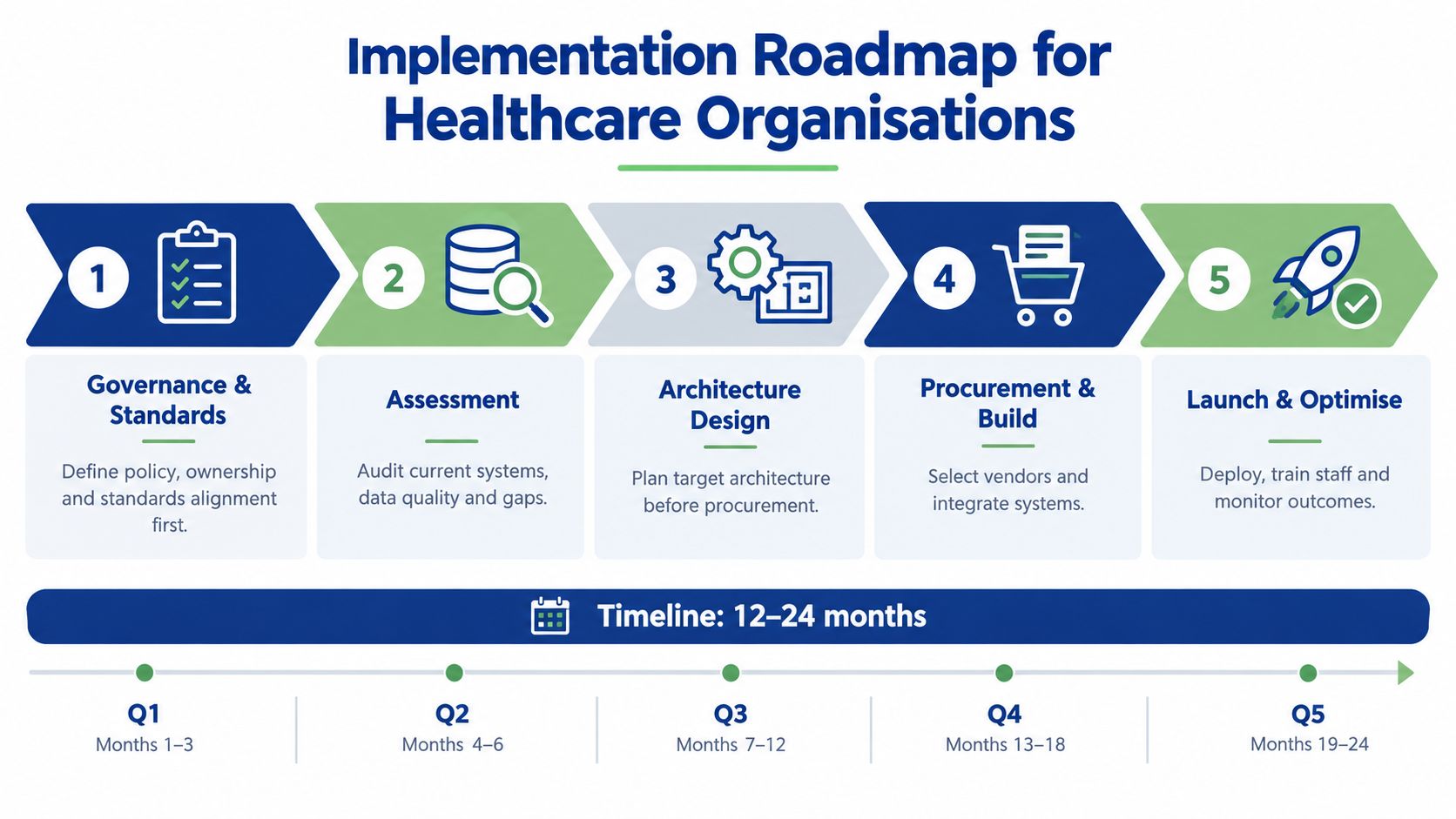
Begin with ownership and standards
Create a small decision group that includes clinical operations, privacy, security, data management, integration, and finance. Assign owners for patient identity, terminology, consent, data quality, and incident response. Then define canonical models for patients, encounters, medications, laboratories, imaging, and providers.
Document which source system is authoritative for each domain. Establish validation rules, provenance requirements, versioning practices, and approval procedures for changes. CIHI explains that clinical and administrative data standards provide the language and technical framework needed for unambiguous exchange, analytics, and decision support in its data standards guidance.
Assess the current environment
Inventory applications, interfaces, manual workarounds, files, paper processes, and recurring reconciliation tasks. Interview people who complete referrals, medication reviews, claims decisions, and discharge follow-up. They know where the data breaks.
Prioritise workflows rather than attempting a universal integration on day one. A referral or medication history may produce more operational value than a broad but low-use data exchange.
Design before buying
Define target data flows, identity rules, access roles, consent states, audit events, and failure handling. Decide what happens when a patient match is uncertain, a receiving system is unavailable, or a source record changes after transmission.
Then select technology that fits the design. Use standards-based APIs where they solve a real exchange need, integration engines where established interfaces remain necessary, and controlled batch processes where real-time exchange would add complexity without clinical benefit. An incremental approach can modernise legacy environments without requiring every system to change at once.
Build, measure, and adjust
Launch a limited workflow with clear acceptance criteria. Train users on what the new exchange does, what it doesn't do, and how to report a mismatch. Track operational outcomes such as fewer repeated forms, reduced manual document handling, faster referral completion, and more complete medication histories.
Scalability, Compliance, and AI Readiness
A scalable healthcare data system is not just one that can hold more records. It must preserve performance, meaning, access controls, lineage, and operational clarity as more organisations, users, devices, and use cases connect.
Design separate concerns where appropriate. Keep transactional clinical workloads distinct from analytical processing, apply retention rules deliberately, and monitor interface queues, failed messages, identity exceptions, and unusual access patterns. Capacity planning should include data transformation and audit workloads, not just application traffic.
Compliance by design
Privacy controls should exist in the architecture before a new use case arrives. Classify information, document lawful purposes and consent conditions, restrict secondary use, record access events, and make retention and deletion decisions explicit. Contracts with vendors should state security duties, breach notification procedures, subcontractor controls, data location expectations, return or destruction obligations, and audit evidence.
What AI readiness really requires
AI applications need consistent, traceable inputs. That means structured records where possible, controlled vocabularies, clear timestamps, source provenance, representative data, and documented transformations. A model can't reliably correct an ambiguous medication code or an identity mismatch that entered upstream.
Vendor due diligence should test whether a provider can explain its data lineage, model-input controls, human review process, monitoring approach, and exit plan. Treat AI as a governed workload on the same infrastructure, not as a separate layer that bypasses consent, security, or clinical accountability.
Key Takeaways and Next Steps
Healthcare data infrastructure is a governance and workflow challenge before it becomes a technology challenge. Clinics should map their highest-friction exchanges, insurers should test identity, consent, and cross-jurisdiction data flows, and health-tech developers should build around standards, provenance, and failure handling from the start. Organisations that improve the plumbing behind referrals, medication histories, and shared records will be better positioned for safe analytics, automation, and AI.
Cleffex Digital Ltd helps healthcare organisations connect EHRs, medical devices, digital platforms, and AI-enabled workflows through FHIR and HL7 data layers, API gateways, legacy-system modernisation, and secure cloud-ready platforms. Visit Cleffex Digital Ltd to discuss an integration architecture built around your clinical workflows and compliance requirements.