

You may already have the same problem every growing ecommerce team hits. A customer lands from email, browses on mobile, buys on desktop, asks support a week later, then disappears into a pile of disconnected tools that all claim to know them. The result is usually the same: duplicate profiles, weak segmentation, slow campaigns, and decisions made from half the story.
A well-built ecommerce Customer Data Platform changes that by pulling fragmented signals into unified customer profiles that teams can use. For Canadian merchants, that matters even more because the market is moving quickly, customer data is increasingly spread across multiple systems, and privacy expectations are higher than ever. Canadian CDP market estimates point to strong expansion, which is a sign that firms are treating customer data integration as infrastructure rather than a nice-to-have add-on.
What is an Ecommerce Customer Data Platform
A store manager can stare at a dashboard and still miss the customer story. One shopper may click a paid ad, abandon a basket on mobile, open an email on desktop, then place an order through a marketplace flow that never connects back to the earlier sessions. Without a customer data integration layer, each touchpoint stays trapped in a different system, and the same person shows up as several records.
An ecommerce Customer Data Platform pulls those signals together into one customer profile. Shopify describes a CDP as a system that consolidates customer information from websites, mobile apps, email campaigns, support tickets, point-of-sale systems, and in-store purchases into a single profile for analysis and use. For merchants, especially smaller and mid-market teams, the key question is not whether the platform can store data, but whether it can do so without adding another expensive layer of complexity.
What the platform is really doing
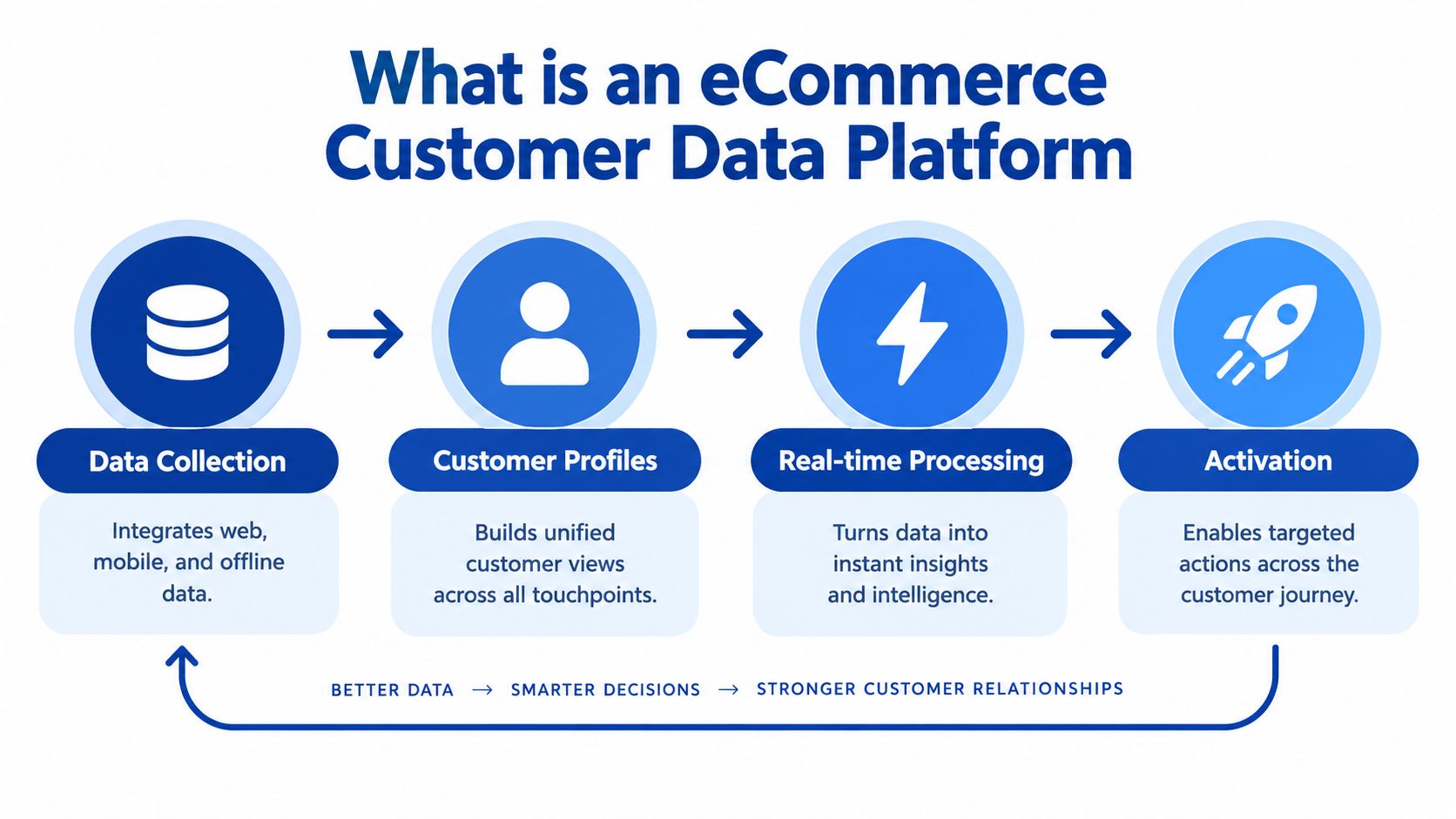
The workflow is straightforward on paper and demanding in practice. Data is collected from multiple sources, identities are matched, duplicates are removed, and the resulting profile is made available for segmentation or activation. Canadian market definitions for CDPs reflect that same pattern, with platforms described as tools that collect and unify customer data from online and offline sources, apply identity resolution, and activate those profiles in other systems.
A practical rule helps separate CDP marketing from CDP value. If your records cannot answer whether a web visit, mobile session, and transaction belong to the same person, the profile is still incomplete.
For merchants comparing vendors, the CartBoss customer data unification guide is a useful reference because it keeps the concept grounded in day-to-day operations. The better platforms centralise information and make it usable, but that benefit only holds if the data model, integrations, and governance fit the business. For a Canadian operation, I would treat cross-channel identity, privacy handling, and integration effort as the first filters, because a platform that looks elegant in a demo can become a cost centre once it meets real store, email, support, and fulfilment systems.
Core Capabilities and Architecture Explained
A CDP earns its keep through three capabilities that sound technical but map neatly to everyday ecommerce work. First is identity resolution, which links emails, device IDs, account logins, and purchase records to one person. Second is ingestion, which pulls data in from the tools you already use. Third is activation, which sends the resulting audience or profile back into marketing, service, and commerce systems.
Identity resolution without the guesswork
Many implementations go wrong. Teams assume that a larger pile of data automatically creates a better profile, but dirty data just creates a bigger mess. If a customer appears as one record in Shopify, another in Klaviyo, and a third in support chat, the platform needs rules for matching and deduping those identities before anyone can trust the output.
That trust matters because Canadian businesses are increasingly storing customer data in off-site third-party services, a shift that makes governance and identity consistency more important, not less. The same research also tracked third-party customer-data storage as a key metric in Canada's retail digitisation market, which tells you how directly architecture choices affect ecommerce operations.
Ingestion and activation in the real stack
A useful architecture does not sit above the stack; it connects into it. Shopify notes that eligible Shopify Plus stores in the US or Canada using Shopify Payments can also use Shopify Audiences to activate data without building a separate CDP for every use case. That is not a universal answer, but it does show why architecture decisions should start with the tools already in place.
A second lens is customer journey analysis. A practical guide to customer journey analytics 2026 helps frame the same issue from the measurement side, because a CDP is only useful when the data can be read and acted on in time.

A good architecture lowers the number of manual joins your analysts need to perform. A bad one just hides the same broken data in a nicer interface.
For Canadian teams, the key question is whether the platform can ingest, resolve, and activate without creating a second engineering backlog. If it can't, the architecture is too expensive for the value it claims to provide.
Business Benefits and ROI for Merchants
A CDP pays off when it changes what customers experience and what the team can measure. In Canadian ecommerce, that matters because shoppers respond to relevant offers, local signals, and clear use of their data. Canada's trade guidance says one in five Canadian customers is willing to spend 20% more for personalised products, and 42% of those customers want the customisation guided by the company. That is a practical signal for merchants weighing whether the cost of a CDP can be justified by better conversion and basket value.
Personalisation that respects context
Personalisation only works when the underlying profile is dependable. If a shopper prefers Canadian products, moves between devices, and responds differently by region, the platform has to keep those signals usable for email, paid media, and onsite merchandising. The same trade source notes that 68% of Canadian consumers prefer Canadian products while shopping online and offline, which makes localisation and preference capture operational inputs, not cosmetic fields.
That is why ROI should begin with segmentation quality, not campaign polish. When the store can identify repeat buyers, high-intent browsers, and dormant customers accurately, the downstream gains show up across channels. Email becomes more relevant, paid spend reaches tighter audiences, and onsite content stops wasting attention on the wrong visitor. For teams building the case internally, a practical overview like AI-driven ecommerce analytics and sales growth in Canada helps frame how better data use can support revenue without turning every campaign into a manual exercise.
What merchants gain
A well-run CDP usually improves three areas at once:
Revenue quality: Better targeting increases the chance that offers reach the right buyer.
Retention: Unified profiles make it easier to recognise returning customers and reduce repetitive messaging.
Efficiency: Cleaner data cuts time spent reconciling records and frees the team to ship campaigns.
The business case is stronger in Canada because the CDP market is still expanding, which suggests vendors are competing on capability and merchants are still standardising their stacks. One estimate values the Canadian market at USD 185.4 million in 2025, with a projection to USD 1,158.1 million by 2034 at a 21.89% CAGR from 2026 to 2034. Another estimate places the market at USD 806.2 million in 2025, projecting USD 2,770.9 million by 2030 at 28.0% CAGR. The scopes differ, but the direction is the same; CDPs are moving into core infrastructure.
ROI rule: if the platform does not improve audience quality, activation speed, or governance, it is not paying for itself; it is just adding another bill.
A practical ROI model should compare platform cost with the value of better segmentation, fewer duplicate communications, and stronger repeat purchase behaviour. That is the conversation stakeholders understand, because it ties data work directly to margin, not just reporting hygiene.
Implementation and Integration Best Practices
A CDP rollout succeeds when the team treats it like a data project with commercial consequences, not a software install. Start by auditing every source that feeds customer truth: ecommerce platform, email system, CRM, support desk, POS, loyalty engine, and any warehouse or event pipeline already in use. If the business cannot name the source of each profile field, the implementation is not ready.
Start with data you can trust
The first step is usually boring, and that is a good thing. Remove duplicate identifiers, standardise field formats, and decide which system owns which truth. If your store, CRM, and support platform all hold different versions of the same customer record, the CDP will only expose those conflicts faster.
That is also where consent discipline matters. Shopify Canada's guidance stresses collecting data with proper consent, transparency, and automated profile updates rather than merely centralising everything in one place. For Canadian merchants, that aligns with how merchants typically prefer to operate, with a defensible audit trail and fewer surprises when a customer asks how their data is used.
Phase the rollout by use case
Do not begin with every channel at once. Pick one or two high-value use cases, such as cart recovery, repeat-purchase segmentation, or service-triggered campaigns, and prove the data path end to end. Once those flows work, expand to broader orchestration.
A simple implementation pattern looks like this:
Map source systems and document fields, ownership, and consent status.
Define identity rules so the same shopper is recognised consistently.
Test one activation loop before adding more channels.
Monitor data quality continuously, because bad source data gets amplified quickly.
Set governance roles so marketing, data, and engineering know who approves changes.
If a CDP launch starts with a thousand fields and no use case, it usually ends with nobody trusting the output.
For larger organisations, a migration should also account for the current stack and the team's actual bandwidth. A useful internal reference on integration planning is ecommerce integration for customer journey, because CDP success depends as much on connective tissue as on the platform itself. A clean implementation is usually the one with fewer moving parts, not the one with the most dashboards.
Selecting the Right Vendor and Tools
Vendor choice should begin with operational fit, not feature lists. Canadian ecommerce teams often need a platform that works with Shopify, existing marketing tools, and privacy requirements without demanding a full re-architecture. RevenueBase's listings suggest the local ecosystem is already deep, with 248 customer analytics platforms headquartered in Canada and 95 ecommerce analytics platforms headquartered in Canada identified as of September 2026. That means the challenge is selection, not scarcity.
What to compare first
Focus on the criteria that affect day-to-day execution:
Integration depth: Can the platform connect to your store, CRM, support tools, and ad channels without custom work every time?
Identity logic: Does it handle duplicates, anonymous sessions, and cross-device matching in a way your team can explain?
Activation speed: Can marketers use the output quickly, or do they wait on engineering for every audience?
Governance: Can you control consent, retention, and access without building separate workflows?
Support model: Will the vendor help your team during migration, or leave you with documentation and a ticket queue?
Match the tool to the operating model
Shopify's own guidance makes one useful point clear: not every business needs to buy a standalone CDP if the ecosystem already covers the use case. For smaller merchants, lighter tooling can be enough when the data model is simple, and the team needs speed more than orchestration depth.
For more complex stacks, a deeper platform may be justified. Cleffex Digital Ltd also works on ecommerce systems that integrate inventory, payments, logistics, and customer data, which is relevant when the customer profile has to sit alongside operational commerce data rather than live in a silo. The right choice is the one that fits the organisation's data maturity, not the one with the longest feature page.
Next-gen ecommerce software thinking is worth reviewing if your team is comparing tools against broader commerce architecture rather than a single campaign need. The strongest vendor is usually the one that reduces manual work while still leaving you room to grow.
Compliance, Measurement, and Next Steps
A CDP project lives or dies on trust. In Canada, privacy rules and consent expectations shape how customer data can be collected, stored, and activated, so the platform must support governance rather than work around it. GDPR still matters for merchants serving European audiences, but local teams should also be clear on Canadian consent handling, retention policy, and access controls.
What to measure
Measurement should be simple enough that the team uses it. Track whether profile matches are improving, whether audiences are moving into campaigns faster, and whether key segments are producing better commercial outcomes than before. If activation takes too long, or if the same customer still receives inconsistent messaging, the platform is not delivering value.
A sensible KPI set includes:
Match quality, so you know whether profiles are becoming cleaner.
Activation latency, so you can see whether audiences are usable in time.
Segment performance, so you can compare targeted campaigns against generic ones.
Governance incidents, so you can spot consent or data-handling issues early.
Next steps by team type
SMBs should start with one business problem, not the whole data estate. Enterprises should align marketing, engineering, legal, and analytics before the first integration goes live. Agencies should evaluate whether the client needs a full CDP, a narrower integration layer, or a phased build that sits inside the existing stack.
For Canadian operators, a mature ecommerce Customer Data Platform is less about collecting more data and more about using the right data with confidence. That is why data quality, consent, and activation design have to be measured together rather than treated as separate workstreams.
Frequently Asked Questions
What is the difference between a CDP and a CRM?
A CRM is built to manage known relationships, deals, support, and communication history. A CDP is built to unify behavioural, transactional, and identity data into a profile that can power segmentation and activation across marketing channels. Many retailers use both because they solve different problems.
Is a CDP necessary for a small ecommerce store?
Not always. If the tech stack is simple and the team only needs basic segmentation, lighter integrations may be enough. A CDP becomes more useful when customer data is spread across multiple systems and manual matching starts slowing campaigns down.
How long does it take to see value?
That depends on the number of source systems and the cleanliness of the data. Teams usually see value first in better segmentation and fewer duplicate journeys, then later in broader governance and personalisation improvements.
What should Canadian merchants watch for?
Consent handling, identity matching, and data residency decisions matter more than feature hype. The platform should support transparent collection, reliable profile updates, and a governance model your team can maintain.
Can a CDP work with Shopify?
Yes, and Shopify's own documentation shows that some merchants can activate customer data through adjacent tools without building everything from scratch. The right path depends on how complex the data environment is and how much control the team needs.
Cleffex Digital Ltd helps ecommerce teams design systems that connect customer data, commerce operations, and marketing workflows without adding unnecessary complexity. If you're planning a CDP rollout or trying to unify fragmented customer records, visit Cleffex Digital Ltd to discuss how a practical integration approach can support your ecommerce growth.