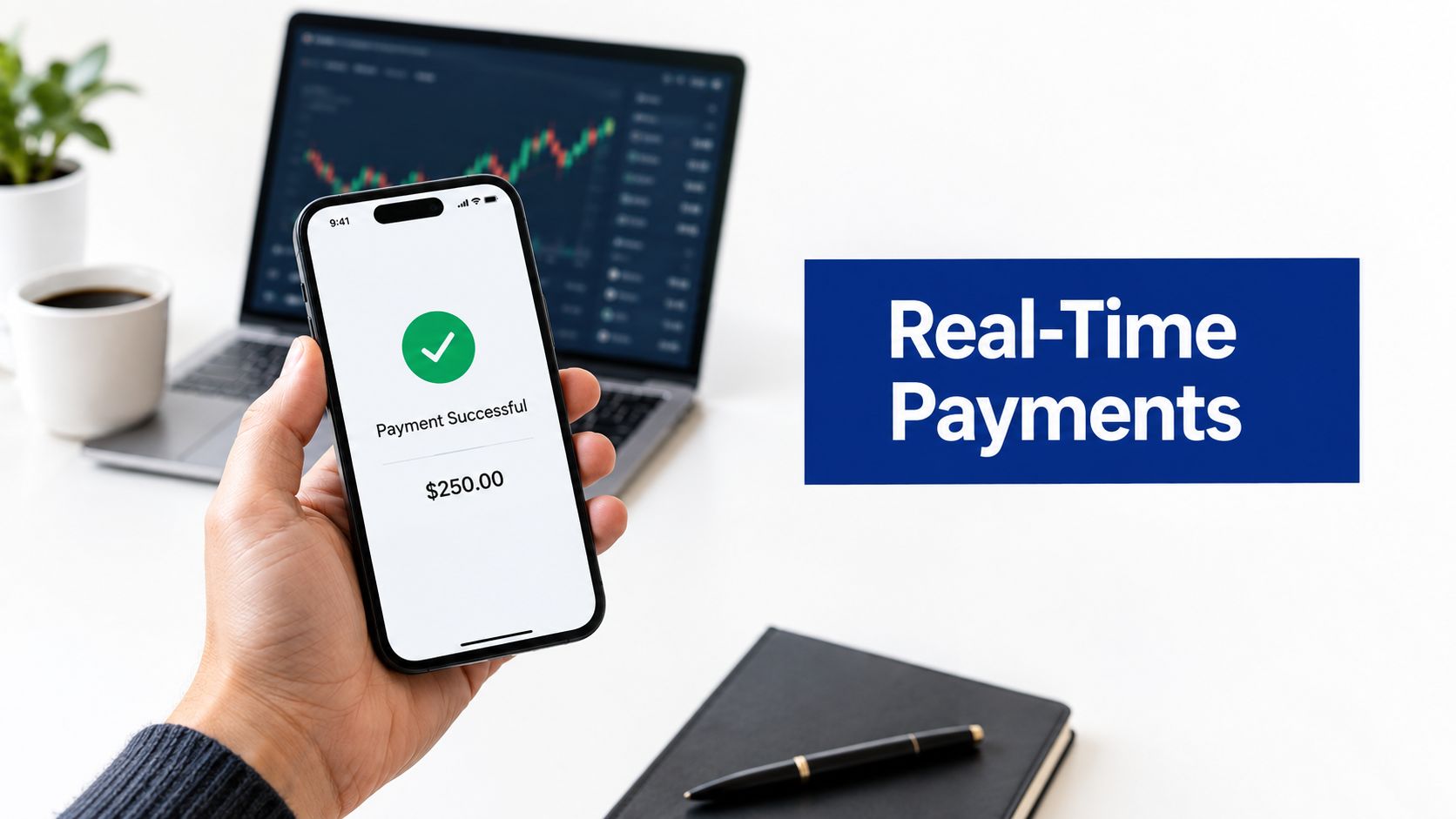


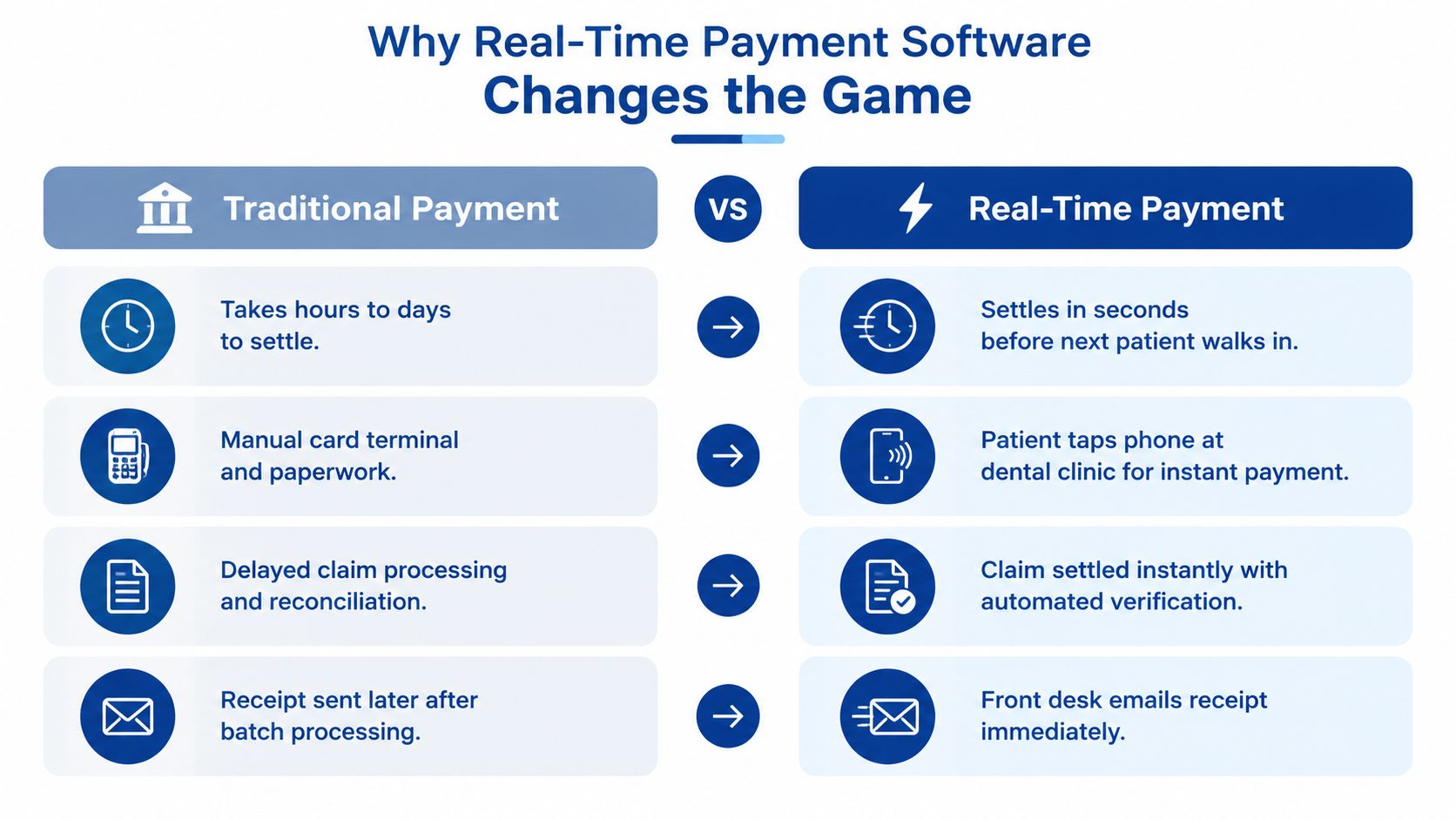
A patient taps a phone at a dental clinic. The payment confirmation reaches the front desk before the next patient sits down, and the receipt is emailed without waiting for an end-of-day file. The same pattern could help an insurer release an approved claim, a healthcare provider close a visit, or a merchant confirm an account-to-account payment while the customer is still at the checkout.
That experience depends on more than a fast button. Real-time payment software coordinates payment initiation, message validation, routing, fraud checks, clearing, settlement, reconciliation, and notifications under strict timing constraints. In Canada, those constraints are becoming concrete through the planned Real-Time Rail, which Payments Canada describes as a new national real-time exchange and clearing and settlement system, with a planned launch in Q4 2026.
This guide explains the technology behind faster financial transactions, using Canada's RTR as the reference point. It focuses on the engineering decisions that determine whether “instant” works reliably in production, not just in a product demo.
Why Real-Time Payment Software Changes the Game
Traditional payment systems often make the customer wait while several organisations process the same transaction in sequence. A card terminal can approve an authorisation quickly, but final settlement and reconciliation may happen later. Batch-based bank transfers collect instructions for scheduled processing, while wire payments commonly depend on operating windows and manual controls.
Real-time payment software changes the operating model. It acts as the orchestration layer that accepts a payment instruction, validates it, routes it to the appropriate participant, sends the required messages, monitors status, and records the result. The objective isn't merely to show a successful screen quickly. The funds must move through the relevant clearing and settlement process, with the receiving party able to use them within the rail's rules.
Canada already has a familiar real-time payment experience through Interac e-Transfer, which has existed since 2002. The upcoming RTR is positioned as a next-generation national rail rather than a simple replacement for the entire ecosystem. Industry data cited by ACI Worldwide records 1.2 billion real-time transactions in Canada in 2023, showing that businesses and consumers already use instant-style payments at meaningful scale.
Why timing changes business operations
Payments Canada says the RTR is designed to support payments 24 hours a day, 7 days a week, 365 days a year, including weekends and statutory holidays. That availability changes what a business can promise its customers.
A successful payment can trigger an automated receipt, update an invoice, release a claim, or confirm a booking without waiting for a later processing cycle. Finance teams can also work from a settled transaction record instead of maintaining a large queue of pending items.
Practical rule: Faster payment processing only creates value when the surrounding workflow is fast enough to use the result.
The change also introduces responsibility. A payment that settles finally and irrevocably can't be treated like a card authorisation that may be reversed through an ordinary chargeback process. The software must make the status clear, preserve the payment data, and support appropriate fraud and exception controls before settlement occurs.
How Real-Time Payment Rails Differ Around the World
A payment rail is shared infrastructure that lets financial institutions and payment providers exchange payment instructions under common rules. It covers participation, message formats, routing, clearing, settlement, status handling, and operational controls.
The distinction matters because a payment app is not a rail. An app or API provides a connection to one or more rails. The rail determines what participants can send, how the receiving institution responds, and when the transfer becomes final.
Markets have built different schemes for this purpose. The United States has The Clearing House RTP network, the United Kingdom operates Faster Payments, India uses systems including UPI and IMPS, Europe supports SEPA Instant Credit Transfer, Singapore uses PayNow, and Brazil operates PIX. Their governance, access models, account addressing, and settlement arrangements vary, so software serving multiple markets needs a corridor-aware design rather than one universal payment flow.
Canada's Real-Time Rail provides a useful reference point. The Bank of Canada describes the RTR as Canada's first real-time payment system, designed to let businesses and consumers send and receive payments continuously. Payments Canada says the RTR will support instant, irrevocable, data-rich payments using ISO 20022 for all transactions.
ISO 20022 as a common payment grammar
ISO 20022 works like a shared payment grammar. Instead of sending a short instruction with loosely formatted text, a message can carry defined fields for the payer, payee, amount, purpose, invoice reference, and remittance details.
Structured data lets each system read the same information consistently. A reconciliation engine can match an invoice reference to an incoming payment without asking staff to interpret free text. Compliance software can inspect payment fields, while an ERP can retain the reference for reporting.
Settlement finality also needs a clear explanation. A final payment is like handing over cash at the counter: once the rail settles it, the sender cannot treat it as a temporary authorisation that will normally reverse through a card chargeback. Software therefore needs to show status accurately and apply fraud and exception checks before settlement.
The global market is a collection of connected but separate rails, not one worldwide network. Businesses working across borders need to account for each corridor's message rules, participants, addressing, and settlement process. Practical implementation considerations appear in this resource on instant cross-border payments for SA businesses.
Global real-time payment rails at a glance
| Rail | Country | Message standard | Settlement window | Participation model |
|---|---|---|---|---|
| RTP | United States | Scheme-supported structured messaging | Real time | Financial institutions and eligible participants |
| Faster Payments | United Kingdom | Scheme-supported payment messaging | Real time | Member institutions and indirect participants |
| UPI and IMPS | India | Scheme-specific and structured payment messaging | Real time or near real time, depending on service | Banks and payment service providers |
| SEPA Instant Credit Transfer | Europe | ISO 20022 | Instant under scheme rules | Participating payment service providers |
| PayNow | Singapore | Scheme-supported structured messaging | Real time | Participating banks and payment institutions |
| PIX | Brazil | Scheme-supported structured messaging | Real time | Participating financial institutions and payment providers |
| RTR | Canada | ISO 20022 | Exchange, clearing, and settlement within 10 seconds, with funds available to the payee within 60 seconds | Direct and indirect settlement participants |
The RTR target makes architecture decisions concrete. Validation, fraud screening, routing, ledger posting, and customer confirmation must be prepared to run within the payment's short operating window. “Instant” describes the rail's processing objective, not a promise that every business workflow, review queue, or external system will respond immediately.
How Real-Time Payment Architecture Works
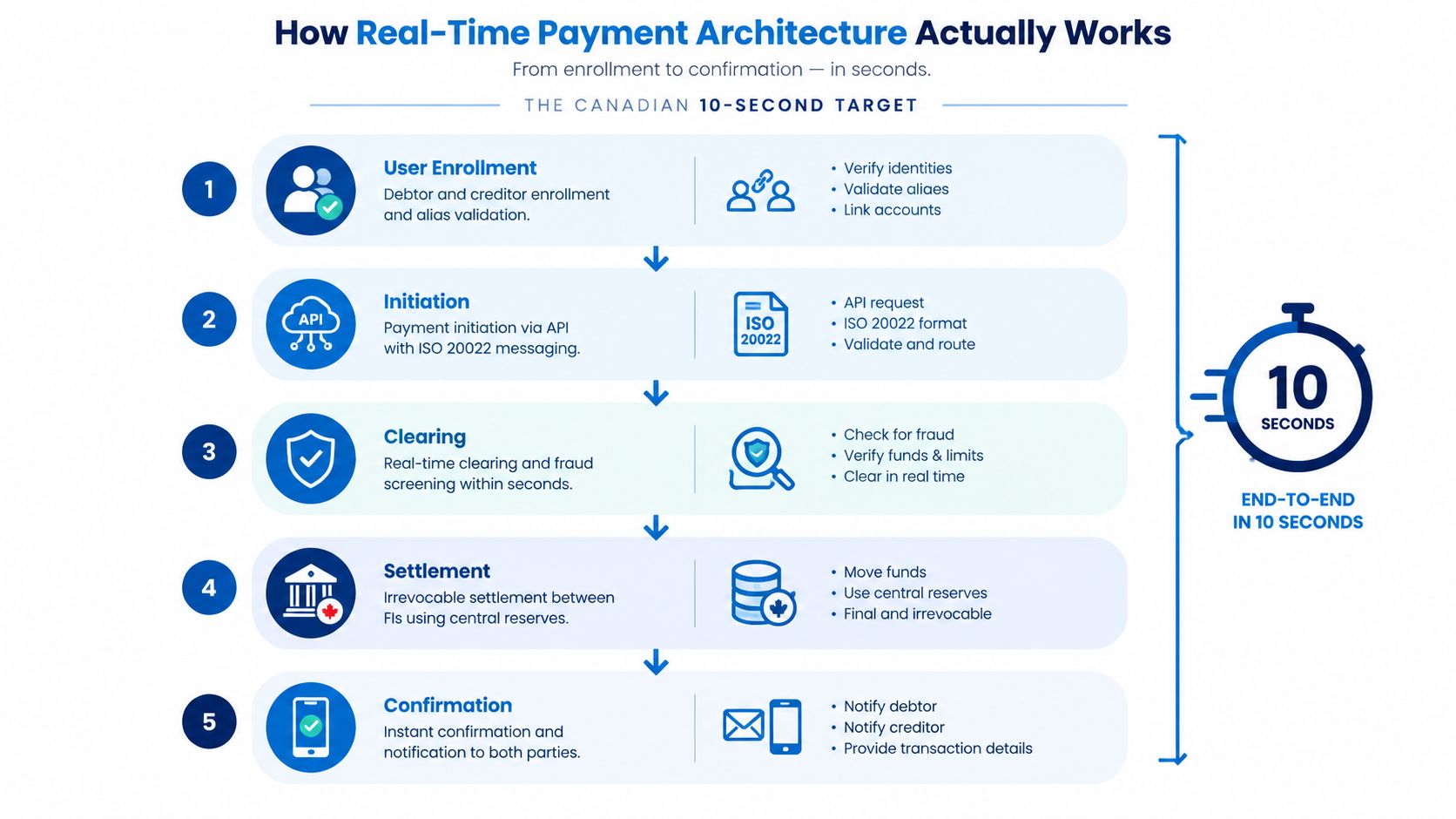
A customer confirms a payment, yet several systems must coordinate before the recipient can use the funds. Canada's RTR design separates the customer-facing orchestration layer from the rail's exchange, clearing, and settlement functions. The RTR Exchange handles payment messages, while RTR Clearing and Settlement moves money on the books of the Bank of Canada, as set out in the Canada Gazette RTR framework.
The interface may show one button. The architecture must complete a sequence of checks and state changes within a short operating window.
Five layers in the transaction path
Enrollment and address resolution: The platform validates the debtor, creditor, account details, and any alias or directory data. A syntactically valid API request must still be stopped if it points to the wrong destination.
Initiation and message construction: The application creates a structured ISO 20022 message. Payment initiation and status messages can use formats such as pain.001 and pain.002, while inter-financial-institution messages use the relevant pacs family. ISO 20022 works like a shared form with named fields. Preserving those fields lets downstream systems read amounts, parties, references, and status without interpreting free text.
Transport and exchange validation: Secure channels carry the message to the exchange. The exchange checks its format, participant status, routing details, and scheme rules before forwarding the instruction toward clearing and settlement.
Clearing and settlement: The clearing and settlement component moves funds between participant settlement accounts. Settlement becomes final and irrevocable when funds move between settlement accounts at the Bank of Canada. That is different from an accepted instruction or a successful API response. The money movement itself is the final event.
Confirmation and downstream posting: The platform receives status information, updates its internal ledger, posts the invoice or claim, and notifies the payer and payee. These records must remain traceable if a notification service is temporarily unavailable.
What the ten-second target forces
Payments Canada materials describe an RTR objective of exchanging, clearing, and settling an initiated payment within 10 seconds, with funds available to the payee within 60 seconds, as discussed in Blake's analysis of the RTR participation guide. The clock covers more than network travel. Fraud controls, sanctions checks, validation, routing, ledger updates, and exception decisions all use part of it.
Software teams therefore need asynchronous processing, controlled queue depth, fast data access, and deliberate retry behaviour. Idempotency prevents a retry from creating a second payment. A unique idempotency key can be assigned to each instruction. Services record that key and its current state, check for duplicates before posting, and emit events with a correlation identifier. If the response disappears after settlement, the client can request status instead of sending the payment again.
Testing must include realistic bursts rather than a quiet sandbox. Guidance on monitoring TPS in testing helps engineers generate load, observe latency, and locate bottlenecks without treating throughput as proof of settlement performance. Teams evaluating scalable fintech platform development should apply the same discipline to queues, retries, and failure handling. In production, “instant” means the critical path behaves predictably, including when a dependency fails.
Core Features Every Modern Platform Must Deliver
A production-grade real-time platform must do more than accept a payment request. For Canada's upcoming Real-Time Rail, the 10-second settlement target makes every handoff visible. Validation, risk decisions, routing, ledger posting, notifications, and exception handling must fit a tightly controlled path.
Finality, data, and reconciliation
Settlement finality is the point at which the rail has completed the movement of funds between participant settlement accounts. It works like a receipt stamped “completed,” not a promise that the payment may settle later. The platform must distinguish that state from authorisation, a pending instruction, a rejected message, or an administrative adjustment.
The reconciliation engine should consume structured payment and status messages, match them with internal invoices or claims, and retain the original references. ISO 20022 works like a shared form with labelled fields. Rich remittance information and structured data help systems interpret the payment consistently, provided middleware does not flatten the message into unstructured text.
A reconciliation service should:
Match by stable references: Connect payment identifiers, invoice references, customer accounts, and settlement records.
Track every state: Record received, validated, sent, accepted, settled, rejected, and exception statuses.
Separate exceptions: Send duplicates, invalid accounts, fraud holds, and technical timeouts to distinct queues.
Support audit review: Export the instruction, decisions, messages, and final outcome as one history.
Risk, APIs, and operational visibility
Instant settlement leaves little time for investigation. Fraud controls should run during initiation, using behavioural signals, sanctions screening, payment metadata, velocity rules, and configurable step-up decisions. The policy must state what happens if a risk service is slow or unavailable, because waiting indefinitely can threaten the 10-second objective.
A practical payment API usually supports fee or quote information, initiation, status retrieval, and permitted cancellation or exception workflows. Idempotency keys, signed webhooks, replay protection, and SDKs help client systems avoid duplicate payments and reject unverified callbacks.
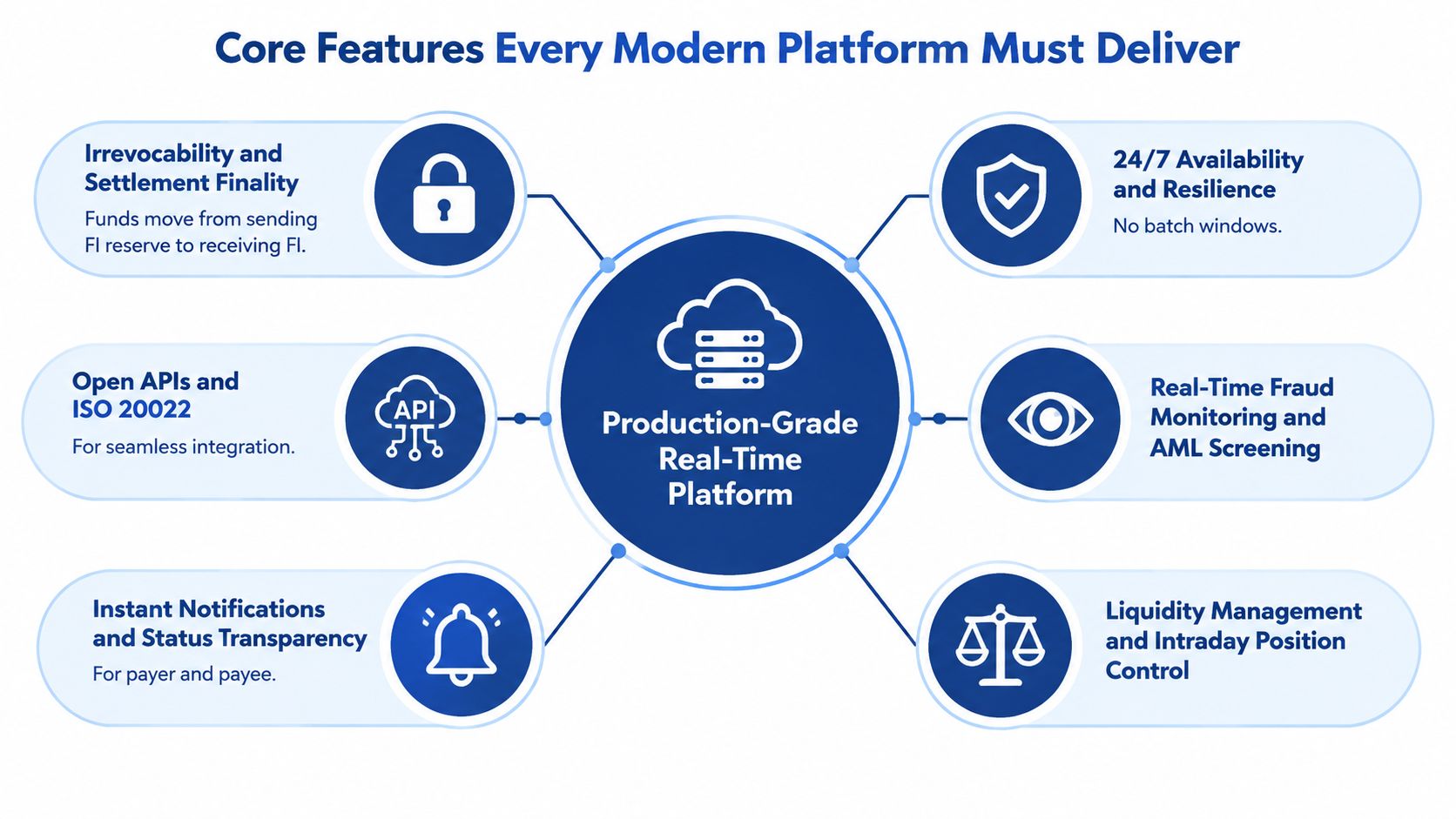
Dashboards should show latency, rejection reasons, settlement confirmation, queue depth, fraud decisions, and notification delivery. Observability isn't decoration. It provides evidence that the payment met the rail's timing requirement and identifies the stage that introduced delay.
For a practical view of connecting payment events with business outcomes, conversion payment tracking provides relevant context. Teams defining controls can also review guidance on building a payment fraud detection system.
Integration Patterns and Vendor Selection
A business can connect to a real-time rail through several participation and integration models. The choice depends on transaction volume, regulatory duties, treasury needs, technical capacity, and the control the organisation requires.
Direct participation connects an institution to the scheme through its own eligible arrangement, often with a sponsoring or settlement bank where required. It offers greater control over routing, liquidity, settlement reporting, and operational policy. The organisation also takes on certification, testing, monitoring, compliance, and support responsibilities.
Indirect participation uses an aggregator, processor, or banking partner that already accesses the rail. This can shorten implementation for a small or mid-market business, while reducing control over scheme configuration, data handling, incident response, and settlement reporting.
API-led and file-based integration
API-led orchestration supports request-response calls, event streams, and webhook callbacks. It fits customer journeys that need a fast payment status, such as a claim portal or point-of-service collection. Because Canada's Real-Time Rail targets settlement within 10 seconds, the application must handle timeouts, retries, and status changes without treating an unanswered request as a failed payment.
File-based integration remains useful during migration or for legacy enterprise resource planning systems. Scheduled ISO 20022 XML or CSV exchanges can fit established finance operations, but their timing conflicts with an interactive payment experience. ISO 20022 works like a shared form. It gives banks and software systems named fields for parties, amounts, and remittance details, while settlement finality tells the business when the transfer is complete and should no longer be treated as pending.
| Integration Model | Best Fit | Typical Vendor Type | Trade-off |
|---|---|---|---|
| Direct scheme connection | Financial institutions and businesses needing control | Scheme-native provider or sponsoring bank | More control, more certification and operational responsibility |
| Indirect aggregator connection | SMEs and mid-market firms seeking faster entry | Fintech orchestration layer or processor | Simpler access, less control over underlying participation |
| API-led integration | Customer-facing applications and automated workflows | Payment API provider or orchestration platform | Strong real-time experience, requires event and error design |
| File-based integration | Legacy finance and batch-compatible operations | Core banking or enterprise software vendor | Familiar operations, weaker fit for instant user journeys |
Vendor assessment should cover sandbox quality, message-validation coverage, settlement-confirmation detail, uptime commitments, scheme coverage, fraud tooling, and ISO 20022 support alongside legacy formats. Testing and certification support should receive its own score. Production access requires more than a working API. Teams must prove that messages, operational procedures, monitoring, and exception handling meet the rail's rules.
Ask how the vendor represents each state: accepted, rejected, settled, timed out, or under investigation. Clear states help customer and finance systems act on settlement finality rather than display a vague “processing” message.
Organisations planning custom workflows can review custom fintech software development before choosing between a configurable product and a bespoke platform.
Sector Use Cases in Insurance, Healthcare, and Merchants
An insurance claims platform receives a first-notice-of-loss event. It checks the policy, validates the approved amount, applies fraud and compliance rules, and initiates a structured payment with remittance information that identifies the claim. If the payment is accepted and settled, the policyholder can receive confirmation without waiting for a cheque cycle or a later batch run.
The claims team still needs safeguards. A fast rail doesn't remove coverage disputes, identity checks, policy exclusions, or fraud investigations. The software should keep the claim decision, payment instruction, settlement status, and customer notification connected in one audit trail.
A healthcare clinic can use the same pattern at the point of service. The patient authorises a co-pay or deductible through a connected account or wallet, the payment platform processes the instruction, and the clinic's billing system receives a status event. The encounter can then move towards closure without a staff member checking a separate banking portal.
That workflow depends on clean identity and account data. A rejected payment, a delayed insurer response, or an unavailable fraud service still needs a visible exception state rather than an ambiguous “processing” message.
For merchants, account-to-account payment confirmation can change checkout design. The customer completes the payment, the merchant receives a status response, and the order system can release the goods based on the result. That differs from treating a card authorisation as the end of the financial workflow.
Where instant payments don't remove friction
Refunds, disputes, mistaken payments, customer verification, and account recovery still require policies and operational work. Settlement finality can make error prevention more important because the business can't assume that an ordinary reversal process will resolve every problem.
The strongest use cases connect real-time payments to an existing business event. A claim becomes payable, a clinic visit closes, or an order becomes fulfilable. Speed matters, but the surrounding data and controls determine whether the result is useful.
Costs, ROI, and the Business Case for Instant
A business case for real-time payment software begins with the current process. Map payment initiation, gateway or processor charges, integration work, ISO 20022 translation, fraud services, reconciliation, support, exception handling, and treasury operations. The goal is to see which costs instant processing removes and which it creates.
Measure the return through operating evidence. Useful indicators include manual reconciliation cases, time spent investigating pending payments, effort required for claim disbursements, funds tied up between approval and settlement, failed-payment support contacts, and the share of customers who complete an instant journey successfully.
Cost versus return
| Cost Component | Typical Range | Offsetting ROI Driver | Measurable Impact |
|---|---|---|---|
| Scheme and processing fees | Varies by provider and arrangement | Lower manual handling and faster funds availability | Cost per settled transaction and processing effort |
| Integration engineering | Depends on legacy systems and API scope | Automated initiation, status, and reconciliation | Delivery effort, defect volume, and support workload |
| ISO 20022 translation | Depends on message coverage | Better structured remittance and fewer matching exceptions | Auto-match rate and unresolved-item queue |
| Fraud and AML tooling | Depends on risk model and service design | Fewer preventable losses and safer instant approvals | Fraud review volume, blocked-risk payments, and confirmed losses |
| Ongoing reconciliation | Depends on transaction complexity | Reduced end-of-day backlog | Reconciliation cycle time and aged exceptions |
| Liquidity operations | Depends on settlement model | Earlier visibility of cash position | Intraday funding actions and idle balances |
Canada's RTR target of 10 seconds for exchange, clearing, and settlement turns speed into an operational test. A finance team can track how many transactions meet the target, how many are stopped by fraud review or technical timeouts, and when the payee can use the funds. The target describes rail performance, not necessarily the time required for every business process around it. A payment may settle quickly while internal approval, account posting, or exception handling remains unfinished.
That distinction affects software design. The platform needs timestamps and status states that separate an instruction awaiting review from a rejected payment, a settled transaction, and funds that the recipient can use. Without those states, a dashboard can show “instant” while operations still depend on manual investigation.
Breakeven depends on volume and control requirements. At lower volumes, an aggregator may cost more per transaction but avoid scheme integration overhead. At higher volumes, direct participation or a controlled orchestration arrangement may become attractive. Model both routes with the organisation's transaction count, average handling time, fraud-review workload, settlement reporting needs, and engineering capacity. Use internal operating evidence rather than a generic ROI percentage.
A Practical Evaluation Checklist and Next Steps
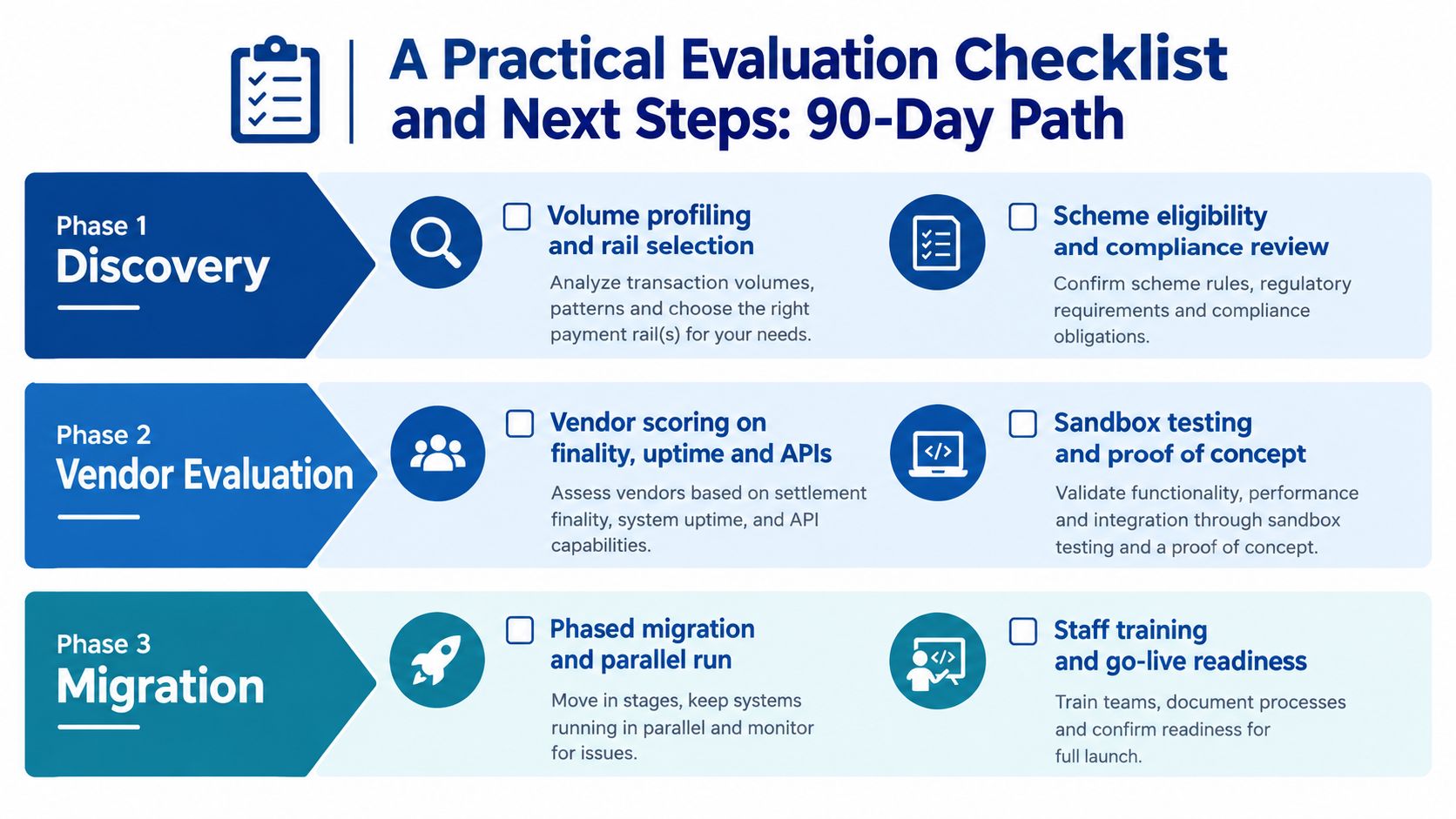
A 90-day evaluation can support a decision without committing the organisation to a full migration. It should produce tested evidence, a control model, and a cutover plan tied to the RTR's 10-second target. That target covers exchange, clearing, and settlement. It does not guarantee that internal approval, ledger posting, fraud review, or exception handling finishes within the same window.
Phase one focuses on discovery
Profile payment volumes, payment types, corridors, customer journeys, exception categories, and reconciliation delays. Select a use case with a clear business event, such as an approved claim or a completed clinic visit. Record the timestamps that matter: instruction received, review completed, payment submitted, settlement confirmed, and funds made available.
Check scheme eligibility, participation arrangements, testing duties, and approval or suspension procedures under the RTR rules, as noted earlier. Separate rail requirements from the organisation's own controls so the evaluation does not treat a fast settlement as a complete business process.
Phase two tests vendors and controls
Score shortlisted providers against:
Scheme access: Confirm participation arrangements and regulatory responsibilities.
Message capability: Test ISO 20022 validation, structured remittance, status messages, and legacy coexistence. ISO 20022 works like a shared label system, giving systems consistent fields for who is paid, why, and how the payment should be handled.
Finality handling: Verify distinct states for pending, rejected, settled, and irrevocable outcomes. Settlement finality resembles handing over cash at a counter: once the rail confirms the exchange, ordinary processing cannot recall it.
API completeness: Review initiation, status, webhooks, idempotency, authentication, and replay controls.
Operational evidence: Inspect settlement reports, audit exports, monitoring dashboards, and incident procedures.
Fraud integration: Test sanctions screening, behavioural scoring, velocity controls, and manual review paths.
Run a sandbox proof of concept with realistic failures. Submit duplicate requests, lose responses, delay callbacks, use invalid account details, trigger fraud holds, and create reconciliation mismatches. Check whether the platform preserves one transaction identity across retries and shows operators what action is safe.
Phase three pilots the migration
Start with a limited use case and run the new workflow alongside the legacy process where controls permit. Compare internal ledger records, settlement reports, notifications, and exception queues before expanding. Define rollback and support ownership before the first live payment.
Frequently Asked Questions
Is a settled real-time payment reversible?
A settled RTR payment is designed to be final and irrevocable when funds move between participant settlement accounts. Prevention, fraud controls, payer confirmation, and pre-settlement review therefore matter more than assuming every error can follow a card chargeback process.
How should a platform handle disputes?
Keep payment settlement separate from the commercial dispute. Preserve the settlement record while the business manages refunds, service disputes, fraud investigations, or contractual remedies through controlled workflows.
Should legacy batch processing be removed immediately?
No. Use a phased migration with reconciliation checks, operational training, fallback procedures, and measured expansion. Retire the legacy path only after the new workflow consistently handles success, failure, timeout, duplicate, and exception states.
Cleffex Digital Ltd develops custom fintech software and banking API integrations for regulated financial services, including payment initiation, financial platform architecture, and workflow automation. Organisations assessing real-time payment software for insurance, healthcare, or merchant operations can visit Cleffex Digital Ltd to discuss architecture, integration, and a pilot path.