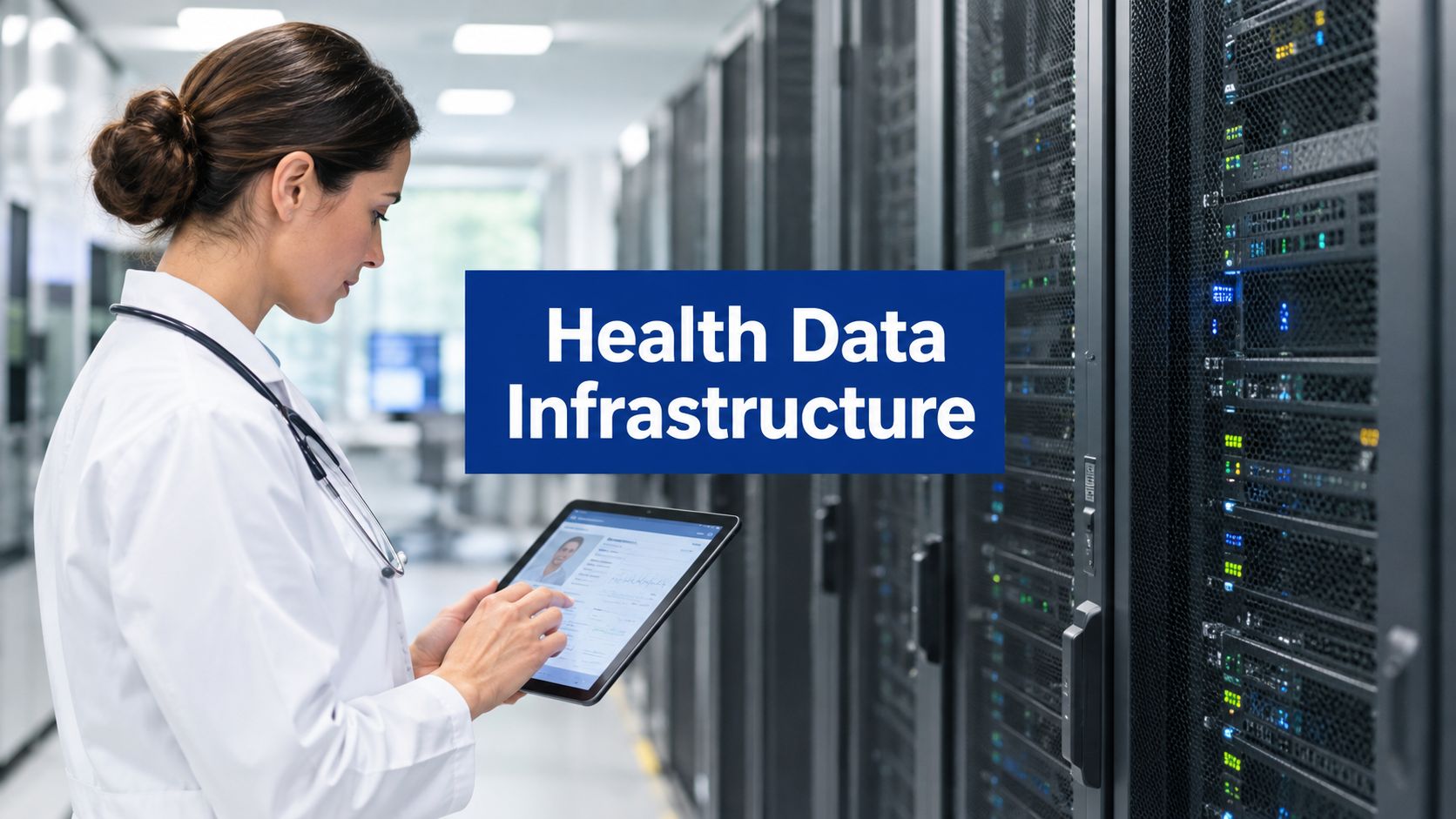


The most popular advice on AI readiness is backwards. Healthcare organisations are often told to start by choosing a model, a cloud provider, or an impressive clinical use case. In production, the harder problem usually sits underneath the algorithm: incomplete records, inconsistent coding, unclear consent, disconnected systems, and data pipelines nobody can confidently monitor.
That's why digital health infrastructure matters more than a promising pilot. Canada's provider-side foundation has matured significantly. Only 36% of Canadian physicians used electronic medical records in 2009, while regular EHR use reached 95% in 2024, according to the 2026 report on Canada's EHR journey. Yet patient access remains uneven. In 2025, 69% of Canadians could access at least one type of electronic health information, but only 13% had online access to all core components of their records.
The lesson is direct. Healthcare AI infrastructure must connect trustworthy data, enforce appropriate access, support clinical workflows, and prepare people to use automated outputs safely. Without those foundations, every new AI project adds another fragile integration and another governance liability.
Why AI Readiness Is Really a Data Plumbing Problem
Healthcare leaders often treat AI readiness as a vendor-selection exercise. They compare model accuracy, review demonstrations, and ask whether a platform supports generative AI or predictive analytics. Those questions matter, but they come too late if the organisation can't establish which patient record is authoritative, whether the data is current, or whether the intended use is permitted.
The most common failure pattern isn't a poor algorithm. It's an unreliable input. A model may receive laboratory results in different formats, medication codes that vary between sites, duplicated patient identities, or clinical notes with no dependable structure. A team can tune the model repeatedly and still fail to produce a safe, repeatable service because the underlying feed changes without warning.
Why isolated pilots create lasting problems
A pilot can hide infrastructure weaknesses because people compensate manually. Analysts clean files by hand, clinicians validate outputs informally, and technical staff repair a broken interface when it fails. That approach may demonstrate a concept, but it doesn't create an operational service.
Once the organisation adds another hospital, clinic, insurer, or data source, those workarounds become technical debt. Each new point-to-point connection introduces another transformation rule, another access decision, and another place where a consent restriction can be missed.
Practical rule: If the team can't explain where a data element came from, how it was transformed, and who can use it, the organisation isn't ready to put an AI decision into a clinical workflow.
Canada's progress illustrates the distinction between adoption and connection. Provider systems are now embedded in medical practice, following sustained public investment that included federal support through Canada Health Infoway for EHR infrastructure development. But patient-facing access and interoperability remain incomplete, which means a healthcare organisation may have extensive digital records without having a reliable, permission-aware data network.
The production question leaders should ask
Before approving an AI pilot, ask whether the proposed pipeline can answer five operational questions:
Source: Which system created the data, and which system owns corrections?
Freshness: How quickly does a new result or observation become available?
Meaning: Do all sites use the same code, unit, and clinical definition?
Permission: Can the platform enforce consent and purpose restrictions at query time?
Traceability: Can a reviewer reconstruct the data and rules behind an output?
If the answer is uncertain, infrastructure work isn't a delay. It's the actual AI readiness programme.
The Six Core Components of Digital Health Infrastructure
A useful way to understand digital health infrastructure is to treat it like a building. The foundation carries the load, the plumbing moves information, the wiring connects rooms, the locks control entry, the filing cabinets preserve records, and the control room turns information into decisions. These layers work as a stack, not as separate purchases.
The foundation and the plumbing
Cloud platforms and compute provide the base. They supply storage, processing, backup, monitoring, and the capacity to run analytics without placing every workload directly on an EHR database. Cloud design still needs residency, encryption, recovery, and workload controls. A scalable environment isn't automatically a suitable healthcare environment.
Data pipelines and ETL processes form the plumbing. They extract information from EMRs, laboratory systems, claims platforms, devices, and applications, then transform it into usable structures. Reliable pipelines validate schemas, flag missing values, preserve provenance, and expose failures to an operations team. A pipeline that drops an event without notice is more dangerous than one that stops and raises an alert.
The wiring and the locks
Interoperability APIs, including FHIR endpoints, provide the wiring. A scheduling application could expose appointment resources through a FHIR-based API, allowing a population health dashboard to retrieve relevant information without direct access to the scheduling database. HL7 interfaces may still carry messages from established clinical systems, so the integration layer must handle both established and newer exchange patterns.
Identity and access management supplies the locks. Role-based access control can give a nurse practitioner access to the clinical information needed for care, while a billing administrator receives a narrower financial and administrative view. Attribute-based rules can add context such as location, care relationship, purpose, or time-limited access.
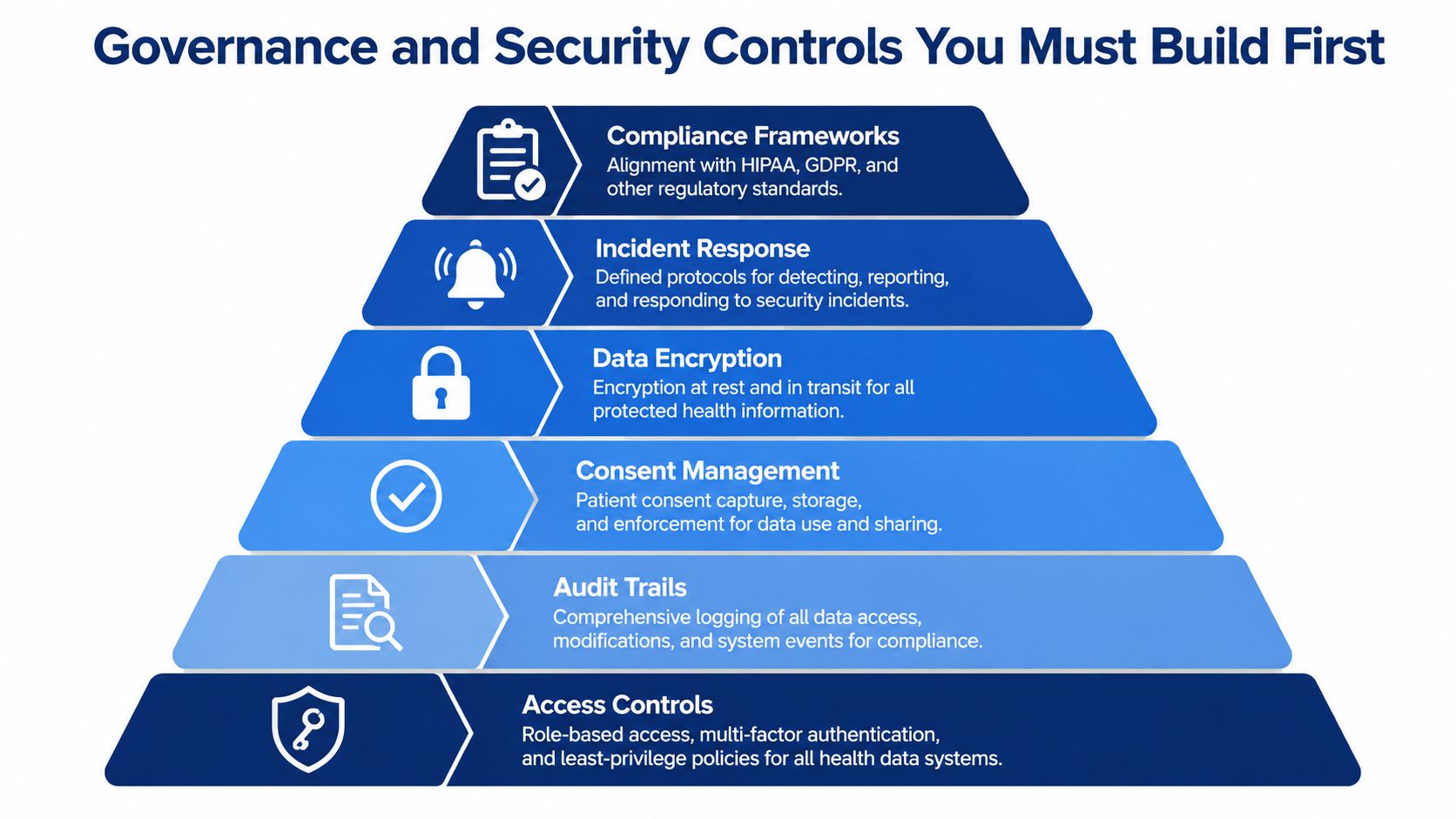
Governance and security controls should sit visibly above every technical layer:
The filing cabinets and the control room
EHR and EMR systems remain important structured data stores, but they're not automatically suitable as analytical platforms. Organisations need a clear separation between transactional clinical operations and workloads that transform, aggregate, or model data.
Analytics and AI engines make up the control room. They consume curated data, run rules or models, produce outputs, and provide monitoring for drift and unexpected behaviour. The control room must never become an uncontrolled side door into clinical records.
The most fragile points sit between layers. Authentication may work in one application but fail during an API hand-off. A transformation may change a code without recording the mapping. A model may use a data set that lacks the latest consent state. Designing the seams is more important than buying each component in isolation.
Standards and Regulations That Shape Healthcare Data Exchange
Data exchange sits at the intersection of technical standards, privacy law, security practice, and local operating rules. A healthcare organisation can implement a technically elegant interface and still create unacceptable exposure if it ignores consent, purpose limitation, retention, or patient rights.
HL7 v2 remains relevant for message-based exchange in established hospital environments. FHIR R4 is better suited to many new integration services because it represents health information as accessible resources and supports application programming interfaces. The practical choice isn't always one or the other. Production environments often need translation between legacy HL7 messages and FHIR resources while preserving meaning and provenance.
Canadian organisations must also account for federal and provincial privacy requirements. PIPEDA may apply depending on the organisation and activity, while provincial legislation such as Ontario's PHIPA can impose additional obligations. US-facing services need to address HIPAA, including the minimum necessary principle. Organisations handling information about EU residents must assess GDPR requirements, even when the technology team operates in Canada.
A Toronto-based health technology company serving Ontario clinics and US health systems therefore needs an architecture that can enforce different obligations by jurisdiction and purpose. It shouldn't rely on a single broad permission applied to every user and every data flow.
| Standard / Regulation | Scope | Primary Requirement | Applies To |
|---|---|---|---|
| HL7 v2 | Clinical messaging | Structured exchange between established systems | Hospitals, laboratories, EMR integrations |
| FHIR R4 | Modern health data APIs | Resource-based, interoperable exchange | New applications, patient portals, analytics services |
| PIPEDA | Canadian privacy | Appropriate collection, use, disclosure, and safeguarding of personal information | Applicable Canadian organisations |
| PHIPA | Ontario health privacy | Rules for personal health information and custodians | Ontario healthcare environments |
| HIPAA | US health information | Privacy, security, and minimum necessary access | US-covered entities and business associates |
| GDPR | EU personal data | Lawful processing, data rights, protection, and accountability | Organisations handling EU residents' data |
Architecture teams should map each data flow before implementation. Record the source, destination, purpose, legal basis, retention rule, user role, and audit requirement. A practical FHIR integration services guide to compliance can help teams connect interface design with compliance decisions rather than treating standards as a purely technical concern.
AI-specific obligations are also becoming harder to separate from broader health data requirements. Teams working with US healthcare organisations may find the AI Compliance Index guide to the NPI mandate useful when reviewing identity, compliance, and operational implications around regulated healthcare processes.
Governance and Security Controls You Must Build First
Governance shouldn't arrive after the pilot demonstrates value. By then, the model may already have touched production data, staff may have developed informal workarounds, and the organisation may struggle to reconstruct who accessed what and why.
A defensible healthcare data infrastructure gives every important action a policy. That includes who can view a record, which fields an AI service can receive, how consent is checked, how data is de-identified, and what happens when an upstream source changes.
Controls that belong in the first release
Start with role-based access control, then add attributes where clinical context requires finer decisions. A nurse, a billing specialist, and an inference service shouldn't receive the same data scope. Use least privilege, multi-factor authentication, service identities, and short-lived credentials where appropriate.
Consent management needs to be executable, not merely documented. The system should capture the decision, connect it to a purpose and data category, and enforce it when a downstream application requests information. Data lineage should show the source, transformation, and destination for important fields.
Encryption protects information at rest and in transit, but it doesn't replace access policy. Tokenisation and carefully designed de-identification can support research and development environments while reducing exposure. Immutable audit logs should record access, changes, exports, and system events in a form that security and privacy teams can review.
The federal-backed VITAL platform demonstrates the scale of the infrastructure challenge. The platform was announced with a $100 million government investment and is designed to connect near-real-time de-identified hospital data across 160 hospitals in Alberta, Ontario, and Quebec, serving more than 20 million Canadians in its first phase, according to the Canada Health Infoway EHR blueprint. The design emphasis is significant. Cross-province federation requires standardised data models, privacy-preserving architecture, and governance that supports exchange without centralising identifiable records.
Make policy executable
Policy-as-code can prevent a deployment from bypassing a consent boundary or sending restricted fields to an unauthorised service. Put access tests, data classification checks, lineage validation, and model-input controls into CI/CD pipelines. Monitoring should alert people when a model receives an unexpected schema, when access patterns change, or when the output distribution shifts.
Canada's governance challenge extends beyond technical implementation. The CIHI overview of interoperability progress and governance work describes policy activity including Bill S-5, the Connected Care for Canadians Act, introduced in February 2026, and work on legislative and regulatory pathways. The Royal College's 2025 task force also called for a national health data governance council and a five-year interoperability plan. Standards only work when organisations know who sets them, who enforces them, and how clinicians and patients can challenge a decision.
A practical healthcare data governance guide is useful when turning those principles into ownership models, review gates, and operating procedures.
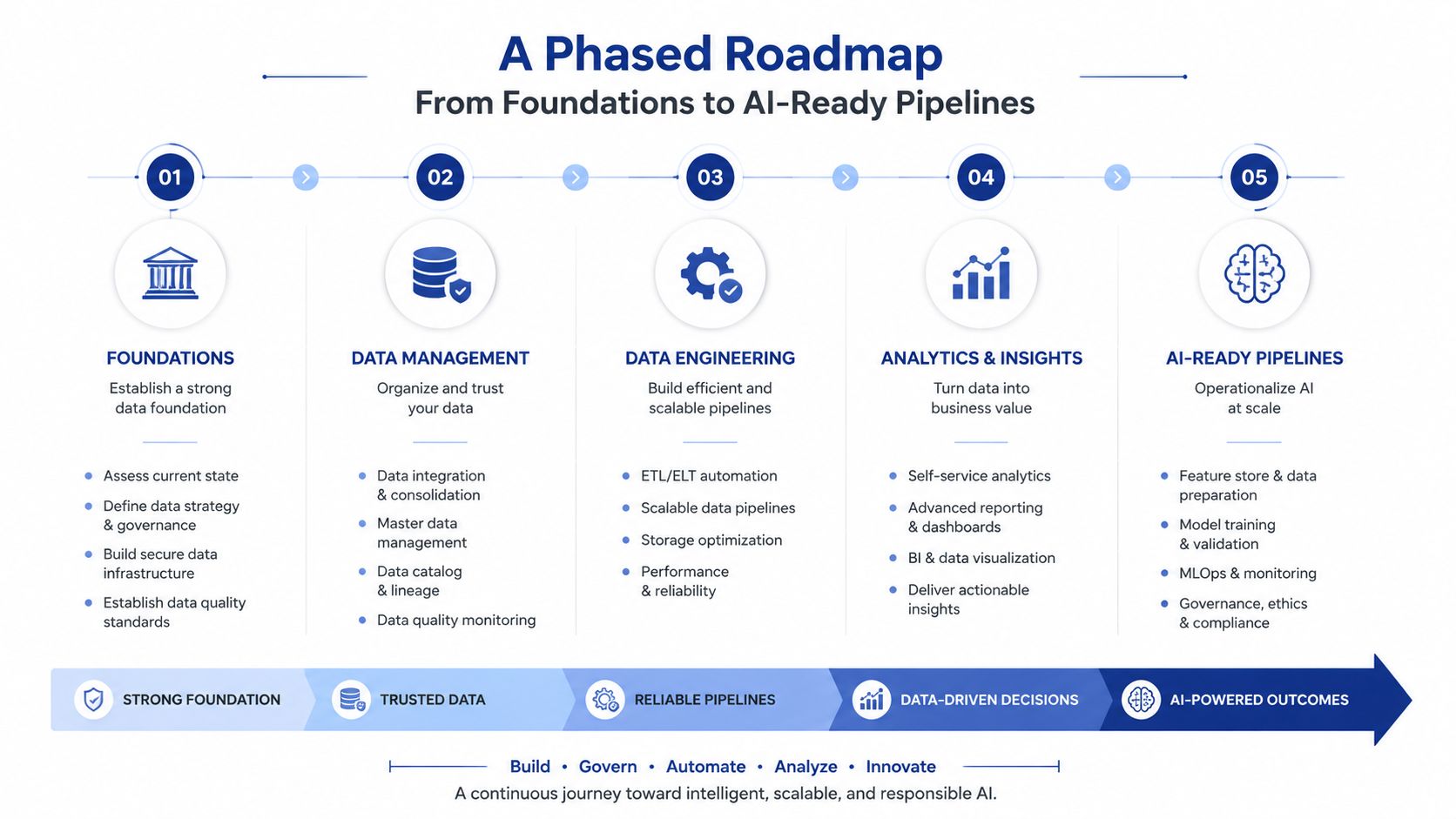
A Phased Roadmap From Foundations to AI-Ready Pipelines
Most organisations shouldn't attempt a full infrastructure replacement before testing value. They should sequence the work so each phase removes a known constraint and leaves behind a reusable capability.
Phase one builds trustworthy records
Begin with data inventory and standardisation. Identify the systems that hold patient, clinical, claims, scheduling, device, and operational information. Normalise legacy exports into FHIR R4 resources where appropriate, establish a master patient index, and deploy a basic identity provider.
The important milestone isn't the launch of a dashboard. It's confidence in identity, meaning, and ownership. Resolve duplicate patients before building feature stores or training data sets. Otherwise, the organisation can teach a model from merged records that belong to different people or split one person's history across multiple identities.
Phase two creates the exchange layer
Add an API gateway, integration engine, and translation services for HL7 v2 and FHIR. Route data according to purpose and consent rather than exposing broad database access. Keep point-to-point connections only where there's a documented reason, and place monitoring at every interface.
A useful delivery sequence is:
Inventory interfaces: Document source systems, messages, resources, owners, and failure modes.
Define canonical models: Agree which fields, codes, units, and identifiers downstream services will use.
Implement permission-aware routing: Apply identity, consent, jurisdiction, and purpose rules before delivery.
Test operational behaviour: Measure retries, duplicate messages, schema changes, alerting, and recovery.
Publish service ownership: Give each feed a named owner and a response process.
Phase three supports safe experimentation
Once identity and exchange are stable, build analytics-ready ingestion. Event-driven pipelines can handle new clinical events, while curated stores support reporting and model development. De-identification sandboxes give data science teams room to work without granting unrestricted access to production records.
Vendor selection should focus on interoperability, observability, security controls, Canadian data residency needs, integration skills, and exit options. A platform that demonstrates AI features but can't export lineage or enforce local policy will create future constraints.
The AI-ready healthcare infrastructure roadmap provides a complementary planning reference. Also account for people. Canadian healthcare commentary identifies standards and infrastructure, value measurement, and trust through staff and patient preparation as foundational steps for AI adoption, as discussed by McKinsey's analysis of AI's potential in Canadian healthcare.
Real-World Use Cases Across Insurers, Clinics, and Startups
Architecture becomes easier to evaluate when the organisation names the workflow it needs to improve. The same healthcare AI infrastructure can serve very different purposes for an insurer, clinic network, or health technology startup, but each setting exposes different governance pressures.
A mid-size Canadian insurer might use a FHIR-based claims adjudication pipeline to bring clinical and administrative information into a controlled workflow. The key decision is separating the data needed for adjudication from information that staff don't need to see. Cross-border members add residency and jurisdiction constraints, so the pipeline needs explicit routing and retention rules rather than one shared data lake.
A multi-site primary care network faces a different problem. Its EMR systems may record observations differently across locations, making a centralised patient identity layer and API gateway more valuable than a new model. An AI alerting service can only use real-time vitals safely when the integration layer confirms source, unit, patient identity, timestamp, and permission.
A digital health startup needs speed without losing evidence. Cloud-native pipelines and sandbox environments can let a team iterate on remote monitoring logic while preserving audit traceability. That traceability matters when the company must show how data entered the system, how the software transformed it, and how the resulting output was reviewed during a regulatory process.
These are patterns, not invented performance claims. They show why the decisive infrastructure component depends on the operational bottleneck.
| Organisation Type | Key Infrastructure Component | Governance Challenge | Measurable Outcome |
|---|---|---|---|
| Insurer | FHIR claims and clinical data pipeline | Purpose limitation, residency, and staff access | Faster, more controlled adjudication workflow |
| Clinic network | Patient identity layer and API gateway | Conflicting EMR structures and clinical safety | Consistent access to data across sites |
| Digital health startup | Cloud-native pipeline and audit-enabled sandbox | Evidence, traceability, and regulated software controls | More defensible product validation |
For additional context, real-world digital health analytics can help technology leaders compare how analytics capabilities translate into operational settings. The right question isn't whether an organisation has an AI use case. It's whether the surrounding infrastructure can make that use case reliable, explainable, and maintainable.
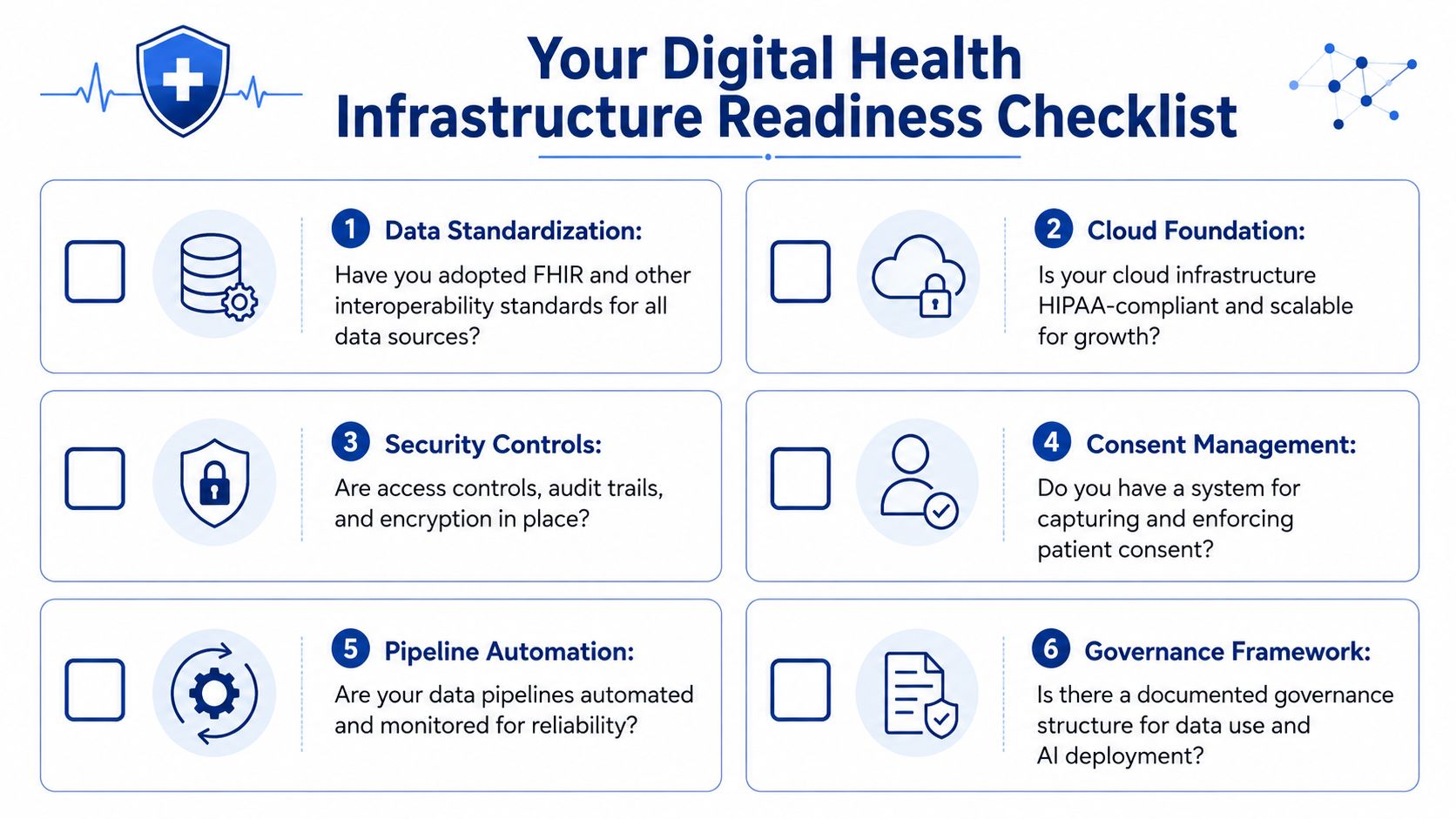
Your Digital Health Infrastructure Readiness Checklist
Before funding a production AI initiative, assess five dimensions. Score each as foundational, developing, or operationally ready, then record the evidence behind the score.
Data standardisation: Are core sources mapped to consistent definitions? Can approved applications retrieve information through documented APIs rather than direct database access?
Identity and access: Does every human and machine identity have a defined scope? Can security teams review access history and investigate unusual activity?
Cloud and pipelines: Can the environment scale without weakening residency or security controls? Do pipelines validate schemas, monitor freshness, and alert on failure?
Regulatory posture: Have teams mapped PIPEDA, PHIPA, HIPAA, GDPR, and other applicable obligations to technical controls? Can the organisation demonstrate consent, purpose, retention, and breach processes?
Workforce capability: Do clinicians understand what an AI output means and when to challenge it? Do technical teams understand clinical risk, privacy, and change management?
A mature checklist also tests ownership. Each critical data set, interface, model, and policy should have a named accountable person, a review cadence, and an escalation path. Revisit the checklist quarterly, because new vendors, jurisdictions, workflows, and AI use cases can change the risk profile.
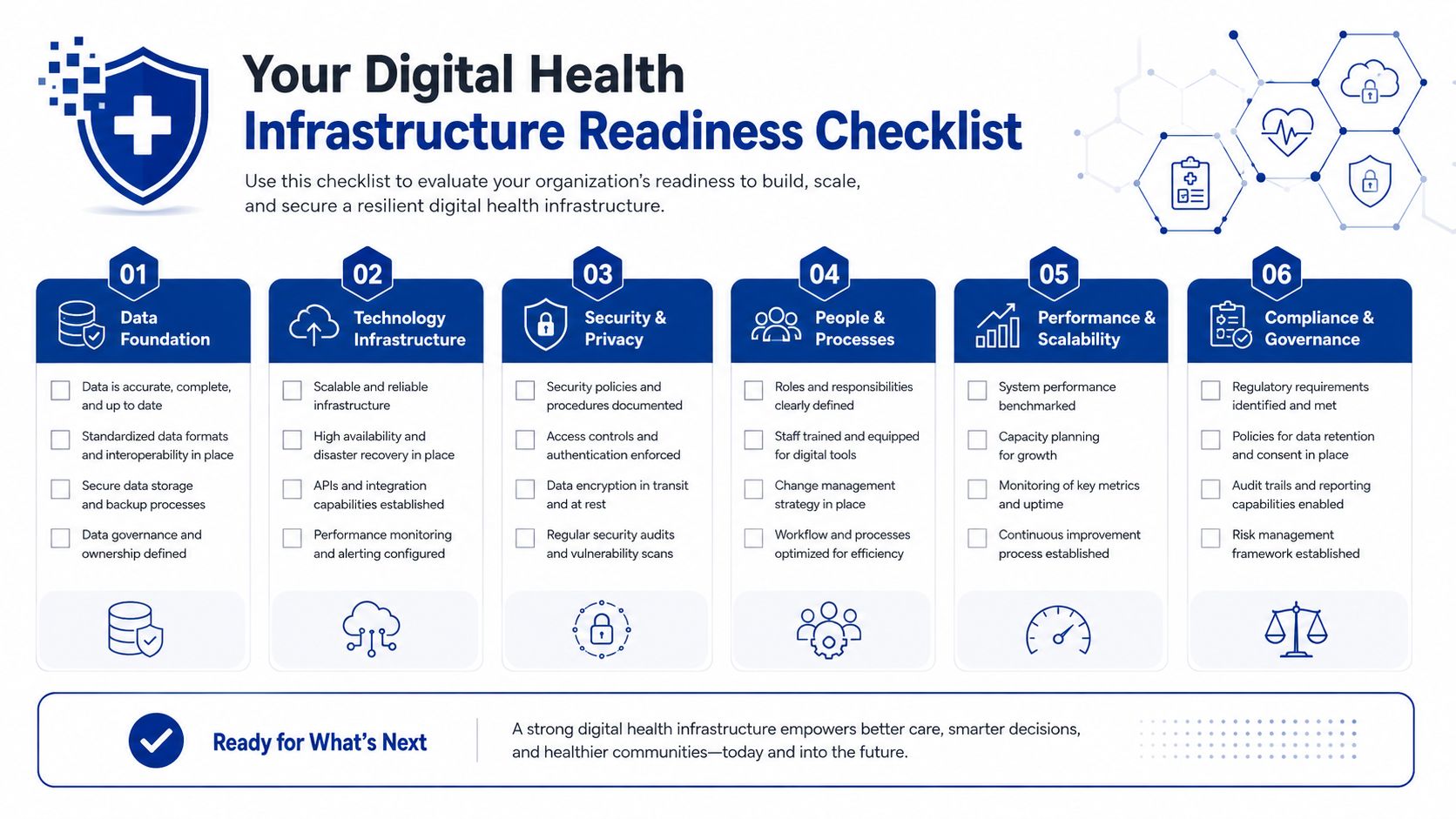
AI healthcare implementation succeeds when infrastructure, governance, and workforce readiness advance together. If any one of those dimensions remains weak, the organisation should fix the constraint before adding another model.
Cleffex Digital Ltd helps clinics, hospitals, and digital health teams connect FHIR APIs, legacy clinical systems, secure gateways, patient-facing applications, and scalable AI platforms. Visit Cleffex Digital Ltd to discuss a practical digital health infrastructure plan for your organisation.