

Canadian shoppers are adopting AI faster than many commerce teams realise. 56% already use generative AI for shopping tasks, including product research, recommendations and deal discovery, yet 32% still won't trust AI to handle payments because of privacy concerns. Omnisend's Canadian survey captures the commercial challenge clearly: shoppers are comfortable using AI to browse, but far less comfortable handing it the transaction.
That gap should shape every AI ecommerce platform decision in 2026. Retailers don't need another chatbot bolted onto an ageing storefront. They need an intelligent commerce foundation that improves discovery, explains recommendations, protects customer control and hands payment to a trusted checkout flow at the right moment.
Why AI Ecommerce Platforms Matter Now
Canada's online retail market has already reached meaningful scale. Online retail sales represented 6.1% of total Canadian retail sales in December 2024, with online sales of about US$3.14 billion that month. The U.S. International Trade Administration's Canada ecommerce market overview also places Canadian ecommerce GMV at roughly US$89.4 billion in 2024 and projects revenue to reach US$104 billion by 2029.
That scale changes the investment question. AI in ecommerce is no longer a speculative experiment for a narrow digital channel. Recommendation engines, semantic search, automated merchandising and conversational assistance can operate across a substantial transaction base, particularly in established online categories such as apparel and electronics.
Yet adoption alone doesn't guarantee better conversion. Canadian consumers are already using AI throughout the buying journey, with 45% using AI while shopping, AI app usage rising 82% in two years, and only 19% trusting AI recommendations outright, according to IBM's Canadian retail findings reported by Retail Insider. The weak point isn't always the model. It's often the surrounding experience.
A platform can generate a relevant product suggestion and still lose the sale if the result has unclear stock status, unexplained ranking, inaccurate delivery information or an abrupt payment handoff. Traditional commerce stacks usually optimise individual functions. An AI ecommerce platform should connect signals across the entire journey, from query interpretation and product retrieval to comparison, support, checkout and post-purchase service.
The adoption and confidence gap
Canadian retailer sentiment reinforces the need for platform-level design. 45% of Canadian retailers plan to expand AI investments in the next year, while 78% are open to AI completing purchases for consumers once budget and brand constraints are set.
That doesn't mean retailers should release unrestricted autonomous purchasing. It means they should build bounded workflows, including:
Budget controls: Let shoppers set spending limits before an agent acts.
Preference memory: Store approved preferences with clear consent and an easy reset option.
Product constraints: Restrict recommendations to available, compliant and brand-approved products.
Human override: Make it simple for shoppers or staff to intervene.
Payment handoff: Require explicit confirmation before the transaction is completed.
The retailers getting value from intelligent commerce treat AI as a redesign of the purchase journey, not a feature add-on. They connect clean catalogue data, real-time inventory, transparent recommendation logic and safe checkout orchestration. That approach converts curiosity into confidence, which is the condition AI needs before it can influence revenue consistently.
Core AI Capabilities That Drive Commerce
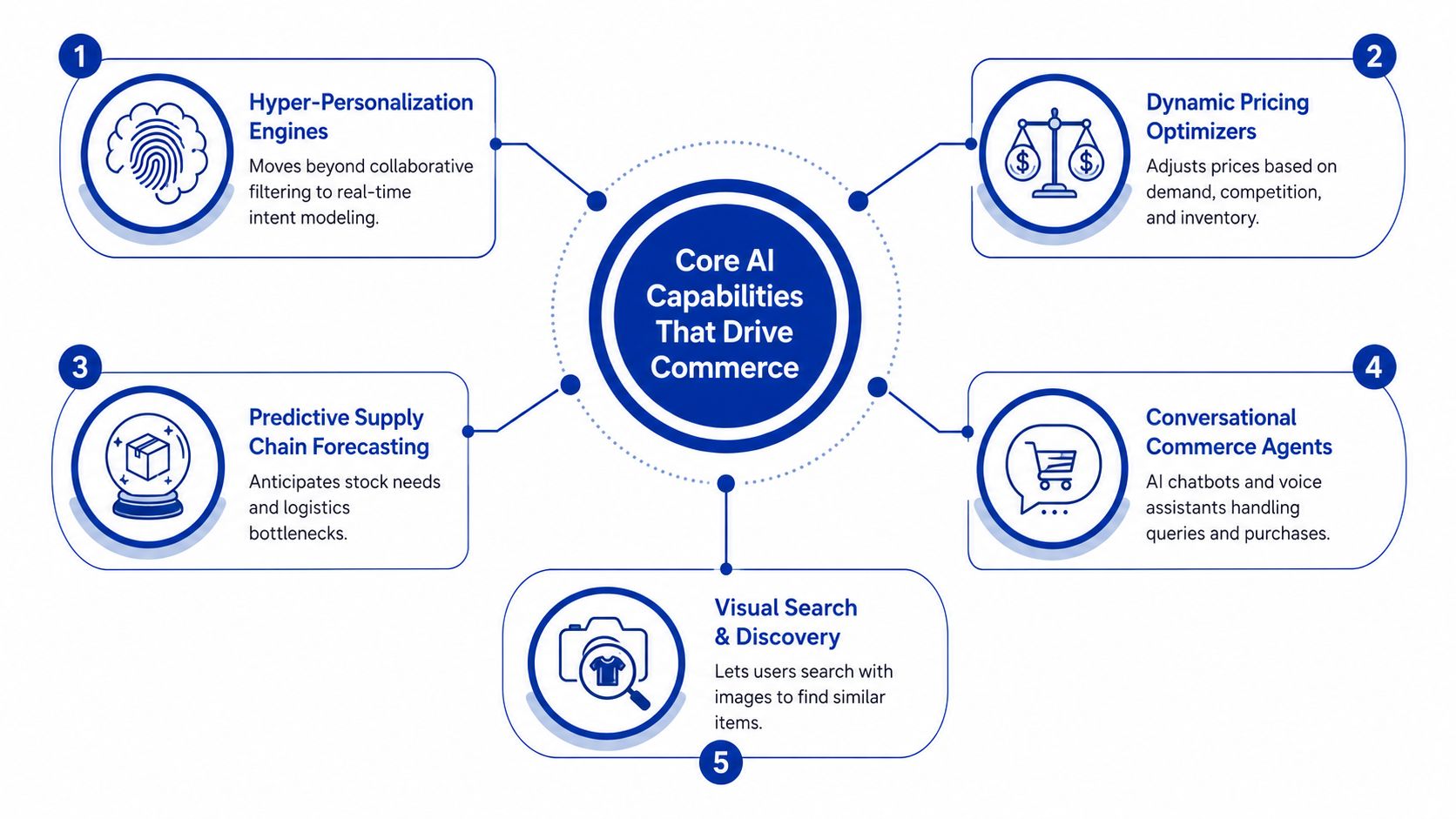
A capable AI ecommerce platform combines specialised systems instead of routing every task through one general-purpose assistant. Each system requires suitable data, integration points and operating limits. Those controls matter because shoppers may welcome AI help while still hesitating at checkout.
Hyper-personalisation engines
Basic collaborative filtering identifies products bought by similar shoppers. A stronger engine models current intent by reading actions such as category entry, filter use, product comparison and a return to an earlier item. It can then adjust the product grid during the same session.
Useful inputs include clickstream events, search terms, product attributes, basket contents and customer history collected with consent. Integration normally connects the storefront, customer data platform and product-ranking service. The practical test is simple: does the shopper see a clearer next choice without feeling watched or manipulated?
Semantic search and visual discovery
Keyword search struggles with natural-language queries, vague descriptions and specialist terminology. Semantic search maps a query to product meaning. Visual discovery can match an uploaded image with similar products or attributes.
The system needs structured descriptions, variant data, images and a vector index. It should also show why a result matches, such as colour, material, fit or compatible specification. Teams assessing product discovery can consult the retail AI guide by Market Edge, particularly when they need search results that remain explainable.
For implementation detail, the AI solutions for ecommerce retail guide outlines ways to connect search, recommendations and customer-facing experiences.
Pricing and promotion optimisation
Dynamic pricing can protect margin, yet uncontrolled automation can weaken trust and produce inconsistent treatment. An optimiser should account for demand, inventory, competitor positioning, promotion rules and minimum margin thresholds. Merchandising staff need to approve those boundaries before a model changes a live price. Clear explanations and an explicit approval path help separate useful automation from decisions shoppers may reject.
Conversational commerce agents
A useful assistant handles product consultation, comparison, policy lookup and post-purchase questions. It should retrieve answers from an approved catalogue, delivery and returns content instead of improvising. Canadian shoppers show interest in specialised assistance, with 39% wanting AI to act as a deal hunter and 33% wanting customer-service automation, according to the Retail Insider report on IBM's study.
The agent should disclose uncertainty, preserve a record of recommendations and hand payment back to an explicit customer confirmation. Helpful conversation does not automatically create transaction confidence.
Predictive analytics
Forecasting tools combine order history, seasonality, stock position, supplier lead times and campaign plans. They support replenishment, customer lifetime value scoring and service prioritisation. The integration point usually belongs in the data warehouse or operational planning layer, rather than the storefront.
Practical rule: Use the simplest model that improves a measurable decision. A transparent ranking model supported by dependable catalogue data is more valuable than an advanced system fed by inconsistent inputs.
Business Benefits by Audience and Industry
A D2C brand and a B2B supplier solve different problems with the same AI tooling. One may need faster product discovery and service responses. The other may need account-specific pricing, technical compatibility and repeat ordering. The platform creates value only when its recommendations support the buyer's actual decision, not merely increase automated interactions.
Different needs, different payback
| Segment | Primary AI value driver | Key implementation challenge | Expected ROI timeline |
|---|---|---|---|
| Small and mid-sized retailers | Automated merchandising, search and customer service | Limited clean data and internal ownership | Begin with a focused pilot and validate before expansion |
| Enterprise commerce | Orchestration across regions, brands and channels | Consistent governance and integration complexity | Build value in controlled stages across priority journeys |
| Healthcare and insurance commerce | Safe guidance, compliant recommendations and clear explanations | Sensitive data and high trust requirements | Prioritise governed workflows before broad personalisation |
| Automotive | Vehicle configuration, parts matching and service scheduling | Compatibility data and legacy system integration | Start with a narrow catalogue or service use case |
| Start-ups | AI-native architecture and fast experimentation | Avoiding premature complexity | Test a small, high-intent journey before scaling |
For a small Canadian retailer, a tagging workflow can read supplier spreadsheets, apply approved attributes such as colour, material and activity, then flag uncertain products for staff review. The team can publish consistent collections without handing final decisions to the model. That capacity is better spent on supplier relationships, exceptions and customer issues requiring judgement.
Enterprise teams face a governance conflict that smaller retailers rarely encounter. A regional merchandising team may want recommendations based on local inventory, while a central brand team requires the same product language and consent rules across markets. A shared taxonomy, policy layer and approval process can resolve that conflict. Adding another isolated model usually cannot.
Healthcare and insurance require controlled guidance. The platform should distinguish educational content from regulated advice, record decision inputs and explain why a recommendation appeared. Automotive has a comparable trust gap: an attractive suggestion still fails if the part does not match the vehicle.
Why a single strategy fails
A start-up can design an API-first catalogue and event model before technical debt accumulates. An established retailer may need staged integration with Shopify, Magento or a custom commerce system. A B2B industrial supplier may gain more from natural-language technical search than from consumer-style personalisation, provided compatibility results are easy to verify.
Retailers should assess AI-powered product recommendations as one part of a broader strategy. Clean product data, sound merchandising and visible customer controls determine whether curiosity becomes transaction confidence.
Building an AI-Ready Commerce Foundation
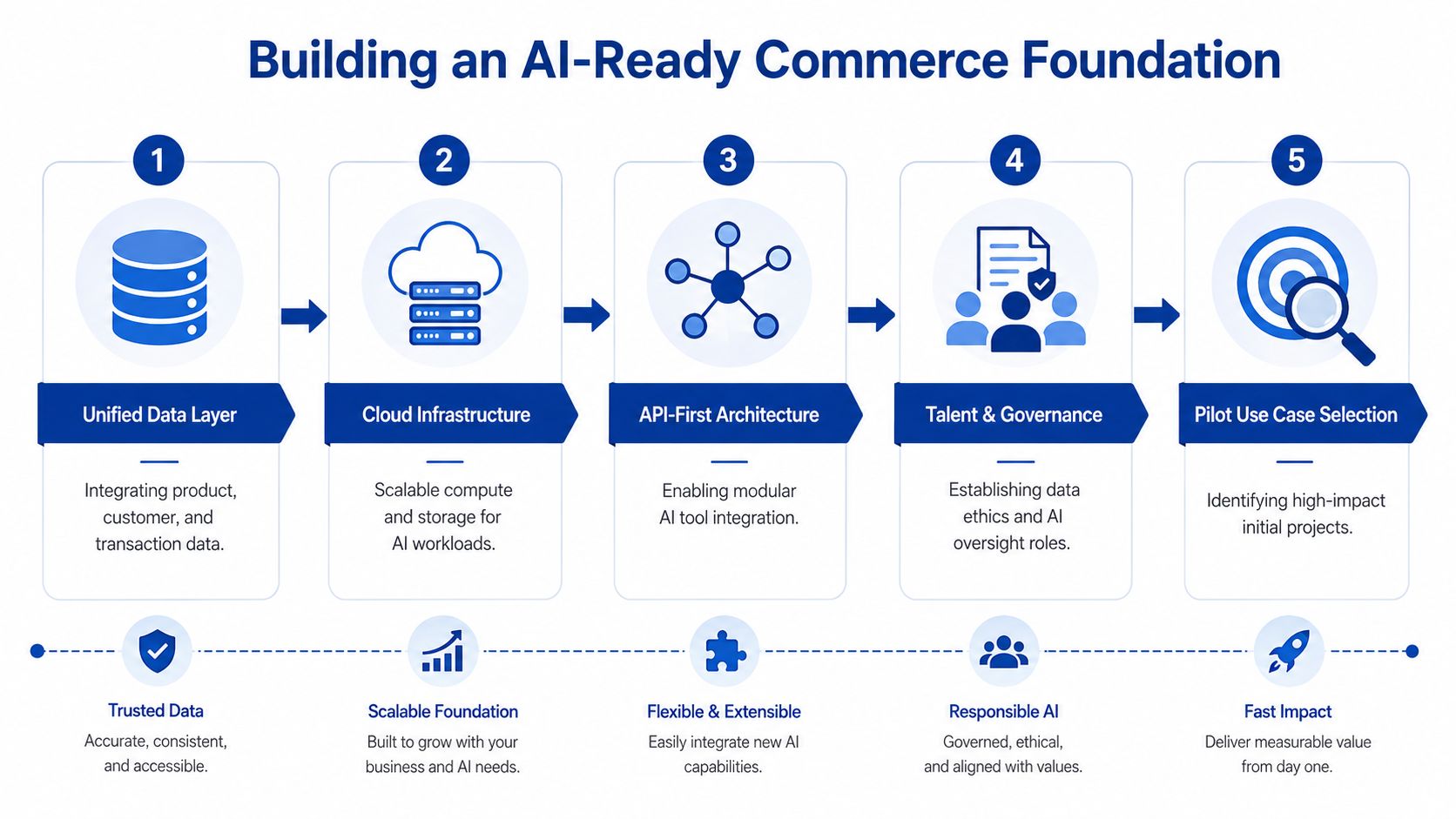
AI amplifies the quality of the systems beneath it. If marketing, fulfilment and customer service hold different product names, stock values or policy rules, the model won't resolve the conflict reliably. It will automate inconsistency.
Start with a unified data layer
Create one authoritative structure for products, variants, attributes, prices, availability, customer permissions and transactions. Product data should describe meaningful properties, not just marketing copy. A jacket taxonomy might separate insulation, waterproofing, fit, activity and temperature range so a semantic search system can retrieve products for a practical request.
Inventory needs similar discipline. A recommendation engine must know whether a product is available for the shopper's location, not merely whether a catalogue record exists.
Connect events in real time
Personalisation depends on timely signals. Configure an event-driven architecture for searches, views, filter selections, basket changes, purchases, returns and service interactions. Send only the data needed for the approved purpose, with consent status attached to the event wherever personal data is involved.
A customer data platform can consolidate these signals, but it isn't a magic repair tool. Audit identity resolution, duplicate profiles, missing events and stale attributes before using the data to train or drive decisions.
Keep the architecture modular
Headless commerce can separate the customer experience from back-end commerce logic, making it easier to test a search service, recommendation engine or conversational interface without replacing the whole storefront. API-first design helps, but an API wrapper around a disconnected system won't create genuine interoperability.
Map each integration between the storefront, catalogue, inventory, order management, payment provider, analytics platform and AI service. Record data ownership, failure behaviour, latency expectations and fallback rules. If an AI service fails, the customer should still be able to search, view products and complete an order.
Teams planning larger changes should review an ecommerce backend modernisation guide before selecting models. Modernisation isn't about adding technology for its own sake. It's about creating dependable operational paths that AI can use safely.
Selection Criteria and Evaluation Checklist
Buyers who accept “AI-powered merchandising” at face value may discover after deployment that the system is mainly a rules-based classifier. Test the product with your catalogue, operational constraints and approval process before signing.
Ask the vendor to demonstrate a real use case, not a polished sample shop. Can the system explain why a product appeared? Can staff adjust business rules without a support ticket? What happens when an API, inventory feed or model is unavailable? A credible platform should preserve search, product pages and checkout through those failures.
| Evaluation category | Critical questions | Red flags | Green flags |
|---|---|---|---|
| Model transparency | Can staff understand ranking and recommendation inputs? | No explanation or audit trail | Reason codes, controls and decision logs |
| Data ownership | Who controls behavioural and catalogue data? | Broad reuse rights or lock-in | Clear export, retention and deletion terms |
| Integration depth | Does the platform connect to inventory, orders and consent systems? | Thin API wrapper with manual workarounds | Native event and operational integrations |
| Scalability | Can performance remain stable during demand spikes? | Unclear capacity planning | Tested limits, monitoring and fallback paths |
| Total cost | What do storage, retraining, support and usage cost? | Hidden model or data charges | Transparent pricing assumptions |
| Governance | Can teams approve, review and reverse decisions? | Autonomous changes without controls | Roles, approvals and human override |
Match the tool to the organisation
Shopify's native AI features can fit a smaller retailer that needs quick deployment and limited operational overhead. Test whether a store team can launch recommendations, correct unsuitable outputs and maintain catalogue rules without specialist support.
Nosto or Dynamic Yield may suit a mature team running segmentation and experimentation across several customer journeys. For a mid-market retailer managing 50,000 SKUs across three regions, test whether the platform can enforce region-specific pricing and promotion rules without manual overrides, while preserving separate reporting for each market.
A custom service offers greater control over ranking logic and data flows, but the retailer assumes responsibility for monitoring, security, model evaluation and maintenance. Use that route only when the technical team can operate those controls and explain decisions to merchandising and customer-service staff.
The choice depends on technical resources, catalogue complexity and growth plans. Extensive controls can overwhelm a small team, while a simplified tool may restrict an enterprise operating across brands and regions. The trust gap appears when shoppers receive confident recommendations, but staff cannot verify or correct them.
Before signing, request:
A data map: Identify every input, output and system owner.
An evaluation method: Define how recommendation quality, search relevance and customer satisfaction will be assessed.
A failure plan: Confirm what happens during model, integration or inventory errors.
A commercial model: Include data storage, usage, support and retraining costs.
An exit path: Verify that product, event and customer data can be exported.
Privacy Compliance and Trust by Design
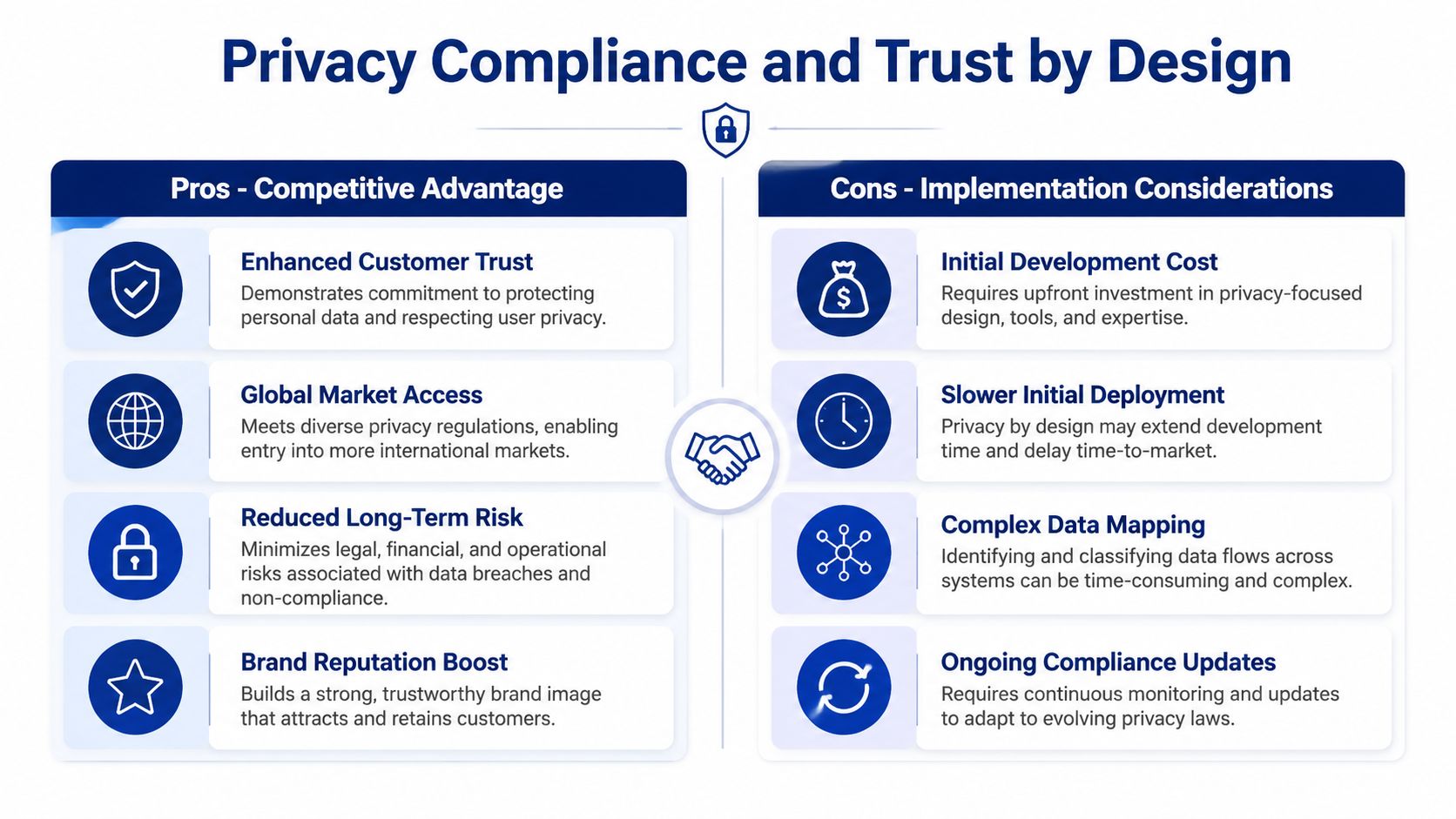
Privacy affects conversion directly. Canadian shoppers may welcome AI-assisted discovery, then abandon an opaque checkout. The platform must explain data use and preserve customer control at the points where recommendations become decisions.
Quebec's Law 25 is fully in force. Commerce platforms processing personal data or supporting automated decisions need a Privacy Officer, a data inventory, a published privacy policy, and privacy impact assessments before acquiring or developing new information systems or using personal data for automated decision-making. Reported penalties can reach C$25 million or 4% of global turnover, as outlined in this Canadian AI privacy and compliance briefing.
Make the recommendation explainable
A brief reason can reduce hesitation. “Recommended because you viewed similar items” gives shoppers a usable explanation, while an unexplained carousel asks them to trust a system they cannot assess. Provide controls to change preferences, dismiss recommendations, limit personalisation, or continue without personalised results.
Consent must remain connected to the data throughout the workflow. The recommendation service, analytics layer, and conversational agent should share the same record of permitted uses. A consent management platform can support that process, but the retailer still has to define purposes, retention periods, and escalation paths.
Protect sensitive signals
Federated learning can improve a model without transferring every sensitive record into one central repository. Differential privacy can lower identification risk by adding controlled statistical noise to aggregate outputs. Neither technique creates compliance by itself. Each requires legal and security review, along with clear limits on which data the platform may process.
Payment handling needs a separate boundary. Let AI recommend products, compare options, and prepare a basket, then require clear confirmation through an established payment flow. For autonomous purchasing, set merchant, category, budget, and timing limits. Record the agent's actions so shoppers and staff can investigate disputed orders.
Trust is not decoration around intelligent commerce. It determines how much authority a shopper will give the platform.
Implementation Roadmap and Next Steps
A sensible rollout starts with a constrained problem and a reliable measurement plan. Don't begin with an autonomous shopping agent if product availability, returns data and checkout events are inconsistent.
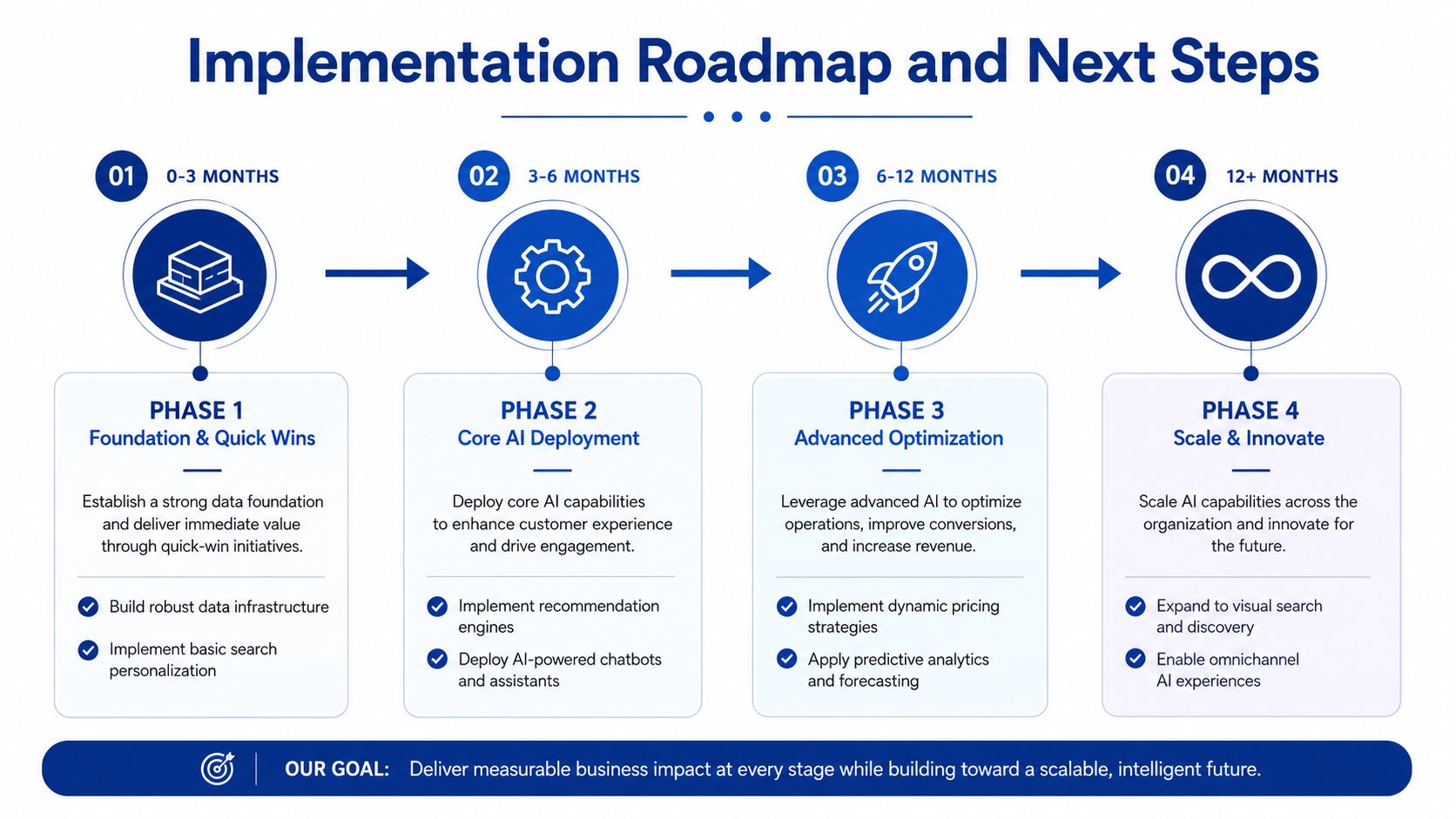
Phase one: Foundation and quick wins
Audit the catalogue, events, consent records, inventory feeds and order flows. Repair missing attributes, standardise naming and establish baseline measures for search engagement, product discovery, service workload and completed purchases.
Choose one journey with clear customer intent, such as category search or product comparison. Deploy semantic retrieval or basic personalisation with a non-AI fallback, then review relevance and failure cases with merchandising and service teams.
Phase two: Core AI deployment
Add recommendations and a controlled assistant once the data layer is stable. Ground the assistant in approved product, delivery, returns and policy content. Set escalation rules for uncertain answers, regulated topics and complaints.
Use a cross-functional team including ecommerce, merchandising, technology, analytics, privacy and customer service. Each group sees different failure modes, and AI projects often fail when one department owns the experience alone.
Phase three: Advanced optimisation
Evaluate pricing, demand forecasting and lifetime value scoring after the organisation can govern earlier use cases. Keep price changes within approved margin, inventory and promotion constraints. Validate model outputs against operational reality, not only offline technical measures.
Phase four: Scale and innovation
Expand to visual search, omnichannel assistance and bounded agentic workflows when the organisation can manage identity, consent, payment, fulfilment and dispute handling across channels. Roll out by journey and risk level, not just by department.
Use this readiness checklist before each expansion:
Confirm the owner: A named team must own the decision and its outcomes.
Define the guardrails: Document what the model may recommend, change or complete.
Test edge cases: Include unavailable products, contradictory preferences and policy exceptions.
Measure customer confidence: Review cancellations, escalations, feedback and payment abandonment alongside commercial metrics.
Keep a fallback: Customers should never be trapped in an AI-only path.
Cleffex Digital Ltd offers ecommerce strategy, platform development and AI integration support for retailers assessing Shopify, WooCommerce and custom commerce architectures. Visit Cleffex Digital Ltd to discuss an AI readiness audit, integration plan or focused pilot for your Canadian commerce operation.
Frequently Asked Questions
What is an AI ecommerce platform?
An AI ecommerce platform combines commerce operations with machine learning and generative AI capabilities. It can connect product data, customer signals, inventory, search, recommendations, service and checkout so the system supports decisions across the buying journey rather than automating one isolated task.
How should a small Canadian retailer begin?
Start with a clean catalogue, reliable inventory data and one high-intent use case. Semantic search, product recommendations or policy-based customer support are often easier to govern than autonomous purchasing. Establish a baseline, run a controlled pilot and expand only after staff can review the outputs.
Can AI complete purchases safely?
It can, but only with explicit controls. Use budget limits, approved product categories, preference permissions, confirmation steps, payment boundaries, audit logs and human override. AI should prepare or propose a transaction before a retailer gives it authority to complete one.
What data does an AI ecommerce platform need?
It typically needs structured product information, variant and availability data, search and browsing events, basket activity, orders, returns and approved customer preferences. The platform also needs consent context and clear ownership for every data source.
Is personalisation compatible with privacy requirements?
Yes, when the retailer designs it around purpose limitation, transparent consent, data minimisation and customer controls. Explain why a recommendation appeared, allow shoppers to adjust personalisation and complete the required privacy assessments before introducing automated decision-making.
Should a business choose native or third-party AI tools?
Native tools can reduce integration effort and suit teams with limited technical capacity. Specialist platforms may provide deeper experimentation and orchestration. Compare them against catalogue complexity, integration depth, data ownership, governance requirements and total cost rather than choosing based on the AI label alone.