

Numerous teams looking at AI in healthcare are stuck in the same place. The ambition is high, but the data is still trapped in separate EHR modules, lab feeds, scanned documents, referral systems, payer portals, and departmental tools that were never designed to work as one coherent platform.
That gap is where projects fail. Data scientists ask for structured clinical features. Integration teams hand over brittle extracts. Compliance teams slow everything down because nobody can clearly explain what data moves where, who can access it, or how model output returns to the point of care. The result is a pilot that looks promising in a notebook and unusable in an actual clinical workflow.
FHIR changes that starting point. AI changes what you can do once the data is accessible. Together, AI and FHIR give healthcare organisations a practical path from fragmented records to usable intelligence. Not magic. Not plug-and-play. But a workable foundation.
The Future of Health Data Is Connected
Healthcare data rarely fails because it is absent. It fails because it is disconnected. A clinician can see one slice in the EHR, another in a lab portal, another in a scanned discharge summary, and something else again in a pharmacy system. An AI model trained on only one of those slices won't behave like a trustworthy clinical tool.
That's the operational reality behind most AI delays in healthcare. The hard part isn't usually model selection. It's getting the right patient context into a format that can be queried, validated, governed, and reused across systems.
Why fragmented data blocks useful AI
When data sits in silos, teams run into the same problems repeatedly:
Feature engineering becomes manual: Analysts spend more time reconciling fields than building models.
Clinical context gets lost: A result without timing, encounter context, or medication history can mislead a model.
Workflow adoption stalls: If output can't return to the systems clinicians already use, it becomes another dashboard nobody opens.
Governance gets murky: Security, consent, lineage, and auditability become harder when every feed uses a different structure.
FHIR matters because it gives teams a consistent way to represent core healthcare information as interoperable resources and access it through modern APIs. That makes data easier to consume for analytics, decision support, automation, and machine learning.
Practical rule: If your AI initiative starts with model architecture before data architecture, you're probably solving the wrong problem first.
What connected health data actually enables
Connected data doesn't just help developers. It changes what an organisation can operate.
A care management team can combine observations, conditions, medications, and encounter history into a risk workflow. A prior authorisation process can assemble a clinical summary without manual chart review. A digital health product can pull patient-facing information through the same standards-based layer instead of building custom interfaces for every source system.
That's why AI and FHIR belong in the same conversation. FHIR provides the transport and structure. AI turns that structure into classification, prediction, summarisation, matching, and operational support. The value comes from the connection between them, not from treating them as separate technology trends.
Demystifying FHIR for AI Practitioners
For AI teams, FHIR is easiest to understand as a standardised API and data model for health information. It doesn't solve every interoperability problem, and it doesn't remove the need for mapping or governance. What it does is replace a lot of one-off integration work with a common structure that software teams can build against.
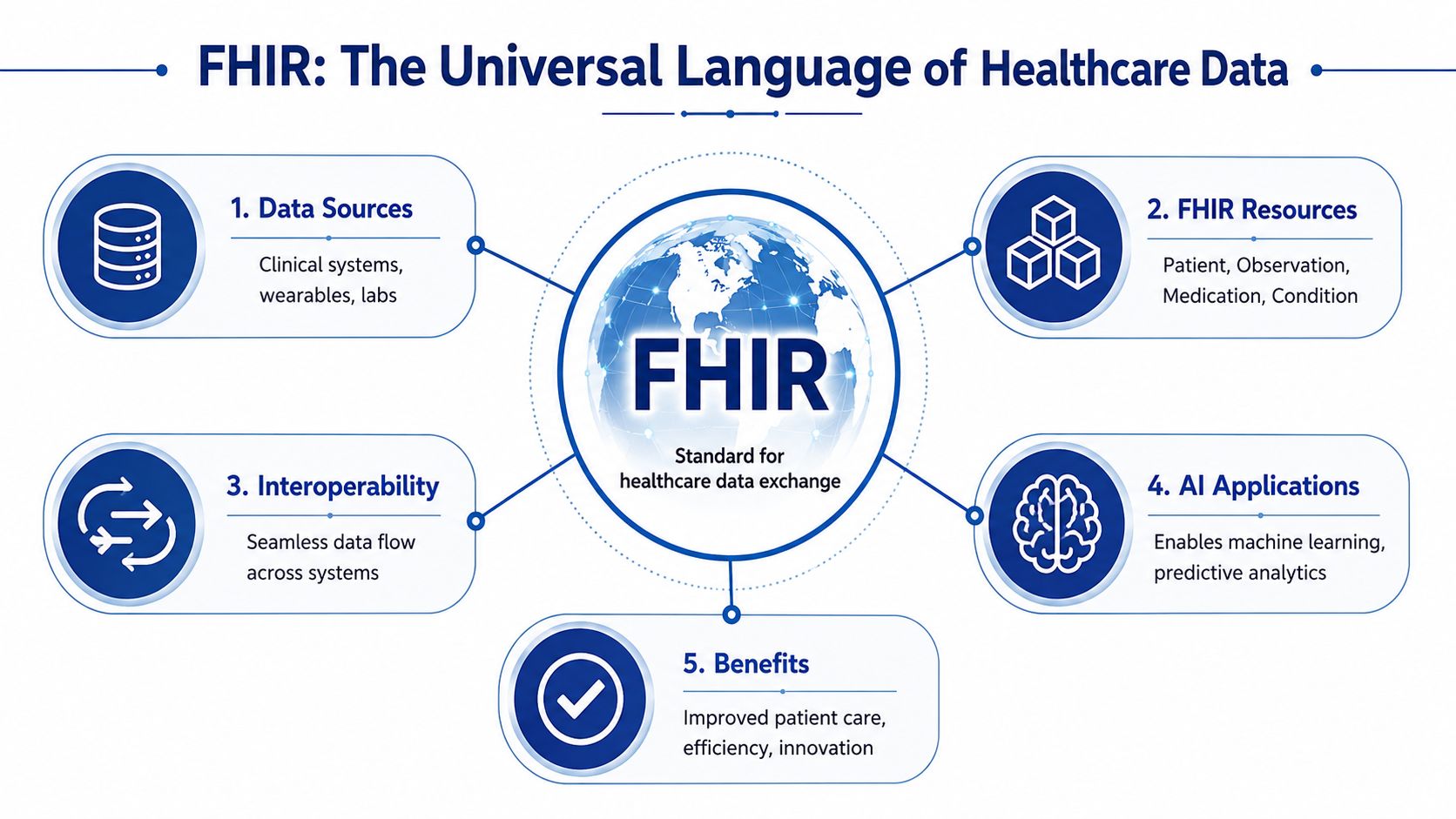
Think in resources, not tables
FHIR organises healthcare data into resources. These are self-contained, well-defined objects such as Patient, Observation, Condition, Encounter, MedicationRequest, DiagnosticReport, and Procedure. If you come from application development, they feel closer to typed domain objects than flat export files.
That matters for AI work because resource-based data is easier to reason about. A blood pressure reading can be represented as an Observation with code, value, units, status, time, performer, and links to the patient and encounter. A medication order can exist as a MedicationRequest with intent, status, dosage instructions, requester, and timing information.
Instead of asking, “Which column in which source file contains the answer?” teams can ask better questions:
Which resources define the patient state I care about?
What search parameters can retrieve them?
How do I preserve temporal order and provenance?
Which profiles or extensions matter for this workflow?
Why FHIR works better for modern software teams
Legacy healthcare integrations often force developers to translate idiosyncratic message formats into something usable before they can even start analytics or application logic. FHIR is still healthcare, so it still has complexity. But it is web-oriented by design. Resources are commonly represented in JSON and exchanged over RESTful APIs, which makes them more accessible to product teams, data engineers, and ML engineers.
That accessibility is no longer niche. As of 2026, over 90% of certified electronic health record systems in North America are required to provide patient data access via a FHIR-based API according to the ONC Cures Rule requirements.
For organisations evaluating platform strategy, that single shift changes the game. It means the addressable surface area for AI and FHIR is now broad enough to support serious investment, not just innovation-lab experiments.
What AI practitioners should care about first
Not every part of FHIR matters equally for machine learning. Start with the resources closest to your use case and workflow.
| AI task | FHIR resources commonly involved | What to watch |
|---|---|---|
| Risk prediction | Patient, Observation, Condition, Encounter | Time windows, coding consistency, missing values |
| Summarisation | DiagnosticReport, DocumentReference, Observation, MedicationRequest | Narrative text, duplication, encounter context |
| Cohort identification | Condition, Procedure, MedicationStatement, Observation | Terminology mapping, inclusion logic |
| Care navigation | Appointment, ServiceRequest, CarePlan, Task | Status changes, ownership, operational latency |
FHIR also supports implementation guides, profiles, and extensions. Those are useful, but they can also create local variation. Smart teams treat FHIR as a strong baseline, then inspect the actual payloads before promising model timelines.
For a practical view of what standards-based integration changes inside delivery environments, this piece on how FHIR integration transforms healthcare is a useful companion.
The AI and FHIR Data Pipeline Explained
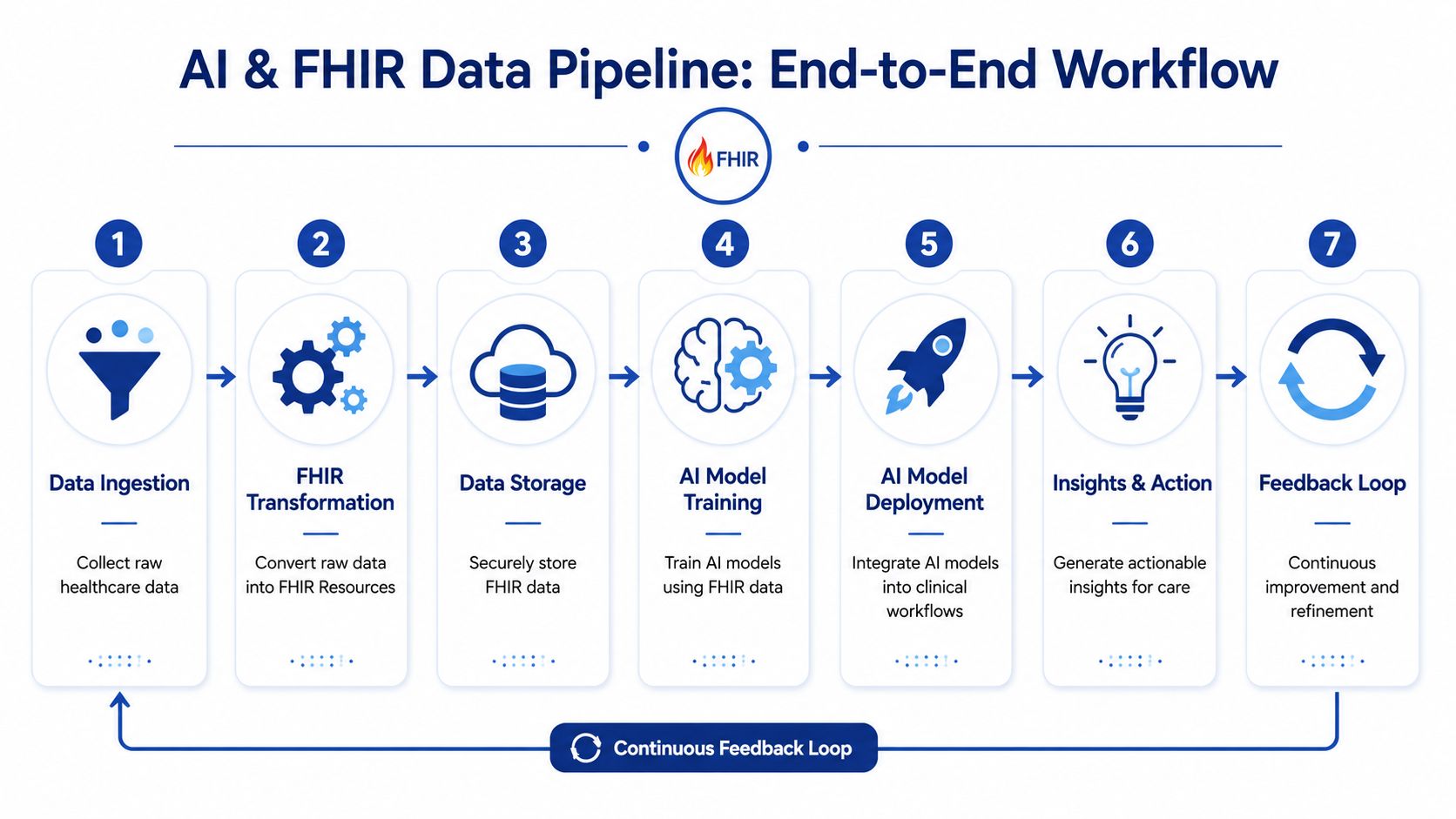
Most failed healthcare AI projects break at the handoff points. Data comes in inconsistently. Clinical meaning gets flattened during transformation. The model produces output, but nobody can feed it back into a workflow safely. A strong AI and FHIR pipeline solves those handoffs deliberately.
How the pipeline starts
A typical pipeline begins by reading from a FHIR server. That can happen through real-time API queries, scheduled synchronisation jobs, subscription-driven events, or bulk export depending on the use case.
The ingestion choice affects everything downstream. A near-real-time deterioration model needs a very different pattern from a population health model trained in batches. Teams often underestimate this and try to force one architecture to serve both.
A practical sequence looks like this:
Pull the right resources: Start with the minimum clinical set needed for the task. More data isn't automatically better.
Preserve references: Keep links between patient, encounter, practitioner, organisation, and event timestamps.
Record provenance: Capture source system, retrieval time, and transformation version from day one.
Separate raw from curated: Store the original FHIR payloads before feature engineering touches them.
The hard middle is transformation
FHIR resources are computable, but they aren't immediately model-ready. AI systems usually need a transformation layer that converts transactional records into longitudinal features.
That means work such as:
Flattening nested structures into analytics-friendly views while keeping the original hierarchy available
Normalising coding systems so equivalent clinical concepts don't fragment into separate features
Resolving timing logic for event sequences, lookback windows, and prediction horizons
Handling absent information without pretending every null means the same thing
Joining across resources to reconstruct the patient story rather than isolated facts
Therefore, many organisations need both FHIR expertise and data engineering discipline. A model trained on poorly transformed medication or observation data may look acceptable in development and behave unpredictably in production.
Good healthcare AI pipelines don't just move data. They preserve meaning while making data usable.
Models should write back, not just read
The strongest AI and FHIR designs treat FHIR as a two-way interface. The model consumes structured patient data, generates an inference or recommendation, and returns the output to the operational environment using the same standards-based approach.
That write-back can take different forms:
A risk score represented as a Risk Assessment
A generated work item captured as a Task
A care suggestion attached to a Care Plan
A summarised finding linked through Document Reference or surfaced in a CDS workflow
A communication event routed to a care team
AI's value in healthcare rarely lies in the prediction itself. Instead, its worth is found in subsequent actions. If a high-risk result never reaches a clinician, case manager, or operational queue in the appropriate format, the system has not improved care or efficiency.
A simple consume-produce view
| Pipeline stage | What happens | Common failure mode |
|---|---|---|
| Ingest | Retrieve FHIR resources from source systems | Pulling too much data without use-case focus |
| Curate | Clean, map, and structure data for analytics | Losing temporal or coding context |
| Train | Build models on curated features | Training on convenience data, not production data |
| Infer | Run model on current patient context | Latency too high for workflow timing |
| Write back | Return result as a workflow-ready artefact | Output trapped in a separate analytics tool |
Teams that get this right build fewer heroic integrations later. They also create reusable plumbing for the next use case instead of rebuilding the stack every time.
Common Architectures for FHIR-Powered AI
A good architecture for AI and FHIR isn't defined by cloud branding. It's defined by separation of concerns. Interoperability services should handle standards-compliant exchange. Analytical platforms should handle transformation and modelling. Operational systems should consume outputs without becoming dependent on experimental code.

Pattern one with a managed FHIR core
A common pattern uses a managed or self-hosted FHIR server as the standards boundary. Systems such as Epic, Oracle Health, Cerner environments, departmental applications, and digital front ends connect to that layer through APIs and integration services. Behind it sits a cloud data platform such as Databricks, Snowflake, BigQuery, or Synapse for curation, feature generation, and model training.
The division is useful:
FHIR server: Interoperability, search, conformance, resource persistence
Integration layer: Mapping, event handling, orchestration, retries
Lakehouse or warehouse: Historical analytics, feature engineering, data science
Model serving tier: Batch scoring, online inference, API endpoints
Operational applications: EHR workflows, care management tools, patient apps
This setup gives architects flexibility. The FHIR layer remains stable even as the analytics stack evolves.
Pattern two with event-driven orchestration
Some use cases need a more responsive design. In that pattern, a clinical event triggers a pipeline. A new observation arrives. A discharge happens. A referral status changes. The event lands on a broker or integration bus, enrichment services fetch supporting FHIR resources, and an inference service decides whether to create a task, recommendation, or alert.
This pattern works well when timing matters, but it creates pressure in places teams often ignore:
| Component | Why it matters | Typical trade-off |
|---|---|---|
| Event broker | Decouples producers and consumers | More moving parts to monitor |
| FHIR facade | Gives a clean read-write contract | Needs careful version management |
| Feature service | Reuses production-grade features | Harder to build than ad hoc SQL |
| Inference API | Supports low-latency scoring | Requires strong operational discipline |
| Audit layer | Tracks every access and decision path | Adds implementation overhead |
What usually works and what usually doesn't
Architecturally, a few patterns hold up well in delivery.
What works: A canonical FHIR layer, a separate analytical store, and explicit contracts for model input and output.
What works: MLOps tooling that versions data transformations alongside model artefacts.
What works: Narrow first use cases with clear owners in both clinical and technical teams.
Other patterns look efficient early and become expensive fast.
What doesn't: Training directly against unstable source schemas with no canonical layer.
What doesn't: Embedding model logic inside interface engines or front-end applications.
What doesn't: Treating the EHR as both the data lake and the ML platform.
Architecture test: If replacing one model requires redesigning your interoperability layer, the stack is too tightly coupled.
The best architecture is usually the one that can survive a second and third AI use case without a full rebuild. Reuse matters more than elegance.
Navigating Privacy Compliance and Data Quality
In healthcare, compliance isn't a box you tick after the model works. It shapes the architecture, operating model, and delivery pace from the start. FHIR can support secure exchange, scoped access, and better auditability, but none of that replaces governance.
Teams get into trouble when they assume standards equal compliance. They don't. Standards provide structure. Organisations still need policy, review processes, role design, retention rules, consent handling, vendor controls, and clear accountability for model behaviour.
Compliance is an operating discipline
A solid programme usually defines who can access what data, for which purpose, under which workflow, and with what review trail. That includes training environments, feature stores, notebooks, inference endpoints, and write-back paths.
The practical questions are not abstract:
Purpose limitation: Is this dataset approved for the intended AI use case?
Minimum necessary access: Does the model pipeline read more than it needs?
Consent and disclosure: If data moves across entities or workflows, who approves that movement?
Auditability: Can you reconstruct what data informed a recommendation after the fact?
Human oversight: Who owns review when model output influences a clinical or operational action?
For teams working through these control layers, this guide to data security in healthcare information systems is a practical reference.
Data quality is where trust is won or lost
Even a compliant pipeline can still produce poor results if the underlying FHIR data is inconsistent. The common issues are familiar. Missing observations. Local codes with no clean terminology mapping. Duplicated records. Narrative-only fields carrying meaning that never made it into structured resources. Extensions used well in one system and carelessly in another.
A durable quality strategy usually includes:
Profile validation: Reject or quarantine resources that don't meet expected structure.
Terminology management: Map local codes to standard vocabularies where possible and track exceptions explicitly.
Temporal validation: Check whether timestamps make clinical sense in sequence.
Completeness rules: Distinguish absent information from not-yet-documented information.
Drift monitoring: Watch for payload shape changes after EHR upgrades or interface changes.
If your team is building these controls, Streamkap's overview of strategies for trusted data management is worth reviewing because it frames quality as an ongoing system, not a one-time cleanse.
The fastest way to lose clinician confidence is to present a precise-looking AI output built on messy inputs nobody validated.
The governance pattern that scales
The most reliable organisations don't leave quality and privacy to separate project workstreams that only meet at release time. They create a shared governance rhythm. Clinical informatics, security, data engineering, legal, and product owners review the same data contracts and deployment checkpoints.
That approach feels slower at first. In practice, it prevents rework, avoids surprise objections late in delivery, and makes production AI sustainable.
Real-World AI and FHIR Use Cases
The best use cases for AI and FHIR don't start with “Where can we use AI?” They start with “Which decision or workflow is currently limited by fragmented data?” Once the workflow is clear, the right resource set and model pattern usually follow.
Predictive monitoring inside care delivery
A deterioration or sepsis-risk workflow typically pulls from resources such as Patient, Observation, Condition, Encounter, MedicationRequest, and sometimes Procedure. The model looks at changing vitals, laboratory trends, active diagnoses, recent interventions, and timing patterns to estimate whether the patient needs faster attention.
The output is only useful when it reaches the care team in an actionable form. In practice, that might mean a RiskAssessment, a Task for follow-up, or integration into a clinical decision support workflow. The model isn't the product. The escalation path is.
Administrative automation that actually reduces friction
Prior authorisation is a strong operational candidate because the work often depends on assembling clinical evidence from multiple sources. FHIR makes it easier to gather diagnoses, procedures, medications, results, and encounter context into a structured package. AI can then summarise that record, identify missing elements, or route the case to the right queue.
This is also where retrieval infrastructure matters. Teams comparing tooling and workflow options for document-heavy environments may find Matil's review of records retrieval companies useful as background on how record access and retrieval operations affect downstream automation.
Trial matching and cohort discovery
Clinical trial matching is another practical example. A matching engine can evaluate Condition, Observation, Procedure, MedicationStatement, and demographic data against inclusion and exclusion criteria. FHIR helps by standardising how those data elements are represented and queried across populations.
What often separates a useful system from a disappointing one is not the matching algorithm alone. It's whether the eligibility logic is transparent, whether exclusions can be reviewed by coordinators, and whether the final candidate list fits existing recruitment workflow.
Personalised recommendations from richer profiles
In more advanced environments, FHIR-based observations and specialised profiles can support personalised medicine workflows. That might include genomic interpretations, pathology results, treatment history, and co-morbidity context. AI can help organise, classify, and surface clinically relevant options.
For organisations thinking about this path inside decision support environments, this discussion of AI clinical decision support systems adds useful context on how model output should align with clinical review rather than compete with it.
The common thread across use cases
| Use case | Typical FHIR inputs | Useful AI output |
|---|---|---|
| Deterioration monitoring | Observation, Encounter, Condition, MedicationRequest | RiskAssessment, triage task |
| Prior authorisation support | Condition, Procedure, DiagnosticReport, MedicationRequest | Summary, missing-data prompt, routing decision |
| Trial matching | Condition, Procedure, Observation, demographics | Ranked eligibility candidates |
| Personalised therapy support | Observation profiles, Condition, Medication history | Prioritised recommendations for review |
These use cases succeed when organisations choose one concrete workflow, define the exact write-back behaviour, and involve the people who will use the result every day.
Your Pragmatic Implementation Roadmap
Most organisations don't need a grand AI platform rollout on day one. They need a sequence that reduces technical uncertainty while proving workflow value. The shortest path is usually phased, with each phase producing an asset you can reuse.
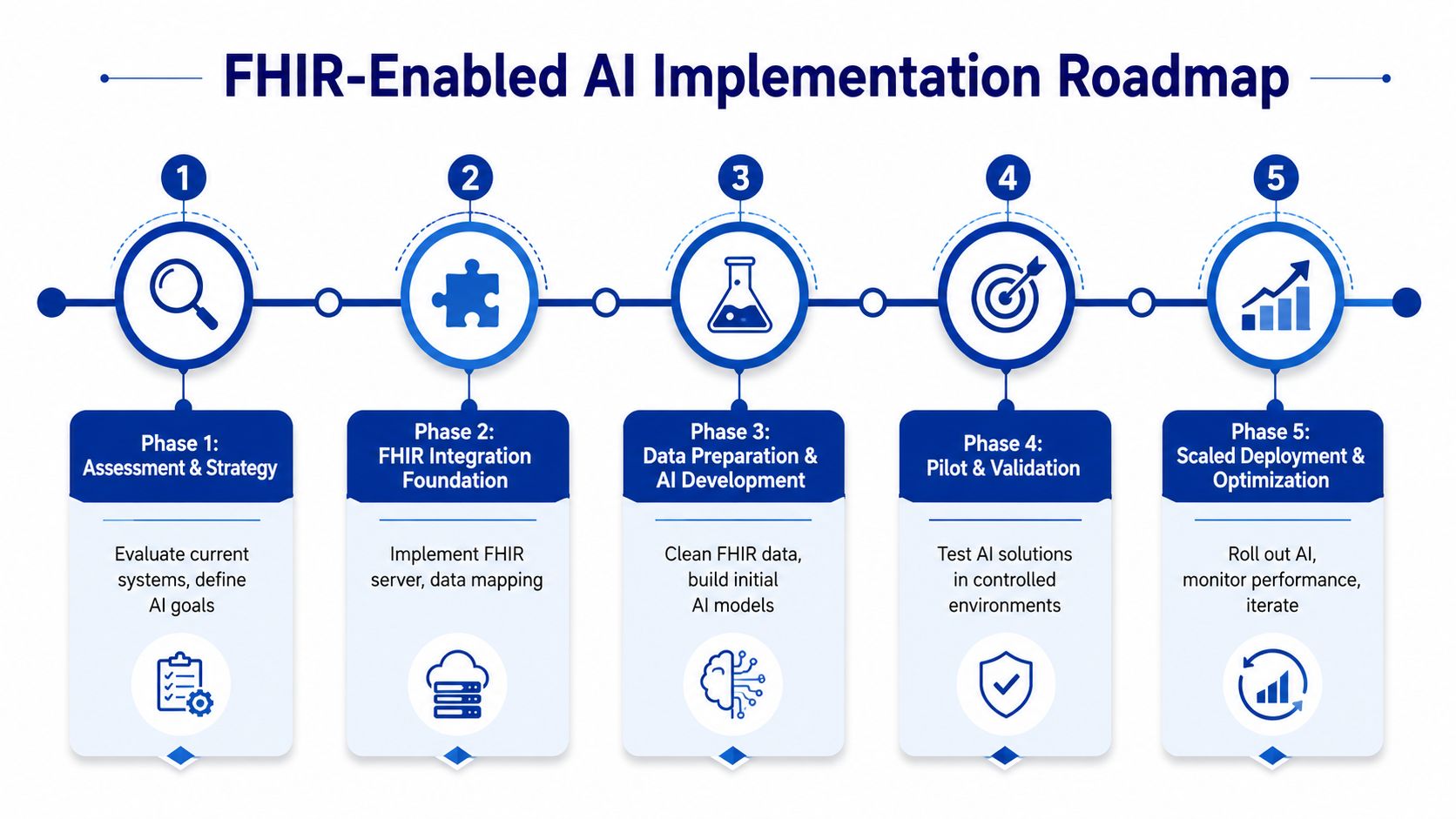
Phase one to phase three
Start by assessing your current interoperability reality. Identify which systems already expose usable FHIR endpoints, which data domains are trustworthy enough for a first pilot, and which workflow owner has a real problem worth solving.
Then build the foundation:
Choose a FHIR layer: Managed service or self-hosted, but make it your canonical standards boundary.
Define the first resource set: Keep scope narrow. Patient, Observation, Encounter, and Condition are often enough for a first use case.
Stand up raw and curated storage: Keep original payloads and transformed views separate.
Select practical tooling: HAPI FHIR, Firely, Apache Spark, dbt, MLflow, and Kubernetes are common building blocks depending on your stack.
The first development cycle should focus on one use case with one operational owner. Don't try to solve every downstream reporting, terminology, and governance issue at once. Solve enough to make one workflow real.
Phase four and phase five
Pilot in a controlled environment with explicit acceptance criteria. Review not only model quality but also access controls, alert routing, fallback handling, audit trails, and user response. In healthcare, a model that works mathematically and fails operationally is still a failed deployment.
Once the pilot proves useful, scale the capability, not just the single model.
Formalise governance: Create review checkpoints for data contracts, privacy, validation, and post-release monitoring.
Industrialise MLOps: Version transformations, features, models, and deployment configurations together.
Expand use cases selectively: Reuse the same FHIR contracts and platform patterns before adding net-new complexity.
Monitor for drift: Watch both model behaviour and source payload changes.
Improve write-back design: The more naturally outputs fit clinical or operational tools, the higher adoption tends to be.
Start with a workflow that hurts, not a model that impresses.
AI and FHIR become strategically valuable when they form a reusable capability. One model can justify a pilot. A reliable standards-based pipeline can change how an organisation builds digital health products for years.
Cleffex Digital Ltd helps healthcare and life sciences teams turn complex data, compliance, and product requirements into usable software. If you're planning FHIR integration, AI-enabled workflows, or a secure healthcare platform build, Cleffex Digital Ltd can support strategy, architecture, and delivery with an engineering-first approach.